Note: I originally wrote a version of this post in 2018. I’ve made a few updates below to include a reader’s comment that was especially apropos.
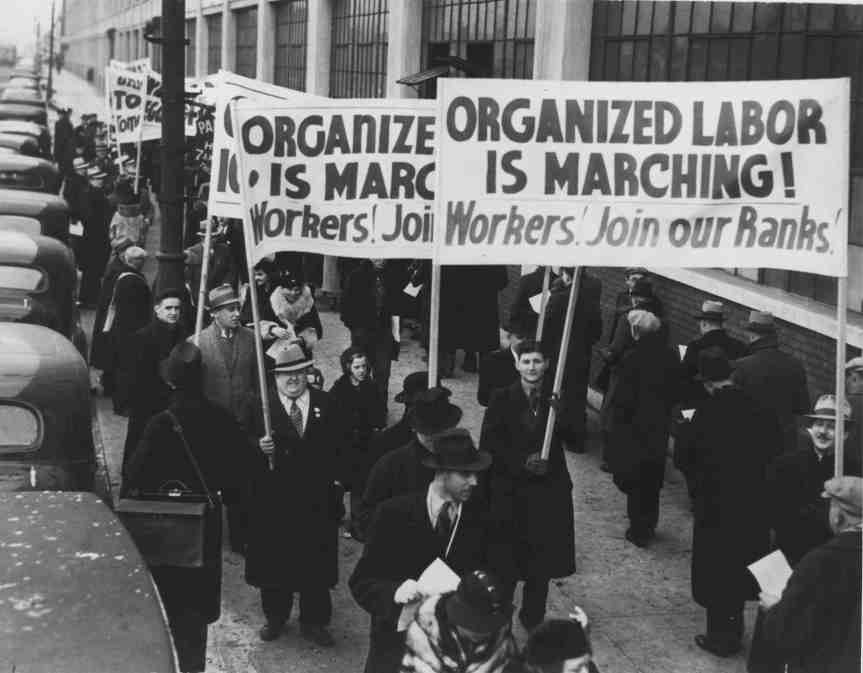
Labor Day weekend is a reminder that there’s no labor party in U.S. politics. Instead, we have two pro-business parties: the Republican and the Republican-lite, otherwise known as the Democratic Party. Both are coerced if not controlled by corporations through campaign finance “contributions” (bribes) and lobbyists (plus the promise of high-paying jobs should your local member of Congress lose an election or wish to transition to a much higher paying job as a lobbyist/influence peddler). With money now defined as speech, thanks to the Supreme Court, there’s a lot of “speech” happening in Congress that has nothing to do with the concerns of workers.
Nevertheless, a myth exists within the mainstream media that “socialist” progressive politicians are coming to take your money and to give it to the undeserving poor (and especially to “illegal” immigrants, who aren’t even citizens!). First of all, the so-called Democratic Socialists are not advocating nationalization of industry; they’re basically New Deal Democrats in the tradition of FDR. Just like Republicans, they believe in capitalism (and bow to corporatism) and the “free” market; they just want to sand down some of the rougher edges of exploitation.
Consider, for example, Bernie Sanders’s past efforts to get a living wage for Disney employees. In 2018 Disney finally promised to pay workers $15.00 an hour (phased in over the next few years), even as the corporation made record profits and the CEO earned hundreds of millions. Second, the bulk of the Trumpian tax breaks didn’t go to the workers and middle class: the richest Americans (and corporations) benefited the most from Trump’s tax cuts. Some of that money was supposed to “trickle down” to workers, but most of it didn’t. (Funding stock buy-backs, not pay raises, was and is especially popular among corporations.)
(An aside: trickle-down economics is almost an honest term, for that is what both major political parties in America support for workers: a “trickle” of pay and benefits. Forget about a stream or steady flow; of course, gushers and floods of money flow upwards to the richest few and remain there, irrespective of physical laws like gravity.)
My father knew the score. As a factory worker, he lived the reality of labor exploitation and fought his own humble battle for decent wages. His experience led him to conclude that the rich had neither sympathy nor use for the poor.
***
I’d like to share a comment made at Bracing Views by a reader back in 2018. It captured the sad reality of Labor Day as it exists today in America:
Labor Day is perhaps our most hollowed out and meaningless of all the the National Holidays we celebrate…
Celebrating Labor Day as it should be, that is the documentation of Labor’s over 100 years of historical struggle against Capitalism is not something we can do. We cannot celebrate it for two reasons: One it would be admission of the class warfare the 1% vs us Proles, and Two we have no Labor Party here in the USA to represent us. ********************* As Leo W. Gerard is the International President of the United Steelworkers (USW) union has written:
“American corporations weren’t always shareholder-centered. For about three decades after World War II, worker wages rose in tandem with productivity. This was a time during which corporations subscribed to the philosophy that they were obligated to serve their customers, communities, workers and shareholders.
Over the past 30 years, however, US corporations embraced a new notion, which is that they had only one responsibility, to fill the pockets of shareholders.
That is the same 30 years during which workers’ wages stagnated and CEO pay rose no matter how badly the executive performed. That is the same 30 years in which private equity firms bought manufacturers, loaded them up with debt, sold them off at massive profit then shrugged when a stumble threw the firm into bankruptcy, closed factories and killed good, family-supporting American jobs. That is the same 30 years when American corporations moved manufacturing from the United States to low-wage, high-pollution countries like Mexico and China.” *******************************************
Today, Labor Day, you can celebrate it by going to your local Big Box Store and take advantage of the Labor Day Sales, and purchase a product NOT Made in USA and sold to you by cashiers probably not making a Living Wage.
Fourteen years ago, I wrote the following article for TomDispatch. A colleague wrote to me today saying he had saved the article, had re-read it, and still found it useful, which is just about the highest compliment you can pay an author. I continue to believe, as I wrote in 2009, that America is experiencing a form of militarism on steroids. It’s a peculiar form of militarism, since the Pentagon works hard to obscure the costs and realities of war (see the recent book by Norman Solomon, War Made Invisible), but camouflaged or not, it persists.
Gary Cooper in “High Noon”
[Written in August 2009]
I have a few confessions to make: After almost eight years of off-and-on war in Afghanistan and after more than six years of mayhem and death since “Mission Accomplished” was declared in Operation Iraqi Freedom, I’m tired of seeing simple-minded magnetic ribbons on vehicles telling me, a 20-year military veteran, to support or pray for our troops. As a Christian, I find it presumptuous to see ribbons shaped like fish, with an American flag as a tail, informing me that God blesses our troops. I’m underwhelmed by gigantic American flags — up to 100 feet by 300 feet — repeatedly being unfurled in our sports arenas, as if our love of country is greater when our flags are bigger. I’m disturbed by nuclear-strike bombers soaring over stadiums filled with children, as one did in July just as the National Anthem ended during this year’s Major League Baseball All Star game. Instead of oohing and aahing at our destructive might, I was quietly horrified at its looming presence during a family event.
We’ve recently come through the steroid era in baseball with all those muscled-up players and jacked-up stats. Now that players are tested randomly, home runs are down and muscles don’t stretch uniforms quite as tightly. Yet while ending the steroid era in baseball proved reasonably straightforward once the will to act was present, we as a country have yet to face, no less curtail, our ongoing steroidal celebrations of pumped-up patriotism.
It’s high time we ended the post-Vietnam obsession with Rambo’s rippling pecs as well as the jaw-dropping technological firepower of the recent cinematic version of G.I. Joe and return to the resolute, undemonstrative strength that Gary Cooper showed in movies like High Noon.
In the HBO series “The Sopranos,” Tony (played by James Gandolfini) struggles with his own vulnerability — panic attacks caused by stress that his Mafia rivals would interpret as fatal signs of weakness. Lamenting his emotional frailty, Tony asks, “What ever happened to Gary Cooper?” What ever happened, in other words, to quiet, unemotive Americans who went about their business without fanfare, without swagger, but with firmness and no lack of controlled anger at the right time?
Tony’s question is a good one, but I’d like to spin it differently: Why did we allow lanky American citizen-soldiers and true heroes like World War I Sgt. Alvin York(played, at York’s insistence, by Gary Cooper) and World War II Sgt. (later, 1st Lt.) Audie Murphy(played in the film “To Hell and Back,” famously, by himself) to be replaced by all those post-Vietnam pumped-up Hollywood “warriors,” with Sylvester Stallone and Arnold Schwarzenegger-style abs and egos to match?
And far more important than how we got here, how can we end our enduring fascination with a puffed-up, comic book-style militarism that seems to have stepped directly out of screen fantasy and into our all-too-real lives?
A seven-step recovery program
As a society, we’ve become so addicted to militarism that we don’t even notice the way it surrounds us or the spasms of societal ‘roid rage that go with it. The fact is, we need a detox program. At the risk of incurring some of that ‘roid rage myself, let me suggest a seven-step program that could help return us to the saner days of Gary Cooper:
1. Baseball players on steroids swing for the fences. So does a steroidal country. When you have an immense military establishment, your answer to trouble is likely to be overwhelming force, including sending troops into harm’s way. To rein in our steroidal version of militarism, we should stop bulking up our military ranks, as is now happening, and shrink them instead. Our military needs not more muscle supplements (or the budgetary version of the same), but far fewer.
2. It’s time to stop deferring to our generals, and even to their commander in chief. They’re ours, after all; we’re not theirs. When President Obama says Afghanistan is not a war of choice but of necessity, we shouldn’t hesitate to point out that the emperor has no clothes. Yet when it comes to tough questioning of the president’s generals, Congress now seems eternally supine. Senators and representatives are invariably too busy falling all over themselves praising our troops and their commanders, too worried that “tough” questioning will appear unpatriotic to the folks back home, or too connected to military contractors in their districts, or some combination of the three.
Here’s something we should all keep in mind: Generals have no monopoly on military insight. What they have a monopoly on is a no-lose situation. If things go well, they get credit; if they go badly, we do. Retired five-star Gen. Omar Bradley was typical when he visited Vietnam in 1967 and declared: “I am convinced that this is a war at the right place, at the right time and with the right enemy — the Communists.” North Vietnam’s only hope for victory, he insisted, was “to hang on in the expectation that the American public, inadequately informed about the true situation and sickened by the loss in lives and money, will force the United States to give up and pull out.”
There we have it: A classic statement of the belief that when our military loses a war, it’s always the fault of “we the people.” Paradoxically, such insidious myths gain credibility not because we the people are too forceful in our criticism of the military, but because we are too deferential.
3. It’s time to redefine what “support our troops” really means. We console ourselves with the belief that all our troops are volunteers, who freely signed on for repeated tours of duty in forever wars. But are our troops truly volunteers? Didn’t we recruit them using multimillion-dollar ad campaigns and lures of every sort? Are we not, in effect, running a poverty and recession draft? Isolated in middle- or upper-class comfort, detached from our wars and their burdens, have we not, in a sense, recruited a “foreign legion” to do our bidding?
If you’re looking for a clear sign of a militarized society — which few Americans are — a good place to start is with troop veneration. The cult of the soldier often covers up a variety of sins. It helps, among other things, hide the true costs of, and often the futility of, the wars being fought. At an extreme, as the war began to turn dramatically against Nazi Germany in 1943, Germans who attempted to protest Hitler’s failed strategy and the catastrophic costs of his war were accused of (and usually executed for) betraying the troops at the front.
The United States is not a totalitarian state, so surely we can hazard criticisms of our wars and even occasionally of the behavior of some of our troops, without facing charges of stabbing our troops in the back and aiding the enemy. Or can we?
4. Let’s see the military for what it is: a blunt instrument of force. It’s neither surgical nor precise nor predictable. What Shakespeare wrote 400 years ago remains true: when wars start, havoc is unleashed, and the dogs of war run wild — in our case, not just the professional but the “mercenary” dogs of war, those private contractors to the Pentagon that thrive on the rich spoils of modern warfare in distant lands. It’s time to recognize that we rely ever more massively to prosecute our wars on companies that profit ever more handsomely the longer they last.
5. Let’s not blindly venerate the serving soldier, while forgetting our veterans when they doff their spiffy uniforms for the last time. It’s easy to celebrate our clean-cut men and women in uniform when they’re thousands of miles from home, far tougher to lend a hand to scruffier, embittered veterans suffering from the physical and emotional trauma of the battle zones to which they were consigned, usually for multiple tours of duty.
6. I like air shows, but how about — as a first tiny step toward demilitarizing civilian life — banning all flyovers of sporting events by modern combat aircraft? War is not a sport, and it shouldn’t be a thrill.
7. I love our flag. I keep my father’s casket flag in a special display case next to the very desk on which I’m writing this piece. It reminds me of his decades of service as a soldier and firefighter. But I don’t need humongous stadium flags or, for that matter, tiny flag lapel pins to prove my patriotism — and neither should you. In fact, doesn’t the endless post-9/11 public proliferation of flags in every size imaginable suggest a certain fanaticism bordering on desperation? If we saw such displays in other countries, our descriptions wouldn’t be kindly.
Of course, none of this is likely to be easy as long as this country garrisons the planet and fights open-ended wars on its global frontiers. The largest step, the eighth one, would be to begin seriously downsizing that mission. In the meantime, we shouldn’t need reminding that this country was originally founded as a civilian society, not a militarized one. Indeed, the revolt of the 13 colonies against the King of England was sparked, in part, by the perceived tyranny of forced quartering of British troops in colonial homes, the heavy hand of an “occupation” army, and taxation that we were told went for our own defense, whether we wanted to be defended or not.
If Americans are going to continue to hold so-called tea parties, shouldn’t some of them be directed against the militarization of our country and an enormous tax burden fed in part by our wasteful, trillion-dollar wars?
Modest as it may seem, my seven-step recovery program won’t be easy for many of us to follow. After all, let’s face it, we’ve come to enjoy our peculiar brand of muscular patriotism and the macho militarism that goes with it. In fact, we revel in it. Outwardly, the result is quite an impressive show. We look confident and ripped and strong. But it’s increasingly clear that our outward swagger conceals an inner desperation. If we’re so strong, one might ask, why do we need so much steroidal piety, so many in-your-face patriotic props, and so much parade-ground conformity?
Forget Rambo and action-picture G.I. Joes: Give me the steady hand, the undemonstrative strength, and the quiet humility of Alvin York, Audie Murphy — and Gary Cooper.
Tacking to starboard, stuck in place, the USS America under Joe Biden is groaning in protest
In America’s two-color political universe, by which I mean blue versus red, whenever I criticize the blue team, I get accused of supporting the red team. But I believe in a multi-color world, not a bicolor one. Even green is an acceptable color! So, as I critique Joe Biden today, rest assured I never have voted, and never will vote, for the red guy, Donald Trump. I’m going green in 2024 with Cornel West.
With that longwinded prologue, I’d like to announce the Biden/Harris unofficial campaign slogan for 2024: No, we can’t.
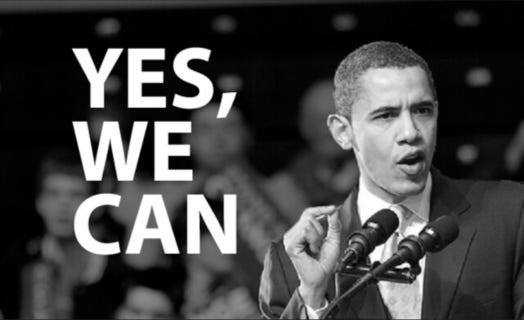
It may sound familiar. Fifteen years ago, Barack Obama embraced the energy and optimism of “Yes, we can.” He also promoted “hope” and “change.” After eight years of Bush/Cheney, those simple slogans resonated with Americans, and Obama/Biden rode to victory in 2008 exuding confidence and a can-do spirit. (Of course, the results in office were, shall I say, disappointing.)
The good old days that never quite were.
But that was then, this is now, and when you go to JoeBiden.com, you get a message that suggests we reelect Joe to “finish the job.” Which job needs to be finished is unspecified. Vague words about protecting freedom and democracy and feel-good imagery is about all you get. Add it up and you get a de facto message of little hope and no change—just more of the same.
The Democrats think that a bland message of normalcy will be enough to prevail against Trump, who seems to be indicted now almost daily. Again, I’m no fan of Trump and won’t be voting for him. But why should I vote for Biden? What compelling reason or even message is there to convince me?
I haven’t heard one other than “Trump is very bad.”
A friend tells me Biden’s record as president is respectable and that he’s tilted left of center. I’m baffled by this claim. Biden/Harris have told me we can’t get Medicare for All; indeed, we can’t even get a public option. We can’t get significant student debt relief. We can’t get a $15 federal minimum wage. We can’t reduce the Pentagon budget and spending on wars and weapons. We can’t stop building more nuclear weapons. We can’t stop drilling in sensitive areas such as pristine wildernesses and offshore waters.
You see where I’m going here. When it comes to progressive agendas, “No, we can’t” is the true motto of Biden/Harris. Corporate Joe and his VP sidekick appear to have little empathy for the working classes and the hurting. Imagine a president coming back from vacation, as Biden recently did, and being asked about deadly wildfires in Hawaii and declaring that he had “no comment.” How hard is it for a president to muster words of sympathy for the suffering people of Hawaii while promising speedy federal aid?
For some reason I’m in a nautical frame of mind (forgive me, my Navy brethren).* As the USS Trump takes on water from multiple torpedo hits (indictments), the USS Biden sits dead in the water, having run aground on the shoals of incompetence and indifference. There is no Bernie Sanders this time around to rally the youthful crew to rock and re-float the boat. Perhaps Americans should search for a new ship to board?
A favorite book is “The Caine Mutiny” (please read it if you haven’t; it’s thrilling as well as hilarious in spots). The Caine was a tired old ship headed for the scrap heap after World War II and its commander, Queeg, was addled and (much worse) cowardly. The ship nearly sinks during a powerful storm that paralyzes Queeg; only a mutiny by its crew prevents disaster. America, our ship of state, faces storms of its own. Do we have confidence in captains like Trump or Biden to lead us through the tempest to calmer waters? Maybe it’s time we mutiny?
My friend believes Biden is a competent captain who’s making good headway even as he tacks to port. I see an increasingly tired and confused commander who’s furiously tacking to starboard even as the ship of state groans, making no progress as it’s battered on those aforementioned shoals.
*Feel free, Navy brethren, to offer your own nautical metaphors, which I’m betting will be better than mine.
Oliver Anthony Strikes A Chord with “Rich Men North of Richmond”
A working-class song has gone viral. Oliver Anthony’s “Rich Men North of Richmond” is a lament for the state of the working classes in America: long hours, low pay, dead-end jobs, even as “the rich men north of Richmond” make the real money on the backs of the working poor.
Here’s a link to the video, which just screams sincerity:
Naturally, his song is drawing attention—and criticism. NBC News calls it a “conservative anthem” because I guess there are no liberals or progressives or even moderates who are working class and who can relate to the song. Also, NBC is at pains to criticize Anthony for making a quick reference to obese welfare moochers, which is fair enough, I suppose, though it’s not the point of his song.
This is what Anthony had to say (also at NBC News): In an introduction videouploaded to his YouTube channel a day before the song’s release, Anthony said that his political views tend to be “pretty dead center” and that both sides “serve the same master.”
He said he used to work 12-hour shifts six days a week and today continues to meet laborers struggling to make ends meet.
“People are just sick and tired of being sick and tired,” he said. “So yeah, I want to be a voice for those people.”
Amen to that, Mr. Anthony. My father knew his pain. Before he became a firefighter, my dad worked in factories doing hard physical work. He told me the harder the work, generally the lower the pay you earn in America. So-called “shit” jobs like cleaning motel rooms, being a waiter or waitress, digging ditches and working as a “common” laborer, are looked down upon despite how tough and necessary they are.
As I said, my dad knew the score, as he recounted in a journal he left me about his life. One time, he organized with a few other men for a pay raise at the factory. Here’s what my dad had to say about that experience:
A five cent an hour pay raise
It seems that Mike Calabrese on his own asked Harry Gilson for a pay raise and he was refused. Mike decided to organize the men members and go down in a group. In our group he got ten men to approach Harry G. for a raise. But when it was time to “bell the cat” only three fellows went to see Harry. Well Mike said he couldn’t join the group because he had already tried to get a raise. I knew I was being used but I was entitled to a raise. Well Harry said to me, “What can I do for you men?” So I said to Harry: 1) Living costs were going up; 2) We deserved a raise. So Harry said, “How much?” and I said ten cents an hour would be a fair raise. So he said I’ll give you a nickel an hour raise and later you’ll get the other nickel. We agreed. So, I asked Harry will everyone get a raise and he replied, “Only the ones that I think deserve it.”
Well a month later I was drinking water at the bubbler [water fountain] and Harry saw me and said what a hard job they had to get the money to pay our raises. Well, Willie, Harry Gilson and his brother Sam and their two other Italian brother partners all died millionaires. No other truer saying than, “That the rich have no sympathy or use for the poor.”
My dad’s experience was roughly 80 years ago, but his sentiment is echoed by Oliver Anthony’s song today. This has nothing to do with conservatism and everything to do with giving workers a fair shake in America. It’s not a left-right, Democrat-Republican, issue: it’s a class issue, a moral issue, and a matter of life and death for so many people struggling across America.
We need more people to raise their voices, whether in song like Oliver Anthony or for pay raises like my dad.
Time for Glasnost, Perestroika, and a New Generation of Leaders in America
A year ago, I asked whether Joe Biden and Donald Trump were too old to serve as president. Recently, concerns about advanced age and failing health have come to the fore in Congress. Senator Diane Feinstein, 90 years old, recently had to be told by her aides to vote “aye.” Senator Mitch McConnell, 81 years old, recently froze mid-sentence at a press conference; he may have suffered a mini-stroke, possibly related to a bad fall he had previously that resulted in a concussion. Meanwhile, concerns about President Biden’s age and declining health are being openly aired even among Democrats, with Hillary Clinton opining that Joe’s age is a legitimate campaign issue. At the young age of 75, is she angling to ride to the rescue in the 2024 election?
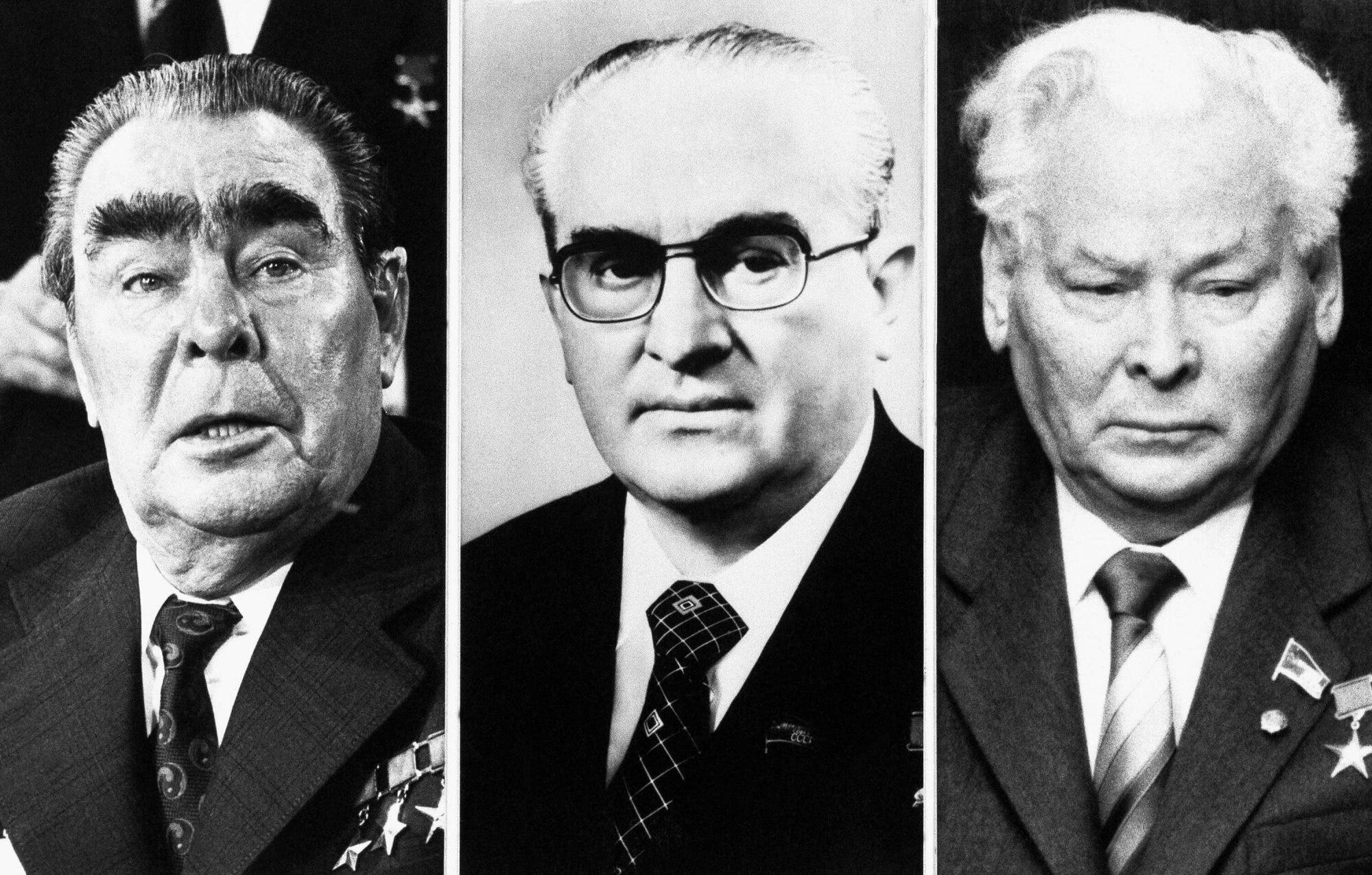
Glenn Greenwald did a long segment on Washington’s gerontocracy that is well worth watching. A point he made is one that I echoed in my article from a year ago. Back in the 1970s, the U.S. pointed to an alleged gerontocracy in the Soviet Union to criticize the hidebound nature of the Communist party there and the way its leaders were holding back much-needed reforms.
Americans made fun of “old” Soviet leaders of the 1970s and early 1980s. They were younger than Biden, Trump, Feinstein, McConnell, and the U.S. gerontocracy of today
The same, of course, is now true of the U.S. empire and its uniparty of Republican and Democrat enablers. An American gerontocracy with a near-death grip on power are holding back much-needed reforms here, especially reductions to the enormous sums of money being spent on weapons and warfare by the federal government.
Much like the former Soviet Union, the United States is a declining empire that’s been debilitated by constant and unnecessary wars and wanton spending on weaponry. Fresh thinking is needed. Remember glasnost and perestroika? Openness and restructuring? They were ushered in by Mikhail Gorbachev in the 1980s, who at age 54 was relatively young when he assumed the reins of power in the USSR.
I still remember when Americans made fun of “old guard” Soviet leaders and used words like “sclerotic” to describe them. They were a visible symbol of Soviet tiredness and decline, the refuse of the past when compared to a younger, more vigorous, United States with its dominant and thrusting world economy.
Who’s laughing now?
Surely, America needs a new generation of leaders who are willing to fight for glasnost (much greater openness and transparency in government) and perestroika (a restructuring of government away from imperialism, weapons, and war). The collapse of the Soviet Union should teach us something about the fate of sclerotic empires that refuse to change.
Too many Americans see war as a positive force as they applaud Ukraine’s ongoing resistance to Russian aggression; along with seeing war as admirable, they see it as predictable and controllable. Of course, it’s easy to cheer Ukraine on from thousands of miles away, celebrating their surprising victories over Russia, even as both sides suffer tens of thousands killed, many more injured, and many more forced from their homes.
When Americans think about war, there’s a tendency to focus on favorable outcomes while eliding war’s worst aspects. So, for example, the American Revolutionary War is celebrated for enabling U.S. independence. The U.S. Civil War freed the slaves. World War II liberated the world from the twin threats of Nazi fascism and Imperial Japan’s militarism. Other wars that are far less easy to simplify and spin as positive, such as the Vietnam War or recents wars in Afghanistan and Iraq, are dismissed or forgotten, to say nothing of open land grabs as in the Mexican-American War and the Spanish-American War. Let’s not even talk about the wanton brutality of various wars against Native American peoples glorified in so many westerns of my youth.
Looking at America’s history, Christ, the Prince of Peace, is clearly not America’s favored god. America’s god is a warrior one, like Ares for the Greeks and Mars for the Romans. “Blessed are the war makers” could be a guiding tenet of American life, especially considering how much money is made and power wielded by those who embrace war.
The Greeks had wisdom in seeing war as akin to a god, a powerful force, capricious, unpredictable, intoxicating, and uncontrollable. War can consume a person, a people, a nation. It appeals to our irrational nature, our darkest passions. “War fever” is thus an accurate descriptive phrase. We can be seized by it, deluded by it, consumed by it.
I’ve never run across “peace fever” as a phrase or descriptor of American behavior.
A young Tom Cruise loving his machine gun in “Taps”
“[W]ar is a distressing, ghastly, harrowing, horrific, fearsome and deplorable business. How can its actual awfulness be described to anyone?” Stuart Hills, By Tank Into Normandy, p. 244
“[E]very generation is doomed to fight its war, to endure the same old experiences, suffer the loss of the same old illusions, and learn the same old lessons on its own.” Philip Caputo, A Rumor of War, p. 81
The persistence of war is a remarkable thing. Two of the better books about war and its persistence are J. Glenn Gray’s “The Warriors” and Chris Hedges “War Is a Force that Gives Us Meaning.” Hedges, for example, writes about “the plague of nationalism,” our willingness to subsume our own identities in the service of an abstract “state” as well as our eagerness to serve that state by killing “them,” some “other” group that the state has vilified.
In warning us about the perils of nationalism, Hedges quotes Primo Levi’s words: “I cannot tolerate the fact that a man should be judged not for what he is but because of the group to which he belongs.” Levi’s lack of tolerance stems from the hardest of personal experiences: surviving Auschwitz as an Italian Jew during the Holocaust.
Gray takes this analysis in a different direction when he notes that those who most eagerly and bloodthirstily denounce “them,” the enemy, are typically far behind the battle lines or even safely at home. The troops who fight on the front lines more commonly feel a sort of grudging respect for the enemy, even a sense of kinship that comes with sharing danger in common.
Part of the persistence of war, in other words, stems from the ignorant passions of those who most eagerly seek it and trumpet its heroic wonders even as they stand (and strive to remain) safely on the sidelines.
Both Hedges and Gray also speak to the dangerous allure of war, its spectacle, its excitement, its awesomeness. Even the most visceral and “realistic” war films, like the first thirty minutes of “Saving Private Ryan,” represent war as a dramatic spectacle. War films tend to glamorize combat (think of “Apocalypse Now,” for example), which is why they do so little to put an end to war.
One of the best films to capture the dangerous allure of war to youth is “Taps.” I recall seeing it in 1981 at the impressionable age of eighteen. There’s a tiny gem of a scenenear the end of the film when the gung ho honor guard commander, played by Tom Cruise before he was TOM CRUISE, mans a machine gun. He’s firing against American troops sent to put down a revolt at a military academy, but Cruise’s character doesn’t care who he’s firing at. He’s caught in the rapture of destruction.
He shouts, “It’s beautiful, man. Beautiful.” And then he himself is shot dead.
This small scene with Cruise going wild with the machine gun captures the adrenaline rush, that berserker capacity latent in us, which acts as an accelerant to the flames of war.
War continues to fascinate us, excite us. It taps primal roots of power and fear and ecstasy all balled together. It masters us, hence its persistence.
If and when we master ourselves, perhaps then we’ll finally put an end to war.
There’s an important point about America’s Global War on Terrorism (GWOT) that people often miss.
When the Bush/Cheney administration announced the GWOT after 9/11, I think nearly all Americans assumed that “global” meant everywhere but the “good” countries. That global meant the axis of evil (Iraq, Iran, North Korea) and similar so-called bad actors, but that it didn’t mean countries like Canada — and certainly not the U.S. homeland.
But global really did mean everywhere on earth as we’ve watched the war on terror escalate domestically. The U.S. government/security state has built the foundation and superstructure for a permanent war on terror, and it simply isn’t going to go away. The Iraq and Afghan wars are essentially over (both lost), and fears of North Korea have subsided as the military-industrial-congressional complex focuses on Ukraine, Russia, and China, but the GWOT continues. It’s now turned inwards, within and along our own borders, and those techniques that were practiced (if not perfected) in Iraq, Afghanistan, and elsewhere are now being used and inflicted upon ordinary Americans who are attempting to resist state-corporate authoritarianism.
The GWOT has come home — but perhaps it’s always been here. What’s changed is how state-corporate entities can define almost any form of determined protest—even civil and nonviolent ones—as “terror.” Labeling someone a “domestic terrorist” gives state-corporate actors a whole host of powerful ways to punish activists, notes by Michael Gould-Wartofsky at TomDispatch.com.
At the same time, America has witnessed the “rise of the warrior-cop,” as Radley Balko noted in his book by that title.
Three years ago, I wrote about the militarization of police forces at TomDispatch. This is what I wrote then:
America’s violent overseas wars, thriving for almost two decades despite their emptiness, their lack of meaning, have finally and truly come home. An impoverished empire, in which violence and disease are endemic, is collapsing before our eyes. “When the looting starts, the shooting starts,” America’s self-styled wartime president [Donald Trump] promised, channeling a racist Miami police chief from 1967. It was a declaration meant to turn any American who happened to be near a protest into a potential victim
As such demonstrations proliferate, Americans now face a grim prospect: the chance to be wounded or killed, then dismissed as “collateral damage.” In these years, that tried-and-false military euphemism has been applied so thoughtlessly to innumerable innocents who have suffered grievously from our unending foreign wars and now it’s coming home.
A few days ago, The Onion, a satirical news site, compared America’s obedience and passivity to power to the current situation in France. Here’s how they put it:
In an ongoing struggle against ruling-class oppression, the people of France again protested in a way that Americans are welcome to at any time, sources confirmed Thursday. According to reports, French citizens across the country were spotted hitting the streets en masse as a unified front against the institutional bondage that seeks to subjugate them while never failing to apply forceful pressure every time injustice strikes, which Americans can and should feel free to do whenever they so choose.
Yes, but are Americans truly “welcome” to protest “whenever they so choose”? We’d like to think so, especially as July 4th approaches (America! Land of the Free!), but who wants to be detained and thrown in jail for domestic terrorism? Anyone in America hankering to be labeled as a terrorist by the state, whether on the right or left of the political spectrum, even if the charge is eventually dismissed?
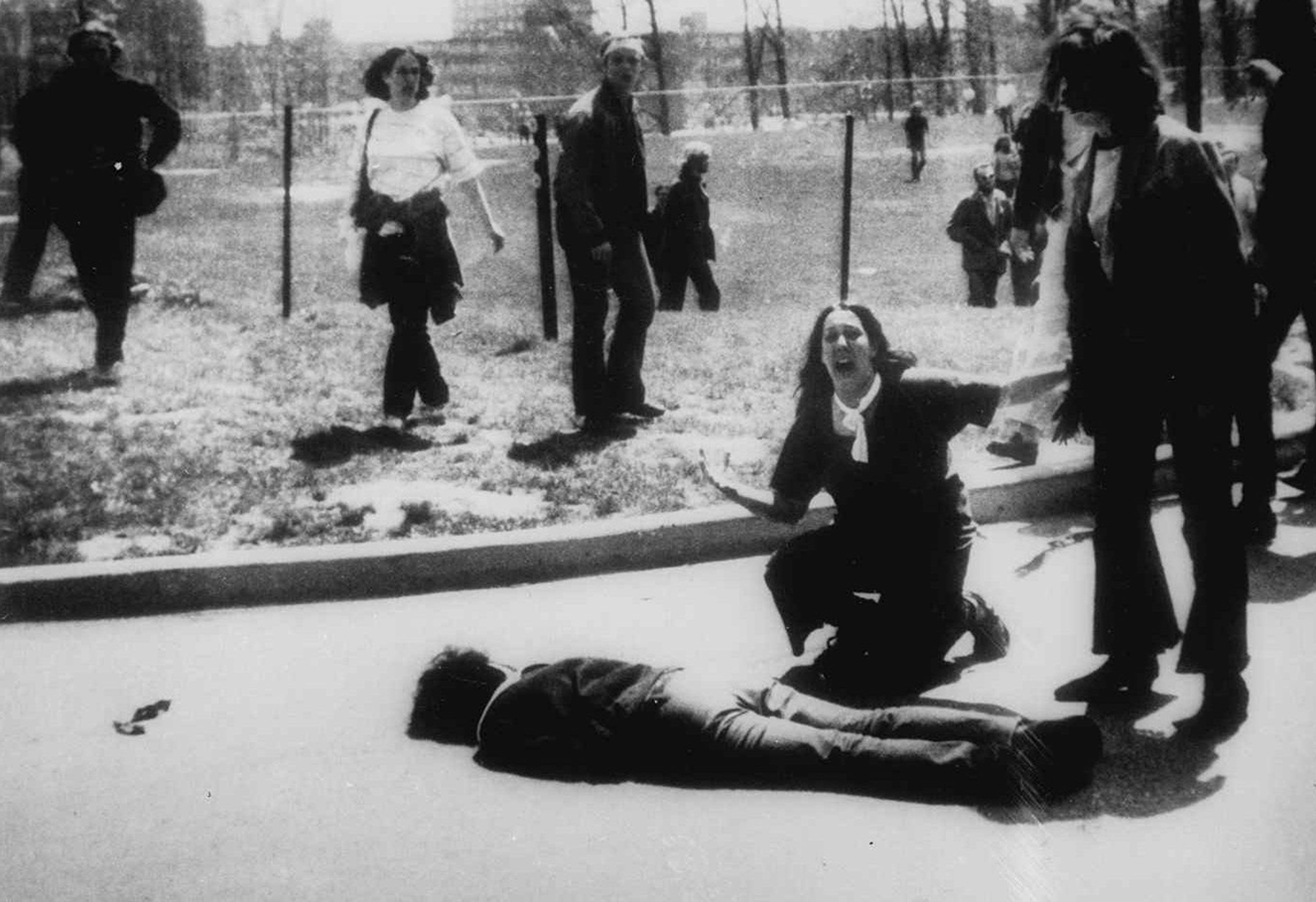
Searing photo of state violence at Kent State in 1970. The dead student’s name was Jeffrey Miller. The young woman crouched in shock and horror was Mary Ann Vecchio. Richard Nixon called the protesters “bums.” What would the state call them today—domestic terrorists?
Remember those innocent days of the 1960s when for some the police were “pigs” and the protesters were “bums” (Richard Nixon’s word for the students killed at Kent State)? Now those protesters could be charged with domestic terrorism even as various heavily armed enforcers of the law would likely be celebrated (consider all those “blue lives matter” flags, for example).
Remember when “defund the police” was briefly a thing? By which people meant less funding for militarized police forces and more for mental health services and the like. President Joe Biden and the Democrats realized any serious effort to restrain police power would leave them open to charges of being soft on crime, so Biden and the party simply declared: Fund the police. (Republicans concur, of course, even as they still accuse Biden and the Dems of being soft on crime.)
And there you have it. Fund the police at all levels, local, state, and federal, and grant them the kind of powers given to America’s “warriors” in the GWOT. Set them loose on all of America’s domestic “terrorists.” After all, the GWOT went so well in Iraq, Afghanistan, Libya, Yemen, and elsewhere. Surely it will go equally well in the Homeland. Right?
Addendum: In writing this, I came across a superb article by Patricia McCormick at the Washington Post on Mary Ann Vecchio, “the girl in the Kent State photo.” She was just 14 when the above photo was taken. She paid a high price, as the article recounts. Letters to her family accused her of being a “drug addict,” a “tramp,” or a “communist.” The then-governor of Florida suggested she was a “professional agitator” and therefore responsible for the students’ deaths. A Gallup poll back then, cited by McCormick, said that 58% of Americans blamed the students at Kent State and only 11% blamed the National Guardsmen who opened fire and killed the four students.
“Professional agitator” sounds much like today’s domestic terrorist. And let’s reflect on those 58% of Americans who believed the students at Kent State were responsible for their own deaths. How dare they block the free flight of “Made in USA” bullets with their young bodies? The “bums”! (“Domestic terrorists.”)
Power did not lie in the tip of a pen. Power did not work against its own interests. Power could only be brought to heel by acts of defiance it could not ignore. With brute, unflinching force. With violence. (p. 432)
It’s hard to disagree with that, especially within imperial settings in countries dominated by rich and powerful interests. Kuang’s novel is set in the British Empire during the 1830s and 1840s, as Britain was ramping up its first opium war against China. Her quote readily applies to the U.S. empire today and its various global wars of dominance.
I’ve been thinking a lot about the so-called Capitol Insurrection on January 6th and the heavy-handed response to it, especially the long-term prison sentences being handed out. Too much attention is being paid to punishing Trump’s so-called coup supporters and not enough to how Washington, D.C., is increasingly fortifying itself against potential protests. Recall, for example, those Democrats who said they wanted to “defund” the police even as they voted for an expansion of the Capitol police force.
As my wife and I watched the January 6th “coup,” we both had the same thought: What if those protesters hadn’t been so misguided? What if they were truly protesting and “breaching” the Capitol for meaningful change? What if they had been advocating for universal health care, higher wages, an end to expensive and unnecessary wars? Would they ever had gained access to the Capitol? Would members of the Capitol police have moved the barricades, or posed for selfies, with the protesters? I highly doubt it.
America today has a rigged political system that is thoroughly captured by the moneyed interests. You don’t change that by speaking truth to power because the powerful already know the truth. Indeed, they create the truth. The golden rule is that he who has the gold makes the rules. And that’s what America means when it talks about a rules-based order. The wealthiest, most powerful, nations and people have the gold, want to keep and expand it, so they make the rules with that goal in mind.
How to effect meaningful change in a rigged system without violence is one of the huge questions of our age or any age. In her novel, Kuang suggests that powerful interests only respond to the demands of the less powerful when they are forced to “by acts of defiance” they can’t ignore. She may well be right.
The problem, of course, is that violence that drives change doesn’t always make things better. The French Revolution produced a Reign of Terror followed by the Napoleonic Wars. The Russian Revolution produced Lenin, Stalin, gulags, and ruthless five-year plans. Here I recall an Alexander Solzhenitsyn quote: “All revolutions unleash the most elemental barbarism.”
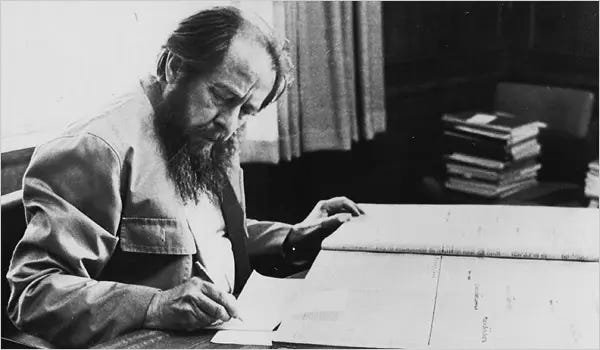
Alexander Solzhenitsyn
Yet, if America’s so-called elites continue to close all legitimate avenues to meaningful change, they may be making elemental barbarism inevitable. And I’m not sure they care, in the sense they believe they will always come out on top, that they will, in a word, win, because the masses can always be manipulated or bullied into compliance.
Matt Taibbi and Walter Kirn on “Catch-22” and Bureaucratic Madness
I wanted to share with you a conversation between Matt Taibbi and Walter Kirn on Joseph Heller’s classic satire, “Catch-22,” that focuses on the idea of loyalty oaths but that has much broader implications for our society today. Their entire conversation is well worth reading, but this passage is especially penetrating and important.
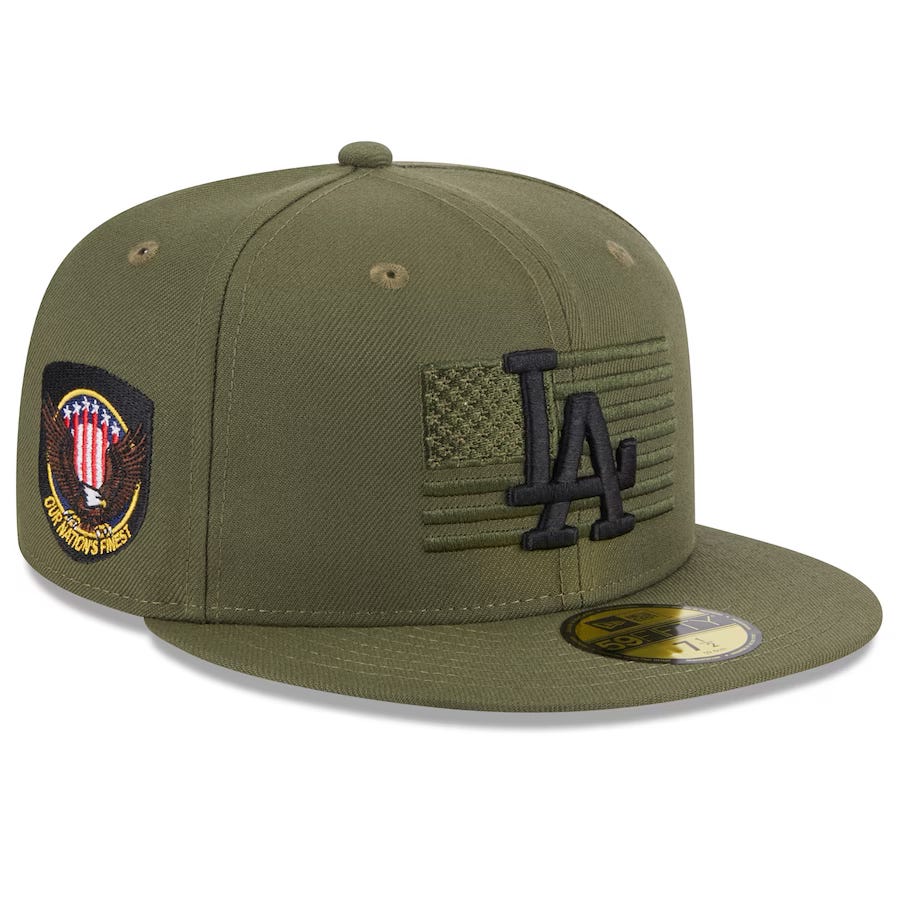
Profess your loyalty with a baseball cap for Armed Forces Day. $50 or less. Buy them for everyone in your family. You can’t be too patriotic — or too careful.
Matt Taibbi: That seems like a good place to segue into the story from this week.
On Joseph Heller’s “Catch-22,” in particular, “The Great Loyalty Oath Crusade.”
Walter Kirn: So we don’t end up being polite and going, no, you do it. No, you do it. It’s Chapter 11 of Catch-22 entitled “Captain Black.” Some people know it as the chapter called “The Great Loyalty Oath Crusade.” It tells a very simple story. There’s an officer on the air base where Catch-22 is set, and he’s been passed over for promotion. His name’s Captain Black, and he lost out when another officer was killed in battle, he thought he would succeed to his post, but he didn’t. Another guy, Major Major, got the job. So how is he going to take his revenge? How is he going to become important on the base? He comes up with the notion that he will start forcing all the troops and all the bombers and the crews of the different aircraft to take a “loyalty oath”, which he has to authorize before they can do anything.
And not just one loyalty oath, because they easily pass that test. They do it, but it’s two, three, four, until the point where the entire air base and its missions are paralyzed by the need to recite these oaths. If you want to get your plane off the ground, if you want to fuel your plane, if you want to eat lunch, you have to recite one of these oaths. And finally, the bureaucratic necessity of reciting oaths completely paralyzes the entire operation such that Heller says they were no longer able to even respond to emergencies. They were no longer able to respond to reality, because almost all they were doing was reciting these oaths over and over and over.
And it was assumed that if you had recited one oath and a minute had passed before you had recited the next one, that you might have become disloyal in the meantime. I guess what this all is a metaphor for is the notion that requiring loyalty of people is a bottomless request, which finally becomes an end in itself. Just as we saw at the hearing yesterday, let’s not get to the substance of what you’re alleging here. Let’s have you recite the oath first and did you recite it correctly and could you recite it again, and do you agree that it’s necessary? So by a Zeno’s arrow thing, you never get to the issue of anything because loyalty must always be the primary question and it is always doubted.
Matt Taibbi: Heller has this great line about the doctrine of “continual reaffirmation” that Captain Black originated. And the quote is,
A doctrine designed to trap all those men who had become disloyal since the last time they had signed a loyalty oath the day before.
Nobody has the authority to stop this thing. Even the colonel in the group, Colonel Korn, he’s complaining: “It’s that idiot Black off on a patriotism binge.”
But when they’re deciding what to do about it, he just says:
Well, this will probably run its course soon. I think the best thing now is to send Captain Black a letter of total support and hope he drops dead before he does too much damage.
In other words, even the people who have authority, once one of these things gets going, nobody wants to get in front of this buzz saw. And if they do, they get cut down.
Walter Kirn: You can’t stop it because as is the abiding theme of Catch-22, you can never get off the hook with a bureaucracy that wants everything. You can never pass the loyalty oath because the one you took was a minute ago, are you taking one now? The perfect loyalty oath, in other words from a bureaucratic point of view, is one that no one can ever pass. One that never ends.
The perfect accusation in a witch trial is one that you can never be innocent of. And I wrote, “The more absurd loyalty oath, and the more often it is required, the better.” Anyone can repeat a loyalty oath that’s true and it is offered only once, but only the truly submissive will repeat it over and over until it loses all meaning. Because finally, what bureaucracy wants of you is humiliation and submission. It doesn’t want an answer. It doesn’t want to give you a pass and say, “You are free to go now. You may enter, you may run your mission. You’ve got your credential.” It wants total power. And total power can only be had if you are never declared loyal.
Matt Taibbi: The only people who succeed in this system are complete sociopaths with no shame. I think that’s one of the great things about this chapter is the way he starts off, Heller — one of the great things about this book in general is his ability to make snap characterizations. I mean, it takes even very skilled authors a paragraph to capture the personality of a person, but he’s able to do it in a sentence or two over and over again.
With Captain Black at the very start of this chapter, he gets a phone call that the unit is going to have to attack Bologna, which is heavily guarded and is going to involve a tremendous number of casualties. There’s a scene:
Captain Black brightened immediately. Bologna, he exclaimed with delight. Well, I’ll be damned.” He broke into loud laughter, “Bologna?” He laughed again and shook his head in pleasant amazement. “Boy, I can’t wait to see those bastards’ faces when they find out they’re going to Bologna.”
And then he goes down again and keeps repeating this.
”That’s right, you bastards, Bologna.” He kept repeating to all the bombardier who inquired incredulously if they were really going to Bologna. “Ha, ha, ha! Eat your livers, you bastards.”
He’s a total sadist. The only thing that has any meaning in his life is that as you said, he was passed over for this promotion when somebody else got killed. The person who stepped in his place was Major Major, a hilarious character to whom all kinds of things happen. Among his distinctive qualities is that he looks like Henry Fonda. When the officers are talking about this, this is where the idea for the loyalty oath comes:
Captain Black asserted that Major Major really was Henry Fonda. And when they remarked it Major Major was somewhat odd. Captain Black announced that he was a communist.
“They’re taking over everything.” He would declare rebelliously. “Well, you fellows can stand around and let them if you want to, but I’m not going to. I’m doing something about it. From now on I’m going to make every son of a bitch who comes to my intelligence tent sign a loyalty oath.”
There’s a great line. “He had really hit on something.” That’s when it starts this whole description of how you have to sign an oath to go to the PX to buy anything, to get your hair cut, to get paid, to do anything. This idiotic, insipid character, who has no positive qualities and is a pure careerist, for whom even the death of other people is totally meaningless, he’s exactly the person who succeeds in this bureaucracy, because bureaucracies are designed to elevate such people.
Walter Kirn: This is why literature is a superior form of analysis for the human condition over politics. Politics has us believe that the content of our arguments matter, that the positions and ideas we’re arguing about matter, but literature suggests that rituals are rituals and human passions are human passions. And that sweep aside what people are talking about and what people are saying and focus on what they’re actually doing. And in this case, we have Black proclaiming Major Major a communist, and the suspicion of communism among the troops becomes the basis for the Great Loyalty Oath. But it could just as well be that he could have accused them of being MAGA or fascists, because loyalty oaths are the same no matter what the occasion for their administration. They are rituals of dominance and submission, they are ritualistic affirmations of the bureaucracy’s preeminence. [Emphasis added.]
We constantly are amazed by the fact that the same machinations that the anti-communist McCarthyite put into place in the fifties are now being used by the liberal party against the presumably patriotic side. In other words, we now have not communist-hunting but MAGA-hunting. And we think that something has changed because politics makes us think it’s all about the ideas. It’s not. It’s all about the whatand who sits above, and who sits below; who administers the oath and who has to take it. Who has the power to come up with an oath, and who is so unfortunate that they have to recite them?
What we’re seeing in American politics is a recapitulation in terms of structure and form of an old drama. But the words have changed, and the names for evil have swapped. And in some ways the D or the R on the desk, the Democrat or Republican plaque, has changed sides, but we’re seeing the same thing. What Heller’s showing in this novel is that bureaucracy itself serves its own interests over and above any particular problem that it’s there to solve.
These people are there to win a war. The great irony of Catch-22 is that this intense deadly war that’s going on in the background, is, actually in the background. What people are really concerned about are their promotions, whether they’ve filled out forms correctly, have they won the esteem of their superior? Have they triumphed over their inferior? And meanwhile, people are dying, thousands of people are being bombed and planes are going down. But that hardly matters when there are new stripes to be won for your uniform, or an extra lunch to be had at the commissary, or whatever. So the book’s continuing comedy is the inversion of values in which the institution is all important, and the purposes are forgotten. [Emphasis added]
END OF EXCERPT
OK, I’m back. I hope you enjoyed reading that passage. It helps to explain why the Pentagon/MICC continues to grow in power even as it’s lost every major war since World War II (ironically the historical setting for Heller’s brilliant satire).
Believe me, I’ve met my share of officers in the U.S. military who weren’t concerned with the mission or higher ideals like their oath to the Constitution. They were concerned about getting promoted and enlarging their own personal rice bowl (an image used often when I was on active duty).
How to stop a runaway bureaucracy that insists on your loyalty and obedience, repeated ad infinitum, is one of the great issues of this moment. With military propaganda in full swing this weekend (It’s Armed Forces Day!), you had best salute the troops smartly and show your loyalty, as baseball players are, by wearing special olive drab military-themed caps to celebrate “our nation’s finest.” Available for less that $50 each at MLB!
If you miss this weekend (Are you sure you’re a real American?), there’ll be themed caps for Memorial Day and July 4th. And if you’re not a baseball fan, the NFL will get you in the fall at all its “Salute to Service” celebrations.
The death penalty shouldn’t apply to turning in the wrong driveway or knocking on the wrong door
As a follow up to my previous article, “Shootings Are Us,” I read a piece today on NBC News about “Stand Your Ground” and “Castle Doctrine” laws. The idea is that people can defend themselves if accosted (“stand your ground”) and if their property is invaded (“castle doctrine”). In America, however, defense often takes a deadly form because people reach for guns rather than, say, a baseball bat, and bullets are quite unforgiving to flesh, and more difficult for most to aim and control than a bat.
Perhaps we all need “Star Trek” phasers set to stun, but, seriously, the problem is that guns are designed to kill. You really can’t modulate their murderous potential. So we have all sorts of Americans shot and killed or wounded for the most innocuous of actions, such as turning down the wrong driveway, knocking on the wrong door, or getting in the wrong car.
Such mistaken actions shouldn’t be subject to a potential death penalty at the trigger-happy hands of mostly untrained and seemingly strung out men.
Reasonable self-defense laws make sense to me, but the so-called castle doctrine is part of the problem. It encourages us to see our houses (and other property) as castles, as fortresses, as something we should defend using murderous force. But is defending one’s property truly a sufficient rationale to take someone’s life?
If a man knocks me from my bike and steals it, am I truly justified in pulling my gun and shooting him dead? Sure, I’d be seriously pissed at losing my bike, but I’d get over it. I’m not sure I’d ever get over shooting the bike thief and putting him six feet under.
A home intruder? I get it. I’d call 911 and do my best to keep my family safe. If a gun were handy, I’d get it, but I wouldn’t start blasting away as a first resort. Firing a gun at someone truly should be the last resort. And when you fire, you should always have a good idea what you’re shooting at. Too many times, the “home intruder” turns out to be a family member visiting unexpectedly or returning late, or perhaps even someone who’s lost or confused.
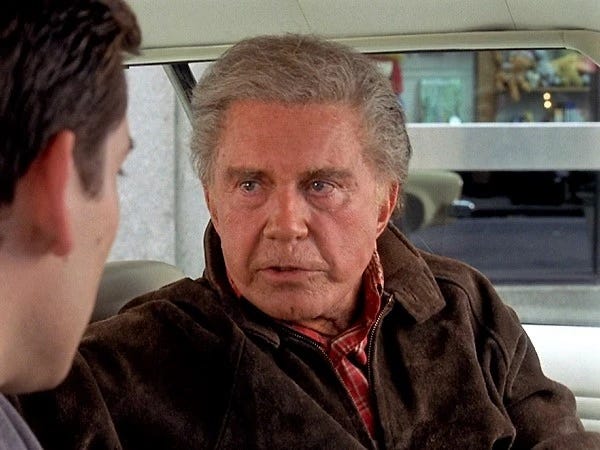
Uncle Ben to Peter Parker (Spider-Man): With great power comes great responsibility
Here, the lesson from Peter Parker’s gentle Uncle Ben comes to mind: With great power comes great responsibility. Guns represent great power, meaning you must exercise great responsibility when employing them. Far too often, America seems to have too many trigger-happy people, eager to use their power but none too eager to consider their responsibility.
So they blast away, then claim they were standing their ground or defending their castle. And given the law in many states across America, it just may be enough of a defense to earn them verdicts of “not guilty,” even when they kill innocents.




 Bracing Views