Noise, Noise, Noise!

United_States_Declaration_of_Independence
Words can be explosive too

W.J. Astore

People who don’t like noise get a bad rap in America. We once had neighbors in Colorado who used to ride off-road dirt bikes up and down the street. Someone complained about the noise and their response was, “Don’t like it? Move. This is America. We have freedom to make all the noise we want.”

Yesterday, my barber was talking about television. He was watching an “entertainment” show in which people were screaming, amplified by explosions, and he just couldn’t abide the noise. But he’s an old fuddy-duddy, like me, right?

When I watch baseball on TV, I keep the “mute” button very close by for the commercials. But even the commentators are getting noisy. Baseball used to be a fairly quiet game with two commentators in the booth, a play-by-play guy and a “color” guy (usually an ex-ballplayer).  Now there are often three people in the booth, with another one (or even two) on the sidelines. They all need to speak, of course, so baseball on TV has become a constant contest of endless chatter featuring mindless statistics.  There’s so much chatter that it’s difficult to hear the crack of a bat or the sound of a fastball smacking a catcher’s mitt.  Then there are the stadiums that feature lots of rock music, sound effects (like smashing glass for a foul ball), horns and pyrotechnics that go off when a player hits a home run, and all those video boards that order the fans to “Make Some Noise!”.

I know — I sound like an old fuddy-duddy again — sort of like the Grinch who stole Christmas because he was tired of all the noise, noise, noise of the Whos in Whoville.  And if the Grinch was bothered by Christmas festivities, just think of how he’d react to July 4th, America’s most pyrotechnic holiday. Prepare for bombs bursting in air, jets screaming overhead, and loud music everywhere.

Just so you know, I’ve been known to pump up the volume on my favorite songs; I’ve thrilled to fireworks exploding in the sky; I’ve watched my share of air shows; I’ve even been at the very front of rock concerts as “security” (I fondly recall a Warren Zevon concert at which I had to arrange the return of a leather coat loaned by a fan to Zevon, who donned it on stage to the delight of the fan).

But you might say those noise events were matters of personal choice.  Lately, noise in America seems pervasive, ubiquitous, almost unavoidable.  And noise isn’t simply about volume: it’s about persistence.  It’s about invasiveness.  Think of people who chatter away on Smart phones even as they’re out for a quiet walk along the beach or in the woods. How can you hear the waves or the birds if you’re screaming into a phone? Bits and pieces of conversations I’ve overheard are not about emergencies or even pressing matters; it’s more like, “Guess where I am?  I’m at the beach/concert/top of the mountain!”  Followed by selfies and postings and more calls or texts.

With all these forms of noise, it’s difficult to be in the moment.  It’s even difficult to find a moment.  Also, even in quiet times, people feel pressured to fill the silence with, well, something.  So unaccustomed to quiet are they that they reach for their Smart phones (perhaps to play a noisy video game), or they turn on the TV, or they chatter away even when they have nothing to say. Must avoid “uncomfortable” silences, so we’ve been told.

Part of this is cultural.  Today’s Americans are not about reflection; we’re about action. We’re not thinkers; we’re doers.  If I rest I rust is our motto.  Together with, Don’t just stand there — do something!  Preferably, something loud, splashy, noisy.

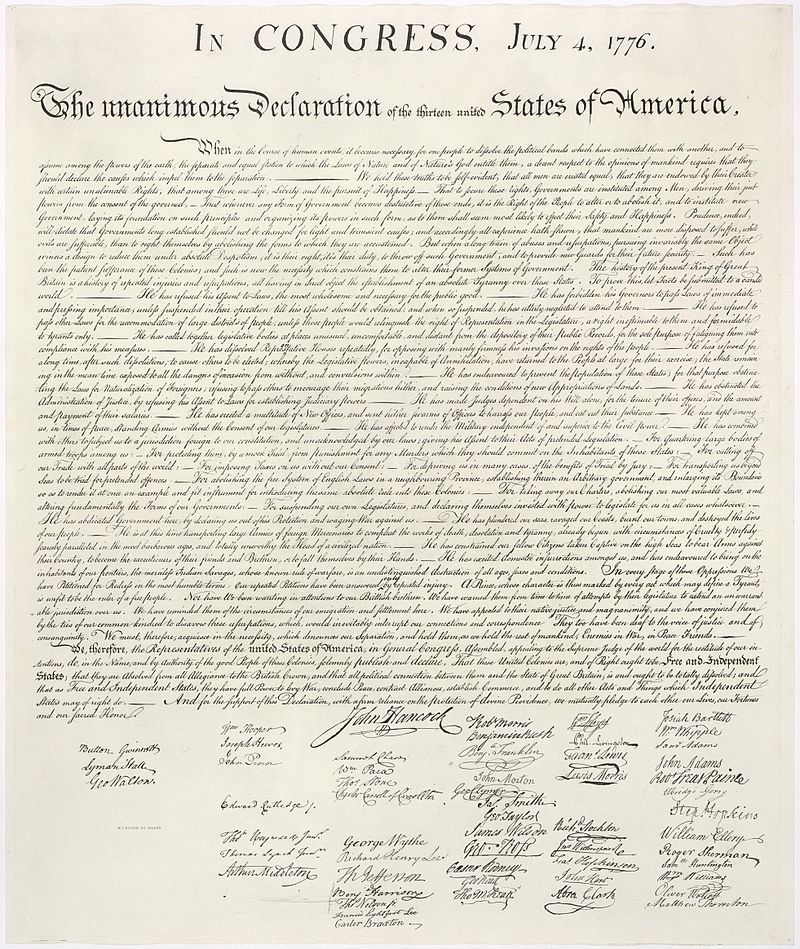
July 4th is a great holiday, but along with the fireworks and noise, perhaps we should celebrate the reflective thinkers of America, people like Thomas Jefferson who put the words to the noise of the American revolution in the Declaration of Independence. The quiet sound of a quill pen dipping in ink and scratching across parchment made a very big noise indeed in U.S. and World history.
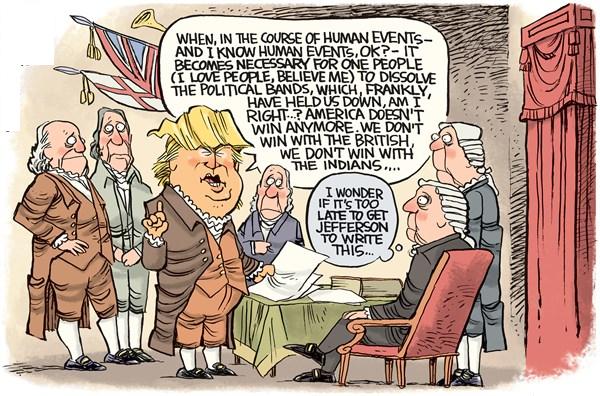
Trump Fourth of July

This weekend, it wouldn’t hurt to put down or turn off the mowers, blowers, fireworks, Smart phones, TVs, and all the rest of our noisemakers and listen to the birds and waves while reading a few passages from that Declaration of Independence.  For the right words can be explosive too.
Guns and Grievances

The Matrix _DivX_ 311_0003
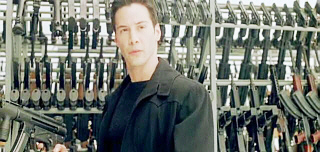
Guns look way too cool in our movies

W.J. Astore

The news out of Orlando is shocking.  Another mass shooting in America.  Another 50+ people dead with an additional 50+ wounded.  And then I saw this headline:

“America has 4.4% of the world’s population, but almost 50% of the civilian-owned guns around the world”

The ready availability of guns in America, to include military-style assault weapons with 30-round clips, makes it far easier for shooters bent on murder to kill large numbers of people.  It doesn’t matter what you call these shooters, whether you label them terrorists or lone wolves or crazed lunatics or whatever.  Apparently the latest shooter bought his guns legally, had a grievance against gay people, expressed some last-minute allegiance to ISIS, and then started blasting away at innocent people in a club that was friendly to gays.

Sure, guns alone are not to blame.  The primary person to blame is the shooter/murderer himself.  But (to repeat myself) the guns sure make it a lot easier to kill, and in large numbers.

We live in a sick society, often a very violent one, certainly a disturbed one, one that places enormous stress on people.  Another exceptional headline that I first heard on Bill Maher is that America, again with 4.4% of the world’s population, takes 75% of the world’s prescription drugs.

Guns and drugs – the two don’t mix, even when they’re legal.   Americans are over-armed and over-medicated.  Add to that mix the fact that Americans are under-educated, at least compared to our peers in the developed world, and you truly have a toxic brew.

Over-armed, over-medicated, and under-educated: surely this is not what our leaders have in mind when they call us the exceptional nation, the indispensable one, the greatest on earth.  Is it?


Hillary’s Clinching of the Nomination

Yet another selfie
Yet another selfie

W.J. Astore

Well, she’s won.  Hillary Clinton’s victories in last night’s presidential primaries have clearly put her over the top, clinching the Democratic nomination. Facing the loudmouthed bigotry and ignorant blustering of Donald Trump this fall, Hillary has an excellent chance of being elected as America’s first female president.

I’ve already written a lot of articles at this site on why I find both Hillary and The Donald to be poor choices as president. I won’t repeat those arguments here.  But I do want to talk about Hillary’s campaign, and what it says about her candidacy.

I remember the first commercial Hillary made, the announcement of her candidacy.  A tedious spot, it focused on her grandmotherly qualities.  It had no vision, no bite, and little hope.  It was about trying to make us feel comfortable with Hillary.  Hey, she’s a mom and a grandma!  Other women like her!  She’s just like us!

It went downhill from there.  Hillary’s campaign has been carefully scripted and modulated, the opposite of impassioned.  Vapidness replaced vision.  That’s why a democratic socialist Jew from Vermont via Brooklyn gave her a run for her money, because she had no passion or vision and he did (and does).

For me, the defining moment of their debates came when Bernie argued strongly for a $15.00 minimum wage for workers and Hillary was content with offering workers a $12.00 wage. (More than enough, peasants!)  Combine that moment with her infamous statement about the gobs of money she made in three speeches to Goldman Sachs (“Well, that’s what they offered”) and you get a clear sense of who she is and what she’s about.

A quick note: A nursing aide making Hillary’s generous $12.00 hourly wage at 40 hours a week would take 28 years to earn the $675,000 that Clinton “earned” in a few short hours giving those speeches.

Her campaign claims she’s “fighting for us.”  But I see Hillary as fighting for herself — and her circle of privileged cronies.  There’s nothing new about this in American politics, of course.  It’s just terribly disappointing for America that two narcissists, two voices of the privileged, will be vying for the presidency this fall.

One thing I would like to see (and it won’t happen): I’d like to see Trump and Hillary debate with Green and Libertarian candidates.  I’d like to hear some real alternative views and how the “major” candidates respond to them.  But even though the media found room for up to seventeen Republican primary candidates on the stage, you can bet the house that Trump and Hillary will share a stage alone together.

Alone together — get ready for gratuitous insults and sound bites, America. One thing is certain: neither candidate is fighting for us, and both are not about making America great again.

Two Big Reasons Not to Vote for Trump

May 29, 2016
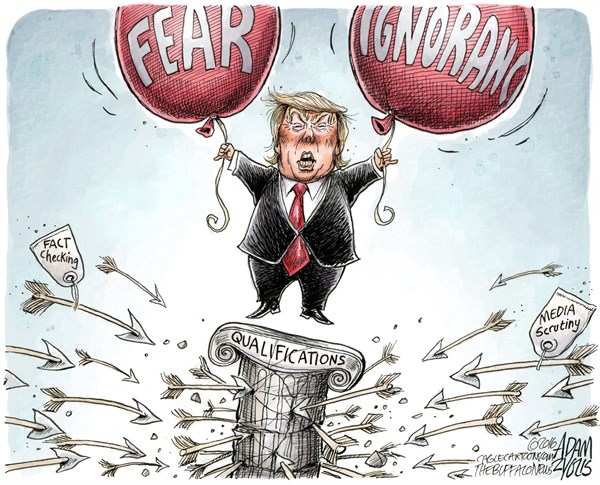
Fear his ignorance

W.J. Astore

Nuclear proliferation and global warming are two big issues that Donald Trump is wrong about.  They’re also the two biggest threats to our planet.  Nuclear war followed by nuclear winter could end most life on earth within a matter of weeks or months.  Global warming/climate change, though not as immediate a threat as nuclear war and its fallout, is inexorably leading to a more dangerous and less hospitable planet for our children and their children.

What does “The Donald” believe?  On nuclear proliferation, which only makes nuclear war more likely, Trump is essentially agnostic and even in favor of other nations joining the nuclear club, nations like Japan, South Korea, even Saudi Arabia.  When all countries should be earnestly working to reduce and then eliminate nuclear stockpiles, Trump is advocating their expansion.  (An aside: recall in a previous debate that Trump had no idea what America’s nuclear triad is; add intellectual sloth to his many sins.)

On global warming, Trump is essentially a skeptic on whether it exists (“hoax” and “con job” are expressions of choice), even as he seeks to protect his resorts from its effects. Along with this rank hypocrisy, Trump is advocating an energy plan that is vintage 1980, calling for more burning of fossil fuels, more drilling and digging, more pipelines, as if fossil fuel consumption was totally benign to the environment and to human health.

Along with his tyrannical and fascist tendencies, Trump is wrong on two of the biggest issues facing our planet today.  His ignorance and recklessness render him totally unfit to be president.

The “Liberal” Media Narrative on Bernie Sanders

Bernie
Keep fighting, Bernie

W.J. Astore

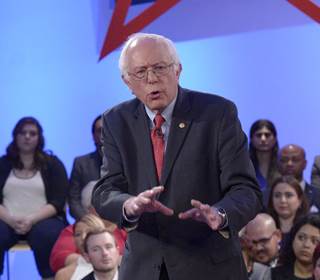
Bernie Sanders has won yet another primary against Hillary Clinton, this time in West Virginia.  He’s likely to win more, perhaps even California in June.  Yet what is the headline at the “liberal” New York Times?

Top News
Senator Bernie Sanders of Vermont campaigning Tuesday in Salem, Ore. His victory in West Virginia's Democratic primary on Tuesday was less about policy differences with Hillary Clinton than about the state's demographics.

Bernie Sanders Wins West Virginia, Prolonging Race With Hillary Clinton

By TRIP GABRIEL

The primary victory by the senator from Vermont will force his Democratic rival to continue a distracting nominating fight.

Can you believe the nerve of that man?  Bernie Sanders is “forcing” his rival, Hillary Clinton, “to continue a distracting nominating fight.”

I suppose Democrats should just hand the nomination to Hillary, uncontested. Now that’s true democracy in action.

Without the “superdelegates,” i.e. without the support of the establishment within the Democratic Party, Hillary and Bernie would be running neck-and-neck.  You’d think the media would love a close horse race like this.  But no: the media is slavering for a Trump versus Hillary race.  Bernie is already an afterthought, even as he keeps winning.

Bernie’s victories highlight Hillary’s weaknesses.  Progressives don’t trust her. Independents are not impressed.  Young people are turned off (her politics as usual is uninspiring, to say the least).  Working-class whites find little of appeal in her message and record.

Yet the media, even the so-called liberal media, has already declared victory for Hillary, looking ahead to the joys of months of mud-slinging between Hillary and Trump.

Please stay in the race, Bernie. You have nothing to lose — and the country has much to gain.

Put ESPN in Charge of the War on Terror

draft
Our wars are games and our games are wars

W.J. Astore

This weekend, I watched a few minutes of NFL draft coverage on ESPN.  If you’re not familiar with NFL football or ESPN coverage of the same in the USA, you should be, because it says much about the American moment.  The first round of the draft kicks off on Thursday night in prime time, followed by the second and third rounds on Friday night in prime time.  The draft concludes on Saturday with rounds four through seven, roughly 250 total picks if you include “supplemental” picks.

Yet this quick summary vastly understates the coverage devoted to the draft.  From the end of the Super Bowl early in February to the draft itself at the end of April, coverage of the draft on ESPN is virtually non-stop, with innumerable “mock” drafts for each team and a parade of “experts” speculating about the prospects of each player and team. Exhaustive (and exhausting) is the word to describe this coverage.  Interminable is another one.

When Round One finally kicks off, it’s essentially a parade of soon-to-be millionaires. These players, selected from various college football teams, can count on multi-year contracts and signing bonuses in the millions of dollars.  ESPN and the NFL stage manages the selection process, turning it into an extravaganza complete with musicians, cheering (or booing) fans, and plenty of past NFL greats, along with the draftees and their families and friends. Coverage also includes shots of the “war rooms” of the various NFL teams as they decide which players to pick, which draft picks to trade, and so on.  The war room — isn’t that a telling phrase?

Indeed, let’s push that further.  Most red-blooded NFL fans would be hard-pressed to find Iraq or Afghanistan on a map, but they can tell you all about their team’s draft picks, rattling off statistics such as times in the 40-yard dash, vertical leap, even the size of a player’s hands (considered especially pertinent if he’s a quarterback or wide receiver). What always astonishes me is the sheer wealth of detail gathered about each player, the human intelligence (or HUMINT in military terms).  Players, especially those projected to go in the first few rounds, are scrutinized from every angle: physical, mental, emotional, you name it.

With millions of dollars at stake, such an exhaustive approach is not terribly surprising. Yet even with a wealth of data, each year there are major draft busts (e.g. Ryan Leaf, selected #2 overall in the first round and a flop) and major surprises (e.g. Tom Brady, selected late in the 6th round as the 199th pick, meaning that not much was expected from him, after which he won four Super Bowls).  Results from the NFL draft should teach us something about the limits of data-driven “intelligence” in “wars,” yet our various military intelligence agencies continue to believe they can quantify, predict, and control events.

But again what wows me is the extent as well as the slickness of ESPN’s coverage of the draft.  As soon as a player is selected, ESPN instantly has video of that player’s college highlights, together with his vital statistics (height, weight, performance at the draft combine in various drills, and so on).  Video and stats are backed up by interviews with a draftee’s previous coaches, who extol his virtues, along with interviews with those “war rooms” again as to why they decided to draft that particular player and not another.  Once the draft is completed, teams are then awarded “grades” by various commentators, even though these players have yet to play a snap in the NFL.  (Imagine if your kid received an instant grade in college — before he attended a single class or completed a single assignment — based upon his performance in high school.)

But you have to hand it to ESPN: their coverage of the draft is an exercise in total information awareness.  It’s blanket coverage, an exercise in full-spectrum  dominance. It’s slick, professional, and driven by a relentless pursuit of victory by each team (and a relentless pursuit of ratings by ESPN).

So, a modest proposal: To win the war on terror, let’s put ESPN in charge of intelligence gathering and coverage.  Just imagine if your average red-blooded American devoted as much attention to foreign wars as they do to their favorite NFL team!  Just imagine if America’s leaders were held accountable for poor results as NFL coaches and staffs are! America still might not win its wars, but at least we’d squarely face the fact that we’re continuing to lose at incredibly high cost.  Indeed, someone high-up in the government might actually be held accountable for these losses.

I know: It’s a frivolous suggestion to treat war like a sport.  But is it?  After all, America currently treats the NFL draft with all the seriousness of a life-and-death struggle, even as it treats wars with comparative frivolity.

Our wars are games and our games are wars.  Small wonder America continues to lose its wars while fielding some winning NFL teams.

Donald Trump and American Decline

The Donald: Easy to make fun of ... too easy
Don’t hire him, America

W.J. Astore

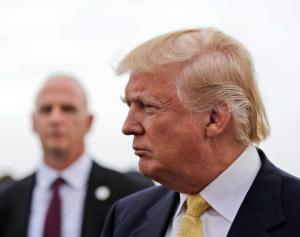
Donald Trump says he wants to make America great again.  What does this mean, exactly?

Think about it.  As American workers, how desperate are we to “hire” a man as president whose signature line to wannabe entrepreneurs is, “You’re fired”?  We’re a bit like abused spouses who, despite being bruised and bloodied, still decide to stand by a bully.

Americans sense that our nation is in decline; indeed, that’s the implicit meaning (as noted in this article by Tom Engelhardt) of Trump’s slogan: he wants to make America great again.  As in, we’re not great now, but we have been in the past, and under Trump we will be again.  But how?  Is Trump just going to fire all the “losers” in America?

Many abused workers have placed their faith in Trump to revive America.  Yet the irony is that Trump himself has precipitated America’s decline, what with his tacky casinos, his off-shoring of jobs, his shady business deals that seek to maximize profits while minimizing pay to workers.

So much of our economic health today, such as it is, consists of massive spending tied to a sprawling national security state, which fosters military adventurism and interventionism as well as weapons exports, amplified by casino capitalism (literally “casino,” as in my old hometown, which desperately seeks a casino as a jobs producer).

Back in the day, the city of my birth was proud to manufacture shoes and to ship them around the world.  Now, my city puts it faith in casinos and gambling.  If that’s not a clear sign of economic decline, what is?

Again, consider the irony of placing faith in Trump to reverse this trend.  Nearly 30 years ago, in the song “Gimme What You Got,” Don Henley captured the hollowness of “promoter Trump” with the following lines:

Now it’s take and take and takeover, takeover
It’s all take and never give
All these trumped up towers
They’re just golden showers
Where are people supposed to live?

Trumped up towers – more true today than when Henley penned that song (along with Stan Lynch and John Corey) back in 1988.

How have so many come to place their faith in America’s resurgence in the trumped up BS of Donald Trump?  Again, someone whose signature line as a boorish and preening boss is, “You’re Fired”?

Let’s make America great again.  Come this fall, let’s not hire Donald Trump as our new boss.

“Unquestionably Syme Will Be Vaporized”: Lessons from Orwell’s 1984

orwell-nineteen-eighty-four-large-cover

W.J. Astore

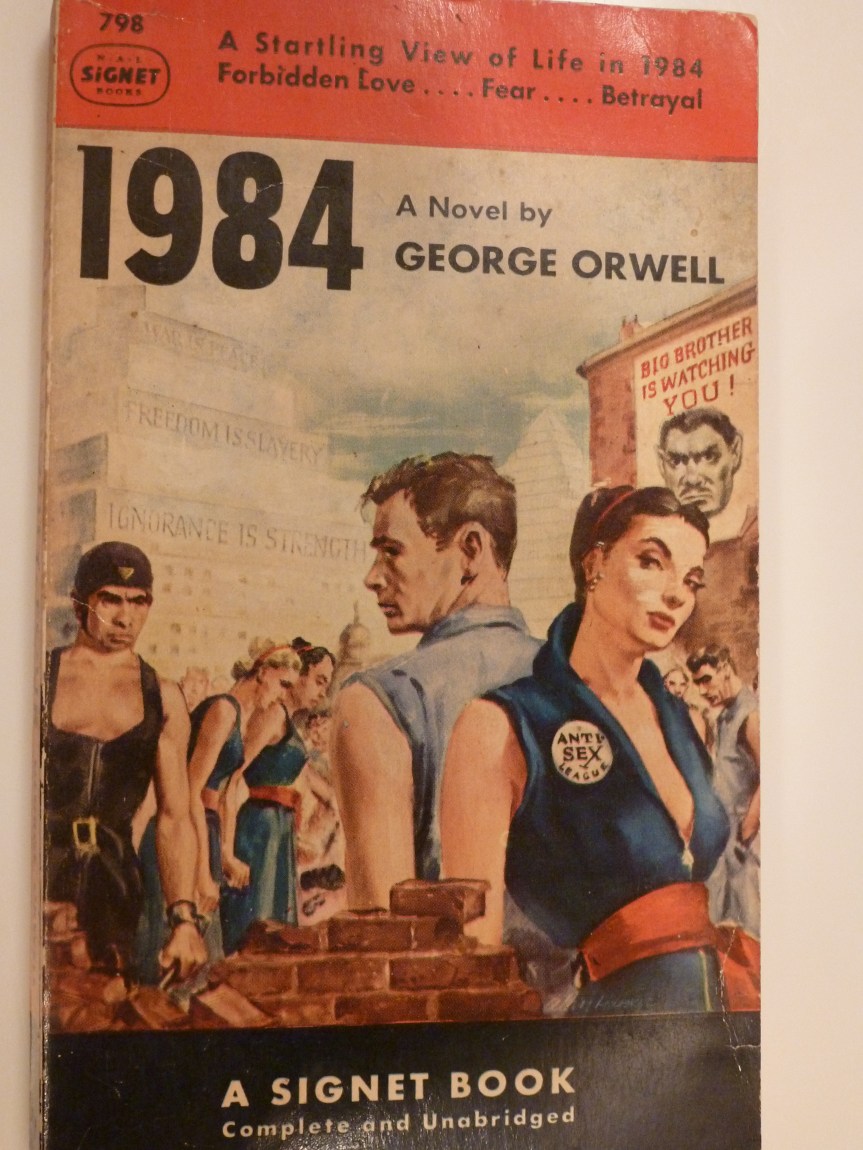
Syme is a minor character in George Orwell’s “1984.”  A philologist, Syme works on the Eleventh Edition of the Newspeak dictionary, “the definitive edition” according to him.  What’s fascinating is Orwell’s description of the intent and main functions of Newspeak, as given by Syme in this passage:

“You think … our chief job is inventing new words. But not a bit of it! We’re destroying words—scores of them, hundreds of them, every day. We’re cutting language down to the bone … You don’t grasp the beauty of the destruction of words. Do you know that Newspeak is the only language in the world whose vocabulary gets smaller every year?”

“Don’t you see that the whole aim of Newspeak is to narrow the range of thought? In the end we shall make thought-crime literally impossible, because there will be no words in which to express it. Every concept that can ever be needed will be expressed by exactly one word, with its meaning rigidly defined and all its subsidiary meanings rubbed out and forgotten … Every year fewer and fewer words, and the range of consciousness always a little smaller… The Revolution will be complete when the language is perfect…”

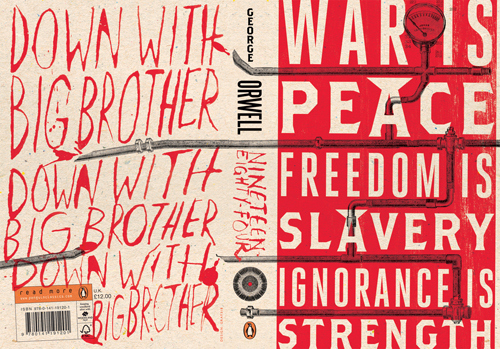
“Even the literature of the Party will change. Even the slogans will change. How could you have a slogan like ‘freedom is slavery’ when the concept of freedom has been abolished? The whole climate of thought will be different. In fact there will be no thought, as we understand it now. Orthodoxy means not thinking—not needing to think. Orthodoxy is unconsciousness.”

This brilliant passage by Orwell sends chills up my spine.  There will be no thought.  Orthodoxy means not thinking.  Is this not in fact true of many people today, content to express unquestioning and unwavering obedience to “the Party,” like the people who support Donald Trump simply because he says he’ll make America great again?

After Syme’s oration on Newspeak, Winston Smith, the main protagonist of “1984,” thinks to himself: “Syme will be vaporized. He is too intelligent. He sees too clearly and speaks too plainly. The Party does not like such people. One day he will disappear. It is written in his face.”

A couple of pages later, Syme makes another penetrating observation:

“There is a word in Newspeak … I don’t know whether you know it: duckspeak, to quack like a duck. It is one of those interesting words that have two contradictory meanings. Applied to an opponent, it is abuse; applied to someone you agree with, it is praise.”

To this observation, Winston thinks to himself: “Unquestionably Syme will be vaporized.”

Why?  Orwell notes that Syme is a Party zealot, a true believer.  But what he lacks, Orwell makes clear, is unconsciousness.  Syme is too self-aware, and speaks too plainly, therefore he must go.  And indeed later in the book he does disappear.

(As an aside, I like Orwell’s reference to some of Syme’s fatal flaws: that he “read too many books” and “frequented … [the] haunt of painters and musicians.”  Yes: books and the arts are indeed the enemy of unconscious orthodoxy in any state.)

The other day, a reader sent to me the following unattributed saying:  We build our houses out of words, then we live in them.

In “1984,” the Party sought total control over language, over words, as a way of dominating people’s consciousness.

One of my favorite sayings of Orwell, also from “1984” and one I always shared with my students, goes something like this: Who controls the past controls the future.  Who controls the present controls the past.

I think you could add to that: Who controls the language, the very words with which we communicate and think, controls the present.

Language is the key, a point Orwell brilliantly makes through the character of Syme in “1984.”

This Modern and Dystopic World

orwell 006
My copy of Orwell’s 1984

W.J. Astore

The modern world is a kluge of Ray Bradbury’s Fahrenheit 451 with screens everywhere in which people submerge themselves, Aldous Huxley’s Brave New World with “soma” of all sorts to keep us drugged and happy, and of course George Orwell’s 1984 with constant surveillance and the “two minutes of hate,” directed mainly at “the enemy,” especially the enemy within, known in 1984 as Goldstein (for some Americans today, “Goldstein” is Donald Trump; for others, it’s Hillary Clinton; for a few, it’s Ted Cruz or perhaps all of the above).

Dystopic elements characterize our American moment, hence the appropriateness of dystopic science fiction novels.  Bradbury was especially good at poking holes in the idea technology was in essence a liberating force.  He captured the way people might submerge their identities within screens, neglecting the real people around them, even those closest to them, for the “virtual reality” of infotainment.  Huxley was keen to debunk mass production as a liberating force, but his invention of “soma,” a mood-enhancing drug that leads to detachment and inaction, captured our overly medicated ways.  (I can’t watch network news without being bombarded by drug ads that promise me release from pain or acne or other nuisances and hence a better life, as long as I take this pill or use this inhaler.)  Finally, Orwell captured the total surveillance state, one driven by fear, obsessed by enemies created by the state to cow the masses.  Perhaps the darkest of the three, Orwell left little hope for the “little man” oppressed under the jackboot of a militaristic and totalitarian state.

The times are not quite that dark in America today, but these three classic novels offer warnings we’d do well to heed.  An aspect of these dystopias we most definitely see in America today is the degeneration of news, of information, of knowledge.  As a society, America is arguably less fact-based today than at any point in its history.  Even as we’re immersed in information via the Internet, the news itself has become shallower, or trivial, or frivolous, when it’s not out-and-out propaganda.

I grew up watching the news.  Before going to school, I used to watch the “Today” show in the morning in the 1970s.  It was a decent show.  Some real and serious news made the cut.  Now it’s largely a laugh-fest featuring celebrities making sales-pitches.  The news as soap opera; the news as vanity.

To state the obvious: The network “news” has been dumbed down.  Image is nearly everything.  Stories are far shorter and without context.  Designed for people with limited attention spans, they’re also designed to keep people watching, so they feature sensationalism and “quick hits” — nothing too taxing or disturbing.

Of course, the real news is still out there, as Tom Engelhardt notes in his latest probing article at TomDispatch.com.  It’s just much harder to find on the network “news”:

What’s left out?  Well, more or less everything that truly matters much of the time: any large, generally unphotogenic process, for instance, like the crumbling of America’s infrastructure (unless cameras can fortuitously zoom in on a bridge collapsing or a natural gas pipeline in the process of blowing up in a neighborhood — all so much more likely in an age in which no imaginable situation lacks its amateur video); poverty (who the hell cares?); the growing inequality gap locally or globally (a no-interest barrier the WikiLeaks-style Panama Papers recently managed to break through); almost anything that happens in the places where most of the people on this planet actually live (Asia and Africa); the rise of the national security state and of militarism in an era of permanent war and permanent (in)security in the “homeland”; and don’t even get me started on climate change…

Coming to grips with the real news would require thought and necessitate action – changes, radical ones, to the status quo.  And what powerbroker wants that?

Focus instead, America, on your screens.  Take your soma.  Hate your Goldstein.  That’s the method driving our madness.  Dystopia, anyone?


Above the people, beside the people, against the people

abe

W.J. Astore

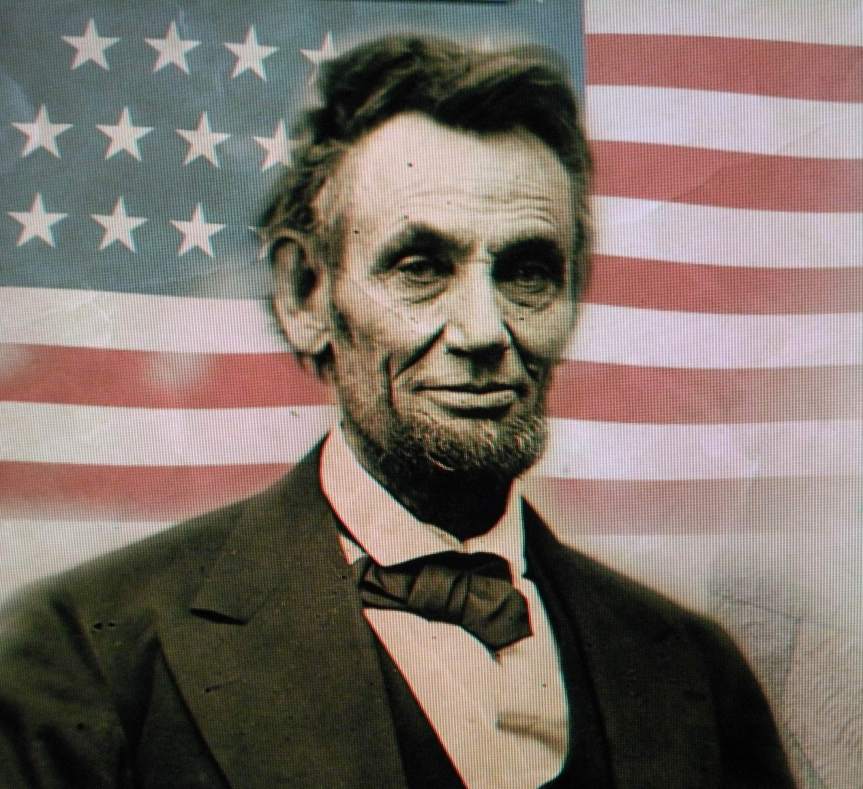
Remember when Abraham Lincoln wrote about our government as being “of the people, by the people, for the people”?  Even after 150 years, those words still resonate, but they are increasingly less true.  Today, our government places itself above the people, and when the government is not working against the interests of (most of) the people, it acts as if the people’s interests are beside the point.

We’ve entered a new historical moment in America, which is precisely the point of Tom Engelhardt’s latest essay at TomDispatch.com.  As Engelhardt notes, our electoral process is “part bread-and-circuses spectacle, part celebrity obsession, and part media money machine.” Our foreign policy, and increasingly our domestic policy as well, is dominated by the national security state, the one leviathan in our government that is never paralyzed.  The political process itself is ever more divisive, polarized, and disconnected from the hardships faced by the working and middle classes.  Even planetary dangers such as climate change are either denied or ignored, as if denial or ignorance will keep seas and temperatures from rising.

The very disconnection of our government from painful realities explains in part the appeal of “maverick” candidates like Donald Trump and Bernie Sanders.  Yes, they are two very different men, but what they have in common is their willingness to take the side of ordinary Americans, who have seen their standard of living stagnate or drop over the last thirty years.  Trump says he wants to make America great again: the implicit message is that we pretty much suck now, that we are a nation in decline, and that the sooner we admit it, the sooner we can take action to restore America to greatness.  Sanders says he wants a future we can believe in, which is at its core much like Trump’s message.  America has serious problems, both men are saying, but greatness is still within our grasp if only we act together as a people.

Again, much separates Trump and Sanders, yet both are willing to admit the times are bad for many hardworking Americans.  What they’re saying is this: the American dream is increasingly a nightmare.  And part of the nightmare is a government that doesn’t act in the people’s interests because it’s been co-opted by special interests.  A government that can’t even do its job, such as to declare war or to advise on a Supreme Court nominee, in accordance with its Constitutional duties.

The promise and potential of our country remains.  But that promise, that potential, is being squandered by an alliance of various interests that are no longer responsive to the people.  If not dead, representative democracy in America is on life support.  Unless we can reinvigorate it, as Engelhardt notes in his article, we will continue to suffer a decline analogous to the declines of other great empires (think Rome, for example).  The difference today is the possibility of planetary-wide destruction, whether quickly from nuclear weapons or slowly from climate change.

Never was a revival in American democracy more urgently needed, not only for ourselves, but for the world.