Andy Rooney on Memorial Day

W.J. Astore

The most powerful video I’ve watched about Memorial Day is this short essay by Andy Rooney at “60 Minutes.”  Each time I watch it, I get choked up a bit.

Andy makes many excellent points in this video.  He says those who die in wars don’t “give” their lives for their country; rather, their lives are taken from them.  He reminds us that war is the least noble of humanity’s actions, even with the displays of courage and bravery that take place during it.  Finally, he wishes for a different Memorial Day, not one in which we remember the dead, but one where we celebrate the end of war and the safety and security of our children.

Andy Rooney knew war, and close friends of his died in World War II.  For me, this video both captures the spirit of Memorial Day while pointing the way forward to a better day in America.

The NFL Draft: USA! USA!

draft
Being drafted in the first round is like winning the lottery

W.J. Astore

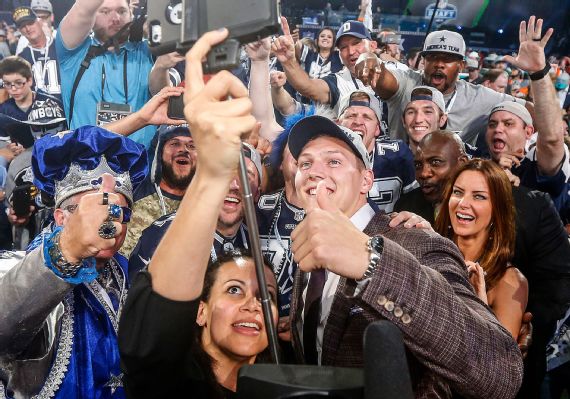
Nothing screams “USA!” like the NFL draft held yearly at the end of April, and I managed to watch a few minutes here and there across the three days of blanket coverage offered by ESPN and the NFL network (I also noticed the draft was in prime time on the Fox network).  The National Football League (NFL) puts on an extravaganza for the draft.  This year I caught a ceremony featuring the family of dead soldier; they “helped” to make a pick in the draft for the Dallas Cowboys.  The huge video screen featured the soldier (Captain Ellery Ray Wallace) who’d been killed, and the fans in the dome started chanting “USA! USA!” in homage to a man who must have loved the Cowboys when he was alive.  The spectacle of it all just made me sad, no matter how much the NFL tried to sell this and similar photo ops as exercises in helping grieving families to recover from the tragedy of losing a loved one in war.

As I wrote about last year’s draft, “I’m always dazed and amazed by the sheer work that goes into the NFL draft: the thoroughness of it all, the expertise on display, the active and informed involvement of the fans. Imagine if ESPN (or any media outlet, for that matter) covered America’s wars with the same commitment to detail and facts as is displayed yearly for American football!”

And as I wrote about the NFL draft two years ago:

If you’re not familiar with NFL football or ESPN coverage of the same in the USA, you should be, because it says much about the American moment.  The first round of the draft kicks off on Thursday night in prime time, followed by the second and third rounds on Friday night in prime time.  The draft concludes on Saturday with rounds four through seven, roughly 250 total picks …

Yet this quick summary vastly understates the coverage devoted to the draft.  From the end of the Super Bowl early in February to the draft itself at the end of April, coverage of the draft on ESPN is virtually non-stop, with innumerable “mock” drafts for each team and a parade of “experts” speculating about the prospects of each player and team. Exhaustive (and exhausting) is the word to describe this coverage.  Interminable is another one.

When Round One finally kicks off, it’s essentially a parade of soon-to-be millionaires. These players, selected from various college football teams, can count on multi-year contracts and signing bonuses in the millions of dollars.  ESPN and the NFL stage manages the selection process, turning it into an extravaganza complete with musicians, cheering (or booing) fans, and plenty of past NFL greats, along with the draftees and their families and friends. Coverage also includes shots of the “war rooms” of the various NFL teams as they decide which players to pick, which draft picks to trade, and so on.

The war room — isn’t that a telling phrase?

Indeed, let’s push that further.  Most red-blooded NFL fans would be hard-pressed to find Iraq or Afghanistan on a map, but they can tell you all about their team’s draft picks, rattling off statistics such as times in the 40-yard dash, vertical leap, even the size of a player’s hands (considered especially pertinent if he’s a quarterback or wide receiver). What always astonishes me is the sheer wealth of detail gathered about each player, the human intelligence (or HUMINT in military terms).  Players, especially those projected to go in the first few rounds, are scrutinized from every angle: physical, mental, emotional, you name it.

With millions of dollars at stake, such an exhaustive approach is not terribly surprising. Yet even with a wealth of data, each year there are major draft busts (e.g. Ryan Leaf, selected #2 overall in the first round and a flop) and major surprises (e.g. Tom Brady, selected late in the 6th round as the 199th pick, meaning that not much was expected from him, after which he won four [now five] Super Bowls).  Results from the NFL draft should teach us something about the limits of data-driven “intelligence” in “wars,” yet our various military intelligence agencies continue to believe they can quantify, predict, and control events.

But again what wows me is the extent as well as the slickness of ESPN’s coverage of the draft.  As soon as a player is selected, ESPN instantly has video of that player’s college highlights, together with his vital statistics (height, weight, performance at the draft combine in various drills, and so on).  Video and stats are backed up by interviews with a draftee’s previous coaches, who extol his virtues, along with interviews with those “war rooms” again as to why they decided to draft that particular player and not another.  Once the draft is completed, teams are then awarded “grades” by various commentators, even though these players have yet to play a snap in the NFL.  (Imagine if your kid received an instant grade in college — before he attended a single class or completed a single assignment — based upon his performance in high school.)

But you have to hand it to ESPN: their coverage of the draft is an exercise in total information awareness.  It’s blanket coverage, an exercise in full-spectrum dominance. It’s slick, professional, and driven by a relentless pursuit of victory by each team (and a relentless pursuit of ratings by ESPN).

In 2016, I made the following proposal, in jest of course, but I repeat it here because I still think it’s telling:

Let’s put ESPN in charge of intelligence gathering and coverage [of America’s wars].  Just imagine if your average red-blooded American devoted as much attention to foreign wars as they do to their favorite NFL team!  Just imagine if America’s leaders were held accountable for poor results as NFL coaches and staffs are! America still might not win its wars, but at least we’d squarely face the fact that we’re continuing to lose at incredibly high cost.  Indeed, someone high-up in the government might actually be held accountable for these losses.

I know: It’s a frivolous suggestion to treat war like a sport.  But is it?  After all, America currently treats the NFL draft with all the seriousness of a life-and-death struggle, even as it treats wars with comparative frivolity.

Our wars are games and our games are wars.  Small wonder America continues to lose its wars while fielding some winning NFL teams.

Jacinda for President!

trump
Trump, America’s very stable genius, doing what he loves

W.J. Astore

My wife perceptively notes how the USA is sliding backwards.  Racism has new vigor even as science is rejected, e.g. climate change denial.  A woman’s right to choose is under attack.  Immigrants once again are openly subjected to prejudice and scorn.  Diversity of views and efforts at inclusion are rejected as so many exercises in “political correctness.”  Unions are being weakened and the working poor are attacked as lazy and irresponsible.  Life expectancy for many is declining, mainly due to suicide, opioid and other addictions, and illnesses related to poor eating habits and obesity.  War is perpetual and violence is never-ending.  Meanwhile, the rich are getting richer, a sign of “greatness,” at least to Trump and his followers.

Sexism, racism, prejudice, ignorance, scapegoating, the privilege of rich white men to say and do whatever they want: this is “greatness” to Trump.  The embodiment of fat cat privilege, Trump rides about in his golf cart and swats balls at his various “resorts.”  Indeed, America’s hard-working president, who said as a candidate he’d have no time for golf or vacations, has spent one-third of his presidency on vacation.  Mission accomplished!

Meanwhile, Democratic officialdom is looking backwards, not forwards.  The Democratic National Committee’s (DNC) idea of progress is to bring a lawsuit against Russia, the Trump campaign, and WikiLeaks for the 2016 election.  This act will “fire up the base,” or so leading Democrats appear to think.  But it’s really sour grapes, a loser policy conducted by pols who remain out of touch with the pressing concerns of ordinary Americans (you know, things like health care, a living wage, and other issues associated with Bernie Sanders’s campaign).  If only America had a true Labor Party instead of a DNC that mirrors the Republicans while lacking their focus and ruthlessness.

Let’s face it: America needs a new leader, a fresh start, an unapologetic progressive, someone who’s smart but who also possesses empathy.  Someone on the side of workers; someone like Jacinda Ardern, the prime minister of New Zealand.

Jacinda
PM Jacinda Ardern of New Zealand.  Yes, she’s pregnant and taking maternity leave after she gives birth.

Roughly half Trump’s age, Jacinda Ardern represents the future. Intelligent, principled, committed to her people, Ardern is refreshingly honest and frank. Imagine, for a moment, a truly progressive woman as president of the United States, one who has the courage of her convictions, one committed to fairness and equity in society, one untainted by big money, even one who’s unabashedly pregnant and who supports maternity and paternity leave for parents.

She’s got spunk too.  When she first met Trump and he had a snide remark for her, she replied that masses of people didn’t take to the streets to protest when she was elected.  As my Kiwi friend put it, “It’s the ability of Jacinda to not only represent her own party but pull together alliances that is impressive. Not only an arrangement with the conservative ‘New Zealand First’ party but also the Greens.”  She brings people together for the greater good — making concessions when she has to.  What a quaint concept.

America could use a woman like Jacinda Ardern as president. If only my Kiwi friends would let her emigrate! (Yes, sadly, she wasn’t born here so she couldn’t run, but let a man dream, dammit.)  Perhaps Congresswoman Tulsi Gabbard will emerge as America’s Jacinda in 2020; aligned with Bernie Sanders, Gabbard has moxie as well as military experience.  But I wouldn’t bank on it.  The DNC, still with its collective head up its ass, isn’t seeing the future too clearly.

800px-Tulsi_Gabbard,_official_portrait,_113th_Congress
Congresswoman Tulsi Gabbard of Hawaii

On Mercy

gollum
Gollum/Smeagol, at war with himself, consumed by desire for the Ring

W.J. Astore

Mercy has been on my mind since re-watching “The Lord of the Rings” trilogy.  There’s a nasty little character known as Gollum.  Before he was seduced by Sauron’s ring (the one ring of power), Gollum was known as Smeagol.  Twisted and consumed by the Dark Lord’s ring, Smeagol becomes a shadow of himself, eventually forgetting his real name and becoming Gollum, a name related to the guttural coughs and sounds he makes.

Gollum loses the Ring to Bilbo Baggins, a Hobbit of the Shire.  The Ring extends Bilbo’s life but also begins to twist him as well.  As Sauron returns to power in Mordor, he needs only to regain the Ring to defeat the combined might of the peoples of Middle Earth.  Bilbo passes the Ring to his much younger cousin, Frodo, who together with a Fellowship consisting of representatives drawn from men, elves, dwarfs, and hobbits as well as the wizard Gandalf, journeys to Mordor to destroy the Ring and vanquish Sauron.

Early in his journey to Mordor, Frodo says he wishes Bilbo had killed Gollum when he’d had the opportunity.  (Gollum, drawn by the Ring, is shadowing the Fellowship on its journey.)  Gandalf sagely advises Frodo that Gollum may yet play an important role, and that mercy is not a quality to disparage.  As the Fellowship is separated and Frodo has to journey to Mordor with only his faithful friend Sam beside him, Gollum soon becomes their indispensable guide, and Frodo begins to pity him.  Frodo, by showing Gollum mercy, reawakens the good within him, calling him Smeagol and preventing Sam from hurting him.

But the corrupting power of the Ring overtakes Smeagol again, and Gollum reemerges.  Even so, without Gollum’s help, Frodo and Sam would never have made it to Mordor and the fires of Mount Doom.  On the brink of destroying the Ring, Frodo too becomes consumed by its power, choosing to use it instead of casting it into the fire.  Here again, Gollum emerges as an instrumental character.  He fights Frodo for the Ring, gains it, but loses his footing and falls into the fires of Mount Doom, destroying himself as well as the Ring and saving Middle Earth.

It was Bilbo and Frodo’s mercy that spared the life of Gollum, setting the stage for Gollum’s actions that ultimately save Frodo and the rest of Middle Earth from Sauron’s dominance.  Without Gollum’s help, Frodo and Sam would never have made it to Mount Doom; or, if by some miracle they had, Frodo in donning the Ring would have been ensnared by Sauron’s power and executed by him.  If Frodo is the hero of the tale, Gollum is the anti-hero, as indispensable to Middle Earth’s salvation as Frodo and the Fellowship.

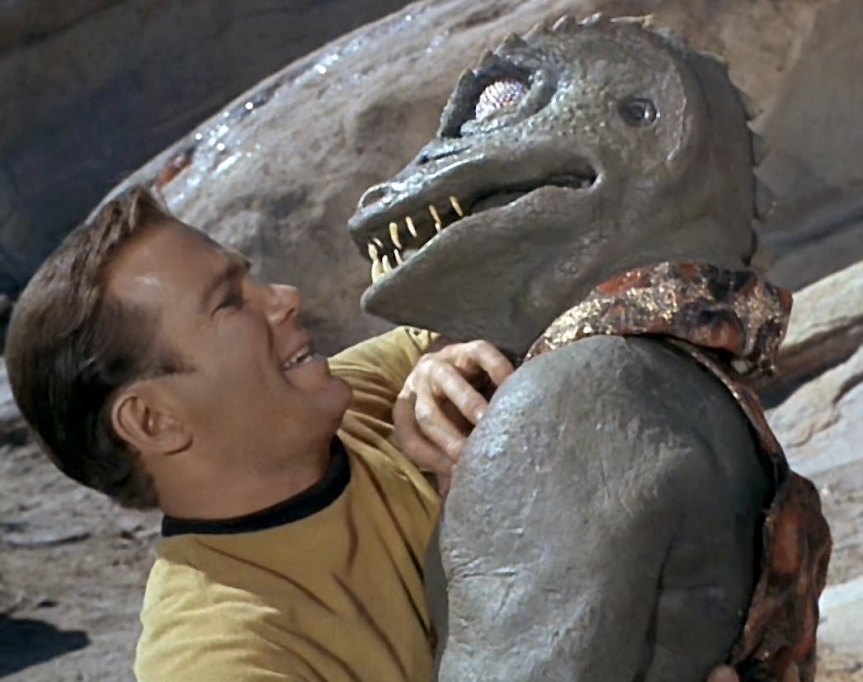
Another story about the role of mercy came in one of my favorite “Star Trek” episodes, “Arena.”  In this episode, Captain Kirk has to fight a duel with an enemy captain of a lizard-like species known as the Gorn.  It’s supposed to be a fight to the death, overseen by a much superior species known as the Metrons.  When Kirk succeeds in besting the Gorn captain, however, he refuses to kill the Gorn, saying that perhaps the Gorn had a legitimate reason for attacking a Federation outpost.  A Metron spokesperson appears and is impressed by Kirk, saying that he has demonstrated the advanced trait of mercy, something the Metrons hardly suspected “savage” humans were capable of showing.

download
Capt Kirk fights the Gorn captain in “Arena”

Perhaps war between the Federation and the Gorn is not inevitable, this episode suggests.  Diplomacy may yet resolve a territorial dispute without more blood being shed, all because Kirk had the courage to show mercy to his opponent: an opponent who wouldn’t have shown mercy to him if their fates had been reversed.

Mercy, nowadays, is not in vogue in the USA.  America’s enemies must always be smited, preferably killed, in the name of righteous vengeance.  Only weak people show mercy, or so our national narrative appears to suggest.  But recall the saying that in insisting on an eye for an eye, soon we’ll all be blind.

The desire for murderous vengeance is making us blind.  The cycle of violence continues with no end in sight.  Savagery begets more savagery.  It’s as if we’ve put on Sauron’s ring and become consumed by it.

Do we have the courage of Bilbo and Frodo Baggins, and even of that man of action, Captain Kirk?  Can our toughness be informed by and infused with mercy?

The Power of Hate and Fear

yoda22

W.J. Astore

Who are we supposed to hate today?  The Russians for allegedly throwing the presidential election?  The Chinese for allegedly stealing our jobs?  The North Koreans for allegedly planning our nuclear destruction?  The Iranians for allegedly working to acquire nuclear weapons?  The “axis of evil” for being, well, evil?

President Franklin Delano Roosevelt famously told Americans that the only thing they had to fear is fear itself.  However, recent American presidents have encouraged us to fear everything.  Let’s not forget the stoking of fear by people like Condoleezza Rice and her image of a smoking gun morphing into a nuclear mushroom cloud.  That image helped to propel America into a disastrous war in Iraq in 2003 that festers still.

One of the most powerful scenes I’ve seen in any movie came in the adaptation of George Orwell’s 1984.  The film version begins with the “two minutes of hate” directed against various (imagined) enemies.  Check it out.  Doubleplusgood!

https://www.youtube.com/watch?v=0KeX5OZr0A4

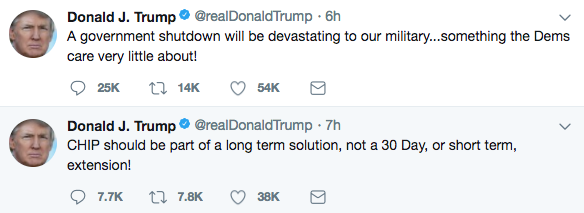
Especially disturbing is the rant against Goldstein, the enemy within.  Here I think of Donald Trump claiming that the Democrats are anti-military for not rubberstamping his budget, a dishonest as well as ridiculous charge, since both parties support high military spending.  Indeed, high Pentagon spending is the one bipartisan area of agreement in Congress.

Screen-Shot-2018-01-18-at-3.07.34-PM
The top tweet is typical of Trump: Accusing Democrats of not caring about “our” troops

This is among the biggest problems in America today: the stoking of hate against the enemy within, e.g. “illegal” immigrants (rapists, gang members, killers, according to our president), Democrats who allegedly don’t support our military, rival politicians who should be “locked up,” protesters who should be punched and kicked and otherwise silenced, high school students who are dismissed as phonies and professional actors, and on and on.

Irrational fear is nothing new to America, of course.  Consider the fear of communism that produced red scares after World Wars I and II.  Consider how fears of the spread of communism led to criminal intervention in Southeast Asia and the death of millions of people there.  Massive bombing, free-fire artillery zones, the profligate use of defoliants like Agent Orange, the prolongation of war without any regard for the suffering of peoples in SE Asia: that behavior constituted a crime of murderous intensity that was in part driven by hatred and fear.

And when hatred and fear are linked to tribalism and a xenophobic form of patriotism, murderous war becomes almost a certainty.  When the zealots of hate are screaming for blood, it’s very hard to hear appeals for peace based on compassion and reason.

Anger, fear, aggression: that way leads to the dark side, as Yoda, that Jedi master, warned us.  Hate too, Yoda says, must be resisted, lest one be consumed by it.  Sure, he’s just an imaginary character in the “Star Wars” universe, but that doesn’t negate the truth of his message.

God is love, the Christian religion says.  Why then are we so open to hate and fear?

Islamophobia in the Trump Administration

CAMPAIGN-MUSLIMSOLDIER
Let us remember the service and sacrifice of Muslim-Americans

W.J. Astore

Lately, Ben Carson at Housing and Urban Development (HUD) has been criticized in the news for wanting taxpayers to fund a dining set that costs $31,000.  (He’s tried to shift the blame to his wife.)  We seem to forget a far more disturbing aspect of Carson’s behavior: his Islamophobia.  Remember his anti-Muslim comments as a presidential candidate?  Remember he said that no Muslim-American should ever serve as president?

Back then, I heard from a fellow Air Force officer, a Muslim-American, originally from Iraq, who served proudly in our armed forces.  He said Ben Carson’s comment brought him to tears — that a candidate for a major political party would insist on a religious test that would bar all Muslims from serving this country as president.

Yet for his Islamophobic position, which was contrary to the U.S. Constitution that forbids any religious test for political office, Ben Carson was rewarded by the Trump administration and appointed Secretary at HUD.

Don’t focus on his pricey dining set, America: Focus on his ignorance and his prejudice against millions of patriotic Americans, who just happen to be Muslim.  And remember how he was rewarded for this.

This episode came back to me when I read TomDispatch today.  A U.S. Navy veteran, Nate Terani, recalls his own personal nightmares of being targeted as a Muslim-American by a Trump administration that leans increasingly toward Islamophobia.  As Tom Engelhardt notes in his introduction to Terani’s article, Trump has “tapped the [CIA’s] previous director, Mike Pompeo, a notorious Tea Party Islamophobe and Iranophobe, to replace Twitter-fired Rex Tillerson as secretary of state. Now, another key post is evidently about to be up for grabs. National Security Advisor H.R. McMaster is reportedly almost out the door as the president openly considers a replacement for him, possibly former Bush-era ambassador to the U.N. John Bolton. He’s another major Iranophobe, who has called for launching military operations against that country for years … [Combine this with] the potential return of torture, the possible refilling of Guantanamo with new prisoners, the intensification of war across the Greater Middle East with a new focus on Iran, and the entrenchment of particularly extreme forms of Islamophobia” and you truly have a recipe for a nightmarish America.

There is no room in America for prejudice based on religious belief (or lack thereof).  Religious wars are nightmares of our past; we must not allow the haters to bring them back into our present or our future.

Lockdown America and School Shootings

cartoon

W.J. Astore

Five years ago, I remember talking about lockdown drills (or “active shooter drills”) with colleagues at Penn College.  Such drills were voluntary.  Basically, the drill involved locking the classroom door, moving students to the back of the classroom, and having them hunker down, away from windows, while keeping silent so as to avoid detection by a shooter roaming the halls.

I was against these drills.  I thought they added to the fear, and I chose not to do them.  But maybe I would do them today.

After one shooting massacre (I can’t recall if it was Virginia Tech in 2007 or Sandy Hook in 2012), locks were added to the classroom doors.  In theory, if I heard gunshots, I or one of my students could jump up and lock the door before a shooter got in.  But what if a determined shooter shot the lock out?

What a world we Americans live in.  Locked classrooms, lockdown drills for active shooters, and now the proposal to turn teachers into so many Harry Callahans (Clint Eastwood’s Dirty Harry) and our schools into “hardened” targets by arming teachers with pistols.  Perhaps we should keep an AR-15 in each classroom (alongside the fire extinguisher), with a sign that reads, “In case of emergency, break glass – then lock and load.”

President Trump has argued that select teachers be armed – following the NRA’s theory that a good man with a gun is the best insurance against a bad man with a gun.  It’s a crazy idea, but we live in a crazy country.  Among the worst parts of Trump’s proposal was his stingy suggestion that armed and trained teachers might earn “a little bit” of a bonus.  How generous of our brave commander-in-chief.

Think about that for a moment.  There is an active shooter (or shooters) in a school, armed with military-style assault weapons and perhaps protected by body armor.  Young people are running and screaming, bullets are flying, and in this bloody chaos, we place our faith in a teacher, perhaps armed with a 9mm pistol, thoroughly trained in shooting under combat conditions, willing to risk it all “for a little bit of a bonus.”

It’s a powerful fantasy: the cold bold Harry Callahan-like teacher, taking aim with his or her pistol and blowing away school intruders with perfect head shots.  And that’s exactly what it is: a fantasy.  As Belle Chesler, a teacher, put it at TomDispatch.com, “We are not warriors, we are teachers. We are not heroes, we are teachers.”

It’s one thing to shoot at paper targets on a gun range; it’s another thing entirely to fire accurately in combat when you’re outgunned and someone is firing back at you.  What if, during the chaos of shooting, a teacher accidentally shoots a few students?  So-called friendly fire incidents happen frequently in combat, despite the most careful troop training.

If you want more security guards in America’s schools, hire them.  Don’t try to turn teachers into cheap cut-rate guards.  Yet “a little bit of a bonus” for armed teachers is the best idea our stingy billionaire of a president can come up with.

As we saw in Parkland, Florida, even armed and trained deputies may hesitate before confronting a heavily-armed shooter.  How is your average teacher going to react? At least we know Trump will rush in, heel spurs and all, whether he’s armed or unarmed, to save the day.  Or so he says.

Most people, even when armed, will not rush toward the sound of gunfire.  We tend instinctively to freeze, to take cover, or to run.  It takes a combination of training, willpower, and courage to rush toward danger, often strengthened by teamwork and inspired by one or more leaders who set the example.  The problem is not as simple as “give a teacher a gun, and he or she will blow the bad guy away.”

In a country awash in weapons, there are no easy answers.  One model is to turn our schools into fortresses, complete with surveillance cameras and panic buttons and smoke ejectors in hallways, as in this “safe” school in Indiana.  Trump’s model is to arm select teachers for a tiny bonus.  Limited efforts at gun control, such as raising the age to purchase an assault rifle from 18 to 21, are like putting a Band-Aid on a sucking chest wound.  One thing is certain: better law enforcement is crucial, e.g. there were many warnings about the Parkland shooter that were dismissed or ignored.

Again, there are no easy answers.  And so Lockdown America is now our reality.

Update (3/9/18): In the wake of the Parkland shootings, Florida legislators have approved guns for teachers in the classroom, as well as more spending on school security.  Assault weapons, however, are not to be banned.  So the solution to bad men with guns is indeed good men with guns, according to Florida.  The NRA wins again.

How long before a teacher, teacher’s aide, or coach with a gun accidentally or intentionally hurts a student with a gun?  How long before the inevitable lawsuits result from this, the multi-million dollar settlements?  Will school districts be required to carry expensive insurance against gun shootings by educators?  Are taxpayers ready to pony up a lot more money to cover the costs of insurance premiums and lawsuits?

A trillion here, a trillion there, and pretty soon you’re talking real money

Imacon Color Scanner
Painting of Everett Dirksen, a thrifty Republican.  Remember those?

W.J. Astore

Though it’s unconfirmed that Congressman Everett M. Dirksen ever uttered perhaps the most famous words attributed to him: “A billion here, a billion there, and pretty soon you’re talking real money,” the sentiment surely needs to be updated for America’s profligate military moment.  Replace “billion” with “trillion” and you have the perfect catchphrase for today’s Pentagon.

Consider the following facts:

  1. The F-35 jet fighter is projected to cost $1.45 trillion over the life of the program.
  2. Modernization of the U.S. nuclear arsenal is projected to cost $1.2 trillion, though some estimates suggest $1.7 trillion as the more likely sum.
  3. America’s Afghan War has already cost $1 trillion.  Add to that another $45+ billion to support war ops for this year, and perhaps the same amount of spending each year for the next decade.
  4. A low-ball estimate for America’s Iraq War is $1 trillion, but when one adds in veterans health care and similar long-term issues, the cost rises into the $2-3 trillion range.
  5.  Each year, spending on the Pentagon, Homeland Security, wars, nuclear weapons, the VA, and interest on the national debt associated with previous military spending approaches $1 trillion.

We’re talking about real money, right?

Yet all this spending is scarcely debated within Congress.  Together with the Trump administration, Congress is a rubber stamp for the Pentagon.  Meanwhile, Congress will fight tooth and nail over a few million dollars to support the arts, humanities, and similar “wasteful” programs.  Planned Parenthood is always under attack, despite the paltry sum they receive (roughly half a billion) to provide vital functions for women’s health.  Even the $200 billion promised by Trump to support infrastructure improvements is a trickle of money compared to the gusher of funds dedicated to the Pentagon and all of its exotic WMD.

People laughed at Bernie Sanders when he proposed health care for all and free education in state colleges.  That socialist fool!  America can’t afford that!  Indeed, much better for people to go into debt as they struggle to pay for health care or college.  That’s private enterprise and “freedom” for you.  Own the debt and you can own the world.

No — Bernie Sanders wasn’t crazy.  America could easily afford universal health care and virtually free education at state colleges and universities.  Our elites simply choose not to consider these proposals, let alone fund them.  But more nukes?  More wars?  More jets and subs and tanks?  Right this way, my boy!

All these trillions for weapons and wars — one thing is certain: “freedom,” as they say, sure isn’t free.

Update (2/27/18): At TomDispatch.com, Bill Hartung goes into greater detail on the Pentagon’s massive budget for 2018 and 2019.  As he notes: “The figures contained in the recent budget deal that kept Congress open, as well as in President Trump’s budget proposal for 2019, are a case in point: $700 billion for the Pentagon and related programs in 2018 and $716 billion the following year. Remarkably, such numbers far exceeded even the Pentagon’s own expansive expectations. According to Donald Trump, admittedly not the most reliable source in all cases, Secretary of Defense Jim Mattis reportedly said, ‘Wow, I can’t believe we got everything we wanted’ — a rare admission from the head of an organization whose only response to virtually any budget proposal is to ask for more.”

The title of Hartung’s article sums it up: The Pentagon Budget as Corporate Welfare for Weapons Makers.

Put succinctly, it’s warfare as welfare — and wealth-care — for the military-industrial complex.

Debunking Spectator Sports: Confessions of an Anti-Sports Fan

download
Are you not entertained?

Richard Sahn

I’ve never gotten excited about or interested in a particular sports team, whether professional or amateur. I don’t care whether a particular team wins or loses and I go out of my way not to watch games on TV or listen to a radio broadcast.

Prior to this year’s Super Bowl game, I listened to people chant, on the phone or in person, “Go Patriots” or “Go Eagles.” Even a Catholic priest at the end of a mass I attended recently couldn’t leave the altar before letting the parishioners know he was a Patriots fan.

Spectator sports have always been a secular religion in most developed countries but with no promise of any form of salvation, afterlife, or reincarnation. The most you can really expect from your team is winning a bet on the game. But  spectator sports  is a distraction with negative consequences, ultimately, to society and the individual sports fan—such as having no understanding of the actions of political parties.

And because each season of the year has its athletic contests there is no letup. A fan is deluged all year round with games as well as incessant commentaries on athletes and the points they score or might score.  Athletic contests and players, even on the high school level, are  a major topic of conversation, especially among adult males  I view such conversations as not only boring but irrelevant to my own life, to what I  would call meaningful concerns.

In fact, I would argue spectator sports discussions have no lasting therapeutic value in dealing with the real “slings and arrows of outrageous fortune.” Political philosopher Noam Chomsky recently said, probably somewhat sarcastically, that if as much mental energy was expended in solving the social and economic problems of the world as is expended in trying to explain why a given team wins or loses a game, much socially and politically induced suffering and death could be eliminated.

Eavesdrop on virtually any conversation, especially at World Series, Super Bowl, or NBA playoff times, and you’ll hear conversations that would make you believe you were in a think-tank rivaling the Institute for Advanced Study at Princeton.

Now, as a sociologist, I realize the important function of sports in society. That function, of course, is a distraction from life’s existential problems and dilemmas. Death, loss of loved ones, nuclear war, global warming are certainly among those problems. And, most assuredly, being a spectator sports fanatic is a far better alternative than being a drug addict or engaging in anti-social behavior.  I also admit spectator sports have a limited psycho-therapeutic effect on some people.

My quarrel is with the level of energy spent watching and then discussing sports events. Even expressing one’s preference for one team or another I find disturbing, mainly because I feel there are more worthwhile causes to champion. Agonizing, so it seems, over the prowess of individual players and their team’s chances of winning playoffs or championships is a waste of time and energy. Simply put, I cannot empathize in the slightest with the sports fan. In that respect I guess I’m a type of sociopath since sociopaths can’t empathize with other human beings in general.

Arguably, spectator sports also contribute to the “us” versus “them” perspective toward social life, the belief that life is not interesting or worthwhile unless “us” is always trying to  defeat “them,” whether “them” be a rival team or country–in other words, not “us.”

The great (former) coach of the Green Bay Packers, Vince Lombardi once proclaimed, “Winning isn’t everything; it’s the only thing.” Could Lombardi’s philosophy be applied to our current president who is also an ardent sports fan?  Could Donald Trump’s insistence on America becoming “great again,” with all the dire consequences to minority groups and the underclass, not to mention the world in general, be the by-product of his obsessive interest in spectator sports? At one time our president wanted to be owner of an NFL team. What does that tell us?

Two psychological processes seem to account for the prevalence of the typical sports fan. These are vicarious identification and reification. Vicarious identification is thinking that one “IS” actually the team he or she is watching.  The team’s victory or defeat is his/her victory or defeat.  Being able to enjoy plays, movies, and novels entails the same process; for the moment, one is a character in a work of fiction. The ability of consciousness (mind, soul, brain, spirit, if you prefer) to immerse itself in a story or situation that is fictitious is, for sure, one of the great joys of life. From time to time I’ve watched certain films or videos multiple times and can still fool myself into thinking that I don’t really know the outcome.  Perhaps spectator sports allow male fans in particular to be the macho male, the alpha male they’re not in everyday life, without having to perform in any way. No need to resort to violent behavior if one vicariously identifies with a football team or professional wrestlers.

Reification is psychologically treating an abstract concept or mental construct as if it were real, as if it were empirical or tangible reality.  Semanticists will say “the word is not the thing” or “the map is not the territory.”  Nations, states, cities do not exist as realities (sui generis); they are only abstract concepts, in other words, words.  People exist, athletes exist, and games are played, but the sports fan wants his/her “team” to win because the name of the team itself is regarded as if it were a live person or group of people.

It doesn’t matter, usually, who the real life players are or even if there are any real life players. It’s the “team” itself—the word is the thing.  I once asked my students who were fans of the Pittsburgh Steelers whether they would still want the Steelers to defeat the Dallas Cowboys if the teams’ executives exchanged players and coaches. The Steelers fans said they would still support or root for the Steelers over the Cowboys. I tried to point out the error in their thinking, that there is no such reality as the “Steelers” or the “Cowboys,” that only players and their coaches exist. No, the Steelers fans would remain Steelers fans and want the team to win because they are “The Steelers.”

Existence precedes essence, say the existentialists.  Existence is what is tangibly real, for example, what could physically maim, hurt, kill. Essence refers to words, ideas, concepts. (For example, essence would be the “thoughts and prayers” for gun victims–what we hear so much these days from our politicians in the wake of shooting violence.) Scoring a touchdown is “existence.” The team that fans roots for is “essence,” in other words, nothing but an idea with no more substance than the number “5.” When one regards spectator sports existentially it becomes difficult to be a fan, although one may enjoy viewing brilliantly executed plays on the field or in the arena.

My argument here, then, is that the serious spectator sports fan is likely to be distracted from engaging in philosophical, political, aesthetic, critical thinking or reflection.  Now, I have no doubt that one could be a sports fan, even a fanatical sports fan, and be a social activist, an artist, a scholar, a reflective person capable of deep meditation.  I just see spectator sports as tending to obstruct or preclude intellectual and aesthetic development in the general population of a given country.

Professional and collegiate athletic events do benefit our economic system by creating all kinds of jobs and careers, and not just for the players. But spectator sports may also stand in the way of the fan being exposed to and contemplating the vital social and political issues of the times. It is reasonable to ask whether being a serious sports fan erodes participation in the democratic process. Why are most universities known for their teams and not for what their faculties teach? What’s the first thing an American thinks of when he or she thinks of “Ohio State” or “Notre Dame” or “Penn State”?  Is it higher learning?  Or football?

Richard Sahn teaches sociology at a college in Pennsylvania.

Frederick Douglass on Patriotism and Taking A Knee

taking a knee
Colin Kaepernick (#7) takes a knee

M. Davout

A week after Super Bowl Sunday, I was reading Frederick Douglass’s “Fourth of July Address,” given by the intrepid abolitionist and eminent public intellectual on July 5, 1852 to several hundred spectators in Rochester, New York. It struck me then how contemporary Douglass’s antebellum insights into the nature of patriotism in America seemed, especially in the wake of an NFL season steeped in controversy over football players (mostly African-American) taking a knee during the national anthem.  Their symbolic protest, dismissed by some, notably including a tweeting president, as unpatriotic, was intended to highlight how police encounters with people of color in this country all too often and disproportionately end in unjustified uses of deadly force.

800px-Frederick_Douglass_by_Samuel_J_Miller,_1847-52
Frederick Douglass near the time of the Rochester Speech, given on the 5th of July 1852

At the time of his Fourth of July Address, Douglass was about fifteen years removed from a state of enslavement he managed, against steep odds, to escape and had become an orator of note in abolitionist circles. Attesting to a sense of trepidation in accepting an invitation to speak before such a large audience on their august day of national celebration, Douglass praised the generation of 1776 (“your fathers,” he calls them) for “lov[ing] their country better than their own private interests” and for their “solid manhood” in “preferr[ing] revolution to peaceful submission to bondage.”

Douglass then reminded his audience that, while it is easy in present times to celebrate the founders for resisting British oppression, “to pronounce against England, and in favor of the cause of the colonies” in the 1770s meant being pilloried and browbeaten as “plotters of mischief, agitators and rebels, dangerous men.”  Moving beyond this critique of the easy and self-congratulatory patriotism of his contemporaries, Douglass raised the prospect that the founders’ great deeds might even be evoked by men of tyrannical intent: “The cause of liberty may be stabbed by the men who glory in the deeds of your fathers.”

Douglass went on to warn his listeners, and free citizens of the American republic generally, against shirking their own responsibility for carrying on the emancipatory tradition celebrated each Fourth of July–“You have no right to wear out and waste the hard-earned fame of your fathers to cover your indolence.”

While there is much more to Douglass’s powerful address, his opening discourse on the patriotic meaning of the Fourth of July provides a way of dousing the “fire and fury” that has been generated by the right-wing media around the symbolic protest started by Colin Kaepernick in 2016 and seeing the significance of that protest with a quiet clarity.

Douglass’s Fourth of July Address warns against the self-serving belief that routinized, programmed patriotic gesture is equivalent to a true love of liberty.  He daringly calls out those who would abuse patriotic gesture in order to control others. His words remind us that the struggle for freedom is always a work in progress and that it is too easy to celebrate its provisional achievement after the hard and risk-laden work is done by others.

Douglass’s speech is part of a tradition of exposing empty patriotic gesture and challenging citizens to live up to the emancipatory demands of true patriotism, a tradition which Colin Kaepernick and his emulators can be seen as stalwartly embracing.  His speech serves as a powerful rejoinder to those who would, like Donald J. Trump, attempt to shame NFL player-protesters into anthem-standing conformity with transparently cynical references to the sacrifices of US veterans and members of the armed forces.

M. Davout (pseudonym) is a professor of political science who teaches in the Deep South.