From the Arsenal of Democracy to an Arsenal of Genocide

W.J. Astore

Time to Make America Sane–Again?

I started blogging in 2007 for TomDispatch.com. Tom Engelhardt, the mastermind of that indispensable site, saw something in an article I sent him on saving the U.S. military from itself. That is, from its own vainglory, its own global ambitions for power and dominance, its own illusions of being number one, both the world’s toughest military and also the world’s freedom-bringers. Certainly, the megalomania and Messiah-like fantasies weren’t a military mindset alone; it was even more pronounced among the neocons who orbited the Bush/Cheney administration and who still largely define U.S. foreign policy in the Biden/Harris administration. Things are so bad that some (wrongly) believe Trump/Vance offer a more moderate, far less warlike, alternative, when Trump’s record suggests little of the sort.

Anyhow, this is my 108th article for TomDispatch in the 17 years I’ve been writing for the site, a mark of persistence that suggests a certain folly on my part, and considerable patience on Tom’s part. 

During World War II, American leaders proudly proclaimed this country the “arsenal of democracy,” supplying weapons and related materiel to allies like Great Britain and the Soviet Union. To cite just one example, I recall reading about Soviet armored units equipped with U.S. Sherman tanks, though the Soviets had an even better tank of their own in the T-34 and its many variants. However, recent news that the United States is providing yet more massive arms deliveries to Israel (worth $20 billion) for 2026 and thereafter caught me off guard.  Israel quite plainly is engaged in the near-total destruction of Gaza and the massacre of Palestinians there.  So, tell me, how over all these years did the self-styled arsenal of democracy become an arsenal of genocide?

Israel, after all, couldn’t demolish Gaza, killing at least 40,000 Palestinians in a population of only 2.1 million, including thousands of babies and infants, without massive infusions of U.S. weaponry. Often, the U.S. doesn’t even sell the weaponry to Israel, a rich country that can pay its own bills. Congress just freely gifts body- and baby-shredding bombs in the name of defending Israel from Hamas. Obviously, by hook or crook, or rather by shells, bombs, and missiles, Israel is intent on rendering Gaza Palestinian-free and granting Israelis more living space there (and on the West Bank). That’s not “defense” — it’s the 2024 equivalent of Old Testament-style vengeance by annihilation.

As Tacitus said of the rampaging Romans two millennia ago, so it can now be said of Israel: they create a desert — a black hole of death in Gaza — and call it “peace.” And the U.S. government enables it or, in the case of Congress, cheers on its ringleader, Israeli Prime Minister Bibi Netanyahu.

Of course, anyone who knows a little American history should have some knowledge of genocide. In the seventeenth century, Native Americans were often “satanized” by early colonial settlers. (In 1994, a friend of mine, the historian David Lovejoy, wrote a superband all-too-aptly titled article on exactly that topic: “Satanizing the American Indian.”) Associating Indians with the devil made it all the easier for the white man to mistreat them, push them off their lands, and subjugate or eradicate them. When you satanize an enemy, turning them into something irredeemably evil, all crimes become defensible, rational, even justifiable. For how can you even consider negotiating or compromising with the minions of Satan?

Growing up, I was a strong supporter of Israel, seeing that state as an embattled David fighting against a Goliath, most notably during the Yom Kippur War of 1973. Forty years later, I wrote an article suggesting that Israel was now the Goliath in the region with Palestinians in Gaza playing the role of a very much outgunned and persecuted David. An American-Jewish friend told me I just didn’t get it. The Palestinians in Gaza were all terrorists, latent or incipient ones in the case of the infants and babies there. At the time, I found this attitude uncommon and extreme, but events have proven it to be far too common (though it certainly remains extreme). Obviously, on some level, the U.S. government agrees that extremism in the pursuit of Israeli hegemony is no vice and so has provided Israel with the weaponry and military cover it needs to “exterminate all the brutes.” Thus, in 2024, the U.S. “cradle of democracy” reveals its very own heart of darkness.

Looking Again at the World Wars That Made America “Great”

When considering World Wars I and II, we tend to see them as discrete events rather than intimately connected. One was fought from 1914 to 1918, the other from 1939 to 1945. Americans are far more familiar with the Second World War than the First. From both wars this country emerged remarkably unscathed compared to places like France, Germany, Russia, the United Kingdom, China, and Japan. Add to that the comforting myth that America’s “greatest generation” pretty much won World War II, thereby saving democracy (and “Saving Private Ryan” as well).

Perhaps, however, we should imagine those years of conflict, 1914-1945, as a European civil war (with an Asian wing thrown in the second time around), a new Thirty Years’ War played out on a world stage that led to the demise of Europe’s imperial powers and their Asian equivalent and the rise of the American empire as their replacement. Germanic militarism and nationalism were defeated but at an enormous cost, especially to Russia in World War I and the Soviet Union in World War II. Meanwhile, the American empire, unlike Germany’s Second and Third Reichs or Japan’s imperial power, truly became for a time an untrammeled world militarist hegemon with the inevitable corruption inherent in the urge for near-absolute power.

Vast levels of destruction visited upon this planet by two world wars left an opening for Washington to attempt to dominate everywhere. Hence, the roughly 750 overseas bases its military set up to ensure its ultimate global reach, not to speak of the powerful navy it created, centered on aircraft carriers for power projection and nuclear submarines for possible global Armageddon, and an air force that saw open skies as an excuse for its own exercises in naked power projection. To this you could add, for a time, U.S. global economic and financial power, enhanced by a cultural dominance achieved through Hollywood, sports, music, and the like.

Not, of course, that the United States emerged utterly unchallenged from World War II. Communism was the specter that haunted its leaders, whether in the Soviet Union, China, or Southeast Asia (where, in the 1960s and early 1970s, it would fight a disastrous losing war, the first of many to come, in Vietnam, Laos, and Cambodia). Here, there, and everywhere, even under the very beds of Americans, there was a fear of the “commie rat.” And for a while, communism, in its Soviet form, did indeed threaten capitalism’s unbridled pursuit of profits, helping American officials to create a permanent domestic war state in the name of containing and rolling back that threat. The collapse of the Soviet Union in 1991 erased that fear, but not the permanent war state that went with it, as Washington sought new enemies to justify a Pentagon budget that today is still rising toward the trillion-dollar mark. Naturally (and remarkably disastrously), it found them, whether in Afghanistan, Iraq, or so many other places in the case of the costly and ultimately futile Global War on Terror in the aftermath of the 9/11 attacks.

And eternally losing (or at least not winning) its wars raised the question: What will replace it? What will happen as imperial America continues to decline, burdened by colossal debt and strategic overreach, and crippled from within by a rapacious class of oligarchs who fancy themselves as a new all-American aristocracy. Will that decline lead to collapse or can its officials orchestrate a soft landing? In World Wars I and II, Europeans fought bitterly for world dominance, powered by militarism, nationalism, racism, and greed. They suffered accordingly and yet did recover even if as far less powerful nations. Can the U.S. manage to curb its own militarism, nationalism, racism, and greed in time and so recover similarly? And by “racism,” I mean, for example, reviving the idea (however put) of China as a “yellow peril,” or the tendency to see the darker-skinned peoples of the Middle East as violent “terrorists” and the latest minions of Satan.

And then, of course, there’s always the fear that, in the future, a world war could once again break out, raising the possibility of the use of nuclear weapons from global arsenals that are always being “modernized” and the possible end of most life on Earth. It’s an issue worth highlighting, since the U.S. continues to “invest” significant sums in producing yet more nuclear weapons, even as it ratchets up tensions with nuclear powers like Russia and China. Though a winnable nuclear war among the great powers on this planet is inconceivable, that hasn’t stopped my country from pushing for a version of nuclear superiority (disguised, of course, as “deterrence”).

Making America Sane Again

The world wars of the previous century facilitated America’s global dominance in virtually all its dimensions. That, in fact, was their legacy. No other nation in history had, without irony or humility, divided the globe into military combatant commandslike AFRICOM for Africa, CENTCOM for the Middle East, and NORTHCOM here at home. There are also “global” commands for strategic nuclear weapons, cyber dominance, and even the dominance of space. It seemed that the only way America could be “safe” was by dominating everything everywhere all at once. That insane ambition, that vainglory, was truly what made the U.S. the “exceptional” nation on the world stage.

Such a boundless pursuit of dominance, absurdly disguised as benefiting democracy, is now visibly fraying at the seams and may soon come apart entirely. In 2024, it’s beyond obvious that the United States no longer dominates the world, even if its military-industrial-congressional complex (MICC) does indeed dominate its national (in)security state and so increasingly the country. What an irony, in fact, that defeating European militarism in two world wars only accelerated the growth of American militarism and nationalism, making the world’s lone superpower for so many decades the scariest country for all too many peoples outside its borders.

Think, in fact, of the U.S. emerging from World War II with what might be thought of as victory disease. The last nearly 80 years of its foreign policy witnessed the remarkable progression of that “disease,” despite a lack of actual victories (unless you count minor escapades like the invasion of Grenada). Put differently, the U.S. emerged from World War II so singularly an economic, financial, and cultural juggernaut that subsequent military defeats almost didn’t seem to matter.

Even as America’s economic, financial, and cultural power has waned in this century, along with its moral position (consider President Obama’s curt “We tortured some folks” admission, along with support for Israel’s ongoing genocide), the government does continue to double-down on military spending. Pentagon budgets and related “national security” costs now significantly exceed $1 trillion annually even as arms shipments and sales continue to surge. War, in other words, has become big business in America or, as General Smedley Butler so memorably put it 90 years ago, a first-class “racket.”

Worse yet, war, however prolonged and even celebrated, may be the very definition of insanity, a deadly poison to democracy. Don’t tell that to the MICC and all its straphangers and camp followers, though.

Ironically, the two countries, Germany and Japan, that the U.S. took credit for utterly defeating in World War II, forcing their unconditional surrender, have over time emerged in far better shape. Neither of them is perfect, mind you, but they largely have been able to avoid the militarism, nationalism, and constant warmongering that so infects and weakens American-style democracy today. Whatever else you can say about Germany and Japan in 2024, neither of them is bent in any fashion on either regional or global domination, nor are their leaders bragging of having the finest military in all human history. American presidents from George W. Bush to Barack Obama have indeed bragged about having a matchless, peerless, “finest” military. The Germans and Japanese, having known the bitter price of such boasts, have kept their mouths shut.

My brother Stevie once memorably said: “No brag, just facts.”

My brother has a saying: no brag, just facts. And when we look at facts, the pursuit of global dominance has been driving the American empire toward an early grave. The “finest” military lost disastrously, of course, in Vietnam in the last century, and in Afghanistan and Iraq in this one. It functionally lost its self-proclaimed Global War on Terror and it keeps losing in its febrile quest for superiority everywhere.

If we met a person dressed in a military uniform who insisted he was Napoleon, boasted that his Imperial Guard was the world’s best, and that he could rule the world, we would, of course, question his sanity. Why are we not questioning the collective sanity of America’s military and foreign-policy elites?

This country doesn’t need to be made great again, it needs to be made sane again by the rejection of wars and the weaponry that goes with them. For if we continue to follow our present pathway, MADness could truly lie in wait for us, as in the classic nuclear weapons phrase, mutually assured destruction (MAD).

Another form of madness is having a president routinely implore God — yes, no one else! — to protect our troops. This is not a knock on Joe Biden alone. He’s just professing a nationalist piety that’s designed to win applause and votes. Assuming Biden has the Christian God in mind, consider the irony, not to say heresy, of functionally begging Christ, the Prince of Peace, to protect those who are already armed to the teeth. It’s also an abdication of the commander-in-chief’s responsibility to support and defend the U.S. Constitution while protecting those troops himself. Who has the biggest impact, God or the president, when it comes to ensuring that troops aren’t sent into harm’s way without a justifiable cause supported by the American people through a Congressional declaration of war?

Consider the repeated act of looking skyward to God to support military actions as a major league cop-out. But that’s what U.S. presidents routinely do now. Such is the pernicious price of pursuing a vision that insists on global reach, global power, and global dominance. America’s leaders have, in essence, elevated themselves to a god-like position, a distinctly angry, jealous, and capricious one, far more like Zeus or Ares than Jesus. Speaking of Jesus, he is alleged to have said, “Suffer the children to come unto me.” The militarized American god, however, says: suffer the children of Gaza to die courtesy of bombs and shells made here in the U.S.A. and shipped off to Israel at a remarkably modest price (given the destruction they cause).

To echo a popular ad campaign, Jesus may “get” us, but our leaders (self-avowed Christians, all) sure as hell don’t get him. I may be a lapsed Catholic, not a practicing one like Joe Biden, but even I remember my catechism and a certain commandment that Thou shalt not kill.
Trump Thoughts

W.J. Astore

A Quintessentially American Figure

Today, I thought I’d write about someone who’s uncontroversial: Donald Trump.

My reflections are impressionistic and random. Regular readers of Bracing Views know I won’t be voting for Trump (or Biden for that matter), so my comments here are not meant as an endorsement. With that said, let’s dive in:

When Trump was trying to get rid of Obamacare, he naturally had no replacement plan in mind. At the time, I read that Trump allegedly turned to his advisers and said, Why don’t we simply give everyone Medicare? It sounds like Trump: a simple solution to a problem he wants to put behind him. Of course, it was also the goal of Bernie Sanders and progressives. Trump’s advisers quickly told him he couldn’t do Medicare for All, and Trump dropped the matter. (I’m not sure this story is true, but it sounds true.)

As a businessman, Trump has a knack for discerning bad deals, so it’s not surprising he hit on NATO as a “bad” one. Why was America spending so much, allegedly to defend Europe, when Europeans themselves were spending far less for their own defense? Does America even need NATO? Once again, Trump’s advisers intervened, keeping the U.S. in NATO even as Trump did win commitments from some European countries to spend more on their militaries.

Trump ran in 2016 on the idea of draining the swamp, after which he surrounded himself with advisers drawn from the swamp, especially retired military generals. They were allegedly the “adults in the room” who were meant to control Trump’s worst impulses. What they ensured was that nothing fundamentally changed in the Trump administration, especially for the military-industrial-congressional complex and similar power complexes.

I’ve read, and I think it’s probably true, that Trump expected to lose in 2016. He ran because the Republican competition was so weak, and it gave him a platform to rebuild his popularity, which he apparently wanted to parlay into another lucrative TV deal. That November, Trump was as surprised as most Americans were when he won. He should have listened to his wife, Melania, who predicted he would win if he ran.

I’ve called Trump a con man, and I stand by that. And he’s a good one! He is absolutely shameless and will slap and stamp his name on anything to make a few bucks, whether it’s Bibles, towers, vodka, steak, sneakers, a university, you name it. This doesn’t make him a “bad” person. It makes him a shameless and therefore highly effective grifter.

Trump recognized in 2015 that the Republican candidates arrayed against him were nowhere near as skilled as he was at attracting attention and selling illusions. That’s how he was able to dispatch JV competitors like Low Energy Jeb, Little Marco, and Lyin’ Ted so quickly. In this, he was aided by Hillary Clinton and the Democrats’ “pied piper” strategy of encouraging Trump. Be careful what you wish for, Hillary.

Trump, unlike so many U.S. politicians, occasionally blurts out a big truth. The Iraq War was a disaster. The U.S. is in decline and is no longer the “greatest” nation. NATO is obsolete. Far too many people are dying in the needless and awful Russia-Ukraine War. We’re in Syria to steal its oil. We want Venezuela’s oil too. If you think Russia has killers, so does the United States. And so on. It’s not Trump’s cons that piss off the establishment. It’s those rare truths that Trump lets slip that they despise.

Yes, Trump is a con man, but he’s a genuine con man. He is exactly what he appears to be. In this sense, Trump is more genuine—more real—than most politicians, Republican and Democrat, who pose as public servants even as they practice their own grifts.

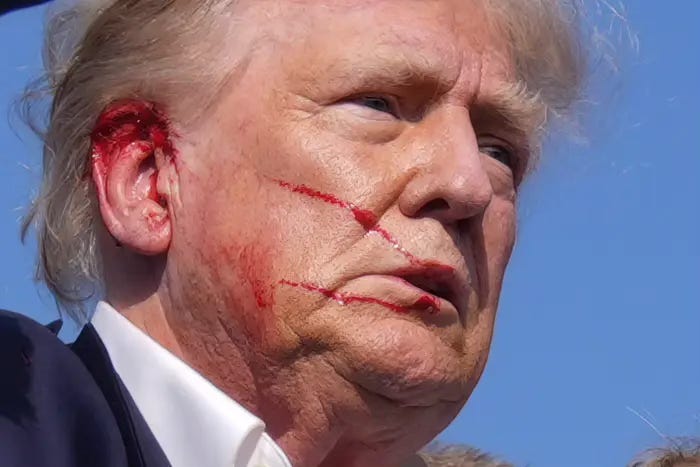
“War Paint” was the first idea that popped into my head when I saw this image

Trump, whatever else you can say about the man, often has superb political instincts. His raised fist and cry of “fight, fight, fight” after the assassination attempt made for stunning theater. The blood smeared on his face looked like war paint.

Trump, in sum, is a complex man, talented and flawed, perceptive and undisciplined, intuitive and uninformed, determined and manipulable. What he is not, in my opinion, is a public servant. What he is likely to become is our next president.

If so, one can only wish he shows a capacity for growth and a spirit of true public service. Whatever else he is or becomes, he is a quintessentially American figure.

The Madness of Threat Inflation

W.J. Astore

And the Insanity of Wanting to Rule the World

What will historians say decades or centuries from now when the U.S. empire collapses into ruin? How will they explain it?

Consider the United States in the big picture. I see a country with unique strengths. Two wide oceans protecting us. A long secure border with Canada. A securable border with Mexico, the current immigrant “crisis” be damned. Canada and Mexico aren’t our enemies. No invasion is coming from them. As a country, the USA occupies a geographical/global position that is uniquely safe and advantageous.

Why are we so fearful? Why do we spend a trillion dollars (or more) each year on national “defense”?

How incredibly lucky we are! (Credit: Tom Van Sant/Geosphere Project, Santa Monica/Science Photo Library)

Of course, I put “defense” in quotes because the USA is an empire with a military configured for offense. Global reach, global power, was the motto of my service, the U.S. Air Force. The U.S. military strives for full-spectrum dominance, meaning total control of the land, sea, air, space, and cyberspace, justified in the false name of “defense.” The cost of this febrile quest for dominance is, I believe, ultimately unbearable. Why do we persist in such folly?

What country would dare to attack the USA? Other than small terrorist networks like Al Qaeda, no country, no people, no leaders in their right mind would dare attack us, let alone invade us. They know they’d likely be obliterated if they did. Does anyone truly fear an attack on the USA from China? Russia? Iran? North Korea? Given America’s belligerence, evidence of our unbridled vengeance after Pearl Harbor and 9/11, and our vast arsenal of highly destructive weaponry, including thousands of nuclear warheads, anyone attacking the U.S. would be pursuing a death wish.

I am not afraid of Russia, a regional power that is stuck in a quagmire war against Ukraine. I am not afraid of China, a regional military power and economic superpower that is tied to us in global trade and has no intent, near as I can tell, to attack my country. I am not afraid of Iran, or North Korea, or similar “threats” of the moment. So why is my government constantly exaggerating these threats and telling me to be afraid?

Of course, I know all about Ike’s military-industrial-congressional complex. I write against it all the time. It’s not just the MICC and its pursuit of profits and power, however. It’s the corporate interests that say Taiwan must be “protected” for its microchips, the Middle East must be “protected” because of its oil, that Ukraine must be “protected” for its rich agricultural wealth (even as Russia’s gas pipelines to Germany are destroyed) and the riches to be had once the war is over and Ukraine is rebuilt. I know there’s nothing new about this; I’ve read my Smedley Butler.

When I first signed up for the U.S. military in 1981, and then went on active duty in 1985, I thought the U.S. did face a possible existential threat: the Soviet Union, the Warsaw Pact, and Communism. By 1991, that threat was largely gone. Even Cold War hawks like Jeanne Kirkpatrick wrote enthusiastically of the U.S. becoming a normal country in normal times. WTF happened? Why didn’t we?

Here we are, more than 30 years after the collapse of the Soviet Union, and the U.S. government is selling Putin’s Russia as a serious threat again. When we see clear evidence that Putin has more than enough to handle with Ukraine, we’re told to look toward China as the Next Big Threat. Meanwhile, irrational, indefensible, blank checks of support given to Israel in its murderous campaign of ethnic cleansing in Gaza threaten a wider war in the Middle East, a war some in our government seem to be spoiling to fight, knowing of course that they and theirs won’t be fighting it.

We Americans need to get a collective grip on ourselves and our own government. Stop feeding the Pentagon brass with money: it only encourages the bastards. Stop listening to the fear mongers. Turn off the mainstream media and ignore all the threat inflation. Look within yourself and control the fear and divisiveness they try to instill in you.

As Senator George McGovern, a war hero, said in 1972 when he won the Democratic nomination for the presidency: Come home, America. Close most of the military bases that America has overseas. Make deep cuts to the Pentagon war budget. Let other peoples settle their differences without our meddling, without our depleted uranium shells, without our cluster munitions, without our Hellfire missiles, without our mendacious rhetoric about a “rules-based order.”

Come home, America. We have a vast country with vast potential—and serious problems. Time to tackle them instead of seeking to dominate the world.

Or, as the Good Book says, “Why do you look at the speck of sawdust in your brother’s eye and pay no attention to the plank in your own eye?” (Matthew 7:3 NIV) Yes, indeed. Let’s remove the planks from our own eyes, which should keep us very busy for decades, rather than globetrotting to remove the sawdust from the eyes of other peoples who’d prefer us to stay home and leave them alone.

Come home, America. Let’s start removing those planks.

Liberty at the Point of a Sword

W.J. Astore

Lessons from Napoleon and Hitler

There’s a man who famously crowned himself emperor rather than submit to the otherworldly power of a pope. A new movie will soon be out on his “glories.” Napoleon Bonaparte, a military genius, embraced war and drove for total victory until his empire collapsed on him and the French people. Napoleon’s Waterloo came in 1815, a decade after perhaps his greatest victory at Austerlitz in 1805. Empires—they often seem to decline slowly before collapsing all at once, though the Napoleonic version flared so brightly that it burned out quickly.

I once studied the military glories of Napoleon, enthusiastically playing war-games like Waterloo and Empire in Arms, where this time maybe I could win a great victory for the emperor. More than a few books on my shelves cover the campaigns of Napoleon. But as my dad quipped to me, Napoleon wanted to give people liberty, equality, and fraternity at the point of his sword.  And that, my dad would say, is an intolerable price to pay for one’s freedom.

Win one for the Emperor

Endless war is, as often as not, the final nail in an empire’s coffin. Early in 1943, after defeat at Stalingrad, which came as a profound shock to a German public sold on the idea it possessed the finest fighting force in history (such rhetoric should sound familiar to Americans today), Joseph Goebbels, the infamous Nazi propaganda minister, gave a fanatical speech calling for “total war” from the German people. Despite disaster at Stalingrad, despite visible and widening cracks in the alleged superiority of the Thousand Year Reich, the German people largely cheered or echoed the cry for more and more war. Two years later, they witnessed total defeat as Germany surrendered unconditionally in May 1945.

As led by Adolf Hitler and his henchmen, Nazi Germany wasn’t interested in peace. These men knew only the feverish pursuit of total victory until it ended in their deaths and total disaster for Germany.  They were the original seekers of “full spectrum dominance” as they asserted Germany was the exceptional and essential nation.

We Americans were supposed to learn something from megalomaniacs like Napoleon and Hitler. Committed to democracy, we were supposed to reject war, to repudiate militarism and the warrior mystique, and to embrace instead diplomacy and the settlement of differences peacefully through international organizations like the United Nations.

America today, however, is busy beating plowshares into swords and sending them to global hotspots like Gaza and Ukraine. What gives?

Endless wars can exhaust even the richest and wisest of empires, and America isn’t as rich or wise as it used to be.  Interestingly, ordinary Americans haven’t been overcome with bloodthirst. Roughly two-thirds of Americans, for example, support a ceasefire in Gaza. But they are a silent majority compared to the loud minority flowing through the halls of power in DC lobbying for war and more war.

The U.S., which largely created the UN in the immediate aftermath of World War II, now does everything it can to block UN calls for ceasefires, whether in Ukraine or Gaza. The U.S., while allegedly manifesting its allegiance to Judeo-Christian values, embraces war and distributes weaponry like the devil while rejecting calls for peace by church leaders such as Pope Francis.

The U.S. is an empire in serious decline because it devotes so much money to wars and more wars.  Military budgets now approach $1 trillion yearly even as the Pentagon just announced it failed its sixth audit in a row.  These repetitive failures provoke a bizarre response from Congress and the President: yet more money for war and dominance.

Whether measured in blood or treasure or both, seeking to dominate the world through military hegemony is a surefire recipe for imperial collapse.  It’s a lesson taught by the fates of Napoleon and Hitler, one U.S. leaders have dismissed as they’ve been caught up in a belief one can be a superpower, a global hegemon, totally dominant, while remaining a beacon of freedom.

Like Napoleon, U.S. leaders sell the idea they’re giving people liberty at the point of a sword.  My dad taught me something about the fallacy and folly of this.

Canada Applauds a Waffen-SS Soldier

W.J. Astore

The Good Nazi?

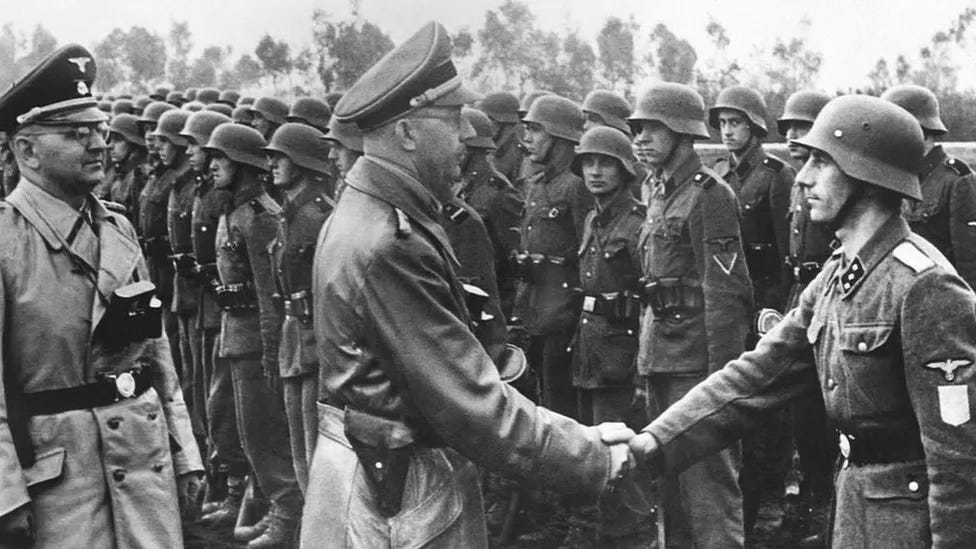
In 1985, President Ronald Reagan was attacked for visiting a German military cemetery in Bitburg, West Germany, because that cemetery included forty graves of members of the Waffen-SS, the combat branch of the Schutzstaffel led by the infamous Heinrich Himmler. Reagan’s intent was to commemorate the 40th anniversary of the ending of World War II in Europe, not to celebrate those forty graves among the 2000 in that cemetery. Nevertheless, he was deeply criticized for laying a memorial wreath at Bitburg, as the photo below shows.

By Elke Wetzig – Own work, CC BY-SA 4.0, https://commons.wikimedia.org/w/index.php?curid=49406384

Fast forward nearly 40 years to 2023 and we recently witnessed the spectacle of the Canadian Parliament giving two sustained standing ovations to a living (former) member of the Waffen-SS, a Ukrainian (Yaroslav Hunka) who’d joined the Nazis to fight against the Soviet Union in World War II.

No one it seems in the Canadian Parliament thought it odd to applaud a soldier who’d fought on the side of the Nazis during World War II against an ally of Canada. And, yes, the Soviet Union was an ally of Canada and the U.S., and more than any other country was responsible for defeating Hitler and his murderously racist regime, whose most fanatical followers were members of the SS.

Prime Minister Justin Trudeau’s apology, meanwhile, was done in two parts. He blamed the House Speaker (who resigned) for this colossal blunder even as he attacked Russia for seeking to exploit the mistake for political advantage. Meanwhile, Poland is seeking to extradite the former member of the Waffen-SS for possible war crimes committed during World War II.

How could such a colossal blunder have occurred, and just before Yom Kippur, the holiest day in the Jewish calendar?

Knowledge of history was simply cast aside, I think, because the Canadian political “elite” were so eager to showcase a Ukrainian who’d killed Russians, even if he’d done so as a member of the murderous SS. Of course, President Zelensky was present at this debacle, applauding along. It was all about showing support for Ukraine in its allegedly righteous war against Russia, with Canada naturally being on the side of the righteous. 

In a recent podcast featuring Matt Taibbi and Walter Kirn, Kirn noted astutely that the Canadian Parliament, apparently to a person ignorant of World War II and Nazi history, was more than anything applauding itself, celebrating their own rectitude, in saluting an old soldier who’d killed Russians. What did it matter that he’d served Heinrich Himmler, who oversaw the “Final Solution” and the Holocaust? What mattered was showing you stood in solidarity today with Zelensky against Putin.

Heinrich Himmler (center), head of the SS, visits the unit of the Waffen-SS under question, the so-called Galicia Division formed in 1943 (Getty image; BBC News)

If America was “ashamed” of Ronald Reagan in 1985 merely for visiting a cemetery to commemorate war dead where two percent of the graves were Waffen-SS members, how should Canadians feel about their political elite standing as one to stormily applaud a living, breathing, former member of Waffen-SS and saluting him as a hero for killing Russians?

“Ashamed” doesn’t begin to capture the depth of this crime against history.

Americans Place Too Much Faith in War

W.J. Astore

Beware worshipping the god of war

Too many Americans see war as a positive force as they applaud Ukraine’s ongoing resistance to Russian aggression; along with seeing war as admirable, they see it as predictable and controllable.  Of course, it’s easy to cheer Ukraine on from thousands of miles away, celebrating their surprising victories over Russia, even as both sides suffer tens of thousands killed, many more injured, and many more forced from their homes.

When Americans think about war, there’s a tendency to focus on favorable outcomes while eliding war’s worst aspects. So, for example, the American Revolutionary War is celebrated for enabling U.S. independence. The U.S. Civil War freed the slaves. World War II liberated the world from the twin threats of Nazi fascism and Imperial Japan’s militarism. Other wars that are far less easy to simplify and spin as positive, such as the Vietnam War or recents wars in Afghanistan and Iraq, are dismissed or forgotten, to say nothing of open land grabs as in the Mexican-American War and the Spanish-American War. Let’s not even talk about the wanton brutality of various wars against Native American peoples glorified in so many westerns of my youth.

Looking at America’s history, Christ, the Prince of Peace, is clearly not America’s favored god. America’s god is a warrior one, like Ares for the Greeks and Mars for the Romans. “Blessed are the war makers” could be a guiding tenet of American life, especially considering how much money is made and power wielded by those who embrace war.

The Greeks had wisdom in seeing war as akin to a god, a powerful force, capricious, unpredictable, intoxicating, and uncontrollable. War can consume a person, a people, a nation. It appeals to our irrational nature, our darkest passions. “War fever” is thus an accurate descriptive phrase. We can be seized by it, deluded by it, consumed by it. 

I’ve never run across “peace fever” as a phrase or descriptor of American behavior.

This being said, here’s an article I wrote a decade ago about the persistence of war. When will we learn that wars not make one great?

The Persistence of War (2013)

A young Tom Cruise loving his machine gun in "Taps"
A young Tom Cruise loving his machine gun in “Taps”

“[W]ar is a distressing, ghastly, harrowing, horrific, fearsome and deplorable business.  How can its actual awfulness be described to anyone?”  Stuart Hills, By Tank Into Normandy, p. 244

“[E]very generation is doomed to fight its war, to endure the same old experiences, suffer the loss of the same old illusions, and learn the same old lessons on its own.”  Philip Caputo, A Rumor of War, p. 81

The persistence of war is a remarkable thing.  Two of the better books about war and its persistence are J. Glenn Gray’s “The Warriors” and Chris Hedges “War Is a Force that Gives Us Meaning.”   Hedges, for example, writes about “the plague of nationalism,” our willingness to subsume our own identities in the service of an abstract “state” as well as our eagerness to serve that state by killing “them,” some “other” group that the state has vilified.

In warning us about the perils of nationalism, Hedges quotes Primo Levi’s words: “I cannot tolerate the fact that a man should be judged not for what he is but because of the group to which he belongs.”  Levi’s lack of tolerance stems from the hardest of personal experiences: surviving Auschwitz as an Italian Jew during the Holocaust.

Gray takes this analysis in a different direction when he notes that those who most eagerly and bloodthirstily denounce “them,” the enemy, are typically far behind the battle lines or even safely at home.  The troops who fight on the front lines more commonly feel a sort of grudging respect for the enemy, even a sense of kinship that comes with sharing danger in common.

Part of the persistence of war, in other words, stems from the ignorant passions of those who most eagerly seek it and trumpet its heroic wonders even as they stand (and strive to remain) safely on the sidelines.

Both Hedges and Gray also speak to the dangerous allure of war, its spectacle, its excitement, its awesomeness.  Even the most visceral and “realistic” war films, like the first thirty minutes of “Saving Private Ryan,” represent war as a dramatic spectacle. War films tend to glamorize combat (think of “Apocalypse Now,” for example), which is why they do so little to put an end to war.

One of the best films to capture the dangerous allure of war to youth is “Taps.”  I recall seeing it in 1981 at the impressionable age of eighteen.  There’s a tiny gem of a scenenear the end of the film when the gung ho honor guard commander, played by Tom Cruise before he was TOM CRUISE, mans a machine gun.  He’s firing against American troops sent to put down a revolt at a military academy, but Cruise’s character doesn’t care who he’s firing at.  He’s caught in the rapture of destruction.

He shouts, “It’s beautiful, man.  Beautiful.”  And then he himself is shot dead.

This small scene with Cruise going wild with the machine gun captures the adrenaline rush, that berserker capacity latent in us, which acts as an accelerant to the flames of war.

War continues to fascinate us, excite us.  It taps primal roots of power and fear and ecstasy all balled together.  It masters us, hence its persistence.

If and when we master ourselves, perhaps then we’ll finally put an end to war.

Magical Weapons for Ukraine

W.J. Astore

Lessons from World War I

If you read the mainstream media, it would seem the answer to the Russia-Ukraine War, now about to enter its second year of mass death and widespread destruction, is weapons of various sorts. Western tanks like the German Leopard and American Abrams. Fighter jets like the F-16 produced by Lockheed Martin. If only Ukraine had more tanks, more jets, and the like, they would be able decisively to defeat the Russian military, ejecting it from Ukrainian territory, even from the Crimea, so the argument goes.

As a historian of technology and warfare, I’ve studied this belief in magical weapons. History teaches us that weapons alone usually do not determine winners and losers in war. Weapons themselves are rarely decisive, especially when the sides engaged fight symmetrically. In such cases, new weaponry often increases the carnage.

Consider the events of World War I. Various weapons were tried in an attempt to win the war decisively through military action. These weapons included poison gas (of various types), tanks, flamethrowers, and submarines, among others. None of these weapons broke the stalemate on the Western Front. Countermeasures were found. And World War I dragged on for more than four long years, producing hecatombs of dead.

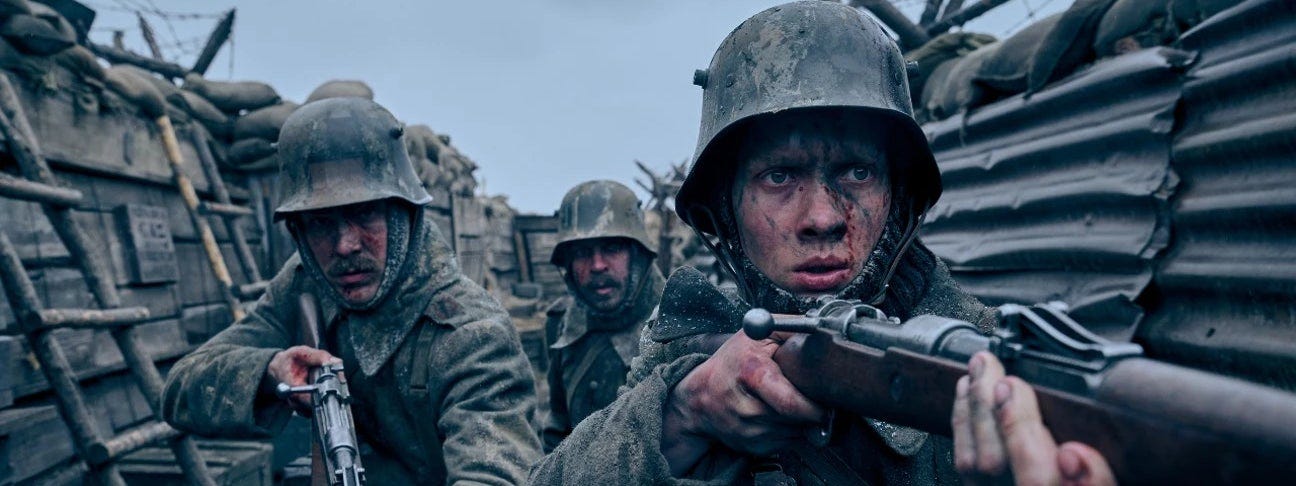
Image from “All Quiet on the Western Front,” 2022, Netflix

What did work? In a word, exhaustion. In the spring of 1918, Germany launched massive, last-ditch, offensives to win the war before U.S. troops arrived in Europe in large numbers. (The U.S. had entered the war in 1917 but was still mobilizing in 1918.) The Germans came close to winning, but when their offensives grounded to a halt, they had little left in the tank to endure Allied counterattacks. Yes, the Allies had more tanks than the Germans, and were learning to use them effectively with airpower in combined arms assaults. But what truly mattered was exhaustion within the German ranks, exacerbated by the Spanish flu, hunger, and demoralization.

No magical weapon won World War I. And no magical weapon is going to provide Ukraine a decisive edge in its struggle with Russia. Certainly not a hundred or so Western tanks or a few dozen fighter jets.

Indeed, looking at some of the media coverage of the Russia-Ukraine War in the West, you might be excused from mistaking it for advertising videos at a weapons trade show. Over the last year, we’ve learned a lot about Javelin and Stinger missiles, HIMARS rocket launchers, and of course various tanks, fighter jets, and the like. But we’ve seen very little coverage of the mass carnage on both sides. It’s been said the real costs of war will never get in the history books, for who wishes to confront fully the brutality and madness of industrialized warfare?

I’m in the middle of watching the new German version of “All Quiet on the Western Front,” a film deservedly nominated for an Oscar for best picture (available on Netflix). It’s one of the better war films I’ve seen in its depiction of the horrific and dehumanizing aspects of modern industrial warfare. Something like this movie is happening currently in Ukraine, but our leaders, supported by the media, think the answer to the carnage is to send even more destructive weaponry so that more troops (and civilians) can die.

Magical weapons are not the answer. For of course there’s nothing magical about weapons of mass destruction.

Let the Weapons Flow and the Body Count Grow

W.J. Astore

Say “no” to killing, “no” to war

Two articles I read yesterday are typical of polarized, indeed antithetical, views on the Russia-Ukraine War.

At the British Guardian, Simon Tisdall says this is Europe’s moment to step up and support Ukraine in a righteous war against Putin. He concludes, with passion:

Zelenskiy is right. Risk-averse Nato has been too slow and too cautious from the start. To outpace tyranny, Europe must fight – and fight to win. Our common future depends on it.

Putin, the tyrant, must be stopped in Ukraine, or Poland and Germany could be next. Fighting to win means that Ukraine must be given not only hundreds of Leopard 2 tanks but also combat jets. The combination of tanks, jets, and related ancillary equipment will enable Ukraine to drive Russian forces out of the country in a quasi-Blitzkrieg operation. Victory to the West!

Why not talks instead of tanks?

At Antiwar.com, Edward Curtin predicts Russia will win this war even as he suggests it’s mainly the West’s fault for inciting it via NATO expansion and U.S. involvement in the 2014 coup in Ukraine:

we are being subjected to a vast tapestry of lies told by the corporate media for their bosses, as the US continues its doomed efforts to control the world. It is not Russia that is desperate now, but propagandists such as the writers of this strident and stupid editorial [by the New York Times]. It is not the Russian people who need to wake up, as they claim, but the American people and those who still cling to the myth that The New York Times Corporation is an organ of truth. It is the Ministry of Truth with its newspeak, doublespeak, and its efforts to change the past.

Which is it? Is this a war that the U.S. and NATO must win, along with Ukraine, to stop an evil and expansionist dictator, or is this a war that the U.S. and NATO provoked, and surely will lose, given Russia’s military superiority empowered in part by the justice of its cause?

To me, the disturbing part of such polarized, us versus them, views is that they really guarantee only one thing: more fighting and more death. Let the weapons flow and the body count grow: that is the result of these debates.

War, as almost any military historian will tell you, is inherently unpredictable. I have no idea who’s going to “win” this war. I do know the Ukrainians are losing. I say this only because the war is being fought on their soil, and the longer it lasts, the more Ukraine will suffer.

That doesn’t mean I want Ukraine to surrender, nor do I want it to lose. But I don’t think it will win with more Western tanks and planes. Just about any escalation by the West can be matched by Russia. I see further stalemate, not Blitzkrieg-like victories, and stalemate means more and more suffering.

It’s said the pen can prove mightier than the sword. Why not try talking in place of tanks? Put those mighty pens to work by signing an armistice or even an enduring peace treaty. Ukraine and Russia are neighbors; unless they want perpetual war, they must find a way to live together.

More weaponry to Ukraine is unlikely to produce decisive victory, but it is likely to produce far more death and destruction in that country. It’s high time both sides said “no” to killing, “no” to yet more war.

History Is Un-American

W.J. Astore

Real Americans Create Their Own Futures

I was bantering online with an old friend and fellow historian and I hit him with my best shot: history is un-American. If you think like an historian, and especially if you think America and its future actions should be informed, or possibly even constrained, by history, you are clearly un-American. History is more or less bunk, Henry Ford famously said, and Americans can safely ignore it. We are like gods, creating our own futures out of nothing, imposing our will on everything around us.

Henry Ford, American god

This attitude, this hubris, explains much about the U.S. military’s woeful record since 1945. The French lost in Indochina? No matter. Americans will prevail in Vietnam, Laos, and Cambodia because we’re not the French. The Soviet Union lost in Afghanistan? No matter. Americans will prevail there because we’re not the Russians. Overthrowing Saddam Hussein and his minority Sunni government will unleash chaos that strengthens Shia forces in Iraq, aligning that country more closely with Iran? No matter. America will bring order and the blessings of democracy to Iraq at the point of gun or a Hellfire missile.

Karl Rove, a major player in the Bush/Cheney administration, summed up this hubris in this now-infamous passage:

“We’re an empire now, and when we act, we create our own reality. And while you’re studying that reality — judiciously, as you will — we’ll act again, creating other new realities, which you can study too, and that’s how things will sort out. We’re history’s actors . . . and you, all of you, will be left to just study what we do.”

That man did not want for confidence.

Related to the idea of history being un-American is the business- and management-oriented nature of the officer corps in the U.S. military. To be promoted to field-grade (major or lieutenant commander), you almost have to have a master’s degree or be close to finishing one. But rarely do officers choose to pursue a master’s in history or any other subject related to the humanities. The master’s of choice is in business administration or some type of management.

By pursuing MBAs and management degrees, officers show their practical nature. They also set themselves up well for future careers once they retire or separate from the military. After all, who needs to know history, even military history? The U.S. military will simply act, creating its own realities, which feckless historians will then passively study as America’s real actors get on with the job of remaking the world in America’s image.

We live in the United States of Amnesia, Gore Vidal quipped, and history is part of that amnesia. Who remembers that America was at war in Afghanistan as late as 2021? It’s on to new “great power” struggles with China and Russia. Look forward, not backward, Barack Obama said when he became president, meaning there was no need to hold the Bush/Cheney administration responsible for anything, including torture and other war crimes. “We tortured some folks” — time to move on!

An expression I learned in the U.S. military is “analysis paralysis,” as in don’t overthink the problem. Act! But if America’s military record since World War II proves one thing, it’s that ignoring history because it’s “bunk” or less practical than another business or management course is a very unwise idea.

Acting should be informed by thinking. Dare I say, historically-informed thinking. Even for America’s wannabe gods.

Don’t Play the Sap for Any Government

W.J. Astore

In The Maltese Falcon, Humphrey Bogart famously tells Mary Astor that he won’t play the sap for her. It’s an immortal cinematic line:

https://www.youtube.com/watch?v=wPT49WXC0Zo

It’s election time in America, meaning there are plenty of candidates wishing we’d all play the sap for them. Don’t do it. Vote for those you believe in: candidates who are principled and have a record of taking bold stances and of telling the truth. People like Matt Hoh, who’s running for the Senate as a member of the Green Party in North Carolina.

Occasionally, I need to state the obvious, if only to remind myself of the realities of this world. All governments lie and all have their instruments of repression. The most dangerous government is most likely your own government, whatever country you live in, because that governing party has direct power over you, and also because you’re likely to have some allegiance to it, perhaps even some affection for it. As an American, for example, it’s far easier to play the patriot than to act as a dissident. The patriot gets applauded and rewarded; the dissident gets attacked and punished.

The U.S. government, like any other government, lies. Think of the Pentagon papers, the Afghan War papers, the “slam dunk” case of WMD in Iraq that were never found, and so on. All governments lie, as I.F. Stone said.

The message is simple: Always question authority, whether it’s Russian or Chinese or American. Be skeptical. Don’t play the sap. Make Humphrey Bogart proud.