Teaching in the Age of AI

Unthinking Robots for the Man?

BILL ASTORE

AUG 19, 2025

AI, of course, stands for artificial intelligence, and I’ve played with it here at Bracing Views. I’ve used ChatGPT and DeepSeek to write critical essays on the military-industrial complex, critiquing the results in my posts. Overall, I was impressed—and glad that I no longer have to wade through student essays completed outside of class.

I stopped teaching eleven years ago, before AI was available. Of course, the Internet was, and I did have students who cut and paste from sources online. Usually, I could tell; I would do a search using a “student” passage that just sounded a bit too good, and often whole paragraphs would come up that the student lazily cut and pasted into an assignment as their own work. Those were easy papers to grade. F!

Today’s AI programs make this more difficult. If I were teaching today, I’d assign fewer essays outside of class, and I’d probably bow to reality and allow students to use AI to help clarify their arguments.

The challenge remains: In this new world of AI, how do you evaluate student performance in a humanities course where research and writing skills are important, along with some command of the facts and an ability to think critically about them?

I’d likely employ a mix of the old and new. Standard exams—the usual multiple choice, short answer, written essay, all completed in the classroom—still have a role. But I’d incorporate AI too, especially for class discussion.

Consider, for example, debating the merits (and demerits) of the military-industrial complex. AI can easily write short essays both in favor and against (or even an essay that examines the pros and cons of the MIC). Those essays could then be used in class to tease out the complexities of the MIC, and how evidence can be used (manipulated?) to tell vastly different stories.

Another example: Should atomic bombs have been used at Hiroshima and Nagasaki? Again, AI can easily write essays in favor, or against, or “neutral” (pros and cons again). Those short essays could then form the basis for class discussion and further debate.

In a way, AI is a selective manifestation of evidence that is already out there. And there’s the rub. Who’s doing the selecting? Who’s writing the algorithms? Which evidence is being favored and which is being suppressed or disregarded?

AI, as I understand it, uses algorithms that favor certain kinds of evidence over other kinds. Generally speaking, AI favors “official” sources, e.g. government documents, mainstream media reporting, scholarly think tanks with credentials, and so on.

Alternatively, it’s possible AI could gather information from less than reputable sources. Again, what algorithms are being used? What are the agendas of those behind the AI in question?

To students, AI is something of a black box. It spits out answers without a lot of sourcing (unless you specifically ask for it). Students in a hurry may not care—they just want answers. But as Tom Cruise demands In A Few Good Men: “I want the truth.” What happens when AI Colonel Jessup decides, “You can’t handle the truth” and feeds us convenient half-truths and propaganda. Will students even care? Will they have the skills to recognize they’re being misled? Or that they’re not getting the full story?

That’s what I worry about. Students who simply accept what AI has to say. Not that they learned nothing—but that they learned exactly what they were programmed to learn. Strangely, in this scenario, the students themselves are reduced to automatons. And I don’t think most students want to be unthinking robots for the Man.

Or do they?

Postscript: Over at his new Substack site, Mike Neiberg is tackling AI and the humanities. Check it out at michaelneiberg.substack.com.
Speaking Truth to Power Is A Great Way to Learn

Truth Is Costly When It Contradicts the Lies of the Powerful

BILL ASTORE

Though the sentiment has been wrongly attributed to George Orwell, it makes sense to say that in an age of universal deceit, telling the truth is a revolutionary act.

Two graduating college students recently decided to tell the truth about Israel’s genocide in Gaza. The first student, Logan Rozos, said he’d searched his heart, a search which led him to condemn mass murder in Palestine.

New York University responded by denouncing his statement and withholding his diploma.

At George Washington University, another student-speaker, Cecilia Culver, used her speech to denounce Israel’s genocide in Gaza and U.S. complicity in the same. I haven’t heard as yet how she will be punished.

It’s truly hard to be a “prestigious university” when you have no moral spine.

It’s nice to think that speaking truth to power works, except that the powerful already know the truth, indeed they work hard to define what is “truth” and what isn’t, and they will indeed punish those who pose a threat to manufactured notions of truth.

I commend these students for speaking boldly and honestly, as democracy withers when it’s defined and dominated by lies. They truly earned their diplomas, even if the powerful conspire to take them away.

These students have learned a valuable lesson that really can’t be taught in classrooms: that doing the right thing, when it’s contrary to the dictates and interests of powerful entities, is risky and will often lead to severe repercussions. Just ask truth-tellers like Edward Snowden, Julian Assange, and Daniel Hale.

Sparta University USA

W.J. Astore

We must have order here!

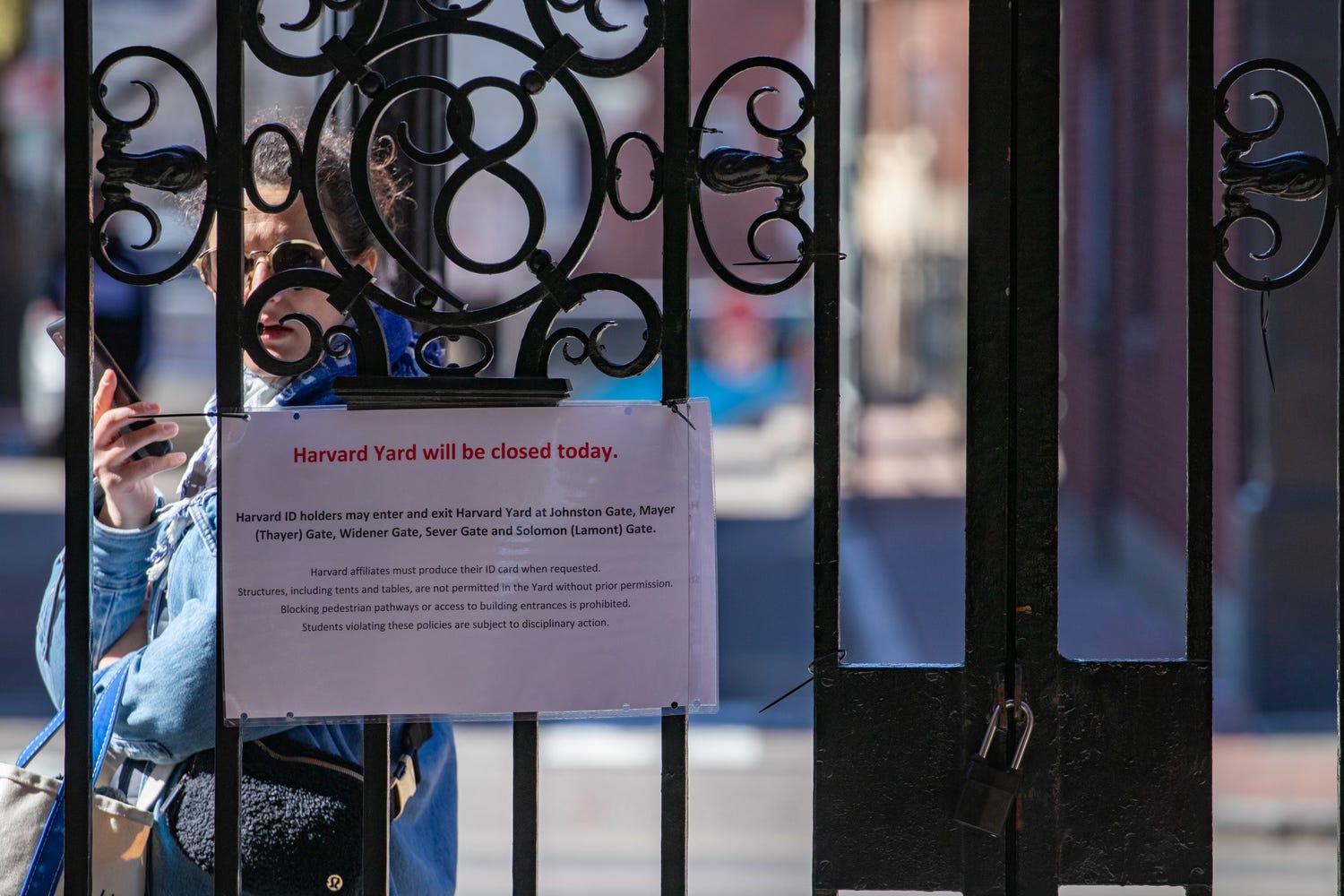
As a retired military officer and also as a longtime student and professor, I’ve come to recognize the increasing resemblance of “civilian” campuses to military academies, especially in light of recent student protests against genocide in Gaza. Controlled gates, armed guards, military-grade weaponry, even men and women in uniform, marching in formation and shouting. The message is clear: Welcome to Sparta University, land of brave warriors, but not of free thought

The famous gate to Harvard, locked for your security.

Once again, America’s imperial wars have come home to inflict their violence on us. In a saying attributed (falsely?) to Leon Trotsky, you may not be interested in war, but war is interested in you, especially if you’re a young person protesting against it. And America’s warfare state is not about to allow you to meddle in its affairs or mess with its profits.

U.S. campuses may espouse liberal Athenian values or look blissfully Arcadian, but behind the facade is billions of dollars of research money funneled to them by the Department of Defense, Homeland Security, and similar Spartan agencies. Whether students know it or not (and they’ve been getting a better idea of it lately), their campuses are already militarized, though that militarization is often carefully camouflaged.

It’s sad, of course, and detrimental to democracy. Campuses, after all, are supposed to be sanctuaries for free thought and expression, not battlegrounds where students are suppressed by warrior-cops using military tactics, even military-grade weaponry. 

Campuses, especially rich ones, are often authoritarian, corporate, and increasingly instruments of empire. Just think of the Harvard “Corporation,” for example. Corporations are citizens too, as Mitt Romney reminded us, and the Harvard version is a very rich citizen indeed, as well as being quite jealous of its power and profits, earned often enough through imperial exploitation.

Students are certainly learning disturbing lessons from all this.  It’s not exactly what they paid six-figure tuition bills for, but who said learning was free?

This brings me to the article that inspired these thoughts, “Repress U,” at TomDispatch yesterday. Its author, Michael Gould-Wartofsky, explains how colleges and universities are becoming adjunct agents of America’s Homeland Security Complex. He’s got a nice seven-step plan of how it’s being done, from repressing students and faculty to dominating the narrative with information warfare. Check it out. It may just make you look at that leafy green campus nearest you in a new Army olive-drab light.

Bonus Lesson: Speaking of “brave” Harvard, they released a statement yesterday saying they will no longer issue official statements on anything other than their “core” functions.

This from The Boston Globe: Harvard University said Tuesday that its leaders would no longer issue official statements about public matters that “do not directly affect the university’s core function.”

Genocide? What genocide? Not our core function to comment on that!

Education in America

W.J. Astore

Protesting genocide in Gaza gets you punished as layoffs and job losses loom for teachers

Two stories landed in my email inbox this morning that tell us something about the state of education in America. The first from The Boston Globe shows how students are being punished for protesting against genocide in Gaza:

Suspended MIT and Harvard protesters barred from graduation, evicted from campus housing

Dan Zeno’s suspension from the Massachusetts Institute of Technology for participating in an encampment protesting the war in Gaza had a swift impact on his family’s life. The graduate student has not only been barred from classes, he was also evicted from campus housing, along with his wife and 5-year-old daughter, with just one week to find another place to live.

He is among the MIT students who won’t be graduating as planned or have lost income by having their fellowships canceled or have had their research projects halted.

And on Friday, Harvard University began suspending protesters. They were told they can’t sit for exams or participate in commencement or other school activities, and will be evicted from student housing.

That’s the way you handle “rebellious” students: make them homeless and perhaps even degree-less. Want to protest mass murder and famine? Prepare to be evicted and probably suspended, if not prosecuted. And this is happening in the “liberal” state of Massachusetts at “liberal-leftist” Harvard.

Schools like MIT and Harvard, having intimate connections to Israel and the military-industrial complex, as well as huge endowments, are corporations rather than schools of higher learning. And, as we learned from “Rollerball,” you are not to interfere with management decisions. Corporate boards at MIT and Harvard are pro-Israel, and so must you be, else keep your mouth shut and maybe we’ll let you graduate. Open your mouth and we’ll shut it for you.

The second story involves teacher and staff layoffs as federal subsidies related to COVID are set to expire at the end of September. A quick summary from CNN:

Schools across the country are announcing teacher and staff layoffs as districts brace for the end of a pandemic aid package that delivered the largest one-time federal investment in K-12 education. The money must be used by the end of September, creating a sharp funding cliff.

Too bad we don’t have any money after September for those teachers and staff. I guess we sent all the money to Ukraine and Israel. Priorities, people.

For a bit of inspiration, consider this student from the University of Chicago, who explains why stopping mass murder is more important than his career prospects:

He gets it right. I wonder how he’ll be punished? “Criminal trespass”? Suspension? Expulsion? Imprisonment?

Someone should compare the funding of police forces, with all their riot gear and weaponry, to the funding of teachers and staff in K-12 schools across America. I’m sure America’s politicians, if pressed to make a choice, will fund the police first and to the max. Teachers? Who needs them. Our students are learning invaluable lessons from the police, who are “teaching” them about Tasers, rubber bullets, tear gas, and other instruments of “higher” learning.

For the U.S. Establishment, Violence Is the Answer

W.J. Astore

Meandering Thoughts on Campus Protests against Genocide and Police Responses

College and university campuses across the USA are increasingly the sites of violence, but that violence is largely being committed by police units called in to disperse and arrest protesters. The police, I assume, are, as they say, just following orders. The question is: Who’s giving those orders? And the answer most often seems to be senior administrators at those colleges and universities. Welcome to your education in liberal values!

Police do what they’re trained to do, just as soldiers do what they’re trained to do. Soldiers aren’t freedom-bringers and diplomats: they are trained in the use of deadly force under the most violent of conditions. Police aren’t educators and negotiators: they are also trained in the use of suppressive force under violent conditions.

On campuses across America, police have done what police are armed and trained to do here. They break out their riot gear, their sniper rifles, their armored cars, their tools of behavior modification (e.g. cuffs, Tasers, truncheons, rubber bullets, tear gas and pepper spray), and they go to work. They literally kick ass and take names (and mug shots, fingerprints, and so on).

Police are here to protect and to serve, so we’re told. But to protect and to serve whom? And for what cause? Ultimately, police protect the powerful, those with property and money, because those are the ones giving them their orders. If and when police begin to refuse orders from above, that’s when the powerful will truly begin to worry.

It’s interesting that some student protesters, as at Columbia, are now being compared (as by MSNBC) to the January 6th protesters and rioters for Trump. It’s a sign of desperation by the establishment to equate anti-genocide protesters with pro-Trump rioters, but there you have it. Recall on January 6th that the police largely stepped aside and allowed protesters for Trump into the Capitol. I don’t see the police stepping aside on campuses or taking selfies with protesters, or even removing barriers, as some police did on January 6th.

In “Rollerball,” John Housemen explains to James Caan that he is not to interfere with management decisions

The overly violent and repressive responses we’re witnessing across America to largely peaceful protests reveals the imperative at the heart of America’s political system. Recalling the movie “Rollerball,” the one thing you’re never supposed to do as a corporate-citizen is to question management decisions. America’s managers have decided to support Israel’s genocide in Gaza, and YOU ARE NOT TO INTERFERE WITH THAT. If you do, your protest will be suppressed, often quickly and violently.

There’s a reason America’s managers “invest” so much in the “thin blue line” of the police. They believe in violence as the way to uphold their power and privilege. It doesn’t matter that violence hasn’t always worked, especially in foreign wars (Vietnam, Afghanistan, Iraq, etc.). They’ll continue to use violence as long as it remains profitable to do so, whether economically or politically.

How long before people are killed or seriously injured in these police actions? How long before those who are killed or wounded are denounced as “bums,” as President Richard Nixon called the dead students of Kent State? How long before we hear that the “silent majority” supports Trump and/or Biden in their call for “law and order”?

How long before Israel renders Gaza Palestinian-free, as various U.S. police forces mobilize to render college campuses protester-free?

And how long before we’re told once again that America is the greatest, most exceptional, nation on earth because of all our freedoms?

History Is Un-American

W.J. Astore

Real Americans Create Their Own Futures

I was bantering online with an old friend and fellow historian and I hit him with my best shot: history is un-American. If you think like an historian, and especially if you think America and its future actions should be informed, or possibly even constrained, by history, you are clearly un-American. History is more or less bunk, Henry Ford famously said, and Americans can safely ignore it. We are like gods, creating our own futures out of nothing, imposing our will on everything around us.

Henry Ford, American god

This attitude, this hubris, explains much about the U.S. military’s woeful record since 1945. The French lost in Indochina? No matter. Americans will prevail in Vietnam, Laos, and Cambodia because we’re not the French. The Soviet Union lost in Afghanistan? No matter. Americans will prevail there because we’re not the Russians. Overthrowing Saddam Hussein and his minority Sunni government will unleash chaos that strengthens Shia forces in Iraq, aligning that country more closely with Iran? No matter. America will bring order and the blessings of democracy to Iraq at the point of gun or a Hellfire missile.

Karl Rove, a major player in the Bush/Cheney administration, summed up this hubris in this now-infamous passage:

“We’re an empire now, and when we act, we create our own reality. And while you’re studying that reality — judiciously, as you will — we’ll act again, creating other new realities, which you can study too, and that’s how things will sort out. We’re history’s actors . . . and you, all of you, will be left to just study what we do.”

That man did not want for confidence.

Related to the idea of history being un-American is the business- and management-oriented nature of the officer corps in the U.S. military. To be promoted to field-grade (major or lieutenant commander), you almost have to have a master’s degree or be close to finishing one. But rarely do officers choose to pursue a master’s in history or any other subject related to the humanities. The master’s of choice is in business administration or some type of management.

By pursuing MBAs and management degrees, officers show their practical nature. They also set themselves up well for future careers once they retire or separate from the military. After all, who needs to know history, even military history? The U.S. military will simply act, creating its own realities, which feckless historians will then passively study as America’s real actors get on with the job of remaking the world in America’s image.

We live in the United States of Amnesia, Gore Vidal quipped, and history is part of that amnesia. Who remembers that America was at war in Afghanistan as late as 2021? It’s on to new “great power” struggles with China and Russia. Look forward, not backward, Barack Obama said when he became president, meaning there was no need to hold the Bush/Cheney administration responsible for anything, including torture and other war crimes. “We tortured some folks” — time to move on!

An expression I learned in the U.S. military is “analysis paralysis,” as in don’t overthink the problem. Act! But if America’s military record since World War II proves one thing, it’s that ignoring history because it’s “bunk” or less practical than another business or management course is a very unwise idea.

Acting should be informed by thinking. Dare I say, historically-informed thinking. Even for America’s wannabe gods.

Time to Study War Some More

W.J. Astore

There’s more to military history than decisive battles, great captains, and sexy weapons 

We sure could use honest and critical teaching about military history and war in America.

I don’t mean celebratory BS. I don’t mean potted histories of the American Revolution and its freedom fighters, the Civil War and its freeing of the slaves, World War II and America’s greatest generation and so on. I mean history that highlights the importance of war together with its bloody awfulness.

Two books (and book titles) come to mind: “War is a force that gives us meaning,” by Chris Hedges, and “A country made by war,” by Geoffrey Perret. Hedges is right to argue that war often provides meaning to our lives: meaning that we often don’t scrutinize closely enough, if at all. And Perret is right to argue that America was (and is), in very important ways, made by war, brutally so in fact.

Why study war? Shouldn’t we affirm that we ain’t gonna study war no more? Well, as Leon Trotsky is rumored to have said: You may not be interested in war, but war is interested in you. Among other reasons, students of history should study war as a way of demystifying it, of reducing its allure, of debunking its alleged glories. War is always a bad choice, though there may be times when war is the least bad in a series of bad choices. (U.S. involvement in World War II was, I believe, less bad than alternatives like pursuing isolationism.)

How are we to make sense and reach sound decisions about war if we refuse to study and understand it? A colleague sent along an interesting article (from 2016) that argues there’s not enough military history being taught in U.S. colleges and universities, especially at elite private schools. Here’s the link: https://aeon.co/ideas/the-us-military-is-everywhere-except-history-books

Visit your local bookstore and you’ll probably see lots of military history — it’s very popular in America! — but critical military history within college settings is much less common.  This is so for a few reasons, I think:

1. Many professors don’t like the “stench” of military history. When I was at Oxford in the early 1990s, I had a professor who basically apologized for spending so much time talking about mercenary-captains and war in early modern Europe. Yet war and controlling it was a key reason for the growth of strong, centralized nation-states in Europe in the 17th and 18th centuries.

2. Many professors simply have no exposure to the military — they’re ignorant of it, almost proudly so. Having taught college myself for fifteen years, including survey subjects like world history, I know the difficulty of teaching topics and subjects where your knowledge is shallow or dodgy. Far easier to stand on firm ground and teach what you know and ignore what you don’t know — or don’t like. But the easier road isn’t always the best one.

3. Critical military history suggests lack of patriotism.  I taught college as a civilian professor for nine years, and I was once told to “watch my back” because I wrote articles that were critical of the U.S. military’s wars in Iraq and Afghanistan. And I’m a retired Air Force officer!

So, with history professors often preferring to ignore or elide military subjects, military history is left to buffs and enthusiasts who focus on great captains, exciting battles, and famous weapons (often featured in glossy coffee-table books) like Tiger tanks and Spitfire fighters.  Such books often sell well and make for exciting reads. What they don’t do is to make us think critically about the costs of war and how disastrous wars often prove.

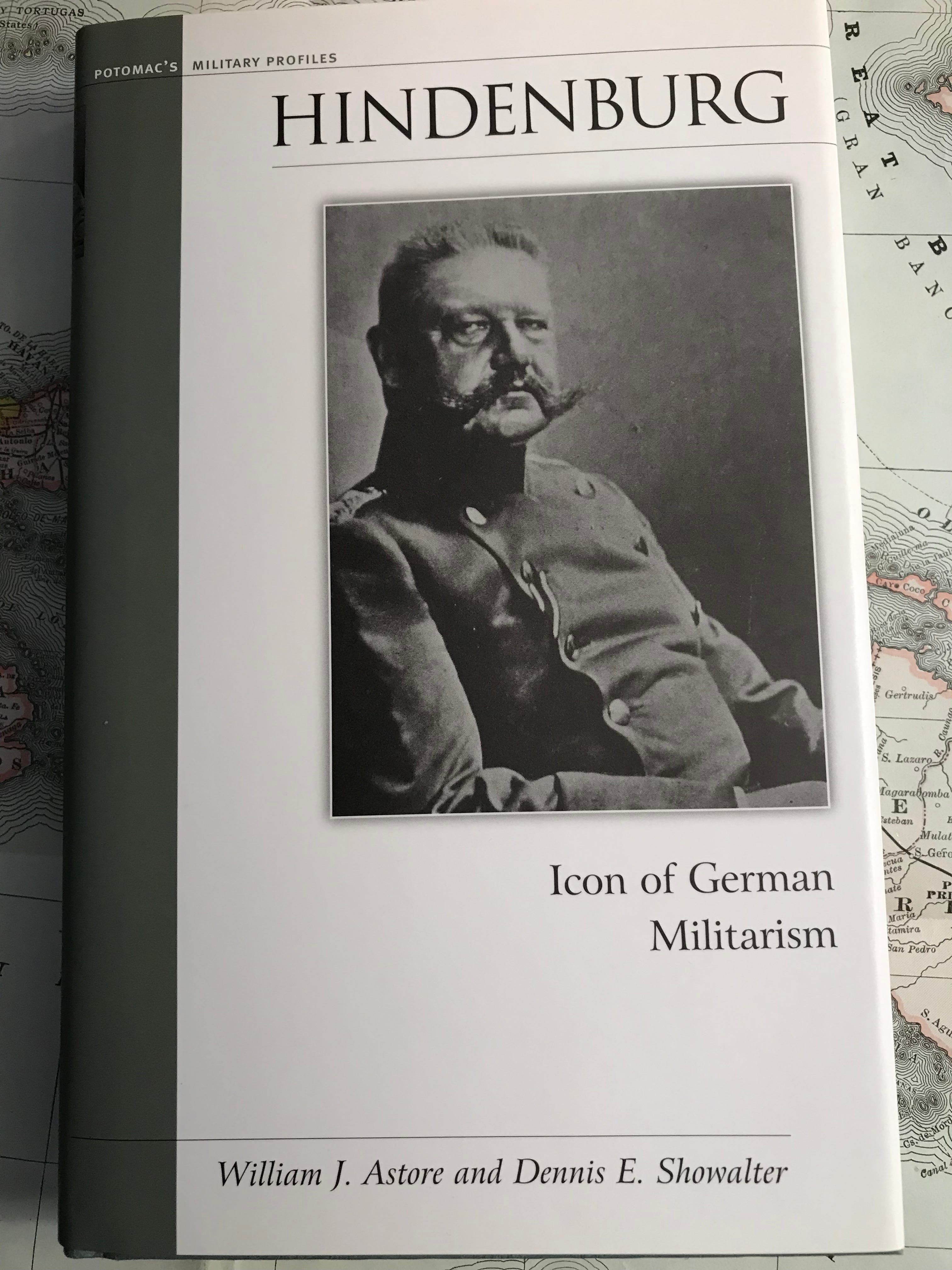
My own book on Paul von Hindenburg is a critical account of his life, including his complicity in the “stab in the back” myth and the rise of Adolf Hitler to power

A subject I taught at the USAF Academy was technology and warfare, and one of my concerns was (and remains) America’s blind faith in technology and the enormous sums of money dedicated to the same.  The Pentagon will spend untold billions on the latest deadly gadgets (actually, as much as $1.7 trillion alone on the F-35 jet fighterthroughout its lifespan) but academia won’t spend millions to think and teach more critically about war.

As an aside, weapons alone don’t make an effective military. It’s not the gladius sword that made Rome dominant but the citizen-soldier wielding it, empowered by republican ideals, iron discipline, and a proven system of leadership by example.

When the principled citizen-soldier ideal died in Rome, a warrior ideal consistent with a hegemonic empire replaced it. There’s much for Americans to learn here, as its own military today identifies as warriors and finds itself in the service of a global empire.

There’s more to military history than drums and trumpets — or bullets and bombs. For better or for worse, and usually for worse, we as a people are made and defined by war. We would all do well to study and understand it better.

(If you’d like to comment, please visit Bracing Views on Substack.)

Biden Tackles Student Debt — and Misses

W.J. Astore

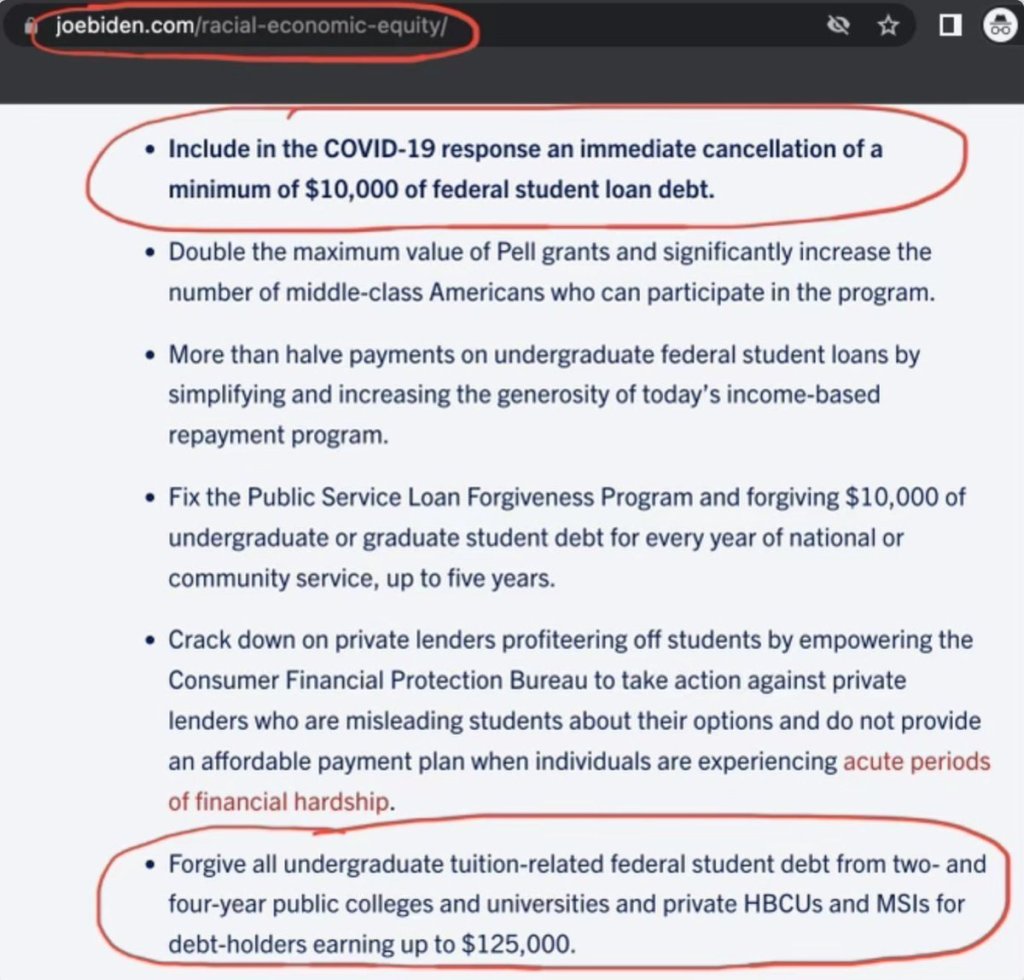
At long last, the Biden administration has taken a modest step on student debt relief. Biden announced yesterday a plan to forgive up to $10K in student debt (assuming you make less than $125K) and up to $20K if you received a Pell grant. It’s a start, right? Naturally, Republicans framed it as yet another government giveaway to the undeserving, which makes me think more highly of Biden, at least for a moment.

Why am I disappointed in Biden’s action? Let’s take a look at his own website and its promises on student debt relief:

So, Biden had promised “immediate cancellation” of a minimum of $10K, with no preconditions and no need to jump through paperwork hoops. That “immediate cancellation” still hasn’t come (you must still apply and wait for “relief”), and “immediate” took 18+ months, timed so as to win some positive feeling in this fall’s election cycle. So be it. Something is better than nothing, right?

But look at Biden’s second big promise. He was going to forgive all tuition-related student debt for many students, especially minority students. I’ll repeat that: all student debt. His latest announcement doesn’t come close to his own stated goal.

What people tell me is this: Too bad. The Republicans wouldn’t give students any relief whatsoever, so the Democrats deserve your vote because they gave $10K in relief. Be happy with that, shut up, and vote blue no matter who.

Color me unconvinced. Student debt in America sits at $1.7 to $1.9 trillion. Biden just canceled about $200 billion of that debt, or just over 10% of it. As I said, it’s a start, but it represents a half-measure at best when you compare it to Biden’s own stated promises and goals.

In the past, Senator Joe Biden helped to secure legislation that prevented student debt from being discharged during personal bankruptcies. So even if you go bankrupt (and the leading cause of bankruptcy in America is medical bills), you still owe all the money on your student debt. As far as I know, that hasn’t changed. Thanks for that too, Joe.

For the cost of the F-35 jet fighter over its lifetime, Joe Biden could cancel all student debt in America. Instead, he chose to nibble at the edges, canceling about 10% of it, while fully funding the F-35, new nuclear weapons, and announcing yet more military “aid” for Ukraine.

Is this really the best the Democrats can do on student debt relief? Is this the best our country can do? Say it ain’t so, Joe.

For the lifetime cost of this warplane, you could cancel all student debt in America.

How to Teach, by Miss Jean Brodie

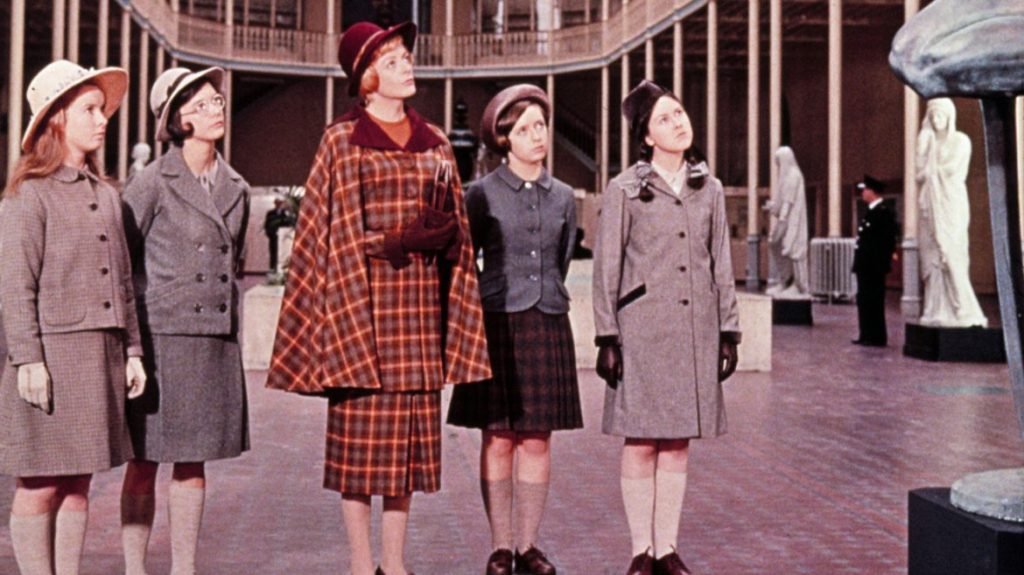
Miss Jean Brodie (center) and “her girls”

Richard Sahn

“The Prime of Miss Jean Brodie” (1969) starring Maggie Smith, who won the academy award for best actress that year, challenges, at least for a moment, pedagogical orthodoxy.  In this fictitious story Jean Brodie is a teacher in a private secondary school for girls in 1932 Edinburgh.  From the beginning it is obvious she is the most popular as well as the most controversial teacher in the school. The rigorously traditional head mistress regards Miss Brodie as a maverick who has consistently demonstrated that her methods over the years of her tenure are starkly incompatible with the goals and values of the school. Jean nurtures a romantic attraction to social, political, and military upheavals. In her classes she avoids talking about the political and moral ramifications of historical events, seeing them as obstacles to her view of history as drama. Showing her students projected slides of classical architectural structures and paintings to engage their capacity for aesthetic appreciation is also a major feature of Miss Brodie’s classes. Engaging her students’ emotions is more important to Jean than detailed historical facts. 

In first day of class for the new semester Miss Brodie describes an imaginary scene of a former lover dying on the battlefield in World War I. She seems to delight in exposing her girls (her students are “my girls”) to the emotional realities of war by providing them with the opportunity to romanticize death.  Listening to the description of the former lover’s death in battle one of her students bursts into tears. At that moment, the head mistress enters the classroom to see how the first day is going. She is perplexed by the student crying, declaring: “You shouldn’t cry during a history lesson.”          

“Truth and beauty” is what Jean Brodie claims she is teaching her students. To challenge her students to appreciate the romantic qualities of even ghastly historical events seems to be a goal. But what she means by “truth” is not necessarily empirical facts. Beauty is truth, Miss Brodie adamantly believes. Even war is an aspect of “beauty” because people die heroically. It doesn’t matter what the reason or cause is as long as passionate feelings can be engaged in the presentation of the lesson.

At one point in the film Jean is called to the head mistress’s office to explain her teaching methods. The head mistress suspects—and rightly so—that Jean is not giving her students the standard information regarding the subject matter. Miss Brodie argues that the meaning of education comes from the Latin word “e-ducare” which means to lead out of.  Her job, she believes, is to elicit her students’ inherent love of learning.  She seeks to stimulate her students’ inherent capacity to see macro and micro events, especially of war, as an art form.  A scene on the battlefield in Spain is to be admired as one appreciates a Giotto painting.

Throughout the movie Jean keeps telling her students they are the “crème de la crème.”  When she asks Mary, a new student at the beginning of the semester what her interests are the student says she doesn’t have any.  Miss Brodie promptly tells her she will give her interests. Later in the school year that same student goes off to fight for Franco in the Spanish Civil War after Jean had told the class that one is not fully living until one is engaged in major social and political events, events which elicit passionate responses. The student drops out of school and join’s Franco’s fascist army. She gets killed before the school year is over. (Jean has obviously omitted discussing with her students the moral purpose of the war in the first place.)

So, what can educators learn from the character of Miss Jean Brodie? Jean’s teaching style—you have to see the movie to really appreciate it–surely leaves something to be desired. But Miss Brodie’s love of teaching itself and her desire to engage her students’ emotions in the learning process is to be taken seriously. After all, her students love and respect her highly, as almost every scene in the film demonstrates.  But Jean’s failure to acknowledge important facts in favor of the aesthetic and the romantic aspects of political events—Mussolini is a beautiful leader, she proclaims–is what brings her down. She is ultimately dismissed from her teaching post.

The film raises an important question in liberal arts education, both on secondary and post-secondary levels. Do teachers and professors need to engage students’ capacity to become emotional, even passionate, about the subject matter? Should the role of the educator be to provide students with interests, as Jean insists her purpose is, at the expense of factual information? Put simply, does the story of Miss Jean Brodie have something significant to offer educators despite Jean’s playing fast and loose with empirical reality?

For myself—I’ve been a professor of sociology for decades–the importance of emotive anecdotal examples throughout the teaching process when the subject matter pertains particularly to human behavior and socio-historical events can’t be overstated.  The teacher of social sciences and history as artist and poet is a very plausible mixture. At any rate I felt very much inspired by the Jean Brodie character.  She genuinely wanted to reach her students to inspire them to live passionately.

Yet, as the movie suggests, passions unguided by a sound moral compass may prove deadly.

Richard Sahn is a sociology professor who challenged and inspired his students to think differently in and out of the classroom for more than four decades.   

You Shouldn’t Need a College Degree

W.J. Astore

A friend sent along an article today with the eye-catching title “You shouldn’t need a college degree to have a decent life in America.” The author argued that Americans are too dependent on college for better opportunities and that a Swiss model of education based on vocational tracking had some lessons for us. Here’s the link: Karin Klein, LA Times, June 13th, https://www.post-gazette.com/news/insight/2021/06/13/You-shouldn-t-need-a-college-degree-to-have-a-decent-life-in-America/stories/202106130026

But what was most interesting to me was what the article left out. Firstly, my dad never finished high school, but he got an education in the Civilian Conservation Corps in the 1930s and the Army during World War II, then did factory work (again) until he got on the civil service as a firefighter. And that’s what was essential: a decent-paying job backed up by a strong union. My dad’s pay and benefits continued to increase throughout his career because of the firefighters’ union and its bargaining power. Yet nowhere in the article above are unions mentioned. In fact, in America today unions are often demonized as being against the interests of workers. Instead, we’re urged to trust in the uber-rich like Jeff Bezos to provide high-paying jobs with great benefits. Just don’t hold your breath waiting for that to happen.

My dad’s “education” included two years in the CCC, including time in Oregon fighting major forest fires. He never formally graduated from high school but loved philosophy and opera

Secondly, the article fails to mention anything about a living wage for these workers and their careers. There’s no mention of Joe Biden’s broken promise to pass a $15 federal minimum hourly wage (which really nowadays should be $20 an hour).  Without unions and without a living wage, how are all these high school graduates with vocations going to support themselves? Not all vocations pay that well, and some pay no more than $10 an hour and come without health care. Small wonder that so many Americans turn to college for some “insurance.”

Yet even in college they often don’t find the insurance they’re looking for. America’s collegiate system is often about funneling the maximum number of young adults to college while extracting as much money from them as they and their parents are able (or unable) to pay. What’s “higher” about higher education are often the bills and little else.

Look, I taught for nine years at a vocational college and I’m all for it. At a community college you can gain certificates and associate degrees without assuming a heavy load of student debt.  I agree we need more decent-paying vocational programs. For example, I had a student who trained as a heavy equipment operator.  He didn’t do that well in my class, but he didn’t much care.  As he told me, he was graduating to a job, probably in the fracking fields of Pennsylvania, where he’d soon be earning $75K-$85K a year, and this was circa 2010. Not bad pay at all for his chosen profession.

I’m all for vocational options that don’t require four-year (or longer) college degrees and lots of debt.  But let’s have strong unions and fair pay as well, else many of these vocational graduates will be screwed yet again by a system that deflates wages as much as possible so as to funnel more money to the richest.

Another subject the author fails to develop is how college has become the new high school for too many students.  I saw my share of students where I taught who needed remedial math and English because they didn’t learn the same in high school.  Partly this is because we underfund our schools, underpay our teachers, and often focus way too much on high school sports (football in Texas, anyone?).

I also wonder at times whether our system is designed to produce dead ends for students.  It’s one way you get more than a few eighteen-year-olds to enlist in the military. They’re often seeking educational benefits, vocational training, and sometimes those enlistment bonuses as well. Often those bonuses are tied directly to enlisting in the most dangerous military occupational specialties, like being a combat infantryman. The empire always needs fresh bodies.

In sum, I think it’s a great idea to open more opportunities to high school graduates in America. But while we do that, let’s do three other things: 1) Strengthen workers’ unions in America; 2) Raise the federal minimum wage to at least $15 an hour; 3) Improve high school education across the board through more educational funding. higher pay for teachers, and an ethos in America that values education as essential to active and informed participation in civic life.