The Yearly Federal Budget for Planned Parenthood: About the Cost of Two F-35 Fighter Jets

Misleading and dishonest chart shown at Congressional hearing to attack Planned Parenthood

W.J. Astore

My wife and I were talking about the Republican attack on Planned Parenthood and how ludicrous it is in the grand scheme of things.  The Federal Government contributes just over $500 million to the budget of Planned Parenthood.  That’s the equivalent of two F-35 jet fighters to support vitally important health services provided at 700 clinics across the country.  Talk about bang for the buck!

If a person playing with a full deck had to make a choice, which would she choose to fund: basic medical and information services for nearly three million Americans each year, or two underperforming F-35 jet fighters?  Indeed, for the projected cost of the F-35 program, you could easily fund Planned Parenthood for more than 2000 years!

Speaking of Planned Parenthood, it’s reassuring to know such centers and clinics exist, especially given how squeamish Americans are, generally speaking, about sex.  Planned Parenthood provides invaluable services at low cost, but I guess Congress prefers funding extraneous jet fighters at sky-high cost.

The true chart for the services rendered by Planned Parenthood is below, courtesy of Politifact.  The false chart had been used to suggest Planned Parenthood was increasing abortions and decreasing cancer screening services.  But a decline in cancer screening is due mainly to changes in frequency of pap smears, and abortion rates have held steady across time.  Note all of the other services provided, to include screening for STDs.

<

Of course, phony charts and Congressional hearings are all about politics and hot button issues like abortion.  Hysterical opposition to Planned Parenthood is a cynical exercise in emotional manipulation by disinformation and scare-mongering.  The sad thing is how easily it gains traction in our country.

Even as Republican men (yes — it’s mostly men) beat their collective chests about Planned Parenthood, consider that the Federal Budget (discretionary) for FY 2016 is $1.168 trillion.  Recall that total federal funding for Planned Parenthood is a mere $500 million.  If this was shown on a pie chart, the budgetary piece for Planned Parenthood would not be a slice; not even a sliver.  It would be a flake off of the crust.

Compare this to defense spending, Homeland Security, and war funding, which constitutes more than half the federal pie (discretionary spending), and which a Republican Congress wants to increase.  Still think we should focus on flakes off the crust of the pie?

For shame, Congress.  For shame, all of us, for allowing our politics to be manipulated by liars, opportunists, and ignoramuses.

(Note: Planned Parenthood “provides sexual and reproductive health care, education, information, and outreach to more than five million women, men, and adolescents worldwide each year.  2.7 million women and men in the United States annually visit Planned Parenthood affiliate health centers for trusted health care services and information.”  Well, they would say that, wouldn’t they?  Except that it’s true.)

Education as Workforce Development: The Horror

Scott Walker: We don't need no higher education (photo courtesy of Slate)
Scott Walker: We don’t need no higher education (photo courtesy of Slate)

W.J. Astore

A strong trend in higher education today is to sell education as workforce development.  I saw this at the college where I used to teach, which was unsurprising given that the college started as a technical institute in a conservative area.  My college proudly advertised itself as valuing partnerships with business and industry, with a “learn to earn” emphasis, so students and parents knew what they were getting when they made their choice.

But the “education as workforce development” ethos is now spreading to universities and states like Wisconsin, driven by Republican governors and administrations keen to put those pointy-headed intellectuals, with their high-falutin’ ideas about education as a pursuit of truth, firmly in their place.  Consider this article at Alternet, and the following passage about Governor Scott Walker’s ideological war on higher education in his state:

Scott Walker has it out for the University of Wisconsin. The University of Wisconsin is a point of pride for the state at large, to the point where their mascot, the badger, is blanketed over everything Wisconsin-related, including government services that aren’t affiliated with the school. Despite this, Gov. Scott Walker, flushwith confidence after decimating public service unions in Wisconsin, has it out now for the university, apparently not caring that it’s the state’s pride and joy. The goal is to slash a whopping $300 million from the University of Wisconsin system over the next two years.

There may be some lip-smacking about “fiscal conservatism” going on with this, but Walker and his staff haven’t really taken many pains to hide that this is rooted in a deeper hostility to the very idea of knowledge itself. “A harbinger of what Walker might face came in an immediate uproar on social media this month after his staff proposed changing the university’s ethereal focus on the pursuit of truth, known as the ‘Wisconsin Idea,’ to a grittier focus on ‘workforce needs,’” reports theWashington Post. Walker backed off recasting higher education as nothing more than job training after his critics pointed out he is a college dropout, but the fact that this wording change was proposed at all shows that the hostility to education is ideological and has little to nothing to do with saving money.”

Higher education should be dedicated to something higher than the pursuit of a job that serves corporate America.  Heck, even corporate America favors the liberal arts as being invaluable to their bottom line, e.g. in the sense of “soft” skills such as the ability to write and speak clearly, collaborating as a team, fostering creativity and curiosity, and the like.  And this is supported by research, as in this report by the Association of American Colleges & Universities, which “is seriously questioning the drive to turn schools into institutions where the primary mission is offering career and vocational training,” according to a CBS News report:

The report, which was released today, concludes that employers “overwhelmingly” endorse broad learning as the best preparation for long-term career success. Employers who were surveyed for the study said that this broad learning should be an expected part of the course work for all students, regardless of their chosen major or field of study.

More than three out of four employers agreed that every college student should be exposed to the liberal arts and sciences, and employers were nearly unanimous (96 percent) in agreeing that all students should gain knowledge of our democratic institutions, which is done through liberal arts courses.”


So, if employers are in favor of liberal arts and the sciences, why are right-wing conservatives like Walker against these subjects?  To ask the question is to answer it.  The push for “workforce development” is all about silencing liberal dissent and squelching critical research.  It’s anti-intellectualism, pure and simple, always a popular trope in America, as Richard Hofstadter noted in his classic book, Anti-Intellectualism in American Life.

Keep ’em dumb and obedient, Walker.  Time-servers in the work trenches.  That’s the way to serve Wisconsin as governor.  Next stop: the presidency.  We don’t need any smart people in that job.  No more Jeffersons need apply.  Right, America?

America’s Military Academies Are Seriously Flawed

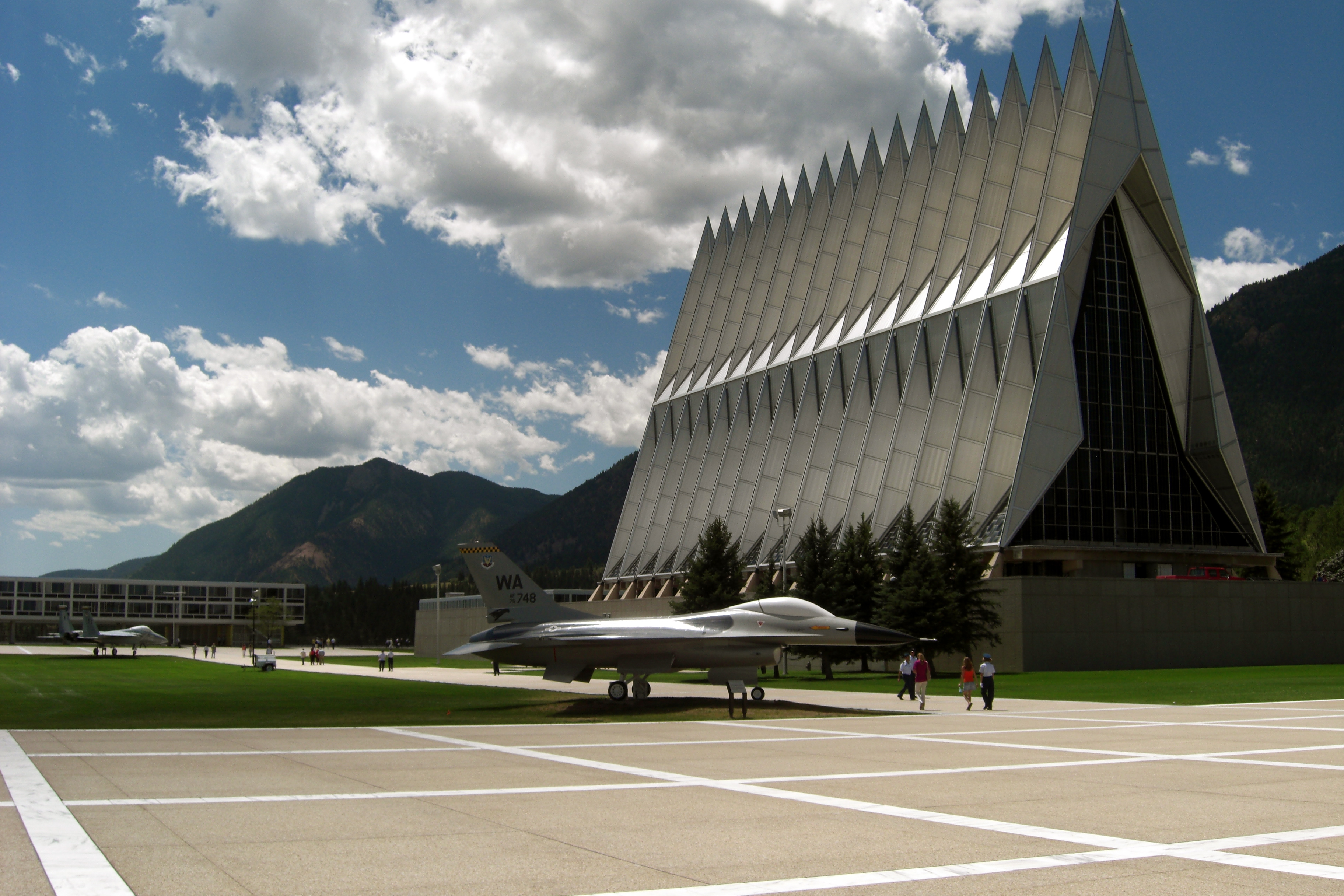
The Air Force Academy Chapel: God and Fighter Jets

W.J. Astore

U.S. military academies are neither Spartan in being dedicated to war, nor are they Athenian in recognizing humanism (even the humanism of war).  They are Archimedean.  They focus on engineering and the machinery of war.  But two millennia ago even Archimedes with his clever war machinery could not save Syracuse from defeat at the hands of Rome.

There is a lesson here for America’s military academies – if only they spent more time studying history and the humanities and less time solving equations.  But they do not.  I taught history at the Air Force Academy (AFA) for six years.  My experience?  The AFA was far too focused on STEM subjects (science/tech/engineering/math) to the neglect of history, political science, and the humanities.  Today, America’s military cadets still concentrate on STEM, and they still receive Bachelor of Science degrees, even when they choose to major in subjects like history.

A technical emphasis may make sense for Air Force test pilots or Navy nuclear engineers; it does not make sense for Marine or Army lieutenants patrolling the mountains of Afghanistan.  Nor does it make sense in counterinsurgency warfare and nation-building operations, which involve soft skills and judgment rather than kinetic action and calculation.  Small wonder that the U.S. military in 2007 had to hire civilian anthropologists to teach the troops that winning is not only about hammering the enemy with superior firepower.

Emerging from an engineering mindset, young officers are too number-oriented, too rule-bound, too risk-averse.  U.S. military officers, old as well as young, tend to think geopolitical problems – even in destabilized cauldrons like Iraq and Afghanistan – are solvable if you identify and manipulate the right variables.  They think history and politics, human and cultural factors, can be controlled or compensated for.

Ever since their service academy days, they have internalized a puzzle-solving mindset, one that is suitable to technocratic hierarchies in which “progress” is measured by metrics.  Their thinking about war is infected by quantification and business-speak in which assets are leveraged and force is optimized.  Reinforcing this impoverished view of war is an officer evaluation system that stresses numbers, numbers, and more numbers, since if it cannot be quantified, it did not happen or does not exist.

When I was an officer and professor teaching history, many military cadets would ask, “What can I do with a History degree?”  They were thinking not in terms of which course of study would make them savvier, more effective, officers and leaders.  They were thinking in terms of which academic major would help them become a pilot (even better: a test pilot or astronaut), or they were thinking which major would make them more marketable once they left the military.

As a result, the vast majority of cadets at the Air Force Academy took two, and only two, history courses: a one-semester survey on world history and another survey course on military history.  (Cadets at West Point take more history courses, but technical subjects are over-stressed there as well.) They had virtually no exposure to U.S. history (unless you count AF heritage or Academy trivia as “history”), but plenty of exposure to thermodynamics, calculus, physics, civil engineering, astronautics, and related technical subjects.  Naturally, an engineering mentality pervaded the air.  Notably absent were critical and sustained studies of recent U.S. military performance.

Combine a reductive, problem-solving approach shared among U.S. military officers with the dominance of lawyers in U.S. governmental systems and you have a recipe for number-crunching rationality and rule-bound conformity.  Solutions, when proffered by such a system, involve cleverness with weapons and Jesuitical reasoning with laws.  A perfect example: America’s high-tech drones and the tortured legal reasoning to sanction their assassination missions.

Educated as engineers and technicians, young officers are deployed to places like Iraq and Afghanistan and charged with negotiating the “human terrain” of cultures utterly foreign to them.  Lacking knowledge of their own history as well as the history of the cultures they walk among, it is hardly surprising that they make little progress, despite hard work and honorable intentions.

Today’s U.S. military likes to fancy itself a collection of warriors, but America is not Sparta.  Today’s military likes to fancy itself the bringers of democracy, but America is not Athens.  Today’s military is Archimedean, infatuated by technology, believing in smart machines and victory achieved through violent action — much like America itself.

But mastery of machines by the military or, for that matter, tortured legalistic gymnastics by civilian commanders, is not in itself sufficient for victory.  Just ask Archimedes at Syracuse, or a US Marine at Fallujah, or even the constitutional lawyer-in-chief at the White House.

A Lame Duck Nation on Steroids

Lame duck, indeed.
It’s not just the Tea Party that’s lame (Toby Toons)

W.J. Astore

The more the United States has come to talk about dominance, the less dominant we’ve become.

To compensate, we’ve become a steroidal nation, to include the violent side effects associated with steroid use (just look at the latest stories out of the NFL about spousal and child abuse, or our steroidal police forces, including MRAPs and M-16s for school police).  If the story of the last fifty years is the gradual decline of the U.S., most notably in the economic and political realms, the story of today is how we’ve compensated with militarized Viagra.  We’ve reached “the age of knowing” that we’ve lost much of our potency as our country.  To compensate, we’re forever popping pills and flexing our muscles.  (Just look at John McCain’s enthusiasm for bombing.)

It’s precisely those steroids that are weakening us as a country.  As we’ve overcompensated with military weapons and bases, we’ve allowed our economy to slide.  As we’ve sought domination overseas, we’ve weakened our country right here at home.  We feverishly build and repair roads in Afghanistan but not here in the USA.  Same with schools — we’d rather build prisons, to include Gitmo, than colleges (since 1984, California has built 21 prisons but only one university).

Consider our binary debates on foreign policy.  It’s the hawks versus the doves, militarized “engagement” versus isolationist “appeasers,” the implication being that the latter is wrong — that minding one’s own business is not an option in a globalized world.  But the world is not some “global village”: it’s a conglomeration of fragments.  And U.S. efforts to dominate those fragments by military means are only accelerating that fragmentation.  Just look at what our government did and is doing to Iraq and Afghanistan.

Fragmentation facilitates dominance by multinational corporations even as the U.S. military is misused and overextended.  The result is more global instability and a retreat (or a return) to ideologies that promise coherence and order.  Witness the rise of militant Islam and ISIS.  By attacking it, the U.S. is acting as an accelerant to it.

As the U.S. weakens itself as a country, as it accumulates debt by constantly fighting wars while passing the costs along to future generations, large multinational corporations grow in power.  They are today’s equivalent to the British East India Company, the Dutch East India Company, and similar entities of the past.  Combine powerful multinationals with privatized mercenary outfits and you see echoes of the seventeenth century, to include wars over religion and resources.  Three centuries ago, it was Catholics versus Protestants and wars over spices like pepper and nutmeg.  Now it’s divisions within Islam and wars over oil.

We’re witnessing the decline of Enlightenment ideals and community-based Democracy, as seen by the way in which the U.S. government routinely betrays those ideals.  Any sense of shared, community-based, obligation is tainted by “socialism,” meaning that a Darwinian capitalism based on selfish individualism is promoted instead, which only feeds the growth of multinationals competing to sell “product” to the masses.

Everything is becoming a consumable, including the most vital parts of life.  As a consumable, it can be marketed, sold, and controlled by those same multinationals.  Even education is now an ephemeral product, marketed and sold as a commodity.

Corporations think and act for short-term profit.  But democracies are supposed to think strategically, over the long term.  Now the quarterly business cycle controls all.  Look at politics: A congressman is elected and instantly starts fund raising to win his next campaign.  Obama wins a second term and is almost instantly branded a lame duck.

But it’s not Obama who is the lame duck – it’s America.  And all the militarized steroids in the world won’t cure that lameness.  Indeed, they just aggravate it.

What Americans Value

There's no shortage of tanks in the USA
There’s no shortage of tanks in the USA

W.J. Astore

A sentiment attributed to Vice President Joe Biden is, Show me what’s in your budget, and I’ll tell you what you value.  These words resonate with me whenever I consider the yearly budget for the Department of Defense (DoD), Homeland Security, the Department of Energy (which handles nuclear weapons), and the various intelligence agencies (roughly 17; that’s why they form a community).

When you add up what we spend on defense, homeland security, “overseas contingency operations” (wars), nuclear weapons, and intelligence and surveillance operations, the sum approaches $750 billion dollars each and every year, consuming more than two-thirds of the federal government’s discretionary spending.

Here are some figures for Fiscal Year 2015 (FY15):

Defense: “Base” budget of $496 billion

Afghan War (not part of “defense”): $85 billion

VA: $65 billion

Homeland Security: $38 billion

Nuclear Weapons: $12 billion

FBI and Cyber Security (part of Justice Department budget): $18 billion

Total: $714 billion

Some of the budget of the State Department and for foreign aid supports weapons and training (“foreign military sales”), bringing us to roughly three-quarters of a trillion dollars, each and every year, on the military, intelligence, security, weapons, and wars.

How much do we spend at the federal level on education, interior, and transportation?  Roughly $95 billion.

When a government spends almost eight times as much on its military, security, wars, weapons, and the like as it does on educating its youth, fixing its roads and bridges and related infrastructure, and maintaining its national parks and land, is there any question what that country ultimately values?

Show me your budget and I’ll tell you what you value.  Sobering words. Sobering — and scary.

Freethinkers Fighting for Fair Play: The True Goal of Higher Education

Do you have what it takes to fight for your rights?  (Movie poster from "Flash of Genius")
Do you have what it takes to fight for your rights, and to fight for what’s right? (Movie poster from “Flash of Genius”)

W.J. Astore

A New York Times editorial back in February caught two trends in higher education today: the proliferation of underpaid adjunct professors as well as the expansion of administrative positions within America’s colleges and universities.  These trends are unsurprising.  America’s colleges and universities are becoming more and more like businesses every day, with a small legion of administrators being hired in fields like assessment, retention, recruitment, student affairs, workforce development, and the like.  Adjunct faculty, meanwhile, are treated as interchangeable providers of ephemeral product, to be hired and dismissed at the whim of administrators.

As faculty increasingly inhabit lower niches within higher ed, students’ aspirations are increasingly shaped by the pursuit of high salaries.  How else to obtain “aspirational products” such as the latest Kate Spade handbag, the latest Apple iPhone, perhaps a BMW or even an Ivy League degree if you’re truly seeking to flaunt “success.”  An inherent contradiction in higher ed today is the way colleges and universities flaunt their success in helping graduates to get high-paying jobs, even as these same colleges and universities underpay adjunct professors.  Contradiction – what contradiction?

Administrative bloat and faculty contingency (“contingency” as in no job security for adjuncts, therefore little in the way of academic freedom, i.e. speak your mind, lose your job) are contributing factors in the loss of purpose within higher ed.  After all, if not for higher salaries or aspirational credentials, what is the higher purpose to higher ed?

Critical thinking should be one such higher purpose.  Alerting students to societal inequities – maybe at their very own colleges, perhaps even staring back at them in their dormitory room mirrors – is a start.  Remediating these inequities should be a goal.

Education, after all, should wake us up.  It should disturb us.  It should also strengthen our democracy.  It should reinforce our freedoms as defined in the Constitution.  It should counter prevailing anti-democratic trends toward plutocracy and authoritarianism within American society and government.

Too many students today are apathetic because they see little connection between their “higher” education and living a life that is fulfilling in wider settings.  They lack a compelling vision of what education is all about.  It doesn’t help when colleges and universities focus on making the educational money train run on time with little thought given to the passengers on board and their ultimate destination.

So, what should be the ultimate destination?  A questing and questioning mind.  Critical and creative thinking.  Curiosity about the world.  At the same time, students need to think and act to preserve what’s best about our world: our freedoms.  Fairness.  Fighters for fair play: that’s what we need more of in America.

Let me give you an example.  One of my favorite scenes in any movie comes in “Flash of Genius” (2008).  It’s about the guy who invented the intermittent windshield wiper.  His idea was stolen from him by the Ford Motor Co., and he takes them to court (true story).  When he’s asked why he’s fighting so desperately hard against Ford, why he’s risking everything, he replies: That idea was my Mona Lisa.

That line has always stayed with me.  Not only because it highlights the fact that technology is an act of creation, a work of art (or artifice).  But also because it highlights the need to be a fighter, the need to fight for what’s fair.

I like to tell my students that they too are society’s creators, that they too can create their own Mona Lisa (even if it takes the form of a new windshield wiper).  But that they too may also need to fight for their rights, and to fight for what’s right.

Motivating and equipping them for that fight: That’s what higher education should be all about, Charlie Brown.

Rulers’ Ideas Rule

Beware the bearded one!

W.J. Astore

I can’t remember where exactly, but I stumbled across this apothegm of Karl Marx:

“In every era, the ideas of the rulers are the ruling ideas.”

Striving for even more brevity, I truncated it to rulers’ ideas rule.

Contrarians of the world should unite to identify and challenge these ruling ideas. When they serve only the needs of the powerful, we should be prepared to mark them as dangerous and most likely as undemocratic. And we should work to change them.

What are some of today’s ruling ideas? I challenge you to come up with some. But on this Friday morning, here are ten that I see as ruling our lives:

1. That capitalism is the only economic system that works, and that rampant consumption is necessary to keep the economy growing.

2. Related to (1) is the idea that GDP and similar economic measures are the best measure of America’s strength.

3. That “success” in life is measured by money and titles and possessions.

4. Related to (3) is the idea that education that doesn’t end in a lucrative career is largely worthless.

5. That poor people and other disadvantaged groups are the way they are because they refuse to work.

6. That it’s absolutely necessary to spend nearly a trillion dollars a year on national defense, wars, homeland security, intelligence agencies, and nuclear weapons, all of which are justified in the name of “keeping us safe.”

7. That privatization is the way to improve everything, including public services like education, the prison system, and health care.

8. That corporate spending in elections is the equivalent to freedom of speech for individuals and is therefore protected by our Constitution as our nation’s founders intended.

9. That there’s no such thing as class warfare in the United States.

10. Related to (5), that there’s equality of opportunity for everyone in the United States, regardless of race, ethnicity, economic background, and so on. Thus those who “fail” do so because of their own failings, not because the system is rigged against them.

That’s my non-rigorous, somewhat off-the-cuff rendering of rulers’ ideas. Please add your ideas in the comments section. Contrarians of the world unite!

STEM Education Is Not Enough

Sir Peter Medawar
Sir Peter Medawar

W.J. Astore

If you’re in education, you’ve heard the acronym STEM. It stands for science, technology, engineering, and mathematics.  As a country, the USA is behind in STEM, so there are lots of calls (and lots of federal money available) for improvements in STEM.  Usually the stated agenda is competitiveness.  If the US wants to compete with China, Japan, Europe, India, and other economies, our students must do better in science and math, else our economy will atrophy.

Here’s a sample rationale that can stand in for hundreds of others: “International comparisons place the U.S. in the middle of the [STEM] pack globally,” said Debbie Myers, general manager of Discovery Communications.  And for corporate managers like Myers, that’s not good enough when competition in the global market is both endless and the means to the end, the end being profit.

I’m all for STEM.  I got my BS in mechanical engineering and worked as an engineer in the Air Force.  I love science and got my master’s and Ph.D. in the history of science and technology.  I love science fiction and movies/documentaries that explore the natural world around us.

And that’s one thing that bugs me about all this emphasis on STEM.  It’s not about curiosity and fun; it’s not even about creativity.  STEM is almost always pushed in the US in terms of market competitiveness.  STEM, in other words, is just another commodity tied to profit in the marketplace.

My other bugaboo is our educational establishment’s focus on STEM to the exclusion of the humanities.  At the same time as the humanities are undervalued, STEM is reduced to a set of skills as mediated and measured by standardized tests.  Can you solve that equation?  Can you calculate that coefficient of friction? Can you troubleshoot that server?  Results, man.  Give me results.

Sir Peter Medawar, a great medical researcher and a fine writer on science, spoke of scientific discovery as an act of creation akin to poetry and other so-called liberal arts.  Nowadays, we simply don’t hear such views being aired in US discourse.  STEM as an act of creation?  As a joyful pursuit? Bah, humbug.  Give me results.  Give me market share.  Make me Number One.

If we as a nation want to encourage STEM, we should be focusing not on rubrics and metrics and scores.  We should instead be focusing on the joy of learning about nature and the natural world. How we model it, manipulate it, understand it, and honor it by preserving it.  STEM, in other words, must be infused with, not divorced from, the humanities.  Why?  Because STEM is a human pursuit.

As we pursue STEM, we should also honor our human past, a past in which we’ve learned a lot about ethics, morality, and humane values.  The problem is that STEM education in the US is often present- and future-focused, with little time for the past.

In American society, those with respect for old ways and traditional values are often dismissed as Luddites or tolerated as quaint misfits (like the Amish).  After all, Luddites aren’t competitive. And Amish quilts and buggies won’t return America to preeminence in science and technology.  The US as a nation has nothing to gain from them.  Right?

Here’s the problem.  We connect STEM to material prosperity.  We dismiss those who question all this feverish attention to STEM as anti-science or hopelessly old-fashioned.  But there’s a lot we can from the humanities about ourselves and our world.

To cite just one example: Consider this passage from Jacob Burckhardt, a great historian writing during the industrial revolution of the late 19th-century:

material wealth and refinement of living conditions are no guarantee against barbarism. The social classes that have benefited from this kind of progress are often, under a veneer of luxury, crude and vulgar in the extreme, and those whom it has left untouched even more so. Besides, progress brings with it the exploitation and exhaustion of the earth’s surface, as well as the increase and consequent proletarianization of the urban population, in short, everything that leads inevitably to decline, to the condition in which the world casts about for ‘refreshment’ from the yet untapped powers of Nature, that is, for a new ‘primitiveness’ – or barbarism.”

What a party-pooper he was, right? Most of what the US defines as STEM is about “material wealth” and “refinement of living conditions,” the very definition of “progress,” at least for those out to make a buck off of it.

Burckhardt was warning us that “progress” tied to STEM had its drawbacks, to include the exhaustion of the earth’s resources as well as the exploitation of human labor. Divorced from ethics and morality, STEM was likely to lead to “primitiveness,” a new barbarism.

Tragically, Burckhardt was right. Consider the industrialized mass murder of two world wars. Consider the “scientific” mass murder committed by the Nazis. (By the way, the Nazis were great at STEM, valuing it highly.)

In a democracy, STEM divorced from the humanities is not “competitive,” unless your idea of competition is barbaric. Disconnected from humane values, a narrow education in STEM will serve mainly to widen the gap between the 1% and the rest of us while continuing to stretch the earth’s resources to the breaking point.

Education in STEM, in short, is not enough. But you won’t learn that by listening to corporate CEOs or presidents prattle on about competitiveness.

For that wisdom, you need to study the humanities.

The Education Business: Money, Money, Money (Updated)

W.J. Astore

As a college professor, I’m in the education business, a word that repels me but which nowadays is undeniably true.  One of the marketing slogans where I teach is “A degree is measured by its success in the workplace.”  In other words, if a college degree leads to a decent salary in the “workplace,” it’s worth it, but if the “workplace” does not reward you with a position with good pay and benefits, your degree is without merit.

Education in America has become just another business.  It’s increasingly monetized and corporatized.  Hence it’s unsurprising that educational results are measured increasingly by standardized tests developed by corporations.  If education is reducible to standardized metrics, you can run it and control it just like a business.  Professors become providers, students become consumers, and education becomes a commodity which is marketed and sold to consumers. Administrators are the middle managers who ultimately answer to corporate-dominated boards. “Success” for an administrator is measured mainly by money: funding drives, corporate donations, endowments, and similar issues related to budget and “the bottom line.”

As usual, Joe Bageant knew the score.  And he knew how to express it in pungent prose:

Now that education has been reduced to just another industry, a series of stratified job-training mills, ranging from the truck-driving schools to the state universities, our nation is no longer capable of creating a truly educated citizenry.  Education is not supposed to be an industry.  Its proper use is not to serve industries, either by cranking out feckless little mid-management robots or through industry-purchased research chasing after a better hard-on drug.  Its proper use is to enable citizens to live responsible lives that create and enhance their democratic culture.  This cannot be merely by generating and accumulating mountains of information or facts without cultural, artistic, philosophical, and human context or priority.

Consider the harsh reality of Bageant’s statement: America “is no longer capable of creating a truly educated citizenry.”  It’s impossible to deny this statement, especially when institutions of higher learning use the “workplace” as the measure of success for their degree programs.

Education today is disconnected from democracy.  It’s disconnected from producing an educated citizenry with critical thinking skills.  Rather, it’s connected to consumption; indeed, education is just another ephemeral consumable in a world of goods.  It’s valued only for its monetary fungibility, i.e. how much money can I make with this degree?  Alternatively, from a provider’s perspective, how much money can I make from offering these degrees?

Increasingly, there’s only one true degree offered by American colleges and universities: the business degree.  Such is the uniformity of market-driven ideology applied to education.

Say what you will of “diversity” in higher education as measured by differences in age, gender, skin color, sexual orientation, and all the rest.  Such diversity doesn’t matter much when all these “diverse” students are striving for the same thing: a fungible degree that’s translatable into money, money, money.

Show me the money!
Show me the money!

Update (12/4): When you treat students as consumers, there’s a tendency to buy the idea that “the customer is always right.” In other words, don’t offend the customer with disturbing ideas, such as the legacy of structural racism in society. Better to ignore such topics, especially when the “customer” complains about being offended by the ideas the professor (whoops — I meant the provider) introduces in class. See this story from Slate for more details.

Of MOOCs and Technology: Why True Education Is Not Content Delivery

Robin Williams in "Dead Poets Society"
Robin Williams in “Dead Poets Society”

W.J. Astore

Massive open online courses (MOOCs) are one of those “pedagogical practices that are current and relevant to the new generation of learners,” to use a description featured prominently in promotional literature. Sure sounds trendy, doesn’t it? But education is not simply about content delivery. Education is about inspiration. It’s about lighting a fire in the mind (and maybe the belly too). Call me skeptical, but I don’t think a MOOC can do that.

OK, I haven’t tried a MOOC, but I have experienced distance learning. As a military officer, I took ACSC (Air Command and Staff College) by “correspondence.” The Air Force sent me the books and study materials, I did the reading and studying — and learned absolutely nothing. Why? First you memorized content, then you took multiple-choice tests to measure your “mastery” of that content. I passed with flying colors — and retained nothing.

As a professor I’ve also advised a graduate student via distance learning. It was an adequate experience for the both of us, but we never met. The mentoring experience was impoverished. I felt little connection to the student, and I’d wager he felt little connection to me.

Distance learning and MOOCs reduce education to content delivery. And it requires an exceptional student to get the most out of them. When I query my students in class about on-line courses, most of them are ambivalent or opposed to them. When they favor them, they say things like: “It was easy to skate by” or “I took it only because it fit my work schedule.”

To be blunt, administrators are looking for ways to reduce costs, and on-line learning is being pushed for that very reason. No classrooms needed. Little or no cost for electricity, facilities, classroom materials and the like. Combine cost-cutting imperatives with growing privatization of education and you have a recipe for education delivered as a commodity driven by the profit motive.

What’s wrong with that, you say? Nothing. Just say “goodbye” to any radical or even fresh ideas being pushed by profit-driven vendors.

Even as we’re overvaluing MOOCs and distance learning, we’re overhyping glitzy technology in the classroom. When it’s appropriate, I use technology in the classroom, but not because I’m trying to be trendy, i.e. not because I think Twitter or Tablets or other gimmicks and gizmos are how you “connect” with today’s students.

Indeed, exactly because my students are perpetually staring at screens, I often use an old-school approach of engaging them in class with vivid stories and amusing anecdotes and open-ended discussion.

Today’s students don’t need more technology; they don’t need more PowerPoint and computer-based learning platforms. What they need are enthusiastic and talented and creative teachers and professors who see education not as a job but as a calling.

I bet every person reading this remembers a teacher or professor who truly inspired you. And I bet he or she did so without glitzy technology and without genuflecting before “current pedagogical practices.”

My father was fond of saying, “The more things change, the more they remain the same.” Give me passion in the classroom. Give me a teacher who throws off sparks, and students with combustible minds. Give me that, and I’ll show you true education.

An Addendum: After writing this, I came across a Northeastern University survey featured at the Chronicle for Higher Education that addressed MOOCs, among other issues.  This is what the survey found:

“Slightly more than half of the respondents believe that MOOCs will fundamentally transform how students are taught, but just 27 percent think the online classes are of the same quality as traditional, in-person education. And yet more than half of the respondents predicted that in five to seven years an online education would be seen as of equal quality to a traditional one.”

So whatever I think about MOOCs, I think it’s fair to say that they are here to stay, and that their influence and reach will continue to grow.

Astore writes regularly for TomDispatch.com and The Contrary Perspective and can be reached at wjastore@gmail.com.