Remember Color-Coded Threat Warnings?

Hsas-chart

W.J. Astore

Back in the ancient time of 2007, you may recall that color-coded threat warnings were constantly appearing on our TV screens.  Those “Homeland Security threat advisory ratings” fluctuated between yellow (elevated) and orange (high).   With the lone exception of the State of Hawaii in 2003, the threat ratings never dropped to blue (guarded) or (heaven forbid) green (low).

It was like we were in an old Star Trek episode with Captain Kirk, stuck on a bridge that’s constantly on Yellow Alert, phasers and photon torpedoes locked on target.

Thankfully, the Department of Homeland Security finally ditched the color-coded warnings.  But have we ditched the mentality that drove them?  Are we not encouraged still to be afraid?

Yes, terrorism remains a threat.  I’m sure there’ll always be terrorists of some sort who seek to harm us.  But we’ve made a lot of progress in the so-called global war on terror.  We killed Osama Bin Laden.  We devastated Al Qaeda.

Indeed, as we teeter on the brink of national financial default, one of the bigger threats we seem to face is our own divided and ineffectual government.  While it appears a last-minute deal is in the works, it’s one of those “solutions” that just kicks the can down the road a few months.  We’ll doubtless be dealing with the same governmental gridlock — the same hostage-taking — after the New Year.

Hmm: Maybe we should revive that color-coded warning system.  But let’s apply it, not to the terrorists outside our borders, but to our own politicians who continue to threaten us with financial default and societal ruin.

If they continue to insist on taking our government hostage, throwing people out of work, and threatening us all with financial collapse, I’d say that rates at least an “orange” rating.  And if they persist in shooting the hostage (that’s us), I’d say that counts as a “red.”

Come on, Homeland Security!  Protect us from those who’d destroy our government.  Or are you shut down too?

Iraq and Afghanistan Are Not Rubik’s Cubes

A Rubik's Cube
A Rubik’s Cube

W.J. Astore

A few years ago I was talking to an experienced U.S. Army lieutenant colonel, a battalion commander in Iraq.  He compared the Iraqi situation to a Rubik’s Cube – a puzzling array of shifting loyalties, interconnected tribes, and religious sects.  At the time, I thought it was a telling metaphor.

But the metaphor was misleading.  A Rubik’s Cube can be solved.  Iraq couldn’t.  Not by the U.S.  Why?  Because Iraq was and is an Iraqi problem, not an American puzzle.  The more we twisted and turned the Iraqi cube, the more we avoided the reality that the heavily militarized U.S. presence in Iraq was a large part of the problem.

Similarly, Afghanistan is an Afghan problem.  Our long-term, heavily militarized, presence there is ultimately not in the best interests of the vast majority of Afghan people.  Nor for that matter is it ultimately in the best interests of America.

This conclusion may seem deceptively simple, even simple-minded.  But it isn’t.  It requires us to be humble.  It requires us to recognize that other countries and people are not problems for us to solve.  And American officials are loath to do that.  They are loath to admit any limits either to their power or insight.

This ham-fisted puzzle-solving mentality was endemic to the American presence in Vietnam.  In a probing book review of Carl Oglesby’s Ravens in the Storm, Dan White cites Oglesby’s experiences talking with the Vietnamese journalist Cao Giao.  One passage in particular caught my attention:

“You Americans [Cao Giao said] like to say the Vietnam problem is complex.  But this is only an excuse to not face the truth.  The truth is that the Vietnam problem is not complex at all.  It is only impossible.  Do you see?  If it was complex, you could try to solve it.  But it is simple because it is impossible.  Because it is simple it cannot be solved.”

Iraq and Afghanistan (or Yemen or Somalia or Syria) are not complex puzzles.  They’re not Rubik’s Cubes to be flipped and turned and massaged until we get all the colors to line up for us.  They’re impossible.  They’re impossible for us, that is.  We can’t “solve” them, no matter how many billions of dollars we spend, no matter how many troop brigades we send, no matter how many weapons we sell to them.

The simple truth (that U.S. officialdom seeks to deny) is that we consume our own myths of global reach, global power, and global goodness.  In the process we reduce other peoples and nations to puzzles.  We play with them until we “solve” them to our satisfaction.  Or we grow bored and tired and throw them away like yesterday’s toys.

Other nations and peoples are not toys.  Nor are they complex puzzles.  Nor should it be puzzling when the peoples we’ve flipped and spun like so many Rubik’s Cubes seek redress – and revenge.

Lessons of the Vietnam War

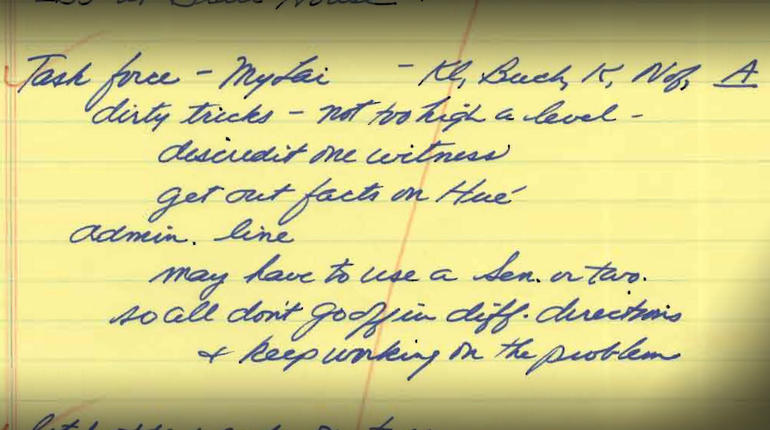
The My Lai Massacre
The My Lai Massacre

W.J. Astore

Nick Turse has a fine op-ed in the New York Times, “For America, Life Was Cheap in Vietnam.”  In it he argues that for Americans involved in the Vietnam War, life was very cheap indeed – Vietnamese lives, that is.  Turse has written a powerful book, “Kill Anything that Moves,” that documents the total war the United States waged on the Vietnamese people and countryside.  As Turse notes in his op-ed, American leaders like General William Westmoreland demonstrated “a profligate disregard for human life,” mainly because their strategy “was to kill as many ‘enemies’ as possible, with success measured by body count.  Often, those bodies were not enemy soldiers,” Turse concludes.

As the U.S. embraced a bloody war of attrition, Turse observes that “the United States declared wide swaths of the South Vietnamese countryside to be free-fire zones where even innocent civilians could be treated as enemy forces. Artillery shelling, intended to keep the enemy in a state of constant unease, and near unrestrained bombing slaughtered noncombatants and drove hundreds of thousands of civilians into slums and refugee camps.”

I recently came across two accounts that lend further support to Turse’s conclusion.  The first is an article written by Bernard Fall, “This Isn’t Munich, It’s Spain,” published in Ramparts in December 1965.  (My thanks to Dan White for bringing this article to my attention.)  Bernard Fall was an expert on Vietnam; among other classic books, he wrote “Hell In A Very Small Place” (about the siege of Dien Bien Phu) and “Street Without Joy.”  He was killed by a mine in Vietnam in 1967.

Writing in 1965, in the early stages of large-scale American deployment of troops, Fall noted that the war had already become “depersonalized and, to a large extent, dehumanized.”  “It is a brutal war,” Fall continued, “and already, in what may loosely be termed the ‘American period’ [of Indochinese conflict], the dead are near a quarter million, with perhaps another half million people seriously maimed.”

“A truly staggering amount of civilians are getting killed or maimed in this war,” Fall concluded, illustrating his point by recounting an air raid he had accompanied that destroyed a Vietnamese fishing village.

By later standards (massive bombing by B-52s in Arc Light attacks), the air raid Fall witnessed, consisting of A-1 Skyraiders carrying napalm and fragmentation bombs, was small.  But don’t tell that to the Vietnamese fishing village that was utterly destroyed in this “small” raid.  As Fall recounts, the village may or may not have been harboring a Viet Cong unit.  If it had been harboring a VC unit, it may have done so unwillingly, and that VC unit may have already moved along by the time the Skyraiders appeared overhead.  No matter.  The village and villagers were burnt, blown apart, and strafed.  A U.S. official report recorded that a VC rest center “had been successfully destroyed.”

Such indiscriminate attacks convinced Fall that the U.S. was not “able to see the Vietnamese as people against whom crimes can be committed.  This is the ultimate impersonalization of war.”

But even more worryingly for Fall was that “The incredible thing about Vietnam is that the worst is yet to come,” a tragically prescient statement.

And the worst might be represented by U.S. Army Lieutenant General Julian Ewell.  As the commanding general of the 9th Infantry Division in Vietnam, Ewell became known as the “Butcher of the Delta.”  Douglas Kinnard, an American general serving in Vietnam under Ewell, recounted his impressions of him (in “Adventures in Two Worlds: Vietnam General and Vermont Professor”):

Ewell, recalled Kinnard, “constantly pressed his units to increase their ‘body count’ of enemy soldiers.  This had become a way of measuring the success of a unit since Vietnam was a war of attrition, not a linear war with an advancing front line.  In the 9th [infantry division] he had required all his commanders to carry 3” x 5” cards with body count tallies for their units by date, by week, and by month.  Woe unto any commander who did not have a consistently high count.”

In a war in which commanding generals rewarded American troops for generating high enemy body count and punished those “slackers” who didn’t kill enough of the enemy, small wonder that Vietnam became an American killing field and a breeding ground for atrocity.

Bernard Fall ended his powerful article on an ambiguous note.  After having talked to a lot of Americans in Vietnam, he noted he hadn’t “found anyone who seems to have a clear idea of the end – of the ‘war aims’ – and if the end is not clearly defined, are we justified to use any means to attain it?”

In Vietnam, the U.S. used immoderate means, often with wanton disregard for the lives or livelihood of the Vietnamese people, in pursuit of ill-defined ends.  Echoing Fall’s words, we pursued open-ended devastation for no clear purpose with little regard to moral responsibility.

We lost more than a war in Vietnam.  We lost our humanity.

Military Academies and American Values — Updated

Football, Yes.  English, No.
Football, Yes. English, No.

W.J. Astore

Bruce Fleming, an English professor at Annapolis, has a great letter at the New York Times about the government shutdown.  Unlike West Point and the Air Force Academy, most instructors at Annapolis are civilians rather than serving military officers.  They have been furloughed because of the government shutdown, so Navy midshipmen are no longer being educated.  They’re being herded into large lecture halls by young LTs.  Lord knows what they’re learning.

The library staff is furloughed as well.  But who needs books nowadays?

But wait!  I have good news.  Even as education in subjects like English is suspended at Annapolis, the football games continue.  There was an alarming report earlier this week that this weekend’s football game might be cancelled due to the shutdown.  But lo and behold, football games were restored for all the service academies.

Here are American values clearly on display.  Football and tailgates and hoopla: essential.  Education in English: optional.

And we wonder why America is in trouble today?

Update (10/7/13): Civilian faculty returned to work today at Annapolis, so “only” one week of classes were missed. I’m just glad no football games were missed. Priorities, people!

The Day the Congress Stood Still

Klaatu: Please unleash Gort

W.J. Astore

With the odds increasing that Congress will shut down the government this coming Tuesday, I couldn’t help but think of the classic Sci-Fi film, “The Day the Earth Stood Still” (the original version, of course).

Remember Klaatu?  He comes to earth in peace, only to be hassled, harassed, and ultimately shot by the authorities in Washington, D.C.

What angered Klaatu were the “childish jealousies” and “petty squabbles” he witnessed among earth’s leaders.  “I’m impatient with stupidity,” he declared.  And when it comes to this Congress, so should we all.

So-called Obamacare is an expansion of medical care based on free-market models supported previously by Republicans like Mitt Romney.  But the usual childish jealousies and petty squabbles are intruding as the Republicans in the House do their best to torpedo a plan that mostly favors the status quo.

The stupid — it burns.  Where is Gort when you need him? 

Martial Virtue: Promise and Peril

It's unwise to worship without question the god of war (Worcester Art Museum, image of Ares)
It’s unwise to worship without question the god of war (Worcester Art Museum, image of Ares)

W.J. Astore

Ever since the attacks of 9/11/2001, the United States has actively celebrated martial virtue.  We’ve portrayed our troops as heroes.  Presidents have celebrated them as the best led and best trained and most effective military in all of human history.  To question the wisdom of such hagiographic portrayals is to be dismissed as ungenerous and un-American.  Just ask the journalist Chris Hayes.

But the hard truth is that martial virtue is consistent both with republican freedoms and with imperial or despotic agendas, to include the suppression of freedom.

History teaches us that martial virtues (such as they are) are readily enlisted or perverted to serve imperial or even fascist regimes.  Sparta celebrated military virtues even as they lived off of slavery and exposed the “weak” to death.  The Romans, in ruthlessly pursuing an empire, created deserts and called them “peace,” to quote Tacitus, one of the great historians of Rome.  Both under the Kaiser and under Hitler, Germany elevated martial virtues and waged two utterly devastating wars.

This is not to say that martial service can’t be ennobling.  Organizing and fighting for what’s right is commendable.  To cite just one example, think of the Jews who organized to resist the Nazis during World War II.  Jewish partisans fought for a cause, for freedom from murderous oppression, a fight in which they found their “treasure,” the treasure of pure acts of will.  In Hannah Arendt’s words (which she applied to the French resistance), “they had become ‘challengers,’ had taken the initiative upon themselves and therefore, without knowing or even noticing it, had begun to create that public space between themselves where freedom could appear.”

During World War II, Jewish (and other) resisters tapped the nobility of martial service, carving out public spaces where decisions were made freely for the purpose of defeating a regime dedicated to their destruction.  Under these conditions, martial virtue upheld freedom.

Martial virtue, in other words, is not an oxymoron.

Did martial virtue help to make “the greatest generation” in America?  No.  It was the events that came before World War II, not the war itself, that “made” this generation.  My dad, born in 1917, had to endure the Great Depression, had to serve in the Civilian Conservation Corps in the mid-1930s, had to work long hours in the factory prior to the war, to support the family.  From this he learned the value of hard work and the reality that life often isn’t fair.  His service in the Army during the war was a duty he performed to the best of his ability, but it was largely what he and his generation endured before the war, and the nation they built after the war, that made them “great.”

American troops during World War II were citizen-soldiers.  Unseduced by Mars, the god of war, most of them endured the degradations of war without becoming degraded themselves.  You can’t say the same of the German Wehrmacht or the Soviet Army. 

And there’s the rub.  Martial service is also consistent with totalitarian states.  Indeed, such states take pains to celebrate the military in order to co-opt its honorable qualities for disreputable ends.  Military service loses its nobility as it is monopolized by the state in the name of furthering anti-democratic agendas.

All of this is to say that the celebration of martial virtue is powerful — and powerfully dangerous.  It may be consistent with protecting freedom, but so too may it be consistent with denying freedom.

Our nation’s founders knew this when they created a small “standing” military, placing it firmly under the control of Congress and a civilian commander-in-chief, augmented by state militias under the control of governors.  Founders like James Madison warned us of the dangers of perpetual war and its corrosive impact on democratic principles.  They were wise to do so.

And we would be wise to heed their counsel.  We would be wise not to celebrate a military setting as being uniquely suited to creating “heroes.”  And we would also be wise not to embrace martial qualities as being uniquely virtuous.

America is not exceptional when we commit to martial virtues; America is exceptional when we commit ourselves to liberty.

Creationism and Global Warming Denial in the USA — Updated

Creationism is bunk, though the idea of riding a dinosaur is cool

W.J. Astore

I grew up learning biology the old-fashioned way, i.e. by learning all about evolution and Charles Darwin.  I was also raised Catholic, where my priests explained to me that there was no conflict between evolutionary theories and Christianity.  The story of creation in Genesis, they explained to me, was meant to be read allegorically.  It wasn’t necessary to believe that God literally created the earth in six days, or that He created Adam from the dust of the earth or Eve from Adam’s rib.  What mattered as a Catholic was Christ’s two great commandments about loving God and thy neighbor.

The growing popularity of creationism and literal readings of the Genesis story sadden me.  Galileo taught us four centuries ago that the Bible teaches us how to go to heaven, not how the heavens go.  Yet people want to invest the Bible with literal authority in all realms of life.  Should we start stoning adulterers again?

The growing popularity of creationism (and an aversion to challenging it) is an American version of Lysenkoism.  OK, creationism is not damaging crop yields, as Lysenkoism did in the Soviet Union.  And those who oppose creationism are not being exiled or imprisoned, as opponents of Lysenkoism were in Stalin’s time.

It’s true that creationism may not influence how real science is conducted in the U.S.  Yet at the same time, it does influence how science is taught in American schools, which is serious enough.  It also serves to discourage scientists from speaking out.  Aware of the highly politicized nature of debates about evolution, many scientists decide it is best to stay out of the public sphere.

But this reluctance to engage extends to issues that are far more pressing to our survival, most especially the issue of global warming/climate change.  Too many scientists, I believe, decide to remain above the fray.  They exempt themselves from public debate, which they see as too messy, too politicized, too time-consuming, and too demeaning.

By staying out of the public debate, scientists are making a political decision: they are ceding much of the public sphere to the evolution deniers (creationists) or global warming deniers.  Such deniers, whether they know it or not, are most definitely facilitating the interests of powerful corporate/state entities with trillions of dollars yet to make in the continued burning of fossil fuels.

Creationism is not real science, but it plays well with Biblical literalists and those who resent or who are afraid of intellectuals.  Global warming is real, but denying it plays well with those who have much to gain from our gas-guzzling lives of unbridled consumption.

Whether it’s creationism or global warming denial, the risk of politicized science in America is more serious to the earth’s ability to sustain life than Lysenkoism ever was.

Update (9/29/2013): The New York Times reports that more than 20 percent of the selection committee for biology textbooks in Texas consists of Creationists.  Texas, like California, is a huge market that drives textbook content for the remaining 48 states.  Those who are Creationists (and global warming deniers as well) say they simply want more “critical thinking.”  But the community of science is neither an encounter group nor a Bible study class.  There is overwhelming scientific evidence that life evolved on earth over billions of years, and also that human beings are contributing to global warming.  To question this on religious terms is to mix faith with fact.

I’d also point out that many evangelicals and Catholics in the past have had no trouble reconciling evolution with Christianity.  They are thoroughly reconcilable.  Today’s Creationist movement is about politics and power; it is not about evidence, and it is certainly not about science.  Nor is it really about faith, since evolution doesn’t threaten Christianity.

To paraphrase Spock, there is nothing logical about Creationism or global warming denial.  For an explanation, you must look to human emotions (distrust of elites), prideful ignorance (don’t you tell me what to believe), and the interests of those who have much to gain from acts of denial.

Of MOOCs and Technology: Why True Education Is Not Content Delivery

Robin Williams in "Dead Poets Society"
Robin Williams in “Dead Poets Society”

W.J. Astore

Massive open online courses (MOOCs) are one of those “pedagogical practices that are current and relevant to the new generation of learners,” to use a description featured prominently in promotional literature. Sure sounds trendy, doesn’t it? But education is not simply about content delivery. Education is about inspiration. It’s about lighting a fire in the mind (and maybe the belly too). Call me skeptical, but I don’t think a MOOC can do that.

OK, I haven’t tried a MOOC, but I have experienced distance learning. As a military officer, I took ACSC (Air Command and Staff College) by “correspondence.” The Air Force sent me the books and study materials, I did the reading and studying — and learned absolutely nothing. Why? First you memorized content, then you took multiple-choice tests to measure your “mastery” of that content. I passed with flying colors — and retained nothing.

As a professor I’ve also advised a graduate student via distance learning. It was an adequate experience for the both of us, but we never met. The mentoring experience was impoverished. I felt little connection to the student, and I’d wager he felt little connection to me.

Distance learning and MOOCs reduce education to content delivery. And it requires an exceptional student to get the most out of them. When I query my students in class about on-line courses, most of them are ambivalent or opposed to them. When they favor them, they say things like: “It was easy to skate by” or “I took it only because it fit my work schedule.”

To be blunt, administrators are looking for ways to reduce costs, and on-line learning is being pushed for that very reason. No classrooms needed. Little or no cost for electricity, facilities, classroom materials and the like. Combine cost-cutting imperatives with growing privatization of education and you have a recipe for education delivered as a commodity driven by the profit motive.

What’s wrong with that, you say? Nothing. Just say “goodbye” to any radical or even fresh ideas being pushed by profit-driven vendors.

Even as we’re overvaluing MOOCs and distance learning, we’re overhyping glitzy technology in the classroom. When it’s appropriate, I use technology in the classroom, but not because I’m trying to be trendy, i.e. not because I think Twitter or Tablets or other gimmicks and gizmos are how you “connect” with today’s students.

Indeed, exactly because my students are perpetually staring at screens, I often use an old-school approach of engaging them in class with vivid stories and amusing anecdotes and open-ended discussion.

Today’s students don’t need more technology; they don’t need more PowerPoint and computer-based learning platforms. What they need are enthusiastic and talented and creative teachers and professors who see education not as a job but as a calling.

I bet every person reading this remembers a teacher or professor who truly inspired you. And I bet he or she did so without glitzy technology and without genuflecting before “current pedagogical practices.”

My father was fond of saying, “The more things change, the more they remain the same.” Give me passion in the classroom. Give me a teacher who throws off sparks, and students with combustible minds. Give me that, and I’ll show you true education.

An Addendum: After writing this, I came across a Northeastern University survey featured at the Chronicle for Higher Education that addressed MOOCs, among other issues.  This is what the survey found:

“Slightly more than half of the respondents believe that MOOCs will fundamentally transform how students are taught, but just 27 percent think the online classes are of the same quality as traditional, in-person education. And yet more than half of the respondents predicted that in five to seven years an online education would be seen as of equal quality to a traditional one.”

So whatever I think about MOOCs, I think it’s fair to say that they are here to stay, and that their influence and reach will continue to grow.

Astore writes regularly for TomDispatch.com and The Contrary Perspective and can be reached at wjastore@gmail.com.

Three Lessons for the U.S. Military from the Falklands War

map_of_falkland-islands

W.J. Astore

In 1992 I had the pleasure of meeting Major General Julian Thompson at a colloquium at Oxford.  It was ten years after the Falklands War in 1982, and Thompson shared some of the lessons he had gleaned from fighting that war.  The inherent unpredictability of war was one such lesson.  Four months before Argentina seized the Falklands, Britain’s First Sea Lord remarked to then Brigadier General Julian Thompson that the capability to launch amphibious assaults against hostile shores was no longer needed.  Half a year later, Thompson, Commander of the 3 Commando Brigade, Royal Marines, found himself leading just such an amphibious assault halfway around the world from Great Britain.

Thompson’s job was to get the landing right the first time.  There would be no second chance; no Normandy triumph to follow the Dieppe disaster.  There were two reasons for this.  The first was halfhearted support in Britain for the war.  Most Britons thought little and cared even less about a few hundred sheep herders on the far side of the world.  The second was Britain’s lack of military resources.  As an exercise in power projection, the Falklands were at the extreme edge of British military capabilities.  It had to go right the first time because Britain had nothing left in the locker with which to recover from a major setback.

Getting it right put an enormous strain on everyone.  Despite tension and worries, Thompson knew he had to project calmness and confidence, a hearty sangfroid captured in a remark made to him by a Welsh staff officer that “You are meant to enjoy this [war], brigadier.”

“Enjoying” this splendid little war called for a particular approach to leadership, in this case agonistic.  The lack of an overriding cause put a premium on the Royal Marines’ culture of competence.  Queen and Country were not in immediate danger at the Falklands.  This was not another Battle of Britain but a war of choice, a fact that elevated the critical importance of bonding within the unit, of unit camaraderie and morale.  And morale drew sustenance from the unit’s faith in its leaders, training, and equipment.

Agonistic leaders and spirited troops gave Britain the edge in the decidedly low-tech, gutter fighting on the islands.  Leaders sought to tap Britain’s imperial heritage, summoning memories of thin red lines that had prevailed against long odds a century ago along the periphery of the empire.

The Argentines, in contrast, lacked the élan and spirit of the British.  Argentine privates were mostly poorly trained conscripts.  Strict class barriers between officers and enlisted served to degrade morale.  Experienced non-commissioned officers (NCOs), the backbone of any military unit, were rare birds in the Argentine forces compared to their hardened counterparts in Britain’s Royal Marines.

But the fatal weakness of the Argentine military was the lack of synergy among the Argentine combat branches.  It was as if the Argentine army, navy, and air force each fought its own war against the British.  Cohesive and coherent leadership was missing-in-action at the highest levels of the Argentine government.  Contrast this with Prime Minister Margaret Thatcher’s unwavering determination to win the Falklands back for Britain, backed up by an integrated vision shared among Britain’s armed services.

Good leaders know their enemy and the terrain, but both were at first largely unknown to the British.  Thompson improvised.  He sent his G-3 (operations officer) to the local library in Plymouth to gather information on Argentine forces (Jane’s defense publications proved useful in a crunch).  Knowledge of island topography was sketchy; the last complete survey of the Falkland Islands dated from 1836.

In this uncertain environment, what proved decisive was small-group cohesion forged within the British Regimental System, a system that produced troops who were both keen to fight and adaptable to uncertain conditions.  Even so, modern troops within democratic settings need to know – at some essential level – both what is going on as well as their part in the plan.  Agonistic warriors are self-actualizing individuals, not unthinking cogs in a machine.  They fight best when they know what their bit is.

The British leaders succeeded in motivating their troops – in explaining what the war was all about.  That said, it is rarely easy contemplating going to war.  Written into a soldier’s contract is a calculated willingness to die.  Commanders, Thompson noted, have a limited license to expend human life to get a tough job done.  Aim for too low a price and failure and wasted men could be the result.  Too high a price may lead to failure and disaster.  The power over life-and-death is an enormous burden on commanders, one made heavier by the intense stresses and hazards of combat.

Many of Thompson’s observations about combat in the Falklands will be familiar to commanders in all wars.  Friction was one: Everything took longer than expected.  Rain, cold, and fatigue were aggravated by incomplete or faulty intelligence.

Luck played its part as well.  Prior to the war, Britain’s 3 Commando Brigade had just completed arctic training in Norway, hence they were well prepared for the atrocious weather and cold temperatures of the Falklands.  Bad weather kept a dangerous Argentine Air Force from attacking the amphibious landing.  And bad luck could turn to good: A security leak in Whitehall alerted the Argentines to the timing of the British landing, but the leak was so gratuitous that the Argentines judged it to be a ruse and dismissed it.

Overall, the Falklands operation might be described as an Iraq-lite.  It was a power projection operation, limited in scope, and limited as well in public and political support.  And the British got it right the first time.  They pulled off a win at long odds.

Are there lessons to be learned here for the U.S. military?  At least three.  The first is that humility is more becoming than hubris, especially in war.  The British military didn’t boast much after the Falklands.  Yet after two long and costly wars in Iraq and Afghanistan, both stalemates, America’s leaders continue to boast that the U.S. has, in the words of President Obama in August 2013, “the best-led, best-trained, best-equipped military in human history.”

A second lesson is the importance of inculcating a culture of competence and agonistic leadership at senior levels.  U.S. military and civilian leaders need to do a better job of explaining why we fight to American troops.  And if that is too tall of an order, these same leaders ought to recognize that a war that cannot be explained is one that should not be fought.

Finally, the entire Falklands campaign illustrates the inherent unpredictability of war.  But clarity was provided by a clear and achievable goal: evicting Argentine forces from the islands.  Clear national objectives are everything in war; that, and sound leadership of skilled troops.  America’s recent extended wars, by way of contrast, have largely lacked clear or achievable objectives.

Clearly “no picnic,” as Thompson’s book on the campaign is titled, the Falklands still have much to teach us about military accountability and war.

America’s Ascetic Warrior-Generals

Irony of ironies: The "ascetic" Petraeus bonded with Broadwell as they ran six-minute miles
Irony of ironies: The “ascetic” Petraeus bonded with Broadwell as they ran six-minute miles

W.J. Astore

A recent article in the New York Times about how General (Ret.) David Petraeus is being honored by the New York Historical Society featured a word often used to describe Petraeus as well as another retired U.S. general fallen on hard times, Stanley McChrystal.  The word is “ascetic.”  The American media loved to hype the ascetic nature of both these men: their leanness, the number of miles they ran or push-ups they did, how hard they worked, how few hours of sleep they required, and so on.  Somehow “ascetic” became associated with superlative leadership and sweeping strategic vision, as if eating sparse meals or running ten miles in an hour is the stuff of a winning general.

Of prospective generals Napoleon used to ask, “Is he lucky?”  In other words, does he find ways to win in spite of the odds?  It seems our media identifies a winning general by how many chin-ups and sit-ups he can perform, or how few calories he needs in a day.

The whole ascetic ideal is not a citizen-soldier concept.  It’s a Spartan or Prussian conceit.  And it’s fascinating to me how generals like Petraeus and McChrystal were essentially anointed as ascetic warrior-priests by the U.S. media.  So much so that in 2007 the Bush Administration took to hiding behind the beribboned and apparently besmirchless chest of Petraeus.

Of course, both Petraeus and McChrystal bought their own media hype, each imploding in his own way, but both manifesting a lack of discipline that gave the lie to the highly disciplined “ascetic” image of the warrior-priest.

And of course both are now being rehabilitated by the powers-that-be, a process that says much about our imperial moment.

Something tells me we’d be better off with a few plain-speaking, un-hyped, citizen-soldier types like Ulysses S. Grant rather than the over-hyped “ascetic warriors” of today.  Or as a friend of mine put it, “I’d prefer a little fat at the gut to lots of fat above the ears.”