Creator of Bracing Views. Contributor to TomDispatch, Truthout, HNN, Alternet, Huffington Post, Antiwar, and other sites. Retired AF lieutenant colonel and professor of history. Senior fellow, Eisenhower Media Network
U.S. media outlets have been consumed by the story today that President Trump improperly or unwisely shared classified material on ISIS with the Russians, material that apparently came from Israel. For its part, the Trump administration denies the charge that information was improperly or unwisely shared.
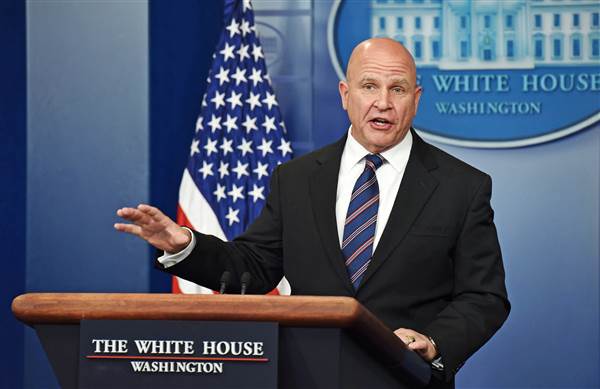
Today, National Security Adviser H.R. McMaster defends Trump’s decision to share classified information with the Russians
A couple of comments. First, the president has broad powers of declassification and the discretion to share sensitive secrets with others. Sharing classified information with the Russians, an ally of a sort in the struggle against ISIS, is not necessarily a bad idea. Trump seems to have decided it was a way to strengthen relations and build trust at high levels with the Russian government, a defensible position, in my view.
Second, I’ll repeat here what I said about classification and the Hillary Clinton email scandal: Far too much information is classified by the U.S. government. Classification is vastly overused by our government to conceal many sins, blunders, nefarious designs, and who knows what else. There’s nothing sacred about secrecy; indeed, a democracy should prefer transparency, rather than stamping everything “secret” or “top secret” and thereby keeping nearly all Americans in the dark.
Obviously, I’m not privy to the exact nature of the intelligence shared, the sensitivity and vulnerability of the source(s) and collection methods, and so on. I’m not an intelligence trade-craft expert. So far, Israeli operatives seem unconcerned, but whether their blase attitude is feigned or not is unknown.
Americans elected Trump because he promised to do things differently. He campaigned on the idea of being unorthodox; indeed, he is unorthodox. Surely no one should be surprised when he decides to speak in the clear to Russian government officials on matters concerning ISIS and terrorism.
Repeat after me, America: Secrecy is not sacred. Transparency is desirable. So too is building trust with rivals as well as friends. Trump has his faults, major ones I believe, but this current controversy is a tempest in a teapot.
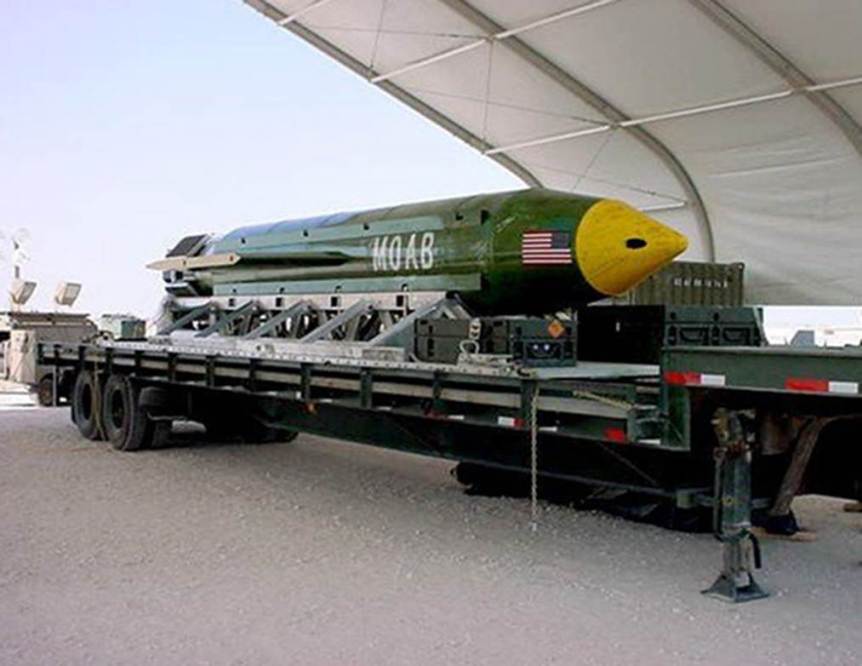
At this moment, it’s hard to think of a better symbol of American militarism than a giant bomb with a U.S. flag on it. President Donald Trump touted the use of the “mother of all bombs” (MOAB) in Afghanistan as a “very, very successful mission” even though evidence of that success is scant. He further cited MOAB as evidence of the “tremendous difference, tremendous difference” between his administration’s willingness to use force and Obama’s. In short, Trump loved MOAB precisely because Obama didn’t use it. To Trump, MOAB was a sort of penis extender and a big middle finger all-in-one. Virility and vulgarity.
MOAB is an icon of U.S. militarism, as are other weapons in the American arsenal. Weapons like our warplanes, aircraft carriers, Predator and Reaper drones, and Tomahawk and Hellfire missiles. U.S. foreign policy often hinges on or pivots about the deployment of these icons of power, whether it’s aircraft carriers and anti-missile systems being sent to Korea or more bombs and missiles being used in Iraq, Syria, and Afghanistan, among other countries.
Weapons sales further define U.S. foreign policy. Witness the recent announcement of $100 billion in arms for the Saudis, soon to be confirmed by Trump in his forthcoming trip to Saudi Arabia. This sale sets up even more military aid for Israel, in that Washington insists Israel must always maintain a qualitative edge in weaponry over its Arab rivals.
Unlike, say, Wilhelmine Germany, which elevated Field Marshal Paul von Hindenburg to iconic status during and after World War I, America today is lacking in winning generals. Sure, there have been a few pretenders. William Westmoreland in Vietnam, H. Norman Schwarzkopf in Desert Storm, Tommy Franks in Iraqi Freedom, and David Petraeus of “Surge” fame come to mind, but their “victories” were either illusory or lacking in staying power. Since we can’t idolize our generals, we celebrate our weapons instead.
These weapons are indeed iconic symbols. They capture an ideology of destruction. A predilection for spreading misery worldwide, as Tom Engelhardt notes in his latest must-read article at TomDispatch.com. As Engelhardt notes in his “send-out” message to his piece:
The first part of my latest post focuses on the now seven month-long U.S.-backed Iraqi military offensive against the city of Mosul, which shows little sign of ending and has reduced that city, like so many other places in the region, to ruins, if not rubble. Mosul, in other words, has been on my mind, but perhaps not completely for the reason you might expect. Its destruction (and the generation of yet more uprooted people and refugees) has led me to wonder what ever happened to the globalizers who for so many years told us about the wonders of tying the planet ever more tightly together and leveling all playing fields. It seems obvious to me that war, American-style, these last 15 years, has played a distinctly globalizing role on this ever smaller planet of ours — just globalizing misery, not happy news. In this piece I use the destruction of Mosul to lay out my thoughts on just what globalization really means in 2017, why the Trump presidency is linked to such grim events, and just why the globalizers have stopped talking about the phenomenon.
When I read Tom’s note above about the “leveling” of “playing fields,” my first thought was that America is indeed working to level the world — just not in the figurative sense of promoting economic equality, but in the literal sense of leveling areas with bombs, cities like Mosul, for example, or alleged training areas for terrorists in Afghanistan. As Engelhardt himself notes in his article, U.S. military action isn’t making the world flatter in the sense of equitable globalization; it’s simply flattening areas with overwhelming explosive force.
Most Americans simply don’t know or care much about foreign cities being leveled/flattened by America’s icons of power. You might say it’s not on our radar screens. The media and our leaders do a very good job of keeping us divided, distracted, and downtrodden. What American has time to worry about Mosul or some obscure region of Afghanistan? Unless or until the leveling and flattening come our way, to our cities and valleys, but by that point it will be far too late to act.
With all our talk of MOAB and aircraft carriers and missiles and their “beauty” and “tremendous success,” are we that far away from the lost souls in the movie “Beneath the Planet of the Apes,” who elevated the atomic bomb as their false idol, their version of the Biblical golden calf?
1. Andrew Bacevich at TomDispatch.com describes 24 stories/questions that are being ignored or neglected by the mainstream media as they obsess about Donald Trump. I’d like to add #25 to his list, as follows: Why is everything in America classified? The constant appeal to classification, to secrecy, prevents the discussion of vitally important military and security matters in public. Is the real target of all this secrecy our rivals and enemies, or is it the American people?
Related to my #25, of course, is the persecution of “whistleblowers” for allegedly violating secrecy. Under the Obama administration, people were accused of sedition and treason when their real “crime” was trying to keep the American people informed about what their government is really doing.
In short, when did the USA become the former Soviet Union, with its own NKVD/KGB and a state-controlled media that essentially promulgates and enforces the dictates of the powerful?
2. Afghanistan is a mess. According to this morning’s SITREP at FP: Foreign Policy, “Defense and intelligence officials are warning that the deteriorating situation in Afghanistan is likely to get worse before it ever gets better, despite the presence of thousands of U.S. troops and tens of billions invested in building and funding the faltering Afghan security forces.”
“’The intelligence community assesses that the political and security situation in Afghanistan will almost certainly deteriorate through 2018, even with a modest increase in military assistance by the United States and its partners,’ Director of National Intelligence Dan Coats said in a Senate hearing Thursday. The Pentagon is looking to add another 3,000 troops to the effort there in the coming months, pushing American advisors closer to the front lines to work directly with Afghan forces in the fight.”
After sixteen years of American/Coalition efforts, the Taliban is resurgent, yet the only strategy U.S. generals can offer is more troops and more money to train Afghan security forces that are mostly unreliable and often non-existent. Why can’t the U.S. military admit defeat and leave?
Consider a sports analogy. Last week, the Yankees-Cubs played an 18-inning game, eventually won by the Yankees. Game over. Imagine if the Cubs had said, “OK — We lost. But we want to keep playing. Maybe another 18 innings. Maybe forever. We just want to keep playing until we can claim, falsely even, that we’ve won.” We’d label the Cubs as crazy. As poor sports. As deluded.
But this is what America is in Afghanistan. We’ve lost in extra innings but we still want to keep playing — forever, it seems.
Daniel Ellsberg nailed it back in 2009. The U.S. is a foreign power in Afghanistan engaged in a bloody stalemate that cannot be won. Yet America persists, in part because U.S. presidents kowtow to military “judgment” and the idea that to withdraw from Afghanistan is to appear weak and unmanly.
3. Speaking of issues of manliness, Donald Trump (among others) likes to use the phrase “taking the gloves off” to refer to hyper-aggressive military actions. When did bare-knuckle brawling become a smart way to fight? Actually, it’s a great way to break your hand. Boxing is dangerous enough while wearing gloves, yet our Washington “fighters” are ready to get down and dirty by doffing their gloves. As I’ve written before, far too many Americans (and people in general) have died in the name of big-boy pants and similar machismo nonsense.
4. At TomDispatch.com, Army Major Danny Sjursen succinctly summarizes the U.S. military’s strategy in one word: More. As Sjursen puts it in his article:
Predictions are always a dicey matter, but recent history suggests that we can expect military escalation, which already seems to be underway in at least three of those countries. More, after all, remains the option of choice for America’s generals almost 70 years after MacArthur went head to head with his president over Korea.
What then is to be expected when it comes to the conflict with ISIS in Iraq, the complex, multi-faceted Syrian civil war, and America’s longest war of all, in Afghanistan? All signs point to more of the same. Open up a newspaper or check out a relevant website and you’ll find, for example, that U.S. Afghan commander General John Nicholson wants a new mini-surge of American troops dispatched into that country, while the U.S. commander in the fight against ISIS, General Stephen Townsend, may require yet more ground troops to “win” in Iraq and Syria.
More is the mantra of America’s generals. It’s how they measure their influence as well as their success. In this, they remind me of the gangster Johnny Rocco in the movie “Key Largo.” When Humphrey Bogart asks Rocco what he wants, Rocco pauses, after which Bogart has the answer that Rocco seizes upon: More. Will he ever get enough? Rocco answers: Well, I never have. No, I guess I won’t.
Even though Trump has promised a major hike in military spending for 2018, the Pentagon is already clamoring for more. Like Johnny Rocco, America’s generals and admirals can never get enough.
5. Finally, a dire lesson from history. When strong men seek to take over a government, they first seek to seize or neutralize the military and police forces of their country. It’s a time-tested formula. Consider Trump’s early actions. From his hiring of generals and his promises of scores of billions more for the Pentagon as well as to his hiring of good buddy Jeff Sessions as Attorney General and his firing of James Comey at the FBI, Trump is well on his way to winning over and controlling the agencies of violence and enforcement in the U.S.
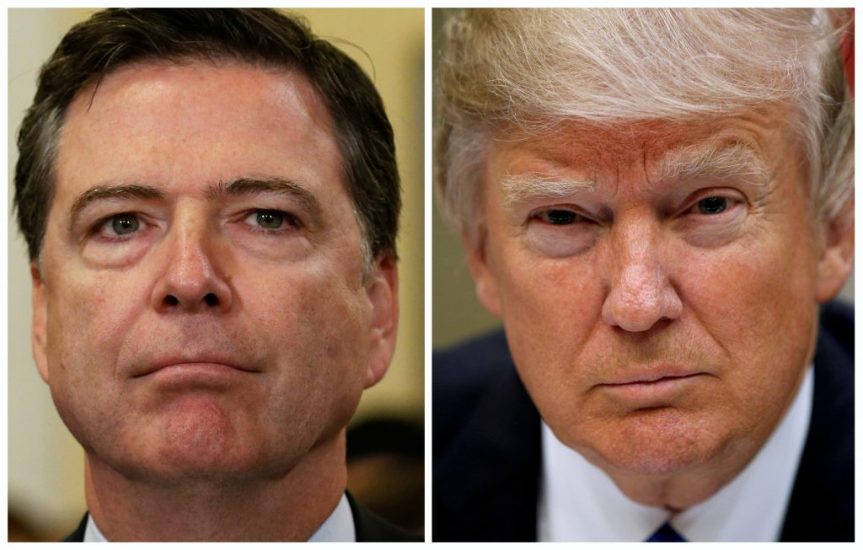
Comey is terminated. An ineffective leader? It takes one to know one.
W.J. Astore
Sometimes it’s necessary to state the obvious. The firing of FBI Director James Comey is not about his job performance and especially his handling of Hillary Clinton’s emails. It’s all about Donald J. Trump.
While I greatly appreciate you informing me, on three separate occasions, that I am not under investigation, I nevertheless concur with the judgment of the Department of Justice that you are not able to effectively lead the Bureau.
The bolded phrase is remarkable. Trump is at pains to suggest that Comey is not investigating him, yet the FBI is indeed looking into Russian influence in the 2016 election, including ties between the Trump campaign and Russian officials.
Whether you believe the whole Russian influence dispute is a made-up scandal, a red herring, so to speak, the fact is that Trump sees it as a major threat to his prerogatives and power. That’s why he’s at pains to state bluntly that Comey is not investigating him. Comey, Trump says, told him three times — three times! — he’s not under investigation.
The president doth protest too much. If you think Comey is unable to lead effectively, fire him for that reason. You don’t need to include a self-aggrandizing statement of how blameless or innocent you are in the ongoing Russian investigation.
Trump’s firing of Comey, moreover, displays his petulance, his impetuousness, and indeed his nervousness about the trajectory of his presidency.
As the CEO of a family business, Trump is used to firing people who don’t kowtow to him. Running a nation, however, is not like running a family business. Right?
Will Trump prevail? Time will tell. One thing is certain: American democracy — what’s left of it — suffered another body blow yesterday.
Joe Bageant was a remarkable writer, the author of “Deer Hunting with Jesus” as well as “Rainbow Pie.” A self-confessed “redneck,” he worked his way into the middle class as an editor, but he never forgot his roots in Appalachia and the subsistence farming of his Scots-Irish family. Bageant had a brutally honest and unadorned way of speaking and writing, and also a great affection and deep respect for traditional communal values in America.
The other day, I was reading an old essay Bageant wrote, “Live from Planet Norte” (June 2010), long before Donald Trump was even remotely considered to be presidential material. As usual, Joe nailed it:
[I]n the process of building our own gilded rat-cage, we have proven that old saw about democracy eventually leading to mediocrity to be true. Especially if you keep dumbing down all the rats. After all, Dan Quayle, Donald Trump and George W. Bush hold advanced degrees from top universities in law, finance and business.
The head rats, our “leaders” (if it is even possible to lead anybody anywhere inside a cage), have proven to be as mediocre and clueless as anyone else. Which is sort of proof we are a democracy, if we want to look at it that way. While it is a myth that virtually anybody can grow up to be president, we have demonstrated that nitwits have more than a fighting chance. During my 40 years writing media ass-wipe for the public, I have interviewed many of “the best of my generation,” and, believe me, most of them were not much.
Naturally, they believe they are far superior by virtue of having made it to an elevated point in the gilded cage, closer to the feed, water and sex. Because they believe it, and the media–sycophants waiting for quotes–echoes their belief, discussing their every brain fart, we tend to believe it, too. Nothing shakes our belief, not even staring directly into the face of a congenital liar and nitwit like Sarah Palin, or a careening set of brainless balls like Donald Trump or a retarded jackal like George W. Bush.
Americans are unable to explain why such people “rise to the top” in our country. We just accept that they do, and assume that America’s process of natural selection – the survival of the wealthiest – is at work. These people are rich; therefore, they should run the country. God said so. It’s a uniquely American principal of governance, which in itself, makes the case for our stupidity.
Donald Trump is best at selling a certain image of himself: the self-made billionaire, the savvy deal-maker, the populist patriot who sides with the little guy. But Joe Bageant had him pegged: a careening set of brainless balls is maybe the best, and certainly the most colorful, descriptor I’ve come across for Trump.
Bageant’s larger question is clear: How did Americans come to value such nitwits, halfwits, and dimwits? Just because they have money? Just because they have a veneer of “success” about them, when this “success” is evidenced by nothing more than money or fame and the sly charm of grifters?
Americans, who worship at the altar of success as measured by the almighty dollar, are kneeling to pray before the empty suits of men like Donald Trump. Bageant knew better than to join that mindless cult; so should we all.
Memories of War: So powerful yet often so fragmentary
W.J. Astore
Memories of war are powerful and fragmentary. At a national level, we do best at remembering our own war dead while scarcely recognizing the damage to others. This is one cost of nationalism. Nationalism is violent, bigoted, and discriminatory. It elevates a few at the expense of the many. It fails fully to recognize common human experience, even one as shattering as war.
One example. I’ve visited the Vietnam War Memorial in Washington, D.C. In seeing all those names of American dead on the wall, I was moved to tears. It’s a remarkable memorial, but what it fails to capture is any sense of the magnitude of death from that war visited upon Vietnam, Laos, and Cambodia. As I wrote for Alternet, to visualize the extent of death from America’s war in Southeast Asia, the Vietnamese would need a wall that would be roughly 20 to 50 times as long as ours.
Think about that for a moment. A wall perhaps 50 times as long as our Vietnam memorial wall. It’s a staggering mental image. Sadly, today in America the only wall garnering much media interest is Trump’s wall along our border with Mexico, yet another manifestation of nationalist bigotry and bias.
John Dower challenges us to think differently. To explore our common humanity. To remember the war dead of other nations and peoples, and to record the true cost of America’s wars, both to others and to ourselves. His latest article at TomDispatch.com explores how Americans both remember and forget their wars. Here’s an excerpt:
While it is natural for people and nations to focus on their own sacrifice and suffering rather than the death and destruction they themselves inflict, in the case of the United States such cognitive astigmatism is backlighted by the country’s abiding sense of being exceptional, not just in power but also in virtue. In paeans to “American exceptionalism,” it is an article of faith that the highest values of Western and Judeo-Christian civilization guide the nation’s conduct — to which Americans add their country’s purportedly unique embrace of democracy, respect for each and every individual, and stalwart defense of a “rules-based” international order.
Such self-congratulation requires and reinforces selective memory. “Terror,” for instance, has become a word applied to others, never to oneself. And yet during World War II, U.S. and British strategic-bombing planners explicitly regarded their firebombing of enemy cities as terror bombing, and identified destroying the morale of noncombatants in enemy territory as necessary and morally acceptable. Shortly after the Allied devastation of the German city of Dresden in February 1945, Winston Churchill, whose bust circulates in and out of the presidential Oval Office in Washington (it is currently in), referred to the “bombing of German cities simply for the sake of increasing the terror, though under other pretexts.”
Too often, Americans believe they’re waging a war on terror, forgetting that war itself is terror. That war itself is evil. That doesn’t mean that war is never justified, as it was, I believe, in the struggle against Nazi tyranny in World War II. Even in justifiable wars, however, we need to recognize that war breeds corruption; that war, in essence, is corruption, a corruption of the human spirit, of a humanity which should be held in common and nourished, but which during war is degraded if not destroyed.
John Dower recognizes this. It’s a theme he explores in his new book, The Violent American Century: War and Terror Since World War Two. Consider it a primer on war’s many corruptions, and a precis of America’s tendency toward a nationalism of callous indifference when it comes to the damages we inflict on others. It’s not happy reading, but then again wars shouldn’t be a subject for happiness.
A remarkable primer and meditation on America’s endless wars
Wars and rumors of war seem always to be with us. Some would say they’re an inevitable part of the human condition. Our historical record seems to support that grim conclusion. Yet there is another way, a more pacific path, a path toward peace. But to walk that path, we must first fully recognize the tangled undergrowth of war that imperils our every footstep. Dower’s latest book helps us to do just that.
News this week that 300 Marines have returned to Helmand Province in Afghanistan recalls the failed surge of 2009-10, when roughly 20,000 Marines beat back the Taliban in the region, only to see those “fragile” gains quickly turn to “reversible” ones (to cite the infamous terms of General David Petraeus, architect of that surge).
While fragility and reversibility characterize American progress, the Taliban continues to make real progress. According to today’s report at FP: Foreign Policy, “the Taliban controls or contests about 40 percent of the districts in the country, 16 years after the U.S. war there began.” Meanwhile, in January and February more than 800 Afghan troops were killed fighting the Taliban, notes Foreign Policy, citing a report by the Special Inspector General for Afghan Reconstruction. That’s a high figure given that fighting abates during the winter.
Besides committing fresh U.S. Marines to more Afghan security forces “training,” the U.S. military has responded with PR spin. For example, when friendly Afghan forces abandoned a district and police headquarters, a U.S. spokesman claimed it had been “repositioned.” According to FP: Foreign Policy, “U.S. forces helped in ferrying [Afghan] government troops and workers out, and American jets came back to destroy the rest of the buildings and vehicles left behind.” Literally, the old district center and its resources had to be destroyed, and a new one created, for the Afghan position to be “saved.”
Destroying things to “save” them: Where have we heard that before? The Vietnam War, of course, a lesson not lost on Aaron O’Connell, a U.S. Marine who edited the book “Our Latest Longest War: Losing Hearts and Minds in Afghanistan.” O’Connell’s recent interview with NPR cites the Vietnam example as he explains the one step forward, two steps back, nature of America’s Afghan War. In his words:
So we’ve spent billions building roads in Afghanistan, but we then turned the roads over to the Afghans in 2013. We trained up a maintenance unit so that it could provide for road maintenance, and nothing has happened since then. Now, today, more than half of the roads are deemed unfit for heavy traffic. And as one taxi driver put it in 2014 – things have gotten so much worse, now if we drive too fast, everyone in the car dies.
So it’s – really, we have to think about the things that are sustainable.
Americans have spent an enormous amount of money in Afghanistan without thinking about how to sustain the improvements we’ve funded. Meanwhile, as O’Connell notes, the security situation (as in lack of security) in Afghanistan undermines those infrastructure efforts.
With respect to U.S. efforts to create a viable Afghan Army, O’Connell doesn’t mince words about its failings:
[T]he massive assembly-line attempt to produce capable, professional national security forces has not worked well, and it’s been at tremendous cost. And for all those who say we should just keep doing what we’re doing in Afghanistan, let me explain why that’s not sustainable. Every year, between a quarter and a third of the Afghan army and the police desert. Now, these are people that we have armed and trained. We’ve given weapons to them. We’ve given them basic military training. And every year, a third of them disappear [with their guns].
Here’s the grim reality: U.S. military efforts to take charge and win the war, as in “winning hearts and minds” (known as WHAM) in 2009-10, proved unsustainable. Follow-on efforts to turn the war over to the Afghan government (analogous to LBJ and Nixon’s “Vietnamization” policy in the waning years of the Vietnam War) are also failing. Yet America’s newest commanding general in Afghanistan wants yet more troops for yet more “training,” effectively doubling down on a losing hand.
Required reading for those with eyes to see and ears to hear
The logical conclusion – that’s it’s high-time U.S. forces simply left Afghanistan – is never contemplated in Washington. This is why Douglas Wissing’s book, “Hopeless But Optimistic: Journeying through America’s Endless War in Afghanistan,” is so immensely valuable. Wissing is a journalist who embedded with U.S. forces in Afghanistan in 2013. His book consists of short chapters of sharply drawn vignettes focusing on the street and grunt level. Its collective lesson: Afghanistan, for Americans, doesn’t really exist as a country and a people. It exists only as a wasteful, winless, and endless war.
What is Afghanistan to Americans? It’s an opportunity for profit and exploitation for contractors. It’s a job as well as a personal proving ground for U.S. troops. It’s a chance to test theories and to earn points (and decorations) for promotion for many officers. It’s hardly ever about working closely with the Afghan people to find solutions that will work for them over the long haul.
A telling example Wissing cites is wells. Americans came with lots of money to drill deep water wells for Afghan villagers and farmers (as opposed to relying on traditional Afghan irrigation systems featuring underground channels that carry mountain water to the fields with minimal evaporation). Instead of revolutionizing Afghan agriculture, the wells drove down water tables and exhausted aquifers. As the well-digging frenzy (Wissing’s word) disrupted Afghanistan’s fragile, semiarid ecosystem, powerful Afghans fought to control the new wells, creating new tensions among tribes. The American “solution,” in sum, is exacerbating conflict while exhausting the one resource the Afghan people can’t do without: water.
Then there’s the “poo pond,” a human sewage lagoon at Kandahar Air Field that was to be used as a source for organic fertilizer. I’ll let Wissing take the tale from here:
But instead of enriching Afghan soil, the U.S.-led coalition forces decided to burn the mountains of fertilizer with astronomically expensive imported gasoline. The [U.S. air force] officer reminded me that the Taliban got $1500 in protection money for each U.S. fuel tanker they let through, so in the process the jihadists were also able to skim the American shit [from the poo pond].
Walking back, I spot a green metal dumpster stenciled with a large sign that reads, “General Waste Only.” At that moment, it seems to sum up the whole war.
Wissing’s hard-edged insights demonstrate that America is never going to win in Afghanistan, unless “winning” is measured by money wasted. Again, Americans simply see Afghanistan too narrowly, as a “war” to won, as a problem to be managed, as an environment to be controlled.
Indeed, the longstanding failure of our “answers” is consistent with the military’s idea we’re fighting a generational or “long” war. We may be failing, but that’s OK, since we have a “long” time to get things right.
After sixteen years and a trillion dollars, the answer in Afghanistan is not another sixteen years and another trillion dollars. Yet that’s exactly what America seems prepared to do in the endless war that to us defines Afghanistan.
Update (5/5/17): According to FP: Foreign Policy, “‘More conventional forces that would thicken the ability to advise and assist Afghan forces — that would absolutely be to our benefit,’ said Gen. Tony Thomas, head of U.S. Special Operations Command who testified alongside Whelan. President Trump is attending a NATO summit in Brussels on May 25, and a decision is expected by then.”
I love that word: thicken. The general refuses to say “improve.” And that’s probably because more U.S. troops really won’t improve training, in the sense of enhancing Afghan forces’ effectiveness. As FP reports, “Washington has spent about $71 billion training and equipping the Afghan army over the past 16 years, and despite that investment, the Taliban remains in control of large areas of the country and outside terrorist groups like the Islamic State have moved in.”
But not to worry: More “thickening” is coming in the form of more U.S. troops and money.
Insanity: repeating the same course of action again and again and yet expecting different results.
Today, I saw another article on why America is losing its wars in places like Iraq, Afghanistan, and elsewhere. The gist of this and similar articles is that America’s wars are winnable. That is, if we bomb more, or send more troops, or change our strategy, or alter our ROE (rules of engagement), or give more latitude to the generals, or use all the weapons at our disposal (to include nukes?), and so on, these wars will prove tractable and even winnable. This jibes with President Trump’s promises about America winning again, everywhere, especially in wars.
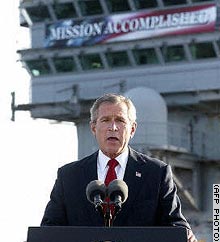
Sorry: The Missions Are Never Going to be “Accomplished”
Nonsense. The U.S. military hasn’t won these wars since the wars themselves are unwinnable by U.S. military action. Indeed, U.S. military action only makes them worse.
Consider Iraq. Our invasion in 2003 and our toppling of Saddam kicked off a regional, religious, ethnic, and otherwise complicated civil war that is simply unwinnable by American troops. Indeed, the presence of (and blunders made by) American troops in Iraq helped to produce ISIS, much-hyped as the current bane of American existence.
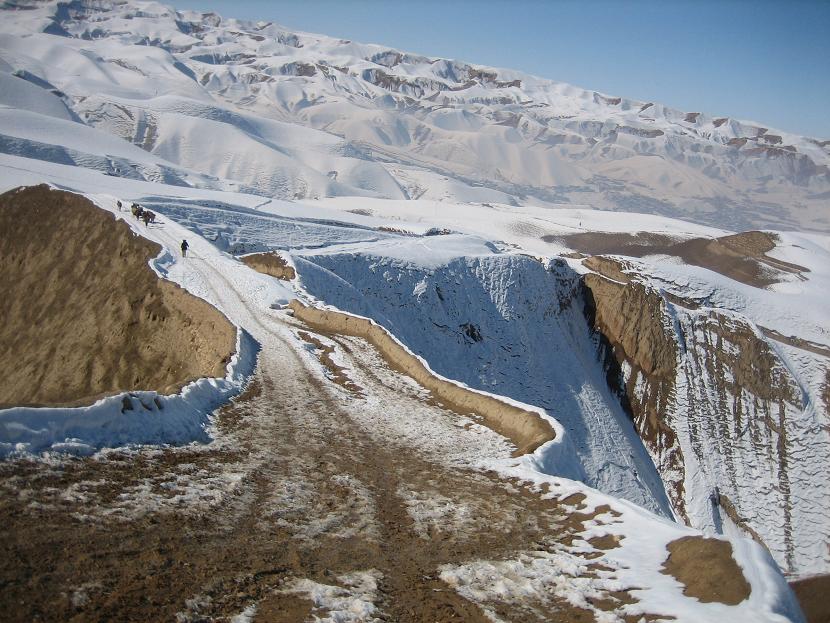
Consider Afghanistan. Our invasion in 2001 toppled the Taliban, at least for a moment, but did not produce peace as various Afghan factions and tribes jostled for power. Over time, the U.S. and NATO presence in the country produced instability rather than stability even as the Taliban proved both resilient and resurgent. U.S. and NATO forces have simply become yet another faction in the Afghan power game, but unless we want to stay there permanently, we are not going to “win” by any reasonable definition of that word.
You could say the same of the U.S. military’s involvement in similar conflicts like Yemen or Syria (look at the mess we made of Libya). We can kill a lot of “terrorists” and drop a lot of bombs, spreading our share of chaos, but we aren’t going to win, not in the sense of these wars ending on terms that enhance U.S. national security.
This hard reality is one that the U.S. military explains away by using jargon. Military men talk of generational wars, of long wars, of fourth generation warfare, of gray zones, of military operations other than war (which has its own acronym, MOOTW), and so on. A friend of mine, an Air Force captain, once quipped: “You study long, you study wrong.” You can say something similar of war: “You wage war for long, you wage it wrong.” This is especially true for a democracy.
America’s wars today are unwinnable. They are unwinnable not only because they are not ours to win: they aren’t even ours. We refuse to take ownership of them. At the most fundamental level, we recognize they are not vital to us, since we don’t bother to unify as a country to declare war and to wage it. Most Americans ignore them because we can ignore them. The Afghans, the Iraqis, the Syrians, and so on don’t have the luxury of ignoring them.
Trump, with all his talk of winning, isn’t going to change this. The more he expands the U.S. military, the more he leans on “his” generals for advice, the more he’s going to fail. Our new commander-in-chief needs to learn one lesson: The only way to win America’s wars is to end them.
The NFL draft is back on TV this weekend with blanket coverage by ESPN. As I wrote this time a year ago, what if Americans paid as much attention to their wars as they did their NFL teams (including of the “fantasy” variety)? I’m always dazed and amazed by the sheer work that goes into the NFL draft: the thoroughness of it all, the expertise on display, the active and informed involvement of the fans. Imagine if ESPN (or any media outlet, for that matter) covered America’s wars with the same commitment to detail and facts as is displayed yearly for American football!
As I wrote last year: “To win the war on terror, let’s put ESPN in charge of intelligence gathering and coverage. Just imagine if your average red-blooded American devoted as much attention to foreign wars as they do to their favorite NFL team! Just imagine if America’s leaders were held accountable for poor results as NFL coaches and staffs are! America still might not win its wars, but at least we’d squarely face the fact that we’re continuing to lose at incredibly high cost.”
This weekend, I watched a few minutes of NFL draft coverage on ESPN. If you’re not familiar with NFL football or ESPN coverage of the same in the USA, you should be, because it says much about the American moment. The first round of the draft kicks off on Thursday night in prime time, followed by the second and third rounds on Friday night in prime time. The draft concludes on Saturday with rounds four through seven, roughly 250 total picks if you include “supplemental” picks.
Yet this quick summary vastly understates the coverage devoted to the draft. From the end of the Super Bowl early in February to the draft itself at the end of April, coverage of the draft on ESPN is virtually non-stop, with innumerable “mock” drafts for each team and a parade of “experts” speculating…
Seven years ago, I wrote an article for TomDispatch.com on American kleptocracy. At the time, it seemed a bit of a stretch. Sure, America was (and is) plutocratic. But kleptocratic? Like a third-world dictatorship in which family members of the ruler enrich themselves while being appointed to government offices for which they’re eminently unqualified? Surely not! But here we are, in 2017, with Trump as president and his son-in-law Jared Kushner seemingly running everything and with daughter Ivanka the “First Daughter” and pseudo-First Lady. I didn’t see that one coming.
Jared and Ivanka: Good at looking good
Anyway, here’s my original article, unedited, from 2010.
American Kleptocracy
How Fears of Socialism and Fascism Hide Naked Theft
By William J. Astore
Kleptocracy — now, there’s a word I was taught to associate with corrupt and exploitative governments that steal ruthlessly and relentlessly from the people. It’s a word, in fact, that’s usually applied to flawed or failed governments in Africa, Latin America, or the nether regions of Asia. Such governments are typically led by autocratic strong men who shower themselves and their cronies with all the fruits of extracted wealth, whether stolen from the people or squeezed from their country’s natural resources. It’s not a word you’re likely to see associated with a mature republic like the United States led by disinterested public servants and regulated by more-or-less transparent principles and processes.
In fact, when Americans today wish to critique or condemn their government, the typical epithets used are “socialism” or “fascism.” When my conservative friends are upset, they send me emails with links to material about “ObamaCare” and the like. These generally warn of a future socialist takeover of the private realm by an intrusive, power-hungry government. When my progressive friends are upset, they send me emails with links pointing to an incipient fascist takeover of our public and private realms, led by that same intrusive, power-hungry government (and, I admit it, I’m hardly innocent when it comes to such “what if” scenarios).
What if, however, instead of looking at where our government might be headed, we took a closer look at where we are — at the power-brokers who run or influence our government, at those who are profiting and prospering from it? These are, after all, the “winners” in our American world in terms of the power they wield and the wealth they acquire. And shouldn’t we be looking as well at those Americans who are losing — their jobs, their money, their homes, their healthcare, their access to a better way of life — and asking why?
If we were to take an honest look at America’s blasted landscape of “losers” and the far shinier, spiffier world of “winners,” we’d have to admit that it wasn’t signs of onrushing socialism or fascism that stood out, but of staggeringly self-aggrandizing greed and theft right in the here and now. We’d notice our public coffers being emptied to benefit major corporations and financial institutions working in close alliance with, and passing on remarkable sums of money to, the representatives of “the people.” We’d see, in a word, kleptocracy on a scale to dazzle. We would suddenly see an almost magical disappearing act being performed, largely without comment, right before our eyes.
Of Red Herrings and Missing Pallets of Money
Think of socialism and fascism as the red herrings of this moment or, if you’re an old time movie fan, as Hitchcockian MacGuffins — in other words, riveting distractions. Conservatives and tea partiers fear invasive government regulation and excessive taxation, while railing against government takeovers — even as corporate lobbyists write our public healthcare bills to favor private interests. Similarly, progressives rail against an emergent proto-fascist corps of private guns-for-hire, warrantless wiretapping, and the potential government-approved assassination of U.S. citizens, all sanctioned by a perpetual, and apparently open-ended, state of war.
Yet, if this is socialism, why are private health insurers the government’s go-to guys for healthcare coverage? If this is fascism, why haven’t the secret police rounded up tea partiers and progressive critics as well and sent them to the lager or the gulag?
Consider this: America is not now, nor has it often been, a hotbed of political radicalism. We have no substantial socialist or workers’ party. (Unless you’re deluded, please don’t count the corporate-friendly “Democrat” party here.) We have no substantial fascist party. (Unless you’re deluded, please don’t count the cartoonish “tea partiers” here; these predominantly white, graying, and fairly affluent Americans seem most worried that the jackbooted thugs will be coming for them.)
What drives America today is, in fact, business — just as was true in the days of Calvin Coolidge. But it’s not the fair-minded “free enterprise” system touted in those freshly revised Texas guidelines for American history textbooks; rather, it’s a rigged system of crony capitalism that increasingly ends in what, if we were looking at some other country, we would recognize as an unabashed kleptocracy.
Recall, if you care to, those pallets stacked with hundreds of millions of dollars that the Bush administration sent to Iraq and which, Houdini-like, simply disappeared. Think of the ever-rising cost of our wars in Iraq and Afghanistan, now in excess of a trillion dollars, and just whose pockets are full, thanks to them.
If you want to know the true state of our government and where it’s heading, follow the money (if you can) and remain vigilant: our kleptocratic Houdinis are hard at work, seeking to make yet more money vanish from your pockets — and reappear in theirs.
From Each According to His Gullibility — To Each According to His Greed
Never has the old adage my father used to repeat to me — “the rich get richer and the poor poorer” — seemed fresher or truer. If you want confirmation of just where we are today, for instance, consider this passage from a recent piece by Tony Judt:
In 2005, 21.2 percent of U.S. national income accrued to just 1 percent of earners. Contrast 1968, when the CEO of General Motors took home, in pay and benefits, about sixty-six times the amount paid to a typical GM worker. Today the CEO of Wal-Mart earns nine hundred times the wages of his average employee. Indeed, the wealth of the Wal-Mart founder’s family in 2005 was estimated at about the same ($90 billion) as that of the bottom 40 percent of the U.S. population: 120 million people.
Wealth concentration is only one aspect of our increasingly kleptocratic system. War profiteering by corporations (however well disguised as heartfelt support for our heroic warfighters) is another. Meanwhile, retired senior military officers typically line up to cash in on the kleptocratic equivalent of welfare, peddling their “expertise” in return for impressive corporate and Pentagon payouts that supplement their six-figure pensions. Even that putative champion of the Carhartt-wearing common folk, Sarah Palin, pocketed a cool $12 million last year without putting the slightest dent in her populist bona fides.
Based on such stories, now legion, perhaps we should rewrite George Orwell’s famous tagline from Animal Farm as: All animals are equal, but a few are so much more equal than others.
And who are those “more equal” citizens? Certainly, major corporations, which now enjoy a kind of political citizenship and the largesse of a federal government eager to rescue them from their financial mistakes, especially when they’re judged “too big to fail.” In raiding the U.S. Treasury, big banks and investment firms, shamelessly ready to jack up executive pay and bonuses even after accepting billions in taxpayer-funded bailouts, arguably outgun militarized multinationals in the conquest of the public realm and the extraction of our wealth for their benefit.
Such kleptocratic outfits are, of course, abetted by thousands of lobbyists and by politicians who thrive off corporate campaign contributions. Indeed, many of our more prominent public servants have proved expert at spinning through the revolving door into the private sector. Even ex-politicians who prefer to be seen as sympathetic to the little guy like former House Majority Leader Dick Gephardt eagerly cash in.
I’m Shocked, Shocked, to Find Profiteering Going on Here
An old Roman maxim enjoins us to “let justice be done, though the heavens fall.” Within our kleptocracy, the prevailing attitude is an insouciant “We’ll get ours, though the heavens fall.” This mindset marks the decline of our polity. A spirit of shared sacrifice, dismissed as hopelessly naïve, has been replaced by a form of tribalized privatization in which insiders find ways to profit no matter what.
Is it any surprise then that, in seeking to export our form of government to Iraq and Afghanistan, we’ve produced not two model democracies, but two emerging kleptocracies, fueled respectively by oil and opium?
When we confront corruption in Iraq or Afghanistan, are we not like the police chief in the classic movie Casablanca who is shocked, shocked to find gambling going on at Rick’s Café, even as he accepts his winnings?
Why then do we bother to feign shock when Iraqi and Afghan elites, a tiny minority, seek to enrich themselves at the expense of the majority?
Shouldn’t we be flattered? Imitation, after all, is the sincerest form of flattery. Isn’t it?









 Our wars are games and our games are wars