

What It Really Means
MAY 07, 2026
The other day, I was reading an old Atlantic Monthly and came across the following cartoon:
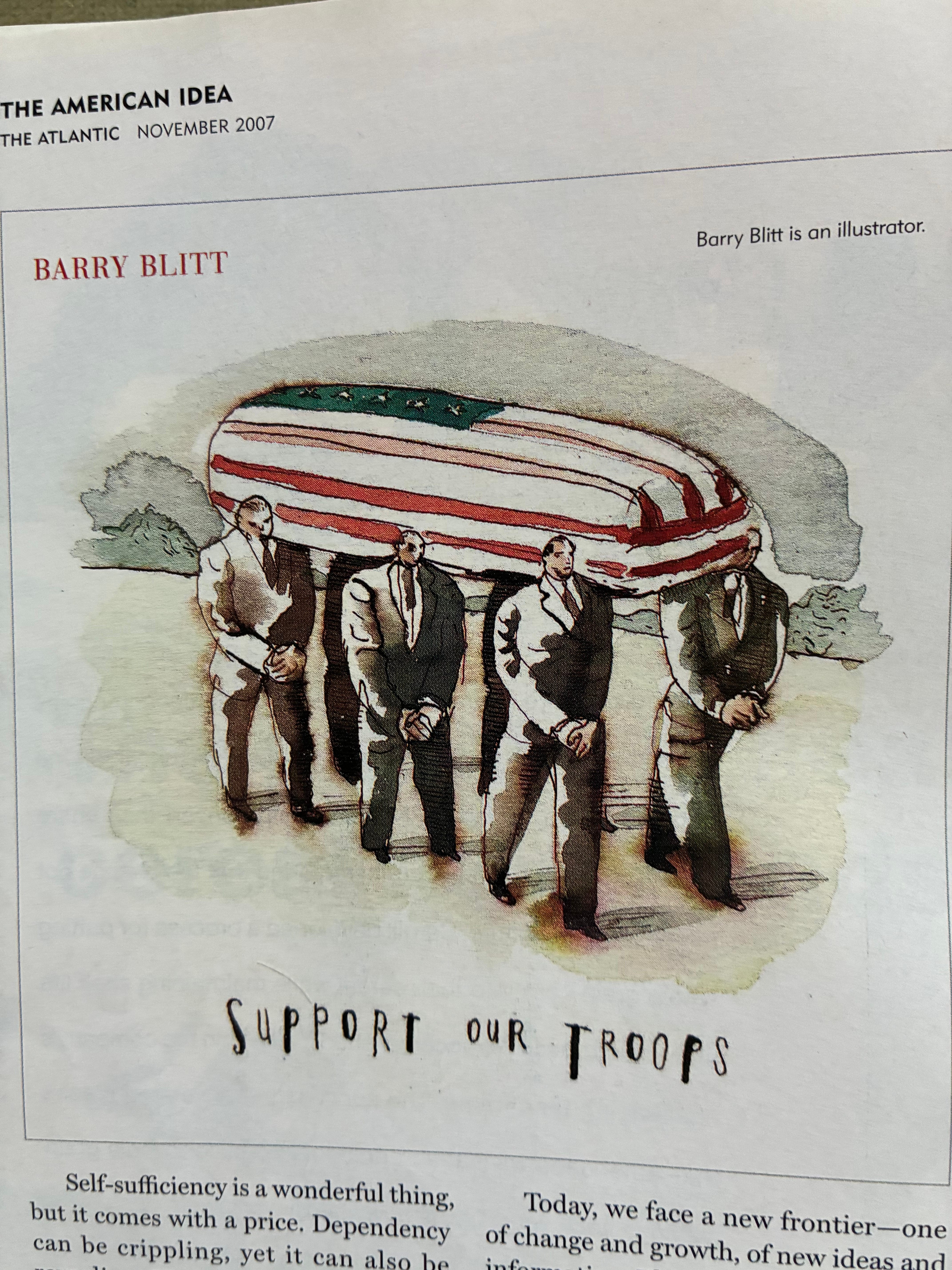
That is one powerful image. I like the tiny heads on the pallbearers. They make me think of the posturing politicians who tell us to “support our troops” while sending them to die in illegal, immoral, and unconstitutional wars.
That cartoon was published near the end of 2007, when America’s disastrous war of choice in Iraq was supposedly improving due to the Petraeus Surge. Of course, General David Petraeus qualified his surge by saying its gains might prove “fragile” and “reversible.” And so they proved.
“Support our troops” is a catchphrase, almost a mantra, often used by cynical politicians to suppress dissent about their disastrous wars of choice. Basically, dissenters are accused of being unpatriotic because their criticism allegedly betrays the troops and weakens national resolve. It’s a BS argument but it’s often compelling and even convincing to some.
Americans have a civic religion defined by the Pledge of Allegiance, the flag, the National Anthem, military parades and pageantry, and U.S. history taught as heritage and as a celebration of American goodness and greatness. When you step outside of that, when you criticize it, dissent from it, you must be prepared to be attacked as a heretic.
Back in 2010, I wrote an article for TomDispatch in which I argued that not every American troop is a hero. I argued instead that real heroes are few and far between, and that the ideal of heroism shouldn’t be associated so closely, even almost exclusively, with military service. These are obvious points (to me, at least), but I took some flak for suggesting that merely donning a military uniform doesn’t and shouldn’t make one a “hero.”
I remain convinced that hyping the troops as universal “heroes” isn’t a form of support. The troops know better. If you truly want to support them, listen to them. Be an informed and knowledgeable citizen. Speak your mind and don’t be afraid to criticize those who seek to use the military for dishonorable or indefensible purposes.
Since this is America, theoretically land of the free, feel free as well to speak out against the military. Our founders were suspicious of large standing armies and were wary of wars as being especially pernicious to democracy.
We Americans celebrate our troops for defending freedom, yet we paradoxically attack those who try to exercise their freedom by denouncing war and militarism. You can’t have it both ways. Unless you want hypocrisy instead of democracy, you can’t celebrate freedom while denying it.
This was, of course, the so-called original sin of the American republic: celebrating freedom while also enshrining the institution of slavery. Rank hypocrisy led inexorably to the U.S. Civil War.
As a retired U.S. military officer, I’ve been thanked for my service more often than I’ve been denounced as a murderous agent of American empire. It’s easy to accept the thanks; slurs and attacks are what they are. People sometimes think to defame or demean others is a way to elevate themselves. So be it.
Another aspect of “support our troops” is communal ritual to mark the passing of local “heroes.” Such rituals take various forms. In my community, one involves a mass motorcycle ride in memory of “fallen” troops killed since 9/11. The language used is that of America’s civic religion, celebrating our “great country” and those “heroes” who’ve made the “ultimate sacrifice.”
It’s easy to acquiesce to that language and sentiment. It’s also easy to attack it and dismiss it as patriotic claptrap.
I see it as something else: a communal rite. A recognition of sacrifice. Even if that sacrifice was not in a worthy cause.
I’m not a fan of these communal rituals and the often cynical uses to which they’re put, but I recognize their potency and the need of some people to participate in them. It’s a collective expression of belonging, of grief, of community. A place to find meaning.
A reader put it very well to me in response to my article on heroes in 2010. I saved the letter and have never quoted from it before but I’d like to do so now:
I think the reason we see the “heroification” of so many is a desperate need of so many to feel a sense of self worth. This is especially true in the working class, who have seen their cultural value, their hopes for the future and the quality of their lives decline so radically in recent decades.
This week here in town we see the massive outpouring for the fallen Marine by those who need so desperately to feel a part of something bigger than themselves, when someone like themselves is honored. I see this as poignant in ways that go far beyond the family’s loss.
This is well and sensitively put. How often in our communal settings are “ordinary” people celebrated for anything? Our culture most often celebrates the rich, the powerful, Hollywood and sports “stars,” while neglecting the everyday heroism (or, if not heroism, acts of generosity) of people from all walks of life.
In sum, “our” troops don’t want to put on pedestals and plinths. They certainly don’t want to be carried in flag-draped caskets. And most don’t want to be celebrated as heroes because they know they haven’t earned it. What they want, I think, is to be understood. What they don’t want is to be wasted, to be betrayed, to be misused.
Who among us would want to see their life as a waste, who would wish to be betrayed, who would seek to be misused?
With Memorial Day approaching, it is good to ponder the wise words of Andy Rooney in the video below. Troops don’t give their lives. Their lives are taken from them. Something so precious shouldn’t be taken so lightly by leaders with neither compassion nor conscience. Even better, as Andy Rooney suggests, is a future where war withers away and peace brings out the very best in us.
 Bracing Views
Troops are tools, human beings turned into tools. A hammer does what a hammer is designed to do, its only purpose. The horror of using a human being as a tool in war is that a human has no fixed purpose and is free to come up with a purpose for itself. To dedicate a human being to killing other human beings is a double tragedy. A third tragedy is that a human being can stand over this and willingly, even eagerly direct the killing of innumerable human beings in complete disregard for all who die as anything other than tools destroying objects.
Saying “support our troops” one might as well say, “support our Apache helicopters” or “support our howitzers” that are also tools, obvious nonsense. The only reason “support our troops” is used is to call on the natural sympathy we have for our fellow citizens that we care about to distract from the horror of what is being done. It isolates them in our minds from what they are being used to do: kill and destroy. It is a perfect example of a red herring used with an unpopular war.
LikeLiked by 1 person
Your second paragraph exposes the ruse. It is the Wizard of Ordnance pulling the levers behind the Curtain of War to make us think he is all powerful, all knowing, all virtuous, that all troops are unselfishly in service to that noble calling.
All bulls***.
LikeLike
Not that other “Bracing Views” entries weren’t sufficient reason to call for it, but this one really says that a compendium of them, plus earlier “Tom Dispatch” ones, need to be put in book form. Certainly for the topics covered, but also for the refined, sophisticated thought; the nuance; the perception; the deftness in expression; the sensitivity. For certain, a picture is worth a thousand words, a pithy cartoon perhaps even more so. Here, about 1,000 speak tens of thousands lying behind those too familiar, too unexamined ones, “Support Our Troops.”
LikeLike