6000 Bombs in Six Days

W.J. Astore

The Israeli Air War on Gaza

I read today that Israel has already dropped 6000 bombs on Gaza in six days. Here’s the report from the Wall Street Journal:

The Israeli Air Force said it has dropped about 6,000 bombs targeted at Hamas in Gaza since the war began, adding that it will continue the campaign as long as necessary. The airstrikes killed hundreds of Hamas militants and damaged the group’s military infrastructure, the Israeli Air Force said in a post on X, formerly known as Twitter.

The Israeli airstrikes caused extensive damage in several neighborhoods in Gaza, killing more than 1,500 Palestinians, nearly half of whom were women and children, according to the Palestinian Ministry of Health in Gaza. More than 1,300 Israelis have died since the Hamas assault began.

In 2019, I wrote an article for TomDispatch on the dark side of airpower. Included within were ten cautionary tenets about the use of airpower, with its illusion of “surgical” and “precision” strikes and the way video footage of the same obscures the deaths of innocents. Below are those tenets, unchanged from 2019.

More bombs will be dropped on Gaza in the coming days and weeks. I’m sure Israel will claim, just as U.S. military officials typically have in other wars, that those bombs mainly killed terrorists and other evildoers and that “collateral damage” (all those dead women and children and other innocents), though regrettable, has been limited. And so it goes.

Bomb crater in the Gaza Strip. We see damage to buildings and infrastructure but rarely do we see dead bodies. (Naaman Omar/Zuma Press)

Ten Cautionary Tenets About Air Power (2019)

1. Just because U.S. warplanes and drones can strike almost anywhere on the globe with relative impunity doesn’t mean that they should. Given the history of air power since World War II, ease of access should never be mistaken for efficacious results.

2. Bombing alone will never be the key to victory. If that were true, the U.S. would have easily won in Korea and Vietnam, as well as in Afghanistan and Iraq. American air power pulverized both North Korea and Vietnam (not to speak of neighboring Laos and Cambodia), yet the Korean War ended in a stalemate and the Vietnam War in defeat. (It tells you the world about such thinking that air power enthusiasts, reconsidering the Vietnam debacle, tend to argue the U.S. should have bombed even more — lots more.) Despite total air supremacy, the recent Iraq War was a disaster even as the Afghan War staggers on into its 18th catastrophic year. 

3. No matter how much it’s advertised as “precise,” “discriminate,” and “measured,” bombing (or using missiles like the Tomahawk) rarely is. The deaths of innocents are guaranteed. Air power and those deaths are joined at the hip, while such killings only generate anger and blowback, thereby prolonging the wars they are meant to end.

Consider, for instance, the “decapitation” strikes launched against Iraqi autocrat Saddam Hussein and his top officials in the opening moments of the Bush administration’s invasion of 2003. Despite the hype about that being the beginning of the most precise air campaign in all of history, 50 of those attacks, supposedly based on the best intelligence around, failed to take out Saddam or a single one of his targeted officials. They did, however, cause “dozens” of civilian deaths. Think of it as a monstrous repeat of the precision air attacks launched on Belgrade in 1999 against Slobodan Milosevic and his regime that hit the Chinese embassy instead, killing three journalists. 

Here, then, is the question of the day: Why is it that, despite all the “precision” talk about it, air power so regularly proves at best a blunt instrument of destruction? As a start, intelligence is often faulty. Then bombs and missiles, even “smart” ones, do go astray. And even when U.S. forces actually kill high-value targets (HVTs), there are always more HVTs out there. A paradox emerges from almost 18 years of the war on terror: the imprecision of air power only leads to repetitious cycles of violence and, even when air strikes prove precise, there always turn out to be fresh targets, fresh terrorists, fresh insurgents to strike.

4. Using air power to send political messages about resolve or seriousness rarely works. If it did, the U.S. would have swept to victory in Vietnam. In Lyndon Johnson’s presidency, for instance, Operation Rolling Thunder (1965-1968), a graduated campaign of bombing, was meant to, but didn’t, convince the North Vietnamese to give up their goal of expelling the foreign invaders — us — from South Vietnam. Fast-forward to our era and consider recent signals sent to North Korea and Iran by the Trump administration via B-52 bomber deployments, among other military “messages.” There’s no evidence that either country modified its behavior significantly in the face of the menace of those baby-boomer-era airplanes.

5. Air power is enormously expensive. Spending on aircraft, helicopters, and their munitions accounted for roughly half the cost of the Vietnam War. Similarly, in the present moment, making operational and then maintaining Lockheed Martin’s boondoggle of a jet fighter, the F-35, is expected to cost at least $1.45 trillion over its lifetime. The new B-21 stealth bomber will cost more than $100 billion simply to buy. Naval air wings on aircraft carriers cost billions each year to maintain and operate. These days, when the sky’s the limit for the Pentagon budget, such costs may be (barely) tolerable. When the money finally begins to run out, however, the military will likely suffer a serious hangover from its wildly extravagant spending on air power.

6. Aerial surveillance (as with drones), while useful, can also be misleading. Command of the high ground is not synonymous with god-like “total situational awareness.” It can instead prove to be a kind of delusion, while war practiced in its spirit often becomes little more than an exercise in destruction. You simply can’t negotiate a truce or take prisoners or foster other options when you’re high above a potential battlefield and your main recourse is blowing up people and things.

7. Air power is inherently offensive. That means it’s more consistent with imperial power projection than with national defense. As such, it fuels imperial ventures, while fostering the kind of “global reach, global power” thinking that has in these years had Air Force generals in its grip.

8. Despite the fantasies of those sending out the planes, air power often lengthens wars rather than shortening them. Consider Vietnam again. In the early 1960s, the Air Force argued that it alone could resolve that conflict at the lowest cost (mainly in American bodies). With enough bombs, napalm, and defoliants, victory was a sure thing and U.S. ground troops a kind of afterthought. (Initially, they were sent in mainly to protect the airfields from which those planes took off.) But bombing solved nothing and then the Army and the Marines decided that, if the Air Force couldn’t win, they sure as hell could. The result was escalation and disaster that left in the dust the original vision of a war won quickly and on the cheap due to American air supremacy.

9. Air power, even of the shock-and-awe variety, loses its impact over time. The enemy, lacking it, nonetheless learns to adapt by developing countermeasures — both active (like missiles) and passive (like camouflage and dispersion), even as those being bombed become more resilient and resolute. 

10. Pounding peasants from two miles up is not exactly an ideal way to occupy the moral high ground in war. 

The Road to Perdition

If I had to reduce these tenets to a single maxim, it would be this: all the happy talk about the techno-wonders of modern air power obscures its darker facets, especially its ability to lock America into what are effectively one-way wars with dead-end results.

For this reason, precision warfare is truly an oxymoron. War isn’t precise. It’s nasty, bloody, and murderous. War’s inherent nature — its unpredictability, horrors, and tendency to outlast its original causes and goals — isn’t changed when the bombs and missiles are guided by GPS. Washington’s enemies in its war on terror, moreover, have learned to adapt to air power in a grimly Darwinian fashion and have the advantage of fighting on their own turf.

Who doesn’t know the old riddle: If a tree falls in the forest and no one is there to hear it, does it make a sound? Here’s a twenty-first-century air power variant on it: If foreign children die from American bombs but no U.S. media outlets report their deaths, will anyone grieve? Far too often, the answer here in the U.S. is no and so our wars go on into an endless future of global destruction.

In reality, this country might do better to simply ground its many fighter planes, bombers, and drones. Paradoxically, instead of gaining the high ground, they are keeping us on a low road to perdition.

War Destroys History

W.J. Astore

The God of War Consumes All

The ancients were wise to make war a god. Violent, unpredictable, destructive, seductive, brutal, and capricious. And of course very, very powerful in its hold on the human mind.

Ares, the Greek god of war

I trained as a historian, where an understanding of facts, context, and other forms of evidence is all-important. War destroys history. War creates its own “facts.” Who needs context when you hear the cry: “We’re at war!”

Consider the Russia-Ukraine War. Americans are encouraged to believe the war began with Putin’s invasion in February 2022. All you need to know is that Putin is evil and that he wants to conquer and subjugate Ukraine. A bit of history is introduced by equating Putin with Hitler; sometimes you see claims that Putin is “worse than Hitler.” But that’s about all the “history” you’re encouraged to know.

To follow the war, you might go to the Guardian, which tells me this is Day 596 of Putin’s invasion. Again, it’s implied that what came before Putin’s decision to invade simply doesn’t matter.  NATO expansion to Russia’s borders, for example, is dismissed as irrelevant. Russia shouldn’t have felt threatened by benevolent, peace-loving NATO. Nor do you need to know anything about U.S. meddling in Ukrainian politics. Focus on the war, cheer on the Ukrainians, and see all Russians as guilty, more or less, even Russian opera singers and tennis players.

Consider as well the war between Israel and Hamas in the Gaza Strip. Again, Americans are encouraged to believe the war began with terrorist attacks by Hamas. All you need to know is that Hamas is engaged in “pure, unadulterated evil” (President Biden) and that Israel must defend itself however it deems fit. Hamas is evil, Israel is good, end of story.

Americans saw this with 9/11 and the Bush/Cheney response to it. President Bush encouraged us to believe that Al Qaeda attacked the U.S. because they hated us for our freedoms. They hate us because they ain’t us, simple as that. Meanwhile, Bush told the world you’re either for us or you’re for the terrorists.

War is the great and terrifying simplifier. We go to war shouting “Remember the Alamo!” or “Remember the Maine; to hell with Spain!” or “Remember Pearl Harbor!” with vengeance on our minds. There’s no need to think. There no need to seek any understanding. Who cares about history and context? It’s time to kill-kill-kill. That’s the only language *they* understand, because they’re pure evil even as we represent pure goodness. Our wrath is righteous and measured; their wrath is unbounded and insane, evil, the work of “human animals.”

Recall what Congresswoman Barbara Lee said when she cast the lone vote of dissentafter 9/11. Instead of authorizing a blank check of support for Bush/Cheney and U.S. military action everywhere, Lee advised restraint and asked a nation in mourning to pause. Citing a clergy member, she memorably cautioned that “as we act, let us not become the evil that we deplore.” Her speech was a profile in courage for which she was widely attacked and condemned.

What followed 9/11 was an orgy of violence by the U.S., a global war on terror akin to a jihad, producing the Afghan War, the Iraq War, Libya’s collapse into chaos, Gitmo, Abu Ghraib, the collateral murder video, torture, and so many other deplorable acts. Yet we as Americans are told by our leaders and the mainstream media to forget these “excesses,” these “mistakes,” because we meant well and we had no choice but to respond to evil terrorists with massive military might.

And so now Israel, aided by the U.S., faces the same choice: how best to respond to a terrorist attack. And it appears their response will be an exercise in massive military might. Because history doesn’t matter. The god of war has taken over. And that god demands vengeance. Violence. Blood sacrifice.

Yet there is wisdom in the Bible when it says (Romans 12:19-21):

Dearly beloved, avenge not yourselves, but rather give place unto wrath: for it is written, Vengeance is mine; I will repay, saith the Lord.
Therefore if thine enemy hunger, feed him; if he thirst, give him drink: for in so doing thou shalt heap coals of fire on his head.
Be not overcome of evil, but overcome evil with good.

What War Does to Us

W.J. Astore

It Makes Us Hate; It Leads Us to Slaughter

From the Gaza Strip, the Hamas offensive against Israel has been murderously effective. The vaunted and much-celebrated Israeli military was caught by surprise and is responding to the Hamas attacks with its own version of murder, as captured in this announcement:

Israel Defense Minister: “I have ordered a complete siege on the Gaza Strip. There will be no electricity, no food, no fuel, everything is closed. We are fighting human animals and we act accordingly.” [emphasis added]

Actually, we have laws against allowing animals to starve. Think of the SPCA, the society for the prevention of cruelty to animals. Furthermore, comparing humans to animals is most often an insult to animals. Animals’ thirst for blood is sated quickly compared to humans and our thirst.

Let’s be clear: Hamas and the Palestinian people are not “human animals.” They are not lesser humans or beasts. Are the Jewish people forgetting the way that the Nazis reduced them to lesser humans or beasts to be exterminated during the Holocaust?

The Gaza Strip has been described as the world’s largest open-air prison.

Announcing a siege against all Palestinians in the Gaza Strip (no food, no power, mostly unsafe water) is the equivalent of launching a holocaust in slow motion. How is this in any way a proportionate and defensible response to the attacks by Hamas?

Meanwhile, as usual the U.S. government, showing its inherent unity and conformity, is 100% behind Israel, sending an aircraft carrier and issuing blank checks of unequivocal support. The mainstream media once again is telling Americans which side to hate. Think of the Palestinians as a gaggle of little Putins and you’ll be applauded for your right-think.

This is why I hate war. It turns us into killers. It leads us to hate those we kill. And hate kills our minds and makes us even more willing killers.

I applaud and support neither Hamas nor Israel. I applaud and support those who fight for a peaceful future in which we don’t see each other as “human animals” to be slaughtered with impunity.

The War Party Rules Washington

W.J. Astore

Guess What’s a High Priority for Democrats in Congress?

Here’s a reminder of a stark reality: When President Joe Biden finally ended the disastrous Afghan War in 2021, the Pentagon war budget went up by roughly $50 billion.

The Afghan War was costing America almost $50 billion a year until the war party in DC (both Democrats and Republicans) decided enough was enough. So how could ending a war result in a substantial increase in military spending?

That’s easily answered. The bipartisan war party pivoted from the lucrative but frustrating war on terror to the much more lucrative “new cold war” with Russia and China. And of course Vladimir Putin’s provoked invasion of Ukraine early in 2022 sealed the deal. Putin’s illegal invasion, provoked as it was, as NATO itself admits, was a massive boon to the military-industrial-congressional complex. Pentagon war budgets have continued to soar since 2021 (and indeed since 2001 and the original launch of the war on terror), with no end in sight other than perhaps nuclear Armageddon. (Not an end I’m looking forward to, but there’s no fate but that which we make.)

A few in Congress, mostly Republicans, are finally growing tired of massive military aid to Ukraine, though these same Republicans are generally in favor of even more massive military budgets to “deter” China. Yet Democrats are fighting against reductions in military weaponry to Ukraine with the kind of energy you’d think would be devoted to helping Americans deal with poverty and inflation.

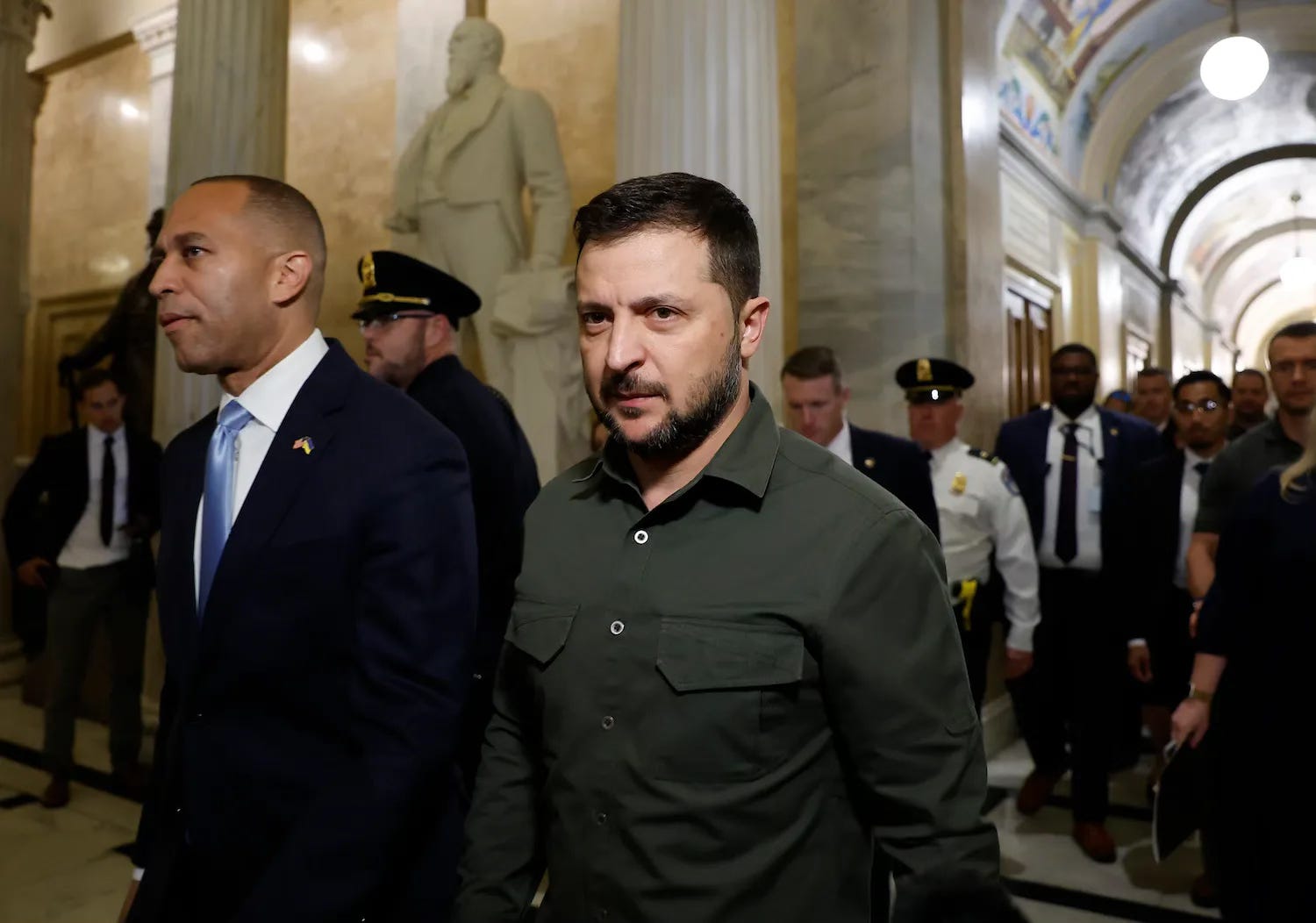
House Minority Leader Hakeem Jeffries (left) carrying water for Zelensky of Ukraine. More war, please! 

So, for example, House Minority leader Hakeem Jeffries has stated that a high priority for Democrats in the ongoing struggle over electing a new House Speaker is that the new Speaker must support higher funding—for Ukraine! (Jeffries also wants the impeachment inquiry into Joe Biden to end.)

Higher military spending for Ukraine is a top priority for Democrats, even as Americans struggle with higher bills for food, housing, health care, and other essentials of life. Think about that for a moment.

Of course, Congress was prepared to continue paying for Ukraine’s war effort even if the federal government had shut down, so Jeffries is nothing but consistent here. Waging a wildly expensive and dangerous proxy war against Russia is more important to Congress than helping Americans who are struggling across our land with food and gas bills.

Small wonder that the largest political party in America is composed of “independents.”

Whether it’s RFK Jr., Cornel West, or someone else, we need to get behind independent candidates and reject the Democratic-Republican war party. Vote the war pigs out!

War as an “Investment”

W.J. Astore

The Bizarre Business-Speak of Mass Killing

Did you know the Russia-Ukraine War is a great “investment” for the United States? A terrific opportunity to kill lots of Russians and to destroy lots of their military equipment at a relatively cheap cost to us? (Just don’t mention the price paid by Ukraine.) It gives new meaning to the expression “making a killing” on the “market.”

To Gordon Gekko’s infamous “greed is good” speech we must now add “war is good.” That war is “right.” That it “works”—at least for America, allegedly. 

War as an “investment” truly symbolizes the moral bankruptcy of conventional discourse in the U.S. political mainstream. Instead of war being a calamity, a catastrophe, a realm of death and destruction, dare I say even a mortal sin of grievous evil, we’re told that instead it’s an investment that’s paying dividends, especially in that growth stock known as Ukraine.

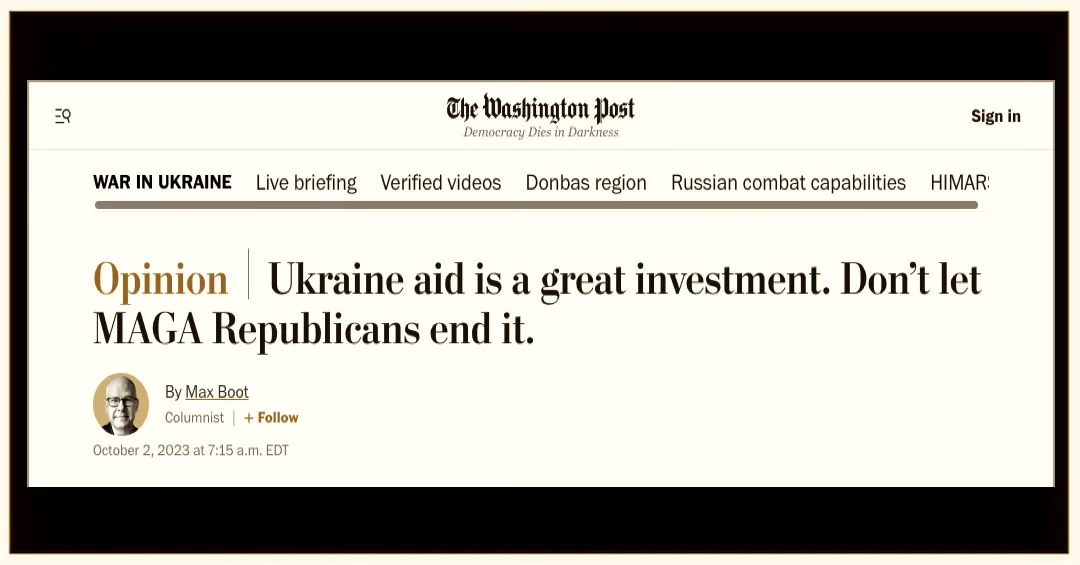
We can’t let MAGA Republicans stop the Ukraine “investment,” can we? Not when it’s paying such great dividends

Even body counts and truck counts from the Vietnam War era are being brought back to show what a great “investment” the Ukraine War has been for the U.S. In her latest, Caitlin Johnstone cites war-lover Max Boot for his advocacy of the Russia-Ukraine War as a continuing investment opportunity for the U.S., including the use of body and truck counts as a measure of progress:

“Russia has lost an estimated 120,000 soldiers and 170,000 to 180,000 have been injured,” [Max] Boot writes [in a Washington Post op-ed]. “Russia has also lost an estimated 2,329 tanks, 2,817 infantry fighting vehicles, 2,868 trucks and jeeps, 354 armored personnel carriers, 538 self-propelled artillery vehicles, 310 towed artillery pieces, 92 fixed-wing aircraft and 106 helicopters.”

“The Russian armed forces have been devastated, thereby reducing the risk to front-line NATO states such as Poland and the Baltic republics that the United States is treaty-bound to protect,” Boot continues. “And all of that has been accomplished without having to put a single U.S. soldier at risk on the front lines.”

“That’s an incredible investment,” gloats Boot.

At no time in his masturbatory gushing about how many Russians this war has helped kill does Boot make any mention of the immense toll this deliberately provoked and completely unnecessary war has taken on Ukrainian lives. Their deaths and dismemberments and displacement are the largest price being paid into this “investment” by far, but Boot doesn’t deem them worthy of even a footnote.

We’ve been seeing this “investment” line being promoted with increasing frequency by US empire managers and their apologists. In an article published in the Connecticut Post last month, Senator Richard Blumenthal assured Americans that “we’re getting our money’s worth on our Ukraine investment.” A few days prior to that Senator Mitt Romney had described the proxy war as “the best national defense spending I think we’ve ever done,” because “We’re diminishing and devastating the Russian military for a very small amount of money… a weakened Russia is a good thing.” In December Senate Minority Leader Mitch McConnell said that funding the proxy war is “a direct investment in reducing Vladimir Putin’s future capabilities to menace America, threaten our allies and contest our core interests.” Last November the imperial war machine-funded think tank Center for European Policy Analysis published a report arguing that “US spending of 5.6% of its defense budget to destroy nearly half of Russia’s conventional military capability seems like an absolutely incredible investment.”

Imagine the vacuity, the bankruptcy, the venality, the sinfulness of writing about war and killing as “an absolutely incredible investment.” And what is our ROI, our return on investment? A lot of dead and wounded Russians and Ukrainians, a devastated and poisoned landscape, millions of war refugees, and an increasing likelihood of a wider war that could possibly go nuclear. ROI, indeed.

War is many things, but it is not an “investment.” People who talk and write like this have no moral center. They are soulless. They are automatons of war.