Understanding Donald Trump’s Appeal

Trump runs over GOP

W.J. Astore

I lived and taught in a rural and conservative area in Pennsylvania for nine years, an area that’s “flyover country” for Beltway elites.  Back in 2008, I remember how the locals went gaga over Sarah Palin’s visit to the area, and how crestfallen so many people were when Barack Obama was elected president.  I remember how people sported Bush/Cheney stickers on their cars and trucks (even the faculty at the largely vocational college at which I taught), long after these men had left office.  Sadly, I also recall a lot of Confederate flag license plates, especially on trucks, but there were also people who flew them at home from their flagpoles.  This was not about “heritage,” since Pennsylvania was Union country in the Civil War.  No – it was about being a White “redneck” and taking the country back from, well, the “other” – Blacks, Muslims, immigrants, anyone considered to be an outsider, anyone part of the “influx,” a racially-loaded word that referred to outsiders (where I lived, mainly Blacks from Philadelphia and its environs).

Rural PA, previously Sarah Palin country, is now Trump country.  In the recent presidential primary, fifty thousand Democrats in PA changed party affiliation so they could vote Republican.  An educated guess: they weren’t switching parties to vote for Kasich or Cruz.  They were caught up in Trump hype about making America great again!
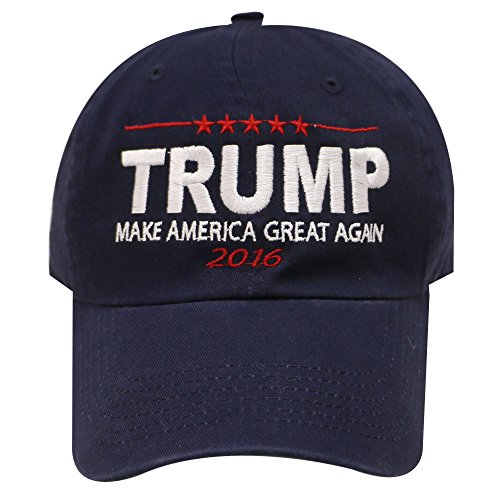
download
It says so on his hat!

That’s a slogan to be reckoned with.  Some say it’s a racist dog whistle.  Those with ears attuned to the frequency hear the message as “making America great again by making it White again.”  There’s truth to this, but the message is also one of nostalgia.  Trump, like many of his followers, has recognized that the USA is no longer NUMBER ONE in all things, and he’s got the balls (as his followers might say) to say it plainly.  No BS about America being the exceptional nation, the bestest, the kind of nonsense that flows freely from the mouths of most U.S. politicians.  America is acting like a 99-pound weakling, Trump says, and he’s the Charles Atlas to whip us back into shape.
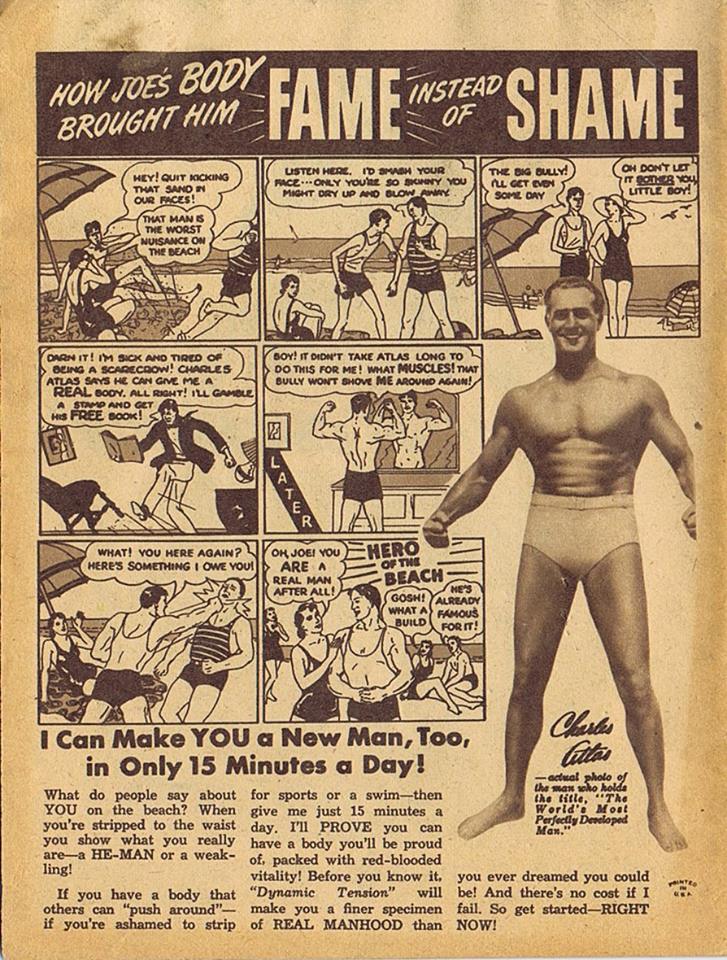
atlas

Trump’s vulgarity, his elaborate comb over, his tackiness, the shallowness of his knowledge (especially on foreign affairs), have contributed to the establishment’s ongoing dismissal of him.  A recent article by Glenn Greenwald and Zaid Jilani documented the many dead certain (yet dead wrong) predictions of Trump’s imminent demise, even as he was winning primary after primary and gaining in the polls.  The establishment elites just couldn’t believe that a man not vetted by them – a man best known for bloated casinos and lowbrow reality TV – could be a viable candidate for the presidency.  And indeed they continue to predict his imminent demise at the hands of one of their own (Hillary Clinton) in the fall.  Yet as I wrote back in July 2015, Trump is not to be underestimated.

What exactly is the appeal of Trump?  Speaking his mind is one.  Yes, he’s vulgar, he’s boorish, he’s ignorant, he’s sexist.  Just like many of his followers.  In a way, Trump revels in his flaws.  He has the confidence to own them.  Many people are attracted to him simply because (like Sarah Palin) he’s not a typical mealy-mouthed politician.

Another obvious appeal: He’s a rich celebrity who acts like a rube.  Indeed, he acts like many regular folks would if they’d just won a Powerball jackpot.  He’s got the trophy wife.  He’s got a lot of pricey toys (How about that Trump jet?).  He doesn’t have much class, but so what?  Trump is Archie Bunker with money, a blowhard, an American classic.  What you see is pretty much what you get.  And that’s a refreshing feature for many of his followers, who have little use for complexity or nuance.
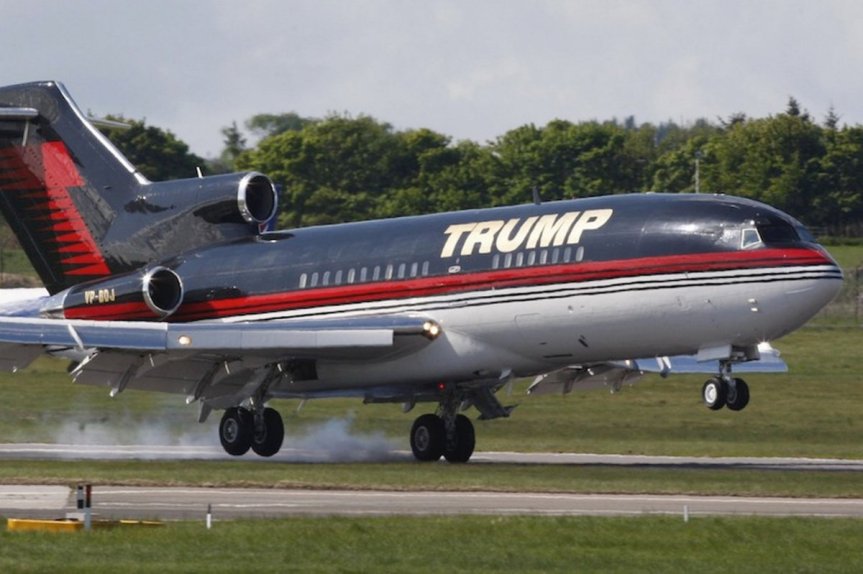
trump jet
Not presidential?  He already has his own “Trump Force One”

For all that, let’s not ignore Trump’s positions (such as they are) on the issues.  He’s against a lot of things that many Americans are also against.  He’s critical of immigration.  He’s more than wary of Muslims.  He despises “political correctness.”  He’s against trade deals (so he says).  The Chinese and Japanese come in for special opprobrium as trade cheaters.  “And China!  And China!” Trump declaims as he launches another round of attacks on the Chinese for stealing American jobs.  Trump’s followers believe they’ve finally found their man, someone who will stand up to the Chinese, the Mexicans, the Muslims, and all those other foreigners who are taking their jobs and hurting America.

Trump is a master of scapegoating.  But more than this, he takes positions that show a willingness to depart from Republican orthodoxy.  He’s expressed support for Planned Parenthood (except for its abortion services) because of the health care it provides to women.  He’s outspokenly critical of U.S. wars and nation-building (as well as Bush/Cheney and company).  He wants to rebuild America’s infrastructure.  He wants to force America’s allies to pay a greater share of their own defense costs.  He’s not slavishly pro-Israel.  He’s not enamored with neo-conservative principles and the status quo in U.S. foreign policy.  He wants to put “America first.”  As far as they go, these are respectable positions.

Yet I’ve not come to praise Trump but to explain, at least partially, his appeal and its persistence.  Trump’s negatives are well known, and indeed I’ve written articles that are highly critical of him (see here and here and here).  Most of Trump’s supporters are aware of the negatives yet plan to vote for him regardless.  Why?

Desperation, to start.  Americans are drowning in debt.  They’re scared.  Not just the lower classes but the middle classes as well.  Just consider the title of a recent article at The Atlantic: The Secret Shame of Middle-Class Americans: Nearly half of Americans would have trouble finding $400 to pay for an emergency.  Times are far tighter for ordinary Americans than Beltway elites know or are willing to admit.

large

In tough times an unconventional candidate like Trump (or Bernie Sanders) offers hope – the promise of significant change.  What does Hillary Clinton offer?  So far, more of the same.  But scared or desperate people don’t want the same, with perhaps a few more crumbs thrown their way by establishment-types.  They want a political revolution, to quote Bernie Sanders.  They want freshness.  Authenticity.

Strangely, despite all his flaws and insults and bigotry, or rather in part because of them, Trump seems more genuine, more of a candidate of the people, than does Hillary.  Bernie Sanders, another genuine candidate with big ideas, beats him handily in the fall, I believe.  But Bernie is being elbowed out by the establishment powerbrokers in the Democratic Party.  The big money (of both parties) is pegging its hopes on Hillary.  It’s already predicted her sobriety and “experience” will triumph over Trump’s wildness and inexperience.

Given the record of “expert” predictions so far in this election, as well as Trump’s own track record, I wouldn’t be too confident in betting against The Donald.


The Vietnam War, the Pentagon Papers, and Lying

In today’s New York Times, there’s an obituary for Donald Duncan, a Green Beret and master sergeant who became an early and outspoken critic of America’s war in Vietnam. The obituary is at this link http://www.nytimes.com/2016/05/07/us/donald-w-duncan-79-ex-green-beret-and-early-critic-of-vietnam-war-is-dead.html, and I want to highlight some of what Duncan said about that war. Here are two excerpts: “The whole thing [the war] was a lie,” Mr. Duncan wrote. “We weren’t preserving freedom in South Vietnam. There was no freedom to preserve. To voice opposition to the government meant jail or death. Neutralism was forbidden and punished. Newspapers that didn’t say the right thing were closed down. People are not even free to leave, and Vietnam is one of those rare countries that doesn’t fill its American visa quota.” Another quotation: He concluded that America was destined to lose the war. “I don’t think Vietnam will be better off under Ho’s brand of communism,” he said. “But it’s not for me or my government to decide. That decision is for the Vietnamese. I also know that we have allowed the creation of a military monster that will lie to our elected officials, and that both of them will lie to the American people.” These words, coming from a decorated combat veteran with direct knowledge of events in Vietnam, must be remembered. Yet as the NYT obituary makes clear, Duncan died in obscurity, all but forgotten. We need to remember people like him: people who are willing to speak up and tell uncomfortable truths.

wjastore's avatarBracing Views

Arendt Hannah Arendt (Arendt Center at Bard College)

W.J. Astore

In November 1971, the political philosopher Hannah Arendt published “Lying in Politics: Reflections on the Pentagon Papers” in the New York Review of Books.  Earlier that year, Daniel Ellsberg had shared those highly classified government papers with the U.S. media.  They revealed a persistent and systematic pattern of lying and deception by the government about U.S. progress in the Vietnam War.  By undermining the people’s trust in government, lies and deception were destabilizing democracy in America, Arendt said.  Furthermore, America was witnessing two new and related categories of lying.  The first was lying as public relations, the creation and distribution of images substituting for facts and premised in human manipulability (a Madison Avenue approach to war and foreign policy).  The second was lying tied to a country’s reputation as embraced by professional “problem-solvers” as the basis for political action. …

View original post 667 more words

A Major Flaw of the U.S. National Security State

prather
My copy has this cover

W.J. Astore

I’m a fan of books and book sales.  A few weeks ago, I came across a vintage copy of Hugh Prather’s “Notes to Myself.”  Published in 1970, it caught the Zeitgeist of the “Age of Aquarius” and became a surprise best seller.  Its considerable influence is shown by the fact it was lampooned on “Saturday Night Live” as part of the “Deep Thoughts” series.

Some of Prather’s “notes” are solipsistic and more than a little pretentious, a fact he himself recognized, but some of them also have considerable depth of meaning.

Consider this one:

When I see I am doing it wrong there is

a part of me that wants to keep on doing

it the same way anyway and even starts

looking for reasons to justify the continuation.

When I read this, I instantly thought of U.S. strategy when it comes to the Middle East.  I recently read Colonel (ret.) Andrew Bacevich’s new book, “America’s War for the Greater Middle East,” and Prather’s note could serve as an epigraph to the book, and an epitaph to U.S. wars and policy in the Middle East.

Despite a painfully expensive and tragically wasteful record of militarized interventions in Iraq, Afghanistan, Lebanon, Iran, Somalia, Libya, and many other countries throughout the greater Middle East, the U.S. military and foreign policy establishment persists in staying its presence course.  Sure, the tactics have changed slightly over the years.  Obama is less enamored of committing big battalions of ground troops than Bush/Cheney were, yet his administration is nevertheless committed to constant military interventions, misguided and one-sided relationships with Israel and Saudi Arabia, and unwavering optimism that this time, maybe this time, we’ll finally build effective Iraqi (or Afghan) security forces while simultaneously encouraging liberty in the region by sending more U.S. troops and selling more weaponry (together with bombing and killing, of course).

As Bacevich notes in his book (you should beg, borrow, or otherwise acquire a copy), experience has not taught the U.S. national security state much of anything.  Whether that state is led by a Clinton or a Bush or an Obama matters little.  The U.S. can’t help but meddle, using its powerful military as a more or less blunt instrument, at incredible expense to our country, and at a staggering cost in foreign lives lost or damaged by incessant warfare.  And no matter how catastrophic the results, that national security state can’t help but find reasons, no matter how discredited by events, to “stay the course.”

Consistent with what Prather says, it looks “for reasons to justify the continuation” of present policy, even when it knows things are going wrong in a very bad way.

Perhaps the U.S. national security state needs to make some “notes to itself.”  Consider it a personal audit of sorts, since the Pentagon can’t pass a financial one.  If it ever does, Prather’s “note” above would be a good place to start.

Hillary Clinton: The MOTS Candidate

image
More of the same (MOTS) versus Feeling the Bern

W.J. Astore

With Trump now the presumptive nominee after his victory in Indiana and Ted Cruz’s withdrawal from the race, the Republican narrative seems clear.  Trump’s appeal is summed up nicely here by NBC:

Trump won by discovering a primal desire among GOP voters for a swaggering populist who would buck orthodoxy on trade, protect entitlements, build a border wall, deport all undocumented immigrants, and implement an “America First” foreign policy that demanded allies pay for U.S. protection or go it alone.

Millions of supporters, distrustful of their party’s leaders, rallied behind him as a unique figure whose personal fortune enabled him to spurn donors and say what he wanted with impunity.

His presumptive opponent: Hillary Clinton.  But not so fast!  Playing the spoiler, Bernie Sanders won in Indiana and has an outside chance of denying the nomination to Hillary. As Bernie pointed out in Indiana, he’s winning the vote of those 45 years of age and younger, and his appeal is strong among liberals and independents.

A large part of Bernie’s appeal is that he’s a man of principle with a clear message.  I can easily tell you what Bernie is for.  He’s for a political revolution.  He wants a single-payer health care system.  He wants free college tuition for students at state colleges.  He wants campaign finance reform.  He wants a $15 minimum wage.  He wants to break up big banks.  He was against the Iraq War and wants a less bellicose foreign policy.  The man knows how to take a stand and stick with it.

Now: What does Hillary Clinton want, besides the presidency of course?  It’s hard to say. For the last few months, she’s essentially been responding to Bernie.  As his progressive and idealistic message resonates with voters, Hillary cautiously adopts aspects of it.  For example, she was against a $15 minimum wage until she was for it.  She’s made noises about getting big money out of politics even as she’s siphoned up as many Benjamins as she could.  Lately, she’s pivoted and begun to run against Trump, as if Bernie has no chance at all to deny her the nomination.

Here’s the problem for Hillary: She’s a MOTS candidate, or more of the same.  She’s promised a continuation of President Obama’s policies, at least domestically, while in foreign policy she’s promised to take a harder line than Obama.  But I’m hard-pressed to name a single major policy initiative that’s uniquely hers, and I’ve watched virtually all of the Democratic debates and town halls.  She’s running as a technocrat, as an insider, as Obama in a pantsuit but with iron fists.

Assuming it’s Hillary versus Trump in the fall, it’ll be Trump who has the ideas, crazy or divisive or unsustainable as they may be.  And it’ll be Hillary who’ll be running as the “safe” candidate, the anti-Trump, the one whose motto might be, “the audacity of establishment incrementalism.”

Is that what American voters are looking for?  Establishment incrementalism?  More of the same?

Stay in the race, Bernie Sanders, and give us a real choice this fall.

Put ESPN in Charge of the War on Terror

draft
Our wars are games and our games are wars

W.J. Astore

This weekend, I watched a few minutes of NFL draft coverage on ESPN.  If you’re not familiar with NFL football or ESPN coverage of the same in the USA, you should be, because it says much about the American moment.  The first round of the draft kicks off on Thursday night in prime time, followed by the second and third rounds on Friday night in prime time.  The draft concludes on Saturday with rounds four through seven, roughly 250 total picks if you include “supplemental” picks.

Yet this quick summary vastly understates the coverage devoted to the draft.  From the end of the Super Bowl early in February to the draft itself at the end of April, coverage of the draft on ESPN is virtually non-stop, with innumerable “mock” drafts for each team and a parade of “experts” speculating about the prospects of each player and team. Exhaustive (and exhausting) is the word to describe this coverage.  Interminable is another one.

When Round One finally kicks off, it’s essentially a parade of soon-to-be millionaires. These players, selected from various college football teams, can count on multi-year contracts and signing bonuses in the millions of dollars.  ESPN and the NFL stage manages the selection process, turning it into an extravaganza complete with musicians, cheering (or booing) fans, and plenty of past NFL greats, along with the draftees and their families and friends. Coverage also includes shots of the “war rooms” of the various NFL teams as they decide which players to pick, which draft picks to trade, and so on.  The war room — isn’t that a telling phrase?

Indeed, let’s push that further.  Most red-blooded NFL fans would be hard-pressed to find Iraq or Afghanistan on a map, but they can tell you all about their team’s draft picks, rattling off statistics such as times in the 40-yard dash, vertical leap, even the size of a player’s hands (considered especially pertinent if he’s a quarterback or wide receiver). What always astonishes me is the sheer wealth of detail gathered about each player, the human intelligence (or HUMINT in military terms).  Players, especially those projected to go in the first few rounds, are scrutinized from every angle: physical, mental, emotional, you name it.

With millions of dollars at stake, such an exhaustive approach is not terribly surprising. Yet even with a wealth of data, each year there are major draft busts (e.g. Ryan Leaf, selected #2 overall in the first round and a flop) and major surprises (e.g. Tom Brady, selected late in the 6th round as the 199th pick, meaning that not much was expected from him, after which he won four Super Bowls).  Results from the NFL draft should teach us something about the limits of data-driven “intelligence” in “wars,” yet our various military intelligence agencies continue to believe they can quantify, predict, and control events.

But again what wows me is the extent as well as the slickness of ESPN’s coverage of the draft.  As soon as a player is selected, ESPN instantly has video of that player’s college highlights, together with his vital statistics (height, weight, performance at the draft combine in various drills, and so on).  Video and stats are backed up by interviews with a draftee’s previous coaches, who extol his virtues, along with interviews with those “war rooms” again as to why they decided to draft that particular player and not another.  Once the draft is completed, teams are then awarded “grades” by various commentators, even though these players have yet to play a snap in the NFL.  (Imagine if your kid received an instant grade in college — before he attended a single class or completed a single assignment — based upon his performance in high school.)

But you have to hand it to ESPN: their coverage of the draft is an exercise in total information awareness.  It’s blanket coverage, an exercise in full-spectrum  dominance. It’s slick, professional, and driven by a relentless pursuit of victory by each team (and a relentless pursuit of ratings by ESPN).

So, a modest proposal: To win the war on terror, let’s put ESPN in charge of intelligence gathering and coverage.  Just imagine if your average red-blooded American devoted as much attention to foreign wars as they do to their favorite NFL team!  Just imagine if America’s leaders were held accountable for poor results as NFL coaches and staffs are! America still might not win its wars, but at least we’d squarely face the fact that we’re continuing to lose at incredibly high cost.  Indeed, someone high-up in the government might actually be held accountable for these losses.

I know: It’s a frivolous suggestion to treat war like a sport.  But is it?  After all, America currently treats the NFL draft with all the seriousness of a life-and-death struggle, even as it treats wars with comparative frivolity.

Our wars are games and our games are wars.  Small wonder America continues to lose its wars while fielding some winning NFL teams.

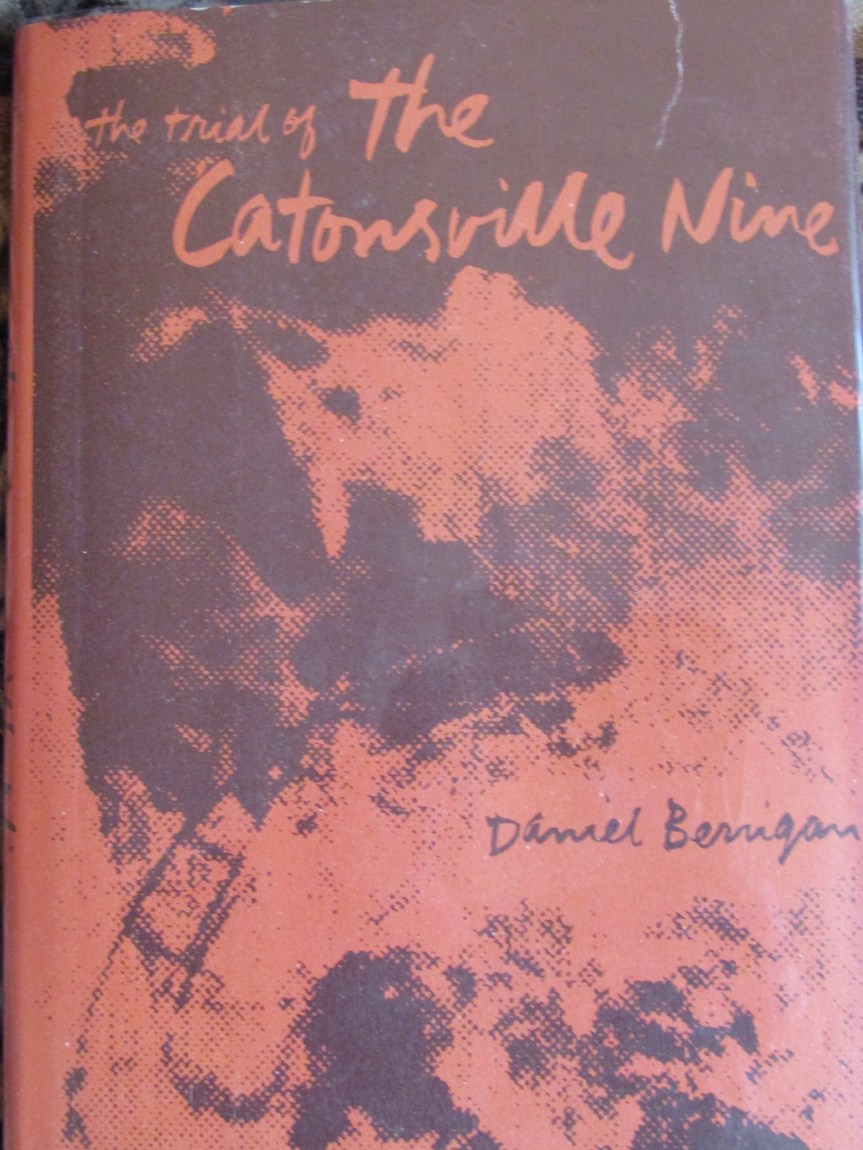
“Members of the jury, you have just found Jesus Christ guilty”: Remembering the Catonsville Nine

Yesterday saw the announcement of the death of Daniel Berrigan at the age of 94. In his memory, I’d like to repost my article on the Catonsville Nine. Berrigan’s obituary is at this link: http://www.nytimes.com/2016/05/01/nyregion/daniel-j-berrigan-defiant-priest-who-preached-pacifism-dies-at-94.html

wjastore's avatarBracing Views

IMG_0518W.J. Astore

In May 1968, nine Catholic activists set fire to draft records in Catonsville, Maryland, in a deliberate act of sabotage and protest against the Vietnam War.  For the crime of destroying government property, a crime they freely admitted, they were tried in federal court in Baltimore and found guilty.  I’ve been reading the edited trial transcript (with commentary) by Daniel Berrigan, one of the Catonsville Nine and a Catholic priest.  What unified these nine people was their moral opposition to the Vietnam War, a moral revulsion to the acts their country was committing in Vietnam, a revulsion that drove them to burn draft records with a weak brew of homemade napalm so as to gain the attention of their fellow citizens.

On this Easter Weekend, I would like to focus on a few of the statements made by the Catonsville Nine, as recorded by Daniel Berrigan in “The…

View original post 718 more words