
Seven Reasons Why We Can’t Stop Making War (2010)

W.J. Astore

From Boots on the Ground to Robot Assassins in the Sky

I’m proud to say I’ve been writing for TomDispatch since 2007, posting more than 100 original articles at the site. Among the many features of that remarkable site, run by Tom Engelhardt, this generation’s I.F. Stone, is its reach across political spectrums, across America, and indeed across the globe. My most recent article, for example, was translated into Portuguese (for a Brazilian site) and Swedish. Tom and I usually aren’t contacted for permission; these translations and postings just happen.

Briefly in 2010, a few of my “tomgrams” broke through to the mainstream media, being reposted by CBS News. What follows is one of them, “Seven Reasons Why We Can’t Stop Making War,” in which I refer to a disaster of that day, the BP Deepwater Horizon oil spill.

Sadly, despite a little boost from CBS News, my critique went unheeded. Surprise! America is still making war (with certain entities profiting greatly from this), now with yet more robots even as U.S. boots on ground in direct combat are far fewer. It’s a formula for “low-cost” forever war that of course comes at a very high cost indeed, starting with a Pentagon budget soaring toward $900 billion a year, not including more than $120 billion already provided or promised to Ukraine for its war effort.

From CBS News in 2010, my article on why the U.S. can’t stop making war. The original title was “Operation Enduring War” at TomDispatch in July 2010.

If one quality characterizes our wars today, it’s their endurance.  They never seem to end. 

Though war itself may not be an American inevitability, these days many factors combine to make constant war an American near certainty.  Put metaphorically, our nation’s pursuit of war taps so many wellsprings of our behavior that a concerted effort to cap it would dwarf BP’s efforts in the Gulf of Mexico.

Our political leaders, the media, and the military interpret enduring war as a measure of our national fitness, our global power, our grit in the face of eternal danger, and our seriousness.  A desire to de-escalate and withdraw, on the other hand, is invariably seen as cut-and-run appeasement and discounted as weakness.  Withdrawal options are, in a pet phrase of Washington elites, invariably “off the table” when global policy is at stake, as was true during the Obama administration’s full-scale reconsideration of the Afghan war in the fall of 2009.  Viewed in this light, the president’s ultimate decision to surge in Afghanistan was not only predictable, but the only course considered suitable for an American war leader. Rather than the tough choice, it was the path of least resistance.

Why do our elites so readily and regularly give war, not peace, a chance?  What exactly are the wellsprings of Washington’s (and America’s) behavior when it comes to war and preparations for more of the same?

Consider these seven:

1.  We wage war because we think we’re good at it — and because, at a gut level, we’ve come to believe that American wars can bring good to others (hence our feel-good names for them, like Operations Enduring Freedom and Iraqi Freedom). Most Americans are not only convinced we have the best troops, the best training, and the most advanced weapons, but also the purest motives.  Unlike the bad guys and the barbarians out there in the global marketplace of death, our warriors and warfightersare seen as gift-givers and freedom-bringers, not as death-dealers and resource-exploiters.  Our illusions about the military we “support” serve as catalyst for, and apology for, the persistent war-making we condone.

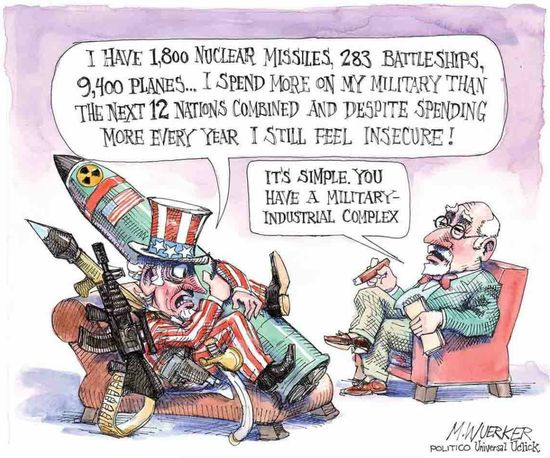
2.  We wage war because we’ve already devoted so many of our resources to it.  It’s what we’re most prepared to do.  More than half of discretionary federal spending goes to fund our military and its war making or war preparations.  The military-industrial complex is a well-oiled, extremely profitable machine and the armed forces, our favorite child, the one we’ve lavished the most resources and praise upon.  It’s natural to give your favorite child free rein.

3.  We’ve managed to isolate war’s physical and emotional costs, leaving them on the shoulders of a tiny minority of Americans.  By eliminating the draft and relying ever more on for-profit private military contractors, we’ve made war a distant abstractionfor most Americans, who can choose to consume it as spectacle or simply tune it out as so much background noise.

4.  While war and its costs have, to date, been kept at arm’s length, American society has been militarizing fast.  Our media outlets, intelligence agencies, politicians, foreign policy establishment, and “homeland security” bureaucracy are so intertwined with military priorities and agendas as to be inseparable from them.  In militarized America, griping about soft-hearted tactics or the outspokenness of a certain general may be tolerated, but forceful criticism of our military or our wars is still treated as deviant and “un-American.”

5.  Our profligate, high-tech approach to war, including those Predator and Reaper drones armed with Hellfire missiles, has served to limit American casualties — and so has limited the anger over, and harsh questioning of, our wars that might go with them.  While the U.S. has had more than 1,000 troops killed in Afghanistan, over a similar period in Vietnam we lost more than 58,000 troops.  Improved medical evacuation and trauma care, greater reliance on standoff precision weaponry and similar “force multipliers,” stronger emphasis on “force protection” within American military units: all these and more have helped tamp down concern about the immeasurable and soaring costs of our wars.
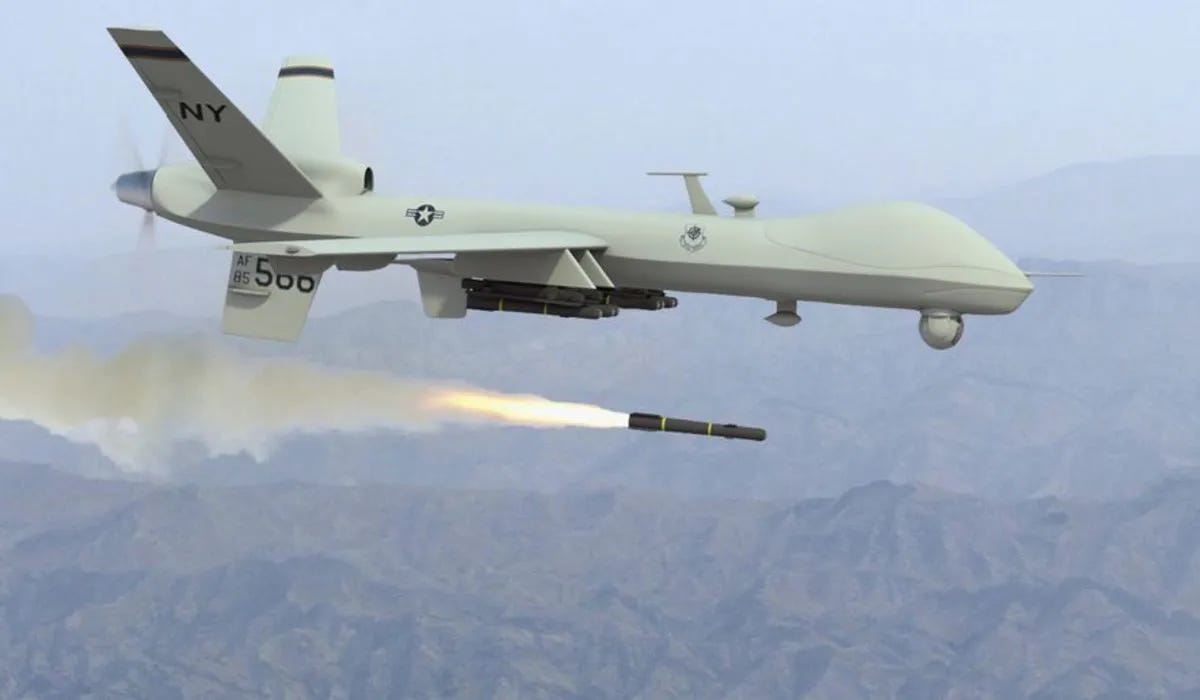
It all seems so easy—even “clean”—from the sky. Not even a single U.S. pilot at risk.

6.  As we incessantly develop those force-multiplying weapons to give us our “edge” (though never an edge that leads to victory), it’s hardly surprising that the U.S. has come to dominate, if not quite monopolize, the global arms trade.  In these years, as American jobs were outsourced or simply disappeared in the Great Recession, armaments have been one of our few growth industries.  Endless war has proven endlessly profitable — not perhaps for all of us, but certainly for those in the business of war.

7.  And don’t forget the seductive power of beyond-worse-case, doomsday scenarios, of the prophecies of pundits and so-called experts, who regularly tell us that, bad as our wars may be, doing anything to end them would be far worse.  A typical scenario goes like this: If we withdraw from Afghanistan, the government of Hamid Karzai will collapse, the Taliban will surge to victory, al-Qaeda will pour into Afghan safe havens, and Pakistan will be further destabilized, its atomic bombs falling into the hands of terrorists out to destroy Peoria and Orlando.

Such fevered nightmares, impossible to disprove, may be conjured at any moment to scare critics into silence.  They are a convenient bogeyman, leaving us cowering as we send our superman military out to save us (and the world as well), while preserving our right to visit the mall and travel to Disney World without being nuked.

The truth is that no one really knows what would happen if the U.S. disengaged from Afghanistan.  But we do know what’s happening now, with us fully engaged: we’re pursuing a war that’s costing us nearly $7 billion a month that we’re not winning (and that’s arguably unwinnable), a war that may be increasing the chances of another 9/11, rather than decreasing them.

Capping the Wellsprings of War

Each one of these seven wellsprings feeding our enduring wars must be capped.  So here are seven suggestions for the sort of “caps” — hopefully more effective than BP’s flailing improvisations — we need to install:

1.  Let’s reject the idea that war is either admirable or good — and in the process, remind ourselves that others often see us as “the foreign fighters” and profligate war consumers who kill innocents (despite our efforts to apply deadly force in surgically precise ways reflecting “courageous restraint“).

2.  Let’s cut defense spending now, and reduce the global “mission” that goes with it.  Set a reasonable goal — a 6-8% reduction annually for the next 10 years, until levels of defense spending are at least back to where they were before 9/11 — and then stick to it.

3.  Let’s stop privatizing war.  Creating ever more profitable incentives for war was always a ludicrous idea.  It’s time to make war a non-profit, last-resort activity.  And let’s revive national service (including elective military service) for all young adults.  What we need is a revived civilian conservation corps, not a new civilian “expeditionary” force.

4. Let’s reverse the militarization of so many dimensions of our society.  To cite one example, it’s time to empower truly independent (non-embedded) journalists to cover our wars, and stop relying on retired generals and admirals who led our previous wars to be our media guides.  Men who are beholden to their former service branch or the current defense contractor who employs them can hardly be trusted to be critical and unbiased guides to future conflicts.

5.  Let’s recognize that expensive high-tech weapons systems are not war-winners.  They’ve kept us in the game without yielding decisive results — unless you measure “results” in terms of cost overruns and burgeoning federal budget deficits.

6.  Let’s retool our economy and reinvest our money, moving it out of the military-industrial complex and into strengthening our anemic system of mass transit, our crumbling infrastructure, and alternative energy technology.  We need high-speed rail, safer roads and bridges, and more wind turbines, not more overpriced jet fighters.

7.  Finally, let’s banish nightmare scenarios from our minds.  The world is scary enough without forever imagining smoking guns morphing into mushroom clouds.

There you have it: my seven “caps” to contain our gushing support for permanent war. 

No one said it would be easy.  Just ask BP how easy it is to cap one out-of-control gusher.

Nonetheless, if we as a society aren’t willing to work hard for actual change — indeed, to demand it — we’ll be on that military escalatory curve until we implode.  And that way madness lies.

The opinions expressed in this commentary are solely those of the author.

By William J. Astore (2010)

Bonus Lesson (2023): “Enduring war” is not consistent with “enduring freedom.” Who knew? And we do seem as a society to be closer to implosion, a prediction I very much hope I’m ultimately proven wrong about.

The “Rationale” of America’s Wars

W.J. Astore

Reason and Rationality Have Little to Do with Them

It is often hard to understand the reasons for America’s wars, especially since World War II, but they always have a rationale backed up by lies.  The rationale for Vietnam was the containment of communism and the domino theory.  The lie was that U.S. naval ships had been attacked at Tonkin Gulf.  The rationale for Iraq was overthrowing a ruthless dictator and spreading “freedom.”  The lie was that he had WMD and that he was somehow connected to the 9/11 attacks.

Nations and peoples are not dominoes

The real reasons for America’s many disastrous wars are opaque.  Domestic politics are almost always paramount.  No U.S. president wants to be accused of losing a war or appearing to be weak, so starting or continuing a war is considered as “strength.”  Congress doesn’t want to be accused of “tying the hands of the president” or of “betraying the troops,” so most members happily go along with wars.  The military, of course, always thinks it can win, and wars are good for promotions and power.  And military contractors, the “merchants of death,” are even more happy to make money off war.  Not surprisingly, perhaps, President Dwight D. Eisenhower’s farewell speech in 1961 warned America of the military-industrial complex, to which Ike had added Congress in an earlier draft.  Ike’s warning has been largely forgotten; even his own monument in DC obscures it.

In Washington today, the Democrats accuse the Republicans of being weak on Russia; the Republicans return the favor by accusing the Biden administration of being weak on China.  Military and industry are happy to play this blame game, knowing the Pentagon budget will soar as a result, as it has.  And thus a dangerous “new cold war” appears to be a certainty.

The folly and fallaciousness of America’s wars, along with their carnage, are enough to make any rational human angry, especially one who has served in one of these wars. Mike Murry, a Vietnam War veteran, is angry, and so am I.  Back in 2017, I wrote a piece on the atrociousness of the Vietnam War, to which Mr. Murry appended this comment.  It merits consideration by all thinking Americans.

The ”Rationale” of America’s Wars.  Comment by Mike Murry in 2017.

An excellent choice of words, “rationale.” Not the reason for doing something in the first place, but a conscious lie made up beforehand just to get things started, or an excuse invented afterwards to avoid accountability and, where required, the necessary punishment that true justice occasionally administers. Marine Corps General Smedley Butler once said that we have only two acceptable reasons for going to war: to defend our homes or defend the Constitution. In not a single case after World War II has either of these conditions applied, so that none of the pointless and ruinous fighting — I won’t dignify these Presidential/Career Military misadventures by calling them “war” — has had any justifiable reason or purpose. Not surprisingly, no Congress has declared war on another nation state since 1941 because no nation state on planet earth has attacked either American homes or America’s Constitution. The United States has not just “gone abroad in search of monsters to destroy,” as our sixth President, John Quincy Adams, warned us against foolishly doing, but has invented imaginary hobgoblins at home before even setting out to vanquish them on the far side of the globe.

Of course, Smedley Butler only made his remarks after serving for thirty years as an admitted “gangster for capitalism,” probably the best summary description of the U.S. military offered to date by one who ought to know. Today, as for the past seventy-plus years, the U.S. military simply fights — aimlessly and disastrously — for the sake of fighting. The fighting has no “reason” other than to provide a steady stream of outrageous corporate CEO bonuses, stockholder dividends, and the pensions and perquisites of retired senior military officers. This Warfare Welfare and Make-work Militarism has secondary beneficiaries, of course, most notably the hothouse orchids, special snowflakes and privileged peacock pugilists known as United States as “political leaders.” Naturally, the feeding and maintenance of this system of corrupt cronyism requires a death grip on over half the nation’s discretionary budget. As George Orwell wrote in “The Theory and Practice of Oligarchical Collectivism” (the book-within-a-book from 1984):

The primary aim of modern warfare (in accordance with the principles of doublethink, this aim is simultaneously recognized and not recognized by the directing brains of the Inner Party) is to use up the products of the machine without raising the general standard of living.” 

In other words, the entire U.S. military/security monstrosity — which I like to call the Lunatic Leviathan — has only one purpose: to suck the life out of the domestic economy so that the productivity of the people’s labor will not result in the betterment of their station in life, which might in due course result in the discarding of America’s useless parasitic economic and political “elites.” Any transparent euphemism designed and deployed to disguise this ugly, fundamental truth properly deserves the label “rationale.” In no way do the usual and time-dishonored obfuscations amount to a reason. Reason has fled the United States, replaced by a deserved and rancid Ridicule. The country now consumes itself, lost in its own vicarious fears and fantasies featuring the celluloid exploits of our vaunted Visigoths vanquishing visions of vultures somewhere, someplace, at some time, until … eventually … after some “progress” and “fragile gains” … as T.S. Eliot wrote of The Hollow Men:

This is the way the world ends
Not with a bang but a whimper. 

Men and women so hollow that you can hear their own bullshit echoing in them even before they start moving their jaws and flapping their lips to begin lying.

The Business of America Is War

W.J. Astore

War is the business of the state. That can be read in more than one way. Back in the 17th and 18th centuries, many wars were the work of mercenaries and mercenary-captains, often serving, more or less, nobility who thought they could supplant the king or queen, or expand their own turf and power, pursuing plunder all the while. People gave their support to strong leaders and nation-states partly because they were tired of constant warfare and being the victims of mercenaries. In the 18th century, war was said to be “enlightened” because it largely didn’t impact the people directly; warfare was “limited” to otherwise under-employed nobility and the so-called dregs of society. And nation-states profited from being able to control warfare.

The French Revolution and Napoleon unleashed a new phase of increasingly unlimited war inspired by ideology (Liberty! Fraternity! Equality!). Nationalism was heavily tapped. Soldiers were told it was an honor to die for the nation-state rather than for plunder or in the service of some minor nobleman. Sweet and fitting it seemed to die for one’s country, so soldiers were told — and are still told to this day.

Nowadays, war is the business of the state may be taken literally with war as business. The U.S. federal government spends more than half of its discretionary budget on the military, weaponry, and war, though it’s disguised as a “defense” budget. As long as war remains a business for the U.S., and as long as people are profiting from it, not just in monetary terms but in terms of power, war will remain supreme in U.S. foreign policy.

I remember reading a newspaper from the 1930s that stated clearly that the way to end war was to remove the profit motive. That same decade, the U.S. Senate held hearings to expose the “merchants of death,” the military contractors that had profited so greatly from wholesale death and destruction during World War I. Since the U.S. in those days didn’t have a large standing military and a vast array of private military contractors, those hearings could go ahead in a nation that sought to avoid another world war, especially yet another one in Europe.

Today, the U.S. routinely wages war couched as ever in terms of peace or, if not peace, then security for America. How America is made more secure by troops in Syria helping to facilitate the seizing of oil, or troops in Africa engaging in the latest scramble for that continent’s natural resources, is left undefined. Or perhaps there is a tacit definition: if war is business, America needs (and deserves) access to the best markets, to vital natural resources, to oil and lithium and similar strategic materials, and the way to secure those is militarily, using force.

One thing that amazes me, though it shouldn’t, is the almost complete lack of emphasis in the U.S. on conservation, on limiting resource extraction by cutting demand. Oil companies are bragging how they’re boosting fossil fuel production in the U.S. The message is clear: keep consuming! No need to cut back on your use of fossil fuels. Your overlords will secure — and sell at inflated prices — the fuel you need and want. Just don’t ask any uncomfortable questions.

I suppose it’s all quite simple (and depressing) in its obviousness:

War is the business of the state.

The business of America is business.

The business of America is war.

The nation-state was supposed to corral war, to control it, to “enlighten” it by keeping it limited, a sideshow. Yet war in America has become unlimited, the main show, and very much unenlightened as well. Corralling and controlling it is out of favor. Planning for the next big war is all the rage, perhaps most clearly with China, though Russia factors in as well. A new cold war wins nods of approval from America’s national security state because it most certainly means job security and more power for those who are part of that state.

What is to be done? America needs to remember that war is not the health of any democracy, and that no democracy can survive when it’s constantly engaged in war and preparations for the same. Yet we know America isn’t a democracy, so that argument is effectively moot. Perhaps homespun wisdom can help: those who live by the sword (or the gun) die by the same, though the American response would seem to be: I’ll just buy more swords (or guns), so take that. Or maybe an appeal to Christianity and how blessed the peacemakers are, and how Christ was the prince of peace, except Americans prefer a warrior-Christ who favors his chosen with lawyers, guns, and money.

Perhaps that’s enough musings for this Monday.

Dominating the World Stage

W.J. Astore

“Make love, not war!” on the helmet of Marine Corporal Billy Winn, Vietnam, 1967 (Photo by William Eggleston)

In the 1960s, in response to the Vietnam War, young Americans vowed to “make love, not war.” Ever since 9/11, if not before, America has a new vow: Make War, Not Love.

The American empire believes it must dominate the world stage. Partly this is due to hubris unleashed by the fall of the Soviet Union in 1991. As Colin Powell put it that year:

“We no longer have the luxury of having a threat to plan for. What we plan for is that we’re a superpower. We are the major player on the world stage with responsibilities around the world, with interests around the world.”

When you define the world as your “stage” and define yourself as a military and economic “superpower,” as the major player, a hubristic and militaristic foreign policy almost naturally follows. And so it has.

In my latest article for TomDispatch.com, I detail five reasons why America remains addicted to hubristic war; what follows is an excerpt that focuses on America’s vision of itself as the best and purest actor on the world stage. Please read the entire article at TomDispatch.com.

***

About 15 years ago, I got involved in a heartfelt argument with a conservative friend about whether it was wise for this country to shrink its global presence, especially militarily. He saw us as a benevolent actor on the world stage.  I saw us as overly ambitious, though not necessarily malevolent, as well as often misguided and in denial when it came to our flaws. I think of his rejoinder to me as the “empty stage” argument.  Basically, he suggested that all the world’s a stage and, should this country become too timid and abandon it, other far more dangerous actors could take our place, with everyone suffering. My response was that we should, at least, try to leave that stage in some fashion and see if we were missed.  Wasn’t our own American stage ever big enough for us?  And if this country were truly missed, it could always return, perhaps even triumphantly. 

Of course, officials in Washington and the Pentagon do like to imagine themselves as leading “the indispensable nation” and are generally unwilling to test any other possibilities.  Instead, like so many ham actors, all they want is to eternally mug and try to dominate every stage in sight. 

In truth, the U.S. doesn’t really have to be involved in every war around and undoubtedly wouldn’t be if certain actors (corporate as well as individual) didn’t feel it was just so profitable. If my five answers above were ever taken seriously here, there might indeed be a wiser and more peaceful path forward for this country. But that can’t happen if the forces that profit from the status quo — where bellum (war) is never ante- or post- but simply ongoing — remain so powerful. The question is, of course, how to take the profits of every sort out of war and radically downsize our military (especially its overseas “footprint”), so that it truly becomes a force for “national security,” rather than national insecurity. 

Most of all, Americans need to resist the seductiveness of war, because endless war and preparations for more of the same have been a leading cause of national decline.  One thing I know: Waving blue-and-yellow flags in solidarity with Ukraine and supporting “our” troops may feel good but it won’t make us good.  In fact, it will only contribute to ever more gruesome versions of war. 

A striking feature of the Russian invasion of Ukraine is that, after so many increasingly dim years, it’s finally allowed America’s war party to pose as the “good guys” again. After two decades of a calamitous “war on terror” and unmitigated disasters in Afghanistan, Iraq, Libya, Somalia, and so many other places, Americans find themselves on the side of the underdog Ukrainians against that “genocidal” “war criminal” Vladimir Putin.  That such a reading of the present situation might be uncritical and reductively one-sided should (but doesn’t) go without saying. That it’s seductive because it feeds both American nationalism and narcissism, while furthering a mythology of redemptive violence, should be scary indeed.

Yes, it’s high time to call a halt to the Pentagon’s unending ham-fisted version of a world tour.  If only it were also time to try dreaming a different dream, a more pacific one of being perhaps a first among equals. In the America of this moment, even that is undoubtedly asking too much. An Air Force buddy of mine once said to me that when you wage war long, you wage it wrong. Unfortunately, when you choose the dark path of global dominance, you also choose a path of constant warfare and troubled times marked by the cruel risk of violent blowback (a phenomenon of which historian and critic Chalmers Johnson so presciently warned us in the years before 9/11).

Washington certainly feels it’s on the right side of history in this Ukraine moment. However, persistent warfare should never be confused with strength and certainly not with righteousness, especially on a planet haunted by a growing sense of impending doom.