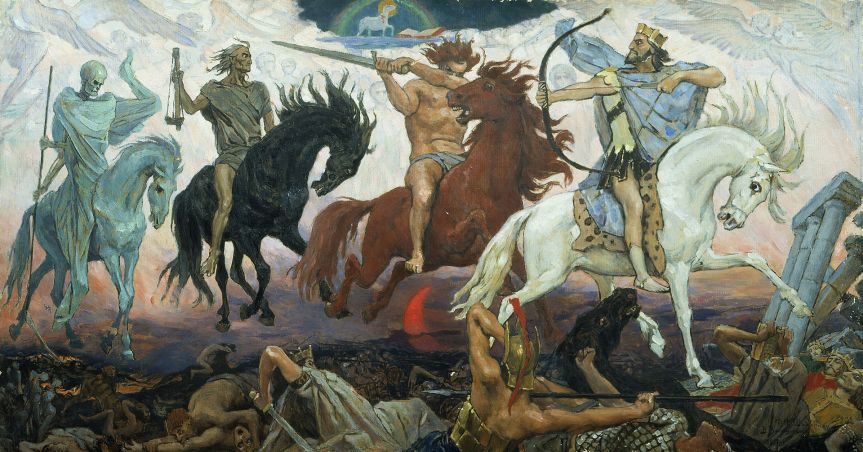
The Four Horsemen of the Apocalypse (Viktor Vasnetsov)
W.J. Astore
On this 15th anniversary of the 9/11 attacks in 2001, we should ask ourselves what those attacks inaugurated. In a word, calamity. The wildly successful actions of Al Qaeda, combined with the wild overreactions of the Bush/Cheney administration, marked the 21st century as one that will likely become known to future historians as calamitous.
In thinking about the 9/11 attacks, as an Air Force officer, what struck me then, and still does now, is the psychological blow. We Americans like to think we invented flight (not just that the Wright Brothers succeeded in the first powered flight that was both sustained and controlled). We like to think that airpower is uniquely American. We take great pride that many airliners are still “Made in the USA,” unlike most other manufactured goods nowadays.
To see our airliners turned into precision missiles against our skyscrapers, another potent image of American power, by a terrorist foe (that was once an ally against Soviet forces in Afghanistan) staggered our collective psyche. That’s what I mean when I say Al Qaeda’s attacks were “successful.” They created an enormous shock from which our nation has yet to recover.
This shock produced, as Tom Engelhardt notes in his latest article at TomDispatch.com, a form of government psychosis for vengeance via airpower. The problem, of course, is that the terrorist enemy (first Al Qaeda, then the Taliban, now ISIS) simply doesn’t offer big targets like skyscrapers or the Pentagon. The best the U.S. can do via airpower is to strike at training camps or small teams or even individuals, all of which matter little in the big scheme of things. Meanwhile, U.S. air strikes (and subsequent land invasions by ground troops) arguably strengthen the enemy strategically. Why? Because they lend credence to the enemy’s propaganda that the USA is launching jihad against the Muslim world.
The wild overreactions of the Bush/Cheney administration, essentially continued by Obama and the present national security state, have played into the hands of those seeking a crusade/jihad in the Greater Middle East. What we have now, so the experts say, is a generational or long war, with no foreseeable end point. Its product, however, is obvious: chaos, whether in Iraq or Libya or Yemen or Syria. And this chaos is likely to be aggravated by critical resource shortages (oil, water, food) as global warming accelerates in the next few decades.
We are in the early throes of the calamitous 21st century, and it all began fifteen years ago on 9/11/2001.
In Nice, France, 84 people were killed by a maniac who drove a truck into a crowd on Bastille Day (French Independence Day). The driver, identified as Mohamed Lahouaiej Bouhlel, was a French-Tunisian with a criminal record but with no known terrorist links.
Much remains unknown about this attack. Was the driver acting alone? Was he “radicalized,” killing for a political/religious purpose? Was he working with a terrorist sect, or perhaps he sympathized with one? We should be careful not to jump to conclusions.
I want to make one rather obvious point: It’s easy to politicize such horrendous attacks. It’s easy to say things like: “It’s all the fault of radical Islam! The West is at war with radical Islam! Muslim immigrants are to blame!” And so on. Before reaching any conclusions, let’s gather all the evidence.
There’s a natural tendency to resort to the rhetoric of warfare here. Politicians are especially prone to this. And if you don’t agree with them, they dismiss you as naive or delusional — or worse.
The problem with warfare rhetoric is that it answers questions before they’re even asked. It imposes solutions before you even fully understand the problem. For example, if it’s a “war,” the inevitable solution is more militarization. More surveillance. More police. More weapons. Perhaps more military strikes as well.
But what if more military strikes actually aggravate the problem? What if more police, more surveillance, more raids combine to abridge the freedoms that France fought for, the very freedoms which the French celebrate each year on Bastille Day?
Liberty, equality, and fraternity are noble goals. They need always to be nourished and protected, not just from terrorists and other criminals, but from those in authority who may overreact in the name of protecting the people.
The news out of Orlando is shocking. Another mass shooting in America. Another 50+ people dead with an additional 50+ wounded. And then I saw this headline:
“America has 4.4% of the world’s population, but almost 50% of the civilian-owned guns around the world”
The ready availability of guns in America, to include military-style assault weapons with 30-round clips, makes it far easier for shooters bent on murder to kill large numbers of people. It doesn’t matter what you call these shooters, whether you label them terrorists or lone wolves or crazed lunatics or whatever. Apparently the latest shooter bought his guns legally, had a grievance against gay people, expressed some last-minute allegiance to ISIS, and then started blasting away at innocent people in a club that was friendly to gays.
Sure, guns alone are not to blame. The primary person to blame is the shooter/murderer himself. But (to repeat myself) the guns sure make it a lot easier to kill, and in large numbers.
We live in a sick society, often a very violent one, certainly a disturbed one, one that places enormous stress on people. Another exceptional headline that I first heard on Bill Maher is that America, again with 4.4% of the world’s population, takes 75% of the world’s prescription drugs.
Guns and drugs – the two don’t mix, even when they’re legal. Americans are over-armed and over-medicated. Add to that mix the fact that Americans are under-educated, at least compared to our peers in the developed world, and you truly have a toxic brew.
Over-armed, over-medicated, and under-educated: surely this is not what our leaders have in mind when they call us the exceptional nation, the indispensable one, the greatest on earth. Is it?
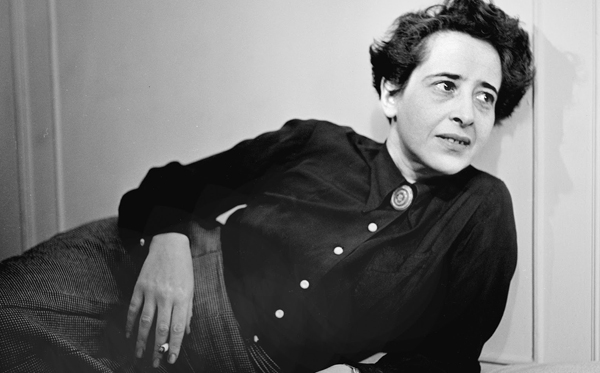
Hannah Arendt, cigarette in hand (Arendt Center, Bard College)
W.J. Astore
(This is part 2 of 2 of an essay dealing with lying, politics, and war, inspired by Hannah Arendt’s writings on The Pentagon Papers. For part 1, click here.)
After the Vietnam War, the U.S. government oversaw the creation of a post-democratic military, one that was less tied to the people, meaning that the government had even less cause to tell the truth about war. Unsurprisingly, then, the hubris witnessed in Vietnam was repeated with Iraq, together with an even more sweeping ability to deny or disregard facts, as showcased best in a statement by Karl Rove in 2004. The actions of the Bush/Cheney Administration, Rove suggested, bypassed the fact- or “reality-based” community of lesser humans precisely because their premises (the need to revolutionize the Middle East and to win the War on Terror through violence) were irrefutable and their motives unimpeachable. In Rove’s words:
We’re an empire now, and when we act, we create our own reality. And while you’re studying that reality—judiciously, as you will—we’ll act again, creating other new realities, which you can study too, and that’s how things will sort out. We’re history’s actors…and you, all of you, will be left to just study what we do.
So it was that the Bush/Cheney administration manufactured its own “facts” to create its own “reality,” as the Downing Street Memo revealed (according to a senior British official, U.S. intelligence was “fixed” in 2002 to justify a predetermined decision to invade Iraq in 2003). Dubious intelligence about yellowcake uranium from Africa and mobile biological weapons production facilities in Iraq (both later proved false) became “slam dunk” proof that Iraq had active programs of WMD development. These lies were then cited to justify a rapid invasion. That there were no active WMD programs in Iraq meant there could be no true “mission accomplished” moment to the war – a fact George W. Bush lampooned by pretending to “search” for WMD at the White House Correspondents’ Dinner in 2004. In this case, lies and self-deception coalesced in a wincing performance before chuckling Washington insiders that recalled the worst of vaudeville, except that Americans and Iraqis were dying for these lies.
Subsequent policy decisions in post-invasion Iraq didn’t fit the facts on the ground because those facts were simply denied. Then-Secretary of Defense Donald Rumsfeld said in July 2003 he didn’t do quagmires even as Iraq was becoming one for U.S. forces. Two years later, then-Vice President Cheney claimed the Iraq insurgency was “in the last throes” even as insurgent attacks began to accelerate. Lies and deception, to include self-deception, doomed the U.S. government to quagmire in Iraq, just as it had in Vietnam forty years earlier. Similar lies continue to bedevil U.S. efforts in Iraq today, as well as in Afghanistan and many other places.
Even as official lies and deception spread, whistleblowers who stepped forward were gagged and squashed. Chelsea Manning, Stephen Kim, and John Kiriakou were imprisoned; Edward Snowden was forced into permanent exile in Russia. Meanwhile, officials who toed the government line, who agreed to dissemble, were rewarded. Whether under Bush or Obama, government officials quickly learned that supporting the party line, no matter how fanciful, was and is rewarded – but that truth-telling would be punished severely.
Lying and Self-Deception Today
How are U.S. officials doing at truth-telling today? Consider the war in Afghanistan. Now in its 15th year, regress, not progress, is the reality on the ground. The Taliban controls more territory than ever, the drug trade is exploding, and Afghan forces remain unreliable. Yet the U.S. government continues to present the Afghan war as winnable and the situation as steadily improving.
Similarly, consider the war on terror, nowadays prosecuted mainly by drones and special ops. Even as the U.S. government boasts of terrorists killed and plots prevented, radical Islam as represented by ISIS and the like continues to spread. Indeed, as terrorism expert David Kilcullen recently admitted, ISIS didn’t exist until U.S. actions destabilized and radicalized Iraq after 2003. More than anything, U.S. intervention and blundering in Iraq created ISIS, just as ongoing drone strikes and special ops raids contribute to radicalization in the Islamic world.
Today’s generation of “best and brightest” problem-solvers believes U.S. forces cannot withdraw from Afghanistan without the Afghan government collapsing, hence the misleading statements about progress being made in that war. Radical Islamic terrorists, they believe, must be utterly destroyed by military means, hence deceptive statements about drone strikes and special ops raids as eliminating terrorism.
Accompanying lies and deception about progress being made in wars is image manipulation. Military action inoculates the Washington establishment, from President Obama on down, from (most) charges of being soft on terror (just as military action against North Vietnam inoculated John F. Kennedy and Lyndon B. Johnson against charges of being soft on communism). It also stokes the insatiable hunger of the military-industrial complex for bottomless resources and incessant action, a complex that the current crop of Republican and Democratic candidates for president (Bernie Sanders excepted) have vowed to feed and expand.
Whether in Vietnam, Iraq, or in the war on terror today, lying and self-deception have led to wrongheaded action and wrongful lessons. So, for example, rather than facing the quagmire of Afghanistan and extricating itself from it, Washington speaks of a generational war and staying the course until ultimate victory. Instead of seeing the often counterproductive nature of violent military strikes against radical Islam, Washington calls for more U.S. troops, more bombing, more “shock and awe,” the approach that bred the Islamic State in the first place.
One thing is certain: The U.S. desperately needs leaders whose judgment is informed by uncomfortable truths. Comfortable lies have been tried before, and look what they produced: lots of dead people, lost wars, and a crippling of America’s ability to govern itself as a democracy.
More than ever, hard facts are at a premium in U.S. politics. But the higher premium is the exorbitant costs we pay as a people, and the pain we inflict on others, when we allow leaders to make lies and deception the foundation of U.S. foreign policy.
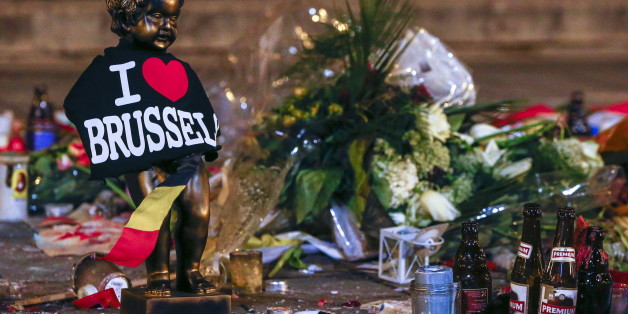
Replica of the Manneken-Pis statue, a major Brussels attraction, among flowers at a memorial for the victims of bomb attacks in Brussels. REUTERS/Yves Herman
W.J. Astore
I grew up during the Cold War when America’s rivalry with the Soviet Union posed a clear and present danger to our country’s very existence. Since the collapse of the USSR, or in other words the last 25 years, the U.S. has not faced an existential threat. Of course, the terrorist attacks on 9/11 were shocking and devastating, as were recent attacks in Paris and Brussels. But terrorism was and is nothing new. We faced it in the 1970s and 1980s, and indeed we will probably always face it. The question is how best to face it.
Stoking fear among the people is the wrong way to face it. Restricting liberty is the wrong way. An overly kinetic approach (i.e. lots of bombs and bullets) is the wrong way. Invading the Middle East (yet again) is the wrong way. Most of counter-terrorism, it seems to me, is an exercise in intelligence and policing (national and international). Yet we seem always to turn to our military to solve problems. The emphasis is relentlessly tactical/operational, stressing how many terrorists we kill in drone strikes and special ops raids (a version of the old “body count” from the Vietnam War era).
Military strikes and raids generate collateral damage and blowback, arguably creating more enemies than they kill. We’re helping to sustain a perpetual killing machine, a feedback loop. The more we “hit” various enemies while playing up the dangers of terrorism, especially in the media, the more they prosper in regards to attention (and recruits) they garner.
One of the first Rand primers I read as young Air Force lieutenant was “International Terrorism: The Other World War,” written by Brian M. Jenkins in 1985. Jenkins made many excellent points: that terrorists seek to instill fear, that their acts are mainly “aimed at the people watching,” that terrorism can’t be defeated like traditional (uniformed) enemies, that terrorists commit crimes for a larger political purpose (“causing widespread disorder, demoralizing society, and breaking down existing social and political order”), that terrorism is a form of political theater. As Jenkins notes:
“Terrorism attracts intense interest but produces little understanding. News coverage focuses on action not words. Terrorist incidents attract the media because they are genuine human dramas, different from ordinary murder and therefore newsworthy. “
Furthermore, “terrorists provide few lucrative targets for conventional military attack,” though this may be less true of state-sponsored terrorism.
What can we learn from Jenkins’s primer on terrorism? Three big lessons:
Deny the terrorists their victory by refusing to succumb to fear. In short, don’t panic. And don’t exaggerate the threat.
Don’t sensationalize the feats of terrorists in 24/7 media coverage of their attacks. That’s what the terrorists want. They want extensive media coverage, not only to shift public opinion and to spread fear, but also to recruit new members.
Finally, don’t change your way of life, your political system, your liberties, in response to terrorism. Abridging freedoms or marginalizing people (e.g. American Muslims) in the name of attacking terrorism is exactly what the terrorists want. They want to turn people against one another. To divide is to conquer.
The question is, when will Americans recognize the complexity of the terrorist threat while minimizing fear and over-reaction?
Terrorists need to be stopped, and that requires robust intelligence gathering, strong policing, and selective military action. But threat inflation, media hysteria, and militarized over-reaction simply play into the terrorists’ hands. Fear is the mind-killer, as Frank Herbert wrote. Let us always remember this as we face the terrorist threat with firmness and resolve.
Yesterday, Ira Chernus had a stimulating article at TomDispatch.com in which he noted the present lack of an American anti-war movement. When it comes to war and foreign policy, Americans face a Hobson’s choice: the Democrats with drones and Special Ops and bombing against evildoers, or the Republicans with even more drones and Special Ops and bombing against even more evildoers. The American master narrative, Chernus noted, is essentially all war.
He’s right about this, and I think it’s mainly for five reasons:
The military draft is gone, so our youth can safely (they think) ignore America’s never-ending wars. In Vietnam, with the draft, most of our youth didn’t have the luxury of apathy. Today, our youth have little personal incentive (as yet) to push back against the prevailing war narrative.
Militarism. Creeping militarism has shifted the American narrative rightwards. In the Vietnam period, General Curtis LeMay’s “bomb them back to the stone age” was a fringe opinion; now it’s mainstream with “carpet bombing” Cruz and Trump and Rubio, the “top three” Republican presidential contenders after the Iowa caucuses.
The Democrats have also shifted rightwards, so much so that now both major political parties embrace endless war. War, in short, has been normalized and removed from partisan politics. As Chernus documents, you simply can’t get an alternative narrative from the U.S. political mainstream. For that, you have to look to much smaller political parties, e.g. the Green Party.
The U.S. mainstream media has been thoroughly co-opted by corporations that profit from war. Anti-war ideas simply don’t get published; or, if they do, they’re dismissed as unserious. I simply can’t imagine any of today’s TV talking heads coming out against the war on terror like Walter Cronkite came out in the 1960s against Vietnam. There is simply no push back from the U.S. media.
Finally, a nebulous factor that’s always lurking: FEAR. The popular narrative today is that terrorists may kill you at any time right here in America. So you must be ready to “lockdown“; you must be ready to “shelter in place.” You must always defer to the police and military to keep you safe. You must fully fund the military or YOU WILL DIE. Repeated incantations of fear reinforce the master narrative of war.
Chernus makes many good points about how America’s constant warring in the Middle East only feeds radical Islam. In short, it’s vital to develop a new narrative, not only because the current one feeds war and death, but also because it’s fated to fail.
I doubt pacifism will fly in warrior corp USA. But why not containment? Containment worked against the Soviet Union, or so most Americans believe. If it worked against the far greater threat posed by the USSR, why shouldn’t it work against radical Islam?
Containment suggests several concrete actions: American troops should pull out of the Middle East. Bombing and drone strikes should stop. Establish a cordon sanitaire around the area. Lead a diplomatic effort to resolve the conflicts. And recognize that violent civil and ideological wars within Islam may need to burn themselves out.
One thing is certain: Because violent U.S. actions are most likely to act as accelerants to radical Islam, we need to stop attacking. Now.
Yes, the U.S. has a responsibility to help the peoples of the region. American actions helped to create the mess. But you don’t “solve” the mess by blowing more people and things to smithereens.
Containment, diplomacy, humanitarian aid. Not a chest-thumping course of action celebrated by the likes of Trump or Cruz or Clinton, but a new master narrative that would be more likely to spare lives and reduce the chaos in the Middle East.
Image showing Jihadi John. Apparently killed, then quickly replaced by a new “Jihadi John” — a visual metaphor of “progress” in the war on ISIS (AP photo)
W.J. Astore
An overarching strategy for defeating ISIS is simple enough to state: A concerted effort by regional power brokers to tamp down Islamic extremism while reducing the violent and chaotic conditions in which it thrives. Regional power brokers include the Israelis, the Saudis, the Iranians, and the Turks, joined by the United States and Russia. They should work, more or less cooperatively, to eliminate ISIS.
Why? Because you never know when a spark generated by extremists will ignite an inferno, especially in a tinderbox (a fair description of the Middle East). We know this from history. Consider the events of the summer of 1914. A Serbian “Black Hand” extremist assassinates an archduke of the Austro-Hungarian Empire in the Balkans (that era’s tinderbox of extremism). Most of Europe yawned, at least initially. A small brush fire between the Serbs and the Empire, easily containable, people said. Yet within weeks European troops were marching in the millions to their deaths in what became World War I.
In today’s Middle East, we’ve been lucky (so far) to avoid the kind of provocation and miscalculation that led to World War I. But consider the actions of a new president, say a Chris Christie. During a presidential debate, Christie promised to declare a no-fly zone over Syria and to shoot down any Russian plane that violated it. It’s the kind of ultimatum that very well could lead to another world war.
Provocations and ultimatums can rapidly spiral among nations that lack uniformity of purpose. For many of the power brokers engaged in the Middle East, defeating ISIS is either not the goal, or it’s not the primary one. Put differently, there are too many forces involved, working to discordant ends. Their actions, often at cross-purposes, ensure that entities like ISIS survive.
Let’s take the United States, for example. Every American politician says he (or she) wants to destroy ISIS. Yet in spite of this nation’s enormous military strength, we seem to be too weak, psychologically as well as culturally, to deal with Russia, Iran, et al. as diplomatic equals. The “exceptional” country thinks it must “lead,” and that means with bombing, drone strikes, troops on the ground, and similar “kinetic” actions. Rather than dousing the flames, such actions fuel the fire of Islamic extremism.
Consider America’s domestic political scene as well. ISIS is incessantly touted as a bogeyman to fear, most notably by Republican presidential candidates seeking to draw a contrast between themselves and Barack Obama, the “feckless weakling” in the words of Chris Christie. But the Republican “alternative” is simply more bombing and more U.S. troops. Making the sand glow is no strategy, Ted Cruz.
Strategy is a synthesis of means, ends, and will. Currently, the means is military force, with a choice of more (from Obama) or even more (from Republicans). Our leaders have no idea of the ends at all, other than vague talk of “destroying” ISIS. The will they exhibit is mostly bombast and fustian.
A nation lacking will, with no clear vision of means and ends, is a nation without a strategy. And a nation without a strategy is one that’s fated to fail.
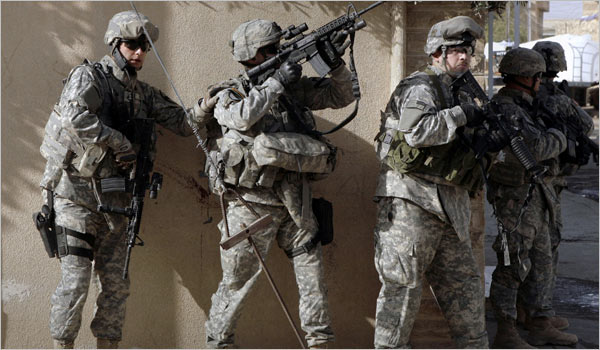
U.S. troops in Mosul, Iraq in 2007. A foreign presence to Iraqis
W.J. Astore
I’m a retired U.S. military officer. When I think of U.S. troops, naturally I see them as my gals and guys. I identify with them. And I know enough of them to know that their intent is usually good — at least in the sense that they seek to do their duty.
But I’m also an historian with a modicum of empathy. I know that foreigners don’t see the U.S. military as I see it. Nor do they experience it the way I experienced it. To cite just one anecdote: I recall a story in the New York Times in which U.S. troops in Iraq ask an Iraqi farmer if he’s seen any foreign fighters around. The Iraqi has a simple answer: “Yes. You.”
Six years ago, I wrote an article for Huffington Post on “Catch-22 in Afghanistan.” I argued that the more the U.S. military intervened in the affairs of Afghanistan, the less likely it was that a permanent, and suitably Afghan, solution would be found to the problems confronting that country. Not much has changed in those six years, except that today the Taliban controls even more territory, the drug trade is even more pervasive, and corruption is even more endemic.
We need to learn (or re-learn) a basic lesson: The more the U.S. intervenes in conflicts within other countries, the less likely it is that a favorable outcome will result (favorable for the U.S., that is), simply because U.S. forces are viewed as a foreign contagion. And indeed we are that.
Ignoring its Afghan failures, the U.S. government now seeks to widen its military commitment to the most hotly contested areas of the Middle East. Our leaders act as if the way to end civil wars driven in part by radical Islam is violent intervention led by American troops.
But American troops (and drones and bombs and all the rest) are not the answer. Indeed, their actions spread the contagion further.
The other day, I was reading about “super-bugs,” those bacterial infections that have become highly resistant to traditional antibiotics due to misuse and overuse of the same. In seeking to “destroy” ISIL and similar “infections,” the American government instead often feeds them. Indeed, I was surprised to learn that in medicine there are super-bugs that literally feed on traditional antibiotics. They gain strength from being attacked. Such is often the case for “bugs” like ISIL, which feed off of heavy-handed U.S. military actions.
This is not an argument for the U.S. military to do nothing. Rather, it’s a reminder of the limits of power and the complexity of life. It’s a reminder too that to foreigners the U.S. military is the foreign presence, the contagion. Even when it seeks to act as a “cure,” it may in fact be feeding the disease.
My wife and I watched the president’s speech last night. Overall, it was a solid, even praiseworthy, performance. First, we had to get past the NBC pre-speech fear-mongering. Lester Holt and Chuck Todd, the NBC commentators, were talking about how afraid Americans were, hinting that we all feared our holiday parties would be invaded by active shooters bent on murder. My wife and I looked at each other. Are you fearful, honey? Neither am I.
President Obama himself made many good points. Yes, we shouldn’t vilify Muslim-Americans or condemn all of Islam. Yes, we shouldn’t commit major ground forces to the Middle East to chase ISIL terrorists. Yes, we need sane gun control measures in the USA. Nobody needs an AK-47 or AR-15 (these are not hunting guns: they are military assault rifles designed to kill people). And nobody needs the right to buy a gun if they’re on a “no fly” list as a possible terror threat.
These were “common sense” points, and it pains me to think the president has to belabor what should be obvious. But he does. Because the National Rifle Association wants no restrictions on gun ownership, and the radical right does want to vilify Muslims, commit large numbers of U.S. ground troops to the Middle East, and extend a regimen of militarized surveillance and security at home that will make us even less safe.
Where President Obama consistently disappoints is what he leaves unsaid. That the U.S. invasion and occupation of Iraq essentially created ISIL; and that his policy of overthrowing the Syrian government by arming indigenous Arab forces contributed to it (according to Lieutenant General Michael Flynn, formerly head of the Defense Intelligence Agency). That his strategy of drone assassination (so-called signature strikes that are often based on faulty intelligence) is creating more terrorists than it kills, as several military drone operators have recently argued.
Defenders of the U.S. drone assassination program argue that it’s not the intent of the U.S. government to kill innocents, therefore the U.S. is free from blame. Try telling that to those who have lost loved ones to drones. (So sorry: We didn’t mean to kill your mother/brother/loved one. Wrong place/wrong time: an explanation as infuriating as it is unconvincing.)
President Obama concluded by arguing that he needed even more of a blank check (in the form of a Congressional authorization) to prosecute the war on terror. All in the name of keeping Americans safe, naturally. But he has it exactly backwards. Congress needs to exercise more oversight, not less. Imagine giving President Donald Trump a Congressional blank check to exercise the war on terror. Not such a good idea, right?
Finally, and disappointingly, Obama misunderstands the solemn duty of his office. As commander in chief, Obama believes his first duty is to keep Americans safe and secure. Wrong. His first duty is to “preserve, protect and defend” the U.S. Constitution and the rights, freedoms, and responsibilities defined within. Put bluntly, you can’t keep Americans safe and secure by abridging their rights to freedom of speech or to privacy or to dissent. “Safety” and “security” were not the bywords of America’s founders. Liberty was. And liberty entails risks.
A saying popular on the right is Thomas Jefferson’s “The tree of liberty must be refreshed from time to time with the blood of patriots and tyrants.” In the USA today, “tyranny” is most likely to come in the form of a leader who promises to keep us safe and secure at any cost. (Just look at the Republican candidates for president with their calls for Muslim detention camps, mass expulsion of immigrants, the shuttering of houses of worship, and similar measures of repression.)
The president was right to argue that we must not betray our values. He was right to talk about human dignity. He was right to say that freedom is more powerful than fear. Now we as Americans need to live up to those words. And so does he.
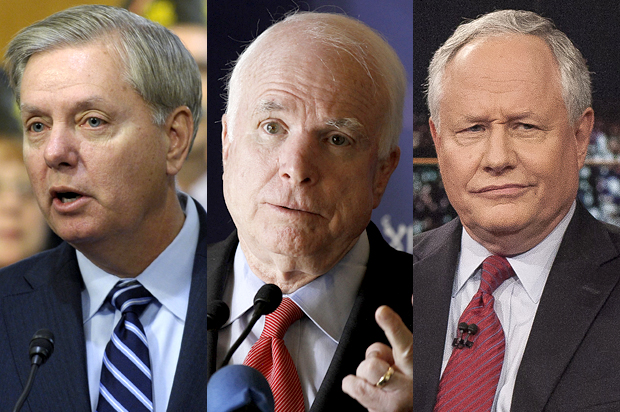
John McCain (middle) bookended by “warriors” Lindsey Graham (left) and Bill Kristol (right)
W.J. Astore
In his latest introduction at TomDispatch.com, Tom Engelhardt reveals a remarkable double standard — perhaps craziness is a better term — in the U.S. approach to terrorism in the wake of the Paris attacks. Prominent “conservative” leaders are calling for a major U.S. military invasion of territory controlled by ISIS, even though they know that ISIS has the “home field advantage.” They know, in short, that such an invasion will be both risky and costly, spreading chaos even further in the region, but they just can’t help themselves: they must “do something,” and the “something” in this case is sending other people’s sons and daughters into harm’s way.
But when it comes to incurring any risk, no matter how remote, to the American “homeland” from allowing refugees fleeing the chaos of the Middle East (chaos partly made by the USA and its previous military interventions, of course) to enter, these same conservative leaders cower. We can’t let “them” in. Too dangerous!
So, where the U.S. has an overwhelming “home field” advantage, these self-styled warriors retreat into paralyzing timidity. “Not in my backyard,” they say. But we sure as hell will send “our” troops into their backyards. See how brave we are in taking the fight to ISIS?
Here is Engelhardt’s introduction that so clearly highlights this tension:
In Washington, voices are rising fast and furiously. “Freedom fries” are a thing of the past and everyone agrees on the need to support France (and on more or less nothing else). Now, disagreements are sharpening over whether to only incrementally “intensify” the use of U.S. military power in Syria and Iraq or go to “war” big time and send in the troops. The editor of the right-wing Weekly Standard, Bill Kristol, is already calling for 50,000 American troops to take the Islamic State’s “capital,” Raqqa. Republican presidential candidate Senator Lindsey Graham, who has been urging that another 20,000 troops be dispatched to the region for months, offers this illuminating analogy to sports: “I’m looking for an away game when it comes to ISIL, not a home game. I want to fight them in their backyard.”
And don’t forget that increasingly angry sideline discussion about the Obama administration’s plan to let 10,000 Syrian refugees, carefully vetted for up to two years, trickle into the country. Alternatives proposed include setting up even harsher, more time-consuming vetting processes to insure that few of them can make it, allowing only certified, God-fearing Christian Syrians in while — give a rousing cheer for the “clash of civilizations” — leaving Muslims to rot in hell, or just blocking the whole damn lot of them.
I’m all for Bill Kristol and Lindsey Graham’s warrior fervor. I wish them every success as they deploy to Raqqa in their “away game” against ISIS.




 U.S. troops in Mosul, Iraq in 2007. A foreign presence to Iraqis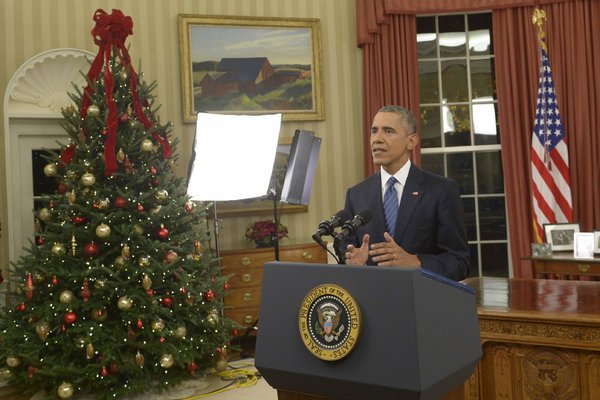
 Bracing Views