Language and repetition of the same is so important. We hear about the Department of Defense (DoD) and the Pentagon budget and we think little of it. The DoD, of course, used to be called the Department of War until 1947, a far more telling and accurate name, and there wasn’t a Pentagon until we built one during World War II. In the old days, the Army fought the Navy for which service would get more money in the War Budget, with the Navy usually winning as America sought to control the seas as a means of dominating trade and “intercourse” among nations.
Those were more honest times when retired generals like Smedley Butler wrote in the 1930s that he’d served as a “gangster” for capitalism. Butler was a Marine who was twice awarded the Medal of Honor, so it wasn’t easy for the imperialists to smear him, though they certainly tried (as they did to David M. Shoup, another Marine Corps general and Medal of Honor recipient who turned against the Vietnam War in the 1960s).
Anyhow, I just saw at Antiwar.com that President Trump is proposing a $1.01 trillion budget for the Pentagon for FY2026, a 13% increase in imperial spending. Trump, of course, is proud of reaching the Trillion Dollar threshold. Big numbers have always appealed to him.
It doesn’t seem to matter who is president, whether it’s Biden or Trump, Democrat or Republican, when it comes to the Department of Empire and its bloated imperial budget. For that is what it is, a budget that seeks to sustain and enlarge America’s imperial domain. If you add other costs related to imperial dominance, such as interest on the national debt due to war spending, VA costs, nuclear weapons, and the like, the true imperial budget soars toward $1.7 trillion yearly.
No matter. A trillion here, a trillion there, and pretty soon you’re talking real money.
The Pentagon tries to disguise the enormous waste of this imperial budget by speaking of it as an “investment,” but imagine an “investment” that you’re involved in which fails seven audits in a row. How likely would you be to see this as anything other than theft?
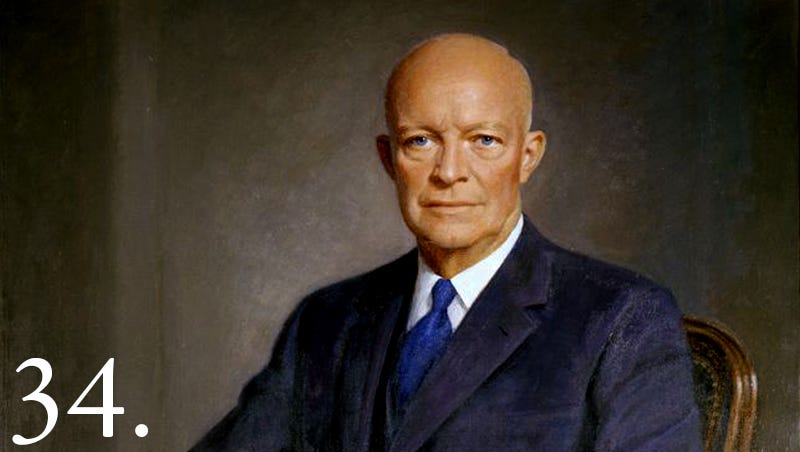
Dwight D. Eisenhower had it right in 1953 when he spoke of military spending as a theft from those who hunger. Ike’s words are almost never heard today inside the Washington Beltway. It’s worth reflecting upon them again as America’s leaders boast of trillion-dollar war budgets:
Every gun that is made, every warship launched, every rocket fired signifies, in the final sense, a theft from those who hunger and are not fed, those who are cold and are not clothed. This world in arms is not spending money alone. It is spending the sweat of its laborers, the genius of its scientists, the hopes of its children… This is not a way of life at all, in any true sense. Under the cloud of threatening war, it is humanity hanging from a cross of iron.
American foreign policy remains in the grip of heretics. They believe that the Prince of Peace is actually a god of war. They believe America is strengthened by entangling alliances (think here of our so-called alliance with Israel). They believe in constant war as a recipe both for dominant power and greater freedom and democracy throughout the world. They believe that spending roughly a trillion dollars each year on weapons and war is a wise “investment.” And they believe they are the toughest and truest of patriots, the ones who see further, the ones with the guts to get things done, no matter how poorly America’s wars have gone from Korea and Vietnam through Afghanistan, Iraq, and today’s proxy wars.
There used to be a different America, a much less militaristic and bellicose one. The American tradition is rich and complex; it contains multitudes, as Walt Whitman might say. Why are we so stuck on warmongers, thieves, and vainglorious simps of empire?
As an American, I’m very much a part of my country’s complexity and richness. And the America that speaks to me contains elements and lessons such as these:
George Washington’s prescient warning about the dangers of entangling alliances with foreign powers.
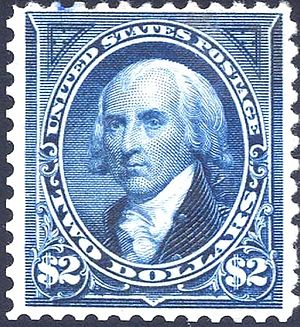
James Madison’s warning that constant warfare is the direst of enemies of liberty, freedom, and democracy in America.
General Smedley Butler’s confession that “war is a racket” and that he had often served as a “gangster for capitalism.”
The Nye Commission in the U.S. Senate that investigated arms manufacturers and weapons makers as “Merchants of Death” that profited greatly from war.
President Dwight D. Eisenhower’s “cross of iron” speech and his warning about the growing power and insidious nature of the military-industrial complex.
President John F. Kennedy’s powerful peace speech in which he extended an olive branch to the Soviet Union.
Martin Luther King Jr.’s powerful speech against the Vietnam War and the perils of militarism, racism, and materialism in America.
Of course, America has always had its dark side, with slavery and the genocidal treatment of Native Americans being at the top of the list. Yet America also has had its triumphs of wisdom and goodness. That is the America we should be embracing and celebrating. I believe it’s captured in the words of Washington, Madison, JFK, MLK, and so many others who’ve fought for peace and sanity, people like Dorothy Day, the Catholic activist who fought against war and all its awful excesses.
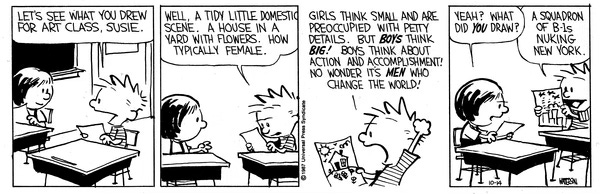
All that said, sometimes cartoons can express truths in ways that are as powerful as they are simple. In the cartoon below, the heretics of U.S. foreign policy are so many Calvins, spreading destruction and employing nukes in the name of manly seriousness. They are wrong. They are heretics. And if we continue to allow them to rule, they will surely lead America (as they already are in Gaza) to mass graves.
As a retired Air Force officer and military historian, I’m familiar with all kinds of euphemisms about killing, e.g. “precision bombing” and “collateral damage.” Just as it’s easier to kill at a distance, it’s easier to kill when we use words that provide distance from the act. Words that facilitate detachment. Words that befuddle and confuse our minds.
When writing honestly about war, it’s best to use bullet-hits-the-bone words: atrocity, murder, war crime, slaughter. Rape, pillage, burn are “old” words associated with war, and these words often most fittingly describe war and its likely effects and outcomes.
Powerful, blunt, and accurate words should remind us that war is inherently horrible and also profoundly anti-democratic. War is consistent with authoritarianism and lack of freedom, yet Americans nowadays seem to think war (and words about war) is conducive to democracy and freedom, e.g. Afghanistan, Iraq, and now Ukraine.
We used to know better. Military people are fond of the saying, “freedom isn’t free,” but neither is war. Indeed, war and its various manifestations are costing this nation more than a trillion dollars a year while weakening democracy and our constitutional freedoms. And that is a very high price to pay to keep the factories of the merchants of death humming and the generals and admirals happy.
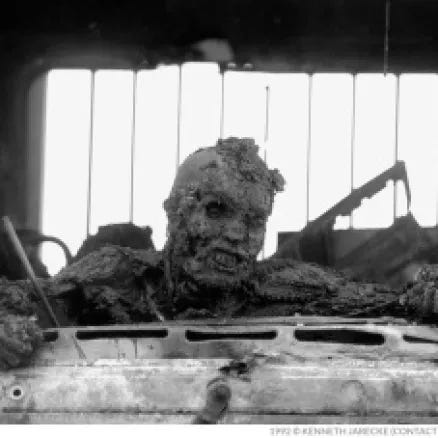
Grisly images like this one (of a dead Iraqi soldier) were censored in America. Language is censored as well.
Fortunately, there’s a new guide and website available that alerts us to the importance of language and war. The website is wordsaboutwar.org, from which you can read and download suggestions on how best to use words to convey the horrors and costs of war to people everywhere. I urge you to visit the site and peruse the guide. (Full disclosure: I was an advisor to this effort, which was ably led by David Vine.)
Here’s a sample of a few comments I made in passing to the group:
A war on terror is truly a war of terror because war itself is terrible.
Friendly fire is being killed by one’s own, often due to the chaos of war, the sheer waste of it all, exacerbated by incompetence. “Fire” is always unfriendly.
Very few troops are “heroes,” and indeed most aren’t, because heroes are rare in all walks of life.
The word “casualty” is too benign. I much prefer killed and wounded: the victims of war.
What are “enemy noncombatants”? They are usually innocent civilians.
With respect to the “War on Terror” that the U.S. has prosecuted for 22 years and counting, I noted that:
We (the U.S.) manifested a Manichean world view; as George W. Bush said soon after 9/11, you’re either for America (and all its violence) or you’re for the terrorists (with their violence). If you wanted a non-violent approach, you were dismissed as naive or “for them.” It was good versus evil, thus the infamous “axis of evil” the U.S. allegedly faced.
This is, of course, a problem with all discourse related to war. Subtlety and nuance are thrown out the window. Language is greatly simplified. The U.S. is “doubleplusgood” and the enemy must be the opposite while simultaneously being dehumanized. We kill “cowardly” enemy troops or terrorists (by drone they’re “bugsplat”) yet our “heroic” troops “fall” in battle and are revered as “the fallen.” Violent combat is disguised as “kinetic action” in U.S. military communiques.
In my view, the dishonesty of this language captures the dishonesty of America’s wars.
General William T. Sherman (U.S. Civil War) famously said that “War is all hell.” Sherman knew the hellish and harsh realities of war; he knew, as he wrote, that “war is cruelty, and you cannot refine it.” Too many people today are using and manipulating words to refine war. They’re camouflaging war’s harshest realities. Writers should write plainly and honestly, as General Sherman did, to capture war’s hellish nature. By choosing honest words, we also help to create a better future in which the threat of war recedes precisely because we recognize more clearly its horrific nature and terrifying costs.
Other high-ranking military officers, like General Smedley Butler, for example, also wrote plainly about war. As Butler famously said, war is a racket, and he described himself as a gangster for capitalism. Now that was plain speaking about war!
The chief intent of speaking and writing plainly about war is to discourage war and save lives. Some might see it as patriotic—saving the lives of U.S. troops by helping to prevent bloody awful wars—but more broadly the goal is humanistic—to save the lives of all those on the receiving end of bullets and bombs.
Interestingly, U.S. troops at lower levels are generally blunt about what war is about. Talk to sergeants at the front and you’ll hear visceral truths, probably enhanced by choice expletives. I’ve heard U.S. Marines shout “Kill!” at graduation ceremonies. Killing, after all, is what war enables. Mass killing leads to atrocities like My Lai in Vietnam. This fact should never be sugarcoated.
Few people, however, truly want to confront war’s horrors. Gazing upon the face of war is profoundly disturbing, which is why we’re encouraged to look away. And so the face of war is airbrushed and camouflaged with euphemisms and buried under a blizzard of acronyms.
If we are to end war and prevent atrocity, we must seek to name things accurately while calling up mental images (no matter how disturbing) appropriate to the horrors of war. The guide at wordsaboutwar.org is an important step in that direction.
Update: I went on Podcast by George today to talk about all this:
Reason and Rationality Have Little to Do with Them
It is often hard to understand the reasons for America’s wars, especially since World War II, but they always have a rationale backed up by lies. The rationale for Vietnam was the containment of communism and the domino theory. The lie was that U.S. naval ships had been attacked at Tonkin Gulf. The rationale for Iraq was overthrowing a ruthless dictator and spreading “freedom.” The lie was that he had WMD and that he was somehow connected to the 9/11 attacks.
Nations and peoples are not dominoes
The real reasons for America’s many disastrous wars are opaque. Domestic politics are almost always paramount. No U.S. president wants to be accused of losing a war or appearing to be weak, so starting or continuing a war is considered as “strength.” Congress doesn’t want to be accused of “tying the hands of the president” or of “betraying the troops,” so most members happily go along with wars. The military, of course, always thinks it can win, and wars are good for promotions and power. And military contractors, the “merchants of death,” are even more happy to make money off war. Not surprisingly, perhaps, President Dwight D. Eisenhower’s farewell speech in 1961 warned America of the military-industrial complex, to which Ike had added Congress in an earlier draft. Ike’s warning has been largely forgotten; even his own monument in DC obscures it.
In Washington today, the Democrats accuse the Republicans of being weak on Russia; the Republicans return the favor by accusing the Biden administration of being weak on China. Military and industry are happy to play this blame game, knowing the Pentagon budget will soar as a result, as it has. And thus a dangerous “new cold war” appears to be a certainty.
The folly and fallaciousness of America’s wars, along with their carnage, are enough to make any rational human angry, especially one who has served in one of these wars. Mike Murry, a Vietnam War veteran, is angry, and so am I. Back in 2017, I wrote a piece on the atrociousness of the Vietnam War, to which Mr. Murry appended this comment. It merits consideration by all thinking Americans.
The ”Rationale” of America’s Wars. Comment by Mike Murry in 2017.
An excellent choice of words, “rationale.” Not the reason for doing something in the first place, but a conscious lie made up beforehand just to get things started, or an excuse invented afterwards to avoid accountability and, where required, the necessary punishment that true justice occasionally administers. Marine Corps General Smedley Butler once said that we have only two acceptable reasons for going to war: to defend our homes or defend the Constitution. In not a single case after World War II has either of these conditions applied, so that none of the pointless and ruinous fighting — I won’t dignify these Presidential/Career Military misadventures by calling them “war” — has had any justifiable reason or purpose. Not surprisingly, no Congress has declared war on another nation state since 1941 because no nation state on planet earth has attacked either American homes or America’s Constitution. The United States has not just “gone abroad in search of monsters to destroy,” as our sixth President, John Quincy Adams, warned us against foolishly doing, but has invented imaginary hobgoblins at home before even setting out to vanquish them on the far side of the globe.
Of course, Smedley Butler only made his remarks after serving for thirty years as an admitted “gangster for capitalism,” probably the best summary description of the U.S. military offered to date by one who ought to know. Today, as for the past seventy-plus years, the U.S. military simply fights — aimlessly and disastrously — for the sake of fighting. The fighting has no “reason” other than to provide a steady stream of outrageous corporate CEO bonuses, stockholder dividends, and the pensions and perquisites of retired senior military officers. This Warfare Welfare and Make-work Militarism has secondary beneficiaries, of course, most notably the hothouse orchids, special snowflakes and privileged peacock pugilists known as United States as “political leaders.” Naturally, the feeding and maintenance of this system of corrupt cronyism requires a death grip on over half the nation’s discretionary budget. As George Orwell wrote in “The Theory and Practice of Oligarchical Collectivism” (the book-within-a-book from 1984):
“The primary aim of modern warfare (in accordance with the principles of doublethink, this aim is simultaneously recognized and not recognized by the directing brains of the Inner Party) is to use up the products of the machine without raising the general standard of living.”
In other words, the entire U.S. military/security monstrosity — which I like to call the Lunatic Leviathan — has only one purpose: to suck the life out of the domestic economy so that the productivity of the people’s labor will not result in the betterment of their station in life, which might in due course result in the discarding of America’s useless parasitic economic and political “elites.” Any transparent euphemism designed and deployed to disguise this ugly, fundamental truth properly deserves the label “rationale.” In no way do the usual and time-dishonored obfuscations amount to a reason. Reason has fled the United States, replaced by a deserved and rancid Ridicule. The country now consumes itself, lost in its own vicarious fears and fantasies featuring the celluloid exploits of our vaunted Visigoths vanquishing visions of vultures somewhere, someplace, at some time, until … eventually … after some “progress” and “fragile gains” … as T.S. Eliot wrote of The Hollow Men:
This is the way the world ends This is the way the world ends This is the way the world ends Not with a bang but a whimper.
Men and women so hollow that you can hear their own bullshit echoing in them even before they start moving their jaws and flapping their lips to begin lying.
My name is Bill Astore and I’m a card-carrying member of the military-industrial complex (MIC).
Sure, I hung up my military uniform for the last time in 2005. Since 2007, I’ve been writing articles for TomDispatch focused largely on critiquing that same MIC and America’s permanent war economy. I’ve written against this country’s wasteful and unwise wars in Iraq and Afghanistan, its costly and disastrous weapons systems, and its undemocratic embrace of warriors and militarism. Nevertheless, I remain a lieutenant colonel, if a retired one. I still have my military ID card, if only to get on bases, and I still tend to say “we” when I talk about my fellow soldiers, Marines, sailors, and airmen (and our “guardians,” too, now that we have a Space Force).
So, when I talk to organizations that are antiwar, that seek to downsize, dismantle, or otherwise weaken the MIC, I’m upfront about my military biases even as I add my own voice to their critiques. Of course, you don’t have to be antiwar to be highly suspicious of the U.S. military. Senior leaders in “my” military have lied so often, whether in the Vietnam War era of the last century or in this one about “progress” in Iraq and Afghanistan, that you’d have to be asleep at the wheel or ignorant not to have suspected the official story.
Yet I also urge antiwar forces to see more than mendacity or malice in “our” military. It was retired general and then-President Dwight D. Eisenhower, after all, who first warned Americans of the profound dangers of the military-industrial complex in his 1961 farewell address. Not enough Americans heeded Ike’s warning then and, judging by our near-constant state of warfare since that time, not to speak of our ever-ballooning “defense” budgets, very few have heeded his warning to this day. How to explain that?
Ike’s warning about the military-industrial complex was also a call to arms to “an alert and knowledgeable citizenry” (Image: WhiteHouse.gov)
Well, give the MIC credit. Its tenacity has been amazing. You might compare it to an invasive weed, a parasitic cowbird (an image I’ve used before), or even a metastasizing cancer. As a weed, it’s choking democracy; as a cowbird, it’s gobbling up most of the “food” (at least half of the federal discretionary budget) with no end in sight; as a cancer, it continues to spread, weakening our individual freedoms and liberty.
Call it what you will. The question is: How do we stop it? I’ve offered suggestions in the past; so, too, have writers for TomDispatch like retired Army Colonel Andrew Bacevich and retired Army Major Danny Sjursen, as well as William Hartung, Julia Gledhill, and Alfred McCoy among others. Despite our critiques, the MIC grows ever stronger. If Ike’s warning wasn’t eye-opening enough, enhanced by an even more powerful speech, “Beyond Vietnam,” by Martin Luther King, Jr., in 1967, what could I and my fellow TomDispatch writers possibly say or do to make a difference?
Maybe nothing, but that won’t stop me from trying. Since I am the MIC, so to speak, maybe I can look within for a few lessons that came to me the hard way (in the sense that I had to live them). So, what have l learned of value?
War Racketeers Enjoy Their Racket
In the 1930s, Smedley Butler, a Marine general twice decorated with the Medal of Honor, wrote a book entitled War Is a Racket. He knew better than most since, as he confessed in that volume, when he wore a military uniform, he served as “a racketeer, a gangster for capitalism.” And the corporate-driven racket he helped enable almost a century ago by busting heads from the Caribbean to China was small-scale indeed compared to today’s thoroughly global one.
There’s an obvious lesson to be drawn from its striking endurance, never-ending enlargement, and distinct engorgement in our moment (even after all those lost wars it fought): the system will not reform itself. It will always demand and take more — more money, more authority, more power. It will never be geared for peace. By its nature, it’s authoritarian and distinctly less than honorable, replacing patriotism with service loyalty and victory with triumphant budgetary authority. And it always favors the darkest of scenarios, including at present a new cold war with China and Russia, because that’s the best and most expedient way for it to thrive.
Within the military-industrial complex, there are no incentives to do the right thing. Those few who have a conscience and speak out honorably are punished, including truth-tellers in the enlisted ranks like Chelsea Manning and Daniel Hale. Even being an officer doesn’t make you immune. For his temerity in resisting the Vietnam War, David M. Shoup, a retired Marine Corps general and Medal of Honor recipient, was typically dismissed by his peers as unbalanced and of questionable sanity.
For all the talk of “mavericks,” whether in Top Gun or elsewhere, we — there’s that “we” again (I can’t help myself!) — in the military are a hotbed of go-along-to-get-along conformity.
Recently, I was talking with a senior enlisted colleague about why so few top-ranking officers are willing to speak truth to the powerless (that’s you and me) even after they retire. He mentioned credibility. To question the system, to criticize it, to air dirty laundry in public is to risk losing credibility within the club and so to be rejected as a malcontent, disloyal, even “unbalanced.” Then, of course, that infamous revolving door between the military and giant weapons makers like Boeing and Raytheon simply won’t spin for you. Seven-figure compensation packages, like the one current Secretary of Defense Lloyd Austin gained from Raytheon after his retirement as an Army general, won’t be an option. And in America, who doesn’t want to cash in while gaining more power within the system?
Quite simply, it pays so much better to mouth untruths, or at least distinctly less-than-full-truths, in service to the powerful. And with that in mind, here, at least as I see it, are a few full truths about my old service, the Air Force, that I guarantee you I won’t be applauded for mentioning. How about this as a start: that the production of F-35s — an overpriced “Ferrari” of a fighter jet that’s both too complex and remarkably successful as an underperformer — should be canceled (savings: as much as $1 trillion over time); that the much-touted new B-21 nuclear bomber isn’t needed (savings: at least $200 billion) and neither is the new Sentinel Intercontinental Ballistic Missile(savings: another $200 billion and possibly the entire Earth from doomsday); that the KC-46 tanker is seriously flawed and should be canceled (savings: another $50 billion).
Now, tote it up. By canceling the F-35, the B-21, the Sentinel, and the KC-46, I singlehandedly saved the American taxpayer roughly $1.5 trillion without hurting America’s national defense in the least. But I’ve also just lost all credibility (assuming I had any left) with my old service.
Look, what matters to the military-industrial complex isn’t either the truth or saving your taxpayer dollars but keeping those weapons programs going and the money flowing. What matters, above all, is keeping America’s economy on a permanent wartime footing both by buying endless new (and old) weapons systems for the military and selling them globally in a bizarrely Orwellian pursuit of peace through war.
How are Americans, Ike’s “alert and knowledgeable citizenry,” supposed to end a racket like this? We certainly should know one thing by now: the MIC will never check itself and Congress, already part of it thanks to impressive campaign donations and the like by major weapons makers, won’t corral it either. Indeed, last year, Congress shoveled $45 billion more than the Biden administration requested (more even than the Pentagon asked for) to that complex, all ostensibly in your name. Who cares that it hasn’t won a war of the faintest significance since 1945. Even “victory” in the Cold War (after the Soviet Union imploded in 1991) was thrown away. And now the complex warns us of an onrushing “new cold war” to be waged, naturally, at tremendous cost to you, the American taxpayer.
As citizens, we must be informed, willing, and able to act. And that’s precisely why the complex seeks to deny you knowledge, precisely why it seeks to isolate you from its actions in this world. So, it’s up to you — to us! — to remain alert and involved. Most of all, each of us must struggle to keep our identity and autonomy as a citizen, a rank higher than that of any general or admiral, for, as we all need to be reminded, those wearing uniforms are supposed to serve you, not vice-versa.
I know you hear otherwise. You’ve been told repeatedly in these years that it’s your job to “support our troops.” Yet, in truth, those troops should only exist to support and defend you, and of course the Constitution, the compact that binds us all together as a nation.
When misguided citizens genuflect before those troops (and then ignore everything that’s done in their name), I’m reminded yet again of Ike’s sage warning that only Americans can truly hurt this country. Military service may be necessary, but it’s not necessarily ennobling. America’s founders were profoundly skeptical of large militaries, of entangling alliances with foreign powers, and of permanent wars and threats of the same. So should we all be.
Citizens United Is the Answer
No, not that “Citizens United,” not the case in which the Supreme Court decided corporations had the same free speech rights as you and me, allowing them to coopt the legislative process by drowning us out with massive amounts of “speech,” aka dark-money-driven propaganda. We need citizens united against America’s war machine.
Understanding how that machine works — not just its waste and corruption, but also its positive attributes — is the best way to wrestle it down, to make it submit to the people’s will. Yet activists are sometimes ignorant of the most basic facts about “their” military. So what? Does the difference between a sergeant major and a major, or a chief petty officer and the chief of naval operations matter? The answer is: yes.
An antimilitary approach anchored in ignorance won’t resonate with the American people. An antiwar message anchored in knowledge could, however. It’s important, that is, to hit the proverbial nail on the head. Look, for example, at the traction Donald Trump gained in the presidential race of 2015-2016 when he did something few other politicians then dared do: dismiss the Iraq War as wasteful and stupid. His election win in 2016 was not primarily about racism, nor the result of a nefarious Russian plot. Trump won, at least in part because, despite his ignorance on so many other things, he spoke a fundamental truth — that America’s wars of this century were horrendous blunders.
Trump, of course, was anything but antimilitary. He dreamed of military parades in Washington, D.C. But I (grudgingly) give him credit for boasting that he knew more than his generals and by that I mean many more Americans need to challenge those in authority, especially those in uniform.
Yet challenging them is just a start. The only real way to wrestle the military-industrial complex to the ground is to cut its funding in half, whether gradually over years or in one fell swoop. Yes, indeed, it’s the understatement of the century to note how much easier that’s said than done. It’s not like any of us could wave a military swagger stick like a magic wand and make half the Pentagon budget disappear. But consider this: If I could do so, that military budget would still be roughly $430 billion, easily more than China’s and Russia’s combined, and more than seven times what this country spends on the State Department. As usual, you get what you pay for, which for America has meant more weapons and disastrous wars.
Join me in imagining the (almost) inconceivable — a Pentagon budget cut in half. Yes, generals and admirals would scream and Congress would squeal. But it would truly matter because, as a retired Army major general once told me, major budget cuts would force the Pentagon to think — for once. With any luck, a few sane and patriotic officers would emerge to place the defense of America first, meaning that hubristic imperial designs and forever wars would truly be reined in because there’d simply be no more money for them.
Currently, Americans are giving the Pentagon all it wants — plus some. And how’s that been working out for the rest of us? Isn’t it finally time for us to exercise real oversight, as Ike challenged us to do in 1961? Isn’t it time to force the Pentagon to pass an audit each year — it’s failed the last five! — or else cut its budget even more deeply? Isn’t it time to hold Congress truly responsible for enabling ever more war by voting out military sycophants? Isn’t it time to recognize, as America’s founders did, that sustaining a vast military establishment constitutes the slow and certain death of democracy?
Just remember one thing: the military-industrial complex won’t reform itself. It just might have no choice, however, but to respond to our demands, if we as citizens remain alert, knowledgeable, determined, and united. And if it should refuse to, if the MIC can’t be tamed, whether because of its strength or our weakness, you will know beyond doubt that this country has truly lost its way.
In “The Godfather,” Michael Corleone, played brilliantly by Al Pacino, says that killing a rival mobster and crooked police captain who conspired to kill his father is nothing personal — it’s strictly business. Something similar can be said of America’s wars and weapons trade today. As retired General Smedley Butler said in the 1930s, U.S. military actions often take the form of gangster capitalism. Want to know what’s really going on? Follow the muscle and the money!
America has “invested” itself in the Russia-Ukraine war, and I use that word deliberately. U.S. weapons makers like Raytheon and Lockheed Martin are making a killing, literally and figuratively, on the ongoing war, whether by sending arms to Ukraine or in the major boost forthcoming to Pentagon spending supported by Democrats and Republicans in Congress. (Who said bipartisanship is dead?) For all the blue-and-yellow flags that America is flying in symbolic solidarity with Ukraine, the true colors of this war, as with most wars, is red for blood and green for money.
Economic sanctions against Russia, meanwhile, are meant to damage the financial wellbeing of that country, possibly leading to instability and even collapse. And who would profit from such a collapse? And who is profiting now from restricting fossil fuel exports from Russia? As war drags on in Ukraine, disaster piles on disaster, and capitalism has a way of profiting from war-driven disasters. Why do you think America’s disastrous Afghan War lasted for two decades?
Curiously, investment-speak in the U.S. military is quite common. Generals and admirals talk of “investing” in new nuclear missiles and immense ships. They further talk of “divesting” in certain weapons that have proven to be disasters in their own way, like the F-22 fighter. What’s with all this “investing” and “divesting” in the U.S. military? One thing is certain: Generals won’t have to change their language as they retire and move through the revolving door to join corporate boards at major weapons contractors.
Today’s generals and politicians never display the honesty of President Dwight Eisenhower, who explained nearly seventy years ago that weapons represent a theft from the people and their needs, not an “investment.” Those who say there’s no business like show business may be right, but Hollywood’s a piker compared to the Pentagon, where there’s truly no business like war business.
Sixty-one years ago, in 1961, President Dwight D. Eisenhower warned America of the threat posed by the military-industrial complex (MIC). To that complex, Ike had rightly added Congress, whose members are generally supportive of immense military spending, especially when it occurs in their district. Americans, in the main, haven’t heeded Ike’s warning, mainly due to government/corporate propaganda, military lobbying and threat inflation, wars and rumors of war, the naked desire for global dominance in the stated cause of keeping the “homeland” safe, and, well, greed.
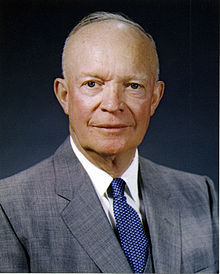
Ike in 1959
How does “an alert and knowledgeable citizenry” tackle such a beast? I was part of a discussion this week on strategies to “dismantle” the MIC; more on that in a moment. First, a caveat. When I use the term “military-industrial complex,” I know what I’m referring to and talking about, and so too do my readers. But what about your average American, who perhaps has barely heard of President Eisenhower, let alone his farewell address in 1961? And what about those who prosper from the MIC, whether they know it or not? Why should they support calls for “dismantling” a big part of their livelihood?
Random example. I went to the doctor’s office today. The receptionist noted my military background as she told me about her son, whose work on red blood cells is funded by the Department of Defense, and her husband, whose work is connected to Raytheon, a major weapons contractor. Another example is my previous dental hygienist, whose husband proudly worked on the helmet system for the F-35 jet fighter. So many of our fellow Americans are connected to the MIC; lots of my friends are, especially if they served. As a retired military officer who writes articles that are generally critical of the MIC, I’m the exception. Many of my peers are still employed by the MIC in good-paying positions that would be difficult for them to replicate in the private, civilian sector of society.
This is not an argument for how wonderful the MIC is. But reformers need to recognize that significant cuts to MIC funding, desirable as they are, will impact ordinary people first, rather than retired generals and corporate CEOs, who will be just fine no matter what happens.
Whatever your reforming zeal, terminology is vitally important. To me, talk of “dismantling” the MIC is a non-starter. Like “defund” the police, it’s doomed to fail because its message is so easily twisted. Recall that for most Americans, the military remains a trusted institution within our society, much more trusted than Congress and the President. “Support our troops” is almost the new national motto, an adjunct to In God We Trust. Indeed, Jesus is often envisioned as a warrior-god who’s always on America’s side.
To be persuasive, we shouldn’t say “defund” the Pentagon; “dismantle” also sounds wrong in this moment. But if we talk of a leaner military, a smarter one, more agile, more cost-effective, more bang for the buck, those phrases will resonate better. Let’s talk as well of a military focused on national defense, motivated by high ideals, and aligned with liberty, freedom, and democracy.
Look: The MIC has a big advantage over would-be reformers and cost-cutters: the clarity that comes with a common goal, which for the Complex is profit/power. We live in a capitalist society that values those things. I don’t think we can compete on the money field with the MIC, but we can compete in the realm of ideas and ideals, and the military can be an ally in this, so long as its members remember the ideals of their oaths to the U.S. Constitution.
What do I mean here? We need to tell Americans their very future is being stolen from them by wanton military spending. At the same time, their past is being rewritten. We’re forgetting past American ideals like “right makes might” and the citizen-soldier as a public servant. Instead, it’s might makes right as enforced by warriors and warfighters. We are in yet another Orwellian moment where war is peace, surveillance is privacy, and censorship is free speech.
In fighting against this moment, we need to use all tools at our disposal. Somehow, we need to bring people together at a moment when our “leaders” are determined to divide us, distract us, and keep us downtrodden.
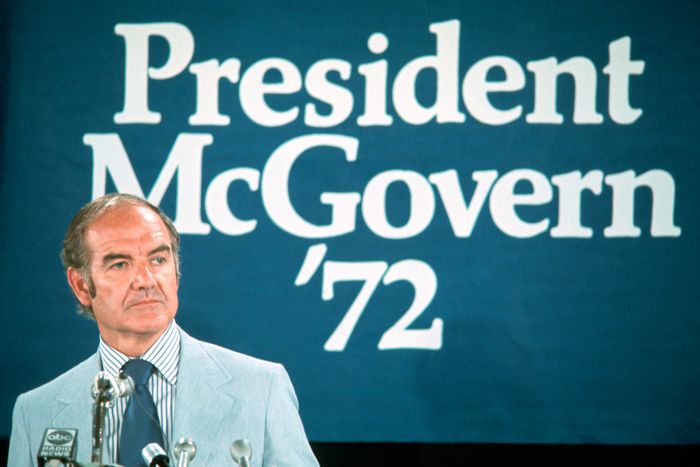
“Come home, America” is a famous speech given fifty years ago by George McGovern. He wanted to cut military/war spending and send rebate checks directly to the American people. Let’s advocate for that! Let’s put money back in the pockets of Americans as we make a leaner, smarter, cheaper U.S. military that can pass a financial audit. (I’d cut all Pentagon funding until it passed an honest and thorough audit.) Most Americans would support major reforms if they were pitched in this way.
At the same time, I’d like to see a revival of the Nye Commission from the 1930s and the “merchants of death” idea. Whatever else it is, selling weapons is not a way to peace, nor is it life-affirming. Harry Truman made his mark in Congress during World War II by attacking fraud and waste related to military spending. Again, today’s Pentagon can’t even pass an audit! We need to show the American people that the Pentagon brass is stealing from them and hiding behind a veil of secrecy that is undemocratic and probably illegal as well. Here, I would love to see Members of Congress act in the spirit of William Proxmire and his “Golden Fleece” awards. The American people are being fleeced by the MIC, and we should be reminding them of this fact, every single day.
In the 1930s, General Smedley Butler, a Marine veteran who was twice awarded the Medal of Honor, saw how war was a racket, and that to end it, you had to take the profit out of it. How can America do that? Can we “nationalize” defense contractors? Can we make weapons building into a non-profit activity? Can we reverse Citizens’ United and outlaw weapons lobbying as a form of protected speech (it’s really legalized bribery)?
How about slowing the revolving door between the U.S. military and weapons contractors? Make it so that retired officers in the grade of major and above must forfeit their pensions if they join a weapons/war firm. Naturally, no one employed by, and especially on the board of, a defense contractor should ever be approved by Congress as the civilian Secretary of Defense.
Another idea: All retired military officers, CIA-types, etc., who appear on TV and media should be required to reveal their conflicts of interest (if any). For example, if retired General John Q. Public appears on TV and works for Raytheon, that should be identified in the on-screen chyron, and by the general himself if he has integrity.
It’s high time the Pentagon shares more information with the American people. Secrecy is a huge problem that the MIC hides behind and exploits. Democracy doesn’t work without transparency, which is why the MIC is at pains to hide the truth from us of malfunctioning weaponry and disastrous and murderous wars.
I would add that tackling the MIC is not a liberal issue, it’s not a progressive issue, it’s not a partisan issue: it’s an American issue. My readers, I’m guessing, are not fans of Fox News or commentators like Tucker Carlson. But if they’re against war and want to see major reforms to the MIC, recruit them! Work with them. They are not the enemy. Not even the MIC is the enemy. I was, after all, part of it for 20 years. The real enemy is war. The real enemy is spending trillions of dollars on weaponry that could, and just might, destroy us all. If we can’t set aside our differences and get together to save ourselves and our planet from war’s destructiveness, we’re pretty much doomed, don’t you think?
The MIC is united by profit and power. Maybe we can find unity in the preservation of our planet and love for the wonderful blessings it has bestowed on us.
Come on people now, smile on your brother everybody get together try to love one another right now. Right now. Right now.
Is building effective security forces in Iraq and Afghanistan and elsewhere really what the U.S. military and government is about? Given the total collapse of the Iraqi military in 2014 and its Afghan equivalent in 2021, I’d have to say no. What are these efforts really all about? A few heretical thoughts:
The top priority is profits for America’s military-industrial-Congressional complex. Foreign military forces are always provided with loads of U.S.-built weaponry, much of it unneeded or inappropriate to their capabilities and missions. When these forces collapse, as they did in 2014 and this summer, enemies such as ISIS or the Taliban are the recipients of plenty of new weapons funded by the American taxpayer. In short, the U.S. arms its (failed) proxy armies and its enemies as well, which almost guarantees more fighting and/or bombing in the future. Call it a win/win for weapons makers even when the U.S. loses.
If profit-making is the top priority, so too is making it last. Until they utterly collapse, often without much combat, America’s proxy militaries are never fully ready to stand on their own. They always require more U.S. training and funding, that is until the lie is exposed.
Along with profit-making, it’s important for the U.S. military to look good while providing the training. Looking good requires lying about progress. And so America’s proxy militaries are always making progress (on paper, if nowhere else) which helps everyone involved get promoted while keeping the money flowing.
Along with perpetual profits and promotions, these proxy militaries must never be allowed to become independent from the U.S. military. Sure, the U.S. government says it’s seeking “standalone” forces, but in practice Iraqi and Afghan forces were always dependent on U.S. logistical support as well as air power. Which is just the way the U.S. government wanted it and wants it. Dependency ensures pliability and control (until the inevitable collapse, that is).
In sum, one must always follow the money and ask, who is profiting the most from these “training” efforts? Most of the billions and billions spent on training and equipping these militaries goes to the military-industrial complex and to local warlords. It sure didn’t go to Iraqi or Afghan foot soldiers. Again, failure here is its own success; the longer it takes to build “reliable” proxy armies, the longer the money flows to military contractors in the USA. And if your proxy military collapses, maybe you can even rebuild it (at ever higher costs) or at least fight the enemy that captured the expensive high-tech weapons funded so generously by the U.S. taxpayer.
I hope this list is useful as one reads an article at Foreign Affairs, “Why America Can’t Build Allied Armies,” sent to me by a friend. It’s not that America can’t build them. It’s more that we really don’t want to build them; indeed, that there are perverse incentives to do a half-assed job, making money all the while, until the rot can no longer be hidden.
Allow me to explain. The author of this article assigns blame mainly to the “partner” militaries, suggesting these “partners” in Iraq and Afghanistan weren’t interested in building effective militaries: they’re interested in money and power instead. Displacing blame onto our “partners” is always good fun, but shouldn’t the U.S. government have recognized this dynamic instead of feeding it? (Let’s face it: the U.S. is driven by money and power as well.)
In fairness to the author, she does advise that maybe the U.S. government should smarten up and stop throwing money at foreign militaries. Here’s an excerpt:
But the United States also has another option: it could scale down its train-and-equip efforts altogether. Rather than using advisory missions as the preferred option for addressing local security threats, it could instead reserve such programs for states with strong national institutions and a demonstrated interest in building better militaries. This pathway would lead to the termination of most U.S. security assistance projects, including the ongoing effort to build the Iraqi security forces.
Too often, the United States’ efforts to train and equip foreign militaries have been motivated by bureaucratic logic rather than sound strategy. The fall of Kabul exposed more than the rot within the armies the United States builds. It also exposed the rot within the United States’ approach to building them.
Sound advice, except the author doesn’t discuss how much these “train-and-equip efforts” are really money laundering operations for the military-industrial-Congressional complex. War is a racket, as General Smedley Butler taught us, and building hollow legions overseas, whether in Iraq or Afghanistan or earlier in Vietnam, is a racket that pays very well indeed.
There’s a bill before the Rhode Island State Legislature (House Bill 6026) that aims to divest state pension funds from military contractors. I wrote a short letter in favor of this bill and submitted it, as follows:
I served in the U.S. Air Force for 20 years, retiring as a lieutenant colonel in 2005. There are many of us within the military who recognize the wisdom of General Smedley Butler, twice awarded the Medal of Honor. Butler wrote that the best way to end war is to take the profit out of it. Butler wrote in the 1930s, when our country believed that weapons makers were “merchants of death.” They were called that because of the vast killing fields of World War I, a war that killed more than 100,000 Americans, together with millions of other troops from Britain, France, Germany, and elsewhere.
Joining Smedley Butler was another great American, General (later President) Dwight D. Eisenhower. In his famous “Cross of Iron” speech in 1953, Ike wrote that unnecessary spending on weaponry would lead to humanity being crucified on a cross of iron. Here are his words:
Every gun that is made, every warship launched, every rocket fired signifies, in the final sense, a theft from those who hunger and are not fed, those who are cold and are not clothed. This world in arms is not spending money alone. It is spending the sweat of its laborers, the genius of its scientists, the hopes of its children… This is not a way of life at all, in any true sense. Under the cloud of threatening war, it is humanity hanging from a cross of iron.
In 1961, President Eisenhower warned all Americans against the dangers of the military-industrial complex. Sixty years later, in 2021, America dominates the world in selling weapons across the globe. We have become the “merchants of death” that Generals Butler and Eisenhower warned us about.
Weapons kill. Weapons make wars more likely. And as Eisenhower said in 1946, “I hate war as only a soldier who has lived it can, only as one who has seen its brutality, its futility, its stupidity.”
It’s time for us to hate war again. It’s time for us to beat our swords into ploughshares, as the Bible tells us. It’s time for us to pursue more peaceful activities.
Rhode Island can set a strong example – a shining example – in the pursuit of peace and sanity. I urge you to vote “for” House Bill 6026.
Let us beat our swords into ploughshares …
*****
The “Divestment Fact Sheet” for the bill explains its purpose, as follows:
Allows us to redirect our investment dollars toward socially productive corporations addressing important social assets like climate resilience, health, and education, which aid economic growth;
Seeks to move money away from corporations whose output foments violence, death, destruction, and social chaos.
Educates the general public about the role of weapons manufacturers in the cycle of tax breaks, lobbying largesse, increasing military budgets and weapon sales.
Reduces the flow of scarce economic resources to military weapons manufacturers by reducing public investment;
Sends a message to the US Congress that we need to sharply reduce investment in military weapons where the costs are increasingly public (ever increasing health bills for traumatized and injured vets of the endless wars, reconstruction bills in foreign lands, ever increasing maintenance bills and graft on weapons systems) and the benefits are private (lobbying firm profits, huge weapons manufacturer bonuses and excessive CEO pay packages).
In America, money talks. As Smedley Butler said, ending the madness of war will most likely come when we can take the profit out of it. Here’s hoping Rhode Island’s effort succeeds — and sets an example for others across our nation.
James Madison knew that endless war is the harshest enemy of liberty
W.J. Astore
Democracies should be slow to start wars and quick to end them. James Madison taught us that. Why is America today the very opposite of this?
I thought of this as I read Danny Sjursen’s fine article at TomDispatch.com. Sjursen, a retired Army major, is a strong critic of America’s forever wars. He served in Iraq and Afghanistan and lost soldiers under his command. He knows the bitter cost of war and expresses it well in his article, which I encourage you to read. Here’s an excerpt:
Recently, my mother asked me what I thought my former students [West Point cadets] were now doing or would be doing after graduation. I was taken aback and didn’t quite know how to answer.
Wasting their time and their lives was, I suppose, what I wanted to say. But a more serious analysis, based on a survey of U.S. Army missions in 2019 and bolstered by my communications with peers still in the service, leaves me with an even more disturbing answer. A new generation of West Point educated officers, graduating a decade and a half after me, faces potential tours of duty in… hmm, Afghanistan, Iraq, or other countries involved in the never-ending American war on terror, missions that will not make this country any safer or lead to “victory” of any sort, no matter how defined.
Repetition. Endless repetition. That is the theme of America’s wars today.
Remember the movie “Groundhog Day,” with Bill Murray? Murray’s character repeats the same day, over and over again. He’s stuck in an infinite loop from which he can’t escape. Much like America’s wars today, with one exception: Murray’s character actually learns some humility from the repetition. He shows a capacity for growth and change. And that’s how he escapes his loop. He changes. He grows. The U.S. military’s leadership? Not so much.
But I don’t just blame the senior leaders of the U.S. military. They’re not that dumb. It’s the system of greed-war they and we inhabit. Why change endless war when certain powerful forces are endlessly profiting from it? War, after all, is a racket, as General Smedley Butler knew. It’s a racket that’s contrary to democracy; one that buttresses authoritarianism and even kleptocracy, since you can justify all kinds of theft in the cause of “keeping us safe” and “supporting our troops.”
Danny Sjursen, a true citizen-soldier, remembers that war is supposed to be waged in accordance with the Constitution and only to protect our country against enemies. But being a citizen-soldier has gone out of style in today’s military. Everyone is supposed to identify as a warrior/warfighter, which has the added benefit of suppressing thought about why we fight.
Eager to fight, slow to think, might be the new motto of America’s military. Such a motto, consistent with forever war, is inconsistent with democracy.






 Bracing Views