
Get Another Goat

Michael Murry

Democrats need an honest post-mortem – not dishonest scapegoating – in the aftermath of their devastating 2016 defeat.

Transferred nationalism, like the use of scapegoats, is a way of attaining salvation without altering one’s conduct. – George Orwell, “Notes on Nationalism” (London: Polemic, 1945)

Many have written about the recent Women’s March in Washington, D.C. — and in other cities across the United States – which occurred in response to President Donald Trump’s early executive orders, cabinet appointments, in-your-face culture-war media-baiting, and (of course) his signature late-night twitter trolling. Lots of things to legitimately oppose and protest, surely, but to my knowledge, few of these articles have analyzed the women-led protest marches from the standpoint of exculpatory political scapegoating, if not transferred nationalism, as George Orwell explained the meaning of that term in his famous essay. For my part, I would like to try and address this imbalance.

First off, several signs that I saw from the Women’s March addressed President Donald Trump personally in terms that I had difficulty connecting with Women’s Rights, such as I understand them. I don’t have a problem with either the imagery or the language, however crude or even profane, since Donald Trump himself seems to delight in offending as many persons, nations, and institutions as he possibly can if it serves his purposes. So, if he receives rough treatment, in picture or word, then he has it coming. He gets no sympathy from me. My problem with these signs stems not from their tone of deserved disrespect, but from their strange fixation on Russia and Russian President Vladimir Putin who – as far as I can tell – has no power to deny an American woman equal pay, access to a safe abortion, maternity leave, or quality public education for her children, among other issues that women – as women – typically consider important.

For example, take the following piece of work, a pointed paraphrase of an old children’s nursery rhyme:

tinkle

I saw other signs of a similar nature, another of which I will cite later as a further example. I cannot speak to the generality of such sentiments, and I would hope that only a few persons harbor them, but this unfortunate expression of malignant partisan irrelevancy immediately gets to the point raised by Robert Parry in an article he wrote for Consortium News (February 1, 2017): namely, “Dangers of Democratic Putin-Bashing – Exclusive: As national Democratic leaders continue to blame Russian President Putin for their 2016 defeat, they’re leading their party into a realignment with the neocons and other war hawks.”

While I concur with Mr. Parry’s article in the main, I have to disagree with his use of the present progressive tense and the word “realignment.” As a matter of fact, the alignment of the Democratic Party with “neocons and other war hawks” took place decades ago, with President Bill Clinton. President Barack Obama and the hapless Democrats in Congress, for their part, have only reinforced and strengthened this alignment.  To speak of this dreadful reality as if it exists only as a possible development in the future rather misstates the truly grim and long-established reality. Otherwise, and specifically as this article relates to the Women’s March, consider a comment I came across in response to Robert Parry’s article:

“evelync”
February 1, 2017 at 11:35 am

I have to admit that I was unable to drag myself to the women’s march because I was unsettled by the concern that it was being used, perhaps, to try to keep Hillary Clinton’s foot in the door.

Another commenter wrote:

“D5-5”
February 1, 2017 at 2:15 pm

I don’t know that having allowed themselves to sink into the behaviors employed to knock off [Senator Bernie] Sanders, then expanding these to Russia-bashing, as the Dems and Clinton did, will likely take them in the direction of an ‘oh, let’s get honest here and see why we lost the election, and straighten ourselves right out to become an actually decent alternative to offer to the American people.’

Two points here:

(1) Why not blame the Democratic Party and its deeply unpopular, demonstrably inept, largely unaccomplished, and repeatedly discredited candidate, You-Know-Her [Hillary Clinton], for losing instead of crediting the political rookie Donald Trump – and by extension, Russian President Vladimir Putin – for “winning”?

(2) Why not insist that the losing Democrats conduct a long-overdue autopsy, summarily purge their Wall-Street/Permanent-War “leadership” (the names Clinton and Obama come to mind here), and reform themselves into a truly working-class, anti-war party capable of winning back the loyalty of those impoverished Americans whom they have betrayed and abandoned for Ivy-League University degrees and swell vacations on Martha’s Vineyard with other newly rich members of their privileged “professional” class?

But attaining emotional salvation through scapegoating – so as not to require actually doing anything to cure the real political and economic disease of neoliberalism – does seem the order of the day among these marchers, most of whom one must suppose voted for You-Know-Her and the neoliberal status quo that downwardly dropping American workers hate with an abiding and vengeful passion. The Damsel of Distress has done it again, snatching defeat from the jaws of victory as only a “New Democrat” named Clinton could manage. How that must hurt!

Moving right along, I came across another image from the Women’s March that showed a man holding a mask of Vladimir Putin in front of his face while holding what looked like marionette strings from which dangled the image of Donald Trump as a puppet.

puppet

Now, I know You-Know-Her openly called Donald Trump a “puppet” of Vladimir Putin during one of the fall campaign debates, so it does not surprise me that some of her partisan supporters would credulously accept this gratuitous slur without bothering to think through the preposterous illogic behind it. For as those who have read the WikiLeaks documents have explained, the Clinton campaign tried everything they could to promote the candidacy of Donald Trump on the theory that he would make the weakest opponent, one whom You-Know-Her would have the least trouble vanquishing. Consider the following excerpt from the articleThey Always Wanted Trump: Inside Team Clinton’s year-long struggle to find a strategy against the opponent they were most eager to face”, by Gabriel Debenedetti, Politico (November 07, 2016):

Clinton’s team drew up a plan to pump Trump up. Shortly after her kickoff, top aides organized a strategy call, whose agenda included a memo to the Democratic National Committee: “This memo is intended to outline the strategy and goals a potential Hillary Clinton presidential campaign would have regarding the 2016 Republican presidential field,” it read.

“The variety of candidates is a positive here, and many of the lesser known can serve as a cudgel to move the more established candidates further to the right. In this scenario, we don’t want to marginalize the more extreme candidates, but make them more ‘Pied Piper’ candidates who actually represent the mainstream of the Republican Party,” read the memo.

“Pied Piper candidates include, but aren’t limited to: Ted Cruz, Donald Trump, Ben Carson

We need to be elevating the Pied Piper candidates so that they are leaders of the pack and tell the press to [take] them seriously.”

Now, aside from the arrogant (but not implausible) notion that You-Know-Her’s campaign could tell [as in, “command”] the press whom to take seriously, no one has ever questioned the accuracy of these memoranda from John Podesta to You-Know-Her’s campaign. But just consider what they tell us.

First, if Donald Trump owed his candidacy to You-Know-Her’s campaign to promote him as a Pied Piper over all the other Republican candidates, and if Russian President Vladimir Putin somehow contrived to make all this happen, then that would credit Vladimir Putin with first manipulating one puppet, You-Know-Her, to control Trump, another puppet. In the interest of metaphorical accuracy, then, the marching protester here should have worn a Putin mask while holding the strings to a puppet of You-Know-Her holding the strings to another puppet, All-About-Him [Trump].

Second, if President Putin had successfully pulled off this convoluted manipulation of both presidential candidates, then why would he possibly let that fact come to light in these WikiLeaks memos? Wouldn’t he want to keep his sinister Machiavellian machinations a secret, so as not – as America’s CIA spooks like to say – reveal his “sources and methods”? As a former KGB intelligence officer, surely he knows his espionage tradecraft better than that. So, logically, President Putin would have no interest in revealing his omnipotent control of America’s two hapless presidential candidates. It makes no sense that Russia would leak anything about this to WikiLeaks or any other journalistic source. That would only discredit Trump as a dupe of both You-Know-Her and Vladimir Putin.

Complete bullshit, either way. It would appear that – in truth – John Podesta and You-Know-Her got just the opponent they wanted to run against: Donald Trump. Then they lost to their own “Pied Piper” puppet. But still they want to scapegoat Russian President Vladimir Putin for their own manifest failure to recognize and respond to the seething desperation of America’s working class. The people want jobs and incomes, not more NAFTA or TPP trade deals. You-Know-Her promised more of the latter. Trump promised at least some of the former. Gee whiz. Who could have ever figured out which way that “choice” would go?

Not that Republican Donald Trump will necessarily deliver anything more than tax cuts and deregulation to the Corporate Oligarchy while shoveling loads of crappy culture war to the proles who voted for him, but sheer luck, some media-sense, and good timing have given him the chance. I seriously doubt that he has the knowledge and competence to pull off anything resembling PEACE, but he does now have that opportunity. Who knows if he has the wit to seize it?

At any rate, it appears as if the defeated Democrats have chosen Russian President Putin as an attractive scapegoat simply due to (1) his “foreignness” and (2) the nature of transferred nationalism. This psychological transference, Orwell wrote, “has an important function. … It makes it possible for [the nationalist] to be much more nationalistic – more vulgar, more silly, more malignant, more dishonest – than he [or she] could ever be on behalf of [their] native country, or any unit of which [they] had real knowledge.”

Americans know little, if anything, about the Russian Federation or its duly elected, competent, domestically popular, and internationally respected president. Creative costumes and too-clever-by-half slogans aside, it seems like a monumental waste of time, energy, and limited American attention span for the Democrats to scapegoat President Putin for their own stupidity, arrogance, and insensitivity to their party’s traditional base.

The Democrats had better look inward and get their own act together. Either that, or get another goat.

Michael Murry is a Vietnam Veteran, gargoyle sculptor, and poet.  A loyal correspondent to Bracing Views, he is also a contributor to The Contrary Perspective.
Provoking Wars: Is that what U.S. Foreign Policy Is About?

Send in the heavily-armed carriers.  It's about peace!
Send in the heavily-armed carriers. It’s about peace!

b. traven and W.J. Astore

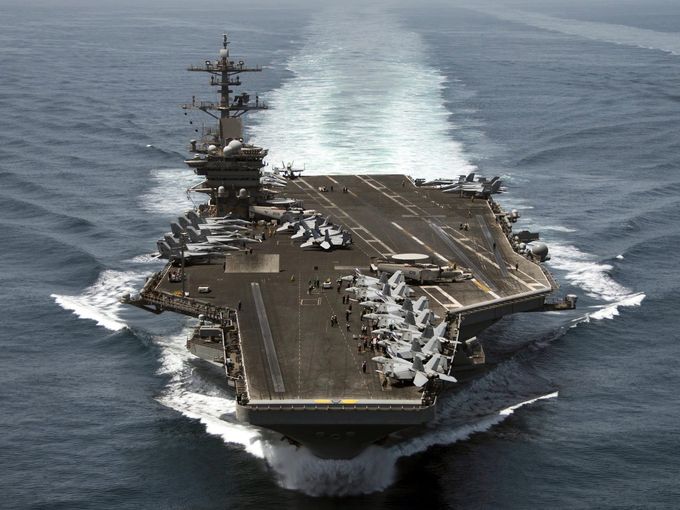
Are America’s foreign policy leaders mad?  It’s a serious question.  Consider last week’s dispatch of 300 military trainers from the 173rd Airborne Brigade to Western Ukraine, a country involved in a contentious jousting match with Vladimir Putin’s Russia.  Or consider this week’s deployment of an aircraft carrier battle group off the coast of Yemen, ostensibly to interdict weapons shipments from Iran, shipments that may not even exist.

These moves have more serious possible repercussions than the usual stupid moves our government makes. They can lead to real war with Russia and Iran. Look at today’s headline in the New York Times: “Putin Bolsters His Forces Near Ukraine.”  Putin may be provoked into an invasion of Ukraine because U.S. meddling has been so blatant (he also knows that when it comes to war in Ukraine, NATO is largely a toothless tiger). The Iranians may renege on the nuclear agreement and deliver extensive military support to the Houthis while directly engaging the House of Saud. In both situations, it’s easy to predict what Obama will do.  Just what John McCain and the neo-cons want him to do.  Bombs away.

It’s a clear case of global reach, global power–and global stupidity.  You’d think massive bungling and endemic corruption in never-ending wars in Iraq and Afghanistan would have taught us something, but the U.S. insists on getting involved in sensitive regional conflicts that could easily spiral out of control.

And when the U.S. chooses to get involved, it’s not with diplomacy.  It’s all about military power.  Yet as much as America professes to love its military, its power is a blunt (and deadly) instrument.  It exacerbates tensions rather than alleviating them.  U.S. military meddling in Ukraine and Yemen promises more conflict, not less.

And perhaps that’s by design.  Consider the reality of America’s ever-burgeoning military budget.  As Dan Froomkin notes, that budget still exceeds the combined defense budgets of the next seven highest spenders (four of those countries—Saudi Arabia, France, the UK, and Germany—are U.S. allies; China and Russia, the only rivals on the list, spend far less than the U.S.).  As the U.S. continues to spend hog-wild on its military, small wonder it remains the go-to option for “diplomacy” around the globe.

Democratic or Republican administration, Obama or Bush, the one constant is global war.  The U.S. is already waging illegal “low intensity” war with drones and special operations across the globe.  (It’s worth pointing out that “low intensity” doesn’t feel low when Hellfire missiles are raining down on your neighborhood or when Special Forces are raiding your village and hauling away your neighbors–or you.)  So why not add another serving of war to an already full plate by meddling in Ukraine?  Sadly, the faction the U.S. seems to favor the most has its share of outright fascists.  But they’re “our” fascists, so who cares if they vote to honor Nazi collaborators and perpetrators of the Holocaust?

Russia, predictably, is antagonized by U.S. meddling.  They see it as the decades-old Anglo-British effort to encircle and isolate Russia and cut them off from their access to the Mediterranean by denying them their Black Sea Fleet base in the Crimea.  To add insult to injury, the essentially Russian population of Eastern Ukraine will be marginalized by the coup regime the U.S. helped to install.  Well, there’s nothing like a new Cold War with Russia to push “defense” spending to even higher levels.

If the U.S. fails to rouse the Soviet bear from slumber, perhaps we can provoke a war with Iran.  So let’s continue to send billions of dollars in weaponry to the Saudis so they can continue to bomb and dominate Shia factions in Yemen.  Heck, let’s send an aircraft carrier task force to show how serious we are about “peace.”  (Let’s hope the U.S. Navy doesn’t blunder and shoot down an Iranian commercial aircraft, as it did in 1988, killing 290 innocent passengers and crew.)

Provocation—that’s when U.S. leaders deploy the military to meddle in Ukraine, in Yemen, and elsewhere across the globe.  Yet men like Bush and Obama continue to sell the military, not as provocateurs, but as peace-bringers.  As diplomats in uniform.  They just happen to carry assault rifles and use Hellfire missiles rather than briefcases and pens.

Saddest of all is that things are only going to get worse.  We’ve witnessed how America’s Nobel Peace Prize-winning President morphed into its assassin-in-chief, approving “signature strikes” to snuff out evil-doers everywhere.  Now look who’s running to replace him in 2016: Hillary the Hun on the Democratic side, and all those little chickenhawk Republicans clucking that they’re to the right of Hillary.

If you’re reading this and have money, we advise you to invest in “defense” stocks.  With all these provocations in the works, the staff here at The Contrary Perspective are bullish on prospects for more weapons–and more war.

The Great War: Why the Germans Lost World War I

trench

W.J. Astore

To mark the 100th anniversary of World War I, which began in the summer of 1914, I’m posting this essay, which I wrote as a graduate student in 1992.  I’ve decided not to edit it since I believe my general conclusions remain sound.  Germany may have had the best military during World War I, but that wasn’t enough for the Kaiser and crew to win the war.

Today, the U.S. should learn from Germany’s mistakes, especially since we are as fond in 2014 of boasting about having the world’s greatest military as the Kaiser was of boasting about his a century ago in 1914.

Strategy is the relationship between national means, ends, and will.  Given the results of the Great War, one might question whether any country followed a sound strategy.  As J.F.C. Fuller observed, at war’s end “Britain was bankrupted and France bled white; Russia and Germany were in the throes of revolution; the Austro-Hungarian Empire had vanished; the Ottoman Empire had been dismembered; Italy was distraught; and every other country in Europe was scorched by the fiery blast – an epoch had gone up in flames.”  However, there were – at least in the short term – winners and losers.  The winners prevailed because their strategies were sounder in balancing means and will with ends than those of their opponents.

Strategies at Sea During the Great War

Britain’s strategic ends in 1914 were to maintain the balance of power in Europe and her hold over her Empire.  Her chief means were the ships of the Royal Navy.  A German victory on the continent threatened these ends and means.  A victorious Germany would dominate Europe, and she might build an even larger navy, one which would threaten the Empire or even Britain itself.  With her will fortified by news of Germany’s violation of neutral Belgium, Britain declared war on Germany on 5 August 1914.

At the outset of the war, the Royal Navy gained command of the sea and never lost it.  Enforcing a loose or distant blockade against German merchant shipping, the Royal Navy slowly constricted the economies (the means) of the Central Powers.  Meanwhile, Britain’s command of the sea ensured that supplies, and eventually troops, came safely from her Empire and America.

As elaborated by Admiral Jellicoe, the navy’s strategy was: 1) neutralize any hostile action of the German High Seas Fleet; 2) protect Entente trade, while blockading German trade; 3) protect Great Britain from invasion.  In brief, the navy’s strategic ends were to prevent the German fleet from affecting the war’s course, and through blockade, to erode Germany’s means and will to fight.

The Royal Navy has been criticized for not doing more with its command of the sea, but Jellicoe and Beatty were understandably cautious.  They had the German fleet encircled, and they controlled the choke points to the Atlantic and Mediterranean.  With excellent intelligence of German fleet movements, they stymied German attempts to break-out.  While the Royal Navy might have preferred to fight another Trafalgar, a battle of annihilation between dreadnoughts, they never took risks that threatened naval supremacy in the home waters.  They triumphed by putting political ends first, and by using their means – the superior fleets of the Royal Navy – to erode the economic means of Germany and the will of her people.  Their “indirect approach” contributed significantly to the collapse of the German homefront in October 1918.

In contrast to the British, who balanced naval means with national ends, the Germans wasted their High Seas Fleet.  The wisdom of building such a fleet was questionable to begin with.  Despite Mahan’s warning that it was probably impossible for a land power to divert enough human and material resources to challenge the Royal Navy’s command of the sea, Tirpitz and Kaiser Wilhelm II persisted.  For them, a navy was a way to gain influence and win friends.  They saw their imitation of the Royal Navy as the sincerest form of flattery, but the British were not appreciative.  Germany was living in a fool’s paradise, believing she could have a fleet that rivaled Britain’s without making Britain a rival.

The resulting rivalry polluted German naval strategy.  Expecting the Royal Navy to mount a close blockade or launch a preemptive strike against her bases, the High Seas Fleet sat put and lost the initiative.  Forced to fight with an inferior fleet at Jutland, Scheer tried to steer Jellicoe’s dreadnoughts onto a series of submarine-laid minefields, hoping thereby to destroy the Grand Fleet’s cohesiveness and defeat it in detail.  He failed, and the Germans never broke the blockade which eventually sapped their will.  Surprised that war had been declared, left without a role to play in the Schlieffen Plan due to poor interservice cooperation with the army, the High Seas Fleet was a means whose main end became self-preservation, its only goal being to intimidate Britain during peace negotiations (to be held after the German army won the war on land).

German naval strategy reflected the defects of strategic mirror-imaging.  To challenge the Royal Navy, the German navy believed it had to be just like it. Billions were spent from 1895-1914 on a surface fleet, devouring funding for innovations like the submarine (only 25 seagoing subs were ready for service in August 1914).  In the end, the Germans only drove the British to improve; even worse, by allocating a large percentage of her industrial resources towards naval production, Germany fatally weakened herself on land.  She tried to be a great land and sea power simultaneously, but the only country in history able to afford the exorbitant costs has been the United States during, and perhaps after, World War II.

Another country whose strategic mirror-imaging absorbed scarce resources to little end was the Soviet Union in the 1970s and 1980s.  The Soviet naval push only spurred the US Navy to improve, which surged to 600 ships under John Lehman.  A bankrupt strategic policy led to a bankrupt Soviet economy.  Today, the Soviet aircraft carrier Admiral Kuznetsov sits in drydock, a second big carrier is up for sale, apparently to China or Iran, and a third was scrapped before completion.  According to the London Times (Oct 1992), there are no Russian naval ships presently in the Indian Ocean or the Mediterranean.  Strategy is the art of the possible, not the striving for the impossible.  Before one embarks on an end, one must be able to afford the resources or means to achieve it.  Germany in the 1900s and 1910s, and the Soviet Union in the 1970s and 1980s, embarked on an end they did not need and could not afford.

The bankruptcy of German naval strategy was best shown in 1917 with the decision to resume unrestricted submarine warfare.  The Germans gambled they could wear down the will of Britain before American troops reached the continent.  What they apparently failed to realize, however, was that the very entry of the US into the war would reinforce the will of the Entente Powers.  Meanwhile, Britain muddled through the U-boat crisis and reformed her naval strategy, learning that the defensive was a more effective means of destroying submarines than the offensive, and that destroyers were better used guarding convoys than the Grand Fleet.  The Germans had expected a short war in which navies would scarcely matter.  Caught in the stalemate of the Western Front, she found she couldn’t improvise an effective maritime strategy.

Strategies on Land on the Western Front

Turning to land warfare on the Western Front, and keeping in mind the definition of strategy as relating means, ends, and will, one must first recognize the changing nature of warfare.  The American Civil War marked a revolution in warfare.  Militaries no longer fought solely against other militaries but also waged war against an enemy’s economy and will.  In hindsight, the stalemate on the Western Front owed everything to modern industrialism.  Ironically, in 1914 most Europeans had believed a long war of attrition was impossible because of modern industry.  In Schlieffen’s words:

A nation’s existence depends upon the uninterrupted continuation of trade and industry, and a quick decision is necessary to start the wheels of industry turning again.  A strategy of attrition is impossible when the maintenance of armies of millions requires the expenditure of billions.

What people failed to foresee was, once hundreds of thousands of men were killed in 1914, nations were willing to pay billions and gear their economies for war rather than negotiate from a weak position.  Since the war was one of economic mobilization, those countries with underdeveloped economies, e.g.  Austria-Hungary, had the most trouble fighting it.  Here the alliance system was crucial.  As Paul Kennedy has observed, Britain kept France fighting, France and Britain kept Italy fighting after Caporetto, and Germany kept Austria-Hungary fighting.  Ivan Bloch, the self-made Warsaw banker, turned out to be right: the ultimate decision was in the hands of starvation of home populations.  The Central Powers starved first.

This fate was by no means obvious, however.  Until the middle of 1918, the Central Powers appeared to be winning the war.  Despite fundamental strategic flaws, Germany, with Austria-Hungary marching reluctantly behind, broke Russia, threw the French army into mutiny, and sowed despair in England.  Germany’s tactical and operational brilliance, however, could not conceal, and in fact contributed to, an underlying strategic rot.

This rot was revealed in the words of the Kaiser.  “The soldiers and the army, not parliamentary majorities and decisions, have welded the German Empire together,” Wilhelm declared. “I put my trust in the army.” But the army, beginning with von Moltke the Elder, had subordinated grand strategy to operational art.  Reinforced by Schlieffen, this trend reached the height of military absurdity under Ludendorff in 1918, when victory on the battlefield became the means and end of Germany’s strategy, as well as the balm which would restore the flagging will of Germany, Austria-Hungary, even Turkey!  In the Great War, Germany experienced a fundamental breakdown in civil-military relationships.  With the military determining policy, Clausewitz’s dictum that war as a form of politics became tragically twisted to war as the only form of politics.

This debasement of politics was not complete until 1917.  By Christmas 1914, Germany realized her strategic nightmare had come true: a two-front war of attrition loomed.  Adopting a defensive stance in the West, Falkenhayn sought victory in the East, nearly achieving a knockout blow against Russia at Gorlice-Tarnow in May 1915.  With Bethmann-Hollweg, Falkenhayn hoped to translate a limited military victory in the East into a political settlement with Russia.  Frederick the Great had institutionalized this concept of fighting limited wars for definite political ends.  However, despite her losses on the battlefield, Russia failed to see the wisdom of negotiations.  Despite criticism by Hindenburg and Ludendorff that he had failed to grasp the total military victory in the East that was still within reach, Falkenhayn turned to the West and Verdun in 1916.

Falkenhayn’s strategic concept for Verdun was simple: by attacking French national pride at Verdun, he would force them to bleed themselves dry in counterattacks.  Britain would then be compelled, before her new armies were ready, to come to the aid of France, exposing herself to decisive German counterattacks.  Falkenhayn made two errors here.  First, and most importantly, he did not coordinate his strategy with Hotzendorff’s in Austria-Hungary.  As a result, the Central Powers lost their advantage of interior lines and their chance to defeat Russia in 1916.  Second, Falkenhayn failed to explain his strategy to his subordinates.  His desire to avoid casualties and unnecessary sacrifice was subverted once Germany’s national pride was inflamed.  Expecting a loss ratio of 2.5:1 in his favor, the actual ratio was a grim 1.075:1.

Verdun was the Great War’s equivalent to Kursk in World War II.  While the Germans gave better than they got, it was they who could least afford the price.  Like the Soviets in 1943, the French had learned.  Petain refused to waste his troops in poorly planned attacks, preferring to rely on artillery and firepower rather than elan to retake ground.  In the end, Falkenhayn failed to enforce his will on the Entente.  He did not force Britain to launch an offensive prematurely, and Russia surprised him by launching the Brusilov offensive in Galicia.  For his failure, Falkenhayn was sacked and Ludendorff effectively assumed command of the German war effort.

1917 was a banner year for the German war effort.  In the West, the Germans wisely retreated to the Siegfried Line, shortening their front and creating a defensive barrier which withstood Nivelle’s disastrous offensives and Haig’s bullheaded assaults at Third Ypres.  With Russia in chaos, Ludendorff could finally concentrate all his resources on the Western Front for the “Victory Offensive” in 1918.

Here again, however, German strategy failed to relate means to ends.  Ludendorff simply didn’t have the means in 1918 to conduct a decisive offensive in the West, and his end was unclear even to himself.  All will be solved once we pierce a hole, he stated.  Attacking along the seam separating the British and French armies, the Germans failed to exploit their initial successes due to Ludendorff’s vague and shifting strategic aims and shortages of manpower and transport.  Like Napoleon in 1815, Ludendorff desperately committed his superbly trained troops one last time.   But like Napoleon, the coalition arrayed against him was too powerful.  Primacy in operational art was not enough to overcome economic blockade and the bigger battalions of fresh troops arriving daily from the Empire and the US.  Shattered by the Entente’s counteroffensive at Amiens on 8 August 1918, and faced with national starvation, the German homefront collapsed.

Why the Entente Won — And Germany Lost

The Entente had won.  But was this due to superior strategy?  Clearly, the Entente suffered some of the same strategic shortcomings as the Central Powers: a breakdown in military-civil relations, with the military reigning supreme; a cult of the offensive as the ultimate arbiter of war; and a lack of contingency planning.  Moreover, the Entente achieved a level of tactical proficiency approaching Germany’s only in mid-1918, if then.  But while it’s been fashionable to attack the “donkeys” and “British butchers and bunglers of World War One,” on the whole Britain and France properly balanced means and ends with will.

Developing a strategy wasn’t easy, though.  Kitchener caught the confusion of his colleagues when he exclaimed: “I don’t know what is to be done – this isn’t war!”.  He came to realize, as Michael Howard has pointed out, that Britain had to “make war as we must; not as we should like.” Like Sherman during the American Civil War, Kitchener knew it would be a long war, and he oversaw the expansion of the British Army from Haldane’s six divisions in 1914 to seventy divisions in 1918.  Pursuing a strategy remarkably similar to the Union’s in the Civil War, the Entente wore down the tactically superior German army on the battlefield as Grant had worn down Lee’s army in 1864.  Through economic blockade, the Entente strangled the German economy as Scott’s Anaconda Plan had suffocated the Confederacy.

The Entente strategy was hardly this clear-cut, however.  Many in Britain preferred an indirect approach, but this seemed to fail at Salonika and Gallipoli.  And while Kitchener may have seen the need for waging a costly war of attrition, most Entente leaders still placed their faith in the offensive.  The Somme, Third Ypres, the Nivelle Offensives: these and other offensives forced the Germans to use up men and materiel, but their primary end was not attrition but breakthrough and decisive victory.  Haig for one pursued offensives long after they were feasible, and wore down his own army in the effort.  Nivelle did the same.  That their costly offensives bore fruit was more by accident than design.  The strain they put on Germany forced her to take desperate measures, the deadliest being her decision to resume unrestricted submarine warfare on 1 February 1917.

Besides blundering into the bloody, tedious, but effective combination of attrition warfare on land, economic warfare at sea, the Entente demonstrated other strategic edges versus their opponents.  With the rise of Lloyd George and Clemenceau, the Entente gradually reasserted civilian control over policy and the war’s course, obeying Clausewitz far better than their German counterparts.  The Entente also waged coalition warfare more effectively than the Central Powers.  While distrust and stubbornness existed within the Entente, France and Britain tended to work towards the same end, unlike Germany and Austria-Hungary, who were usually fighting uncoordinated battles on different fronts against different enemies.

Finally, the Entente used a wider array of strategic means in pursuit of their ends.  The British were especially clever in their use of propaganda to strengthen public will at home and to convince the US to enter the war.  In short, the Entente recognized more clearly than the Central Powers the widening dimensions of strategy.  Battles were only one means to victory, and not always the most important when compared with political, economic, intellectual, and psychological means.  The “genius” of the German military was evident but restricted to operations; the Entente bumbled about on the battlefield but used a wider array of means, under firmer political control, to wear down the will of Germany.

Yet despite her defeats in the First and Second World Wars, too much has been made, at least in the American military, of German battle skill.  In Vietnam, one might argue that like Germany, American grand strategy was irredeemably flawed no matter how many victories we won on the battlefield.  And while the operational brilliance of our victory in Desert Storm is clear, we must not let it blind us to our need to balance needs, ends and will in strategy.