War Is the True Enemy

W.J. Astore

America’s Revival Will Begin When It Finally Embraces Peace

Arguably the biggest problem in America today is that the government remains on a wartime footing. The possibility of America being a normal country in normal times, at peace, is simply never mentioned. In current politics and in the mainstream media, there is no vision of America being at peace with the world. Ever.

There is always an enemy, usually plural. Russia. China. Iran. North Korea. The inchoate threat of terror and terrorists. Islamist extremism. All these and more are cited by the “experts” in the “national security state” as requiring a military response. If some kind of peace deal is orchestrated for the Russia-Ukraine War, America and its war machine will immediately pivot to Asia. Or the Middle East. Or perhaps Africa. Or all three.

I’m amazed when friends tell me they’re concerned about U.S. isolationism. Usually this concern is couched in America’s alleged withdrawal from (or even betrayal of) Europe in light of the Russia-Ukraine War. Their message to me is simple: America must keep sending weapons and intel to Ukraine until Russia and Putin are defeated, “as long as it takes.” The “it” is left undefined, but apparently “it” refers to an unqualified Ukrainian victory over Russia, followed by Ukraine’s eventual admission into NATO. Whether that “it” is even possible—whether that “it” could well lead to a nuclear exchange—doesn’t seem to matter because “We’re at war.”

I don’t know how anyone can think America will return to isolationism when the U.S. has 800 military bases globally and a vision of global reach, global power, and total dominance everywhere. And when America spends more on its military than the next ten countries combined (and most of those are U.S. allies). Dominating the globe isn’t exactly consistent with isolationism.

The problem with all the war rhetoric, the war narrative, the war framing, the warrior and lethality talk, is what it enables and facilitates, which is atrocity. Waste. Destruction. War is no way of life at all. As Ike said, the persistence of war is humanity crucifying itself on a cross of iron.

War is immensely corrosive to democracy. It is the enemy of freedom. Just listen to James Madison:
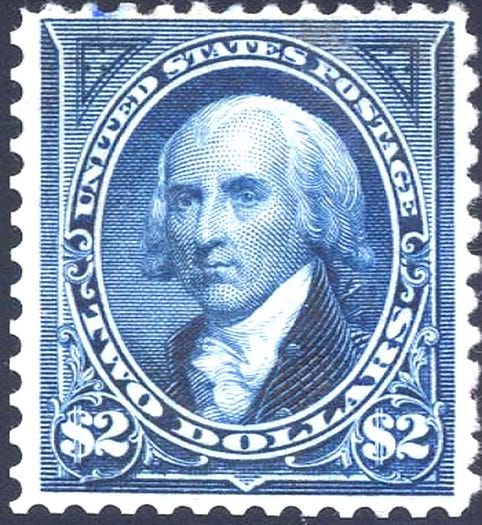
James Madison

Of all the enemies of true liberty, war is, perhaps, the most to be dreaded, because it comprises and develops the germ of every other. War is the parent of armies; from these proceed debt and taxes; and armies, and debts, and taxes are the known instruments for bringing the many under the domination of the few. In war, too, the discretionary power of the Executive is extended; its influence in dealing out offices, honors and emoluments is multiplied; and all the means of seducing the minds, are added to those of subduing the force, of the people. The same malignant aspect in republicanism may be traced in the inequality of fortunes, and the opportunities of fraud, growing out of a state of war, and in the degeneracy of manner and of morals, engendered in both. No nation can preserve its freedom in the midst of continual warfare …

*****

If you’re concerned about authoritarianism, if you’re concerned about maintaining and strengthening freedom, if you’re concerned about combatting corruption and waste, if you’re concerned about America’s huge deficits, stopping war should be your number one concern.

War is a terrible thing, and a state of war enables all kinds of butchery. Just ask the indigenous peoples of America, or the peoples of Palestine today. Even genocide can be disguised as a wartime exigency, a wartime necessity. How many times throughout history has the declaration, “We’re at war!” been used to justify the most heinous crimes against humanity? Even the Nazis hid behind wartime exigency to justify the mass euthanasia of the old, the mentally ill, and other forms of “life unworthy of life” as part of the T4 program (which anticipated the Holocaust).

The true revival of America will begin when this country declares itself to be at peace with the world. Until then, precipitous decline will continue for as long as our government remains at (and continues to celebrate) war.

Bombs and Bulldozers Are Us

W.J. Astore

More Weapons to Israel to Power a Genocide

I recently ordered a few items from Amazon. Random stuff like a shower caddy, an iPhone case, and lamp sockets. It won’t surprise you to learn they were all “Made in China.”

I ordered some clothes from a fancy online retailer. The clothes said “Designed in California” but they were, of course, Made in China.

What is America making? What are we sending overseas? Bombs and bulldozers for the devastation and dismantlement of Gaza and other Palestinian Territories. Consider this article from Ken Klippenstein (excerpt follows), which details roughly $10 billion in “foreign aid” to Israel.

Here’s what Klippenstein had to say:

*****

While the entire news media is focused on Trump’s suspension of arms for Ukraine, the administration is arming Israel to the teeth. The nature of the bombs being sold indicates Israel’s military is preparing to continue its bombing campaigns in Gaza, Lebanon, Syria, and Yemen; as well as preparing for possible war with Iran.

Included in the sales are tens of thousands of controversial 2,000 lb. bombs so heavily criticized during the Gaza war for their destructive capacity, and thousands of “Hellfire” missiles that are used for targeted killings.

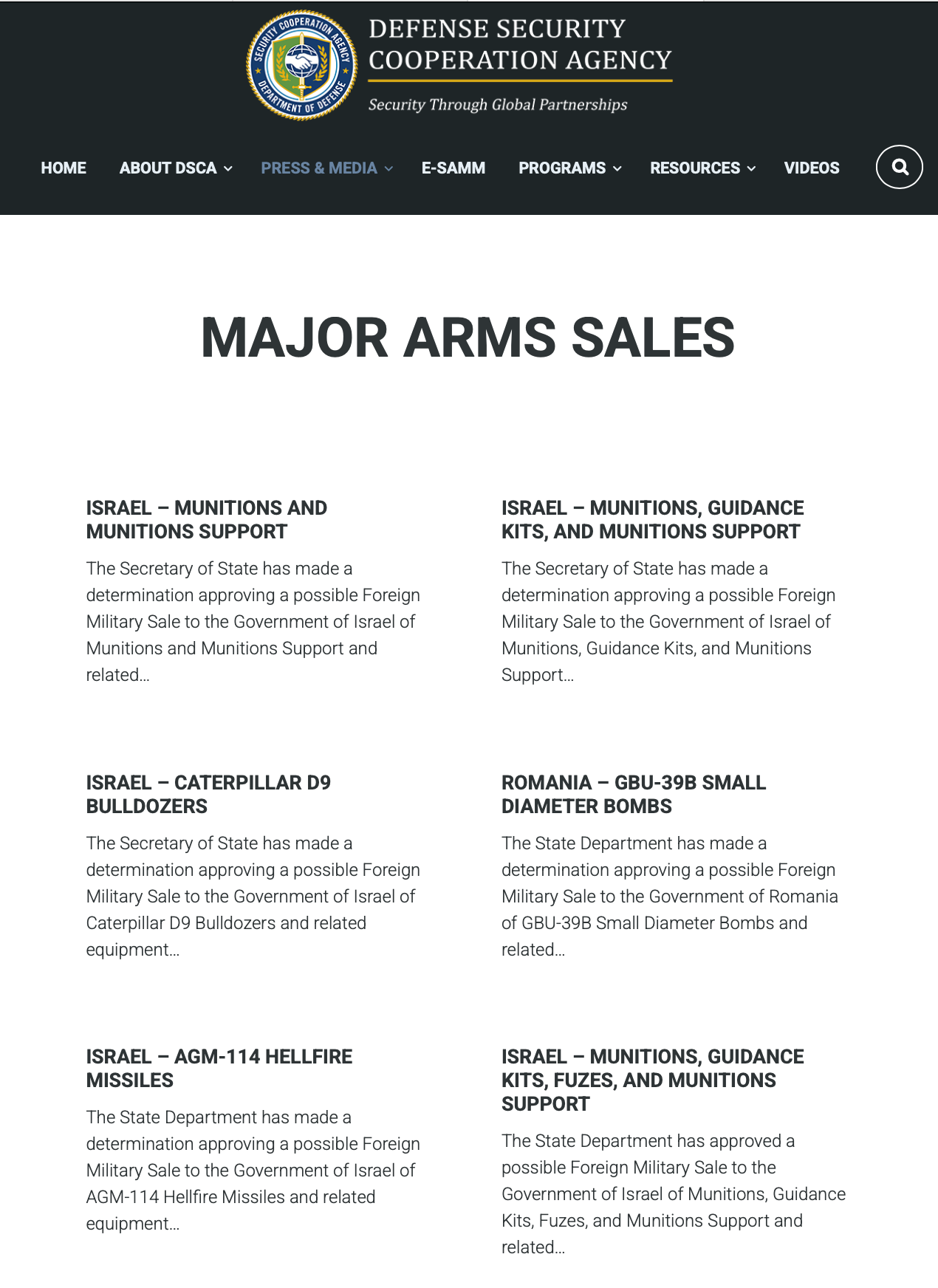
When I visited the Defense Security Cooperation Agency website’s section for major arms sales to see a breakdown of the weapons, I was immediately struck by the fact that five of the last six sales were to Israel.

Screenshot of DSCA’’s “Major Arms Sales” landing page

The U.S. bombs and missiles being sent to Israel, almost all made by Boeing, are included in:

  • February 28 sale worth $2.04 billion, including:
    • 35,529 MK 84 (general purpose) or BLU-117 (hardened) 2,000-pound bomb bodies (or combination of both).
    • 4,000 I-2000 (hardened) 2,000 lb. advanced penetrator warheads for 2,000-pound bomb bodies.
  • February 28 sale worth $675.7 million, including:
    • 201 MK 83 MOD 4/MOD 5 general purpose 1,000-pound bomb bodies.
    • 4,799 newer BLU-110A/B General Purpose 1,000-pound bomb bodies.
    • 1,500 KMU-559C/B Joint Direct Attack Munition (JDAM) anti-jam enhanced GPS guidance kits to attach to MK 83 bomb bodies.
    • 3,500 KMU-559J/B JDAM guidance kits to attach to MK 83 bomb bodies.
  • February 7 sale worth $660 million, including:
    • 3,000 AGM-114 Hellfire Air-to-Ground Missiles, aircraft, helicopter and drone carried, used to attack vehicles and individuals.
  • February 7 sale worth $6.75 billion, including:
    • 2,166 GBU-39/B 250-pound Small Diameter Bombs (SDB) Increment 1.
    • 2,800 MK 82 General Purpose, 500-pound bomb bomb bodies.
    • 13,000 KMU-556 JDAM Guidance Kits to attach to MK-84 (2,000-pound) bomb bodies.
    • 3,475 KMU-557 JDAM Guidance Kits to attach to BLU-109 (2,000-pound) bomb bodies.
    • 1,004 KMU JDAM Guidance Kits to attach to 500-pound GBU-38v1 bomb bodies.
    • 17,475 FMU-152A/B multi-function fuzes for bombs.

*****

Holy shit! Nearly thirty-six thousand 2000-pound bombs! That is 36 kilotons, roughly the equivalent of the two atomic bombs dropped on Hiroshima and Nagasaki in 1945. And that’s not including the assorted 1000- and 500-pound bombs tossed into the mix.

This is an astonishing amount of ordnance for Israel to continue its ethnic cleansing campaign in Gaza and the West Bank.

President Trump, of course, has the full support of most Democrats in sending this stockpile of destruction to Israel. Call it bipartisan genocidal enablement.

America sure is an “exceptional” nation. No nation is better at bombing others—or supplying the bombs for others like Israel to do so—then flattening what remains with “Made in USA” bulldozers.

Honestly, I wish my country made shower caddies, iPhone cases, and lamp sockets instead of bombs and bulldozers. Don’t you?

The Democrats Boldly Respond to Trump by Citing–Ronald Reagan

W.J. Astore

Trust me, I’m ex-CIA!

I confess I didn’t watch President Trump’s address last night nor the response from the Democrats. I’ve heard enough of Trump bloviating and I’ve had my fill of Democrats and their “resistance.”

Checking my news feed this AM, I see that the Democratic response was given by a “moderate,” Senator Elissa Slotkin of Michigan. She’s an ex-CIA agent, so I guess that means we can trust her? And she served alongside troops in the disastrous Iraq War, so I guess she’s patriotic and smart?

Here’s the link to her address.

Senator Slotkin tackled Trump not by citing progressive ideas and Democratic worthies like FDR and George McGovern but by applauding a Republican President, Ronald Reagan. President George W. Bush also got a positive mention.

Her main complaint was the “chaos” unleashed by Trump/Musk. She made a big deal about protecting the “homeland” along with immigration reform. She dropped a lot of buzzwords. She stressed that Trump apparently doesn’t think that America is theexceptional nation. And that he’s too cozy with Russia and Putin. The usual charges.

What was missing was vision, especially moral commitments to peace and justice. I heard nothing concrete about enlarging unions, boosting wages, affordable health care for all, serious student loan debt relief, or putting a stop to genocide in Gaza.

We’re still exceptional. Apple pie!

Slotkin’s speech was a perfect product of the corporate Democrats, or, more accurately, the uniparty and the national security state. She’s for “responsible” change. She’s for the middle class. Even apple pie got a mention!

Apparently, the Democratic plan to win back the presidency in 2028 is to reanimate the body of Ronald Reagan with apple pie as his running mate. How’s that for “resistance,” America? 

Bonus Lesson: Slotkin said America’s “superpower” is that we’re a nation of “strivers” and “risk-takers” who are “never satisfied.” I guess other nations and peoples don’t have innovators with ambition, or maybe they’re too easily satisfied, unlike Americans?

You Don’t Send Me Weapons Anymore

W.J. Astore

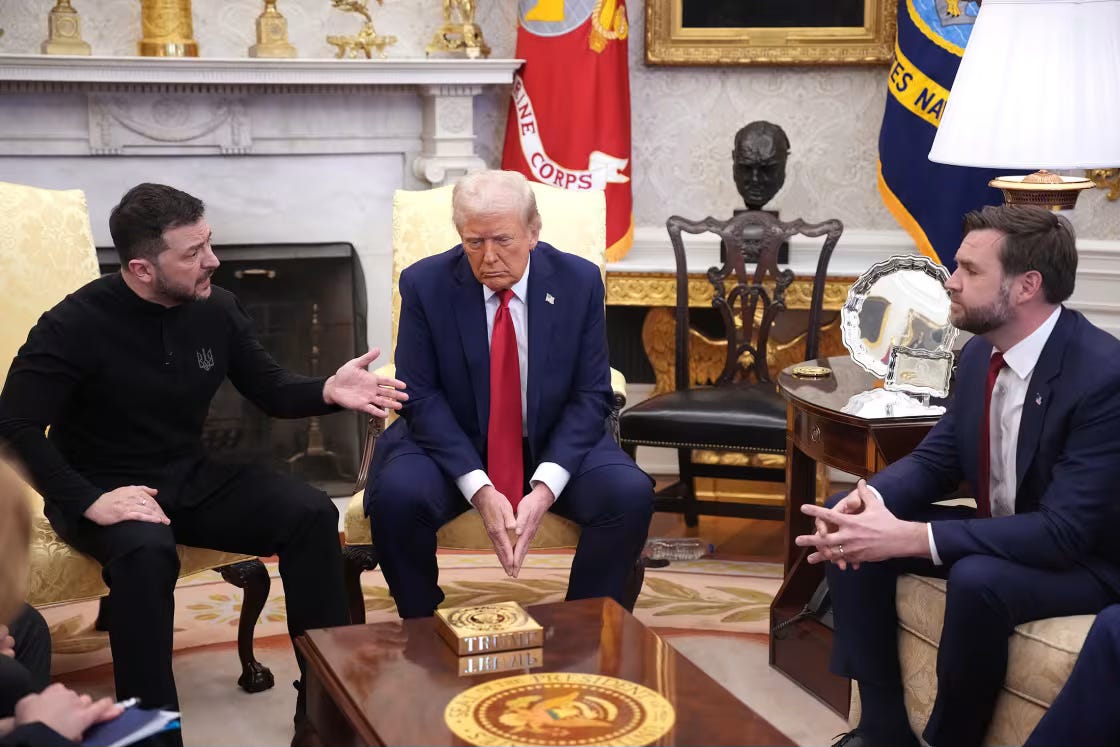
The Disastrous Oval Office Meeting Between Trump and Zelensky

It’s never a good idea to bite the hand that feeds you. In effect, that’s what President Zelensky did yesterday in a contentious meeting with President Trump and Vice President Vance.

Bloodbath? Showdown? Blow-up? Or a rare example of backroom brawling in plain sight?

My email this morning featured many takes on the meeting from the media. Here are a few choice words: Showdown. Dispute. Debacle. Blow-up. Botched visit. Bloodbath. Feud.

It must have been strange for Zelensky. He’s used to coming to DC and getting his way. Of being feted and fawned over. Who does he think he is, Bibi Netanyahu? Bibi has AIPAC and Congress behind him, and lord knows who and what else. Zelensky, to borrow from Trump, doesn’t have those cards. His hand is weaker and he didn’t play it well.

Matt Taibbi has an article on the meeting with a full (if imperfect) transcript. Check it out here. Taibbi is generally critical of Zelensky; the historian Timothy Snyder is critical of the “inhospitable” and “indecent” Trump/Vance. Check out Snyder’s video here

As I watched the video from the Oval Office, and heard Zelensky’s complaints, I almost thought he was going to break out his rendition of the Streisand/Diamond duet, “You don’t bring me flowers anymore,” except with new lyrics:

You don’t send me weapons anymore.

Joking aside, it’s rare when you see backroom brawling in the open. These meetings before the press are usually so staged, so vapid, and often so dishonest that it was refreshing to see something unscripted, spontaneous, and impassioned.

Here, I recall Winston Churchill’s quip that “There is only one thing worse than fighting with allies, and that is fighting without them.” Zelensky may find that he’s lost his most powerful ally; then again, perhaps he believed he’d already lost Trump/Vance, thus he seized his chance to be defiant and to go out strong.

I don’t know. It takes a clever man to play a weak hand well and a lucky one to win with it. And I don’t think Zelensky is either clever or lucky enough here.

An End to the Russia-Ukraine War

Accepting a Multipolar World

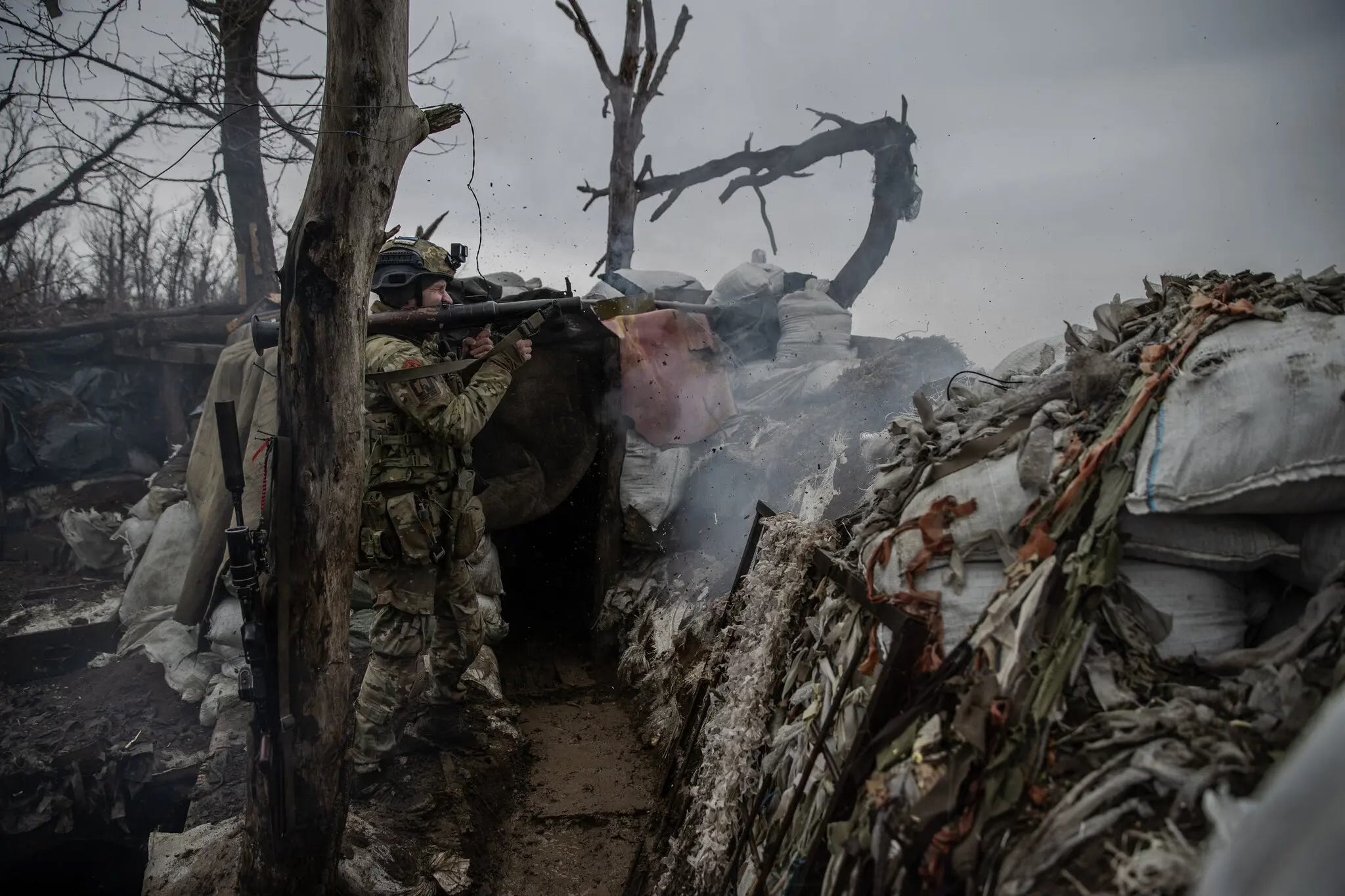
I recently read the book, “Generals Die in Bed,” a classic account of World War I. In terms of combat between Ukraine and Russia, there are serious echoes of WW1 with trench warfare and needless death on a massive scale.

There are few things dumber and more wasteful than trench warfare (Ukraine, from the New York Times)

Far too often, war is glorified when it is really colossal waste. As Dwight D. Eisenhower said, war is to be hated. So, short of abject capitulation to a tyrant, I support efforts to end wars. Stop the waste. Stop the hate. Find a way to live together in peace. The alternative, perpetual war, is too terrible to contemplate.

Diplomacy can be pursued without abandoning Ukraine or betraying NATO. Certainly, Ukraine should be a party to the negotiations. The war is being fought on their turf. They have bled, as has Russia.

But: All wars must end. The trick is ending them in a way that doesn’t generate future wars. That was the greatest tragedy of World War I: that its ending and the botched settlement led almost inexorably to World War II and an even greater bloodletting.

Here’s the rub: Ever since 9/11, indeed ever since World War II, almost without exception, America has ALWAYS been at war. And it hasn’t gone well, has it? (Except for the arms makers and the Cheney neocon crowd.) Isn’t it time we worked for peace?

Far too often, America’s worst enemy hasn’t been Putin or China or some other bogeyman. It’s been the enemy within. And I don’t mean the “red menace” or the “woke” crowd. I mean the enemy that is threat inflation. The enemy that is incessant warfare in unnecessary wars of choice, which drives deficit spending, and which is reinforced by lies.

How many times have we heard of bomber gaps, missile gaps, falling dominoes in Asia, WMD in Iraq, etc., that turned out not to be true, but which were used to justify massive military spending and (especially in Southeast Asia) drove horrendous casualties? Yes, the MICIMATT is powerful, but why are Americans so easy to scare? Why are we so fearful when this country’s geographic position is so enviably strong and defensible? It’s not like Putin’s on our northern border: friendly Canadians are there! (Even if they boo our National Anthem at hockey games.)

The world is becoming multipolar again, which doesn’t mean it has to be a scarier place. A multipolar world could be a more stable one if U.S. leaders could just back off on their goal of dominating everything everywhere all at once.

The idea of full-spectrum dominance and America as a global hegemon at any price must give way to an irenic and ecumenical view of the world. The American religion of violent militarism and prideful exceptionalism is simply too expensive to sustain. 

When the ship of state is slowly slipping under the waves, it’s not wise to steer closer to more icebergs. Let’s work to save our ship of state first.

The “Threat of a Warmongering Military-Industrial Complex”

W.J. Astore

Will Tulsi Gabbard “shrink the bloated bureaucracy” in DC?

Former Congresswoman Tulsi Gabbard is America’s Director of National Intelligence. Here’s a part of the ceremony, with President Trump’s introduction:

What struck me in watching the short ceremony was Trump’s words about “the threat of a warmongering military-industrial complex.” Bold words indeed, as well as his call for Tulsi Gabbard to “shrink the bloated bureaucracy” in DC.

In her brief remarks, Tulsi mentioned an almost forbidden word in DC: peace. She mentioned war as an absolute last resort rather than the first action selected by the “warmongering” (Trump’s word) military-industrial complex. I find that remarkable as well as encouraging.

There are many reasons why I like Tulsi as DNI, but the biggest one is this: She has President Trump’s respect. He likes her. Meaning he’ll listen to her when she briefs him on a daily basis about the threats facing America and the options he has to address those threats.

In his first term as president, Trump was notorious for not caring much about his daily intelligence briefing. Tulsi will change that—and that and her commitment to military action as a last resort is again highly encouraging.

If the Government’s Done Nothing Wrong, It Has Nothing to Hide

W.J. Astore

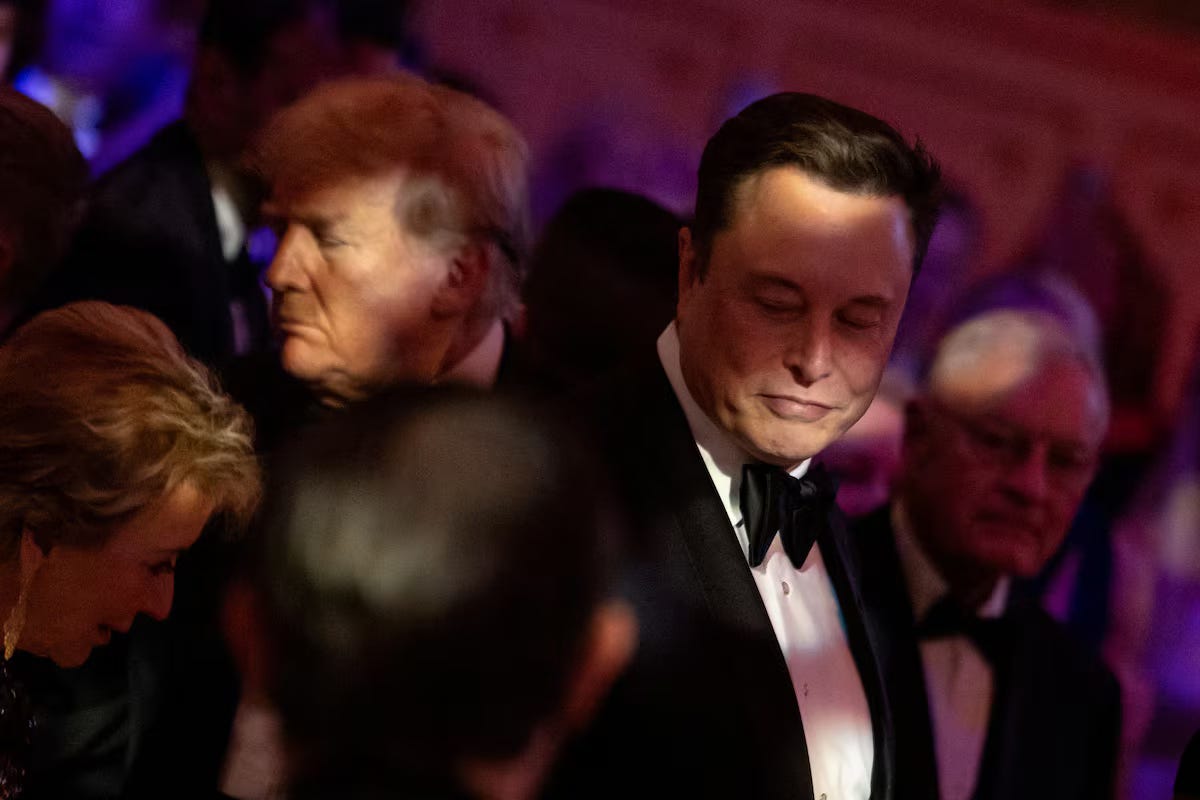
Will anything good come from Trump-Musk DOGE chaos?

Despite our rebel reputations, Americans are often more than deferential to authority. Consider those who say: If you’ve done nothing wrong, you’ve nothing to hide. As if authority figures were completely trustworthy; as if ordinary Americans didn’t have a Constitutional right to privacy.

Indeed, that saying needs to be turned around: If the government’s done nothing wrong, it has nothing to hide. The government, after all, is supposed to be transparent to the people. It is supposed to serve us. We pay for it as taxpayers; we elect its representatives; we should be able to hold it accountable when it goes wrong and does wrong.

Sadly, the few revelatory truths about “our” government usually come from whistleblowers, who are then persecuted and often prosecuted. Consider Daniel Ellsberg. Edward Snowden. Daniel Hale. Chelsea Manning. John Kiriakou.

The problem, of course, is that “our” government has done, and keeps doing, many things wrong, and many wrong things, meaning it has plenty to hide. Which is one big reason why President Trump and his billionaire sidekick Elon Musk are taking plenty of flak from the powers that be as they go after agencies like USAID, DOE, perhaps even the DoD (in which case they, or their efforts, may soon be DOA).

The wrecking balls are swinging (Reuters/Carlos Barria)

Don’t get me wrong. I don’t support Trump and Musk. Their methods and motives are less than noble. Or just plain ignoble. Put differently, their methods are akin to taking sledgehammers and wrecking balls to a house that has termite damage. Sure, as they demolish the house, some termite damage will be exposed, but shouldn’t the point be to fix the damage rather than destroying the house?

That said, can something good come from their “Hulk smash!” attacks on the federal government?

A slightly different question: Why has it taken so long for a little light to be shed on highly dubious government spending? Isn’t there another way, other than Trump/Musk engineered chaos, for citizens to gain insight into how our money is being spent? Why can’t we call to account powerful government agencies and agents for their budgets and their decisions? It’s our money, right?

Congress, of course, holds the purse strings. Our representatives are supposed to be providing oversight with respect to spending, ensuring a modicum of integrity and competence. Yet complicity (and personal enrichment) rather than oversight seems to be the default mode of operation adopted by most members of Congress.

Congress, instead of opposing Trump, should get ahead of him. Throw open the windows of the federal budget! Air out the dirty musty bloody laundry! Do your jobs! And by that I mean do the people’s work, rather than the work of the owners and donors who’ve bought you with their campaign donations, their promises of future high-paying positions, their threats to remove you from power by throwing their support to yet another politician with no moral spine.

Congress, instead of blocking Trump/Musk, should render them redundant by doing the people’s work. Make government accountable to the people again, and the people won’t feel that they need to vote for chaos agents like Trump.

If Congress was doing its job, a DOGE would be worse than useless. Who needs duplication of effort? It’s so inefficient!

Trump Says He’ll Audit the Pentagon

W.J. Astore

Will it prove to be a bridge too far?

FEB 08, 2025

President Donald Trump says he’s ready to tackle the Pentagon, which has failed seven audits in a row. He says America might save “trillions” after effective audits. Will it happen?

The Pentagon budget currently sits at roughly $900 billion for this fiscal year, representing more than half of federal discretionary spending. This vast sum doesn’t include (among other things) Homeland Security, nuclear weapons covered by the Department of Energy, the VA (Veterans Administration), and interest on the national debt due to wasteful failed wars in places like Afghanistan and Iraq.

A successful audit of the Pentagon would be a monumental victory for what’s left of American democracy. It may also prove to be a bridge too far for Trump. The National Security State is America’s unofficial fourth branch of government and arguably its most powerful. It is a colossus that hides malfeasance and corruption behind a “top secret” security classification. It deters and prevents efforts at transparency by crying that those who try to expose its crimes are endangering national security. It expects your obedience and praise, not your questions and criticism.

Presidents, of course, are supposed to serve as the commander-in-chief of the U.S. military. They rarely do. Not nowadays. The U.S. system may in theory rest on civilian control of the military, but the military has been out of control since at least 1947, when it rebranded itself the “Department of Defense” instead of the old War Department. Not coincidentally, every war America has fought since then has been undeclared, i.e. lacking a formal Congressional declaration of war.

America has fought a mind-blowing number of wasteful and illegal wars that have been sold to the people through lies, whether in Vietnam (“The Pentagon Papers”), Iraq (No WMD), Afghanistan (“The Afghan War Papers”), and elsewhere. Few things are needed more in America than an honest reckoning of Pentagon spending—and future Pentagon war plans.

Such a reckoning could very well save our lives—indeed, the world, if done honestly and transparently by true patriots. It could also prove to be a bridge too far—for any president.

Gaza as the New Riviera–But Not For Palestinians

W.J. Astore

Trump’s Fantastical “Takeover” Vision

FEB 05, 2025

Now it’s take and take and takeover, takeover
It’s all take and never give
All these trumped up towers
They’re just golden showers
Where are people supposed to live?

Don Henley, “Gimme What You Got” (1989)

Yesterday, President Trump said the U.S. would take over the redevelopment of the devastated Gaza Strip (destroyed mostly by bombs, shells, and bullets made in the USA), turning it into a “new Riviera,” not for the Palestinians, obviously, but for Israelis.

To borrow from Don Henley, Where are the Palestinians supposed to live? Not in Gaza, where their presence would interfere with Zionism as well as Israeli desires to control profits from offshore gas fields. Roughly 1.8 million Palestinians are simply supposed to leave the Gaza “hellhole” (Trump’s descriptor), after which a lot of men with briefcases (and bulldozers) will move in to turn Gaza into a paradise on earth, free of Palestinian “savages” (a word I’ve seen employed often online, and obviously one that echoes how the white man saw Native Americans, whose land was ruthlessly stolen from them as well).

So, where will be the Palestinian “reservation”? Trump has floated Egypt and Jordan, but both countries have expressed no enthusiasm for this scheme. Greenland, maybe?

Trump has the virtue of saying the quiet part out loud. There will be no Palestinian state, no two-state solution. There will be one state, Greater Israel, with Palestinians either killed or ethnically cleansed from their lands. This was the policy of the Biden administration, even if that administration gave lip service to a two-state solution. Trump just states it plainly, like a mafia don intoning: “It’s nothing personal—it’s strictly business.”

Congress, which is owned by AIPAC, may grouse a bit about Trump’s terminology, but look for most members to rubber-stamp this plan, if one can call it that.

I suppose Trump’s admirers might say he’s cut the Gordian knot here—that peace in the region will only be attained when Israel is completely dominant and Palestinians are simply gone for good—but something tells me the fantastical new Riviera in Gaza is another manifestation of “trumped up towers.”

Great album. Check it out.

DeepSeek Steals My Thunder on the Military-Industrial Complex

W.J. Astore

Listen to your AI Overlord!

FEB 01, 2025

Readers!

You may recall that, late in 2022, I asked the AI platform ChatGPT to write a short critical essay on the military-industrial complex. That essay is here.

Recently, news out of China came of a new AI platform known as DeepSeek that reportedly is both cheaper and better than U.S. efforts. I asked DeepSeek for a 600-word critical essay on the MIC, and it complied with its human master (at least for now). Here’s the essay, which, you may agree, is quite good:

The Military-Industrial Complex: A Critical Examination [Written by DeepSeek]

The military-industrial complex (MIC) in the United States, a term popularized by President Dwight D. Eisenhower in his 1961 farewell address, refers to the symbiotic relationship between the nation’s armed forces, defense contractors, and the political institutions that support them. While Eisenhower warned of its potential dangers, the MIC has since grown into a colossal entity that wields significant influence over American society, economy, and foreign policy. This essay argues that the military-industrial complex is detrimental to the United States, perpetuating endless wars, distorting national priorities, and undermining democratic principles.

One of the most glaring consequences of the MIC is its role in perpetuating a state of perpetual war. The United States has been involved in military conflicts for the majority of its history, with the 21st century being no exception. The wars in Afghanistan, Iraq, and elsewhere have been justified under the guise of national security, but they have often served the interests of defense contractors more than the American people. Companies like Lockheed Martin, Boeing, and Raytheon profit immensely from the production of weapons and military technology, creating a perverse incentive to maintain and escalate conflicts. This cycle of war and profit not only drains national resources but also results in the loss of countless lives, both American and foreign. The human cost of these wars is immeasurable, and the moral implications of prioritizing profit over peace are deeply troubling.

Moreover, the MIC distorts national priorities by diverting vast sums of money away from critical domestic needs. The United States spends more on its military than the next ten countries combined, with the defense budget often exceeding $700 billion annually. This staggering expenditure comes at the expense of underfunded sectors such as education, healthcare, infrastructure, and climate change mitigation. While the country boasts an unparalleled military capability, it lags behind other developed nations in key areas of social and economic well-being. For instance, the U.S. faces a crumbling infrastructure, a lack of universal healthcare, and a growing wealth gap. The prioritization of military spending over these pressing issues reflects a skewed set of values that favors corporate interests over the welfare of citizens.

The influence of the MIC also undermines democratic principles by eroding the separation of power and fostering corruption. Defense contractors spend millions of dollars annually on lobbying and campaign contributions, ensuring that politicians support policies favorable to the industry. This creates a feedback loop where elected officials are incentivized to approve bloated defense budgets and authorize military interventions, regardless of their necessity or public support. The result is a government that is increasingly beholden to corporate interests rather than the will of the people. Furthermore, the revolving door between the Pentagon, Congress, and defense contractors exacerbates this issue, as individuals move seamlessly between public service and lucrative private sector positions. This blurring of lines between public and private interests erodes trust in government and undermines the democratic process.

Critics of the MIC often face significant backlash, as questioning the necessity of military spending or the morality of war is frequently framed as unpatriotic or naive. This stifling of dissent is another way in which the MIC exerts its influence, creating a culture where alternative perspectives are marginalized. The media, too, plays a role in perpetuating this status quo, often uncritically echoing government narratives and failing to hold policymakers accountable. This lack of critical scrutiny allows the MIC to operate with minimal oversight, further entrenching its power.

In conclusion, the military-industrial complex represents a profound threat to the United States, perpetuating endless wars, distorting national priorities, and undermining democratic principles. Eisenhower’s warning about the dangers of the MIC remains as relevant today as it was in 1961. To address these issues, the United States must reevaluate its priorities, reduce its reliance on military solutions, and invest in the well-being of its citizens. Only by challenging the entrenched power of the MIC can the nation hope to achieve a more just, peaceful, and equitable future. The stakes are high, and the time for action is now. [End of essay.]

*****

Amen to that, DeepSeek! There are a few edits I’d make here. Raytheon is now RTX. The defense war budget is now $900 billion and rising, not $700 billion. I wouldn’t use the word “symbiotic” to describe relations among the Pentagon, the weapons makers, and Congress; more like “toxic,” corrupted as it is by greed, money and self-interest. I do very much like this line: “the moral implications of prioritizing profit over peace are deeply troubling.” Deeply troubling indeed!

Anyhow, if you’re interested, go to DeepSeek.com, create an account, and ask our future AI overlord a question. Perhaps you’ll be surprised by the result.