
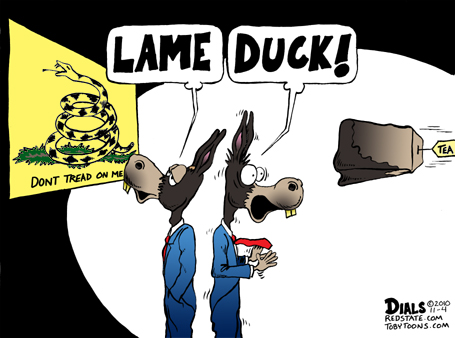
A Lame Duck Nation on Steroids

Lame duck, indeed.
It’s not just the Tea Party that’s lame (Toby Toons)

W.J. Astore

The more the United States has come to talk about dominance, the less dominant we’ve become.

To compensate, we’ve become a steroidal nation, to include the violent side effects associated with steroid use (just look at the latest stories out of the NFL about spousal and child abuse, or our steroidal police forces, including MRAPs and M-16s for school police).  If the story of the last fifty years is the gradual decline of the U.S., most notably in the economic and political realms, the story of today is how we’ve compensated with militarized Viagra.  We’ve reached “the age of knowing” that we’ve lost much of our potency as our country.  To compensate, we’re forever popping pills and flexing our muscles.  (Just look at John McCain’s enthusiasm for bombing.)

It’s precisely those steroids that are weakening us as a country.  As we’ve overcompensated with military weapons and bases, we’ve allowed our economy to slide.  As we’ve sought domination overseas, we’ve weakened our country right here at home.  We feverishly build and repair roads in Afghanistan but not here in the USA.  Same with schools — we’d rather build prisons, to include Gitmo, than colleges (since 1984, California has built 21 prisons but only one university).

Consider our binary debates on foreign policy.  It’s the hawks versus the doves, militarized “engagement” versus isolationist “appeasers,” the implication being that the latter is wrong — that minding one’s own business is not an option in a globalized world.  But the world is not some “global village”: it’s a conglomeration of fragments.  And U.S. efforts to dominate those fragments by military means are only accelerating that fragmentation.  Just look at what our government did and is doing to Iraq and Afghanistan.

Fragmentation facilitates dominance by multinational corporations even as the U.S. military is misused and overextended.  The result is more global instability and a retreat (or a return) to ideologies that promise coherence and order.  Witness the rise of militant Islam and ISIS.  By attacking it, the U.S. is acting as an accelerant to it.

As the U.S. weakens itself as a country, as it accumulates debt by constantly fighting wars while passing the costs along to future generations, large multinational corporations grow in power.  They are today’s equivalent to the British East India Company, the Dutch East India Company, and similar entities of the past.  Combine powerful multinationals with privatized mercenary outfits and you see echoes of the seventeenth century, to include wars over religion and resources.  Three centuries ago, it was Catholics versus Protestants and wars over spices like pepper and nutmeg.  Now it’s divisions within Islam and wars over oil.

We’re witnessing the decline of Enlightenment ideals and community-based Democracy, as seen by the way in which the U.S. government routinely betrays those ideals.  Any sense of shared, community-based, obligation is tainted by “socialism,” meaning that a Darwinian capitalism based on selfish individualism is promoted instead, which only feeds the growth of multinationals competing to sell “product” to the masses.

Everything is becoming a consumable, including the most vital parts of life.  As a consumable, it can be marketed, sold, and controlled by those same multinationals.  Even education is now an ephemeral product, marketed and sold as a commodity.

Corporations think and act for short-term profit.  But democracies are supposed to think strategically, over the long term.  Now the quarterly business cycle controls all.  Look at politics: A congressman is elected and instantly starts fund raising to win his next campaign.  Obama wins a second term and is almost instantly branded a lame duck.

But it’s not Obama who is the lame duck – it’s America.  And all the militarized steroids in the world won’t cure that lameness.  Indeed, they just aggravate it.

What Is Terrorism?

My copy.  Not the sexiest cover, but a good primer nonetheless
My copy. Not the sexiest cover, but a good primer nonetheless

When I entered the Air Force in 1985, I grabbed a pamphlet by Brian M. Jenkins of Rand.  The title caught my eye: International Terrorism: The Other World War.  Back then, the country was focused on the Cold War against the Evil Empire of the Soviet Union.  Jenkins suggested there was another war we should be focusing on.

In his pamphlet, he provided a “working definition” of terrorism:

“Terrorism is the use of criminal violence to force a government to change its course of action.”

And: “Terrorism is a political crime.  It is always a crime…”

But Jenkins also knew that terrorism, as a word and concept, was contentious and politicized.  As he explained:

“Some governments are prone to label as terrorism all violent acts committed by their political opponents, while antigovernment extremists frequently claim to be the victims of governmental terror.  Use of the term thus implies a moral judgment.  If one group can successfully attach the label terrorist to its opponent, then it has indirectly persuaded others to adopt its moral and political point of view, or at least to reject the terrorists’ view.  Terrorism is what the bad guys do.  This drawing of boundaries between what is legitimate and what is illegitimate, between the right way to fight and the wrong way to fight, brings high political stakes to the task of definition.”

Jenkins correctly notes that the word “terrorism” implies both a political and moral (and legal) judgment.  By his working definition, to be a terrorist is to be a criminal.

Can nation-states be terrorists?  Interestingly, no.  Not if you accept the definitional imperative common to international relations.  Nation-states draw their identity (and authority) in part by and through their ability to monopolize the means of violence.  Because a state monopolizes or “controls” violence in a legally sanctioned international system, it cannot commit a criminal act of terror, however terrorizing that act might be.  (By this definition, dropping atomic bombs on Hiroshima and Nagasaki and killing 200,000 people were not terrorist acts, even though the intent was to terrorize the Japanese into surrendering.) Put differently, a state can sponsor terrorism, but it cannot commit it.

It’s an unsatisfying definition to many.   As Glenn Greenwald, constitutional lawyer and journalist for the Guardian, has noted many times, terrorism as a concept is now so highly politicized, so narrowly defined and closely tied to evil acts committed by Muslim extremists, that the word itself has become polluted.  It’s more weapon than word, with an emotional impact that hits with the explosive power of a Hellfire missile.

Terrorism, in short, has become something of an Alice in Wonderland word.  As Humpty Dumpty put it, “When I use a word, it means just what I choose it to mean — neither more nor less.”  Such is the case with “terrorist” and “terrorism”: they’re often just epithets, ones we reserve for people and acts we find heinous.

Terrorism exists, of course.  But so too does politically-motivated manipulation of the English language, as George Orwell famously warned.  If terrorist = criminal = always them but never us (because we’re a nation, and a good-hearted one at that), we absolve ourselves of blame even as we shout, like the Queen of Hearts in Alice, “Off with their heads!” at the “terrorists.”

That shout may be satisfying, but it may also be all too easy — and all too biased.

W.J. Astore

The Death of Serious Discourse in America

Come, Let Us Reason Together (Isaiah 1:18)

A good friend of mine wrote to me the other day about an increasingly rare privilege he enjoyed, courtesy of a visitor from Europe.  In my friend’s words,

Yesterday we had a friend visit from Europe. We sat from about 7 PM to midnight just talking about anything from personal or work problems to politics and the time just flew by… The contrast with the limited ability of the well-educated Americans we have met here to really discourse was astounding. Free discourse and examination of competing ideas is fundamental to democracy yet most Americans today consider it either “impolite” or “bad manners” to reveal themselves in even random conversations. Most Americans have decided to live in a black or white world, not the grey that is the reality.

Imagine that!  My friend’s European guest demonstrated both the ability to reason, distinguishing facts from theories and conjecture, as well as tolerance, the ability to entertain other points of view, even when they disagree with your own.

Remember when Americans enjoyed the cut and fray of conversation, the pleasure of minds working hard to shed light on difficult matters?  Just as our bodies prosper from demanding physical chores, so too do our minds.

Sadly, discourse in the USA today, such as it is, is mostly polarized.  It’s I’m right and you’re wrong, and the way I prove it is to outshout you.  This is one reason why otherwise thoughtful people tend to avoid protracted or revealing conversations.  What’s the point, when all the other person wants to do is to cow you, condemn you, or convert you?

That said, Americans are slowly losing the ability to converse, for lots of different reasons.  Young people are educated indoctrinated to get a job, with “success” measured by their pay and benefits.  They place little value on becoming educated, informed, critical thinkers.  They’re constantly distracted by various electronic devices and video games, and constantly bombarded with trivial information masquerading as meaningful news.

Immersion in the trivial stifles creative discourse and is an ever-present threat, as Alexandr Solzhenitsyn warned us 35 years ago:

People also have the right not to know, and it is a much more valuable one. The right not to have their divine souls stuffed with gossip, nonsense, vain talk. A person who works and leads a meaningful life does not need this excessive burdening flow of information.

Solzhenitsyn
Solzhenitsyn

A large part of leading a meaningful life is healthy communal discourse.  But our society no longer sees discourse — the true exchange of ideas — as valuable.  You can’t put a dollar figure on it, you can’t sell advertising for it, you can’t assign a metric to it, so just abandon it.

Writing skills are also degenerating.  My students have difficulty sustaining an argument in print.  They have difficulty in conversing intelligently on a range of subjects.  They can’t distinguish facts from propaganda, or they prefer to deny facts that disagree with their received opinions.  And they are tainted by me-first American exceptionalism.

And it’s only gotten worse since 9/11.  As my friend noted, “On top of the social attitudes of feeling that conversation on serious topics is outré, the post 9/11 suppression of free speech has had a devastating effect on private discussion of national politics.”

In these times of conformity and confusion and complicity with power, we need thoughtful and contrarian discourse more than ever.

Come, let us reason together.  And let’s not be afraid of heated discussion.  A controlled burn can stop the most raging wildfire in the mind.  We all need to burn more brightly to shed the light that is the essence of an active mind and a thriving democracy.

W.J. Astore