Lately, there’s a “Talking Heads” lyric that’s been popping up in my brain: Our president’s crazy/Did you hear what he said?
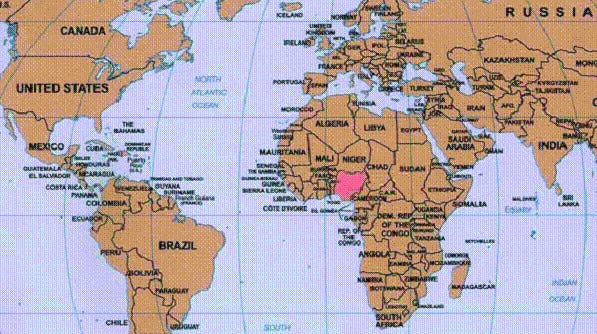
A few days ago, President Trump threatened war against Nigeria. He vowed that U.S. military action against Nigeria would be “fast, vicious, and sweet.”
Sweet? What kind of president describes warfare as “sweet”? Truly this is militarism run amuck.
What is wrong with our country? Must we wage war on everyone?
Speaking of “sweet,” J. Robert Oppenheimer described the development of the atomic bomb as a “technically sweet” challenge for the scientists and engineers who worked on it. I suppose it was, but the results were bitter indeed.
America, all is not sweetness here.
Wars and threats of war: It’s how Americans learn geography
It’s always the right time to stop building more weapons of mass destruction
William Astore and Matthew Hoh
[Note to readers: Back in early September, Congressman Mike Turner penned an op-ed for the “liberal” New York Times supporting a massive “investment” in new nuclear weapons. Matt Hoh and I quickly submitted letters to the Times to protest this op-ed and its arguments; the Times ignored them. We then wrote our own op-ed below, shopping it to various mainstream media outlets without success. Here it finally appears for the first time.]
*****
Representative Mike Turner’s essay on nuclear weapons in The New York Times (We Must Invest in Our Aging Nuclear Arsenal, September 6, 2024) is dangerously loyal to counterproductive US national security policies and narratives.
Turner’s lamentation over foreign nuclear weapons programs ignores destabilizing US arms control choices this century. The US spends more on nuclear weapons than the rest of the world combined. Its $1.7 trillion modernization program (the Sentinel ICBM; the B-21 Raider bomber; Columbia-class nuclear submarines) has done little more than upset the decades-long nuclear deterrence balance among nations.
In his essay, Turner neglects to mention the US government’s unilateral withdrawal from multiple arms control treaties. Then-Senator Joe Biden rightly predicted the effects of George W. Bush’s abandonment of the Anti-Ballistic Missile (ABM) Treaty: “A year ago [in 2000], it was widely reported that our intelligence community had concluded that pulling out of ABM would prompt the Chinese to increase their nuclear arsenal tenfold.” The Chinese are now clearly headed in that escalatory direction.
To prevent the apocalyptic consequences of yet another nuclear arms race, the US should act to decrease “investments” in new weapons while cutting current arsenals by negotiating and enacting new arms reduction treaties. Together, the US and Russia already possess ten thousand nuclear warheads, enough to destroy life on earth and several other earth-sized planets. We need desperately to divest from nuclear weapons, not “invest” in them.
Consider as well that America’s current nuclear triad, especially the Navy’s Trident submarine force, is potent, survivable, and more than sufficient to deter any conceivable adversary.
Simply put, the US must stop building genocidal nuclear weapons. It must instead renew international efforts and treaties to downsize these dreadful and dangerous arsenals. Spending yet more trillions on more world-shattering nukes is worse than a mistake—it’s a crime against humanity.
Here we are haunted by the words of Hans Bethe, who worked on the Manhattan Project that created the atomic bomb during World War II. The first reaction Bethe said he’d had after Hiroshima was one of fulfillment—that the project they had worked on for so long had succeeded. The second reaction, he said, was one of shock and awe: “What have we done? What have we done,” he repeated. And the third reaction: It should never be done again.
That is the imperative here. The US must act so that future Hiroshimas will never happen.
It’s not America’s fate alone that’s at stake here, but the fate of humanity itself, and indeed most life on earth, as only a few dozen thermonuclear warheads exploding would likely produce nuclear winter and an eventual “body count” in the billions.
During the First Cold War, one heard it said: “Better dead than red.” That mentality remains, even as the “reds” today are more capitalist than communist. Meanwhile, the weapons makers for the military-industrial-congressional complex (MICC), in their greed, are the adversary within. From Israel and events in Gaza, we’ve learned the MICC will literally empower a people to commit mass murder. With more and newer thermonuclear weapons, the MICC may yet kill the world.
Higher quarterly profits will mean little when everybody is dead.
During the Vietnam War, a US Army major was heard to say: “We had to destroy the town to save it [from communism].” If America can destroy towns in Vietnam to “save” them from communism, if it can facilitate the destruction of Gaza to “save” it from Hamas, it can similarly destroy the earth to “save” it from China, or Russia, or some other “threat.” That is the indefensible (il)logic of building yet more weapons of mass destruction.
Contra Congressman Turner, there is no logical, sensible, defensible reason for America’s proposed “investment” in new nuclear weapons. But there are nearly two trillion reasons why it’s going forward, because that’s the projected total cost of modernizing America’s nuclear triad. Money talks—loudly, explosively, perhaps catastrophically.
Today, more than half of US federal discretionary spending is devoted to war and weapons. Americans, in essence, live both in a permanent war state and a persistent state of war. As bad as that reality is, a state of nuclear war is unimaginable and must not be allowed to happen.
At the height of the Cold War, one of us served in Cheyenne Mountain, America’s nuclear command center, and witnessed a simulated nuclear attack on the US. Even on the primitive monitors the Air Force had back in 1986, seeing Soviet missile tracks crossing the North Pole and terminating at American cities was unforgettable.
A generation earlier, Robert Oppenheimer, the “father of the atomic bomb,” tragically noted in 1965 that it was 20 years too late to control nuclear arms. Those efforts, he said, should have been started “the day after Trinity” in July of 1945.
Let’s not make it 80 years too late. Congressman Turner is exactly wrong here. We must cut America’s nuclear arsenal and pursue new nuclear disarmament treaties. Never should our children be haunted as we were (and still are) by the darkness and doom of radioactive mushroom clouds.
William Astore, a retired lieutenant colonel (USAF) and historian, is a senior fellow at the Eisenhower Media Network.
Matthew Hoh, a former Marine Corps captain and State Department official, resigned in protest in 2009 against America’s ill-conceived war in Afghanistan. He is Associate Director at the Eisenhower Media Network.
When I was in the U.S. military, I learned a saying (often wrongly attributed to the Greek philosopher Plato) that only the dead have seen the end of war. Its persistence through history to this very moment should indeed be sobering. What would it take for us humans to stop killing each other with such vigor and in such numbers?
Song lyrics tell me to be proud to be an American, yet war and profligate preparations for more of the same are omnipresent here. My government spends more on its military than the next 10 countries combined (and most of them are allies). In this century, our leaders have twice warned of an “axis of evil” intent on harming us, whether the fantasy troika of Iraq, Iran, and North Korea cited by President George W. Bush early in 2002 or a new one — China, Russia, and North Korea — in the Indo-Pacific today. Predictably given that sort of threat inflation, this country is now closing in on a trillion dollars a year in “defense spending,” or close to two-thirds of federal discretionary spending, in the name of having a military machine capable of defeating “evil” troikas (as well as combatting global terrorism). A significant part of that huge sum is reserved for producing a new generation of nuclear weapons that will be quite capable of destroying this planet with missiles and warheads to spare.
My country, to be blunt, has long been addicted to war, killing, violence, and massive preparations for more of the same. We need an intervention. We need to confront our addiction. Yet when it comes to war and preparations for future conflicts, our leaders aren’t even close to hitting rock bottom. They remain in remarkable denial and see no reason to change their ways.
To cite two recent examples: Just before Easter weekend this year, President Biden swore he was personally devastated by Palestinian suffering in Gaza. At the same time, his administration insisted that a United Nations Security Council resolution for a ceasefire in Gaza that it allowed to pass was “non-binding” and, perhaps to make that very point, reportedly shipped 1,800 MK84 2,000-pound bombs and 500 MK82 500-pound bombs off to Israel, assumedly to be used in — yes! — Gaza.
The Biden administration refuses to see the slightest contradiction in such a stance. Men like Joe Biden and his chief diplomat Antony Blinken confess to being disturbed, even shocked, by the devastation our bombs deliver. Who knew Israel would use them to kill or wound more than 100,000 Palestinians? Who knew that they’d reduce significant parts of Gaza to rubble? Who knew that a blank check of support for Israel would enable that country to — it’s hard not to use the phrase — offer a final solution to the Gaza question?
Not to be outdone by the Democrats, Republican Congressman Tim Walberg of Michigan recently cited the examples of Hiroshima and Nagasaki in seeking a “quick” end to the conflict in Gaza (before walking his comments back somewhat). For him, Israel remains America’s greatest ally, whatever its actions, even as he argues that Palestinians in Gaza merit no humanitarian aid from the United States whatsoever.
With that horrifying spectacle — and given the TV news and social media, it truly has been a spectacle! — of genocide in Gaza, America’s leaders have embraced the very worst of Machiavelli, preferring to be feared rather than loved, while putting power first and principle last. Former National Security Adviser and Secretary of State Henry Kissinger, recently deceased, rightly vilified for pursuing a Bismarckian Realpolitik, and deeply involved in the devastation of Vietnam, Cambodia, and Laos, might even have blanched at the full-throttled support for war (and weapons sales) now being pursued by this country’s leaders. Dividing the world into armed camps based on fear seems basic to our foreign policy, a reality now echoed in domestic politics as well, as the Democratic blue team and the MAGA Republican red team attack each other as “fascistic” or worse. In this all-American world of ours, all is conflict, all is war.
When asked about such an addiction to war, your average government official will likely claim it’s not our fault. “Freedom isn’t free,” so the bumper sticker says, meaning in practice that this country stands prepared to kill others without mercy to ensure its “way of life,” which also in practice means unbridled consumption by an ever-shrinking portion of Americans and unapologetic profiteering by the richest and greediest of us. Call it the “moderate” bipartisan consensus within the Washington Beltway. Only an “extremist” would dare call for restraint, tolerance, diplomacy, and peace.
A Common Cause to Unify Humanity
Short of an attack on Earth by aliens, it’s hard to imagine the U.S. today making common cause with “enemies” like China, Iran, North Korea, or Russia. What gives? Isn’t there a better way and, if so, how would we get there?
In fact, there is a common foe — or perhaps a common cause — that should unite us all as humans. That cause is Earth, the health of our planet and all the life forms on it. And that foe, to state the obvious (even if it regularly goes unsaid), is war, which is unhealthy in the extreme not just for us but for our planet, too.
War turns people into killers — of our fellow humans, of course, but also of all forms of life within our (often very large) blast radii. In addition, war is a mass distraction from what should truly matter to us: the sacredness of life and the continued viability of our planet and its ecology. Call it a cliché but there’s no way to deny it: there is indeed only one Spaceship Earth. As far as we know now, our planet is the sole body in the universe teeming with life. Of course, the universe is incomprehensibly vast and there could well be other forms of life out there, but we don’t know that, not with certainty anyway.
Imagine, in a dystopic future, America’s “best and brightest” (or the “best and brightest” of another country) acting in a nuclear fury, employing the very weaponry that continues to proliferate but hasn’t been used since the destruction of two Japanese cities on August 6 and 9, 1945, and so crippling Spaceship Earth. Imagine also that our planet is truly the universe’s one magnificent and magical spot of life. Wouldn’t it be hard then to imagine a worse crime, not just against humanity, but life itself cosmically? There would be no recompense, no forgiveness, no redemption — and possibly no recovery either.
Of course, I don’t know if God (or gods) exists. Though I was raised a Catholic, I find myself essentially an agnostic today. Yet I do believe in the sacredness of life in all its diversity. And as tenacious as life may be, given our constant pursuit of war, I fear the worst.
Earthrise from the Apollo 8 mission
If you’re of a certain age, you may recall when the astronauts on Apollo 8 witnessed earthrise as their spaceship orbited the moon in 1968. The crew read from Genesis, though in truth it could have been from any creation story we humans have ever imagined to account for how we and our world came to be. Specific religions or creeds didn’t truly matter at that moment, nor should they now. What mattered was the sense of awe we felt as we first viewed the Earth from space in its full glory but also all its fragility.
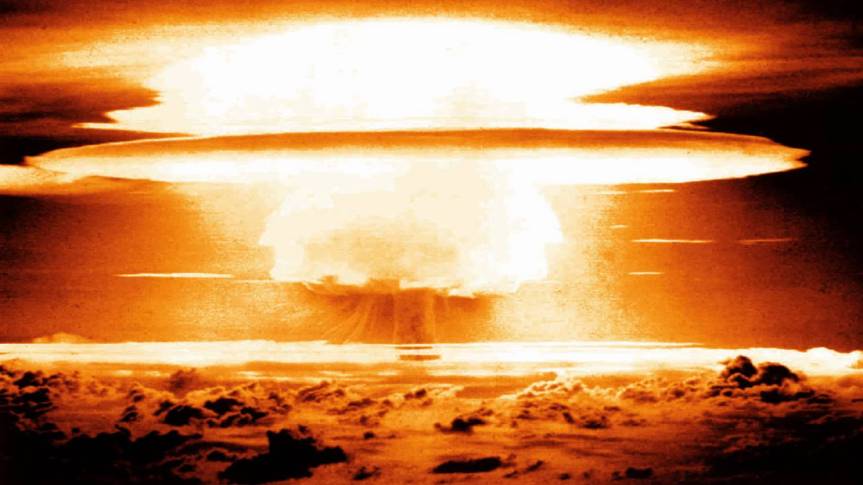
For make no mistake, this planet is fragile. Its ecosystems can be destroyed. Not for nothing did the inventor of the atomic bomb, J. Robert Oppenheimer, turn to the Hindu scriptures to intone, “Now I am become death, the destroyer of worlds,” when he saw the first atomic device explode and expand into a mushroom cloud during the Trinity test in New Mexico in July 1945.
In the febrile postwar climate of anti-communism that would all too soon follow, America’s leaders would decide that atomic bombs weren’t faintly destructive enough. What they needed were thermonuclear bombs, 1,000 times more destructive, to fight World War III against the “big fat commie rat.” Now nine (9!) nations have nuclear weapons, with more undoubtedly hankering to join the club. So how long before mushroom clouds soar toward the stratosphere again? How long before we experience some version of planetary ecocide via a nuclear exchange and the nuclear winter that could follow it?
Genocide and Ecocide on a Planetary Scale
The genocide happening in Gaza today may foreshadow one possible future for this planet. The world’s lone superpower, its self-styled beacon of freedom, now dismisses U.N. Security Council resolutions to stop the killing as “non-binding.” Meanwhile, Israel, whose founding was a response to a Holocaust inflicted during World War II and whose people collectively said Never Again, is now killing, starving, and displacing hundreds of thousands of Palestinians in the name of righteous vengeance for Hamas’s October 7th attack.
If the U.S. and Israel can spin mass murder in Palestine as not just defensible, but even positive (“defeating Hamas terrorists”), what hope do we have as a species? Is this the future we have to look forward to, an endless echoing of our murderous past?
I refuse to believe it. It truly should be possible to imagine and work toward something better. Yet, in all honesty, it’s hard to imagine new paths being blazed by such fossilized thinkers as Joe Biden and Donald Trump.
“Don’t trust anyone over thirty” was a telling catchphrase of the 1960s. Now, we’re being told as Americans that we’ll have to place our trust in one of two men almost at or exceeding 80 years of age. Entrusting and empowering political dinosaurs, however, represents an almost surefire path toward future extinction-level events.
Let me turn instead to a 25-year-old who did imagine a better future, even as he protested in the most extreme way imaginable the genocide in Gaza. This February, fellow airman Aaron Bushnell lit himself on fire outside the Israeli embassy in Washington, D.C. He sacrificed his life in a most public way to challenge us to do something, anything, to stop genocide. America’s “leaders” answered him by ignoring his sacrifice and sending more bombs, thousands of them, to Israel.
Aaron Bushnell did, however, imagine a better world. As he explained last year in a private post:
“I’ve realized that a lot of the difference between me and my less radical friends is that they are less capable of imagining a better world than I am. I follow YouTubers like Andrewism that fill my head with concrete images of free, post-scarcity communities and it makes me so much more prepared to reject things about the current world, because I’ve imagined how things could be and that helps me see how extremely bullshit things are right now.
“What I’m trying to say is, it’s so important to imagine a better world. Let your thoughts run wild with idealistic dreams of what the world should look like and let the pain and anger at how it’s not that way flow through you. Let it free your mind and fuel your rage against the machine.
“It’s not too late for you or anyone. We can have the world of our dreams tomorrow, but we have to be willing to fight today.”
His all-too-public suicide was a fiery cry of despair, but also a plea for a better future, one free of mass murder.
Earlier this week, millions of people across America witnessed a total eclipse of the sun. It’s awe-inspiring, even a bit alarming, to see the sun disappear in the middle of the day. Those watching took comfort in knowing that it would reappear from behind the moon in a matter of seconds or minutes and so gloried in that fleeting moment of preternatural darkness.
But imagine if the moon and sun were somehow to become permanently stuck in place. Imagine that darkness was our future — our only future. Sadly enough, however, it’s not the moon but we humans who can potentially cast the Earth into lasting darkness. Via the nuclear winter that could result from a nuclear conflict on this planet, we could indeed cast a shadow between the sun and life itself, a power of destruction that, tragically, may far exceed our current level of wisdom.
We know from history that it’s far easier to destroy than to create, far easier to kill than to preserve. Yet when countries make genocide or ecocide (from nuclear winter) possible and defensible (as a sign of uncompromising “toughness” and perhaps the defense of “freedom”), you know that their leaders are, in some sense, morally obtuse monsters. And who or what are we if we choose to follow such monsters?
As human populations rise, as vital resources like water, food, and fuel shrink, as this planet grows ever hotter thanks to our intervention and our excesses, we’ll need to cooperate more than ever to ensure our mutual survival. Far too often, however, America’s strategic thinkers dismiss cooperation through diplomacy or otherwise as naïve, unreliable, and impractical. “Competition” through zero-sum games, war, or other hyperviolent urges seems so much more “reasonable,” so much more “human.”
To the victor goes the spoils, so it’s said. But a planet despoiled by thermonuclear war, cast into darkness, ravaged by radiation, disease, and death, would, of course, offer no victory to anyone. Unless we put our efforts into ending war, rather than continuing to war on one another, such conflicts will, sooner or later, undoubtedly put an end to us.
In reality, our worst enemy isn’t some “axis” or other combination of imagined foes from without, it’s within. We remain the world’s most dangerous species, the one capable of wiping out most or all of the rest, not to speak of ourselves, with our folly. So, as Aaron Bushnell wrote, free your mind. Collectively, there must be a better way for all creatures, great and small, on this fragile spaceship of ours.
I turn 60 this year. My health is generally good, though I have aches and pains from a form of arthritis. I’m not optimistic enough to believe that the best years of my life are ahead of me, nor so pessimistic as to assume that the best years are behind me. But I do know this, however sad it may be to say: the best years of my country are behind me.
Indeed, there are all too many signs of America’s decline, ranging from mass shootings to mass incarceration to mass hysteria about voter fraud and “stolen” elections to massive Pentagon and police budgets. But let me focus on just one sign of all-American madness that speaks to me in a particularly explosive fashion: this country’s embrace of the “modernization” of its nuclear arsenal at a price tag of at least $2 trillion over the next 30 years or so — and that staggering sum pales in comparison to the price the world would pay if those “modernized” weapons were ever used.
Just over 30 years ago in 1992, a younger, still somewhat naïve version of Bill Astore visited Los Alamos National Laboratory (LANL) in New Mexico and the Trinity test site in Alamogordo where the first atomic device created at that lab, a plutonium “gadget,” was detonated in July 1945. At the time I took that trip, I was a captain in the U.S. Air Force, co-teaching a course at the Air Force Academy on — yes, would you believe it? — the making and use of the atomic bombs that devastated the Japanese cities of Hiroshima and Nagasaki to end World War II. At the time of that visit, the Soviet Union had only recently collapsed, inaugurating what some believed to be a “new world order.” No longer would this country have to focus its energy on waging a costly, risky cold war against a dangerous nuclear-armed foe. Instead, we were clearly headed for an era in which the United States could both dominate the planet andbecome “a normal country in normal times.”
I was struck, however, by the anything-but-celebratory mood at Los Alamos then, though I really shouldn’t have been surprised. After all, budget cuts loomed. With the end of the Cold War, who needed LANL to design new nuclear weapons for an enemy that no longer existed? In addition, there was already an effective START treaty in place with Russia aimed at reducing strategic nuclear weapons instead of just limiting their growth.
At the time, it even seemed possible to imagine a gradual withering away of such great-power arsenals and the coming of a world liberated from apocalyptic nightmares. Bipartisan support for nuclear disarmament would, in fact, persist into the early 2000s, when then-presidential candidate Barack Obama joined old Cold War hawks like former Secretary of State Henry Kissinger and former Senator Sam Nunn in calling for nothing less than a nuclear-weapons-free world.
An Even More Infernal Holocaust
It was, of course, not to be and today we once again find ourselves on an increasingly apocalyptic planet. To quote Pink Floyd, the child is grown and the dream is gone. All too sadly, Americans have become comfortably numb to the looming threat of a nuclear Armageddon. And yet the Bulletin of Atomic Scientist’sDoomsday Clockcontinues to tick ever closer to midnight precisely because we persist in building and deploying ever more nuclear weapons with no significant thought to either the cost or the consequences.
Over the coming decades, in fact, the U.S. military plans to deploy hundreds — yes, hundreds! — of new intercontinental ballistic missiles (ICBMs) in silos in Wyoming, Montana, North Dakota, and elsewhere; a hundred or so nuclear-capable B-21 stealth bombers; and a brand new fleet of nuclear-missile-firing submarines, all, of course, built in the name of necessity, deterrence, and keeping up with the Russians and the Chinese. Never mind that this country already has thousands of nuclear warheads, enough to comfortably destroy more than one Earth. Never mind that just a few dozen of them could tip this world of ours into a “nuclear winter,” starving to death most creatures on it, great and small. Nothing to worry about, of course, when this country must — it goes without saying — remain the number one possessor of the newest and shiniest of nuclear toys.
And so those grim times at Los Alamos when I was a “child” of 30 have once again become boom times as I turn 60. The LANL budget is slated to expand like a mushroom cloud from $3.9 billion in 2021 to $4.1 billion in 2022, $4.9 billion in 2023, and likely to well over $5 billion in 2024. That jump in funding enables “upgrades” to the plutonium infrastructure at LANL. Meanwhile, some of America’s top physicists and engineers toil away there on new designs for nuclear warheads and bombs meant for one thing only: the genocidal slaughter of millions of their fellow human beings. (And that doesn’t even include all the other life forms that would be caught in the blast radii and radiation fallout patterns of those “gadgets.”)
The very idea of building more and “better” nuclear weapons should, of course, be anathema to us all. Once upon a time, I taught courses on the Holocaust after attending a teaching seminar at the U.S. Holocaust Memorial Museum. Now, the very idea of modernizing our nuclear arsenal strikes me as the equivalent of developing upgraded gas chambers and hotter furnaces for Auschwitz. After all, that’s the infernal nature of nuclear weapons: they transform human beings into matter, into ash, killing indiscriminately and reducing us all to nothingness.
I still recall talking to an employee of Los Alamos in 1992 who assured me that, in the wake of the collapse of the Soviet Union, the lab would undoubtedly have to repurpose itself and find an entirely new mission. Perhaps, he said, LANL scientists could turn their expertise toward consumer goods and so help make America more competitive vis-à-vis Japan, which, in those days, was handing this country its lunch in the world of electronics. (Remember the Sony Walkman, the Discman, and all those Japanese-made VCRs, laser disc players, and the like?)
I nodded and left Los Alamos hopeful, thinking that the lab could indeed become a life-affirming force. I couldn’t help imagining then what this country might achieve if some of its best scientists and engineers devoted themselves to improving our lives instead of destroying them. Today, it’s hard to believe that I was ever so naïve.
“Success” at Hiroshima
My next stop on that tour was Alamogordo and the Trinity test site, then a haunted, still mildly radioactive desert landscape thanks to the world’s first atomic explosion in 1945. Yes, before America nuked Japan that August at Hiroshima and Nagasaki, we nuked ourselves. The Manhattan Project team, led by J. Robert Oppenheimer, believed a test was needed because of the complex implosion device used in the plutonium bomb. (There was no test of the uranium bomb used at Hiroshima since it employed a simpler triggering device. Its first “test” was Hiroshima itself that August 6th and the bomb indeed “worked,” as predicted.)
J. Robert Oppenheimer, the “father” of the atomic bomb
So, our scientists nuked the desert near the Jornada del Muerto, the “dead man’s journey” as the Spanish conquistadors had once named it in their own febrile quest for power. While there, Oppenheimer famously reflected that he and his fellow scientists had become nothing short of “Death, the destroyer of worlds.” In the aftermath of Hiroshima, he would, in fact, turn against the military’s pursuit of vastly more powerful hydrogen or thermonuclear, bombs. For that, in the McCarthy era, he was accused of being a Soviet agent and stripped of his security clearance.
Oppenheimer’s punishment should be a reminder of the price principled people pay when they try to stand in the way of the military-industrial complex and its pursuit of power and profit.
But what really haunts me isn’t the “tragedy” of Opie, the American Prometheus, but the words of Hans Bethe, who worked alongside him on the Manhattan Project. Jon Else’s searing documentary film, The Day After Trinity, movingly catches Bethe’s responses on hearing about the bomb’s harrowing “success” at Hiroshima.
His first reaction was one of fulfillment. The crash program to develop the bomb that he and his colleagues had devoted their lives to for nearly three years was indeed a success. His second, he said, was one of shock and awe. What have we done, he asked himself. What have we done? His final reaction: that it should never be done again, that such weaponry should never, ever, be used against our fellow humans.
And yet here we are, nearly 80 years after Trinity and our country is still devoting staggering resources and human effort to developing yet more “advanced” nuclear weapons and accompanying war plans undoubtedly aimed at China, North Korea, Russia, and who knows how many other alleged evildoers across the globe.
Fire and Fury Like the World Has Never Seen?
Perhaps now you can see why I say that the best years of my country are behind me. Thirty years ago, I caught a fleeting glimpse out of the corner of my eye (Pink Floyd again) of a better future, a better America, a better world. It was one where a sophisticated lab like Los Alamos would no longer be dedicated to developing new ways of exterminating us all. I could briefly imagine the promise of the post-Cold-War moment — that we would all get a “peace dividend” — having real meaning, but it was not to be.
And so, I face my sixtieth year on this planet with trepidation and considerable consternation. I marvel at the persuasive power of America’s military-industrial-congressional complex. In fact, consider it the ultimate Houdini act that its masters have somehow managed to turn nuclear missiles and bombs into stealth weapons — in the sense that they have largely disappeared from our collective societal radar screen. We go about our days, living and struggling as always, even as our overlords spend trillions of our tax dollars on ever more effective ways to exterminate us all. Indeed, at least some of our struggles could obviously be alleviated with an infusion of an extra $2 trillion over the coming decades from the federal government.
Instead, we face endless preparations for a planetary holocaust that would make even the Holocaust of World War II a footnote to a history that would cease to exist. The question is: What can we do to stop it?
The answer, I think, is simply to stop. Stop buying new nuclear stealth bombers, new ICBMs, and new ultra-expensive submarines. Reengage with the other nuclear powers to halt nuclear proliferation globally and reduce stockpiles of warheads. At the very least, commit to a no-first-use policy for those weapons, something our government has so far refused to do.
I’ve often heard the expression “the nuclear genie is out of the bottle,” implying that it can never be put back in again. Technology controls us, in other words.
That’s the reality we’re all supposed to accept, but don’t believe it. America’s elected leaders and its self-styled warrior-generals and admirals have chosen to build such genocidal weaponry. They seek budgetary authority and power, while the giant weapons-making corporations pursue profits galore. Congress and presidents, our civilian representatives, are corrupted or coerced by a system that ensnares their minds. Much like Gollum in The Lord of the Rings, the nuclear button becomes their “precious,” a totem of power. Consider President Trump’s boast to Kim Jong-un that “his” nuclear button was much bigger than theirs and his promise that, were the North Korean leader not to become more accommodating, his country would “face fire and fury like the world has never seen.” The result: North Korea has vastly expandedits nuclear arsenal.
It wouldn’t have to be this way. To cite Dorothy Day, the Catholic peace activist, “Our problems stem from our acceptance of this filthy, rotten system.” Don’t accept it, America. Reject it. Get out in the streets and protest as Americans did during the nuclear freeze movement of the early 1980s. Challenge your local members of Congress. Write to the president. Raise your voice against the merchants of death, as Americans proudly did (joined by Congress!) in the 1930s.
If we were to reject nuclear weapons, to demand a measure of sanity and decency from our government, then maybe, just maybe, the best years of my country would still lie ahead of me, no matter my growing aches and pains on what’s left of my life’s journey.
Not to be morbid, but I suppose we all walk our own Jornada del Muerto. I’d like what’s left of mine to remain unlit by the incendiary glare of nuclear explosions. I’d prefer that my last days weren’t spent in a hardscrabble struggle for survival in a world cast into darkness and brutality by a nuclear winter. How about you?
Thirty years ago, I co-taught a course on the making and use of the atomic bomb at the U.S. Air Force Academy. We took cadets to Los Alamos National Laboratory in New Mexico, where the first nuclear weapons were designed and built during World War II, and we also visited the Trinity test site, where the first atomic device exploded in a test conducted in July of 1945. It was after that first test when J. Robert Oppenheimer, the father of the atomic bomb, mused that he had become death, the destroyer of worlds. And that is what nuclear weapons are: they are death, and they can literally destroy our world, producing nuclear winter and mass sickness and starvation.
Over the last two years, the Covid-19 pandemic has killed millions of people across the globe. A general nuclear war could kill billions of people in a matter of days. As Soviet Premier Nikita Khrushchev reportedly said in 1963, “The living will envy the dead” after such a nuclear cataclysm.
Not a good idea
Despite this, an intellectual fad of the Cold War era was to “think about the unthinkable,” to “war game” or plan for various nuclear “exchanges” resulting in the deaths of hundreds of millions of people, even to imagine that there could be a “winner” of such a war. Remarkably, in the context of the ongoing Russia-Ukraine war, that fad is returning today as pundits write articles that suggest the US needs to show the Russians it is willing and able to fight and win a nuclear war, as an op-ed in the Wall Street Journal argued on April 27th of this year.
Such suggestions are madness.
As a young Air Force lieutenant, I sat in the Missile Warning Center in Cheyenne Mountain during an exercise that simulated a nuclear war. This was 35 years ago, but I still remember those simulated Soviet missile tracks crossing the North Pole and ending in various American cities. There were no snazzy special effects or colorful high-definition computer monitors. It all happened in silence on a monochrome monitor as I sat under two thousand feet of solid granite in America’s largest nuclear bomb shelter. “There goes Kansas City,” somebody quietly said. It was a sobering experience that I’ll never forget.
Many years later, I watched a stunning documentary, The Day After Trinity, that detailed the development of the atomic bomb. I’ll never forget the words of Hans Bethe, legendary physicist and one of the bomb’s key developers. The first reaction among the scientists to the news the bomb had exploded over Hiroshima, Bethe recalled, was a feeling of fulfillment. The crash project to build the bomb had worked. The second reaction was one of shock and awe, of “What have we done,” Bethe quietly noted. And the third reaction: It should never be done again. And after Nagasaki the world somehow managed not to do it again, despite nearly catastrophic events like the Cuban Missile Crisis 60 years ago.
I was raised Roman Catholic, and I can think of no worse crime against humanity than mass murder by genocidal weaponry, not only of ourselves but of all life forms that would be vaporized by thermonuclear warheads. Let’s not think about the unthinkable; let’s not think we must show the Russians (or anyone else) that we’re willing to use nuclear weapons. Rather, let’s achieve the difficult but doable. The only sane course of action here is for all the world’s nations to negotiate major reductions in nuclear arsenals with the eventual goal of total nuclear disarmament.




 Bracing Views