The business of nuclear weapons is booming in the U.S., as Part II of a documentary on the military-industrial complex reveals. It’s well worth a few minutes of your time:
The documentary is especially strong in its focus on the Sentinel ICBM program, the least survivable leg of the nuclear triad. I didn’t know, for example, that Northrop Grumman has already spent $220 million lobbying for the Sentinel. Meanwhile, the projected cost of the Sentinel system, the documentary points out, has mushroomed from $78 billion to $140 billion. And I see estimates today have risen to $160 billion. All this for a system that’s not needed. Land-based ICBMs should be retired, not replaced.
Because land-based ICBMs represent a fixed target (unlike bombers and submarines, the other two legs of the triad), they are likely to be attacked first in a nuclear war, contributing to a “launch on warning (of attack)” mentality. But with warnings of nuclear attacks being both uncertain (false alarms have occurred in the past) and “time-sensitive,” i.e. urgent and pressure-packed, it’s likely a U.S. president, faced with a crisis, would only have 5-10 minutes to decide whether to launch ICBMs.
As the U.S. prepares to spend as much as $1.7 trillion on upgrading the triad, more money is also being dedicated to low-yield nuclear weapons, lowering the threshold for going nuclear. An escalatory spiral could follow from any use of nuclear weapons, but that concern doesn’t seem to trouble advocates for so-called tactical nukes.
Even as President Trump in the past has bragged about the size of his nuclear button, he does appear to view nuclear weapons as awful things, which they are. They are genocidal weapons. In essence, America is “investing” $1.7 trillion in weapons that are genocidal, indeed ecocidal, for any “general exchange” of nuclear weapons in a future war would destroy most life on earth (blast and heat, followed by radiation and nuclear winter).
As the Outlaw Josey Wales once mused, “Dyin’ ain’t much of a living.” The same applies to mass dying.
Replacing an older suicide vest with a newer one is not a sound plan
We are losing the struggle for the heart and soul of our country.
That much is apparent by the government’s embrace of genocide in Gaza, its boasts of trillion dollar war budgets, and its pride in global weapons sales, which the U.S. dominates (more than 40% of the global arms trade consists of weapons made in the USA).
I’ve been involved in efforts to criticize America’s “merchants of death” and to challenge America’s love affair with the military-industrial complex (MIC), but seemingly nothing we say or do changes the abusive and sociopathic power structure in DC. I suppose that’s none too surprising, given the power of the MICIMATT and the persuasiveness of propaganda.
Still, we must persist in these efforts, bringing a positive message, which I think should focus on the revival of democracy by reinvesting in America while rejecting militarism and restoring peace. Peace should be America’s normal, not war and constant preparations for the same. Yet “peace” seems to be the hardest word, one that’s rarely spoken in the halls of power.
Anyhow, in 2022 I wrote the following email to likeminded colleagues; I hope it’s worth sharing. As I think about it, three years later, I marvel at the death of idealism in America and the triumph of militarism. When more than half of the federal government’s discretionary spending goes to the military and weaponry, despite the Pentagon’s failure to pass audit after audit for seven years running, we must conclude we are one sick society.
The question is: How do we restore ourselves to health? Because I for one do not believe that war is the health of the state.
*****
Written in 2022 to colleagues seeking to reform the military-industrial complex (MIC).
When I was a college student in the early 1980s, and in Air Force ROTC, I wrote against the Reagan “defense” buildup. Caspar Weinberger, he of the “Cap the knife” handle for cost-cutting, became “Cap the ladle” as Reagan’s SecDef, ladling money in huge amounts to the Pentagon. History is repeating itself again as the Biden administration prepares to ladle $813 billion (and more) to the Pentagon.
How do we stop this? Of course, we must recognize (as I’m sure we all do) what we’re up against. Both political parties are pro-military and, in the main, pro-war. Our economy is based on a militarized Keynesianism and our culture is increasingly militarized. Mainstream Democrats, seemingly forever afraid of being labeled “weak” on defense, are at pains to be more pro-military than the Republicans. Biden, in Poland, echoed the words of Obama and other past presidents, declaring the U.S. military to be “the finest fighting force” in history. Think about that boast. Think about how Biden added that the nation owes the troops big. This is a sign of a sick culture.
Ike gave his MIC speech in 1961, and for 61 years the MIC has been winning. Even after the collapse of the Soviet Union in the early ‘90s, the MIC held its own; after 9/11, it went into warp speed and is accelerating. To cite Scotty from Star Trek: “And at Warp 10, we’re going nowhere mighty fast.”
We need a reformation of our institutions; we need a restoration of our democracy; we need a reaffirmation of the U.S. Constitution; we need to remember who we are, or perhaps who we want to be, as a people.
Do we really want to be the world’s largest dealer of arms? Do we really want to spend a trillion or more dollars, each and every year, on wars and weapons, more than the next dozen or so countries combined, most of which are allies of ours? (“Yes” is seemingly the answer here, for both Democrats and Republicans.) Is that really the best way to serve the American people? Humanity itself?
Consider plans to “invest” in “modernizing” America’s nuclear triad. (Notice the words used here by the MIC.) What does this really mean? To me, it means we plan on spending nearly $2 trillion over the next 30 years to replace an older suicide vest with a newer one, except this suicide vest will take out humanity itself, as well as most other life forms on our planet.
As Ike said in 1953, “This is not a way of life at all … it is humanity hanging from a cross of iron.”
We will need the broadest possible coalition to tackle this outrage against civilization and humanity. That’s why I applaud these efforts, even as I encourage all of us to enlist and recruit more people to join our ranks.
My father enlisted in the Civilian Conservation Corps in 1935 to do his bit for his family and his nation. He fought forest fires in Oregon and later became a firefighter after serving in the Army during World War II. That was the last formally declared war that America fought. It was arguably the last morally justifiable war this country has fought, waged by citizens who donned a uniform, not “warriors” who are told that the nation owes them big.
In “It’s A Wonderful Life,” Jimmy Stewart, a true war hero, played a man who never fought in WW2, who stayed at home and helped ordinary people even as his younger brother Harry went off to war and earned the Medal of Honor. Yet the movie doesn’t celebrate Harry’s war heroism; it celebrates the nobility, decency, and humility of George Bailey.
How do we get back to that America? The America from before the MIC, that celebrated decency and kindness and humanitarianism?
Yes, I know. It’s just a Frank Capra movie, and America has never been a perfect shining city. All I’m saying is we need more of that spirit if we are to prevail.
Yesterday, I posted the following comment to a fine article that addressed America’s nuclear triad and the reality that we really only need the Navy’s nuclear submarine force for deterrence:
My old service, the Air Force, will fight for new ICBMs and new “stealth” bombers just because they always want MORE. More money, more bases, more planes, more power. Doesn’t matter if America needs them or not. Doesn’t matter if new nuclear weapons may end the world. What matters is dominance, especially Air Force dominance over the U.S. Navy and Army.
“Nothing can stop the U.S. Air Force” in its budgetary battles at the Pentagon.
Honestly, this is self-evident to me. The Air Force always wants more planes, especially offensive aircraft like fighters and bombers. The Army always wants more divisions, more equipment, a bigger Army. The Navy always wants more ships.
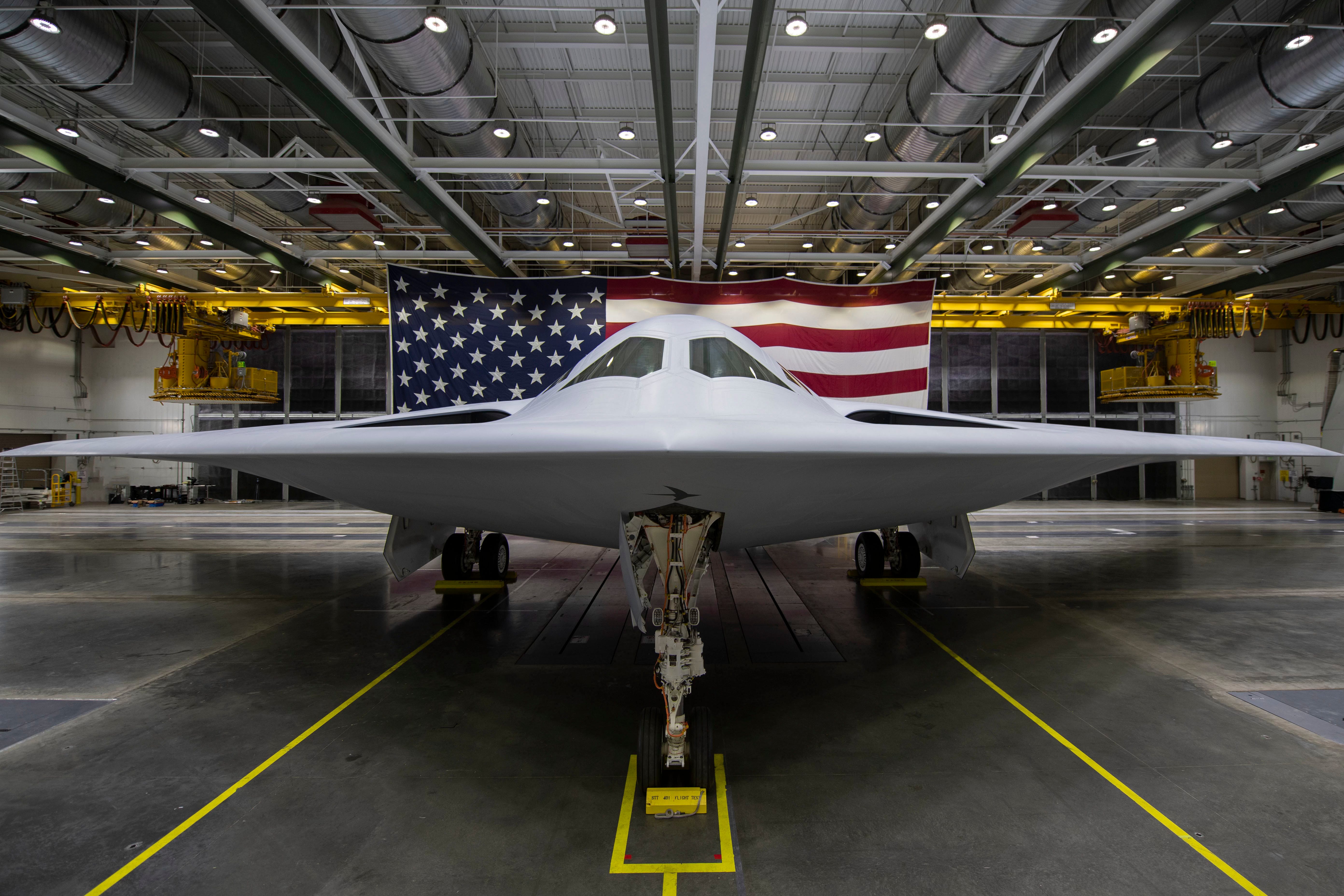
Who cares if it costs $700 million per plane? Or even a billion? It’s a bomber and the Air Force wants it! (The B-21 Raider)
Within the armed services, there are special interests. So, for example, the Navy carrier enthusiasts fight for their hegemony while the submariners fight to keep their slice of the budgetary pie. Within the “old” Army, the combat branches (infantry, armor, artillery) fought to ensure their continued relevance (and money). Now there’s an entire special ops and forces community, a military within the military, along with a new Space Force, a cyber command, various intelligence “communities,” all fighting for more budgetary authority and power.
Everyone always wants MORE. Victory in the U.S. military is measured by who wins the Pentagon budgetary battles, not who wins in Vietnam or Iraq or Afghanistan.
Service parochialism is encouraged at the highest levels and is instilled by the service academies. A friend of mine’s daughter recently received her acceptance letter to West Point. The letter stressed the proud tradition of the Army, and though it mentioned service, it said nothing about the Constitution and the oath of office. Each service academy stresses loyalty to service branch. Duty, honor, country takes a back seat to bleeding Air Force blue or Army green.
Pride in service isn’t necessarily a bad thing, but it can be blinding on issues like building new ICBMs and stealth bombers. The default Air Force position is to support more missiles and bombers “just because.” Because they’re “our” toys, part of “our” mission, bringing with them bases, command billets, influence, and all the rest.
Service parochialism ensures a military that is wasteful, overly conservative, and dysfunctional. Too much bleeding of Army green or Air Force blue has led to too much real bleeding of red.
As a late-stage baby boomer, a child of the 1960s, I grew up dreaming about America’s nuclear triad. You may remember that it consisted of strategic bombers like the B-52 Stratofortress, land-based intercontinental ballistic missiles (ICBMs) like the Minuteman, and submarine-launched ballistic missiles (SLBMs) like the Poseidon, all delivery systems for what we then called “the Bomb.” I took it for granted that we needed all three “legs” — yes, that was also the term of the time — of that triad to ward off the Soviet Union (aka the “evil empire”).
It took me some time to realize that the triad was anything but the trinity, that it was instead a product of historical contingency. Certainly, my mind was clouded because two legs of that triad were the prerogative of the U.S. Air Force, my chosen branch of service. When I was a teenager, the Air Force had 1,054 ICBMs (mainly Minutemen missiles) in silos in rural states like Montana, North Dakota, and Wyoming, along with hundreds of strategic bombers kept on constant alert against the Soviet menace. They represented enormous power not just in destructive force measured in megatonnage but in budgetary authority for the Air Force. The final leg of that triad, the most “survivable” one in case of a nuclear war, was (and remains) the Navy’s SLBMs on nuclear submarines. (Back in the day, the Army was so jealous that it, too, tried to go atomic, but its nuclear artillery shells and tactical missiles were child’s play compared to the potentially holocaust-producing arsenals of the Air Force and Navy.)
When I said that the triad wasn’t the trinity, what I meant (the obvious aside) was this: the U.S. military no longer needs nuclear strategic bombers and land-based ICBMs in order to threaten to destroy the planet. As a retired Air Force officer who worked in Cheyenne Mountain, America’s nuclear redoubt, during the tail end of the first Cold War, and as a historian who once upon a time taught courses on the atomic bomb at the Air Force Academy, I have some knowledge and experience here. Those two “legs” of the nuclear triad, bombers and ICBMs, have long been redundant, obsolete, a total waste of taxpayer money — leaving aside, of course, that they would prove genocidal in an unprecedented fashion were they ever to be used.
Nevertheless, such thoughts have no effect on our military. Instead, the Air Force is pushing ahead with plans to field — yes! — a new strategic bomber, the B-21 Raider, and — yes, again! — a new ICBM, the Sentinel, whose combined price tag will likely exceed $500 billion. The first thing any sane commander-in-chief with an urge to help this country would do is cancel those new nuclear delivery systems tomorrow. Instead of rearming, America should begin disarming, but don’t hold your breath on that one.
A Brief History of America’s Nuclear Triad
It all started with atomic bombs and bombers. In August 1945, the Japanese cities of Hiroshima and Nagasaki were obliterated by two atomic bombs carried by B-29 bombers, ending World War II. However, in the years that followed, as the Cold War with the Soviet Union heated up, the only “delivery system” the military had for its growing thermonuclear arsenal was the strategic bomber. Those were the glory days of the Strategic Air Command, or SAC, whose motto (believe it or not) was “Peace Is Our Profession” — the “peace” of a mass nuclear grave, had those hydrogen bombs ever been dropped on their intended targets in the Soviet Union and China.
However, as this country’s weapons makers produced ever more powerful hydrogen bombs and strategic bombers, a revolution was afoot in missile technology. By the late 1950s, missiles tipped with nuclear warheads became a practical reality. By the 1960s, the Air Force was already lobbying for 10,000 ICBMs, even if my old service had to settle for a mere thousand or so of them during the administration of President John F. Kennedy. Meanwhile, the Navy was maneuvering its way into the act by demonstrating that it was indeed possible for mobile, difficult-to-detect submarines to carry nuclear-tipped missiles.
By the late 1960s, that triad of potentially ultimate nuclear death had become so sacrosanct that it was untouchable. More than half a century later, America’s nuclear triad has endured and, all too sadly, is likely to do so far longer than you or me (if not, of course, used).
You might wonder why that should be so. It’s not for any sensible military or strategic reason. By the 1980s, if not before, bombers and ICBMs were obsolete. That was why President Jimmy Carter canceled the B-1 bomber in 1977 (though it would be revived under President Ronald Reagan, with the Air Force buying 100 of those expensive, essentially useless aircraft). That was why the Air Force developed the “peacekeeper” MX ICBM, which was supposed to be mobile (shuffled around by rail) or hidden via an elaborate shell game. Such notions were soon abandoned, though not the missiles themselves, which were stuffed for a time into fixed silos. The endurance of such weapons systems owes everything to Air Force stubbornness and the lobbying power of the industrial side of the military-industrial complex, as well as to members of Congress loath to give up ICBM and bomber bases in their districts, no matter how costly, unnecessary, and omnicidal they may be.
In that light, consider the Navy’s current force of highly capable Ohio-class nuclear submarines. There are 14 of them, each armed with up to 20 Trident II missiles, each with up to eight warheads. We’re talking, in other words, about at least 160 potentially devastating nuclear explosions, each roughly five to 20 times more powerful than the Hiroshima bomb, from a single sub. In fact, it’s possible that just one of those submarines has an arsenal with enough destructive power not just to kill millions of us humans, but to tip the earth into a nuclear winter in which billions more of us could starve to death. And America has 14 of them!
Why, then, does the Air Force argue that it, too, “needs” new strategic bombers and ICBMs? The traditional arguments go like this: bombers can be launched as a show of resolve and, unlike missiles, recalled. They are also allegedly more flexible. In Air Force jargon, they can be rerouted against “targets of opportunity” in a future nuclear war. Of course, generals can always produce a scenario, however world-ending, to justify any weapons system, based on what an enemy might or might not do or discover. Nonetheless, strategic bombers were already nearing obsolescence when Stanley Kubrick made his classic antinuclear satire, Dr. Strangelove (1964), so prominently featuring them.
And what about land-based ICBMs? Once the claim was that they had more “throw-weight” (bigger warheads) than SLBMs and were also more accurate (being launched from fixed silos rather than a mobile platform like a submarine). But with GPS and other advances in technology, submarine-launched missiles are now as accurate as land-based ones and “throw-weight” (sheer megatonnage) always mattered far less than accuracy.
Worse yet, land-based ICBMs in fixed silos are theoretically more vulnerable to an enemy “sneak” attack and so more escalatory in nature. The U.S. currently has 400 Minuteman III ICBMs sitting in silos. If possible incoming enemy nuclear missiles were detected, an American president might have less than 30 minutes — and possibly only 10 or so — to decide whether to launch this country’s ICBM force or risk losing it entirely.
That’s not much time to determine the all-too-literal fate of the planet, is it, especially given the risk that the enemy attack might prove to be a “false alarm“? Just before I arrived at Cheyenne Mountain, there were two such alarms (one stemming from a technical failure, the other from human error when a simulation tape was loaded into computers without any notification that it was just a “war game”). Until they were found to be false alarms, both led to elevated DEFCONs (defense readiness conditions) in preparation for possible nuclear war.
New ICBMs will only add “use them or lose them” pressure to the global situation. Mobile, elusive, and difficult to detect, the Navy’s submarine force is more than sufficient to deter any possible enemy from launching a nuclear attack on the United States. Strategic bombers and ICBMs add plenty of bang and bucks but only to the Air Force budget and the profits of the merchants of mass nuclear death who make them.
A Sane Path Forward for America’s Nuclear Force
I still remember the nuclear freeze movement, the stunningly popular antinuclear protest of the early 1980s. I also remember when President Reagan and Soviet leader Mikhail Gorbachev met in 1986 and seriously discussed total nuclear disarmament. I remember Barack Obama, as a 2008 presidential candidate, being joined by old Cold War stalwarts like Henry Kissinger and Sam Nunn in calling for the eventual elimination of nuclear weapons.
Today, we’re not supposed to recall any of that. Instead, we’re told to focus on the way a developing “new cold war” with Russia and China is driving a “requirement” for a “modernized” U.S. nuclear triad that could cost $2 trillion over the next 30 years. Meanwhile, we’re discouraged from thinking too much about the actual risks of nuclear war. The Biden administration, for example, professes little concern about the possibility that arming Ukraine with weaponry capable of hitting deep inside Russia could lead to destabilization and the possible use of nuclear weapons on the battlefield (something Vladimir Putin has threatened to do). Nor are we to fret about surrounding China with ever more U.S. military bases and sending ever more weaponry to Taiwan, while the Chinese are enlarging their own force of ICBMs; or, for that matter, about the fact that the last nuclear agreement limiting the size of the American and Russian arsenals will run out in less than 1,000 days.
To such issues, the only response America’s “best and brightest” ever have is this one: give us more/newer strategic bombers, more/newer ICBMs, and more/newer nuclear submarines (whatever the cost)! To those men, it’s as if nuclear war were a theoretical (and distinctly money-making) chess match — and yes, they are indeed still mostly men! — a challenging game whose only components are profits, jobs, money, and power. Yet when the only story to be told is one featuring more nuclear warheads and more delivery systems, it’s hard not to conclude that, in some horrific fashion, nuclear Armageddon is indeed us (or at least them).
And though few spend much time thinking about it anymore, that’s madness personified. What’s needed instead is a new conviction that a nuclear Armageddon must not be our fate and, to make that so, we must act to eliminate all ICBMs, cancel the B-21 bomber, retire the B-1s and B-2s, work on global nuclear disarmament, start thinking about how to get rid of those nuclear subs, and begin to imagine what it would be like to invest the money saved in rebuilding America. It sure beats destroying the world.
And again, in the most practical terms possible, if we’re set on preserving Armageddon, America’s existing force of Ohio-class nuclear submarines is more than enough both to do so and undoubtedly to “deter” any possible opponent.
There was a time, in the early stages of the first Cold War, when America’s leaders professed fears of “bomber” and “missile” gaps vis-à-vis the Soviet Union — gaps that existed only in their minds; or rather only in the reverse sense, since the U.S. was ahead of the Soviets in both technologies. Today, the bomber and missile “gaps” are, in fact, gaps in logic wielded by a Pentagon that insists strategic bombers and ICBMs remain a “must” for this country’s safety and security.
It’s all such nonsense and I’m disgusted by it. I want my personal thermonuclear odyssey to come to an end. As a kid in the 1970s, I built a model of the B-1 bomber. As a ROTC cadet in the early 1980s, I made a presentation on the U.S./Soviet nuclear balance. As a young Air Force officer, I hunkered down in Cheyenne Mountain, awaiting a nuclear attack that fortunately never came. When I visited Los Alamos and the Trinity Test Site at Alamogordo, New Mexico, in 1992, I saw what J. Robert Oppenheimer’s original atomic “gadget” had done to the tower from which it had been suspended. When the Soviet Union collapsed, I genuinely hoped that this country’s (and the world’s) long nuclear nightmare might finally be coming to an end.
Tragically, it was not to be. The gloomy Los Alamos of 1992, faced with serious cuts to its nuclear-weapons-producing budget, is once again an ebullient boom town. Lots of new plutonium pits are being dug. Lots more money is flooding in to give birth to a new generation of nuclear weapons. Of course, it’s madness, sheer madness, yet,this time, it’s all happening so quietly.
Even as the nuclear clock ticks ever closer to midnight, nobody is ducking and covering in America’s classrooms anymore (except against mass shooters). No one’s building a nuclear bomb shelter in their backyard (though doomsday shelters for the ultra-rich seem to have become status symbols). We’re all going about our business as if such a war were inconceivable and, in any case, akin to a natural disaster in being essentially out of our control.
And yet even as we live our lives, the possibility of a nuclear Armageddon remains somewhere in our deepest fears and fantasies. Worse yet, the more we suppress the thought of such horrors and the more we refuse even to think about acting to prevent them, the more likely it is that such an Armageddon will indeed come for all of us one day, and the “trinity” we’ll experience will be a horrific version of the blinding flash of light first seen by J. Robert Oppenheimer and crew at that remote desert site nearly 80 years ago.
Today is Earth Day: a good day to commit ourselves to saving the earth from the ravages of nuclear war. Global warming may get us in the long term, but nothing will kill the planet quicker than a nuclear war.
I’ve written a lot about the folly, the greed, the absurdity, of yet another round of “investment” in nuclear weapons. There’s no need for an updated nuclear triad when the present triad is more than enough to destroy the earth and probably several other planets as well.
America’s nuclear triad currently consists of land-based ICBMs (Minuteman III), bombers like the B-1 and B-2, and submarines that carry nuclear-tipped missiles. The Pentagon plans to “modernize” all these “legs” of the triad at a possible total cost of $2 trillion over the next 30 years.
First off, land-based ICBMs and nuclear bombers are no longer needed. The ICBMs are especially vulnerable to attack, putting pressure on DC decisionmakers to launch them quickly in case of a warning (perhaps false) of a nuclear attack against their silos.
All the U.S. truly needs for deterrence is the current Ohio-class sub force with its Trident II missiles. That force can be modernized without an entirely new class of sub being built, which is perhaps why we’re seeing ads about building new submarines as “job-creators.”
In the USA, more nukes are “justified” most often by threat inflation (or even threat creation) and military Keynesianism—morally dubious claims that jobs are created by building genocidal weapons and doomsday machines.
Speaking of America’s submarines and their missiles: Each Trident II D5 missile has up to 8 warheads, with up to 20 missiles per submarine. One submarine could conceivably destroy 160 targets, with each of those warheads having a “yield” of somewhere between 5 and 25 Hiroshima bombs. That arsenal, if launched, could very well tip the world into nuclear winter while killing tens of millions of people outright. A nuclear winter would kill billions. From one sub! And the Navy has 14 of them!
Senator George McGovern in 1963 complained about the absurd nuclear “overkill” the U.S. possesses. Just over 60 years ago, some members of Congress vowed to do something to stop the madness. And then came Vietnam … and so many other wars and rumors of war.
We Americans are so easily distracted by war and propagandized into believing that safety comes from swinging the biggest nuclear club.
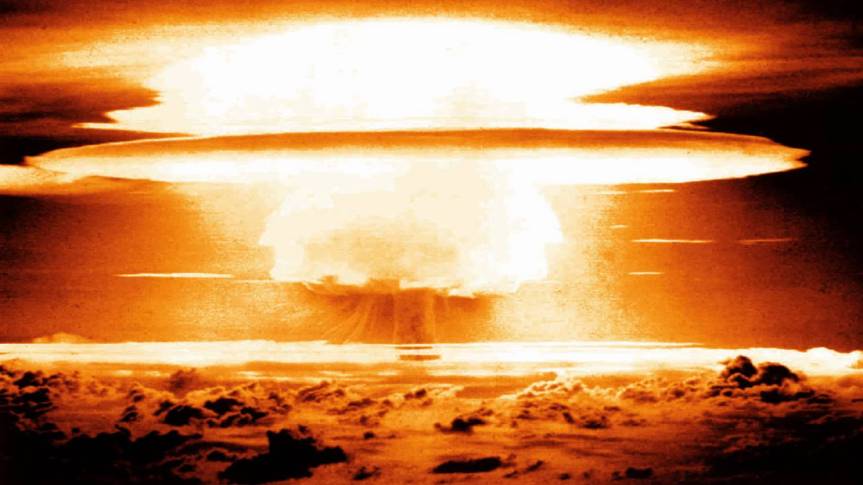
Anyone who thinks about nuclear weapons and war games in the abstract should watch this scene from “Terminator II.” It’s perhaps the best, most visceral, image of what one nuclear bomb would produce.
“There’s no fate but what we make for ourselves.” The more nuclear weapons we build, the darker our fate becomes, and the closer we come to terminating ourselves and our planet.
On this Earth Day, the U.S. should commit itself to a “no first use” policy with respect to using nuclear weapons and to total nuclear disarmament, to be achieved over the next 20-30 years.
Something like a JFK-like vow is needed here: Before the decade is out, America should commit itself to halving its nuclear forces, working with other countries on the goal of nuclear disarmament.
Only the future of humanity, as well as that of the earth and all living things, is at stake here.
Names Like Minuteman, Peacekeeper, and Sentinel Are Diabolically Dishonest
Ever think about names of U.S. weapons of war? Rarely are those names honest. I do applaud the relative honesty of Predator and Reaper drones, because those names capture the often predatory nature of U.S. foreign policy and the grim reaperish means that are often employed in its execution. Most names are not so suggestive. For example, U.S. fighter planes carry noble names like Eagle, Fighting Falcon, or Raptor. Nuclear bombers are an interesting case since they can carry thermonuclear bombs and missiles to kill hundreds of thousands, possibly millions, of people. So we have the B-52 Stratofortress (a great 1950s-era name), the B-1 Lancer, the B-2 Spirit, and the new B-21 Raider (the name has historical echoes to the Doolittle Raid on Tokyo in 1942).
Reaping what we sow? Just reaping? Whatever the case, the U.S. way of war is grim
Shouldn’t these bombers carry names like Megadeath or Mass Murder?
Think too of nuclear missiles. The Air Force’s Intercontinental Ballistic Missiles (ICBMs) have had names like Titan, Minuteman, Peacekeeper, and now the new Sentinel. But since these missiles carry warheads that could easily kill millions, wouldn’t a more honest name be The Holocaust ICBM? For that’s what these missiles promise: a nuclear holocaust.
Consider too the Navy’s Ohio-class nuclear missile-firing submarines (SSBN) with their Trident missiles. (Trident—gotta hand it to the Navy.) Just one submarine can carry 20 Trident II missiles, each with up to eight warheads, each warhead being roughly equivalent to six Hiroshima bombs. Again, roughly speaking, each of these submarines carries an arsenal equivalent to one thousand Hiroshima bombs. And the U.S. has fourteen of these submarines.
Instead of the Ohio-class of submarines, shouldn’t they be called the Armageddon-class? Or the Apocalypse-class? The Genocide-class?
With a bit more honesty, perhaps it wouldn’t be so easy to sell these horrific weapons to Congress and the American people. Then again, when the bottom line is higher budgets for the Pentagon and more jobs for Congressional districts, I guess America will buy most anything. Even Holocaust missiles and Armageddon submarines. And for upwards of $2 trillion over the next 30 years as well.
If they don’t bust the budget, perhaps they’ll destroy the world.
My Speech for the Rage Against the War Machine Rally
February 19th is the Rage Against the War Machine rally in DC. It just so happens to be my dad’s birthday as well. He was born on that date in 1917, endured the Great Depression, worked in the Civilian Conservation Corps and in factories until being drafted in 1942, and after the war became a firefighter, serving for more than thirty years until retiring. With my dad in mind, here’s the speech I’d give if I was invited on the stage. (The rally already has 27 speakers, but hopefully I can add a bit of rage and inspiration of my own.)
[To be clear: this is an “imaginary” speech. I am not one of the 27 speakers.]
My dad in the Army during World War II
Hello everyone. Today would have been my dad’s 106th birthday. Happy Birthday, Dad!
In the late 1930s, when my dad was working hard for low pay in a factory, he tried to enlist in the U.S. Navy. The Navy recruiter rejected him because he was roughly a half inch too short. After Pearl Harbor, and remembering his rejection, my dad didn’t join the eager volunteers. He waited to be drafted and reported to the Army. He served in an armored headquarters group but never went overseas to fight. That fact, and his earlier rejection by the Navy, is perhaps why I’m alive today to add my voice of rage against the military-industrial complex and America’s permanent state of undeclared war.
Dad and Mom raised me during the Cold War. I was conceived around the time of the Cuban Missile Crisis and was in diapers when John F. Kennedy was shot and killed in Dallas. As a boy, I embraced military things, played with toy soldiers, GI Joes, imitation M-16s, and similar toys of war. I built model tanks, model warplanes, model warships. I blew them up with firecrackers, imagining heroic battles.
As a teenager in the 1970s, I believed the Soviet Union was an insidious threat to American democracy. We faced the prospect of nuclear destruction. My dad was philosophical about this. Even if Americans and Russians killed each other in mutual assured destruction, known appropriately as MAD, a billion Chinese would survive to kickstart humanity, he quipped.
But there were two harsh realities my dad and I didn’t know back then. Nuclear winter was one. Any major exchange between nuclear powers, we now know, wouldn’t just kill the people in those countries. The soot and ash thrown into the atmosphere from thermonuclear war would likely lead to mass starvation globally. (Let’s not forget global radioactivity, sickness, and death as well.) The second one was that America’s nuclear plans, known as the SIOPs, envisioned not just massive attacks on the USSR but China as well, even if China hadn’t attacked the United States.
Sorry, Dad: In case of a major nuclear war, China’s goose was cooked, as was most other forms of life on our planet.
When I graduated from college in 1985, a brand-new 2nd lieutenant in the U.S. Air Force, my first assignment took me to Colorado Springs and Cheyenne Mountain, America’s very own Mount Doomsday. Cheyenne Mountain was America’s nuclear command and control center, literally blasted and tunneled out of a mountain, protected by 2000 feet of solid granite above it. Giant blast doors and buildings mounted on immense springs theoretically enabled us to ride out a nuclear war. But we few under the mountain knew that if DEFCON 1 came to pass, we’d likely be among the first to die in a nuclear war, even with all that rock over our heads.
You might say I’ve been to the mountain, Cheyenne Mountain, that is, both inside and outside. I much preferred the outside, hiking in the cool crisp Colorado air.
Once, when I was inside the mountain, the “battle staff” ran a wargame that ended with a nuclear attack on U.S. cities. In a sense, then, I’ve seen the missiles fly, I’ve seen their tracks end at American cities, if only on a monochrome monitor. Even that low-tech video screen convinced me that I never, ever, want to see the real thing.
A few years later, I walked the desert wilderness of Alamogordo, New Mexico, site of the first atomic blast in July of 1945, the Trinity test that preceded Hiroshima and Nagasaki. I’ve seen what little remained from that test, a test that changed everything, after which the survival of humanity as a species became problematic, precarious, and uncertain, dependent on men and their control over their thermonuclear toys, the playthings of the demented.
I’ve been to doomsday mountain, I’ve walked in an atomic wilderness, and I’ve come here to say: enough is enough.
As the doomsday clock ticks ever closer to midnight, we must act to stop it, to turn it back. We must act so that it never has the remotest chance of striking midnight.
We must walk – better yet, run – out of the dark and dank tunnel of doomsday mountain into the glorious light awaiting us. We must relish the wondrous sights and sounds of life. We must embrace each other, share the warmth of our common humanity as we seek a better, peaceful future for everyone everywhere.
Because mountains won’t protect us. Missiles won’t save us. Weapons won’t warm us, unless by warmth you mean death by nuclear fire.
Ending war will protect us. Ending missiles will save us. Compassion, tolerance, and love will warm us.
I know because I’ve been to doomsday mountain. I’ve witnessed nuclear war, if only during an exercise. I’ve walked in a desert where an atomic blast obliterated and irradiated most everything in its path. And that’s not a future I want. That’s not a future any sane person wants. That way lies madness.
Come, take my hand. Join me in leaving Cheyenne Mountain. Let’s run like children, with joy, away from tunnels and blast doors, toward the light of peace.
And, once we’re out, let’s put the darkness of war and nuclear terror behind us and never look back.
Supporting trillions of dollars “to update and modernize our nuclear arsenal” is akin to advocating for more production of Zyklon B and improved gas chambers.
Incendiary claim? I think not. Like Zyklon B, nuclear weapons are genocidal. They are designed to kill millions; used en masse, they will kill billions. They are ecocidal as well; nuclear weapons with their intense heat and blast and radiation kill virtually everything in their radius. How can anyone who’s sane want more of them?
I happened to catch Kelly Ayotte, a former U.S. senator who’s now the Chair of the Board of Directors for BAE Systems, a major weapons contractor, say that she’s “always” been a strong supporter of updating and modernizing the U.S. nuclear arsenal. Of course, she and her company stand to profit from this. But at what cost to life on this planet?
Nevertheless, nuclear “modernization” proceeds apace in the U.S. at an estimated cost of nearly $2 trillion over the next few decades. Is this not the very definition of a murderous insanity?
As Daniel Ellsberg pointed out, U.S. nuclear attacks plans in the early 1960s could have resulted in the death of 600 million people, mainly in China and the Soviet Union. As Ellsberg noted, the U.S. was prepared to launch 100 Holocausts in the name of defending its “ideals.” (And this was before we knew about the dangers of nuclear winter.)
This murderous madness has to stop before we put an end to ourselves and our planet.
We’ll produce new nuclear missiles like so many sausages. But it’s all OK because we need to “update” and “modernize” our (genocidal and ecocidal) nuclear arsenal. Sure makes me proud to be an American.
Addendum: When you think of nuclear weapons as “investments” or as “sensible” (see comments), please consider this scene from “Terminator II.”
What is “sensible” about any of this? Sorry, count me out of “investing” in mass death via nuclear holocaust.
Imagine you’re a parent with a difficult son. You send him to the most expensive schools, you give him prodigious sums of money, but when Johnny comes home from school with his report card, you see he got an “F” in Afghanistan, an “F” in Iraq, and an “F” in Libya, among other “classes.” Projects he’s working on, like the F-35 jet fighter or Ford-class carriers, are also proving to be expensive failures. Even in deportment he’s receiving an “F,” with the teachers telling you he’s prone to bullying his fellow students as he boasts of being the most exceptional student in the world.
How would you handle Johnny? Well, our collective Johnny is the Pentagon and the National Security State, and our government’s way of handling him is to shove more money his way, another $24 billion or so, with more promised in the future.
Is it any wonder why Johnny Pentagon never changes its behavior?
That’s the subject of my latest article at TomDispatch.com. Here’s the first half of the article; please go to TomDispatch.com to read the rest. Many thanks!
William Astore, A Bright Future for Weapons and War
Yoda, the Jedi Master in the Star Wars films, once pointed out that the future is all too difficult to see and it’s hard to deny his insight. Yet I’d argue that, when it comes to the U.S. military and its wars, Yoda was just plain wrong. That part of the future is all too easy to imagine. It involves, you won’t be shocked to know, more budget-busting weaponry for the Pentagon and more military meddling across the globe, perhaps this time against “near-peer” rivals China and Russia, and a global war on terror that will never end. What’s even easier to see is that peace will be given no chance at all. Why? Because it’s just not in the interests of America’s deeply influential military-congressional-industrial complex.
When that vast complex, which President Dwight Eisenhower warned us about six decades ago, comes to my mind, I can’t help thinking of a song from the last years of the then seemingly endless Cold War. (How typical, by the way, that when the Soviet Union finally imploded in 1991, it barely affected Pentagon funding.)
“The future’s so bright (I gotta wear shades)” was that 1986 song’s title. And I always wonder whether that future could indeed be nuclear-war bright, given our military’s affection for such weaponry. I once heard the saying, “The [nuclear] triad is not the Trinity,” which resonated with me given my Catholic upbringing. Still, it’s apparently holy enough at the Pentagon or why would the high command there already be planning to fund the so-called modernization of the American nuclear arsenal to the tune of at least $1.7 trillion over the next 30 years? Given this nation’s actual needs, that figure blows me away (though not literally, I hope).
What is that “triad” the complex treats as a holy trinity? It consists of land-based intercontinental ballistic missiles, or ICBMs; nuclear-weapons-capable bombers like the B-1, B-2, and the venerable B-52; and submarine-launched ballistic missiles, or SLBMs. Given our present vast nuclear arsenal, there’s no strategic need for building new ICBMs at a price beyond compare. In fact, as the most vulnerable “leg” of the triad, the ones the Air Force currently has should be decommissioned.
Nor is there a strategic need for an ultra-expensive new bomber like the Air Force’s proposed B-21 Raider (basically, an updated version of the B-2 Spirit “stealth” bomber that’s most frequently used these days for flyovers at big college and Super Bowl football games). America’s Ohio-class nuclear submarines that still wander the world’s oceans armed with Trident missiles are more than capable of “deterring” any conceivable opponent into the distant future, even if they also offer humanity a solid shot at wholesale suicide via a future nuclear winter. But reason not the need, as Shakespeare once had King Lear say. Focus instead on the profits to be made (he might have added, had he lived in our time and our land) by building “modernized” nukes.
As my old service, the Air Force, clamors for new nuclear missiles and bombers, there’s also the persistent quest for yet more fighter jets, including overpriced, distinctly underperforming ones like the F-35, the “Ferrari” of fighter planes according to the Air Force chief of staff. If the military gets all the F-35s it wants, add another $1.7 trillion to the cost of national “defense.” At the same time, that service is seeking a new, “lower-cost” (but don’t count on it) multirole fighter — what the F-35 was supposed to be once upon a time — even as it pursues the idea of a “6th-generation” fighter even more advanced (read: pricier) than 5th-generation models like the F-22 and F-35.
I could go on similarly about the Navy (more Ford-class aircraft carriers and new nuclear-armed submarines) or the Army (modernized Abrams tanks; a new infantry fighting vehicle), but you get the idea. If Congress and the president keep shoveling trillions of dollars down the military’s gullet and those of its camp followers (otherwise known as “defense” contractors), count on one thing: they’ll find ever newer ways of spending that dough on anything from space weaponry to robot “companions.”
Indeed, I asked a friend who’s still intimate with the military-industrial complex what’s up with its dreams and schemes. The military’s latest Joint Warfighting Concept, he told me, “is all about building Systems of Systems based in AI [artificial intelligence] and quantum computing.” Then he added: “All it will do is give us more sophisticated ways to lose wars.” (You can see why he’s my friend.) The point is that AI and quantum computing sound futuristically super-sexy, which is why they’ll doubtless be used to justify super-expensive future budgetary requests by the Pentagon.
In that context, don’t you find it staggering how much the military spent in Afghanistan fighting and losing all too modernistically to small, under-armed units of the Taliban? Two trillion-plus dollars to wage a counterinsurgency campaign that failed dismally. Imagine if, in the next decade or two, the U.S. truly had to fight a near-peer rival like China. Even if the U.S. military somehow won the battles, this nation would undoubtedly collapse into bankruptcy and financial ruin (and it would be a catastrophe for the whole endangered planet of ours). It could get so bad that even Jeff Bezos and Elon Musk might have to pay higher taxes, if, that is, they haven’t already slipped the surly bonds of Earth to mingle with the twinkling stars.
If America’s post-9/11 war-on-terror military spending, including for the Afghan and Iraq wars, has indeed reached the unimaginable sum of $8 trillion, as Brown University’s Costs of War Project estimates, imagine how much a real war, a “conventional” war, featuring the air force, the fleet, big battalions, and major battles, would cost this country. Again, the mind (mine at least) boggles at the prospect. Which is not to say that the U.S. military won’t fight for every penny so that it’s over-prepared to wage just such a war (and worse).
The idea that this country faces a perilous new cold war that could grow hot at any moment, this time with China, crops up in unusual places. Consider this passage by Dexter Filkins, a well-known war reporter, that appeared recently in the New Yorker:
“We’ve spent decades fighting asymmetrical wars, but now there’s a symmetrical one looming. The United States has never faced an adversary of China’s power: China’s G.D.P. is, by some measures, greater than ours, its active-duty military is larger than ours, and its weapon systems are rapidly expanding. China appears determined to challenge the status quo, not just the territorial one but the scaffolding of international laws that govern much of the world’s diplomatic and economic relations. If two forever wars are finally coming to an end, a new Cold War may await.”
A new war is “looming.” Our adversary has more money and more troops than us and is seeking better weaponry. Its leadership wants to challenge a “status quo” (that favors America) and international laws (which this country already routinely breaks when our leaders feel in the mood).
Why are so many otherwise sane people, including Joe Biden’s foreign policy team, already rattling sabers in preparation for a new faceoff with China, one that would be eminently avoidable with judicious diplomacy and an urge to cooperate on this embattled planet of ours?
Why indeed? Please read the rest of my article at TomDispatch.com.
Did you know the U.S. is developing a new land-based ICBM? That’s intercontinental ballistic missile, and back in the 1980s we pretty much considered them obsolete in the Air Force. That’s because they’re the least survivable “leg” of the nuclear triad, which consists of ICBMs, nuclear bombers like the B-2 stealth, and submarines like the current Ohio-class ones armed with Trident missiles.
But never mind all that. When I visited Los Alamos National Laboratory (home of the Manhattan Project) as an Air Force captain in the spring of 1992, the mood there was glum. With the collapse of the Soviet Union, Los Alamos was facing major cuts in funding, since back then we naively believed there was going to be a “peace dividend” and the U.S. would return to being a normal country in normal times. We wouldn’t have to “invest,” as our military likes to say, in more nukes. We had plenty already; indeed, more than enough to end life on earth.
But that was then and this is now and the Biden administration, joining the previous Trump and Obama administrations, is “investing” up to $1.7 trillion over the next thirty years in more nuclear weapons to destroy the earth. It’s a job-creator, don’t you know. And rural areas with nuclear missile bases, like Wyoming and North Dakota, don’t want to lose jobs or the billions in federal dollars that flow to their states in the stated cause of nuclear deterrence. Deterring who or what is uncertain.
Americans love things that blow up while lighting up the sky and causing the heavens to glow. We witness it every year at this time. Let’s just hope the nuclear firecrackers stay stashed away. Some firecrackers are too dangerous to contemplate.
I remember back in 1992 walking around the desert at Alamogordo, New Mexico, site of the first atomic blast that preceded Hiroshima and Nagasaki. There’s not much left of the tower where the bomb sat: just the concrete base and some twisted metal. Walking around the area, you can still find sand that’s been fused into glass by the heat of the atomic blast. I didn’t take any home with me as it’s still radioactive. People were walking around with masks before masks became a thing with Covid. It was an eerie experience.
We don’t spend much time, if any, on July 4th thinking about all our weapons that are designed with great care and ingenuity to blow up and kill, whether it’s one person or millions (or perhaps even the planet itself). But I urge you to set aside a few minutes to read Tom Engelhardt’s latest article at TomDispatch.com. He writes about his own eerie and disturbing experience visiting Japan and Hiroshima and thinking about the unthinkable.





 Bracing Views