
A Few Thoughts About NATO and Russia

W.J. Astore

NATO, the North Atlantic Treaty Organization, dates from 1949. From its very name, the alliance focused on North Atlantic countries and Western Europe, and stated its intent was to deter the Soviet Union from attacking European countries like Germany, France, and Italy.

Interestingly, Dwight D. Eisenhower was NATO’s first SACEUR, or Supreme Allied Commander in Europe, and he favored the complete withdrawal of U.S. troops when Europeans were back on their feet from World War II and capable of defending themselves. Since U.S. troops are still stationed in Europe nearly 75 years after the founding of NATO, one must assume Europe is still not ready.

All kidding aside, getting the U.S. to commit troops to NATO was in part a European ploy against a repeat of American isolationism, which had manifested itself in the aftermath of World War I. There was indeed a time when Americans wanted nothing to do with European intrigue and folly, and in the 1930s the U.S. Senate even attacked European arms manufacturers as warmongering “merchants of death.” Imagine that!

Nowadays, of course, it’s the USA that dominates the world’s arms market, and our merchants of death truly dominate the world. Our weapons merchants now deliver weapons to places like Ukraine in the name of “freedom” and “protecting democracy,” though I have yet to see a freedom or democracy bomb. (Interestingly, the names we choose for weapons systems are far more honest, like Hellfire missiles and Predator and Reaper drones. Talk about peddling death!)

When the Soviet Union collapsed in 1991, NATO’s reason for being collapsed along with it, but reason not the need, as King Lear said. NATO was not about to disband itself; lucrative and powerful bureaucracies rarely do. So NATO’s mission began to change to “out of area” operations, working in concert with the UN in places like Bosnia and Kosovo. Speaking of “out of area,” NATO countries also got involved in the War on Terror, including U.S. folly in Afghanistan, which provided political cover for the U.S. in the sense that American officials could claim to be working as part of a coalition to help the Afghan people.

But the biggest money maker of all for NATO and for today’s merchants of death has been expansion. Recall that the Soviet Union collapsed in 1991. Recall that NATO was created to deter a Soviet attack on Western Europe. If NATO was going to continue to exist, it needed to morph into something else, but most of all it needed to grow. And so it did.

In 1999, former Warsaw Pact countries like Poland, Hungary, and the Czech Republic joined. Five years later, Bulgaria, Romania, Slovakia, Slovenia, and the three Baltic States (Latvia, Lithuania, and Estonia) joined as well. In short, what began as a defensive alliance focused on Western Europe has grown into an alliance that includes just about all of Eastern Europe. And the new NATO members have been eager customers for NATO-compatible weaponry, much of it made in the USA.
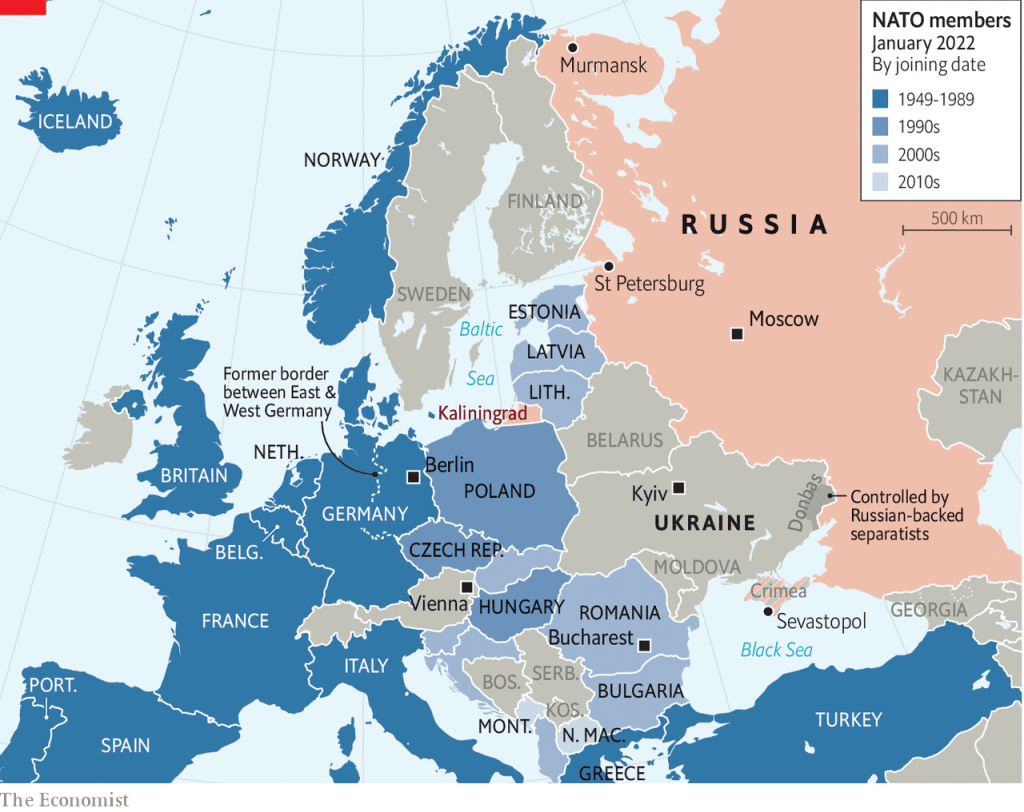
The caption from the Economist suggested this map showed how Russia was menacing Ukraine! And that NATO was unlikely to retreat

If I were Russian, I think I’d look at the dramatic eastern expansion of NATO as worrisome. If not aggressive, it is most certainly constrictive. And with former Soviet republics like Georgia and Ukraine mentioned as future NATO members, this constriction would seem more like strangulation if I occupied the Kremlin. And I’m not an ex-KGB agent like Vladimir Putin.

I remember a military history symposium in 1998 I attended in which the future of NATO was bandied about. Russian concerns about NATO expansion were discussed by four senior generals. One of them, General Sir Anthony Farrar-Hockley, basically argued that NATO should tell the Russians to go pound sand. In the notes I took from the discussion, Farrar-Hockley said that to forego NATO expansion because of Russian concerns would be to grant Russia a continuing fiefdom in Eastern Europe. Besides, Russia had nothing to fear from an expanded NATO, he added. The three other generals expressed some concern that Russia could see expansion as encirclement, and given Russia’s history of being invaded and devastated by countries to its west, any expansion would have to be done carefully, with plenty of dialogue.

We’re not witnessing much dialogue, are we? Instead, NATO expansion is seen by the U.S. as uncontroversial, and indeed as desirable, and certainly as non-threatening. Surely the Russians have nothing to fear from such a vast alliance creeping up to its very door step! It’s not like Russia wasn’t devastated by Napoleon in 1812, or by Germany and its various allies in World Wars I and II. I’m sure that will never happen again. Right, comrade?

Here’s an idea. Perhaps NATO expansion would be less problematic for the Russians if the U.S. withdrew all its troops from Europe, harkening back to Eisenhower’s initial vision. Shouldn’t European countries be able to defend themselves after almost 75 years of U.S. aid? Maybe Donald Trump wasn’t so crazy after all in asking whether NATO was really worth the candle.
When In Doubt, Send Troops

W.J. Astore

On that proverbial table in Washington D.C. where all options are allegedly kept, the one option that’s always used is military escalation. First, the U.S. sent more weaponry to Ukraine. Now, America’s commander-in-chief is sending more troops, according to this news update today from the Boston Globe:

President Biden is sending about 2,000 troops from Fort Bragg, North Carolina, to Poland and Germany this week and sending part of an infantry Stryker squadron of roughly 1,000 troops based in Germany to Romania, a senior administration official said Wednesday.

The military moves come amid stalled talks with Russia over its military buildup at Ukraine’s borders. And they underscore growing fears across Europe that Russian President Vladimir Putin is poised to invade Ukraine — and smaller NATO countries on the eastern flank worry they could be next.

Has Russia given any sign of invading “smaller NATO countries on the eastern flank”? No matter. The solution is obviously to send small contingents of U.S. troops as a sign of resolve. A couple thousand troops split between Poland and Romania will show Vladimir Putin that America means business. (War business, that is.)

Such small troop contingents have negligible military value, so their real significance is in domestic politics. Biden, a typical Democratic president, is forever on guard against accusations of “weakness” vis-a-vis Russia or China or Iran or you-name-it. To minimize such accusations, while keeping the military-industrial complex happy, the go-to option on the table is to send in the weapons and the troops. Who cares about the risk of military escalation and a wider war between major nuclear powers?

One could imagine a different president, a savvier one, winning major international points by offering to defuse tensions between Ukraine and Russia through negotiation. But that option, farfetched as it would be, is never on that table of options kept in Washington. And why Russia would trust the U.S. is beyond me.

Kyiv (Kiev) in Ukraine is roughly 5500 miles from me by airplane. That’s a very long way indeed from what I consider to be my “eastern flank.” Maybe America should practice a new foreign policy in which we learn to mind our own business, or, if you prefer, stay in our own backyard?

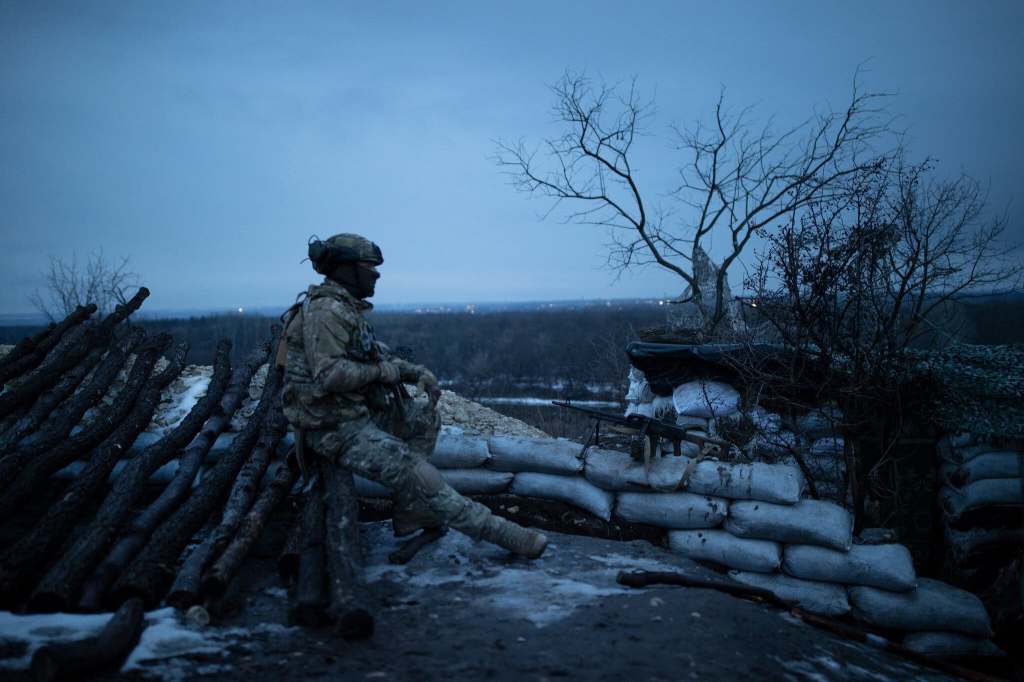
A Ukrainian soldier. One imagines he’s hoping for a peaceful solution. But this is not what I think of as America’s (or NATO’s) eastern flank

Why America’s Wars Never End

s-l300
Really?

W.J. Astore

Inspired by three recent articles at TomDispatch.com, I’d like to suggest why America’s wars never end.

The first article marking the 30th anniversary of the fall of the Berlin Wall is by James Carroll.  It brought me back to when I was a young Air Force captain on active duty.  All of us in the military were surprised when the wall came down.  Soon the Soviet Union would collapse as well.  I know because I got a certificate signed by President G.H.W. Bush congratulating us for winning the Cold War.

In the early 1990s there was much talk about a New World Order (largely undefined) and a Peace Dividend.  The “new” world order quickly became global military adventurism for the U.S. and the peace dividend withered as Desert Shield/Storm and other operations commenced.

I recall some personnel cuts, but no real cuts in weaponry.  And no change to strategy.  NATO remained even though the Warsaw Pact had dissolved.  Indeed, NATO would soon be expanded (in the cause of peace, naturally), even as U.S. imperial ambitions grew.  It was the “end of history” and the U.S. had triumphed, or so we thought.

But why had we triumphed?  Apparently the lesson our leaders took from it was that military strength was the key to our triumph, therefore more of the same would lead to new triumphs.  Pax Americana was not about democracy or freedom: it was about weapons and wars.  Peace through military strength (and destruction) was the driving philosophy.

Unbounded ambition and unbridled power – that was the new world order for America.  The wall came down in Berlin, but it didn’t come down in our minds.  Instead of an open society, Fortress America became the norm.

The second article is by Allegra Harpootlian and focuses on the “collateral damage” (murdered innocents) of America’s global bombing and drone campaigns.  It made me think of a conversation I had with a student; he’d been in the U.S. Army and fought in Afghanistan.  Basically, he described it as a dirt-poor country with a primitiveness that seemed Biblical to him.  He got me thinking about how we “see” people like the Iraqis and Afghans as less than us.  Different.  Inferior.  Primitive.  From another time, and from another place.

So, when Americans kill civilians in those places, it’s almost like it’s cinematic, not real, “a long time ago, in a galaxy far, far away.”  We just move on.

Of course, Americans are not encouraged to be empathetic people.  The world is supposed to revolve around us.  “You can have it all.”  In a world of selfies, why care about others?  Look out for #1!

To put a bow on this, consider evangelical Christianity and the prosperity gospel.  (The idea God will reward you with material goods and money as a sign of righteousness.)  Remember when charity to others was valued?  Not anymore.

Another way of putting this: In America there’s a huge market for self-help books, videos, etc.  But where are the books and videos encouraging us to help others?

The third article is by Andrew Bacevich and specifically addresses the never-ending nature of America’s wars.  His piece made me think of Congresswoman Tulsi Gabbard, who as a presidential candidate has called for an end to regime-change wars (though not the war on terror).  For her pains, she’s been accused of being a Russian asset by Hillary Clinton & Company.

Why is this?  Because there’s just so much money – literally trillions of dollars – at stake here, and the military-industrial-congressional complex knows how to protect itself.

The Complex offers or supports hundreds of thousands of decent-paying jobs, building weapons, staffing think tanks, and so forth.  President Trump may have voiced some skepticism about America’s failed and failing wars, yet he keeps giving the Pentagon more money.  Hence the wars will continue, no matter what sounds come out of Trump’s mouth.

As Tom Engelhardt has noted, for the Pentagon, failure is success.  Naval accidents mean the Navy needs more money.  Failed wars mean the military needs more money to replace weaponry, “modernize,” and prepare for the next round.  Defeat is victory, as in more money.

To recap, America’s wars persist because a martial imperialism is our new world order; because we have limited empathy for others, especially darker-skinned “primitives”; and because war is simply a thriving business, the Washington way to rule.

Here’s a final, bonus, reason America’s wars persist: thoughtfulness is not valued by the U.S. military.  Another “t” word is: toughness.  The U.S. military would rather be strong and wrong than smart and right.

For all the “think” tanks we have inside the Washington beltway, what matters more than thought is toughness.  Action.  Making the other guy whimper and cry, to cite President Trump.  This is yet another reason why America loses.  We prefer to act first, then (grudgingly) think, then act some more.

Thinking implies prudence.  Caution.  Restraint.  Patience.  Un-American qualities!

Here I think of U.S. officer performance reports, which also stress action, results, even when the results are “fragile,” “reversible,” or even made up.  How many officers have been promoted on pacification campaigns that pacified no one?  On training efforts, e.g. for the Iraqi Army, that trained no one?  On battles or skirmishes “won” that had no staying power?  Remember that Petraeus Surge in Iraq?

In a nutshell, perhaps we wage war without end simply because we want to.  We’ll stop when we wake up from our madness – or when someone makes us stop.

Trump Questions NATO: The Horror!

0711trumpnato
Trump at a NATO meeting.  Looking to go his own way?

W.J. Astore

News that President Trump has considered withdrawing from the North Atlantic Treaty Organization (NATO) has drawn great consternation and criticism in the mainstream media.  According to the New York Times, “Mr. Trump’s national security team, including Jim Mattis, then the defense secretary, and John R. Bolton, the national security adviser, scrambled to keep American strategy on track without mention of a withdrawal that would drastically reduce Washington’s influence in Europe and could embolden Russia for decades.”  On NBC News today, an op-ed suggests that “Trump’s reported desire to leave NATO is a belated Christmas present for Putin.”  In both cases, there’s more than a hint that Trump is favoring Russia and Putin while possibly endangering European allies.

Twenty years ago, I was a major at the Air Force Academy, and we hosted a symposium on coalition warfare during which the future of NATO was discussed.  This was a few years after the collapse of the Soviet Union and the Warsaw Pact.  There were quite a few senior officers at that symposium who, like Trump today, were willing to question the continued relevance of NATO.  One of the “roundtables” specifically addressed the future of NATO.  Its chair was retired General James P. McCarthy, USAF, and its panel consisted of retired Generals Andrew L. Goodpaster, USA; Sir Anthony Farrar-Hockley; and John A. Shaud, USAF.

With another officer, I wrote an “executive summary” of this symposium and what these retired generals said about NATO back in 1998.  Here’s what I wrote two decades ago:

The value of America’s most successful and most enduring alliance, NATO, has been called into question since the end of the Cold War, a confrontation many credit it with winning.  But, like many successful alliances after the common foe has been vanquished, NATO’s long-time raison d’être has seemingly evaporated.  That the alliance has managed not just to survive but thrive has baffled many observers.  The four former high-ranking NATO generals who made up this panel shared a common view of the continued high value of the alliance to America’s foreign policy interests.  However, their views diverged on several key issues that face NATO in the years ahead.

General McCarthy opened the discussion … [suggesting] that advancing the causes of peace, prosperity, and security remain NATO’s central task, made more difficult today because of the expansion of NATO’s membership.  Yet NATO continues to be important on the continent to discourage temptations to revert to old insecurities.  General Shaud echoed Goodpaster’s view of NATO’s essential role, saying if NATO did not exist, we would have to invent it.

On the effects of expansion, Shaud stated that NATO needed to expand, both in membership to include Eastern Europe and in mission to include conflict prevention and “out of area” operations.  Goodpaster quoted the late Secretary General Manfred Woerner, “It’s either out of area or out of business.”  He then raised a provocative question: Should NATO’s mission expand to include not just nations but peoples?  General Farrar-Hockley expanded on NATO’s continuing value, noting that during the Cold War, member countries came not to seek advantage for themselves over other members but came to put alliance interests and views first.

The sensitive issue of the effects of NATO’s expansion on Russia brought out disagreement among the panel members.  Farrar-Hockley took the position that to forego expansion because of Russian concerns would be to grant Russia a continuing fiefdom in Eastern Europe.  Russia has nothing to fear from NATO, and besides, it can do nothing to prevent expansion.  If the Soviet Union was an anemic tiger, Russia is more like a circus tiger that may growl but won’t bite.  Goodpaster suggested that NATO could have followed a different path that would not have antagonized Russia.  In the early post-Cold War years, the Soviet Union may have been open to an “overarching relationship” encompassing peaceful relations.  But as NATO developed partnerships with Eastern European countries, it chose not to pursue this approach with Russia.  Partnership for Peace itself could have been done differently by providing a more equal forum analogous to the new European-Atlantic Partnership Council.  Goodpaster asked rhetorically if NATO is a defensive alliance or a collective security alliance, but answered that NATO is what the times require.  It is ultimately a forum for solidarity in Europe, an organization in which different peoples have come to respect and trust one another.  Shaud took a middle view, saying NATO should ensure Russia does not become isolated; continuing dialogue is necessary.  He noted that earlier panels had pointed out Russia’s historical concerns about encirclement, suggesting that Russia’s views on expansion are not ephemeral concerns but rather enduring issues.

Policy Implications

One of the more pressing questions NATO faces today is expansion, the possible inclusion of former Soviet states.  Russian leaders believe, perhaps with some justification, that NATO is directed at them.  It is not that NATO has aggressive intentions, but that former Soviet satellites seek security in NATO’s orbit, thereby tending further to isolate Russia from the West.  The possibilities are ominous—the rise of a new demagogue in Russia in the absence of effective leadership, or alternatively chaos resulting from the implosion of an ungovernable, ineffective state.  How should the United States and NATO manage this sensitive relationship?  Can Russia be brought back from the brink on which it now stands through inclusion in Western institutions?  Or should NATO gather the flock against the impending storm, expanding to Russia’s very doorstep to take in all states desiring inclusion?  If NATO continues to expand, what will become of the cohesion that has been the hallmark of the most successful alliance in modern history?  If NATO stops expanding, what will become of non-members if crisis erupts in regions formerly controlled by the Soviet Union?  Whatever course of action NATO adopts, communication and openness must be its bywords; secrecy and exclusion will reap only suspicion and mistrust.

Again, this was written 20 years ago.  But I’d like to make a few points about this discussion:

  1. With the collapse of the Soviet Union, NATO was no longer needed in Europe in the sense of its original purpose.
  2. Senior leaders disagreed on whether NATO expansion would serve the peace in Europe. Like General Goodpaster, some believed expansion would isolate and perhaps antagonize Russia, while others believed this was a risk worth taking in efforts to contain possible Russian aggression or turmoil.
  3. There was consensus that NATO was worth preserving in some form, but at other times during the symposium, concerns were expressed about equity, i.e. burden-sharing, and the perceived unfairness of the U.S. paying much more that its fair share to keep the alliance functioning.

In short, a generation ago military experts questioned whether NATO had outlived its purpose.  They asked whether the U.S. was paying too high a price, and they wondered whether NATO expansion would alienate Russia.  These were reasonable questions then, and they remain reasonable today.

Trump is not some “Russian agent” or Putin stooge for questioning whether the U.S. still needs to be in NATO.  In this case, he’s shown a willingness to think outside the NATO box.  After all, how long should NATO last?  Don’t all alliances eventually come to an end?  Or is NATO to exist forever?

Personally, I don’t think a precipitous withdrawal from NATO would be in the best interests of the U.S.  But surely there’s something to be said for building a new agreement or alliance in Europe that would be less driven by military concerns, less dependent on American money and weaponry and troops, and more inclusive toward Russia.