The Russia-Ukraine War Continues

The Endgame Remains Unpredictable–Dangerously So 

BILL ASTORE

OCT 08, 2025

Since the last time (July 19th) I wrote about the Russia-Ukraine War, perhaps the biggest change has been to President Trump’s rhetoric. After being frustrated in his efforts to end the war (and perhaps win a Nobel Peace Prize to boot), Trump effectively washed his hands of the conflict. A Truth Social post was especially surprising, as the BBC reported on 9/24:

US President Donald Trump has said Kyiv can “win all of Ukraine back in its original form”, marking a major shift in his position on the war with Russia. 

In a post on his Truth Social platform, he said Ukraine could get back “the original borders from where this war started” with the support of Europe and Nato, due to pressures on Russia’s economy …

Trump has repeatedly expressed his desire to end the war, but has previously warned that process would likely involve Ukraine giving up some territory, an outcome Zelensky has consistently rejected.

In his post, Trump added Ukraine could “maybe even go further than that”, but did not specify what he was referring to.

Exactly how Ukraine is going to win back all the land captured by Russia is unclear. Also less than clear is the role of the EU and NATO in this. Trump appears to have said it’s up to the EU and NATO to support Ukraine (as if NATO is not commanded and controlled by America), with the U.S. more than willing to sell weapons to EU and NATO countries to support Ukraine’s efforts.

Trump’s gambit is this: If Ukraine wins, he takes credit for continuing to supply weaponry and for his new vote of confidence. If Ukraine loses, Trump shifts the blame to the EU and possibly to Ukraine and Zelensky too.

It’s a cynical policy—but these are cynical times.

An undeniable truth is that the war grinds on with no end in sight. U.S. aid to Ukraine will soon reach $200 billion. Meanwhile, front lines have stagnated, counteroffensives have stalled, and Ukrainians themselves have grown increasingly weary of war.

Observers in the West point to a weakening Russian economy and high battlefield losses as signs Russia itself may be nearing a tipping point that could lead to collapse and defeat. Both a heavily damaged Ukraine and a destabilized Russia might be the fruits of “victory,” leading to chaos and possible nuclear escalation.
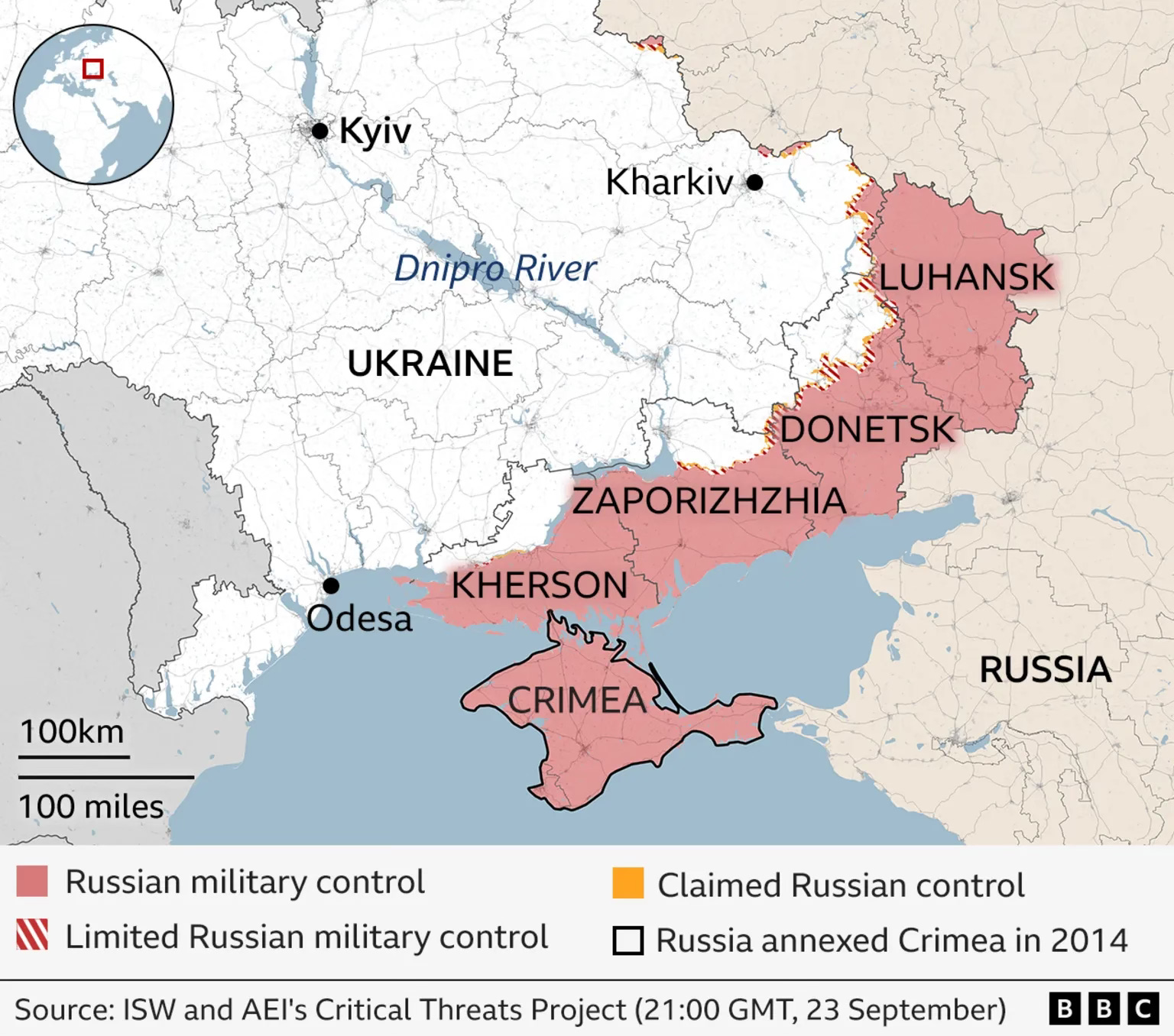
Again, no matter what Trump says, a total victory for Ukraine looks remote. Russia controls about 20 percent of Ukrainian territory, including the industrial Donbas and much of the south. Ukraine’s economy is weakened (as is Russia’s), its army is depleted, and its demographics are unfavorable to success (millions of Ukrainians have sought sanctuary abroad).

The Media’s Role in Perpetuating Illusion

The mainstream media in the U.S. has been partisan since day one. The MSM framed the conflict as a morality play: a heroic democracy versus an evil autocrat.

Meanwhile, the MSM overhyped U.S. weapons as “decisive” and Ukrainian counteroffensives in 2023 as “war-winning.” Media hype distorted expectations and contributed to public fatigue.

Most strikingly, the press has consistently downplayed the risks of escalation with a nuclear power. Ukraine’s use of long-range Western missiles to strike inside Russia carries serious dangers. That Putin will tolerate further provocations without escalating himself is a dangerous bet.

The Case for Diplomacy

Ukraine, no matter Trump’s new faith, cannot win this war in the maximalist sense of regaining all occupied territories and forcing Russia’s surrender. The longer the war continues, the more Ukraine will suffer—physically, economically, and politically.

Wars feed autocracy. Already, Ukraine has postponed elections, banned several opposition parties, and restricted media outlets. These measures may be understandable in wartime, but they belie the notion that Ukraine is a flourishing democracy.

A negotiated settlement is not capitulation. It is recognition of limits. The alternative is indefinite conflict—one that may bleed Ukraine dry even as it edges the world closer to catastrophe.

Dangerous Assumptions

Some policymakers argue a prolonged war will weaken Russia to the point of collapse. But a weakened Russia is not necessarily a safer one. If the Russian state disintegrates, who controls its nuclear arsenal? What if chaos in Moscow produces a more radical, vengeful leader? What if a desperate Kremlin lashes out, or if fighting spills into a NATO country like Poland?

Conversely, what if Ukraine, drained by endless war and reliant on foreign arms, slides toward authoritarianism? Wars have a way of transforming republics into garrison states. The longer the conflict lasts, the greater the risk that Ukraine’s democracy will become a casualty of its own “great patriotic war.”

The Limits of Analogy

Too often, the war is discussed through lazy historical analogies. Putin is Hitler; Zelensky is Churchill; negotiations are “another Munich.” Such framing flatters Western moral vanity but obscures strategic reality. This is not 1938. Putin is not on the verge of conquering Europe, and diplomats are not appeasing him by seeking peace.

Putin may be ruthless, but he is not suicidal. He knows that attacking a NATO member would invite his own destruction. Nuclear deterrence remains real. To suggest otherwise is to indulge in a fever-dream of perpetual conflict, one that justifies limitless military spending and forecloses diplomacy.

The American Connection

For most Americans, the Russia–Ukraine War remains distant and impersonal. We are not threatened by Russian artillery; the war is thousands of miles away. Yet we are paying for it—literally. Every artillery shell, every tank, every missile financed through our taxes contributes to death and destruction abroad. Some justify this as moral duty: helping Ukraine defend freedom. But morality also demands an accounting of consequences.

How many Americans know that 69 percent of Ukrainians report being weary of the war, or that their own government has suspended elections? How many realize that each dollar spent on war is a dollar not spent on schools, infrastructure, or healthcare at home?

We are told the U.S. can afford virtually limitless weapons for Ukraine, but when it comes to social programs, we always hear the same question: How are you going to pay for that? Apparently, there’s always money for war, never for peaceful pursuits.

A Broader Reckoning

The Russia–Ukraine War has become a mirror reflecting America’s own pathologies: our addiction to militarism, our aversion to diplomacy, our willingness to spend without scrutiny when the cause is war, and our moral complacency about the human cost of conflict.

We have turned foreign policy into a morality play, where compromise is dismissed as cowardice and negotiation is treated as akin to sin. Yet history teaches the opposite: the greatest statesmen are not those who glorify war but those who end it.

The Russia–Ukraine War continues, and so does the silence around the most basic of questions: What is America’s endgame? If the answer is “as long as it takes,” we should ask: takes for what? For Ukraine’s victory—or for its ruin? For democracy’s defense—or for another endless war?

It is time to demand accountability, restraint, and above all, diplomacy. Supporting Ukraine should not mean subsidizing endless cycles of death and destruction. How many more must die before this war is finally ended?

War Is the True Enemy

W.J. Astore

America’s Revival Will Begin When It Finally Embraces Peace

Arguably the biggest problem in America today is that the government remains on a wartime footing. The possibility of America being a normal country in normal times, at peace, is simply never mentioned. In current politics and in the mainstream media, there is no vision of America being at peace with the world. Ever.

There is always an enemy, usually plural. Russia. China. Iran. North Korea. The inchoate threat of terror and terrorists. Islamist extremism. All these and more are cited by the “experts” in the “national security state” as requiring a military response. If some kind of peace deal is orchestrated for the Russia-Ukraine War, America and its war machine will immediately pivot to Asia. Or the Middle East. Or perhaps Africa. Or all three.

I’m amazed when friends tell me they’re concerned about U.S. isolationism. Usually this concern is couched in America’s alleged withdrawal from (or even betrayal of) Europe in light of the Russia-Ukraine War. Their message to me is simple: America must keep sending weapons and intel to Ukraine until Russia and Putin are defeated, “as long as it takes.” The “it” is left undefined, but apparently “it” refers to an unqualified Ukrainian victory over Russia, followed by Ukraine’s eventual admission into NATO. Whether that “it” is even possible—whether that “it” could well lead to a nuclear exchange—doesn’t seem to matter because “We’re at war.”

I don’t know how anyone can think America will return to isolationism when the U.S. has 800 military bases globally and a vision of global reach, global power, and total dominance everywhere. And when America spends more on its military than the next ten countries combined (and most of those are U.S. allies). Dominating the globe isn’t exactly consistent with isolationism.

The problem with all the war rhetoric, the war narrative, the war framing, the warrior and lethality talk, is what it enables and facilitates, which is atrocity. Waste. Destruction. War is no way of life at all. As Ike said, the persistence of war is humanity crucifying itself on a cross of iron.

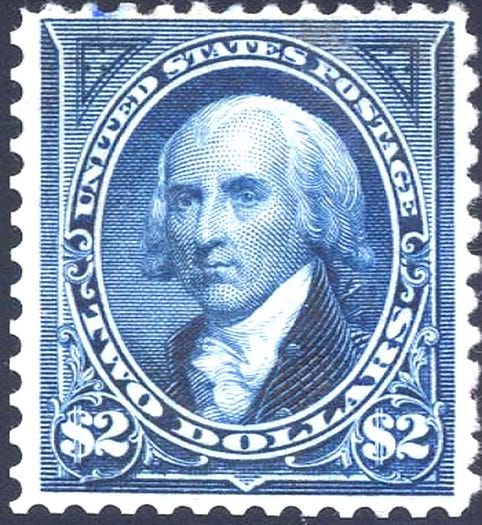
War is immensely corrosive to democracy. It is the enemy of freedom. Just listen to James Madison:

James Madison

Of all the enemies of true liberty, war is, perhaps, the most to be dreaded, because it comprises and develops the germ of every other. War is the parent of armies; from these proceed debt and taxes; and armies, and debts, and taxes are the known instruments for bringing the many under the domination of the few. In war, too, the discretionary power of the Executive is extended; its influence in dealing out offices, honors and emoluments is multiplied; and all the means of seducing the minds, are added to those of subduing the force, of the people. The same malignant aspect in republicanism may be traced in the inequality of fortunes, and the opportunities of fraud, growing out of a state of war, and in the degeneracy of manner and of morals, engendered in both. No nation can preserve its freedom in the midst of continual warfare …

*****

If you’re concerned about authoritarianism, if you’re concerned about maintaining and strengthening freedom, if you’re concerned about combatting corruption and waste, if you’re concerned about America’s huge deficits, stopping war should be your number one concern.

War is a terrible thing, and a state of war enables all kinds of butchery. Just ask the indigenous peoples of America, or the peoples of Palestine today. Even genocide can be disguised as a wartime exigency, a wartime necessity. How many times throughout history has the declaration, “We’re at war!” been used to justify the most heinous crimes against humanity? Even the Nazis hid behind wartime exigency to justify the mass euthanasia of the old, the mentally ill, and other forms of “life unworthy of life” as part of the T4 program (which anticipated the Holocaust).

The true revival of America will begin when this country declares itself to be at peace with the world. Until then, precipitous decline will continue for as long as our government remains at (and continues to celebrate) war.

“Taking the Handcuffs Off” U.S. Missiles in Ukraine

W.J. Astore

Feeding the Obscenity of War

I woke to this disconcerting story from CNN:

President Joe Biden has authorized Ukraine to use powerful long-range US weapons deep inside Russia.

Why now? Biden is a lame duck president, shuffling out the door, and now he decides to allow Ukraine to use American ATACMS missiles, with a range of roughly 190 miles, inside Russia. It’s also expected that these and similar longer-range missiles provided by the French and British will have no decisive impact on the war. They may kill and wound more Russians and inspire responses in kind by Russia against Ukraine, but their use won’t contribute to “victory” for Ukraine. So what’s the point?

My wife put it well when she learned of the decision: “stupid” and “ridiculous” were her words of choice. It’s amazing how well our “experts” feed the obscenity of war.

How dare you handcuff our missiles!

I take my title from a comment made by President-elect Trump’s nominee for National Security Adviser, Mike Waltz, who said we should take the handcuffs off of U.S. missiles in Ukraine, as if those missiles were people being held prisoner.

Whether in the Biden or Trump administrations, the advisers at the top are moral midgets, murderously so. I wonder how they’d feel being targeted by ATACMS. Hey, we just took the handcuffs off, Mr. Waltz. Enjoy your time being bombarded by these liberated missiles.

At the end of September, I noted how Vladimir Putin had redefined Russian nuclear policy to include a possible nuclear response to the use of “tactical” missiles like ATACMS. Here’s what I wrote then:

Vladimir Putin is redefining Russian policy for the use of nuclear weapons. He’s sending a clear warning that Ukraine’s use of U.S. and Franco-British missiles like ATACMS and Storm Shadow deep within Russia could draw a nuclear response. To my knowledge, the U.S. has not yet approved of the use of ATACMS deep within Russia, though Ukraine is pushing for it.

It seems many brain-dead, zombie-like advisers and “experts” insist that Russia is bluffing. They’re willing to bet the health and safety of the world that Russia won’t respond with nuclear weapons. And for what? ATACMS and Storm Shadow missiles aren’t war-winning weapons. The Russia-Ukraine War is a slog, an attritional struggle, featuring trenches and artillery and high casualties, a situation akin to World War I. It’s not going to be won by conventional tactical missile strikes.

Yet certain “experts” seemingly want it to escalate to World War III with nukes.

Just about 80 years ago, we humans entered the atomic age at the Trinity test site in July of 1945. We still haven’t come to grips with how the world changed when the first atomic “gadget” exploded in the desert in New Mexico. We had better hurry up and grow up before we all burn.

So, Putin has warned that deep strikes within Russia could draw a nuclear response, and Biden has now approved said strikes just before he leaves the White House. “Stupid” and “ridiculous” are indeed good descriptors here.

The obscenity of war knows no handcuffs in America.

Escalation in the Russia-Ukraine War

W.J. Astore

More Missiles Are Not the Answer, Unless You Want World War III

It’s Friday the 13th, and though I’m not superstitious about the date, I’m not liking this headline in today’s New York Times:

Top News

Biden Poised to Approve Ukraine’s Use of Long-Range Western Weapons in Russia

The topic will be on the agenda Friday with the first official visit to Washington by Britain’s new prime minister, Keir Starmer.

*****

That’s a headline that proves once again that America is led by the best and brightest. (Sarcasm alert.)

Vladimir Putin has already said that long-range weapons striking targets in Russia means war between Russia and NATO. I don’t think he’s bluffing. And, lest we forget, Russia has nearly 6000 nuclear warheads in its inventory.

Why is the U.S. and NATO allowing Ukraine to use missiles that can strike targets deep into Russian territory? The short answer is that Ukraine is losing the war. But any escalation by Ukraine can be matched (and over-matched) by Russia. The most likely scenario is an even more devastated Ukraine. The worst-case scenario is World War III.

Wars are made by fools with stars on their shoulders and produce more fools, especially in government circles. Ukraine isn’t going to win the war by launching Storm Shadow missiles 150 miles into Russia. More attacks on Russia are likely to reinforce Putin’s rule than to weaken it. 

Meanwhile, Ukraine continues to lose more territory to Russian forces in the east, as this map (courtesy of the NYT) shows.

In a war that’s now lasted more than two and a half years, we’ve been told repeatedly that new “magical” weapons will make all the difference for Ukraine, whether Leopard and Challenger and Abrams tanks or F-16 fighter jets or ATACMS or what-have-you. Yet the Russia-Ukraine War is largely an old-fashioned infantry and artillery war, a land war, an attritional war, in which Ukraine is slowly being worn down.

Long-range missiles launched into Russia aren’t going to turn the tide in Ukraine’s favor. But they may provoke a devastating response from Russia that could provoke a far wider conflict. And for what, exactly?

“Peace” Seems to Be the Hardest Word

W.J. Astore

Bipartisan Support in America for More War

With apologies to Elton John and Bernie Taupin, “peace” seems to be the hardest word, for both Democrats and Republicans.

This is hardly surprising. The National Security State is the unofficial fourth branch of government and arguably the most powerful. Presidents and Congress serve it, and the SCOTUS carves out special exceptions for it. Back in the days of a bit more honesty, it was called the Department of War. And so it remains.

Let’s say you’re like me and you see war as humanity’s greatest failing. We kill and maim each other, we scorch and kill every living thing in the path of our weapons, we destroy the environment, we even have the capacity to destroy life on earth via nuclear weapons. War—it really is good for absolutely nothin’, unless, of course, you profit from it.

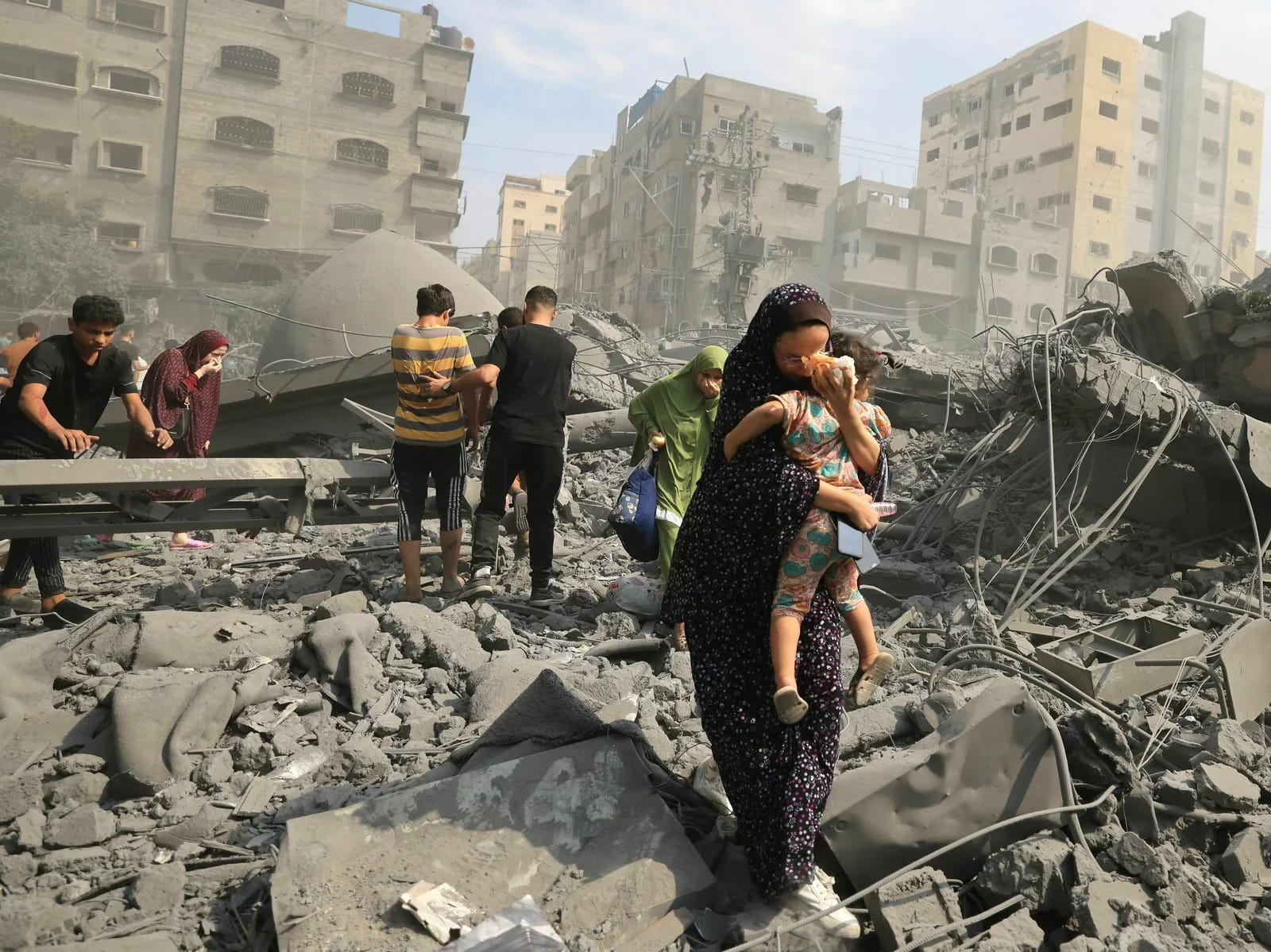
Gaza after an Israeli bombing attack. Anyone want more war?

So, who are you going to vote for in America who sees the awfulness of war and who’s willing to pursue diplomacy and peace instead? Democrats? Republicans?

Generally speaking, Democrats are fixated on war with Russia. They support massive aid to Ukraine and are against negotiations. They also support massive aid to Israel in its ongoing genocide against Palestinians in Gaza. And they fully support the military-industrial-congressional complex (MICC) and soaring spending on weapons and war, including “investing” in new nuclear weapons.

Republicans are much the same, except they tend to see China rather than Russia as the main threat, e.g. Donald Trump and J.D. Vance are willing to negotiate an end to the Russia-Ukraine War. But, in the main, Republicans fervently support Israel in its genocide, are outspoken critics of Iran (Got to punch them hard, Vance recently said), are willing enablers of the MICC, and also vote for massive spending on weaponry and war, including nuclear weapons.

Neither major U.S. political party, the red or blue teams, is pro-peace. Both are pro-aggression and pro-empire. They just occasionally choose different targets for their ire, even as they accuse the other team of “weakness,” of being “Putin puppets” or “Manchurian candidates.” 

As I’ve said before, the only word or sentiment apparently forbidden among the red and blue teams is “peace.” If you want an antiwar candidate in America, you have to go outside the two main parties to the Greens or similar fringe parties.

In America, “antiwar” is defined by America’s propaganda machine, otherwise known as the corporate media, as weak and unAmerican, because “the health of the state” is war.  Every election, whether the red or blue team prevails, the National Security State, the old War Department, wins. And humanity loses. 

The last mainstream candidate for the presidency who spoke consistently of peace was George McGovern in 1972. Unless we the people demand peace, we will continue to get war. In fact, in a bizarrely Orwellian way, colossal military spending and incessant wars are sold to us as keeping America safe. “War is peace” is quite literally the message of the National Security State and its Ministry of Truth, the corporate-owned media.

What is the solution? Here’s one possible approach: Whenever America deploys troops overseas, those troops most immediately in harm’s way must be drawn from the ranks of America’s most privileged and their children. So, corporate CEOs, Members of Congress, lawyers at White Shoe firms, private equity billionaires and millionaires and their progeny, Hollywood celebrities and America’s best-known sports stars: those Americans who prosper and profit the most from empire should be the first to serve it. And that service must be made mandatory, no exceptions, no way to buy your way out or plead that you have “higher” priorities.

Those who want war should serve in war, leaving the rest of us alone. This rule, more than any other, might just keep the chickenhawks from screeching for more war with Russia, or China, or Iran, or North Korea, or Syria, or somebody. A few minutes at the front, facing bullets and shells and cluster munitions while hearing the screams of the dying, might just cure these wannabe “warriors” of their fever.

Want a war? Go to war. And leave the rest of us in peace.

The Circus Tiger Bit Back

W.J. Astore

Thoughts on the Ongoing Russia-Ukraine War

In 1998, as an Air Force major, I attended a military history symposium on coalition warfare that discussed the future of NATO.  One senior officer present, General Sir Anthony Farrar-Hockley, spoke bluntly in favor of NATO expansion.  From my notes taken in 1998:

Farrar-Hockley took the position that to forego expansion because of Russian concerns would be to grant Russia a continuing fiefdom in Eastern Europe.  Russia has nothing to fear from NATO, and besides, it can do nothing to prevent expansion.  If the Soviet Union was an anemic tiger, Russia is more like a circus tiger that may growl but won’t bite.

That sums up the Western position vis-a-vis NATO expansion and Russia: too bad.  You lost the Cold War. There’s nothing you can do.

Until the “circus tiger” finally bit back. 

The U.S. and NATO calculated that Russia, now led by Vladimir Putin, wouldn’t bite back.  It did so in 2022.

Even circus tigers may do more than growl

Now, you might argue it’s the tiger’s fault for biting; you might say Ukraine didn’t deserve to be bitten.  But I don’t think you can say that U.S. and NATO actions were entirely guiltless or blameless in provoking the tiger.  At the very least, the actions were misjudged (assuming there wasn’t a plot to provoke Putin and Russia into attacking).

Ukraine is central to Russia’s concerns.  Both countries share a long common border and an even longer history.  By comparison, Ukraine, I think, is peripheral to U.S. concerns, just as Afghanistan and Vietnam ultimately proved peripheral.  Here I recall the critique of political scientist Hannah Arendt that, with respect to America, the Vietnam War was a case of using “excessive means to achieve minor aims in a region of marginal interest.”  Whether in Vietnam or more recently in Afghanistan, the U.S. could always afford to accept defeat, if only tacitly, by withdrawing (even though die-hard types at the Pentagon always want to keep fighting).

All this is to say Russia’s will to prevail may prove more resilient than the current U.S. commitment to Ukraine of “blank check” support.

Ukraine resistance to Russia has indeed been strong, backed up as it has been by bountiful weapons and aid from the U.S. and NATO.  Faced by an invasion, they are defending their country.  But a clear victory for Ukraine is unlikely in the short term, and in the long term will likely prove pyrrhic if it is achieved.

No one in the U.S. thought that a punitive raid against the Taliban in 2001 would produce an Afghan War that would last for 20 years.  When the U.S. committed troops in big numbers to Vietnam beginning in 1965, most at the Pentagon thought the war would be over in a matter of months. How long is the U.S. and NATO truly prepared to support Ukraine in its war against Russia?

In the 17 months or so since the Russian invasion, the U.S. has already committed somewhere between $115-$200 billion to Ukraine and the war.  Should that commitment remain open-ended at that level until Ukraine “wins”?  What of legitimate fears of regional escalation or nightmare scenarios of nuclear exchanges?

Long wars usually don’t end with a healthier democracy.  Indeed, wars most often generate censorship, authoritarianism, suppression of dissent, and many other negative aspects.  Think of the enormous burden on Russia and Ukraine due to all the wounded survivors, the grieving families, the horrendous damage to the environment.  The longer the war lasts, the deeper the wounds to society.

Scorched by decades of war, areas of Afghanistan are wastelands.  Vietnam, Laos, and Cambodia are still recovering from America’s orgy of violence there.  What will Ukraine have to recover from, assuming it’s fortunate enough to “win”?

I don’t see a quick victory for either side in the immediate weeks and months ahead.  Channeling John F. Kennedy’s famous “peace” speech of June 10, 1963, I do believe that peace need not be impractical, and war need not be inevitable.  As JFK also cautioned, forcing a nuclear power into a humiliating retreat while offering no other option is dangerous indeed.

Recent attention has focused on the Biden administration’s decision to provide cluster munitions to Ukraine.  Russia can, and likely will, match Ukraine’s use of U.S.-provided cluster munitions.  Earlier, the U.S. claimed Russia was guilty of war crimes for using these munitions.  Now it’s all OK since Ukraine needs them.  When they kill Russians, they’re “good” bombs?

I also hear U.S. commentators speaking of “terror bombing campaigns” by Russia.  Perhaps so, but when U.S. commentators use that expression, they should fully acknowledge what the U.S. did in Japan, North Korea, Vietnam, Laos, Cambodia, Iraq, Afghanistan, and elsewhere.  No country in the world comes close to the number and amount of bombs, defoliants, cluster munitions, DU shells, and napalm that the U.S. has used in various wars in the last 80 years.  When it comes to terror bombing, the U.S. is truly the exceptional nation.

But can the U.S. be exceptional at peace?  The U.S. should and must wage diplomacy with the kind of fervor that it usually reserves for war.

Higher Military Spending Will Save Democracy

W.J. Astore

So the “liberal” New York Times says

Four days ago, I got a story in my New York Times email feed on “A Turning Point in Military Spending.” The article celebrated the greater willingness of NATO members as well as countries like Japan to spend more on military weaponry, which, according to the “liberal” NYT, will help to preserve democracy. Interestingly, even as NATO members have started to spend more, the Pentagon is still demanding yet higher budgets, abetted by Congress. I thought if NATO spent more, the USA could finally spend less? 

No matter. Russia’s invasion of Ukraine, as well as the hyping of what used to be called the “Yellow Peril,” today read “China,” is ensuring record military spending in the USA as yearly Pentagon budgets approach $900 billion. That figure does not include the roughly $120 billion or more in aid already provided to Ukraine in its war with Russia. And since the Biden administration’s commitment to Ukraine remains open-ended, you can add scores of billion more to that sum if the war persists into the fall and winter.

Here’s an excerpt from the New York Times piece that I found especially humorous in a grim way:

[Admittedly,] The additional money that countries spend on defense is money they cannot spend on roads, child care, cancer research, refugee resettlement, public parks or clean energy, my colleague Patricia points out. One reason Macron has insisted on raising France’s retirement age despite widespread protests, analysts believe, is a need to leave more money for the military.

But the situation [in Europe of spending more on butter than guns] over the past few decades feels unsustainable. Some of the world’s richest countries were able to spend so much on social programs partly because another country — the U.S. — was paying for their defense. Those other countries, sensing a more threatening world, are now once again promising to pull their weight. They still need to demonstrate that they’ll follow through this time.

Yes, Europe could continue to invest in better roads, cleaner energy, and the like, but now it’s time to buckle down and build more weapons. Stop freeloading, Europe! Dammit, “pull your weight”! You’ve had better and cheaper health care than Americans, stellar educational systems, child care benefits galore, all sorts of social programs we Americans can only dream of, but that’s because we’ve been paying for it! Captain America’s shield has been protecting you on the cheap! Time to pay up, you Germans, you French, you Italians, and especially you cheap Spaniards.

Look at all those cheap Spaniards. They have good stuff because of Captain America. Freeloaders! (NYT Chart, 7/12/23)

As the NYT article says: NATO allies need to “follow through this time” on strengthening their militaries. Because strong militaries produce democracy. And European “investments” in arms will ensure more equitable burden sharing in funding stronger cages and higher barriers to deter a rampaging Russian bear.

Again, you Americans out there, that doesn’t mean we can spend less on “defense.” What it means is that the U.S. can “pivot to Asia” and spend more on weaponry to “deter” China. Because as many neocons say, the real threat is Xi, not Putin.

We have met the enemy, and he is us. That’s an old saying you won’t see in the “liberal” NYT.

Let the Weapons Flow and the Body Count Grow

W.J. Astore

Say “no” to killing, “no” to war

Two articles I read yesterday are typical of polarized, indeed antithetical, views on the Russia-Ukraine War.

At the British Guardian, Simon Tisdall says this is Europe’s moment to step up and support Ukraine in a righteous war against Putin. He concludes, with passion:

Zelenskiy is right. Risk-averse Nato has been too slow and too cautious from the start. To outpace tyranny, Europe must fight – and fight to win. Our common future depends on it.

Putin, the tyrant, must be stopped in Ukraine, or Poland and Germany could be next. Fighting to win means that Ukraine must be given not only hundreds of Leopard 2 tanks but also combat jets. The combination of tanks, jets, and related ancillary equipment will enable Ukraine to drive Russian forces out of the country in a quasi-Blitzkrieg operation. Victory to the West!

Why not talks instead of tanks?

At Antiwar.com, Edward Curtin predicts Russia will win this war even as he suggests it’s mainly the West’s fault for inciting it via NATO expansion and U.S. involvement in the 2014 coup in Ukraine:

we are being subjected to a vast tapestry of lies told by the corporate media for their bosses, as the US continues its doomed efforts to control the world. It is not Russia that is desperate now, but propagandists such as the writers of this strident and stupid editorial [by the New York Times]. It is not the Russian people who need to wake up, as they claim, but the American people and those who still cling to the myth that The New York Times Corporation is an organ of truth. It is the Ministry of Truth with its newspeak, doublespeak, and its efforts to change the past.

Which is it? Is this a war that the U.S. and NATO must win, along with Ukraine, to stop an evil and expansionist dictator, or is this a war that the U.S. and NATO provoked, and surely will lose, given Russia’s military superiority empowered in part by the justice of its cause?

To me, the disturbing part of such polarized, us versus them, views is that they really guarantee only one thing: more fighting and more death. Let the weapons flow and the body count grow: that is the result of these debates.

War, as almost any military historian will tell you, is inherently unpredictable. I have no idea who’s going to “win” this war. I do know the Ukrainians are losing. I say this only because the war is being fought on their soil, and the longer it lasts, the more Ukraine will suffer.

That doesn’t mean I want Ukraine to surrender, nor do I want it to lose. But I don’t think it will win with more Western tanks and planes. Just about any escalation by the West can be matched by Russia. I see further stalemate, not Blitzkrieg-like victories, and stalemate means more and more suffering.

It’s said the pen can prove mightier than the sword. Why not try talking in place of tanks? Put those mighty pens to work by signing an armistice or even an enduring peace treaty. Ukraine and Russia are neighbors; unless they want perpetual war, they must find a way to live together.

More weaponry to Ukraine is unlikely to produce decisive victory, but it is likely to produce far more death and destruction in that country. It’s high time both sides said “no” to killing, “no” to yet more war.

German Panzers in Ukraine

W.J. Astore

What could possibly go wrong?

The U.S. and Germany are currently discussing sending German Leopard 2 tanks to Ukraine. This is in addition to British Challenger 2 tanks. These weapons are needed so that Ukraine can take the offensive and evict Russian forces from Ukrainian territory, according to Andriy Yermak, head of the Ukrainian presidential administration.

Who knew that Cold War-era German Panzers would possibly meet their Soviet counterparts in a clash of armor featuring Ukraine against Russia? I don’t think anyone predicted that scenario forty years ago.

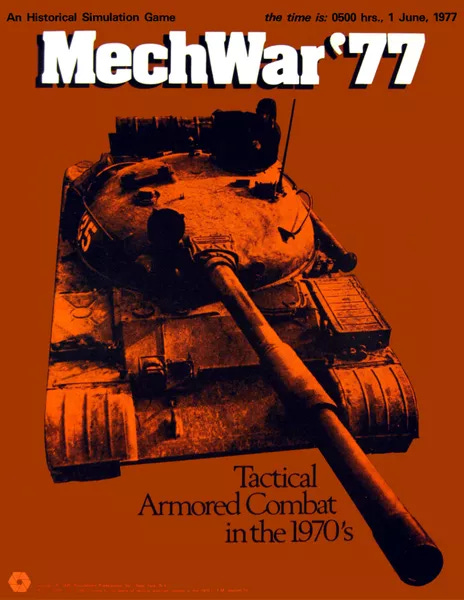
In fact, as a teenager in the 1970s, I played war games such as “MechWar ‘77,” which envisioned a massive Soviet armored thrust into West Germany countered by NATO armored forces consisting primarily of German and U.S. tanks. You know, the good old days.

In “MechWar ‘23,” it’s now possible that German- and British-made tanks, crewed by Ukrainians, will face their Soviet/Russian counterparts in heated combat. The Germans, considering the legacy of Panzers in Russian and Ukrainian territory in World War II, are understandably reluctant to send tanks to Ukraine to kill Russians. The historical echoes here are more than faintly disturbing.

As the U.S. and NATO keep sending heavier and more powerful offensive weaponry to Ukraine, the dangers of escalation continue to creep upwards. So too do the ambitions of those involved. What started in the West as an allegedly limited effort to help Ukraine defend its soil against Russian attacks is rapidly becoming a full-fledged war to roll back Russian forces not only in Ukraine but also in the Crimea.

Again, what could possibly go wrong in MechWar ‘23?

The Disastrous War in Ukraine

W.J. Astore

A blank check of support is often a dangerous thing, especially in war

Remarkably, U.S. aid to Ukraine may soon exceed $100 billion if the Biden administration’s latest ask is approved. And more than a few Americans believe Ukraine merits this vast sum—and more.

They argue the Ukraine war is a necessary one and applaud the Biden administration for taking a firm stance against Russian aggression.  They see Putin as a dangerous dictator who seeks to revive a Russian empire at the expense of Europe, and they wholeheartedly approve of U.S. and NATO military aid.  They argue Ukraine is winning the war and that, once the war is won, Ukraine should be invited to join NATO.  They see NATO as a benign presence and dismiss Russian concerns that NATO expansion is in any way provocative. And they see negotiation with Putin as at best premature and at worst as rewarding Putin for his Hitlerian aggression.

My stance is different.  Yes, I denounce Putin’s invasion of Ukraine and hope that he loses, but I’d prefer to see a negotiated settlement.  The longer the war lasts, the more people die, Russian and Ukrainian, and the greater the chance of miscalculationfollowed by escalation, possibly even to nuclear weapons.

I don’t think the U.S. government cares a whit about defending democracy in Ukraine; heck, it barely defends democracy in America. I think the government and specifically the MICC (military-industrial-congressional complex) has several goals:

1.     To weaken Russia militarily and economically via what some term a proxy war.

2.     To sell more natural gas to Europe (hence the sabotage of the Nord Stream pipelines).

3.     To sell massive amounts of weaponry to Ukraine.

4.     To elevate Russia to an “evil empire” once again, ensuring higher Pentagon spending.  Notice how there’s been no “peace dividend” in the aftermath of the Afghan War. Indeed, Pentagon budgets have soared since the Russian invasion.

5.     To support the narrative of a new cold war against Russia and China, ensuring even more spending on weapons and wars.

6.     Finally, as Biden stated openly, the desire to effect regime change in Russia, i.e. the overthrow of Putin by his own people.

Again, I’m no Putin fan, and I truly wish he’d give up and withdraw his forces. But I very much doubt he’ll do that. It seems more likely that both sides, Ukraine and Russia, will continue launching missiles and drones at each other while the war escalates further. Consider recent reports of Ukrainian attacks on Russian barracks in the Crimea even as Russia targets infrastructure in Odesa.

So, while it’s true U.S. and NATO aid will keep Ukraine in the war, it’s also true Ukrainians and Russians will continue to suffer and die in a war that is already escalating in dangerous ways. It all has the makings of a far-reaching disaster, but what we’re encouraged to do is to ask no questions while flying the Ukrainian flag just below our American ones.

A blank check of support is often a dangerous thing, especially in war.