I remember seeing the first Rambo flick (“First Blood”) in a movie theater in 1982 when I was nineteen and rooting for Sly Stallone’s character against the police and national guardsmen who are sent to kill him. The police think it’ll be easy to subdue one man, but we the viewers know better. As Colonel Trautman, Rambo’s former commanding officer, says in the movie: In war, it’s wise to have “a good supply of body bags” on hand, a telling reminder about the harsh reality of combat.
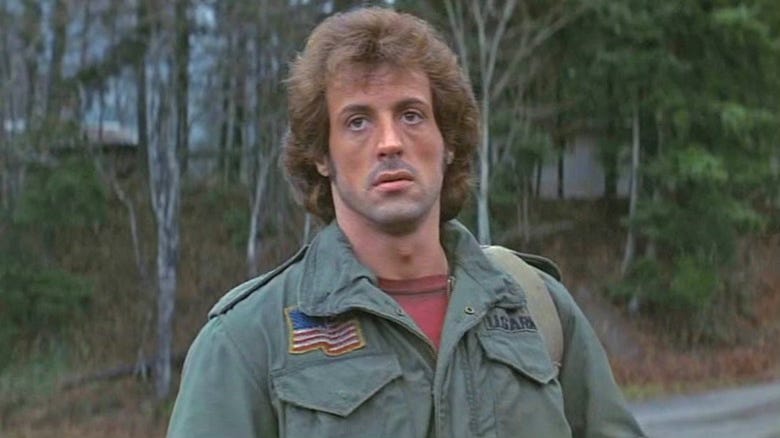
In “First Blood,” military clothing and the flag offer no protection to John Rambo, who’s treated as a lowlife by the local sheriff
Yet, there’s a deeper meaning to “First Blood” captured near the end of the movie, when John Rambo, having improbably acted as a one-man invincible army (a true “Army of One”), bitterly reflects on his own post-Vietnam experiences. Rambo, breaking down, admits he can’t adapt to regular civilian life. A loner, he feels himself to be a loser, even though he was decorated for heroism in war with the Medal of Honor. Wounded and haunted by war, his soul seared by violence, he surrenders to Colonel Trautman.
The original Rambo movie wasn’t necessarily deep, but it did remind us that soldiers like Rambo carried hidden wounds of war; it also highlighted a societal suspicion, whether just or unjust, of military veterans. The sheriff in “First Blood” has no respect for Rambo as a military “hero”; he sees him as a disreputable and dangerous outsider and just wants to be rid of him, one way or another.
Subsequent Rambo films would portray him as a virtually unstoppable killing machine. In the first sequel, Rambo is sent back to Vietnam to rescue American POWs betrayed and abandoned by the U.S. government. Perhaps the most famous line from that movie is when Rambo asks Colonel Trautman whether, in returning to Vietnam, the government will finally allow U.S. soldiers to win this time. It was a concise statement of the stab-in-the-back myth, the idea the U.S. military would have won the war in Vietnam if only it hadn’t been betrayed by a duplicitous and spineless government.
“Do we get to win this time?” That’s a question that should haunt all Americans, since we haven’t won a war since 1945. But who is to blame for not winning? And have the wars America has fought since World War II really been worth fighting to begin with?
Update (9/2923): A lot has changed in forty years, as a couple of my friends pointed out in response to this article. We could imagine at least two scenarios for a revised Rambo made in 2023:
Version 1: In 2023, the sheriff wouldn’t have to call in the National Guard. All his deputies would gear up with assault rifles, sniper rifles, body armor, and MRAPs donated by the Pentagon as excess gear and the local SWAT team would be mobilized and deployed to find and kill Rambo.
Version 2: Perhaps the most likely one: Rambo would be wearing a “blue lives matter” flag, the sheriff’s patrol car would be festooned with “support our troops” stickers, and they’d call a town meeting to give Rambo the keys to the town as a Medal of Honor winner.
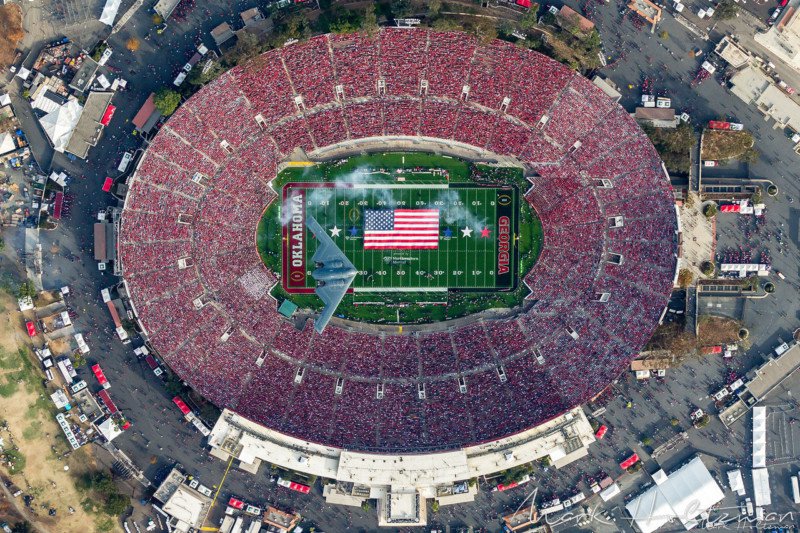
America the beautiful? Yes, that’s a stealth bomber designed for nuclear attack cruising over a football stadium, because America!
W.J. Astore
It’s a new year! And as we adjust to 2019, I thought I’d share a few random observations (hopefully of some import).
“Retirement”: Many Americans fear the concept of retirement. Part of the challenge is coming to grips with the word. In America, your identity often hinges on your title, your job, and your paycheck. Since retiring from teaching (after retiring from the military), I’m still mentally adjusting to not having a fixed schedule, to not having expectations on the job that have to be met. I’ve never been an especially driven person but I’ve always sought to do well. Now I have to do well on terms defined by me. It’s a mental adjustment.
One thing is certain: society is always trying to pigeonhole us. When I tell people I’m “retired,” the immediate response is “You’re too young” or “But what do you do?” said in an incredulous voice. To avoid this problem, sometimes I tell people I’m a writer or a historian, both true, though I currently have no salaried position as such. To state the obvious, American culture is job-centered. Look at our health care: lose your job, lose your health insurance. So much of our identity, as well as our ability to navigate American society, is based on our jobs.
People find meaning in work. But inspiration can be found elsewhere. Find something of value to you that’s inspiring and I don’t think you’ll ever be “retired.”
“A man’s home is his castle”: Is it good that men are encouraged to think of their homes as their castles? For what are castles but fortresses? And fortresses need defending, with guns and security alarms and fences and all the rest. And if a man is Lord of his Castle, then everyone else is his subject, including his wife and children. Perhaps especially his wife and children. We need to think of home as home, not as a castle, not as a fortress in which a man fortifies and actuates his own fears and aggression. (This observation was inspired by an article on male violence in the home.)
On Mourning America’s War Dead: A subject worthy of discussion is how we mourn our troops. When flag-draped caskets return to American soil, our troops are honored. But they are mourned mainly within family settings, or among neighbors in close-knit communities. Rarely are they mourned within wider communal settings. And I sense that some families are torn: there is little serenity for them, not only because they lost a loved one, but because there is a sense, a suspicion, that loved ones died for lesser causes, causes unrelated to ideals held sacred.
Of course, a soldier never dies in vain when he dies for his fellow troops. But that can be said of all soldiers on all sides in all wars. In a republic like the USA, or a polis as in ancient Greece, soldiers are supposed to die for something greater than the unit. That larger purpose is a communal ideal. Call it truth, justice, and the American way. Or call it something else, a sense of rightness if not righteousness.
But where is the rightness in America’s wars today?
On America’s Standing Military and Congressional Authority: The nation’s founders knew there’d be national emergencies that would require a larger “standing” military (i.e., not just state militias of “minutemen”), but they wanted to prevent a state of permanent war, which they attempted to do with the two-year appropriation clause. They were well familiar with history and all those hundred years’, thirty years’, and seven years’, wars. By giving the people (Congress) the power of the purse, they hoped to prevent those long wars by cutting off open-ended funding.
Of course, today that doesn’t apply. The AUMF (authorization for the use of military force) that dates from 2001 is used to justify a state of perpetual war and the funding of the same. Congress has abnegated its responsibility to check overweening Executive power for war-making, but actually it’s worse than that: Congress has joined the Executive branch in pursuing perpetual war. We no longer even bother with formal Congressional declarations; permanent war is considered to be the new normal in America: business as usual.
Not only have we created a permanent standing military — we devote the lion’s share of federal resources to it and brag about how great it is. That reality is antithetical to our national ideals as imagined and articulated by this nation’s founders.
Sports, Movies, and the Military in America: There’s a tendency for people to dismiss sports as “just sports” or movies as “just movies.” Yet astute people recognize the power of both. The classic case is Nazi Germany and the 1936 Olympics, and of course Leni Riefenstahl and spectacles like “The Triumph of the Will.” These, of course, were blatant, in-your-face, rallies. Today, U.S. sports/military celebrations may not be as blatant, but sports connects powerfully to feel-good patriotism as fanatical boosterism, which is precisely why the military is so eager to appropriate sports imagery (and to infiltrate sporting events). The corporate sponsors see it as a win-win: a win for profits, and a win for their image as “patriots.”
Hollywood is the dream factory. Sports too has a strong fantasy element. Speaking as an American male, who hasn’t dreamed of hitting the big home run like Big Papi or pitching a no-hitter like Matt Scherzer?
Man does not live by bread alone; to a certain extent, we live by dreams. Through our aspirations. And our dreams and aspirations are being channeled along certain lines: along more military lines, both at and by sporting events as well as at the movie theater.
It’s not just crass commercialism. It’s about shaping dreams, defining what’s appropriate (and what isn’t).
Thank you for indulging me as I cram into this article a few observations I’ve been kicking around. I’d also like as ever to thank all my readers and especially my faithful commenters and correspondents. Fire away in the comments section, readers!


 Bracing Views