The Pentagon has failed eight consecutive financial audits. For decades it has been unable to account for trillions of dollars. It has not won a major war since World War II. That is not a record of excellence. It is a record of entrenched failure.
Naturally, President Trump’s answer is to give it another $500 billion in next year’s budget.
If enacted, that would drive annual U.S. military spending north of $1.5 trillion. The math is almost too neat: U.S. GDP hovers around $30 trillion; five percent of that is $1.5 trillion. Somewhere along the way, the arbitrary idea that “defense” spending should equal 5 percent of GDP hardened into dogma. A considered strategy no longer informs budgets. Arbitrary numerology does.
Did the Pentagon request an extra half-trillion dollars? No. Has the administration identified a new existential threat that requires it? No. There is no grand strategy unveiled to justify this “surge.” Just a number — large, round, politically expedient.
An institution that cannot pass an audit is not prepared to manage another half-trillion dollars. Pouring money into a system riddled with cost overruns, duplicated programs, and strategic confusion does not produce security. It produces contractors’ profits and future disasters.
Let’s be honest about what this really is. The national security state — the blob, the military-industrial-congressional-intelligence-media-academia-think tank complex — is already the most powerful force in Washington. When you add “defense,” nuclear weapons, intelligence, veterans’ programs, and homeland security, it consumes well over half of federal discretionary spending. It is the unofficial fourth branch of government, and arguably the first in power.
Few presidents confront it. Dwight D. Eisenhower warned about the military-industrial complex — and even he presided over huge Cold War budgets. John F. Kennedy spoke of peace while deepening involvement in Vietnam. Lyndon B. Johnson escalated that war catastrophically. Barack Obama accepted a Nobel Peace Prize and then defended the necessity of permanent American war. Presidents learn quickly: you appease the Pentagon or you risk political ruin.
And so Trump does what presidents do. Even as he talks of peace, he feeds the war machine.
We are told this is about safety. That peace comes only through overwhelming force. That America must dominate every domain — land, sea, air, space, cyberspace — indefinitely. That garrisoning the globe is synonymous with freedom. That “exceptional” nations do not generate blowback.
Yet two decades in Iraq and Afghanistan ended not in triumph but exhaustion and retreat. Each failure somehow justifies a larger budget. Nothing succeeds like failure.
In a functioning democracy, military spending would be tied to actual defense. It would be scrutinized, debated, constrained. Instead, military failure yields medals and ribbons. Audit failure yields budget growth. Strategic stalemate yields expansion. The larger the disappointment, the louder the demand for more money and authority.
When an institution grows more powerful no matter how poorly it performs, accountability has died. When elected officials dare not meaningfully challenge it, civilian control becomes theater. Call it what you will, but a republic that cannot rein in its military establishment is drifting toward a system where the sword outweighs the ballot and proves mightier than the pen.
As Joe Biden once said, “Show me your budget, and I’ll tell you what you value.” A $1.5 trillion military budget tells us that war — or at least preparation for it — sits at the center of national life.
Perhaps not so happy
On Presidents’ Day, it is worth recalling that George Washington surrendered military power to constitutional authority. That was the founding act of the republic. The test of any president is whether he sees himself as bound by law — or as a ruler who commands legions.
Empires require Caesars. Republics require restraint. The colossal size of Trump’s proposed war budget suggests which path he (and America) is choosing.
Hello Everyone: here’s an interview I did with Dick Price and Sharon Kyle at LA Progressive about why we can’t seem to heed Ike’s warning about the dangers of the military-industrial complex in 1961.
Other topics covered include sports and the military, Hollywood and the Pentagon, first-person shooter games, and toxic masculinity.
We also discuss what it would take to change America—to redirect energies dedicated to imperialism and war to democracy and peace. I say something here about idealism, a sign perhaps of my own naïveté.
You can have my ideals when you pry them from my cold dead brain.
Hi Everyone: Here’s my latest post for TomDispatch.com. It was inspired by President Trump’s notion of a “dream military,” a dream that consists of throwing another $500 billion at the Pentagon while building a “golden dome,” more nuclear weapons, and a new class of naval battleship named after—you guessed it—Donald Trump.
Once upon a time, in the aftermath of a devastating civil war, Americans recognized that “war is all hell.” Do we need the antidote of another calamitous war to move us to rethink our imperial march and global warmongering? If that war should go nuclear, it will be far too late to rethink anything as humanity (what’s left of it) struggles to survive a post-apocalyptic hellscape.
What does not kill us does not necessarily make us stronger.
What constitutes national security and how is it best achieved? Does massive military spending really make a country more secure, and what perils to democracy and liberty are posed by vast military establishments? Questions like those are rarely addressed in honest ways these days in America. Instead, the Trump administration favors preparations for war and more war, fueled by potentially enormous increases in military spending that are dishonestly framed as “recapitalizations” of America’s security and safety.
Such framing makes Pete Hegseth, America’s self-styled “secretary of war,” seem almost refreshing in his embrace of a warrior ethos. Republican Senator Lindsey Graham is another “warrior” who cheers for conflict, whether with Venezuela, Iran, or even — yes! — Russia. Such macho men revel in what they believe is this country’s divine mission to dominate the world. Tragically, at the moment, unapologetic warmongers like Hegseth and Graham are winning the political and cultural battle here in America.
Of course, U.S. warmongering is anything but new, as is a belief in global dominance through high military spending. Way back in 1983, as a college student, I worked on a project that critiqued President Ronald Reagan’s “defense” buildup and his embrace of pie-in-the-sky concepts like the Strategic Defense Initiative (SDI), better known as “Star Wars.” Never did I imagine that, more than 40 years later, another Republican president would again come to embrace SDI (freshly rebranded as “Golden Dome”) and ever-more massive military spending, especially since the Soviet Union, America’s superpower rival in Reagan’s time, ceased to exist 35 years ago. Amazingly, Trump even wants to bring back naval battleships, as Reagan briefly did (though he didn’t have the temerity to call for a new class of ships to be named after himself). It’ll be a “golden fleet,” says Trump. What gives?
For much of my life, I’ve tried to answer that very question. Soon after retiring from the U.S. Air Force, I started writing for TomDispatch, penning my first article there in 2007, asking Americans to save the military from itself and especially from its “surge” illusions in the Iraq War. Tom Engelhardt and I, as well as Andrew Bacevich, Michael Klare, and Bill Hartung, among others, have spilled much ink (symbolically speaking in this online era) at TomDispatch urging that America’s military-industrial complex be reined in and reformed. Trump’s recent advocacy of a “dream military” with a proposed budget of $1.5 trillion in 2027 (half a trillion dollars larger than the present Pentagon budget) was backed by places like the editorial board of the Washington Post, which just shows how frustratingly ineffectual our efforts have been. How discouraging, and again, what gives?
Sometimes (probably too often), I seek sanctuary from the hell we’re living through in glib phrases that mask my despair. So, I’ll write something like: America isn’t a shining city on a hill, it’s a bristling fortress in a valley of death; or, At the Pentagon, nothing succeeds like failure, a reference to eight failed audits in a row (part of a 30-year patternof financial finagling) that accompanied disastrous wars in Vietnam, Afghanistan, Iraq, and elsewhere. Such phrases, no matter how clever I thought they were, made absolutely no impression when it came to slowing the growth of militarism in America. In essence, I’ve been bringing the online equivalent of a fountain pen to a gun fight, which has proved to be anything but a recipe for success.
In America, nothing — and I mean nothing! — seems capable of reversing massive military spending and incessant warfare. President Ronald Reagan, readers of a certain (advanced) age may recall, was nicknamed the “Teflon president” because scandals just didn’t seem to stick to him (at least until the Iran-Contra affair proved tough to shed). Yet history’s best candidate for Teflon “no-stick” status was never Reagan or any other president. It was and remains the U.S. warfare state, headquartered on the Potomac River in Washington, D.C. And give the sclerotic bureaucracy of that warfare state full credit. Even as the Pentagon has moved from failure to failure in warfighting, its war budgets have continued to soar and then soar some more.
Forgive the repetition, but what gives? When is our long, national nightmare of embracing war and (wildly overpriced) weaponry going to end? Obviously, not anytime soon. Even the Democrats, supposedly the “resistance” to President Trump, boast openly of their support for what passes for military lethality (or at least overpriced weaponry), while Democratic members of Congress line up for their share of war-driven pork. To cite a cri de coeur from the 1950s, have they no sense of decency?
The Shameless Embrace of Forever War and Its Spoils
I’m just an aging, retired Air Force lieutenant colonel. Who cares what I think? But America should still care about the words of Dwight D. Eisenhower, also known as Ike, the victorious five-star general of D-Day in 1944 and beyond, and this country’s president from 1953 to 1961. Ike was famously the first significant figure to warn Americans about the then-developing military-industrial complex (MIC) in his farewell address to the nation. Yet, even then, his words were largely ignored. Recently, I reread Ike’s warning, perhaps for the 100th time and was struck yet again by the way he highlighted the spiritual dimension of the challenge that is, all too sadly, still facing us.
In case you’ve forgotten them (or never read them), here are Ike’s words from that televised address in January 1961, when he put the phrase “the military-industrial complex” in our language:
“This conjunction of an immense military establishment and a large arms industry is new in the American experience. The total influence — economic, political, even spiritual — is felt in every city, every state house, every office of the Federal government. We recognize the imperative need for this development. Yet we must not fail to comprehend its grave implications. Our toil, resources, and livelihood are all involved; so is the very structure of our society.
“In the councils of government, we must guard against the acquisition of unwarranted influence, whether sought or unsought, by the military-industrial complex. The potential for the disastrous rise of misplaced power exists and will persist.
“We must never let the weight of this combination endanger our liberties or democratic processes. We should take nothing for granted. Only an alert and knowledgeable citizenry can compel the proper meshing of the huge industrial and military machinery of defense with our peaceful methods and goals, so that security and liberty may prosper together.”
Those were the prescient words of the most senior military man of his era, a true citizen-soldier and president, and more than six decades later, we should and must act on them if we have any hope left of preserving “our liberties and democratic processes.”
Again, wise words, yet our leaders have seldom heeded them. Since 1961, the “disastrous rise of misplaced power” when it comes to the MIC has infected our culture, our economy, even — to steal a term from the era of the disastrous American war in Vietnam — our hearts and minds. Indeed, despite the way the MIC failed so spectacularly to win the hearts and minds of the Vietnamese, the Afghans, the Iraqis, and other embattled peoples across the globe in various misbegotten and mendacious wars, it did succeed spectacularly over the years in winning the hearts and minds of those who make the final decisions in the U.S. government.
In an astonishing paradox, a spendthrift military establishment that almost never wins anything, while consistently evading accountability for its losses, has by now captured almost untrammeled authority within our land. It defies logic, but logic never was this country’s strong suit. In fact, only recently, we reached a point of almost ultimate illogic when America’s bully-boy commander-in-chief insisted that a Pentagon budget already bloated with cash needs an extra $500 billion. That, of course, would bring it to about $1.5 trillion annually. Apologies to my Navy friends but even drunken sailors would be challenged to spend that mountain of money.
In short, no matter what it does, the Pentagon, America’s prodigal son, never gets punished. It simply gets more.
More, More, More!
Not only is such colossal military spending bad for this country, but it’s also bad for the military itself, which, after all, didn’t ask for Trump’s proposed $500 billion raise. America’s prodigal son was relatively content with a trillion dollars in yearly spending. In fact, the president’s suggested increase in the Pentagon budget isn’t just reckless; it may well wreck not just what’s left of our democracy, but the military, too.
Like any massive institution, the Pentagon always wants more: more troops, more weapons, more power, invariably justified by inflating (or simply creating) threats to this country. Yet, clarity of thought, not to speak of creativity, rarely derives from excess. Lean times make for better thinking, fat times make for little thought at all.
Not long ago, Trump occasionally talked sense by railing on the campaign trail against the military-industrial complex and its endless wars. Certainly, more than a few Americans voted for him in 2024 because they believed he truly did want to focus on domestic health and strength rather than pursue yet more conflicts globally (and the weapons systems that went with them). Tragically, Trump has morphed into a warlord, greedily siphoning oil from Venezuela, posturing for the annexation of Greenland and all its resources, while not hesitating to bomb Iran, Nigeria, or most any other country. Meanwhile, China and Russia lurk in the wings as scary “near-peer” rivals and threats.
Although Trump’s supporters may indeed have been conned into imagining him as a prince of peace, this country’s militarism and imperialism clearly transcend him. Generally speaking, warfare and military boosterism have been distinctly bipartisan pursuits in America, making reform of any sort that much more difficult. Replacing Trump in 2028 won’t magically erase deep-rooted militarism, megalomaniacal imperial designs, or even the possibility of a $1.5 trillion military budget. Clearly, more, more, more is the bipartisan war song being sung inside the Pentagon, Congress, and the White House these days.
Taking on the MICIMATTSHG, or Blob
Ex-CIA analyst Ray McGovern coined a useful acronym from the classic military-industrial complex, or MIC. He came up with MICIMATT (the Military-Industrial-Congressional-Intelligence-Media-Academia-Think-Tank complex) to highlight its blob-like growth. And it’s true that Congress and the rest are all deeply implicated in the blob. To which I’d add an “S” for the sporting world, an “H” for Hollywood, and a “G” for the gaming sector, all of which are implicated in, influenced by (as well as influencing), and often subservient to Ike’s old MIC. So, what we now have is the MICIMATTSHG. Recall that Ike warned us about the “disastrous rise of misplaced power” if we failed to challenge it back in 1961. Recall that he also warned us that the MIC could change the very structure of our society, making America far less democratic and also far less free. And most subtly, he warned us that it might also weaken America spiritually.
What did he mean by that? To reference a speech Ike made in 1953, he warned then that we could end up hanging ourselves from a cross of iron. He warned that we could become captives of militarism and war, avid believers in spending the sweat of our laborers, the genius of our scientists, and the blood of our youth, pursuing military dominance globally, while losing our democratic beliefs and liberties at home in the process. And that, it seems to me, is exactly what did indeed happen. We the people were seduced, silenced, or sidelined via slogans like “support our troops” or with over-the-top patriotic displays like military parades, no matter that they represented something distinctly less than triumphant in their moment.
And it never ends, does it? Americans in various polls today indicate that they don’t want a war against either Venezuela or Iran, but our opinions simply aren’t heeded. Increasingly, we live in a “might makes right” country, even as military might has so regularly made for wrong since 1945.
And what in the world is to be done? Many things, but most fundamentally it’s time as a society to perform an “about-face,” followed by a march in double-time away from permanent war and toward peace. And that, in turn, must lead to major reductions in Pentagon spending. The best and only way to tackle the inexorable growth of the blob is to stop feeding it money — and stop worshipping it as well. Instead of a $500 billion increase, Congress should insist on a $500 billion decrease in Pentagon spending. Our task should be to force the military-industrial complex to think, improvise, become leaner, and focus on how most effectively to protect and defend America and our ideals, rather than fostering the imperial dreams of the wannabe warlords among us.
Trump’s current approach of further engorging the imperial blob is the stuff of national nightmares, not faintly a recipe for American greatness. It is, in fact, a sure guarantee of further decline and eventual collapse, not only economically and politically but spiritually as well, exactly as Ike warned in 1961. More wars and weapons simply will not make America great (again). How could they when, as Civil War General William T. Sherman so famously observed, war is “all hell”?
Americans, we must act to cut the war budget, shrink the empire, embrace diplomacy, and work for peace. Sadly, however, the blob has seemingly become our master, a well-nigh unstoppable force. Aren’t you tired yet of being its slave?
On the 250th anniversary of America’s founding, which was predicated on resistance to empire and military rule, it should be considered deeply tragic that this country has met the enemy — and he is indeed us. Here the words of Ike provide another teachable moment. Only Americans can truly hurt America, he once said. To which I’d add this corollary: Only Americans can truly save America.
As we celebrate our nation’s birthday this July 4th, wouldn’t it be wonderful if we could save this deeply disturbed country by putting war and empire firmly in the rearview mirror? A tall task for sure, but so, too, was declaring independence from the mighty British Empire in 1776.
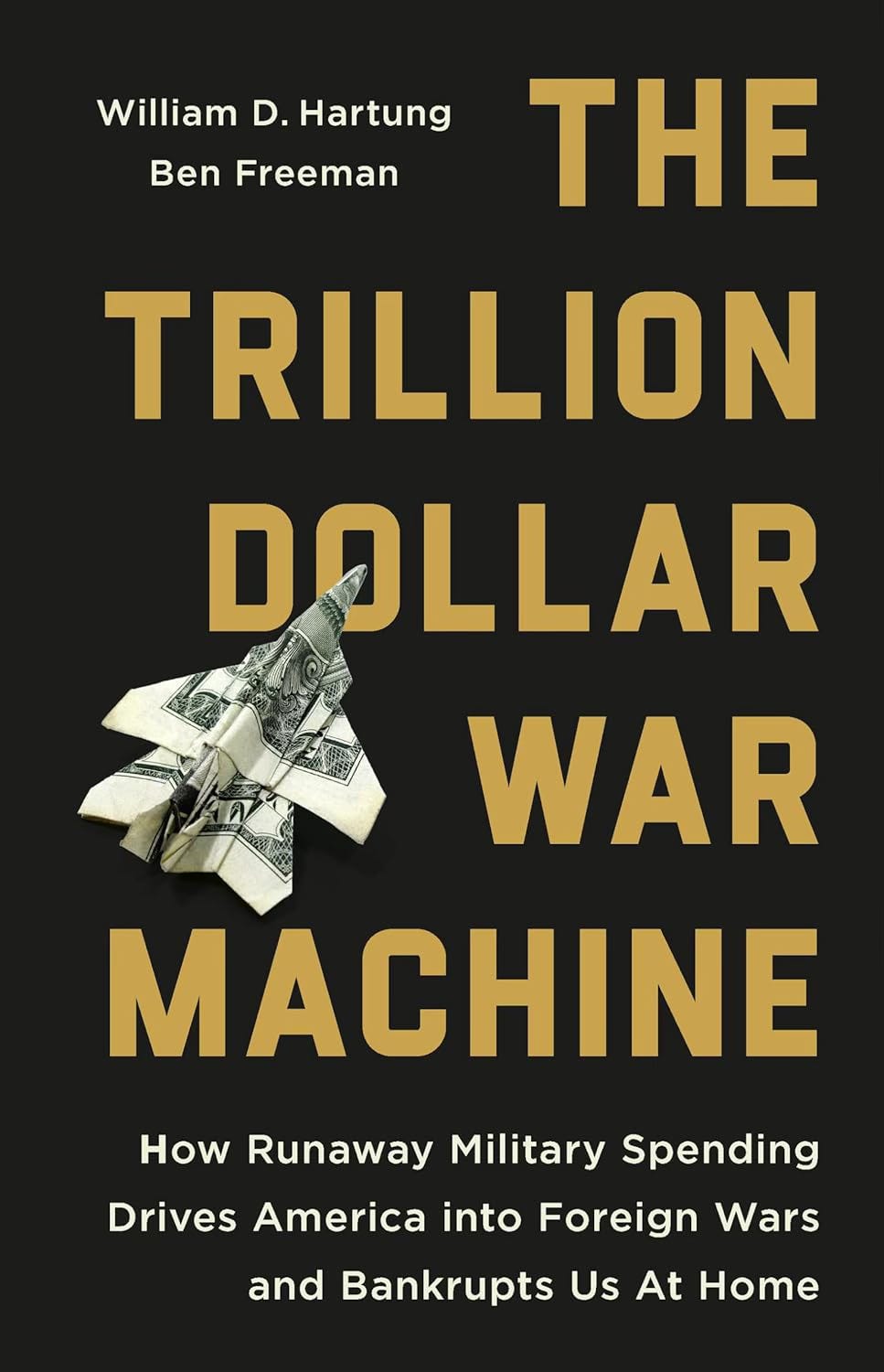
Wow. Just wow. That was my response after reading “The Trillion Dollar War Machine” by Bill Hartung and Ben Freeman. The book’s subtitle captures the “wow” part succinctly: “How runaway military spending drives America into foreign wars and bankrupts us at home.” And now, naturally, President Trump wants even more money for that runaway war machine: an almost unimaginable $500 billion more for FY2027. Egads! How did America’s so-called elites come to embrace war and weapons so wholeheartedly, so lustily, so greedily?
Many of the answers to that question are provided by Hartung and Freeman. They cite and explore President Dwight D. Eisenhower’s famous warning from 1961 about an emerging military-industrial complex. They explain how Congress is complicit in the growing power (and dangers) of the MIC, funding incessant warfare overseas and explosive spending on (often overpriced and largely ineffective) weaponry like the F-35 fighter and the Littoral Combat Ship (known colloquially as “little crappy ships”). Corruption, they show, is baked into the system: the corruption of the revolving door that spins so easily between the military, think tanks, the government, and weapons makers like Boeing and Lockheed Martin. It’s all thoroughly shocking as well as depressing.
Hartung and Freeman, both experienced researchers, know the MIC well. They also know it’s more than the MIC: it’s more like the MICIMATTSHG, or the military-industrial-congressional-intelligence-media-academe-think-tank-sports-Hollywood-gaming complex, so thoroughly has profiteering through militarism and war permeated American culture and society. Military and weapons funding is so colossal it’s seemingly everywhere even as it adds inexorably to the U.S. debt while contributing to military adventurism that further deepens that same debt. Small wonder that our national debt clock is fast approaching $39 trillion. It’s a golden dome of debt!
Reading this book made me think back to another classic account of the MIC and its many follies: James Fallows’s “National Defense.” That book came out in 1981, just as the “defense” buildup under President Ronald Reagan began. Timely as that book was, the Pentagon and its many camp followers were and are rarely forced to retreat when confronted by sensible and logical analysts. I fear this latest effort by Hartung and Freeman, much needed as it is, will similarly be ignored by a purblind Pentagon always in pursuit of power irrespective of the cost.
That would truly be a shame, not only for Americans in general but for the Pentagon as well. Hartung and Freeman aren’t anti-military: they’re pro-defense when defense is smart, effective, thrifty, and focused on upholding the U.S. Constitution. Everyone in uniform, indeed everyone without a uniform, should read this book. You really should know where so much of your taxpayer dollars go—and how much of that money is being wasted by a system that is not only burning your money but weakening America as a democracy. (Indeed, when it comes to money, the Pentagon may be the ultimate burn pit.)
Buy it, study it, absorb it. As Sun Tzu said, it’s smart to know your opponent. Far too often, the military-industrial complex is exactly that.
My fellow Americans, my critical voice has finally been heard inside the Oval Office. No, not my voice against the $1.7 trillion this country is planning to spend on new nuclear weapons. No, not my call to cut the Pentagon budget in half. No, not my imprecations against militarism in America. It was a quip of mine that the Department of Defense (DoD) should return to its roots as the War Department, since the U.S. hasn’t known a moment’s peace since before the 9/11 attacks, locked as it’s been into a permanent state of global war, whether against “terror” or for its imperial agendas (or both).
A rebranded Department of War, President Trump recently suggested, simply sounds tougher (and more Trumpian) than “defense.” As is his wont, he blurted out a hard truth as he stated that America must have an offensive military. There was, however, no mention of war bonds or war taxes to pay for such a military. And no mention of a wartime draft or any other meaningful sacrifice by most Americans.
Rebranding the DoD as the Department of War is, Trump suggested, a critical step in returning to a time when America was always winning. I suspect he was referring to World War II. Give him credit, though. He was certainly on target about one thing: since World War II, the United States has had a distinctly victoryless military. Quick: Name one clear triumph in a meaningful war for the United States since 1945. Korea? At best, a stalemate. Vietnam? An utter disaster, a total defeat. Iraq and Afghanistan? Quagmires, debacles that were waged dishonestly and lost for that very reason.
Even the Cold War that this country ostensibly won in 1991 with the collapse of the Soviet Union didn’t lead to the victory Americans thought was coming their way. After much hype about a “new world order” where the U.S. would cash in its peace dividends, the military-industrial-congressional complex found new wars to wage, new threats to meet, even as the events of 9/11 enabled a surge — actually, a gusher — of spending that fed militarism within American culture. The upshot of all that warmongering was a soaring national debt driven by profligate spending. After all, the Iraq and Afghan Wars alone are estimated to have cost us some $8 trillion.
Those disasters (and many more) happened, of course, under the Department of Defense. Imagine that! America was “defending” itself in Vietnam, Afghanistan, Iraq, Libya, Syria, Somalia, and elsewhere, even as those wars killed and wounded significant numbers of our troops while doing far more damage to those on the receiving end of massive American firepower. All this will, I assume, go away with a “new” Department of War. Time to win again! Except, as one Vietnam veteran reminded me, you can’t do a wrong thing the right way. You can’t win wars by fighting for unjust causes, especially in situations where military force simply can’t offer a decisive solution.
It’s going to take more than a rebranded Department of War to fix wanton immorality and strategic stupidity.
We Need a Return of the Vietnam Syndrome
Hey, I’m okay with the Pentagon’s rebranding. War, after all, is what America does. This is a country made by war, a country of macho men hitching up their big boy pants on the world stage, led by the latest (greatest?) secretary of war, “Pomade Pete”Hegseth, whose signature move has been to do pushups with the troops while extolling a “warrior ethos.” Such an ethos, of course, is more consistent with a War Department than a Defense Department, so kudos to him. Too bad it’s inconsistent with a citizen-soldier military that’s supposed to be obedient to and protective of the Constitution. But that’s just a minor detail, right?
Here’s the rub. As Trump and Hegseth have now tacitly admitted, the national security state has never been about “security” for Americans. Rather, it’s existed and continues to exist as a war state in a state of constant war (or preparations for the same), now stuffed to the popping point with more than a trillion dollars yearly in taxpayer funds. And the leaders of that war state — an enormous blood-sucking parasite on society — are never going to admit that it’s in any way too large or overfed, let alone so incompetent as to have been victoryless for the last 80 years of regular war-making.
And count on one grim reality: that war state will always find new enemies to attack, new rivals to deter, new weapons to buy, and a new spectrum of warfare to try to dominate. Venezuela appears to be the latest enemy, China the latest peer rival, hypersonic missiles and drone swarms the new weaponry, and artificial intelligence the new spectrum. For America’s parasitic war state, there will always be more to feed on and to attempt (never very successfully) to dominate.
Mind you, this is exactly what President Dwight D. Eisenhower warned us against in his 1961 Farewell Address. Sixty-plus years ago, Ike could already see that what he was the first to call the military-industrial complex was already too powerful (as the Vietnam War loomed). And of course, it has only grown more powerful since he left office. As Ike also wisely said, only Americans can truly hurt America — notably, I’d add, those Americans who embrace war and the supposed benefits of a warrior ethos instead of democracy and the rule of law.
Again, I’m okay with a War Department. But if we’re reviving older concepts in the name of honesty, what truly needs a new lease on life is the Vietnam Syndrome that, according to President George H.W. Bush, America allegedly got rid of once and for all with a rousing victory against Saddam Hussein’s Iraq in Operation Desert Storm in 1991 (that would prove to be anything but).
That Vietnam Syndrome, you may recall, was an allegedly paralyzing American reluctance to use military force in the aftermath of disastrous interventions in Vietnam, Laos, and Cambodia in the 1960s and early 1970s. According to that narrative, the U.S. government had become too slow, too reluctant, too scarred (or do I mean scared?) to march speedily to war. As President Richard Nixon once said, America must never resemble a “pitiful, helpless giant.” To do so, he insisted, would threaten not just our country but the entire free world (as it was known then). America had to show that, when the chips were down, our leaders were up for going all-in, no matter how bad our cards were vis-à-vis those of our opponents.
If nothing else, no country had more chips than we did when it came to sheer military firepower and a willingness to use it (or so, at least, it seemed to Nixon and crew). A skilled poker player, Nixon was blinded by the belief that the U.S. couldn’t afford to suffer a humiliating loss on the world stage (especially when he was its leader). But the tumult that resulted from the fall of Saigon to communist forces in 1975 taught Americans something, if only temporarily: that one should hasten very slowly to war, a lesson Sparta, the quintessential warrior city-state of Ancient Greece, knew to be the sign of mature wisdom.
Spartan wannabes like Pete Hegseth, with his ostentatious displays of “manliness,” however, fail to understand the warrior ethos they purport to exhibit. Wise warrior-leaders don’t wage war for war’s sake. Considering the horrific costs of war and its inherent unpredictability, sage leaders weigh their options carefully, knowing that wars are always far easier to get into than out of and that they often mutate in dangerously unpredictable ways, leaving those who have survived them to wonder what it was ever all about — why there was so much killing and dying for so little that was faintly meaningful.
What Will Trump’s “Winning” War Department Look Like?
Perhaps Americans got an initial look at Trump’s new “winning” War Department off the coast of Venezuela with what could be the start of a new “drug war” against that country. A boat carrying 11 people, allegedly with fentanyl supplies on board, was obliterated by a U.S. missile in this country’s first “drug war” strike. It was a case where President Trump decided that he was the only judge and jury around and the U.S. military was his executioner. We may never know who was actually on board that boat or what they were doing, questions that undoubtedly matter not a whit to Trump or Hegseth. What mattered to them was sending an ultimate message of toughness, regardless of its naked illegality or its patent stupidity.
Similarly, Trump has put the National Guard on the streets of Washington, D.C., deployed Marines and the National Guard to Los Angeles, and warned of yet more troop deployments to come in Chicago, New Orleans, and elsewhere. Supposedly looking to enforce “law and order,” the president is instead endangering it, while disregarding the 1878 Posse Comitatus Act that prohibits a president from deploying active-duty troops as domestic law enforcers.
If America isn’t a nation of laws, what is it? If the president is a lawbreaker instead of an upholder of those laws, what is he?
Recall that every American servicemember takes a solemn oath to support and defend the Constitution and bear true faith and allegiance to the same. Warriors are driven by something different. Historically, they often just obeyed their chieftain or warlord, killing without thought or mercy. If they were bound by law, it was most often that of the jungle.
Knowingly or unknowingly, that’s exactly the kind of military Pete Hegseth and the new Department of War (and nothing but war) are clearly seeking to create. A force where might makes right (although in our recent history, it’s almost invariably made wrong).
I must admit that, from the recent attack on that boat in the Caribbean to the sending of troops into Washington, I find I’m not faintly surprised by this developing crisis (that’s almost guaranteed to grow ever worse). Remember, after all, that Donald Trump, a distinctly lawless man, boasted during the Republican debate in the 2016 election campaign that the military would follow his orders irrespective of their legality. I wrote then that, with such a response, he had disqualified himself as a candidate for the presidency:
“Trump’s performance last night [3/3/16] reminded me of Richard Nixon’s infamous answer to David Frost about Watergate: ‘When the president does it, that means it’s not illegal.’ No, no, a thousand times no. The president has to obey the law of the land, just as everyone else has to. No person is above the law, an American ideal that Trump seems neither to understand nor to embrace. And that disqualifies him to be president and commander-in-chief.”
If only.
In retrospect, I guess Trump had it right. After all, he’s won the presidency twice, no matter that his kind of “rightness” threatens the very foundations of this country.
So, color me more than worried. In this new (yet surprisingly old) age of a War Department, I see even more possibilities for lawlessness, wanton violence, and summary executions — and, in the end, the defeat of everything that matters, all justified by that eternal cry: “We’re at war.” At which point, I return to war’s miseries and how quickly we humans forget its lessons, no matter how harsh or painful they may be.
Someday, America’s soon-to-be War Department, led by wannabe warrior chieftains Trump and Hegseth, will perhaps seem like the ultimate blowback from this country’s disastrous wars overseas since its name changed to the Defense Department in the wake of World War II. In places like Iraq and Afghanistan, this country allegedly waged war in the name of spreading democracy and freedom. That cause failed and America’s own grip on democracy and freedom only continues to loosen — perhaps fatally so.
In harkening back to a War Department, perhaps Trump is also channeling a nostalgia for the Old West, or at least the myth of it, where justice was served through personal bounties and murderous violence enforced by steely-eyed men wielding steel-blue pistols. Trump’s idea of “justice” does seem to be that of a hanging judge on a “wild” frontier facing hostile “Injuns” of various sorts. For men like Trump, those were the glory days of imperial expansion, never mind all the bodies left in the wake of America’s manifest destiny. If nothing else, that old imperial Department of War certainly knew what it was about.
Whatever else one might expect from America’s “new” Department of War, you can bet your life (or death) on a whole lot of future body bags. Warriors are, of course, okay with this as long as there are more boats to blow up, more people to bomb, and more foreign resources to steal in the pursuit of a “victory” that never actually arrives. So hitch up those big boy pants, grab a rifle or a Hellfire missile, and start killing. After all, in what might be thought of as a distinctly victoryless culture, it seems as if America is destined to be at war forever and a day.
Just what we need: autonomous killer drone swarms powered by algorithms and AI.
Part 3 of the excellent Al Jazeera documentary The Business of War focuses on Israel’s use of killer drones in Gaza. The trend is toward “fully autonomous weapons”—drone swarms that rely on algorithms to identify targets to hit and humans to kill. Officially, a human is still supposed to make the final decision to strike, but in some cases the operator has only 20 seconds to give a “go” or “no go.” And, let’s be honest, the system drives operators toward “go.”
The documentary is especially powerful in showing the devastation in Gaza (images of Stalingrad in World War II come to mind), the deliberate killing of journalists (a war crime), and how drones are used not just for killing but as tools of intimidation and control.
Images of AI-enabled drone swarms chasing and killing people recall scenes from the Terminator films. But as the documentary notes, the danger right now isn’t some future Skynet—it’s how these drones have already emerged as “new forms of domination and oppression.”
Almost as troubling is the military-corporate fusion as these drone swarms are supported by “cloud” resources supplied by Amazon, Google, and Microsoft. A new conceit boasts of Israel as an “AI superpower,” even as corporations make a killing in profits.
All this technology, all this high-tech prowess, is fueling a holocaust in Gaza. Eisenhower warned us in 1953 that humanity might crucify itself on a cross of iron. Looking at today’s autonomous weapons, perhaps we’ve chosen a different cross—one made of silicon.
Last Tuesday, I appeared again on Judge Napolitano’s show. We talked about the Russia-Ukraine War and President Trump’s efforts to foster a peace deal, as well as the so-called Deep State and (briefly) the CIA.
The show’s lede raises a provocative question: Can America be rid of the CIA? Anything is possible in theory; the problem is the sprawling size and enormous power of the so-called intelligence community, or IC. (This idea of “community” was already a euphemism in the 1970s, as the movie “Three Days of the Condor” reveals; I’ve always liked how Robert Redford’s character scoffs at the “community” conceit.)
There are eighteen (18!) agencies that make up the IC with a combined yearly budget just north of $100 billion. For all that spending on intelligence, America has not fared well in recent wars in places like Iraq and Afghanistan. A bureaucracy of that size and reach is difficult to corral and control, especially since its budget keeps rising. Threat inflation is a major component of these rising budgets; you’re not going to get a threat assessment from the IC that says, well, actually, America’s pretty safe, let’s spend money on infrastructure, education, and social uplift.
As Chuck Schumer once said about Trump’s efforts to challenge the IC, the community has “six ways from Sunday” to get back at the president. That is, of course, more than worrisome. POTUS is supposed to command the IC; the IC is supposed to serve the president while upholding the U.S. Constitution. The IC shouldn’t scheme to “get back” at the president—any president.
My guess is that Trump has learned that lesson from Schumer. He’s appeasing the IC by giving it more and more money. Meanwhile, a Trump loyalist, Tulsi Gabbard, is trying to exert a measure of control as DNI, or Director of National Intelligence. I can’t imagine the in-fighting going in within the “community” as Gabbard releases files that suggest elements within the IC put their thumbs on the scale against Trump’s runs for president.
Eighteen agencies, $100 billion, and less than impressive results suggest a deep state that is out of control and in urgent need of major reform. Meanwhile, Edward Snowden’s revelations show a power structure that is more than willing to illegally spy on and surveil Americans.
For democracy to prosper, Americans need privacy and the government should be transparent to and controllable by the people. Instead, the IC is shrouded in secrecy and Americans are the ones whose lives are transparent to and controllable by the IC.
Of course, I’m not suggesting the IC is peeking under every door—unless you’re some kind of crazy dissident who believes genocide is wrong and the military-industrial complex is dangerous. You know—someone like Dwight D. Eisenhower.
The business of nuclear weapons is booming in the U.S., as Part II of a documentary on the military-industrial complex reveals. It’s well worth a few minutes of your time:
The documentary is especially strong in its focus on the Sentinel ICBM program, the least survivable leg of the nuclear triad. I didn’t know, for example, that Northrop Grumman has already spent $220 million lobbying for the Sentinel. Meanwhile, the projected cost of the Sentinel system, the documentary points out, has mushroomed from $78 billion to $140 billion. And I see estimates today have risen to $160 billion. All this for a system that’s not needed. Land-based ICBMs should be retired, not replaced.
Because land-based ICBMs represent a fixed target (unlike bombers and submarines, the other two legs of the triad), they are likely to be attacked first in a nuclear war, contributing to a “launch on warning (of attack)” mentality. But with warnings of nuclear attacks being both uncertain (false alarms have occurred in the past) and “time-sensitive,” i.e. urgent and pressure-packed, it’s likely a U.S. president, faced with a crisis, would only have 5-10 minutes to decide whether to launch ICBMs.
As the U.S. prepares to spend as much as $1.7 trillion on upgrading the triad, more money is also being dedicated to low-yield nuclear weapons, lowering the threshold for going nuclear. An escalatory spiral could follow from any use of nuclear weapons, but that concern doesn’t seem to trouble advocates for so-called tactical nukes.
Even as President Trump in the past has bragged about the size of his nuclear button, he does appear to view nuclear weapons as awful things, which they are. They are genocidal weapons. In essence, America is “investing” $1.7 trillion in weapons that are genocidal, indeed ecocidal, for any “general exchange” of nuclear weapons in a future war would destroy most life on earth (blast and heat, followed by radiation and nuclear winter).
As the Outlaw Josey Wales once mused, “Dyin’ ain’t much of a living.” The same applies to mass dying.
America’s war budget now exceeds $1 trillion a year—an almost unimaginable sum.
The Pentagon plans to spend $1.7 trillion “modernizing” a nuclear triad that should instead be downsized. A proposed “Golden Dome” missile defense system may cost $500 billion while making nuclear war more likely. And a “new” Cold War with China and Russia is already underway, with threat inflation as one of its defining features.
With military spending so high—and the military so valorized—Washington offers it as the solution to nearly everything: crime in D.C., eliminating drug cartels south of the border, containing China and Russia, “winning” in Somalia, preventing Iran from acquiring nuclear weapons—the list is endless. Supporting and defending the Constitution, however, is rarely mentioned.
War has become America’s new normal. “Peace” is now a word that dare not speak its name. According to the Pentagon, the only peace worth pursuing is “peace through [military] strength.” A warrior ethos is marketed as if it were synonymous with democratic virtue.
I once called for a 10% reduction in Pentagon spending. That’s no longer enough. We need a 50% cut—we need a military dedicated to genuine national defense, not imperial dominance. Surely we can protect America for $500 billion a year rather than the $1 trillion we’re spending now.
Changing the narrative is crucial. Why do we need 750+ bases overseas? Why expand our nuclear arsenal when we already have 5,000 warheads? We don’t need these things—they are the hallmarks of wasteful militarism. They escalate tensions, endanger us, and drain the nation’s wealth.
And why do we have 17 or 18 intelligence agencies? Despite all that intelligence, we still lost in Vietnam, Iraq, and Afghanistan. Where is the accountability? Why are no generals relieved of command for such failures? In fact, they’re more likely to fail upwards.
“All governments lie,” as I.F. Stone warned. Combine that with the truth that war’s first casualty is truth itself, and you begin to see the rot in America today. Perpetual war fuels deception and government overreach. Almost anything can be justified when the cry is, “We’re at war!”—even when the reasons for going to war are false.
Consider the Gulf of Tonkin incident—revealed later as phony—and the Pentagon Papers during the Vietnam War. Consider Iraq’s mythical WMDs. Consider the lies revealed in the Afghan War Papers. Consider the weasel words of generals like David Petraeus, forever hedging “gains” as “fragile” and “reversible.” Consider the U.S. military’s record since World War II—generally ineffective because there’s been little accountability for failure. (And yes, civilian leaders share the blame.)
The military-industrial complex grows ever more powerful, sidelining the American people while democracy withers.
Something is rotten in the States of America.
Many thanks to Judge Napolitano for asking me to discuss some of these issues on his show, “Judging Freedom.”
It’s well worth a few minutes of your time to watch the first episode of this series on the military-industrial complex and its enormous reach and power, especially in American society.
I remember when I used to see thoughtful series like this on Frontline. Occasionally, you’d see critical reports on the mainstream media: I’m referring here to the 1970s and 1980s and shows like “60 Minutes” and “20/20.” Those days, dear reader, are long gone.
It’s rather amazing that Americans have to look to Al Jazeera for critical and sensible reporting on our very own military-industrial complex. Remember what Ike warned us about in 1961? Remember when he challenged us to remain alert and knowledgeable? America, we have a trillion-dollar “pentagon of power” to monitor—and we’re not doing the greatest job at it, are we? In fact, that pentagon of power is doing a far better job at monitoring us.
Indeed, when our mainstream media covers the Pentagon, it usually relies on retired generals and admirals, who often have unreported conflicts of interest (they may sit on corporate boards of weapons contractors, for example, or even get their talking points handed to them by the Pentagon). Let’s just say you rarely hear a negative word about the MIC in this very much unbalanced and biased coverage.
I see that YouTube is cautioning us that Al Jazeera is partially funded by the Qatari government. The horror!
Anyway, Al Jazeera is promising three more episodes in the series, the next one on America’s $1.7 trillion “investment” in new nuclear weapons. Should be sobering.





 Bracing Views