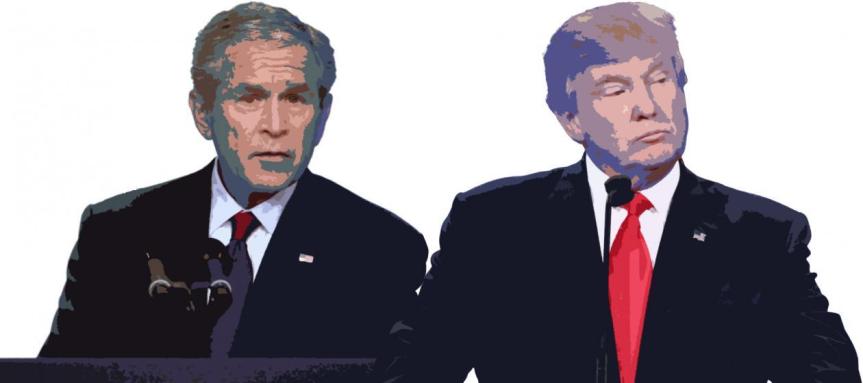
Democracy is Impossible in Post-Truth America

truthiness
Post-truth is Anti-democracy (Getty Images at The Week)

W.J. Astore

“Post-truth” was the big word for 2016, according to Oxford Dictionaries. And why not? Donald Trump won the presidency with lies and half-truths and spin, so the word does indeed resonate.

But America has been edging toward post-truth for a long time — even at its founding, skeptics might say.  The “City on a Hill,” forged on an image of Christian rectitude, witnessed the genocide of Native Americans (“savages”) and the embrace of slavery based on specious theories of racial inferiority, even as the Bible taught the love of neighbor and the equality of all before God.

More recently, America has witnessed the triumph of post-truth in the aftermath of 9/11. Recall how the attacks on 9/11 were falsely connected to Iraq, which was then connected to false claims of Iraq having active programs of WMD development, including “yellowcake” uranium as well as chemical and biological agents spread by aerial drones.  All proven false, but all used to justify the invasion of Iraq in 2003.

Indeed, many Americans continue to believe that Saddam Hussein planned the 9/11 attacks (in league with Osama Bin Laden). Recall here the rare honesty of Britain’s Downing Street Memo of 2002, which asserted that the “facts” being offered by the Bush/Cheney administration were being manufactured (“fixed”) around a pre-determined policy of invasion.  The result?  Iraq was yet another un-democratic war, based in part on lies. Indeed, it’s no accident that Congress hasn’t issued a formal declaration of war since 1941.  (Another war based on lies: the Vietnam War, e.g. recall the false reports of attacks at Tonkin Gulf.)

Another example of post-truth was the Surge of 2007, advertised as a “win” for America even as General David Petraeus warned that progress in Iraq was both “fragile” and “reversible.”  So it has proved, for here we are, a decade later, trying to recapture territory (such as Mosul) that had allegedly been pacified under Petraeus.

America’s post-truth crew has now been captured by a shameless con man, the Tweeter-in-chief, Donald Trump.  Recall a saying often attributed to P.T. Barnum that “a sucker is born every minute.” Trump knows this — and will exploit it to the hilt, if the American people let him.

As January 20th approaches, Americans need to prepare themselves for a post-truth presidency.  As my dad used to say to me: “Don’t believe anything that you read and only half of what you see.”  Wise words for the days and years to come, but they come with a major problem.  Some sense of truth, of consensus based on acknowledged facts and a rigorous and fair-minded process of reasoning, is needed for a democracy to function.

Without integrity, which is based on facts and honesty and a willingness to reason together in good will and with honorable intentions, democracy simply cannot function. Put simply, a post-truth America is an anti-democratic America.  For without truth, without some consensus based on facts, all you have is lies, misinformation, and spin: a foundation of sand upon which nothing of worth can be built.
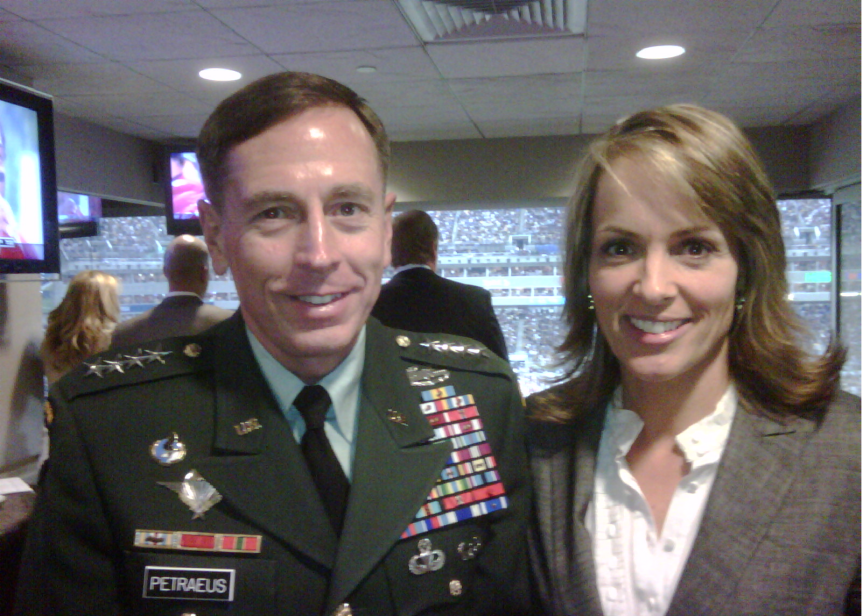
Why is Petraeus an Expert on Mosul?

Petraeus with Broadwell
He’s back: General Petraeus in happier days

General (retired) David Petraeus was on PBS the other day to explain the current Iraqi offensive on Mosul.  Sure, his military “surges” in Iraq and Afghanistan had no staying power, and he disgraced himself by sharing classified information with his mistress during an extramarital affair, but nevertheless let’s call on him as an unbiased “expert” on all things military.  Right?

Anyway, I thought the following words of Petraeus were revealing:

But that’s the extent of what we [the U.S.] can do [in Iraq today]. We can encourage, we can nudge, we can cajole [the Iraqi military and Kurdish forces]. We can’t force. And it is going to have to be Iraqis at the end of the day that come together, recognizing that, if they cannot, fertile fields will be planted for the planting of the seeds of ISIS 3.0, of further extremism in Iraq.

Wow.  There’s no sense here that the U.S. is to blame for planting the seeds of Iraqi extremism (or, at the very least, fertilizing them) in those “fertile fields.”  Overthrowing Saddam Hussein in 2003 and demobilizing Iraqi military forces predictably left a power vacuum that facilitated factionalism and extremism in Iraq, which was only exacerbated by an extended and mismanaged U.S. occupation.  Petraeus’s “Surge” in 2007 papered over some of the worst cracks, but only temporarily, a fact that Petraeus himself knew (consider all his caveats about “gains” being “fragile” and “reversible”).

But no matter.  Petraeus is now saying it’s up to the Iraqis to get their act together, with some “nudging” and “cajoling” by the U.S.  I’m sure Iraqi leaders are happy to learn that U.S. experts like Petraeus are behind them, ready to encourage and nudge and cajole.  They’re likely happiest with U.S. Apache helicopters and direct tactical assistance via Special Ops teams (yes, there are U.S. boots on the ground, and they’re in harm’s way).

And Petraeus’s reference to ISIS 3.0: Isn’t it strange to compare a terrorist organization’s evolution to a new software product roll-out?  Petraeus might have added that ISIS 1.0 came as a result of the extended U.S. occupation of Iraq, and that ISIS 2.0 came as U.S. forces pulled out, leaving behind Iraqi security forces that the U.S. claimed were ready to defend Iraq, but which fled in 2014, abandoning their weapons and equipment to ISIS forces.  Put plainly, U.S. bungling helped to launch ISIS 1.0 and to equip ISIS 2.0.  And yet Petraeus suggests if there’s an ISIS 3.0, that version will be entirely the fault of the Iraqis.

Throughout the Petraeus interview, there’s a callous calculus in place.  For example, earlier in the interview, Petraeus casually notes the population of Mosul, originally 2 million people, is down to 1.2 million and dropping.  Nothing is said about the missing 800,000 Iraqis.  Most are refugees, but many are dead.  Doesn’t their fate suggest a colossal failure of the war and occupation you ran, General Petraeus?  But questions such as this are never asked in the mainstream media.

In its long wars in the Greater Middle East, the U.S. has an incredibly short and corrupted memory.  Indeed, to stay with Petraeus and his software analogies, the American memory is a circular file that is constantly overwritten with flawed data.  That’s a recipe not for smooth running but for catastrophic crashes.  And so it has proved.

The USA in Iraq: Putting Out the Fire with Gasoline

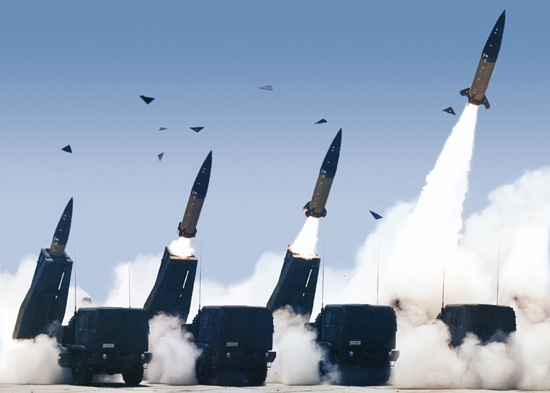
himars_10
Surely, HIMARS will bring peace to Iraq

W.J. Astore

Today brings yet another announcement of more U.S. troops to Iraq.  This time 600 are being sent as logistics support, advisers, and enablers (that term, “enabler,” is fuzzy indeed: enabler of what?  More failure?).  That brings the number of U.S. troops in Iraq to more than 5200, but of course this figure seriously under-represents the American presence in the region.  Nowadays, most “troops” are provided by private contractors, and many of these are U.S. military veterans who discovered they could make a lot more money wearing mufti than in Uncle Sam’s uniforms.  At the same time, the U.S. continues to provide heavy-duty weaponry to the Iraqi military, including Apache attack helicopters and the HIMARS rocket system.  All of this is intended to help the Iraqi military retake the city of Mosul.

That the U.S. is yet again providing more troops as well as heavy weapons as “force multipliers” highlights the failure of U.S. military efforts to “stand up” an effective Iraqi military. The enemy, after all, has no Apache helicopters, no HIMARS system, and no U.S. advisers, although we certainly “enable” them with all the U.S. weaponry they’ve been able to capture or steal.  Despite a lack of U.S. military training and aid, ISIS and crew have proven to be remarkably resilient.  What gives?

Two years ago, I wrote an article at TomDispatch.com on “America’s Hollow Foreign Legions.”  Back then, I said this:

Military training, no matter how intensive, and weaponry, no matter how sophisticated and powerful, is no substitute for belief in a cause.  Such belief nurtures cohesion and feeds fighting spirit.  ISIS has fought with conviction.  The expensively trained and equipped Iraqi army hasn’t.  The latter lacks a compelling cause held in common.  This is not to suggest that ISIS has a cause that’s pure or just. Indeed, it appears to be a complex mélange of religious fundamentalism, sectarian revenge, political ambition, and old-fashioned opportunism (including loot, plain and simple). But so far the combination has proven compelling to its fighters, while Iraq’s security forces appear centered on little more than self-preservation. 

Despite an ongoing record of failure, pulling out of Iraq is never an option that’s considered by the Pentagon.  The only option our leaders know is more: more troops, more weapons, more money.  As I wrote for TomDispatch back in October 2014:

pulling out is never an option, even though it would remove the “American Satan” card from the IS propaganda deck.  To pull out means to leave behind much bloodshed and many grim acts.  Harsh, I know, but is it any harsher than incessant American-led bombing, the commitment of more American “advisers” and money and weapons, and yet more American generals posturing as the conductors of Iraqi affairs?  With, of course, the usual results.

Here we are, two years later, and nothing has changed.  The war song remains the same, as discordant as ever, with a refrain as simple as it is harsh: putting out the fire with gasoline.

State of (Military) Failure

turse

Tom Engelhardt

Reposted from TomDispatch.com and used by permission.

Someday, someone will write a history of the U.S. national security state in the twenty-first century and, if the first decade and a half are any yardstick, it will be called something like State of Failure.  After all, almost 15 years after the U.S. invaded the Taliban’s Afghanistan, launching the second American Afghan War of the past half-century, U.S. troops are still there, their “withdrawal” halted, their rules of engagement once again widened to allow American troops and air power to accompany allied Afghan forces into battle, and the Taliban on the rise, having taken more territory (and briefly one northern provincial capital) than at any time since that movement was crushed in the invasion of 2001.

Thirteen years after George W. Bush and his top officials, dreaming of controlling the oil heartlands, launched the invasion of Saddam Hussein’s Iraq (the second Iraq War of our era), Washington is now in the third iteration of the same, with 6,000 troops (and thousands of private contractors) back in that country and a vast air campaign underway to destroy the Islamic State.  With modest numbers of special operations troops on the ground and another major air campaign, Washington is also now enmeshed in a complex and so far disastrous war in Syria.  And if you haven’t been counting, that’s three wars gone wrong.

Then, of course, there was the American (and NATO) intervention in Libya in 2011, which cracked that autocratic country open and made way for the rise of Islamic extremist movements there, as well as the most powerful Islamic State franchise outside Syria and Iraq.  Today, plans are evidently being drawn up for yet more air strikes, special operations raids, and the like there.  Toss in as well Washington’s never-ending drone war in Pakistan’s tribal borderlands, its disastrous attempt to corral al-Qaeda in the Arabian Peninsula in Yemen (leading to a grim and horrifying Saudi-led, American-supported internecine conflict in that country), and the unending attempt to destroy al-Shabaab in Somalia, and you have at least seven wars and conflicts in the Greater Middle East, all about to be handed on by President Obama to the next president with no end in sight, no real successes, nothing.  In these same years Islamic terror movements have only spread and grown stronger under the pressure of the American war machine.

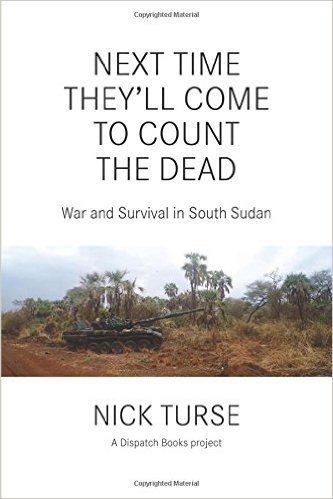
It’s not as if Washington doesn’t know this. It’s quite obvious and, as TomDispatch Managing Editor Nick Turse, author of the highly praised Next Time They’ll Come to Count the Dead, points out today in his latest report on the U.S. military’s pivot to Africa, the pattern is only intensifying, something clearly recognized by key American commanders. What’s strange, however, is that none of this seems to have caused anyone in the national security state or the military to reconsider the last 15 years of military-first policies, of bombs dropped, troops dispatched, drones sent in, and what the results were across the Greater Middle East and now Africa. There is no serious recalibration, no real rethinking. The response to 15 years of striking failure in a vast region remains more of the same. State of failure indeed!

Be sure to read Nick Turse on how U.S. military efforts in Africa show more regress than progress.

Feeding the Disease of Terrorism

07kurds.xlarge1 U.S. troops in Mosul, Iraq in 2007.  A foreign presence to Iraqis

W.J. Astore

I’m a retired U.S. military officer.  When I think of U.S. troops, naturally I see them as my gals and guys.  I identify with them.  And I know enough of them to know that their intent is usually good — at least in the sense that they seek to do their duty.

But I’m also an historian with a modicum of empathy.  I know that foreigners don’t see the U.S. military as I see it.  Nor do they experience it the way I experienced it.  To cite just one anecdote: I recall a story in the New York Times in which U.S. troops in Iraq ask an Iraqi farmer if he’s seen any foreign fighters around.  The Iraqi has a simple answer: “Yes. You.”

Six years ago, I wrote an article for Huffington Post on “Catch-22 in Afghanistan.”  I argued that the more the U.S. military intervened in the affairs of Afghanistan, the less likely it was that a permanent, and suitably Afghan, solution would be found to the problems confronting that country.  Not much has changed in those six years, except that today the Taliban controls even more territory, the drug trade is even more pervasive, and corruption is even more endemic.

We need to learn (or re-learn) a basic lesson: The more the U.S. intervenes in conflicts within other countries, the less likely it is that a favorable outcome will result (favorable for the U.S., that is), simply because U.S. forces are viewed as a foreign contagion. And indeed we are that.

Ignoring its Afghan failures, the U.S. government now seeks to widen its military commitment to the most hotly contested areas of the Middle East.  Our leaders act as if the way to end civil wars driven in part by radical Islam is violent intervention led by American troops.

But American troops (and drones and bombs and all the rest) are not the answer.  Indeed, their actions spread the contagion further.

The other day, I was reading about “super-bugs,” those bacterial infections that have become highly resistant to traditional antibiotics due to misuse and overuse of the same.  In seeking to “destroy” ISIL and similar “infections,” the American government instead often feeds them.  Indeed, I was surprised to learn that in medicine there are super-bugs that literally feed on traditional antibiotics.  They gain strength from being attacked.  Such is often the case for “bugs” like ISIL, which feed off of heavy-handed U.S. military actions.

This is not an argument for the U.S. military to do nothing.  Rather, it’s a reminder of the limits of power and the complexity of life.  It’s a reminder too that to foreigners the U.S. military is the foreign presence, the contagion.  Even when it seeks to act as a “cure,” it may in fact be feeding the disease.

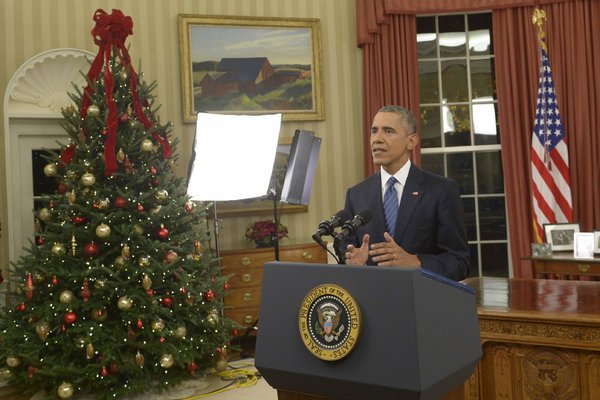
President Obama’s Speech on Terror

07obama-01-SUB-articleLarge

W.J. Astore

My wife and I watched the president’s speech last night.  Overall, it was a solid, even praiseworthy, performance.  First, we had to get past the NBC pre-speech fear-mongering.  Lester Holt and Chuck Todd, the NBC commentators, were talking about how afraid Americans were, hinting that we all feared our holiday parties would be invaded by active shooters bent on murder.  My wife and I looked at each other.  Are you fearful, honey?  Neither am I.

President Obama himself made many good points.  Yes, we shouldn’t vilify Muslim-Americans or condemn all of Islam.  Yes, we shouldn’t commit major ground forces to the Middle East to chase ISIL terrorists. Yes, we need sane gun control measures in the USA.  Nobody needs an AK-47 or AR-15 (these are not hunting guns: they are military assault rifles designed to kill people).  And nobody needs the right to buy a gun if they’re on a “no fly” list as a possible terror threat.

These were “common sense” points, and it pains me to think the president has to belabor what should be obvious.  But he does.  Because the National Rifle Association wants no restrictions on gun ownership, and the radical right does want to vilify Muslims, commit large numbers of U.S. ground troops to the Middle East, and extend a regimen of militarized surveillance and security at home that will make us even less safe.

Where President Obama consistently disappoints is what he leaves unsaid. That the U.S. invasion and occupation of Iraq essentially created ISIL; and that his policy of overthrowing the Syrian government by arming indigenous Arab forces contributed to it (according to Lieutenant General Michael Flynn, formerly head of the Defense Intelligence Agency). That his strategy of drone assassination (so-called signature strikes that are often based on faulty intelligence) is creating more terrorists than it kills, as several military drone operators have recently argued.

Defenders of the U.S. drone assassination program argue that it’s not the intent of the U.S. government to kill innocents, therefore the U.S. is free from blame.  Try telling that to those who have lost loved ones to drones.  (So sorry: We didn’t mean to kill your mother/brother/loved one. Wrong place/wrong time: an explanation as infuriating as it is unconvincing.)

President Obama concluded by arguing that he needed even more of a blank check (in the form of a Congressional authorization) to prosecute the war on terror.  All in the name of keeping Americans safe, naturally. But he has it exactly backwards.  Congress needs to exercise more oversight, not less.  Imagine giving President Donald Trump a Congressional blank check to exercise the war on terror.  Not such a good idea, right?

Finally, and disappointingly, Obama misunderstands the solemn duty of his office.  As commander in chief, Obama believes his first duty is to keep Americans safe and secure.  Wrong.  His first duty is to “preserve, protect and defend” the U.S. Constitution and the rights, freedoms, and responsibilities defined within.  Put bluntly, you can’t keep Americans safe and secure by abridging their rights to freedom of speech or to privacy or to dissent.  “Safety” and “security” were not the bywords of America’s founders.  Liberty was.  And liberty entails risks.

A saying popular on the right is Thomas Jefferson’s “The tree of liberty must be refreshed from time to time with the blood of patriots and tyrants.”  In the USA today, “tyranny” is most likely to come in the form of a leader who promises to keep us safe and secure at any cost.  (Just look at the Republican candidates for president with their calls for Muslim detention camps, mass expulsion of immigrants, the shuttering of houses of worship, and similar measures of repression.)

The president was right to argue that we must not betray our values.  He was right to talk about human dignity.  He was right to say that freedom is more powerful than fear.  Now we as Americans need to live up to those words.  And so does he.


America’s Military Strategy? Persistent Overreach

A Roman Cavalry Mask found at the presumed site of the Battle of Teutoburg Forest

W.J. Astore

Reports that President Obama is considering even more troops and bases to fight ISIS in Iraq put me to mind of Roman general Publius Quinctilius Varus.  Two millennia ago, Varus committed three Roman legions to the Teutoburg Forest in Germania in terrain that neutralized Roman advantages in firepower and maneuverability.  Ambushed and caught in a vise, his legions were destroyed in detail as Varus took his own life.  To Rome the shock and disgrace of defeat were so great that Emperor Augustus cried, “Quinctilius Varus, give me back my Legions!”

Ever since 9/11, American presidents and their military advisors have repeatedly committed U.S. troops and prestige to inhospitable regions in terrain that largely neutralizes U.S. advantages in firepower and maneuverability.  Whether it’s the urban jungles of Baghdad or Fallujah or Mosul or the harshly primitive and mountainous terrain of Afghanistan, American troops have been committed to campaigns that they can’t win (in any enduring sense), under conditions that facilitate ambushes by an elusive enemy with superior knowledge of the local terrain.  The number of U.S. soldiers killed or seriously wounded in these campaigns is roughly equivalent to those lost by Varus, though unlike Varus no U.S. general has yet to fall on his sword.

Unlike Rome, which did learn from Varus’s catastrophe the perils of imperial overreach, the U.S. persists in learning nothing.  Perhaps that’s because America’s defeat is collective and gradual, rather than singular and quick.  America may lack a Varus or a calamity like Teutoburg Forest, yet the overall result since 9/11 has been no less debilitating to American foreign policy.

Despite setback after setback, American presidents and generals persist in trying to control hostile territory at the end of insecure logistical lines while mounting punitive raids designed to deny Al Qaeda or ISIS or the Taliban “safe havens.”  We should have learned the impossibility of doing this from Vietnam, but it seems America’s presidents and generals keep trying to get Vietnam right, even if they have to move the fight to the deserts of Iraq or the mountains of Afghanistan.

Yet seeking to control territory in inhospitable regions like the Middle East or Afghanistan, whether you use American troops or proxy armies, is an exercise in strategic futility.   It’s also old-fashioned thinking: the idea that, to exert influence and control, you need large numbers of military boots on the ground.  But the world has already moved past such thinking into “borderless” hegemony as demonstrated by the Internet, by global business and finance, and by America’s own practice of drone strikes and cyber-war.

By repeatedly deploying American troops – whether in the tens of hundreds or tens of thousands – to so many equivalents of the Teutoburg Forest, our leaders continue a strategy of overreach that was already proven bankrupt in Vietnam.  Meanwhile, despite our own early revolutionary history, our leaders seem to have forgotten that no country likes to be occupied or interfered with by foreigners, no matter how “generous” and “benevolent” they claim to be.  Let’s also not forget that boots on the ground in faraway foreign lands cost an enormous amount of money, a cost that cannot be sustained indefinitely (just ask the British in 1781).

America simply cannot afford more troop deployments (and commitments of prestige) that set the stage for more military disasters.  When you persist in committing your legions to torturous terrain against an enemy that is well prepared to exact a high price for your personal hubris and strategic stubbornness, you get the fate you deserve.

After Varus’s calamity, the Romans stopped campaigning east of the Rhine.  When will America’s leaders learn that persistence in strategic overreach is nothing but folly?

Update (6/21/15): A friend writing from Germany reports that “new archaeological finds near the Elbe apparently show at least one major battle between Roman and Germanic forces in the second century AD. The documentary film’s claim was that the archaeological finds, combined with a few classical source references, show that the Roman armies did engage in major punitive expeditions deep into the territory across the Rhine in the time after Varus, including the one newly discovered which apparently showed a major Roman victory.”

Difficult to see.  Always in motion the future, Yoda once said.  He might have added that the past too “is always in motion.” Did a punitive raid such as this strengthen the Roman Empire or weaken it?  If the Romans won a victory, was it of the Pyrrhic variety?  Did the Romans attempt to sustain a presence across the Rhine only to abandon the attempt?  It will be interesting to see what new evidence is uncovered by archaeologists working in the area.

The Ongoing Civil War in Iraq: Mission Accomplished?

Yet another "magnificent victory" in Iraq, this time in Tikrit, twelve years after "Mission Accomplished" was declared
Yet another “magnificent victory” in Iraq, this time in Tikrit, twelve years after “Mission Accomplished” was declared

W.J. Astore

American reporting on Iraq focuses on the eternal now, such as the rise of ISIS or recent battles in Tikrit.  Rarely is any context given to these events, and rarer still is any accounting of the costs of war (still rising) to the Iraqi people.

Let’s return to 2003 and the U.S. invasion of Iraq.  Before the invasion, the U.S. Army War College accurately predicted what was to come.  A report co-authored by Conrad C. Crane and W. Andrew Terrill warned that U.S. forces would have “to prevent Sunnis from fighting Shiites, secular Iraqis from fighting religious ones, returned Iraqi exiles from fighting non-exiles, Kurds from fighting Turkomans or establishing an independent state, tribes within all these groups from fighting one another, Turkey from invading from the north, Iran from invading from the east, and the defeated Iraqi army–which may be the only national institution that can keep the country from being ripped apart–from dissolving,” as summarized in “After Saddam,” a short article in “Primary Sources” in the Atlantic Monthly in June 2003.*

Read that last bit again: America’s military experts stated the Iraqi army had to be preserved so as to prevent Iraq from devolving into factionalism and chaos.  So what did America’s proconsul for Iraq, L. Paul Bremer III, proceed to do when he took over in 2003?  He dissolved the Iraqi army!  Under the orders of the all-wise Bush Administration.

In a much longer article for the Atlantic Monthly, James Fallows detailed how the Bush Administration went “Blind into Baghdad” (January/February 2004).  Fallows concluded that Bush/Cheney (and Rumsfeld/Wolfowitz) oversaw “a historic failure” in Iraq precisely because they “willfully” disregarded “a vast amount of expert planning.”  Whether this was by design or not is still disputed, but one must recall Cheney’s rosy prediction that Iraqis would welcome U.S. troops as “liberators.”

Hubris is one explanation for such folly.  Other commentators suggest a deliberate policy to destabilize Iraq.  Whatever the case, the big winner of Iraq’s decline and near fall was Iran, followed by various forms of Islamic extremism that arose from the ashes of violence and civil war.

By the spring of 2004, as the Coalition Provisional Authority (CPA) headed by Bremer prepared to return “sovereignty” to the allegedly newly-democratic Iraq, American officials who hadn’t drunk the kool-aid recognized that civil war was coming.  A friend of mine, an Army major, was at that time serving with the CPA in Baghdad.  He wrote to me at the time that:

“The emperor has no clothes … corruption, private militias, insecurity, and coming civil war [in Iraq] is accepted as given amongst the CPA staff.  The focus is on making some sort of transition on 30 June [2004] to whatever ‘government’ we can get in place by then.  Anything after 30 June is ‘we’ll get to that when we can.’  This whole operation is a train wreck waiting to happen, and the [Bush] administration simply refused to acknowledge it, much less do anything about it.”

Ominously, my friend concluded that “Even the Iraqis who welcomed us after Saddam [fell] have lost patience with us and are pursuing other routes to power and national control.”  This was because the U.S. was throwing its support behind an Iraqi regime “which is seen as completely illegitimate by the people it’s supposed to rule in the name of democracy.”

In short, the CPA and Bush Administration were selling a lie in 2004, and they knew it.  But Bush won reelection later that year, so who really cares if the U.S. lost, in the words of my friend, “serious credibility” in the region as a result?

For informed Americans not suffering from amnesia, the above narrative shouldn’t come as a total surprise.  By its actions and inaction and lies, the Bush Administration brought endless civil war to Iraq.  The U.S. essentially created the conditions for the rise of ISIS and similar extremist groups.  But the U.S. media has cloaked this hard reality in a shroud of myths about the “decisive” Petraeus Surge of 2007 (really a temporary lull in the civil war) or various other “mission accomplished” moments promoted by both Bush and Obama.

Mission accomplished?  A magnificent victory?  Only if the “mission” was the dismantling of Iraq, and “victory” is measured by more and more war.

*The report, dated February 2003, was “Reconstructing Iraq: Insights, Challenges, and Missions for Military Forces in a Post-Conflict Scenario.”

The Best and the Brightest Have Become the Venal and the Vacuous

the-best-and-the-brightest

W.J. Astore

Over at TomDispatch.com, retired Army Colonel Andrew Bacevich asks a telling question: Why does Washington continue to rely on policy “experts,” the “best and brightest” as they were called during the Vietnam War, even when events prove their advice to be consistently wrong?

As Bacevich puts it (with considerable relish):

“Policy intellectuals — eggheads presuming to instruct the mere mortals who actually run for office — are a blight on the republic. Like some invasive species, they infest present-day Washington, where their presence strangles common sense and has brought to the verge of extinction the simple ability to perceive reality. A benign appearance — well-dressed types testifying before Congress, pontificating in print and on TV, or even filling key positions in the executive branch — belies a malign impact. They are like Asian carp let loose in the Great Lakes.”

One of the big drawbacks of a Hillary Clinton vs. Jeb Bush joust in 2016 is that both candidates will be relying on the same neocon “experts” who got us into Afghanistan and Iraq and the ongoing, seemingly endless, war on terror.  What Washington needs most of all is fresh blood and fresher thinking; what 2016 promises is retread candidates and recycled pundits.

The problem is that these pundits rarely admit that they’re wrong.  Even when they do, their admissions run false. They say things like: “We were wrong for the right reason [about Iraq and WMD],” a sentiment echoed by George W. Bush in his memoir that “There are things we got wrong in Iraq, but the cause is eternally right.”  So, as long as your cause is “eternally right” (fighting against Communism in Vietnam; against terror in the Middle East), it doesn’t matter how many things you get wrong (such as how many innocents you end up killing, especially if they’re foreigners).

Their mantra is something like this: Never admit your wrong.  And never apologize. Instead, double down on talking tough and committing troops.

As Bacevich notes:

The present-day successors to Bundy, Rostow, and Huntington subscribe to their own reigning verities.  Chief among them is this: that a phenomenon called terrorism or Islamic radicalism, inspired by a small group of fanatic ideologues hidden away in various quarters of the Greater Middle East, poses an existential threat not simply to America and its allies, but — yes, it’s still with us — to the very idea of freedom itself.  That assertion comes with an essential corollary dusted off and imported from the Cold War: the only hope of avoiding this cataclysmic outcome is for the United States to vigorously resist the terrorist/Islamist threat wherever it rears its ugly head….

The fact that the enterprise itself has become utterly amorphous may actually facilitate such efforts.  Once widely known as the Global War on Terror, or GWOT, it has been transformed into the War with No Name.  A little bit like the famous Supreme Court opinion on pornography: we can’t define it, we just know it when we see it, with ISIS the latest manifestation to capture Washington’s attention.

All that we can say for sure about this nameless undertaking is that it continues with no end in sight.  It has become a sort of slow-motion Vietnam, stimulating remarkably little honest reflection regarding its course thus far or prospects for the future.  If there is an actual Brains Trust at work in Washington, it operates on autopilot.  Today, the second- and third-generation bastard offspring of RAND that clutter northwest Washington — the Center for this, the Institute for that — spin their wheels debating latter day equivalents of Strategic Hamlets, with nary a thought given to more fundamental concerns.”

Tough talk by “experts” with no skin in the game has proved to be a recipe for disaster in slow-motion.  The best and the brightest have become the venal and the vacuous.  Bacevich is right: We can do better, America.

In Iraq, That Dog Don’t Hunt

That President Don't Hunt?
That President Don’t Hunt?

W.J. Astore

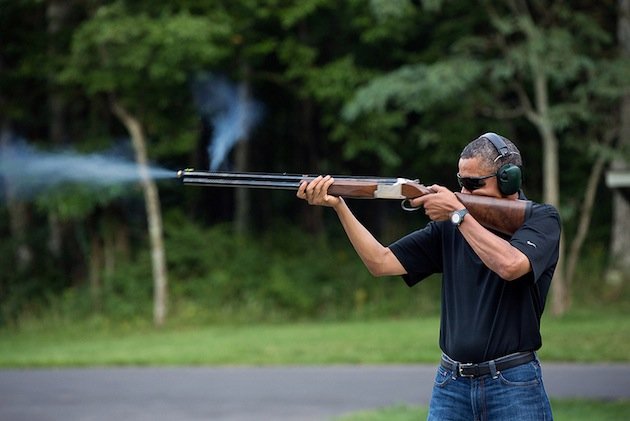
News that President Obama has doubled the number of American troops (whoops — I mean advisers) in Iraq to 3100 is already a tacit admission of defeat in that troubled region.  Let’s recall that the Iraqi security forces the U.S. trained and equipped to the tune of $25 billion simply melted away when faced with serious combat this summer.  Their performance put me to mind of the National Rifle Association’s slogan against John Kerry in the presidential campaign of 2004.  Kerry had gone bird shooting, mainly it seems to be photographed with a gun in his hand, a necessity for any red-blooded American male (just ask Obama).  But the NRA wasn’t fooled (or so they claimed).  “That dog don’t hunt,” the NRA said about Kerry.  And something about that slogan stuck.

You could say the same of that Iraqi army that the U.S. created and funded and trained and equipped: That dog don’t hunt. Or, it won’t hunt for us.  Because that’s not its purpose.  That’s not how or even why we trained it.  But that’s OK.  We’ll just send more American troops to Iraq, and waste more money, further destabilizing the region, making it even easier for radical jihadists to recruit more followers, whether to the ISIS banner or some other Islamist flag (Khorasan, perhaps?).

It’s just incredible how inept U.S. foreign policy is today.  If George C. Marshall had been like this during World War II, we’d be speaking German today at the Pentagon, instead of simply misinterpreting Clausewitz.

Of course, Congress will have to authorize funding for the latest U.S. military misadventure.  Anyone want to offer odds on Congress actually exercising oversight on our foreign entanglements?  A long shot, indeed.

Even as Congress seeks to cut funding to the poor, there’s always plenty of money for military adventurism overseas, no matter how often those adventures fail.  When it comes to exercising real oversight, Congress is always a lame duck — so lame that even a dog that don’t hunt (that Iraqi military again) succeeds in bagging billions of dollars from the American taxpayer.

The moral to the story?  America doesn’t lack for guns; we lack for brains.

Update: Iraq has “shook up” its military, relieving 26 officers of their commands and forcibly retiring 10 others, even as 18 new commanders were appointed by Prime Minister Haider al-Abadi among promises of greater professionalism and less graft and corruption.  Progress?  Time will tell.  But what does it say about a military that, in spite of prolonged training and massive infusions of cash from the U.S., was so ridden with corruption that it collapsed when facing its first challenge?  Sadly, the need for ever more U.S. advisers and money suggests this is yet another case of rearranging the deck chairs on the Titanic.

Update 2 (written by b. traven)

What is truly tragic is how the back story to the total failure of the Bush-Cheney wars is not reviewed by Obama, the Senate, or the House as this tragedy for Iraq unfolds. Obama just continues to follow the Bush lies by one week saying no “boots on the ground” while his top military people say “yes, more boots” and the next week Obama announces doubling the number of troops with no sense of embarrassment. And the American people stay entranced with baseball, football, and basketball scores.

And you can say you saw it here first. No sooner had General Dempsey said he wanted more troops in Iraq then Obama complied by doubling the force. Now Dempsey has told Obama what he wants even more troops so you can count on Obama complying in a couple of weeks. There’s nothing like doubling down on a failed policy in hopes that the result will come out differently than the last failure. Here’s Dempsey’s new demand as reported in the Guardian of London newspaper:

“The top-ranking officer in the American military said on Thursday that the US is actively considering the direct use of troops in the toughest upcoming fights against the Islamic State (Isis) in Iraq, less than a week after Barack Obama doubled troop levels there.

General Martin Dempsey, the chairman of the joint chiefs of staff, indicated to the House of Representatives armed services committee that the strength of Isis relative to the Iraqi army may be such that he would recommend abandoning Obama’s oft-repeated pledge against returning US ground troops to combat in Iraq.”

President Truman fired the most renowned five star General of his day, Douglas MacArthur for voicing a policy contradicting Truman’s in regard to China. If we had a real president he would do the same with Dempsey, who is certainly no MacArthur.