The Department of War Is Back!

But Victoryless Culture Remains

Also at TomDispatch.com.

BY WILLIAM J. ASTORE

My fellow Americans, my critical voice has finally been heard inside the Oval Office. No, not my voice against the $1.7 trillion this country is planning to spend on new nuclear weapons. No, not my call to cut the Pentagon budget in half. No, not my imprecations against militarism in America. It was a quip of mine that the Department of Defense (DoD) should return to its roots as the War Department, since the U.S. hasn’t known a moment’s peace since before the 9/11 attacks, locked as it’s been into a permanent state of global war, whether against “terror” or for its imperial agendas (or both).

A rebranded Department of War, President Trump recently suggested, simply sounds tougher (and more Trumpian) than “defense.” As is his wont, he blurted out a hard truth as he stated that America must have an offensive military. There was, however, no mention of war bonds or war taxes to pay for such a military. And no mention of a wartime draft or any other meaningful sacrifice by most Americans.

Rebranding the DoD as the Department of War is, Trump suggested, a critical step in returning to a time when America was always winning. I suspect he was referring to World War II. Give him credit, though. He was certainly on target about one thing: since World War II, the United States has had a distinctly victoryless military. Quick: Name one clear triumph in a meaningful war for the United States since 1945. Korea? At best, a stalemate. Vietnam? An utter disaster, a total defeat. Iraq and Afghanistan? Quagmires, debacles that were waged dishonestly and lost for that very reason.

Even the Cold War that this country ostensibly won in 1991 with the collapse of the Soviet Union didn’t lead to the victory Americans thought was coming their way. After much hype about a “new world order” where the U.S. would cash in its peace dividends, the military-industrial-congressional complex found new wars to wage, new threats to meet, even as the events of 9/11 enabled a surge — actually, a gusher — of spending that fed militarism within American culture. The upshot of all that warmongering was a soaring national debt driven by profligate spending. After all, the Iraq and Afghan Wars alone are estimated to have cost us some $8 trillion.

Those disasters (and many more) happened, of course, under the Department of Defense. Imagine that! America was “defending” itself in Vietnam, Afghanistan, Iraq, Libya, Syria, Somalia, and elsewhere, even as those wars killed and wounded significant numbers of our troops while doing far more damage to those on the receiving end of massive American firepower. All this will, I assume, go away with a “new” Department of War. Time to win again! Except, as one Vietnam veteran reminded me, you can’t do a wrong thing the right way. You can’t win wars by fighting for unjust causes, especially in situations where military force simply can’t offer a decisive solution.

It’s going to take more than a rebranded Department of War to fix wanton immorality and strategic stupidity.

We Need a Return of the Vietnam Syndrome

Hey, I’m okay with the Pentagon’s rebranding. War, after all, is what America does. This is a country made by war, a country of macho men hitching up their big boy pants on the world stage, led by the latest (greatest?) secretary of war, “Pomade Pete”Hegseth, whose signature move has been to do pushups with the troops while extolling a “warrior ethos.” Such an ethos, of course, is more consistent with a War Department than a Defense Department, so kudos to him. Too bad it’s inconsistent with a citizen-soldier military that’s supposed to be obedient to and protective of the Constitution. But that’s just a minor detail, right?

Buy the Book

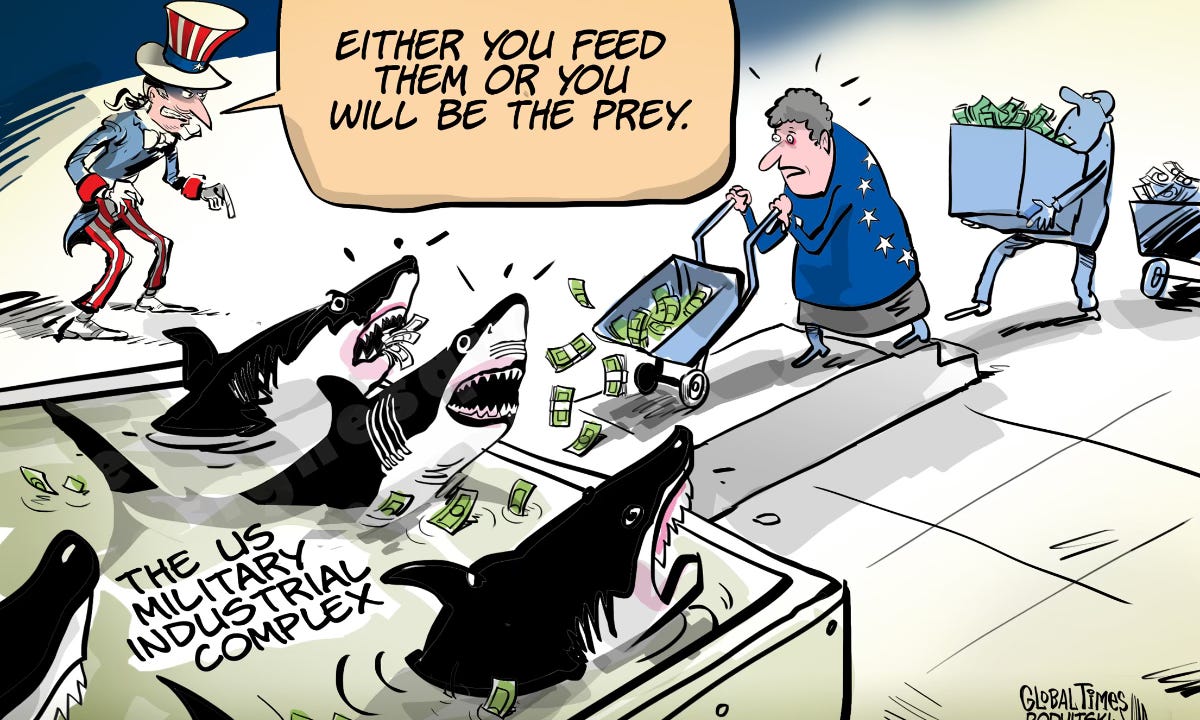
Here’s the rub. As Trump and Hegseth have now tacitly admitted, the national security state has never been about “security” for Americans. Rather, it’s existed and continues to exist as a war state in a state of constant war (or preparations for the same), now stuffed to the popping point with more than a trillion dollars yearly in taxpayer funds. And the leaders of that war state — an enormous blood-sucking parasite on society — are never going to admit that it’s in any way too large or overfed, let alone so incompetent as to have been victoryless for the last 80 years of regular war-making.

And count on one grim reality: that war state will always find new enemies to attack, new rivals to deter, new weapons to buy, and a new spectrum of warfare to try to dominate. Venezuela appears to be the latest enemy, China the latest peer rival, hypersonic missiles and drone swarms the new weaponry, and artificial intelligence the new spectrum. For America’s parasitic war state, there will always be more to feed on and to attempt (never very successfully) to dominate.

Mind you, this is exactly what President Dwight D. Eisenhower warned us against in his 1961 Farewell Address. Sixty-plus years ago, Ike could already see that what he was the first to call the military-industrial complex was already too powerful (as the Vietnam War loomed). And of course, it has only grown more powerful since he left office. As Ike also wisely said, only Americans can truly hurt America — notably, I’d add, those Americans who embrace war and the supposed benefits of a warrior ethos instead of democracy and the rule of law.

Again, I’m okay with a War Department. But if we’re reviving older concepts in the name of honesty, what truly needs a new lease on life is the Vietnam Syndrome that, according to President George H.W. Bush, America allegedly got rid of once and for all with a rousing victory against Saddam Hussein’s Iraq in Operation Desert Storm in 1991 (that would prove to be anything but).

That Vietnam Syndrome, you may recall, was an allegedly paralyzing American reluctance to use military force in the aftermath of disastrous interventions in Vietnam, Laos, and Cambodia in the 1960s and early 1970s. According to that narrative, the U.S. government had become too slow, too reluctant, too scarred (or do I mean scared?) to march speedily to war. As President Richard Nixon once said, America must never resemble a “pitiful, helpless giant.” To do so, he insisted, would threaten not just our country but the entire free world (as it was known then). America had to show that, when the chips were down, our leaders were up for going all-in, no matter how bad our cards were vis-à-vis those of our opponents.

If nothing else, no country had more chips than we did when it came to sheer military firepower and a willingness to use it (or so, at least, it seemed to Nixon and crew). A skilled poker player, Nixon was blinded by the belief that the U.S. couldn’t afford to suffer a humiliating loss on the world stage (especially when he was its leader). But the tumult that resulted from the fall of Saigon to communist forces in 1975 taught Americans something, if only temporarily: that one should hasten very slowly to war, a lesson Sparta, the quintessential warrior city-state of Ancient Greece, knew to be the sign of mature wisdom.

Spartan wannabes like Pete Hegseth, with his ostentatious displays of “manliness,” however, fail to understand the warrior ethos they purport to exhibit. Wise warrior-leaders don’t wage war for war’s sake. Considering the horrific costs of war and its inherent unpredictability, sage leaders weigh their options carefully, knowing that wars are always far easier to get into than out of and that they often mutate in dangerously unpredictable ways, leaving those who have survived them to wonder what it was ever all about — why there was so much killing and dying for so little that was faintly meaningful.

What Will Trump’s “Winning” War Department Look Like?

Perhaps Americans got an initial look at Trump’s new “winning” War Department off the coast of Venezuela with what could be the start of a new “drug war” against that country. A boat carrying 11 people, allegedly with fentanyl supplies on board, was obliterated by a U.S. missile in this country’s first “drug war” strike. It was a case where President Trump decided that he was the only judge and jury around and the U.S. military was his executioner. We may never know who was actually on board that boat or what they were doing, questions that undoubtedly matter not a whit to Trump or Hegseth. What mattered to them was sending an ultimate message of toughness, regardless of its naked illegality or its patent stupidity.

Similarly, Trump has put the National Guard on the streets of Washington, D.C., deployed Marines and the National Guard to Los Angeles, and warned of yet more troop deployments to come in Chicago, New Orleans, and elsewhere. Supposedly looking to enforce “law and order,” the president is instead endangering it, while disregarding the 1878 Posse Comitatus Act that prohibits a president from deploying active-duty troops as domestic law enforcers.

If America isn’t a nation of laws, what is it? If the president is a lawbreaker instead of an upholder of those laws, what is he?

Recall that every American servicemember takes a solemn oath to support and defend the Constitution and bear true faith and allegiance to the same. Warriors are driven by something different. Historically, they often just obeyed their chieftain or warlord, killing without thought or mercy. If they were bound by law, it was most often that of the jungle.

Knowingly or unknowingly, that’s exactly the kind of military Pete Hegseth and the new Department of War (and nothing but war) are clearly seeking to create. A force where might makes right (although in our recent history, it’s almost invariably made wrong).

I must admit that, from the recent attack on that boat in the Caribbean to the sending of troops into Washington, I find I’m not faintly surprised by this developing crisis (that’s almost guaranteed to grow ever worse). Remember, after all, that Donald Trump, a distinctly lawless man, boasted during the Republican debate in the 2016 election campaign that the military would follow his orders irrespective of their legality. I wrote then that, with such a response, he had disqualified himself as a candidate for the presidency:

“Trump’s performance last night [3/3/16] reminded me of Richard Nixon’s infamous answer to David Frost about Watergate: ‘When the president does it, that means it’s not illegal.’ No, no, a thousand times no. The president has to obey the law of the land, just as everyone else has to. No person is above the law, an American ideal that Trump seems neither to understand nor to embrace. And that disqualifies him to be president and commander-in-chief.”

If only.

In retrospect, I guess Trump had it right. After all, he’s won the presidency twice, no matter that his kind of “rightness” threatens the very foundations of this country.

So, color me more than worried. In this new (yet surprisingly old) age of a War Department, I see even more possibilities for lawlessness, wanton violence, and summary executions — and, in the end, the defeat of everything that matters, all justified by that eternal cry: “We’re at war.” At which point, I return to war’s miseries and how quickly we humans forget its lessons, no matter how harsh or painful they may be.

Someday, America’s soon-to-be War Department, led by wannabe warrior chieftains Trump and Hegseth, will perhaps seem like the ultimate blowback from this country’s disastrous wars overseas since its name changed to the Defense Department in the wake of World War II. In places like Iraq and Afghanistan, this country allegedly waged war in the name of spreading democracy and freedom. That cause failed and America’s own grip on democracy and freedom only continues to loosen — perhaps fatally so.

In harkening back to a War Department, perhaps Trump is also channeling a nostalgia for the Old West, or at least the myth of it, where justice was served through personal bounties and murderous violence enforced by steely-eyed men wielding steel-blue pistols. Trump’s idea of “justice” does seem to be that of a hanging judge on a “wild” frontier facing hostile “Injuns” of various sorts. For men like Trump, those were the glory days of imperial expansion, never mind all the bodies left in the wake of America’s manifest destiny. If nothing else, that old imperial Department of War certainly knew what it was about.

Whatever else one might expect from America’s “new” Department of War, you can bet your life (or death) on a whole lot of future body bags. Warriors are, of course, okay with this as long as there are more boats to blow up, more people to bomb, and more foreign resources to steal in the pursuit of a “victory” that never actually arrives. So hitch up those big boy pants, grab a rifle or a Hellfire missile, and start killing. After all, in what might be thought of as a distinctly victoryless culture, it seems as if America is destined to be at war forever and a day.

America the FUBAR

An Ailing, Flailing, Failing Empire Lashes Out

BILL ASTORE

AUG 06, 2025

Hello Everyone: Here’s my latest article at TomDispatch.com. Whereas my articles for BV are usually 400-600 words, my articles for TomDispatch are usually just over 2000 words, which allows me to develop my points further, supported by plenty of links. Oh, and my wife and I really do use the expression, “But Bibi needs bombs,” whenever the government says it can’t fund something for the American people. It’s funny but I’ve never heard anyone in Congress ask: Bombs for Bibi—how are you going to pay for that? America’s bipartisan warmongers always find plenty of money for weapons and war, even as money for health care and other needs evaporates. It’s almost as if America has a powerful military-industrial complex combined with pushy lobbying groups like AIPAC.

*****

As a retired U.S. Air Force officer, I firmly believe in civilian control of our military. This country should be a nation of laws — not of special interests, oligarchs, or kings. Before committing our forces to battle, Congress should always declare war in the name of the people. Our military should indeed be a citizen-soldier force, not an isolated caste driven by a warrior ethos. And above all, the United States should be a republic ruled by law and shaped by sound moral values, not a greed-driven empire fueled by militarism.

Yet when I express such views, I feel like I’m clinging to a belief in the tooth fairy, the Easter Bunny, and Santa Claus. It feels idealistic, naïve, even painful to think that way. Yes, I served this country in uniform for 20 years, and now, in the age of Donald Trump, it has, as far as I can tell, thoroughly lost its way. The unraveling began so long ago — most obviously with the disastrous Vietnam War of the 1960s and 1970s, though in truth this country’s imperial desires predated even the Spanish-American War of 1898, stretching back to the wanton suppression of indigenous peoples as part of its founding and expansion.

A glance at U.S. history reveals major atrocities: the displacement and murder of Native Americans, slavery, and all too many imperial misadventures abroad. I knew of such realities when I joined the military in 1985, near the end of the Cold War. Despite its flaws, I believed then that this country was more committed to freedom than the Soviet Union. We could still claim some moral authority as the leader of what we then referred to as “the free world,” however compromised or imperfect our actions were.

That moral authority, however, is now gone. U.S. leaders fully support and unapologetically serve an ongoing genocide against the Palestinian people in Gaza. They sell weapons to nearly every regime imaginable, irrespective of human rights violations. They wage war without Congressional approval — the recent 12-day assault on Iran being just the latest example. (The second Trump administration has, in fact, launched almost as many air strikes, especially in Yemen and Somalia, in its first five months as the Biden administration did in four years.) Those same leaders have been doing a bang-up job dismantling the America I thought I was serving when I took that oath and put on second lieutenant’s bars four decades ago. That America — assuming it ever existed — may now be gone forever.

FUBAR: A Republic in Ruins

My fellow citizens, America is FUBAR (a term that dates from World War II). We are not faintly who we claim to be. Rather than a functioning republic, we are an ailing, flailing, perhaps even failing empire. We embrace war, glorify warriors, and profit mightily from the global arms trade, no matter the civilian toll, including tens of thousands of dead and wounded children in Gaza, among the latest victims of U.S.-made bombs, bullets, and missiles.

Signs of moral rot are everywhere. Our president, who would like to be known for his budget cuts, nonetheless giddily celebrates a record trillion-dollar war budget. Our secretary of defense gleefully promotes a warrior ethos. Congress almost unanimously supports or acquiesces in the destruction of Gaza. Images from the region resemble bombed-out Stalingrad in 1942 or Berlin in 1945. Meanwhile, for more than two decades now, America’s leaders have claimed to be waging a successful global “war on terror” even as they fuel terror across the globe. What do they think all those U.S. weapons are for — spreading peace?

My wife and I cope through dark humor. We see news on cuts to Medicaid, the mentally ill in the streets, and crumbling infrastructure, and quip: “But Bibi [Netanyahu] needs bombs. Or Ukraine does. Or the Pentagon needs more nukes.” That’s why Americans can’t have nice things like health care. That’s why all too many of us are unhoused, in debt, out of work, and desperate. In 1967 — yes, that’s almost 60 years ago! — Martin Luther King warned of exactly this: America’s approaching spiritual death through militarism (aggravated by extreme materialism and racism). That death is visibly here, now.

A book cover of a city

AI-generated content may be incorrect.

Buy the Book

Washington is not even faintly committed to “peace through strength,” a vapid slogan touted by the Trump administration, and an unintentional echo of George Orwell’s dystopian “war is peace.” It is committed instead to what passes for dominance through colossal military spending and persistent war. And let’s face it, that warpath may well end in the death of the American experiment.

The Mediocrity of Our Generals

In this era of creeping authoritarianism and mass surveillance, perhaps the U.S. is lucky that its generals are, by and large, so utterly uninspired. Today’s American military isn’t open to the mercurial and meteoric talents of a Napoleon or a Caesar. Not in its upper ranks, at least.

One struggles to name a truly great American general or admiral since World War II. That war produced household names like George C. Marshall, Dwight D. Eisenhower, George S. Patton, and Chester W. Nimitz. In contrast, America’s recent generals — Norman Schwarzkopf and Colin Powell of Desert Storm fame, Tommy Franks in Iraq in 2003, David Petraeus and Stanley McChrystal of the “fragile” and “reversible” Iraq and Afghan “surges” — have left anything but a legacy of excellence or moral leadership, not to speak of decisive victory. At best, they were narrowly competent; at worst, morally compromised and dangerously deluded.

Mind you, this isn’t a criticism of this country’s rank-and-file troops. The young Americans I served with showed no lack of courage. It wasn’t their fault that the wars they found themselves in were misbegotten and mismanaged. Twenty years have passed since I served alongside those young troops, glowing with pride and purpose in their dedication, their idealism, their commitment to their oath of service. Many paid a high price in limbs, minds, or lives. Too often, they were lions led by donkeys, to borrow a phrase once used to describe the inept and callous British leadership during World War I at bloody battles like the Somme (1916) and Passchendaele (1917).

Today, I fear that America’s lions may, sooner or later, be led into even deeper catastrophe — this time possibly a war with China. Any conflict with China would likely rival, if not surpass, the disasters produced by World War I. The world’s best military, which U.S. presidents have been telling us we have since the 9/11 attacks of September 2001, stands all too close to being committed to just such a war in Asia by donkeys like Donald Trump and Secretary of Defense Pete Hegseth.

And for what? The island of Taiwan is often mentioned, but the actual reason would undoubtedly be to preserve imperial hegemony in the service of corporate interests. War, as General Smedley Butler wrote in 1935 after he retired from the military, is indeed a racket, one from which the rich exempt themselves (except when it comes to taking profits from the same).

A disastrous conflict with China, likely ending in a U.S. defeat (or a planetary one), could very well lead to a repeat of some even more extreme version of Trump’s Make America Great Again campaign, amplified and intensified by humiliation and resentment. From the ashes of that possible defeat, an American Napoleon or Caesar (or at least a wannabe imitator) could very well emerge to administer the coup de grace to what’s left of our democracy and freedom.

Avoiding a Colossal Act of Folly

War with China isn’t, of course, inevitable, but America’s current posture makes it more likely. Trump’s tariffs, his bombastic rhetoric, and this country’s extensive military exercises in the Pacific contribute to rising tensions, not de-escalation and rapprochement.

While this country invests in war and more war, China invests in infrastructure and trade, in the process becoming what the U.S. used to be: the world’s indispensable workhorse. As the 10 BRICS countries, including China, expand and global power becomes more multipolar, this country’s addiction to military dominance may drive it to lash out. With ever more invested in a massive military war hammer, impetuous leaders like Trump and Hegseth may see China as just another nail to be driven down. It would, of course, be a colossal act of folly, though anything but a first in history.

And speaking of folly, the U.S. military as it’s configured today is remarkably similar to the force I joined in 1985. The focus remains on ultra-expensive weapons systems, including the dodgy F-35 jet fighter, the unnecessary B-21 Raider bomber, the escalatory Sentinel Intercontinental Ballistic Missile, and Trump’s truly fantastical “Golden Dome” missile defense system (a ghostly rehash of President Ronald Reagan’s “Star Wars” proposal, vintage 1983). Other militaries, meanwhile, are improvising, notably in low-cost drone technology (also known as UAS, or uncrewed autonomous systems) as seen in the Russia-Ukraine War, a crucial new arena of war-making where the U.S. has fallen significantly behind China.

The Pentagon’s “solution” here is to continue the massive funding of Cold War-era weapons systems while posing as open to innovation, as an embarrassing video of Hegseth walking with drones suggests. America’s military is, in short, well-prepared to fight a major conventional war against an obliging enemy like Iraq in 1991, but such a scenario is unlikely to lie in our future.

With respect to drones or UAS, I can hear the wheels of the military-industrial complex grinding away. A decentralized, low-cost, flexible cottage industry will likely be transformed into a centralized, high-cost, inflexible cash cow for the merchants of death. When the Pentagon faces a perceived crisis or shortfall, the answer is always to throw more money at it. Ka-ching!

Indeed, the recent profit margins of major military contractors like Lockheed Martin, Boeing, and RTX (formerly Raytheon) have been astounding. Since 9/11, Boeing’s stock has risen more than 400%. RTX shares are up more than 600%. Lockheed Martin, maker of the faltering F-35, has seen its shares soar by nearly 1,000%. And Northrop Grumman, maker of the B-21 Raider bomber and Sentinel ICBM, two legs of America’s “modernized” nuclear triad, has seen its shares increase by more than 1,400%. Who says that war (even the threat of a global nuclear war) doesn’t pay?

Meanwhile, the Pentagon’s war budget, soaring to unprecedented levels, has been virtually immune to DOGE cuts. While Elon Musk and his whiz kids searched for a few billion in savings by gutting education or squelching funding for public media like PBS and NPR, the Pentagon emerged with about $160 billion in new spending authority. As President Biden once reminded us: Show me your budget and I’ll tell you what you value. Far too often, America’s leaders, whatever they’ve said in their election campaigns, have valued weapons and wars over almost anything else.

What Is To Be Done

I’ve written against warriorswarfighters, and U.S. militarism since 2007. And yes, it often feels futile, but silence means surrender to warmongering fools like Hegseth, Senator Tom Cotton, and the farrago of grifters, clowns, toadies, con men, and zealots who inhabit the Trump administration and much of Congress as well. The fight against them must go on.

All leaders, military and civilian, must remember their oath: loyalty to the Constitution, not to any man. Illegal orders must be resisted. Congress must impeach and remove a president who acts unlawfully. It must also reassert its distinctly lost authority to declare war. And it must stop taking “legal” bribes from the lobbyists/foot soldiers who flood the halls of Congress, peddling influence with campaign “contributions.”

For tyranny to be stopped, for a catastrophic war with China (and who knows what else) to be avoided, America must have profiles in courage, not cowardice. Yet even despair is being weaponized. As a retired colonel and friend of mine wrote to me recently: “I don’t even know where to start anymore, Bill. I have no hope for anything ever improving.”

And don’t think of that despair as incidental or accidental. It’s a distinct feature of the present system of government.

Trump and Hegseth are not faintly what the founders of this country envisioned when they placed the military under civilian control. Yet power ultimately resides in the people (if we remember our duties as citizens). Isn’t it high time that we Americans recover our ideals, as well as our guts?

After all, the few can do little without the consent of the many. It’s up to the many (that’s us!) to reclaim and restore America.

Appeasing the Military-Industrial Complex

Orwell’s 1984 Wasn’t Meant As a How-To Guide

BILL ASTORE

JUL 15, 2025

In an ever-changing world, the one constant in Universe USA is rising Pentagon budgets. For President Trump, a trillion-dollar war budget is something to crow about. Of course, it’s sold as “peace through strength.” For what is more peaceful than more weaponry, especially nuclear-tipped ICBMs and SLBMs?

America is always arming, uparming, rearming for war allegedly to prevent war. The problem is arming for war usually leads to yet more war. You don’t “invest” in weaponry to keep it on a shelf, rusting away in armories.

Excuse my language, but Vietnam vets and war protesters put it well: Fighting (or bombing) for peace is like fucking for virginity.

Vintage 1969. Makes sense, right?

More telling, however, is the constant state of war preparations that infect and influence our minds. Our “leaders” talk about “all options being on the table” when the only option they consider is military force. We are what we “invest” in. And weapons ‘r’ us.

In U.S. politics, strong and wrong is seen as far better than “weak” and right. And just about every politician inside the DC Beltway appeases the military-industrial complex, Israel, or both. That’s how you end up with disastrous wars of choice in Vietnam, Afghanistan, Iraq, and elsewhere, together with full-throated support for genocide in Gaza.

Who cares about right and wrong when might always makes right?

An anecdote: I have a friend who works in the belly of the beast (the DoD). He told me his job makes him think of Winston Smith in George Orwell’s “1984.” The Pentagon under Pete Hegseth has become an exercise in eliminating DEI bad speak and replacing it with doubleplusgood warrior-ethos speak. Lots of time is wasted sending “bad” terms and names down the memory hole.

Even as the DoD’s language is purged of bad speak about DEI, the Pentagon’s embrace of a permanent war economy is tightened. The very idea of a “peace dividend,” floated by Republican President George H.W. Bush in the aftermath of the Soviet Union’s collapse, is seemingly ancient history, an idea never to be considered again, not in Trump and Hegseth’s warrior-USA.

Preparing constantly for war is a powerful way to ensure more war. Overspending on esoteric and genocidal weaponry is a powerful way to hollow out one’s country while establishing the conditions for global mass death.

Perhaps our “leaders” need to recall that Orwell’s “1984” was meant to be a warning of what to avoid, not a how-to guide for authoritarian rule and perpetual war.