“When the Devil Is Loose in the Village”

W.J. Astore

Coming to Hate Those You Kill

After attending a seminar at the U.S. Holocaust Memorial Museum with Henry Friedlander, I taught my first course on the Holocaust just over two decades ago. I then continued to teach courses on the Holocaust until I retired as a professor of history in 2014. Having read dozens of books on the Holocaust, seen dozens of moviesand documentaries on it, and having talked to Jewish survivors of the Holocaust, including Henry Friedlander, I learned a few things about how and why such a colossal crime against humanity happened. 

When I took his seminar, Friedlander, who as a teenager survived Auschwitz, taught us that “You don’t kill the people you hate—you hate the people you kill.” It may seem paradoxical, but this insight is powerful. Normal human beings don’t want to be or become killers. Thankfully, killing isn’t easy, even at a remove. (Drone operators are known to suffer adverse symptoms from witnessing death at a distance.)

Yet, if you’re taught and told that you must kill, the moral, mental, physical, and other burdens of killing may drive you to hate those you are killing. “Look at what you made me do!” the killer thinks. You made me do this—and I hate you for it. Doesn’t matter that you’re a guiltless child, I still hate you.

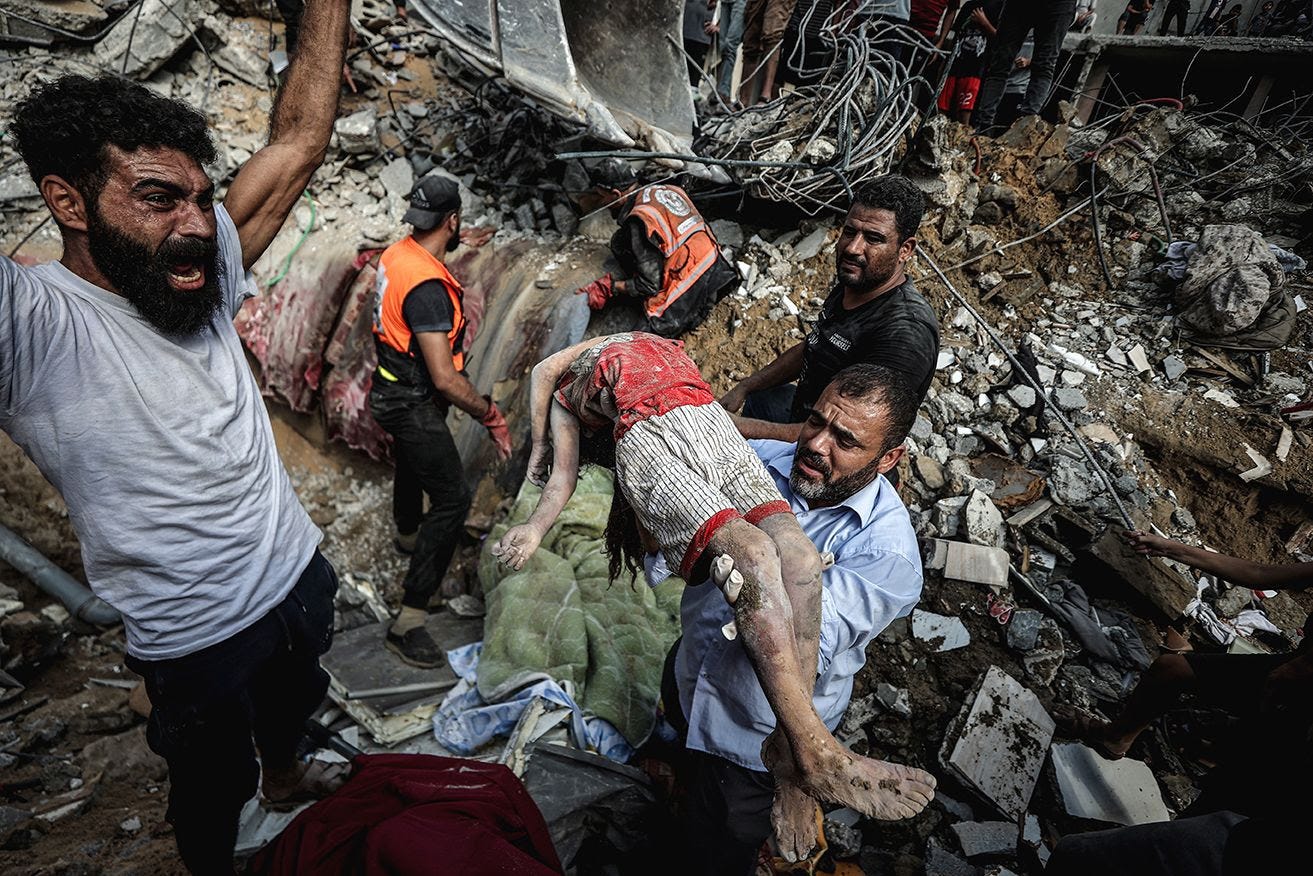
A group of people carrying a person on the ground

Description automatically generated
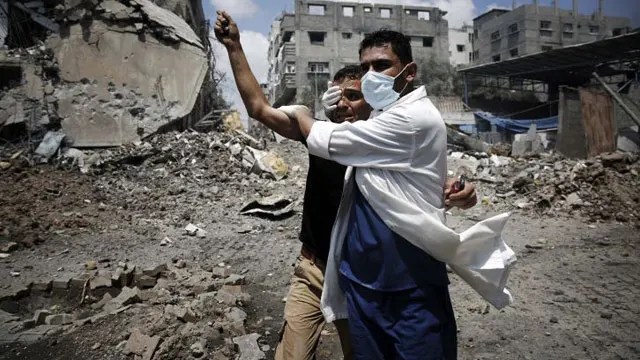
Photo by Ali Jadallah in Gaza (Anadolu Agency via Getty Images) 

I wonder about Israeli officials today, those who are in control of the demolition of Gaza. A few must truly hate Hamas, but there are many more, I think, who’d prefer not to be put in the position of ordering (or carrying out) massive bombing raids and ground invasions that result in the deaths of tens of thousands of innocent Palestinians.

How many in Israel, notably in the Israeli Defense Forces, will come to hate those that they kill? How many will succumb to hate as a matter of survival, a sort of mental coping mechanism?

Honestly, I don’t pretend to understand it all.  Catchphrases like “man’s inhumanity to man” or “the banality of evil” seem too easy.  I remember reading an interview with Primo Levi, another Holocaust survivor, who related an anecdote about his experience communicating with an unrepentant Nazi in Germany well after World War II.  This man wrote to Levi to defend himself; unbeknownst to him, his wife snuck a note into the letter that read:

“When the devil is loose in the village, a few people try to resist and are overcome, many bow their heads, and the majority follow him with enthusiasm.”*

Whether you prefer “devil” or “evil” or “racist extremist” or some other term, history shows how humans readily unleash the most elemental barbarism when they believe they are threatened, especially when the “threat” is dehumanized.

Do we kill those we hate, or do we come to hate those we kill?  Regardless of the causality here, the common words “hate” and “kill” tell us that to stop the hating and killing, we must simply stop.  Stop killing.  Stop hating.  Find another way, a better way, a way that is life-affirming.

In teaching the Holocaust, I came across a multi-volume encyclopedia devoted to humanity’s genocides throughout history.  Imagine that!  An encyclopedia is needed just to document the almost countless times humans have engaged in mass murder against other humans.

Will Gaza (2023) become the latest entry in this devilish encyclopedia?

*Ferdinando Camon, Conversations with Primo Levi, The Marlboro Press, 1989, p. 37.

What Gaza Needs Now Is Mercy

W.J. Astore

A grim historical lesson taught by Thucydides, who wrote on the Peloponnesian War more than two millennia ago, is that the strong do what they will while the weak suffer what they must. Historically, the Jewish people have often been weak. Weak in the sense they had no homeland. They had no army. They were, in a word, vulnerable.

Compounding this vulnerability was prejudice. People who are vilified, who are dismissed as untrustworthy, who are defined as “other,” even as “human animals,” are especially vulnerable to the strong because the vilified rarely attract staunch champions or even sympathetic helpers.

Today, the Jewish people remember and commemorate those who helped them, who stood for justice, who were “righteous gentiles,” at places like Yad Vashem.

A person in a bow tie

Description automatically generated
Armin Wegner, a German who spoke out against the Nazi persecution of Jews, was jailed and tortured. He is counted among the righteous at Yad Vashem.

There’s a famous saying, the gist of which is that all it takes for evil to triumph is for good people to do nothing. During the Holocaust, far too many people did nothing when confronted by the evils of Nazism, and millions died as a result.

Today, the Jewish people are no longer weak. In Israel they have a homeland protected by powerful armed forces. They have staunch allies, including the world’s premier “superpower,” along with nuclear weapons, perhaps 200 of them, enough to wipe out the nations and peoples in their immediate vicinity.

Again, Israel today is strong. Thus it faces the ethical dilemma of the strong: the ability to kill on a mass scale, an ability too easily justified in the name of “defense.”  Will Israel illustrate Thucydides’ maxim of the strong doing what they will and the weak—in this case, the Palestinians—suffering as they must?

The hardline Israeli government appears to see mass violence, mass death, and mass expulsion as the only solution in Gaza.

History is replete with examples of the strong doing what they will while the weak suffer. Yet Israel is exercising overwhelming power against weak and vulnerable people in ways well known to Jews who’ve suffered greatly themselves in a long and tortured past.

Palestinians in Gaza are not collectively guilty of crimes committed by Hamas. They are an entrapped and desperate people.  What is to become of them?

Israel knows the value of righteousness, of justice for all, of an abiding love for all life, as reflected in the moral exemplars honored at Yad Vashem.

What Israel needs now is moral heroism. What Gaza needs now is mercy.

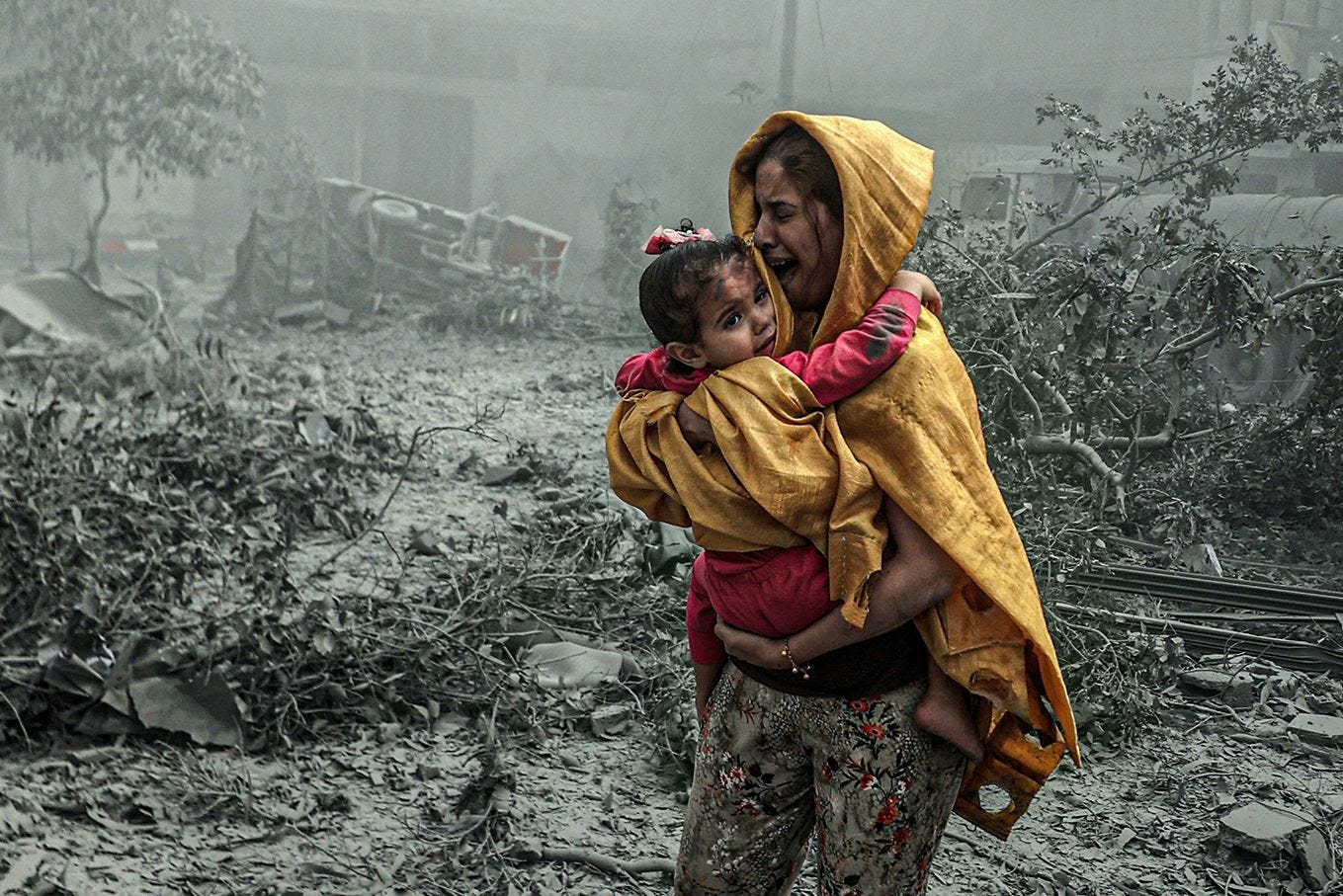
Photo by Ali Jadallah in Gaza (anadolu agency via getty images)

Israel, America, and Going “Massive”

W.J. Astore

Using Terror Attacks as an Excuse to Kill Indiscriminately

In the immediate aftermath of the 9/11 attacks on America in 2001, Secretary of Defense Donald Rumsfeld knew exactly what to do: “go massive.” Al Qaeda’s “shock and awe” attacks were an opportunity for the Bush/Cheney administration not only to strike against “terror” but against Saddam Hussein and Iraq, possibly even Iran, even though those countries had no role in 9/11. Here’s how Rumsfeld put it:

“Hard to get good case [against Iraq]. Need to move swiftly. Near term target needs – go massive – sweep it all up, things related and not.”

Going “massive” had another benefit: it distracted Americans from the colossal failure of Bush/Cheney/Rumsfeld to keep America safe, to anticipate and prevent the Al Qaeda attacks. Americans rallied around the flag and asked few questions as Congress gave the president a blank check to wage a “global war on terror.”

Something similar is happening in Israel today. The Hamas terror attacks are giving Bibi Netanyahu and the hard right in Israel an opportunity to “go massive,” to “sweep it all up, things related and not.” This has the added virtue of distracting Israelis from the colossal failure of Netanyahu in anticipating and preventing the Hamas attacks. Like their American counterparts, Israelis are tending to rally around the flag as their government is given a blank check (supported by the USA) to wage a war on terror in Gaza.

Of course, a war on terror is a war of terror, which is what we’re witnessing in Gaza. Massive Israeli bombing. Deaths that will soon exceed ten thousand. Widespread hunger, thirst, and suffering. Massive displacement of Palestinians from their homes. All justified because Israel was attacked, and not just attacked but embarrassed, as America was embarrassed on 9/11.

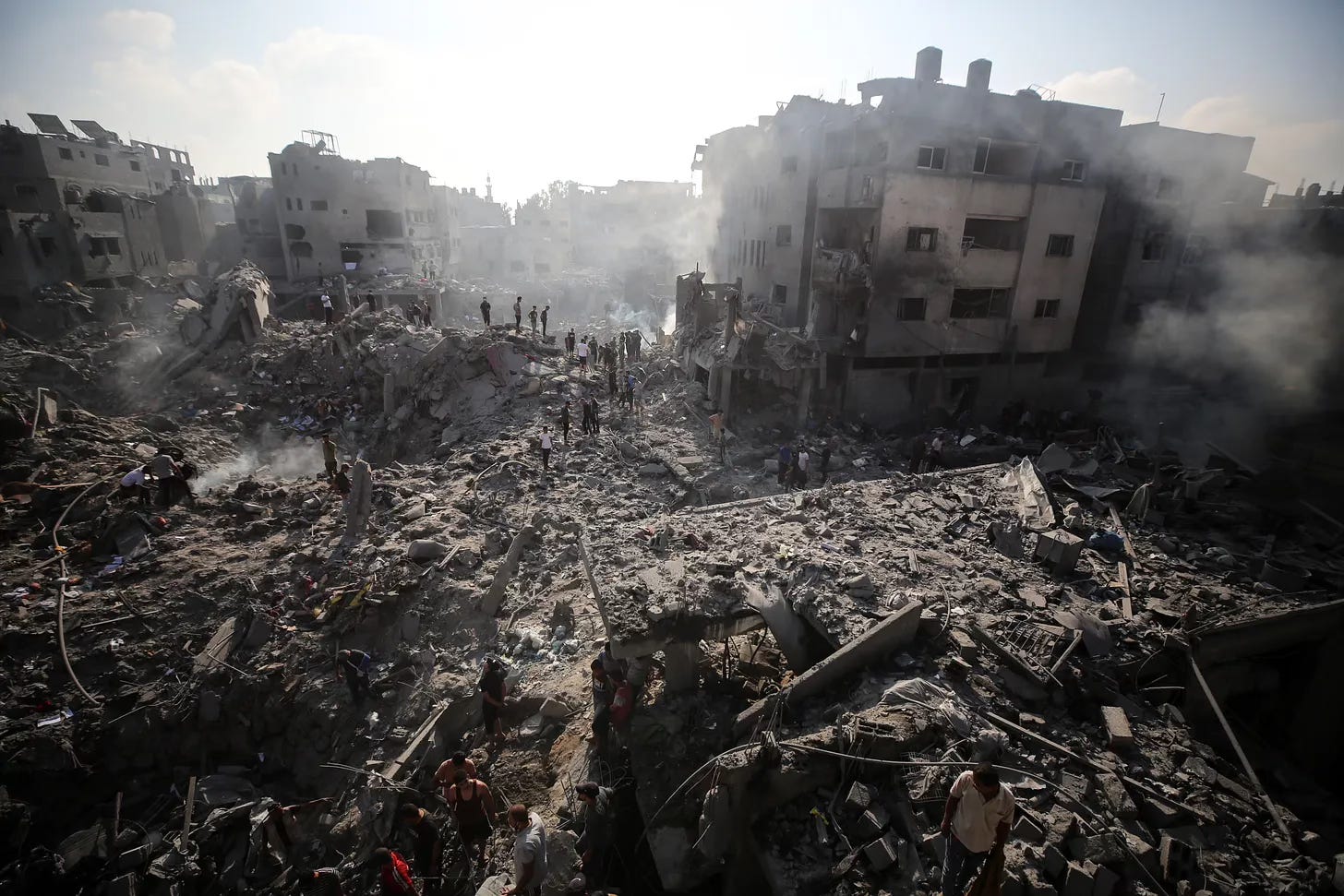
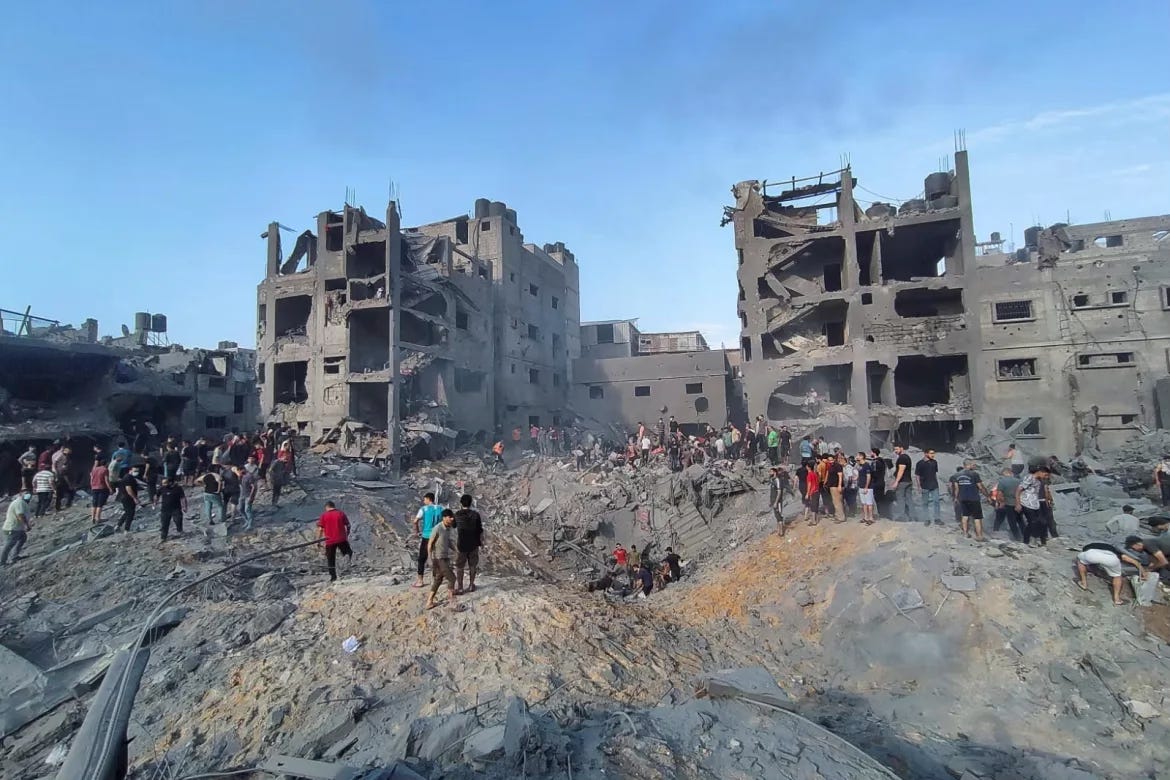
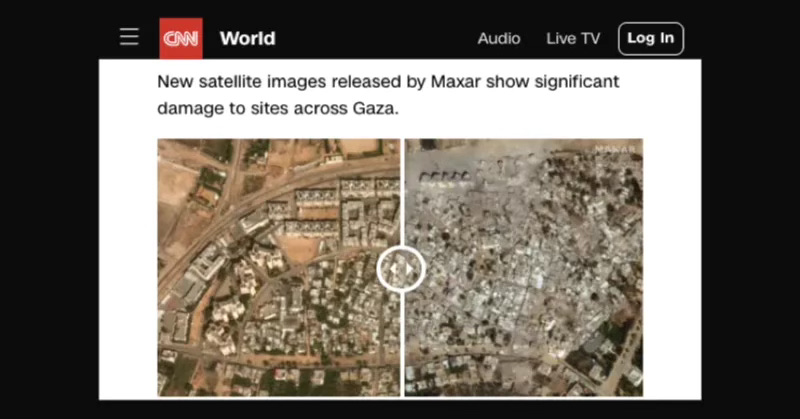
Consider these satellite images from Gaza showing massive destruction from Israeli bombing.

Broadly speaking, the USA and Israel share a conceit of being God’s chosen people and also of having the world’s finest and best military forces. These conceits were challenged respectively by the success of the Al Qaeda and Hamas terror attacks. Embarrassment coupled with anger and revenge leads to going “massive,” irrespective of wisdom or legality (or morality). Going “massive” is also a great CYA exercise, as in covering your ass.

Now is the time, these failed leaders decide, to punish “evildoers,” innocent people be damned. What matters is violence, action, vengeance, settling scores, irrespective of human rights and the so-called rules-based international order. It’s time to kill.

If history doesn’t quite repeat itself, it surely does echo as Israel, much like the USA after 9/11, goes “massive” and kills innocents while claiming it’s all in the cause of self-defense and justice.

Israel, Gaza, and the Language of War

W.J. Astore

Pay Attention to What You Read

Here’s a typical quick summary of the dire situation in Gaza from CNN this AM:

The US is seeking to delay an Israeli ground offensive in Gaza amid calls to free more hostages held there by Hamas and allow aid into the besieged enclave. A senior Israeli official told CNN there will be “no ceasefire” in Gaza, but emphasized efforts are ongoing to free the more than 200 hostages in the region “as quickly as possible.” However, the official added, “humanitarian efforts cannot be allowed to impact the mission to dismantle Hamas.” More than 4,600 people have been killed in Gaza since October 7 and over 14,200 others wounded, the health ministry there said.

Conditions on the ground in Gaza continue to deteriorate as Israel repeatedly bombards the strip with airstrikes.

For “Israeli ground offensive,” substitute massive military assault.  Note the mention of hostages held by Hamas but no mention of hostages/prisoners held by Israel.  “Besieged enclave”–open-air prison or concentration camp under constant bombing would be more telling.  “Dismantle Hamas”: the IDF goal is the total destruction of Hamas, with the death of civilians being blamed on Hamas because “they” allegedly use human shields, i.e. the Israeli government and military is never to blame.

Note the passive voice: 4600 people “have been killed in Gaza” — well, who’s killed them?  Who’s wounded 14,200 others?  With weapons provided by which countries?

Conditions in Gaza continue to “deteriorate”: What does this mean, specifically?  Lack of food, water, power, people dying in hospitals due to lack of supplies, people screaming in agony due to lack of anaesthesia, etc. And why are they “deteriorating”? It’s not just due to airstrikes by Israel. The Israeli government’s decision to stop food, fuel, electricity, and water to Gaza is creating the conditions for death and illness on a massive scale.

Looks like bombs over Gaza today—what can you do? It’s just the weather (Caitlin Johnstone)

Caitlin Johnstone has a fine critique about how Israeli bombing is being reported by the Western press. In essence, it’s reported as if bombs are simply dropping from the sky on Gaza: massive bombing as a very bad hail storm that must be endured and over which humans have no control.

Pay very close attention to how this war is being reported, especially in the Western mainstream press. For we all know the saying that the first casualty of war is truth.

Update: I’m involved with an effort, “Words About War Matter,” and the group led by David Vine has posted guidance for language related to Israel, Hamas, and Gaza. The link is https://www.wordsaboutwar.org/gaza.html.

Can We Agree on a Few Basics?

W.J. Astore

Sides in War Are Not “Teams”

1. Killing civilians and especially children is wrong.

2. Cutting off water, food, electricity, and fuel to millions of vulnerable people is wrong.

3. Forced mass evacuations of hundreds of thousands of people in preparation for a destructive invasion is wrong.

4. Dropping thousands of bombs and killing thousands of innocents is wrong. So is launching hundreds of unguided rockets and killing scores of innocents. 

5. Holding hostages and threatening to slay them is wrong.

Whether Hamas or Israel are doing these things, they are wrong.  Putting an end to such wrongs through a ceasefire is right.  Certainly, it’s less wrong.

In going to Israel and embracing Netanyahu, President Biden is obviously choosing one side, that of Israel, and empowering it to do whatever it wants in Gaza. Interestingly, Biden claimed that yesterday’s destruction of a hospital in Gaza was done in his words by the “other team,” meaning Hamas.

The terminology here is striking. Israel and Hamas are not sports “teams” in which we choose to root for one side against the other. Israelis and Palestinians are people equally deserving of human dignity and human rights.

I’ve written about the invasion (so to speak) of war terms into sports and vice-versa. Biden’s dismissal of Hamas as the “other team” that’s allegedly responsible for the hospital’s destruction and the deaths of hundreds of innocents trivializes a deep human tragedy.

Are we ever going to move beyond this “team” mentality where we root for the total victory of one “team” over another?

What, Exactly, Is “Repugnant” About Efforts to Stop Mass Killing?

W.J. Astore

The Biden Administration Embraces War and Israel

Remarkably, the press secretary of the Biden administration stated that calls for deescalation of conflict in Gaza, calls for restraint, calls for a ceasefire, are “disgraceful” and “repugnant.” There are not two sides to the conflict, the press secretary said. There’s only the Israeli side of righteousness. And Israel must be given a blank check, as well as plenty of U.S. weaponry, to strike back. And so Israel has, dropping 6000 bombs in six days. Obviously, Israel had a prepared list of targets; you don’t drop one thousand bombs a day on Gaza in “precision” strikes without being long prepared to do so.

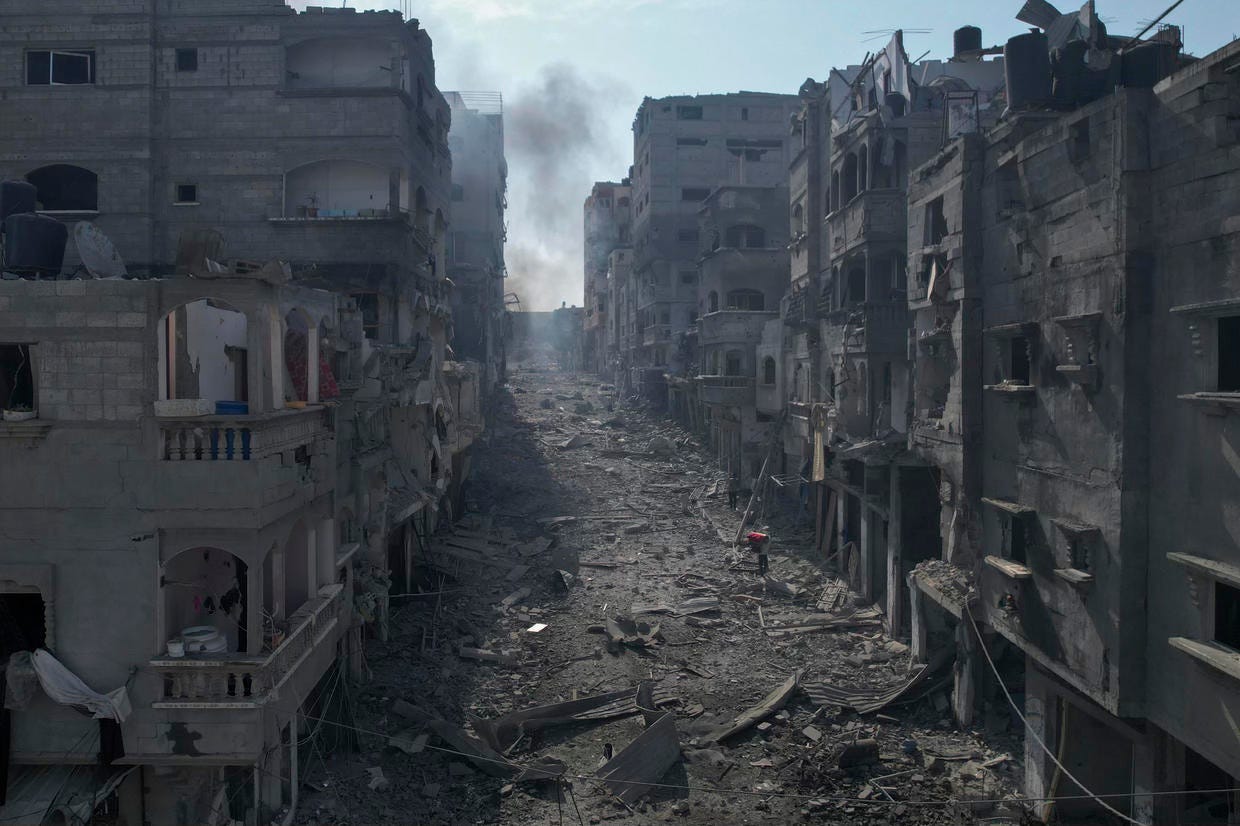
Sure looks “precise” to me. Jabalia, Gaza Strip, 10/11/23 (Hatem Moussa/AP) 

Meanwhile, President Joe Biden said he had seen photos of Hamas attackers beheading Israeli babies. No such photos exist. Indeed, the initial claim of Hamas beheading babies was false, a frontline rumor that was debunked by the reporter who put it out there.

By recklessly repeating an unsubstantiated battlefield rumor of heinous atrocities and inventing “photos” to support it, President Biden demonstrated his complete lack of fitness to serve as president.

Think about it. In what world is it acceptable for America’s president to claim he’d seen actual photos of beheadings of babies when no such photos exist? How could the president be so recklessly confused, assuming it was simply confusion?

As far as I know, the only candidate for the presidency in 2024 who’s acquitted himself with dignity is Cornel West. West actually accepts that Palestinian babies and children are just as precious and worthy of life as their Israeli counterparts. Every other “name” candidate, e.g. Marianne Williamson and Robert F. Kennedy Jr. as well as all the Republicans, are at pains to support Israel without reservation or qualification.

Indeed, far more debate is allowed in Israel about the actions of the government there than is allowed in the U.S. mainstream media and in Congress. Congress is far more obedient to Netanyahu than the Knesset. Perhaps he should be nominated as the new House Speaker? He’d win in a landslide.

Of course, I deplore the Hamas attacks and the deaths of innocent Israelis, just as I deplore the deaths of innocent Palestinians caught in the reprisal bombings. It’s horrible when innocent people die. Isn’t this how any normal and sane human being would feel? Shouldn’t we all unite in calling for a ceasefire, an end to the killing, and some kind of way forward that doesn’t end in mass death and the total destruction of Gaza?

What is so “repugnant” about that?

Dissent and Democracies

us constitution
W.J. Astore

Dissent is fundamental to democracy.  Or so we claim.  Until such dissent makes us angry or uncomfortable.  Then we yell at the dissenter to shut up; better yet, we denounce him or her as a traitor to … well, whatever fits.

But responsible criticism of the actions of one’s government is not disloyalty; rather, it’s often a form of higher loyalty, a loyalty to the ideal of freedom of speech as well as the ideal of organized political action.  The alternative is “My government, right or wrong.”  And who wants that, except for government leaders and their lackeys?

The USA and Israel claim to be democracies.  Yet in difficult times, dissent is often suppressed, and dissenters painted as disloyal.  Recall the aftermath of 9/11 in the USA, when those who questioned the rush to war against Iraq were painted as naive peaceniks (at best) or as dupes of Saddam Hussein or even (at worst) as supporters of Al Qaeda.  That was the mentality of Bush and Company, a Manichean “you’re either for us or against us.”  And look where that got us.

Sorry, I’m not “for” a government and its leaders.  I’m “for” the US Constitution and our essential rights and liberties, including the right to dissent from my government when I believe it is wrong.

Today, the debate on Israel and Gaza is similarly heated.  Those who risk expressing sympathy for the Palestinians often get painted as supporters of Hamas and terrorism.  Jon Stewart showcased this mentality on The Daily Show here.  Similarly, David Harris-Gershon wrote a telling article with the meaningful title, “Empathizing with Gaza does NOT make me anti-Semitic, nor pro-Hamas or anti-Israel.  It makes me human.”

It almost goes without saying that Stewart and Harris-Gershon are Jewish. Indeed, Harris-Gershon’s wife was seriously injured by a terrorist bomb in Israel, an ordeal he wrote about in his book, “What Do You Buy the Children of the Terrorist Who Tried to Kill Your Wife?  A Memoir of Jerusalem.”  That they have to fight against the charge of being “self-hating Jews” or enemy sympathizers says much about the suppression of dissent by authoritarian elements in Israel as well as the USA.

Look: The situation in Gaza is highly inflammatory.  As an organization, Hamas is quite obviously dedicated to launching rockets against innocents and building tunnels to launch terrorist attacks.  Few people can blame Israel for wanting to stop the rocket attacks and destroy the tunnels.  But honest people in good faith can definitely disagree with how the Israeli government is going about it.

Let me close with a comment from a Jewish friend.  He wrote to me with grave concern about Israel’s actions in Gaza.  What he said resonated with me.  He said that the Israeli government’s actions in Gaza were betraying a fundamental core value of Jewish identity.

That value?  Compassion.

You may agree or disagree with him.  But is it too much to ask that we take his concern seriously, without denouncing him as naive or misguided or calling him a self-hating Jew or even a traitor?

Update (8/4/14): Call it “dissent” or call it “gumption” (the word Andrew Bacevich uses below): We need it when the experts are marching in lockstep in the pursuit of bad policies, as they did with the Tonkin Gulf Resolution in August 1964 that enabled the disastrous escalation of the Vietnam War.  But let Bacevich tell it:

“It takes gumption to question truths that everyone “knows” to be true. In the summer of 1964, gumption was in short supply. As a direct consequence, 58,000 Americans died, along with a vastly larger number of Vietnamese, Cambodians, and Laotians.

“After 9/11, similar mistakes — deference to the official line and to the conventional wisdom (“terrorism” standing in for communism) — recurred, this time with even less justification. The misbegotten Iraq war was one result. Yet even today, events in Syria, Ukraine, and elsewhere elicit an urge to ‘do something,’ accompanied by the conviction that unless troops are moving or bombs dropping the United States is somehow evading its assigned responsibilities. The question must be asked: Are Americans incapable of learning?”

We’re especially incapable of learning when those few who dare to question the wrongheaded policies of our government are painted as malcontents or traitors.

Check out Bacevich’s article here.

David versus Goliath in the Middle East

david and goliath_aaron wolpert

W.J. Astore

When I was a kid, I was a big admirer of Israel.  I saw Israel as being surrounded by implacable enemies bent on its destruction.  Israel was the plucky underdog, David against Goliath, with Goliath being Arab countries like Egypt and Syria, having militaries trained and equipped by the Soviet Union, sworn enemy of the U.S. during the Cold War (or so my ten-year-old mind saw it).  I recall keeping a scrapbook of articles on the Yom Kippur War of 1973.  I cheered the Israeli “blitzkrieg” (What an odd term for a daring Jewish armored attack!) that crossed the Suez Canal and isolated the Egyptian Third Army, as well as the Israeli riposte on the Golan Heights against Syria.

That was 1973.  Forty-one years later, Israel is engaged in yet another assault on Gaza and the Palestinians.  Compared to the Israeli Defense Forces (IDF), the Palestinian militants are undergunned and hopelessly outclassed.  Organizations like Hamas rely on the traditional tactics of terrorists (or freedom-fighters, choose your loaded word): hit-and-run raids, random attacks (unguided rockets), war in the shadows (or in the tunnels).  Who is David and who is Goliath now?

What hasn’t changed, of course, is the mainstream media in the U.S., which cheers the Israelis while condemning Hamas and any other Palestinians who choose resistance instead of compliance.  Watching a snippet of CNN, I witnessed Wolf Blitzer, who poses as a disinterested journalist, demanding from his Palestinian interviewee an immediate stoppage in rocket attacks.  Blitzer had nothing critical to say of Israeli air raids or the disproportionate casualties suffered by the Palestinians in this latest skirmish in a very long war.

What can be done?  As one of my historian friends put it, the Middle East has “a massive legacy of entropy.”  All I know is that more bloodshed, and more innocents killed, like those four young boys playing soccer on the beach, only adds to that entropy — and the legacy of hatred.

Perhaps one thing I’ve learned in four decades is that negotiations in good faith can’t occur when either side sees itself as a heroic David fighting against a glowering Goliath.  Until Israelis and Palestinians see each other as fellow human beings, as equals rather than as monsters, wars will continue, innocents will suffer, and hopes will be left in the dust, slayed like so many Goliaths by self-anointed Davids.