It’s “Take America Back” Versus “We’re Not Going Back”
This year’s presidential election is as grim as can be, and that grimness is reflected in the campaign slogans. Trump wants to “Take America back,” the implication being that bad people, I suppose the Democrats, have captured America and ruined it, and that only Trump can fix it. Harris says “We’re not going back,” meaning Trump can’t win again because he’d take America back to a hateful and brutal past.
Not a positive election, is it? How do you like your future, very bad or even worse?
It’s reflected in a story I saw in The Boston Globe this AM. Here’s an excerpt from a report on the swing state of Wisconsin:
Here in this key swing county of a key swing state [Wisconsin] that may well decide the presidency, voters across the political spectrum are gripped by fear over who will win the upcoming election.
Instead of expressing excitement about supporting their candidate — or simply relief that the election will soon be over — more than 50 voters interviewed here three weeks before Election Day repeatedly used words like “anxious,” “apprehensive,” “scared,” “worried,” and “terrified” to describe their feelings about the other party’s candidate winning.
Voters supporting former president Donald Trump said they fear that if Vice President Kamala Harris wins, inflation, crime, and illegal immigration will rise, leading to a fundamental change in American life. And Harris supporters say another four years of Trump would increase division and undermine the country’s democratic institutions.
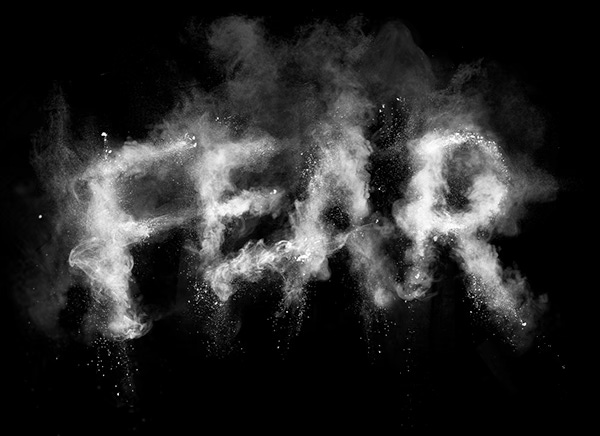
Two memorable quotes about fear occur to me. One is from Master Po from “Kung Fu” who said, Fear is the only darkness. And then Frank Herbert from “Dune”: Fear is the mind-killer. And of course FDR who told us at the height of the Great Depression that the only thing we had to fear is fear itself.
It’s an incredible disservice to the American people for both candidates to be stoking fear. What cowardice by both the Blue and Red Teams!
That’s yet another reason why I like third parties and why Jill Stein and the Green Party appeal to me. Stein presents a positive vision of the future, a more peaceful one, one in which Americans come together to tackle common problems like climate change, health care, infrastructure, and the like.
I refuse to vote for parties and candidates that stoke fear, that promote darkness and that seek to kill my mind.
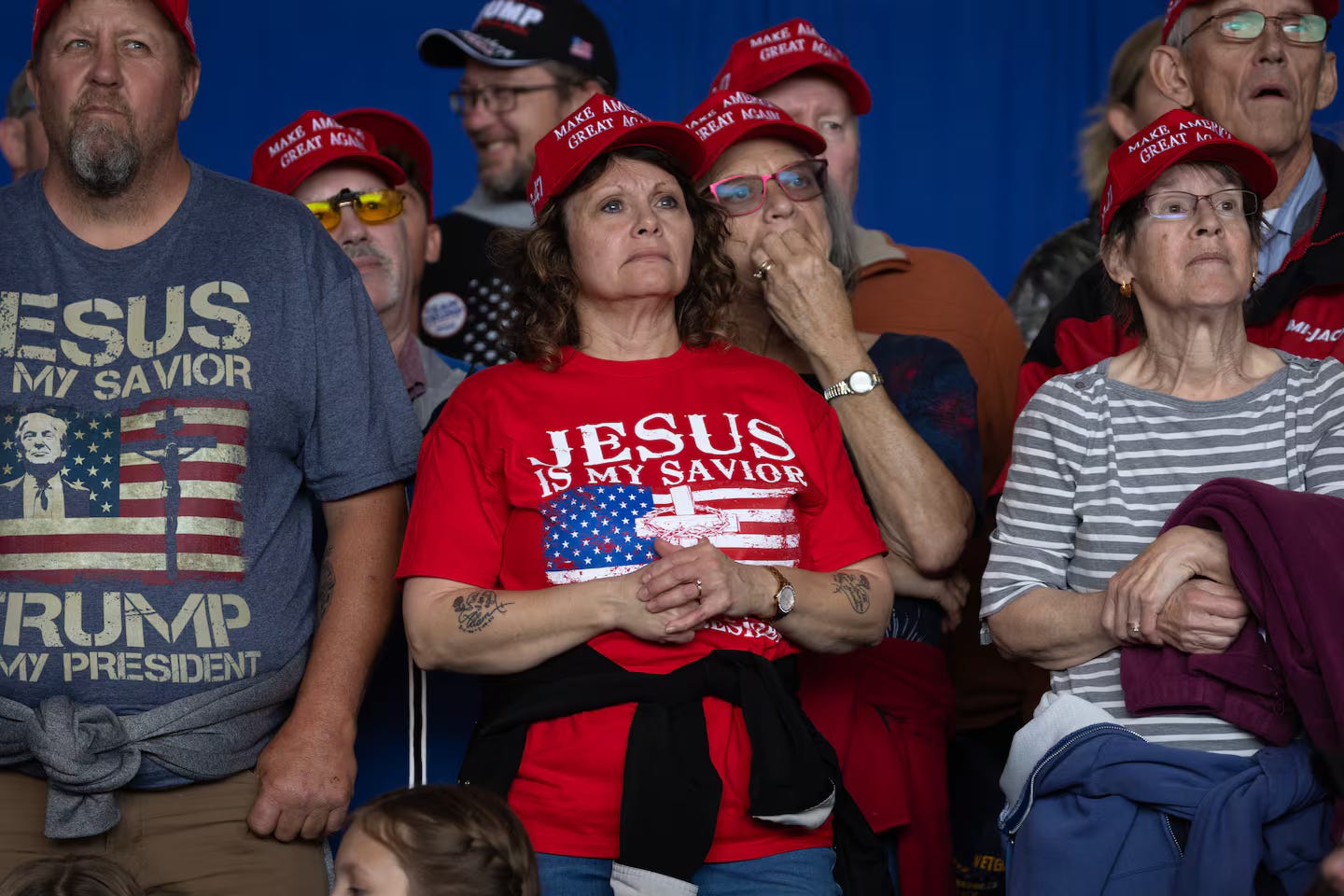
Trump supporters at a rally in Wisconsin (Scott Olson/Getty)
Sorry, Democrats and Republicans: I’m not going “back” to you and your fear.
The latest fear-raising fundraising letter from President Biden
I got another fundraising letter from Joe Biden and it’s a doozy. The words “extreme” and “extremist” are used a dozen times to describe MAGA Republicans. Other words used to describe Trump and MAGA include dangerous, threats, vengeance, vindictiveness, trample (“the American way of life as we know it”), and smashed (as in a MAGA movement that allegedly seeks to smash and destroy democracy).
Now, I’m no fan of Trump. He’s a con man, not a public servant, and I won’t vote for him. Even so, this Biden fundraising letter is the equivalent of promising a bloodbath if Trump gets elected again later this year.
I can’t recall a presidential campaign like the Biden/Harris effort. Its message is almost entirely negative. It’s based on fear. Fear of Trump, fear of MAGA, fear of “extremism.” There’s almost no hope and no promise of substantive changes for the better. It’s a singular message: Vote for Joe because Trump and his followers are very very bad.
This latest fundraising letter embraces Hillary Clinton’s rhetoric that Trump’s followers are irredeemable deplorables. It encourages Americans to fear their neighbors if they happen to wear a MAGA cap and support Trump. It stokes division rather than encouraging unity. And I simply don’t think it’s effective politics.
Biden’s message is simple: Vote for me because the other guy is even worse. Now I’m seeing claims from the Democrats that Trump is even more physically enfeebled and mentally confused than Biden.
If Biden loses this November, surely it will be due to a campaign that has no compelling and positive message to motivate and inspire people to vote for him. It’s just not enough, I think, to run on a message of fear.
“A Ministry of Risk” is a new book on Philip Berrigan that gathers his “writings on peace and nonviolence.” It’s edited by Brad Wolf, who has helped to lead the ongoing “Merchants of Death” war crimes tribunal against the vast profiteering of America’s military-industrial complex. (Full disclosure: I participated in the tribunal and blurbed the book.)
The Berrigan brothers, Phil and Dan, fought courageously against war and for peace, coming from a deeply felt Catholicism centered in Christ’s teachings, e.g. blessed are the peacemakers, for they shall be called the children of God. I previously wrote about Dan Berrigan and his spirited protest against the Vietnam War as part of the Catonsville Nine. Phil was equally devoted to peace, being a Christian witness against America’s deep-seated culture of war and other forms of violence.
Phil wrote with great eloquence about the need to change America, and his short entry on “Liberation from Fear” in 1969 from New Politics vividly shows the brilliance of his insights. I’ve written before about the salience of fear in America and the need to counter it. Given my own peculiar interests, I’ve cited a powerful saying from “Dune” that “fear is the mind-killer” as well as the words of Master Po from “Kung Fu” that “fear is the only darkness.”
This is what Phil Berrigan had to say about fear, love, and the need for a revolution in America, not, hopefully, a violent revolution, but a complete change in values:
As for myself [wrote Berrigan], I fail to see how a society can be thrown into revolution except through massive civil disobedience, which in the case of America means that domestic and foreign business is rendered unprofitable, and hence inoperable. And I fail to see how extensive civil disobedience can be an effective factor unless the movement is built of people who are less concerned about power and more about justice; who are fearless but not rash; who are disciplined but not bureaucratic; who are patient but not dilatory; who are moral but not moralistic—in private and in public.
But above all, a movement must be built of those who would risk the jaws of the Beast, not in the prospect of being torn alive but rather in trust of their own weapons—truth, justice, freedom, love. Revolution is a time of personal and public purification if it is truly revolution, and the liberation principally sought after is a liberation from fear. Doesn’t Scripture say something about perfect love casting out fear? Which may suggest that the chief obstacle to revolution is fear, or the fear to love. And revolution without vast resources of love will be a bloodbath and, at best, a mere shift in power.
These words pulse with meaning and insight. America needs a revolution, and one based on love is the one least likely to end in a violent bloodbath. Marianne Williamson, to her credit, campaigned on a message of love four years ago to counter the fear she saw being stoked by candidates like Donald Trump. She wasn’t wrong about this.
A progressive Pentagon? Talk about an oxymoron! The Pentagon continues to grow and surge with ever larger budgets, ever more expansive missions (for example, a Space Force to dominate the heavens and yet more bases in the Pacific to encircle China), and ever greater ambitions to dominate everywhere, including if necessary through global thermonuclear warfare. No wonder it’s so hard, to the point of absurdity, to imagine a Pentagon that would humbly and faithfully serve only the interests of “national defense.”
Yet, as a thought experiment, why not imagine it? What would a progressive Pentagon look like? I’m not talking about a “woke” Pentagon that touts and celebrates its “diversity,” including its belated acceptance of LGBTQ+ members. I’m glad the Pentagon is arguably more diverse and tolerant now than when I served in the Air Force beginning in the early 1980s. Yet, as a popular meme has it, painting “Black Lives Matter” and rainbow flags on B-52 bombers doesn’t make the bombs dropped any less destructive. To be specific: Was it really a progressive milestone that the combat aircraft in last year’s Super Bowl flyover were operated and maintained entirely by female crews? Put differently, are the bullets and bombs of trans Black G.I. Jane somehow more tolerant and less deadly than cis White G.I. Joe’s?
A progressive military shouldn’t stop with “more Black faces in high places,” more female generals “leaning in” around conference tables, and similar so-called triumphs for diversity. Consider Lloyd Austin, the first Black secretary of defense, whose views and actions have been little different from those of former Defense Secretaries James Mattis or Donald Rumsfeld, and whose background as a retired Army four-star general and well-paid former board member of Raytheon makes him the very stereotype of Dwight D. Eisenhower’s military-industrial complex.
No, all-female air crews aren’t nearly enough. Indeed, they are, I’d argue, a form of “woke” camouflage for a predatory military leopard that refuses to change its spots — or curb its appetite.
A truly progressive military should start with the fundamentals. All service members swear an oath to support and defend the Constitution, the system of laws that defines and enshrines our vital rights and freedoms (speech, a free press, the right to assemble, privacy, and so on); in short, the right to live untrammeled by domineering forces. Yet, almost by definition, that right is threatened, if not violated, by a massive military-industrial-congressional complex that penetrates nearly every domain of American life. That complex, after all, is anti-democratic, shrouded in secrecy, and jealous of its power, as well as fundamentally and profoundly anti-progressive. Indeed, it’s fundamentally and profoundly anti-truth.
Consider these hard facts. All too many Americans didn’t know how badly they’d been lied to about the Vietnam War until the Pentagon Papers emerged near the end of that disastrous conflict. All too many Americans didn’t know how badly they’d been lied to about the Afghan War until the Afghan War Papers emerged near the end of that disastrous conflict. All too many Americans didn’t know how badly they’d been lied to about the Iraq War until the myth of Saddam Hussein’s weapons of mass destruction (which had been part of the bogus rationale for invading that country) crumbled; nor did they know how badly they continued to be lied to until the myth of the American “surge” there collapsed when the Islamic State forces triumphed all too easily over an American-built Iraqi security structure that collapsed like a rotten house of cards. Perhaps some of them didn’t truly know until a loudmouthed Republican candidate for president, Donald J. Trump, dared to say that the Iraq War had been an unmitigated disaster, or, in Trump-speak, “a big fat mistake.” That burst of honesty helped him win the presidency in 2016. (His rival in that election, Hillary Clinton, remained essentially the chief spokesperson for the Pentagon.)
Yet despite the horrendous failures (and war crimes) of Vietnam, Afghanistan, Iraq, and other U.S. military ventures of this century, no one is ever punished! Sure, you could point to Donald Rumsfeld being cashiered as secretary of defense amid the rubble of “the Global War on Terror,” a belated admission by the administration of President George W. Bush and Vice President Dick Cheney that the Iraq War was going poorly indeed. Still, all those cracks were later papered over with the myth of “the surge” and when Rumsfeld died in 2021, he would receive remarkably glowing tributes in obituaries, as well as bipartisan salutes for his “service” to America rather than condemnation for his numerous crimes and blunders.
The Pentagon’s rampant culture of dishonesty, a cancer that above all infects the brass, led one serving Army officer, Lieutenant Colonel Paul Yingling, to write a now-renowned (or, if you’re part of the Pentagon, infamous) paper for Armed Forces Journal in 2007 on America’s failure of generalship. As he memorably noted, a U.S. Army private suffered far more dearly for losing a rifle than America’s generals did for losing a war. The Army’s response was — no surprise — to change nothing, leading Yingling to retire early.
13 Tasks for a Progressive Pentagon
Venturing into the Pentagon’s innermost corridors of power, one might be excused for recalling Obi-Wan Kenobi’s warning to Luke Skywalker in Star Wars as they approached the spaceport of Mos Eisley: “You will never find a more wretched hive of scum and villainy. We must be cautious.”
How does one possibly reform such a top-heavy, self-serving, and dishonest institution along progressive lines? A moment in Greek mythology comes to mind: Hercules and the Augean Stables. Let me nevertheless press ahead with this all too herculean task.
Dreaming is free, as Blondie once sang, so why not dream a little dream with me? Here’s a list — a baker’s dozen, in fact — of ways a progressive Pentagon would both exist and act far differently from America’s current regressive (and very, very aggressive) version of the same.
A progressive Pentagon would:
* Take the lead in working to eliminate all nuclear weapons everywhere — that is, total nuclear disarmament — rather than investing vast sums in the coming decades in the U.S. nuclear arsenal. It would disavow using nuclear weapons first (“no first use”) in any conflict. It would cancel all plans to “modernize” the current nuclear triad of missiles, planes, and submarines at an estimated cost of $2 trillion. It would also immediately eliminate obsolete and vulnerable land-based Intercontinental Ballistic Missiles, or ICBMs, and cancel as redundant the Air Force’s new B-21 stealth bomber.
* Oppose sending any more of those devastating cluster munitions or depleted uranium tank shells to Ukraine; indeed, it would take the lead in eliminating such awful weaponry.
* Stop inflating threats and end all talk of a “new Cold War” with China and Russia.
* Celebrate the insights of Generals Smedley Butler and Dwight D. Eisenhower that war is fundamentally a racket (Butler) and that the military-industrial-congressional complex poses the severest of threats to freedom and democracy in America (President Eisenhower).
* Reject the language of militarism, including describing its troops as “warriors” and “warfighters,” as profoundly undemocratic and un-American.
* Recognize the costs of wars already fought to those troops and ensure full funding of the Department of Veterans Affairs, including for post-traumatic stress disorder (PTSD), traumatic brain injury (TBI), and moral injuries, among the other wounds of war.
* End the war on terror, launched just after the attacks of September 11, 2001, and urge Congress to repeal the open-ended war authorization it passed then with but a single dissenting vote, because war itself is terror.
* Refuse to go to war unless there’s a formal congressional declaration of the same as the Constitution demands. If the United States had followed that rule, the last war we would have fought was World War II.
* Reject its present culture of secrecy as profoundly counterproductive to success not just in war but in general. That doesn’t mean, of course, sharing specific battle plans (of which there should be far fewer) or detailed information about weaponry with potential enemies. It does mean a willingness to speak truth to the American people, whose support would be needed to prosecute any genuinely necessary war, assuming there even is such a thing.
* Embrace honor and integrity including a willingness of the U.S. military to fall on its own sword — that is, take genuine responsibility for both its deeds and its misdeeds.
* Recognize that one cannot serve both a republic and an empire, that a choice must be made, and that a Pentagon of the present kind in a genuine republic would voluntarily downsize itself, while largely dismantling its imperial infrastructure of perhaps 800 overseas bases.
* Lead the way in demilitarizing space, including eliminating America’s fledgling Space Force and its “guardians.”
* Clearly acknowledge that large, standing militaries and constant wars, as well as preparations for more of the same, are corrosive to democracy, liberty, and the Constitution, as America’s founders recognized.
Imagine that! A progressive Pentagon of peace rather than a regressive one of power and unending warfare. You may say I’m a dreamer, but I’m not the only one.
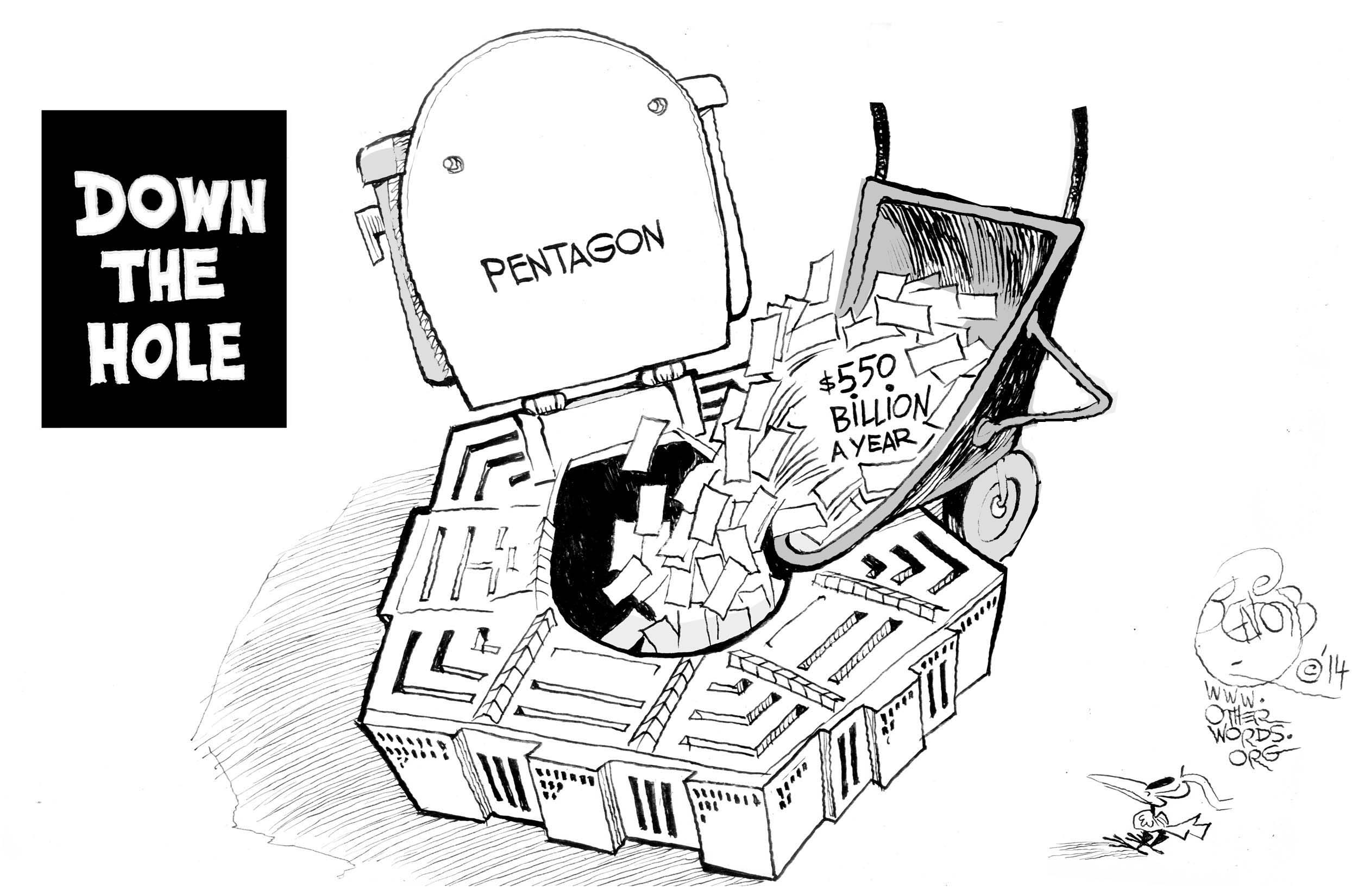
What was $550 billion down the crapper in 2014 is approaching $900 billion a decade later
Three Maxims for a Progressive Pentagon
Careful readers won’t be surprised to learn that I was an early Star Wars fan. Naturally, I rooted for the underdog rebels against the evil empire and its henchman, Darth Vader. I saw myself as a potential Jedi Knight, wielding an elegant weapon, a protector of freedom and the republic. (In my defense, I was 14 years old in 1977 when I first saw Star Wars.)
Then, in 1980, I watched The Empire Strikes Back, just as I was pursuing an Air Force ROTC scholarship for college. I heard Yoda, the Jedi master, declare to Luke that “wars not make one great.” That pearl of wisdom floored me then and continues to inform my life.
I’ve read my share of “heavy” philosophy and have the academic credentials to pose as a “serious” enough thinker. Yet I come back to the homespun wisdom captured in certain movies and TV shows that still carries weight for me. Let me share bits of such wisdom with you.
The first is from Kung Fu, the 1970s TV series starring David Carradine. As a young Kwai Chang Caine meets Master Po for the first time, he is astonished to discover that his master is blind. He takes pity on Po, suggesting that his life must be one of endless darkness. Master Po instantly corrects him. “Fear,” he says, “is the only darkness.”
The second is from The Outlaw Josey Wales, a classic western starring Clint Eastwood, also from the 1970s. Josey Wales is a renegade, a wanted man who leaves dead bodies in his wake wherever he travels. Yet he’s also tired of killing, a man in search of peace. In a moving scene, he negotiates just such a peace with Ten Bears, a Comanche chief, saying that there must be a way for people to live together without butchering one another, without constant bloodletting, without race-based hatreds.
A progressive Pentagon would recognize the deep truth of those three maxims: that wars not make one great, that fear is the only darkness, and that there’s a better way for people to live together than constantly butchering one another.
As a Catholic youth, I was taught that the beginning of wisdom is the fear of God. Today, I’d put that differently. The beginning of wisdom is the quest to master one’s fear, the urge to turn away from fear-driven hatreds, to find better, more pacific, more loving ways.
At the core of the original Star Wars trilogy, George Lucas implanted a message that anger, fear, aggression, and violence — the “dark side” of the Force, as he put it — should be resisted. As Darth Vader confesses to Luke, the power of that dark side is nearly irresistible. Fear and related negative emotions, eerily seductive as they are, can consume our minds (and, as it turns out, given the Pentagon budget, our taxpayer dollars as well).
Too many Americans are prey to the dark side, allowing fear to be the mind-killer. It’s not entirely our fault. From the end of World War II until this very moment, we’ve been told time and again to fear — and fear some more. Fear the communists in Korea and Vietnam. Fear Saddam Hussein and his weapons of mass destruction in Iraq. Fear Russia and its Hitleresque leader, Vladimir Putin. Fear China and its growing authoritarian power. Closer to home, we’re even now regularly told to fear our neighbors, MAGA or “woke,” depending on your “blue” or “red” team allegiance.
In truth, though, fear is the true darkness. You shouldn’t have to be a Jedi master to know that wars not make one great, that the darkness of fear (and arming ourselves against it) is a path to hell, and that people could indeed live together without eternally slaughtering one another. Those, then, would be my three maxims for a newly progressive Pentagon.
To echo the words of Steven Tyler of Aerosmith: Dream until your dreams come true.
Its biggest advantage is that it knows what it wants
The military-industrial-congressional complex (MICC) has a huge advantage over its critics. Its proponents are united by greed and power. They know exactly what they want. Like Johnny Rocco in “Key Largo,” they want MORE. More money. More authority. And obviously more weapons and more war.
Whereas critics of the MICC tend to approach the beast from different angles with different emphases. Tactical differences lead to fissures. Fissures prevent coalitions from forming. Unity is lacking, and not for want of trying. And so the MICC rumbles on, unchallenged by any societal force that is remotely its size.
A colleague of mine, Dennis Showalter, was fond of a saying that helps to explain the situation. Critics and intellectuals, he said, have a propensity to see the fourth side of every three-sided problem. Analysis leads to paralysis. The tyranny of small differences prevents unanimity of purpose.
Dennis Showalter, a fine historian and a better friend.
Another key strength of the MICC is reflected in an alternate acronym: the MICIMATT, which adds the intelligence “community,” the mainstream media, academe, and various think tanks to the military, industry, and Congress. To that we might also add the world of sports, entertainment (Hollywood and TV especially), and the very idea of patriotism in America with all its potent symbols. I’d even add Christianity here, the muscular version practiced in the U.S. rather than the compassionate version promulgated by Christ.
When you focus just on the MICC, you miss the wellsprings of its power. It’s not just about greed and authority, it’s about full-spectrum dominance of all aspects of American life and society.
America hasn’t won a major war since World War II, but the MICC has won the struggle for societal dominance in America. Serious challenges to it will require Americans to put aside differences in the name of a greater cause of peace and sanity. The wildcard here, of course, is the ever-present hyping of fear by the MICC.
FDR told Americans the only thing we truly needed to fear was fear itself. Fear paralyzes the mind and inhibits action. Fear is the only darkness, Master Po said in “Kung Fu.”
If we can overcome our fear and our differences to focus on building a more compassionate world, a world in harmony with nature and life, then maybe, just maybe, we can see the foolishness of funding and embracing an MICC based on an unnatural pursuit of destruction and death.
Shootings are all over the news today. A young woman killed in rural New York when she drove up the wrong driveway and the owner of the house came out blasting. A Black teenager shot and wounded when he mixed up an address and knocked on the wrong door in Kansas City. And a news flash from The Boston Globe this PM reporting that at least four people have been killed and three more wounded in two shootings in Maine.
America has so many deadly shootings on a daily basis that they hardly qualify as news anymore. What gives?
Ralph Yarl, shot and wounded when he mixed up an addressKaylin Gillis, shot and killed in rural NY
No guns, no shootings, of course, but America is awash in guns, and no one is going to pry them from the hands of those who want them.
You’d think brandishing a gun would be enough of a threat, but far too often, those who have guns seem eager to use them as well. Why shoot at a car that pulls in your driveway, even as the car is turning around and leaving? Why shoot at a young Black man for simply walking up and knocking on the door? In both cases, the shooters pulled the trigger at least twice, and apparently used no warning shots or for that matter any other kind of warning. It’s shoot first, ask questions later, in this man’s America.
There’s a weird toxic brew at work here, I think. First, the guns themselves. I’ve fired plenty of them and they do give you a feeling of power. Second, fear. People are fearful. Sometimes the fear may be race-based, sometimes it’s something else, but there’s nothing like fear to paralyze the mind. Then there’s a fantasy element. Some people, mostly men I’m guessing, think they’re akin to Dirty Harry, blowing away bad people with their guns. Finally, sadly, some people just find guns to be fun, even when they’re pointing them at other people.
I know it’s more complicated than this, but fear, fantasy, and fun don’t mix well with guns. In America, guns are WMD: weapons of mass destruction. Because of their deadly power, they should be used only in the rarest of circumstances and as a last resort.
Yet Americans seem to be grabbing their guns and blasting away as a first resort and with no remorse.
Stay safe out there. And to those with guns, why not just call 911? Or keep your door locked? Do you really want to take the life of an innocent just because you felt afraid or angry and fancied yourself a vigilante?
Perhaps America, Home of the Brave, Simply Fears Too Much
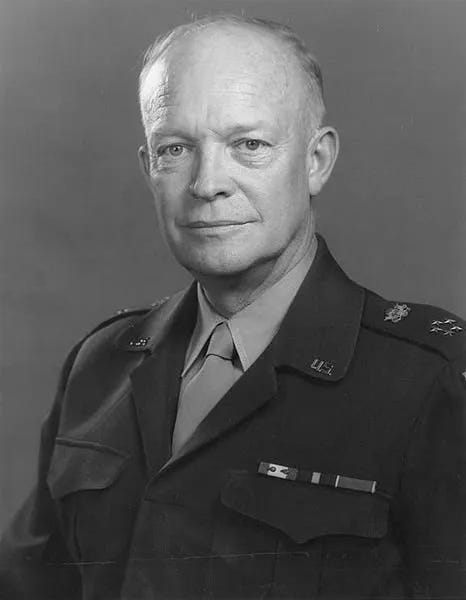
In 1961, in his famous farewell address, President Dwight D. Eisenhower warned America about the military-industrial complex. He said it potentially posed a grave threat to liberty and democracy, noting that only an alert and knowledgable citizenry could keep its “disastrous rise” in check. In an earlier draft of his speech, Ike had included Congress as part of the complex, but he removed it from the final draft in the interest of parting with Congress on good terms.
Ike, of course, knew the military and loved it and had worked with industry as well. He knew of what he spoke. Every year when he was president, the military wanted more. So did the weapons manufacturers. And Congress was willing to give them more in the name of jobs and for that nebulous cause of national security. Ike did a decent job as president containing the ambitions of the military and the greed of America’s merchants of death. His speech in 1961 was his parting shot across the bow of the complex and a warning that’s largely been forgotten by Americans then and now.
Ike, I think, would be dismayed but not shocked at how the military-industrial complex or MIC has expanded its “misplaced” power over the last sixty years. The MIC is now the MICIMATT, or the military industrial congressional intelligence media academia think tank complex, employing millions of Americans in pursuit of full-spectrum dominance across the globe. In fact, America has proudly become a warrior nation (the citizen-soldier ideal is long dead) with 750 bases around the world and military budgets that routinely touch or exceed a trillion dollars. Permanent war is the new normal in America, justified as always in terms of making the world safe for democracy.
In the spirit of Ike, we should recognize the military or industry or Congress alone is not the enemy. It’s the conjunction of an immense military establishment with powerful industrial interests, and the enabling of the same by Congress, that needs to be addressed and reformed.
Yet, given its enormity and its power, the complex is remarkably resistant to change, let alone to being shrunk and weakened. It will take enormous national will, working against powerful propaganda forces that will paint every Pentagon budget reduction, large or small, as unsafe if not un-American.
So why did Ike fail? Or why did we fail Ike? He warned us in 1961. Why have we as “an alert and knowledgable citizenry” failed to guard against the acquisition of “disastrous” power by the MIC?
For the truth is America has become an Orwellian country where war is peace. War (or preparations for war) has been continuous since Ike’s speech. Our government wages war in the alleged cause of peace. It acts imperially in the name of democracy, and we collectively accept or tolerate the tale that Big Brother tells us.
Short of a revolution, what America needs is radical honesty. An awakening. If we truly want as a people to pursue peace, we can’t do that by constantly waging war. If we truly favor democracy, we can’t pursue one through militarism and imperialism.
What kind of nation — what kind of people — do we want to be? Judging by our federal discretionary budget and by the general affection for all things military in our nation, perhaps we want to be a bellicose empire. I’m not saying all Americans want this; even those who do probably wouldn’t state it so baldly. But maybe this is just who we are, a nation and a people convinced that it’s always at risk, and thus one that’s forever fearful, hyper-vigilant, coiled to strike and ready to rumble.
“Quite an experience to live in fear, isn’t it? That’s what it is to be a slave.” So says Roy Batty, the doomed replicant in Blade Runner, played so brilliantly by Rutger Hauer. There’s a lesson here for all of us. The first step to heeding Ike’s warning, as well as his marching orders to us, is to control our collective fear. To stop listening to threat inflation about China or Russia or Iran or terrorism or whatever. Fear is the mind-killer, Frank Herbert noted in Dune, thus to think freely requires us to master that which kills thought. Fear, Master Po said in Kung Fu, is the only darkness.
We will only begin to downsize the military-industrial complex and end our pursuit of militarism when we acknowledge our fear, stop being slaves to it, and head away from the darkness.
America is the home of the brave, so we say. Isn’t it time we acted like it?
There’s way too much fear mongering in America, which helps to drive the paranoid nature of U.S. foreign and domestic policy. This is the subject of my latest article at TomDispatch.com, which I’ve included below in its entirety. If you don’t read TomDispatch, I urge you to subscribe (top right corner on the home page). Tom Engelhardt has been running the site for 20 years (I’ve been writing for it for 15 of them), and I’ve found the content to be stimulating and thought-provoking. Many thanks for your continued interest in “Bracing Views” as well, which, I joke to Tom, is a little like a baby TomDispatch.
Dystopia, Not Democracy
I have a brother with chronic schizophrenia. He had his first severe catatonic episode when he was 16 years old and I was 10. Later, he suffered from auditory hallucinations and heard voices saying nasty things to him. I remember my father reassuring him that the voices weren’t real and asking him whether he could ignore them. Sadly, it’s not that simple.
That conversation between my father and brother has been on my mind, as I’ve been experiencing America’s increasingly divided, almost schizoid, version of social discourse. It’s as if this country were suffering from some set of collective auditory hallucinations whose lead feature was nastiness.
Take cover! We’re being threatened by a revived red(dish) menace from a “rogue” Russia! A “Yellow peril” from China! Iran with a nuke! And then there are the alleged threats at home. “Groomers”! MAGA kooks! And on and on.
Of course, America continues to face actual threats to its security and domestic tranquility. Here at home that would include regular mass shootings; controversial decisions by an openly partisan Supreme Court; the Capitol riot that the House January 6th select committee has repeatedly reminded us about; and growing uncertainty when it comes to what, if anything, still unifies these once United States. All this has Americans increasingly vexed and stressed.
Meanwhile, internationally, wars and rumors of war continue to be a constant plague, made worse by the exaggeration of threats to national security. History teaches us that such threats have sometimes not just been inflated but created ex nihilo. Those would, for instance, include the non-existent Gulf of Tonkin attack cited as the justification for a major military escalation of the war in Vietnam in 1965 or those non-existent weapons of mass destruction in Iraq used to justify the 2003 U.S. invasion of that country.
All this and more is combining to create a paranoid and increasingly violent country, an America deeply fearful and perpetually thinking about warring on other peoples as well as on itself.
My brother’s doctors treated him as best they could with various drugs and electroshock therapy. Crude as that treatment regimen was then (and remains today), it did help him cope. But what if his doctors, instead of trying to reduce his symptoms, had conspired to amplify them? Indeed, what if they had told him that he should listen to those voices and so aggravate his fears? What if they had advised him that sanity meant arming himself against those very voices? Wouldn’t we, then or now, have said that they were guilty of the worst form of medical malpractice?
And isn’t that, by analogy, true of America’s leaders in these years, as they’ve driven this society to be ever less trusting and more fearful in the name of protecting and advancing their wealth, power, and security?
Fear Is the Mind-Killer
If you’re plugged into the mental matrix that’s America in 2022, you’re constantly exposed to fear. Fear, as Frank Herbert wrote in Dune, is the mind-killer. The voices around us encourage it. Fear your MAGA-hat-wearing neighbor with his steroidal truck and his sizeable collection of guns as he supposedly plots a coup against America. Alternately, fear your “libtard” neighbor with her rainbow peace flag as she allegedly plots to confiscate your guns and brainwash your kids. Small wonder that more than 37 million Americans take antidepressants, roughly one in nine of us, or that, in 2016, this country accounted for 80% of the global market for opioid prescriptions.
A climate of fear has led to 43 million new guns being purchased by Americans in 2020 and 2021 in a land singularly awash in more than 400 million firearms, including more than 20 million assault rifles. A climate of fear has led to police forces being heavily militarized and fully funded rather than “defunded” (which actually would mean a bit less money going to the police and a bit more to non-violent options like counseling and mental-health services). A climate of fear has led Democrats and Republicans in the House of Representatives who can agree on little else to vote almost unanimously to fork over $840 billion to the Pentagon in Fiscal Year 2023 for yet more wars and murderous weaponry. (Of course, the true budget for what is still coyly called “national defense” will soar well above a trillion dollars then, as it often has since 9/11/2001 and the announcement of a “global war on terror.”)
The idea that enemies are everywhere is, of course, useful if you’re seeking to create a heavily armed and militarized form of insanity.
It’s summer and these days it just couldn’t be hotter, so perhaps you’ll allow me to riff briefly about a scene I’ve never forgotten from The Big Red One, a war film I saw in 1980. It involved a World War II firefight between American and German troops in a Belgian insane asylum during which one of the mental patients picks up a submachine gun and starts blasting away, shouting, “I am one of you. I am sane!” In 2022, sign him up and give him a battlefield commission.
Where fear is omnipresent and violence becomes routinized and normalized, what you end up with is dystopia, not democracy.
We Must Not Be Friends but Enemies
At this point, consider us to be in a distinctly upside-down world. Reverse Abraham Lincoln’s moving plea to Southern secessionists in his first inaugural address in 1861 — “We must not be enemies but friends. We must not be enemies” — and you’ve summed up all too well our domestic and foreign policy today. No, we’re neither in a civil war nor a world war yet, but America’s national (in)security state does continue to insist that virtually every rival to our imperial being must be transformed into an enemy, whether it’s Russia, China, or much of the Middle East. Enemies are everywhere and must be feared, or so we’re repetitiously told anyway.
I remember well the time in 1991-1992 when the Soviet Union collapsed and America emerged as the sole victorious superpower of the Cold War. I was a captain then, teaching history at the U.S. Air Force Academy. Those were also the years when, even without the Soviet Union, the militarization of this society somehow never seemed to end. Not long after, in launching a conflict against Saddam Hussein’s Iraq, this country officially kicked ass in the Middle East and President George H.W. Bush assured Americans that, by going to war again, we had also kicked our “Vietnam Syndrome” once and for all. Little did we guess then that two deeply destructive and wasteful quagmire wars, entirely unnecessary for our national defense, awaited us in Afghanistan and Iraq in the century to come.
Never has a country squandered victory — and a genuinely global victory at that! — so completely as ours has over the last 30 years. And yet there are few in power who consider altering the fearful course we’re still on.
A significant culprit here is the military-industrial-congressional complex that President Dwight D. Eisenhower warned Americans about in his farewell address in 1961. But there’s more to it than that. The United States has, it seems, always reveled in violence, possibly as an antidote to being consumed by fear. Yet the intensity of both violence and fear seems to be soaring. Yes, our leaders clearly exaggerated the Soviet threat during the Cold War, but at least there was indeed a threat. Vladimir Putin’s Russia isn’t close to being in the same league, yet they’ve treated his war with Ukraine as if it were an attack on California or Texas. (That and the Pentagon budget may be the only things the two parties can mostly agree on.)
Recall that, after the collapse of the Soviet Union, Russia was in horrible shape, a toothless, clawless bear, suffering in its cage. Instead of trying to help, our leaders decided to mistreat it further. To shrink its cage by expanding NATO. To torment it through various forms of economic exploitation and financial appropriation. “Russia Is Finished” declared the cover article of the Atlantic Monthly in May 2001, and no one in America seemed faintly concerned. Mercy and compassion were in short supply as all seemed right with the “sole superpower” of Planet Earth.
Now the Russian Bear is back — more menacing than ever, we’re told. Marked as “finished” two decades ago, that country is supposedly on the march again, not just in its invasion of Ukraine but in President Vladimir Putin’s alleged quest for a new Russian empire. Instead of Peter the Great, we now have Putin the Great glowering at Europe — unless, that is, America stands firm and fights bravely to the last Ukrainian.
Add to that ever-fiercer warnings about a resurgent China that echo the racist “Yellow Peril” tropes of more than a century ago. Why, for example, must President Joe Biden speak of China as a competitor and threat rather than as a trade partner and potential ally? Even anti-communist zealot Richard Nixon went to China during his presidency and made nice with Chairman Mao, if only to complicate matters for the Soviet Union.
If imperial America were willing to share the world on roughly equal terms, Russia and China could be “near-peer” friends instead of, in the Pentagon phrase of the moment, “near-peer adversaries.” Perhaps they could even be allies of a kind, rather than rivals always on the cusp of what might potentially become a world-ending war. But the voices that seek access to our heads prefer to whisper sneakily of enemies rather than calmly of potential allies in creating a better planet.
And yet, guess what, whether anyone in Washington admits it or not: we’re already rather friendly with (as well as heavily dependent on) China. Here are just two recent examples from my own mundane life. I ordered a fan — it’s hot as I type these words in my decidedly unairconditioned office — from AAFES, a department store of sorts that serves members of the military, in service or retired, and their families. It came a few days later at an affordable price. As I put it together, I saw the label: “Made in China.” Thank you for the cooling breeze, Xi Jinping!
Then I decided to order a Henley shirt from Jockey, a name with a thoroughly American pedigree. You guessed it! That shirt was plainly marked “Made in China.” (Jockey, to its credit, does have a “Made in America” collection and I got two white cotton t-shirts from it.) You get my point: the American consumer would be lost without China, the present workhouse for the world.
You’d think a war, or even a new Cold War, with America’s number-one provider of stuff of every sort would be dumb, but no one is going to lose any bets by underestimating how dumb Americans can be. Otherwise, how can you explain Donald Trump? And not just his presidency either. What about his “Trump steaks,” “Trump university,” even “Trump vodka”? After all, who could be relied upon to know more about the quality of vodka than a man who refuses to drink it?
Learning from Charlie Brown
Returning to fears and psychiatric help, one of my favorite scenes is from “A Charlie Brown Christmas.” In that classic 1965 cartoon holiday special, Lucy ostensibly tries to help Charlie with his seasonal depression by labeling what ails him. The wannabe shrink goes through a short list of phobias until she lands on “pantophobia,” which she defines as “the fear of everything.” Charlie Brown shouts, “That’s it!”
Deep down, he knows perfectly well that he isn’t afraid of everything. What he doesn’t know, however, and what that cartoon is eager to show us, is how he can snap out of his mental funk. All that he needs is a little love, a little hands-on kindness from the other children.
America writ large today is, to my mind, a little like Charlie Brown — down in the dumps, bedraggled, having lost a clear sense of what life in our country should be all about. We need to come together and share a measure of compassion and love. Except our Lucys aren’t trying to lend a hand at the “psychiatric help” stand. They’re trying to persuade us that pantophobia, the fear of everything, is normal, even laudable. Their voices keep telling us to fear — and fear some more.
It’s not easy, America, to tune those voices out. My brother could tell you that. At times, he needed an asylum to escape them. What he needed most, though, was love or at least some good will and understanding from his fellow humans. What he didn’t need was more fear and neither do we. We — most of us anyway — still believe ourselves to be the “sane” ones. So why do we continue to tolerate leaders, institutions, and whole political parties intent on eroding our sanity and exploiting our fears in service of their own power and perks?
Remember that mental patient in The Big Red One, who picks up a gun and starts blasting people while crying that he’s “sane”? We’ll know we’re on the path to sanity when we finally master our fear, put down our guns, and stop eternally preparing to blast people at home and abroad.
The Republican National Convention is over. Its main message: be afraid. Be very afraid. Of socialism. Of people coming to take your guns. Of open borders. Of anarchy in the street. Of “cancel culture.” And so on.
Its ancillary message: the Democrats are not a rival party of patriotic Americans. They are dangerous. Dishonest. Scheming. And un-American.
In last night’s acceptance speech, Trump was his usual huckster and grifter self. Perhaps my favorite claim was when Trump said he’d done more to help black people than any other president, Abraham Lincoln excepted. There’s little doubt that in his own mind Trump believes he’s done more than Lincoln “for the black.”
What can I say that hasn’t already been said about the alternate (un)reality that Trump sells to his acolytes? It’s total BS, it’s fantasy, it’s often hateful or spiteful, but it resonates with certain people, even as it disgusts others.
Trump, among many other things, is a sower of discord. A manufacturer of outrage based on lies and misinformation. But he needs an audience of willing followers, and there are plenty of those in America.
In life, Trump has failed at so many things. I’d argue he has failed miserably as a president, dividing the country instead of uniting it, effectively feeding the rich while starving the poor. Yet the man has captured an entire political party and the fervid support of roughly one-third of those Americans most likely to vote in November.
He has shown us a face of America we’d prefer not to see, a face defined by appetites and grievances and prejudices actuated by violence and fear and lies. But I’d go further. By fomenting violence and fear and lies, Trump has acted not like a true mirror but a funhouse one. He has distorted America. He has made it more grotesque. He has twisted it and contorted it and made it more like him.
In short, he has made his mark on the face of America. And that mark will be a very difficult one to erase.
President Trump claims the USA is being invaded. “Masses of illegal aliens” are going to “overrun” America. “Giant” caravans. Bad people from Central America. Fear them!
Isn’t it amazing that a nation of over 300 million people — which claims to have “the world’s finest fighting force” in all of history — fears an “invasion” by a few thousand desperate people, mainly women and children, who most likely would be happy cleaning toilets and doing other jobs that most Americans believe are beneath them?
This election cycle seems like a gloss on the “The Empire Strikes Back,” with the Dark Side of the Force triumphing on the Republican side. As Yoda the Jedi Master put it, “anger, fear, aggression.” They are “quicker, easier, more seductive” than the good side.
Trump and his minions know this. They know what stirs up his base and drives them to the polls to vote.
Trump is more opportunistic grifter than evil Sith Lord, but he’s stirring up anger, fear, aggression among voters to sustain his power.
Is the Dark Side stronger? We’ll soon see.
Update (11/4/18): A U.S. military report suggests that most of the several thousand people currently in the caravan in Mexico are unlikely to reach the U.S. border. To face down the roughly one thousand people who are likely to reach the border and apply legally for asylum, Trump is deploying roughly 15,000 troops while threatening that rock-throwers will be met by Army bullets.
This isn’t tough-talking; it’s irresponsible, it’s inflammatory, it’s even bat-shit crazy. Will bat-shit crazy work for Trump? Stay tuned: same bat-time, same bat-channel.









 Bracing Views