Declaring Our Independence from War

W.J. Astore

“War is a madhouse”

It’s Independence Day in America, so it seems like a good day to declare our independence from the insanity of war.

Sadly, since the presidency of George W. Bush if not before, it’s become routine for U.S. commanders-in-chief to boast of having the world’s finest military in all of history. Obama did it routinely, and Biden recently said the same during his disastrous debate with Trump. Few Americans stop to think about the implications of boasting about having the world’s greatest military—is such a boast truly consistent with democracy, liberty, and freedom?

Certainly, empires rely on strong militaries. Think of the Roman Empire or the Mongol Empire, or the Third Reich (Empire) of Nazi Germany. Do we want to be like them?

Those empires lived by the sword (quite literally so with the Roman Empire) and died by it as well. Their militaries, I would argue, were also more effective than the U.S. one, which hasn’t won a major war since 1945, the latter with a lot of help from our “friends” like the Soviet Union. The Roman, Mongol, and German empires are no more, worn down in part through the constant costs and demands of war. We need to learn more from history than the “fact” that America’s military is supposedly the world’s best since forever and a day ago.

I’ve been reading Oriana Fallaci’s “Nothing, and So Be It,” in which she recounted her time reporting on the Vietnam War. Two conversations with U.S. troops in Vietnam caught my attention. On pages 22-23, she recounts a conversation with Army Captain Scher, during which Scher confesses his disgust with war: 

God, how disgusting war is. Let me say it—I’m a soldier. People who enjoy making war, who find it glorious and exciting, must have twisted minds. There’s nothing glorious, nothing exciting; it’s just a filthy tragedy you can only cry over. You cry for the man you refused a cigarette to and who didn’t come back with the patrol. You cry for the man you bawled out and who is blown to pieces in front of you. You cry for the man who killed your friends …

Later in the book, she interviews a Marine Lieutenant whose surname is Teanek (pages 174-75). Here’s what he had to say:

Teanek: “Men have been saying that [we should abolish war] for thousands of years, and with the justification that they’re abolishing war, they’ve soaked the greatest periods of their civilization in blood.”

Fallaci: “That’s no good reason to keep on doing it.”

Teanek: “Theoretically, you’re right, but in practice what you’re saying is very silly. It’s like convincing yourself—as I bet you do—that when you describe people dying in war you’re helping to abolish war. On the contrary. The more you see people who’ve been killed in war, the more you want to go on fighting wars: it’s a mystery of the human soul.”

It is indeed “a mystery of the human soul” why we humans persist in killing each other in such vast numbers through war. Of course, it’s partly because we glorify it, when we should recognize, as Fallaci does on page 187, that “War is a madhouse.”

I am sane!

One of my favorite scenes in any war film came in “The Big Red One,” a World War II movie by Samuel Fuller starring Lee Marvin as a grizzled Army sergeant of the 1st Infantry Division. It’s a scene in which U.S. troops liberate an insane asylum.

The unforgettable part of this scene for me is when one of the madhouse residents picks up a submachine gun and starts blasting away, crying “I am one of you. I am sane!”

We need to declare our independence from that.

Liberty at the Point of a Sword

W.J. Astore

Lessons from Napoleon and Hitler

There’s a man who famously crowned himself emperor rather than submit to the otherworldly power of a pope. A new movie will soon be out on his “glories.” Napoleon Bonaparte, a military genius, embraced war and drove for total victory until his empire collapsed on him and the French people. Napoleon’s Waterloo came in 1815, a decade after perhaps his greatest victory at Austerlitz in 1805. Empires—they often seem to decline slowly before collapsing all at once, though the Napoleonic version flared so brightly that it burned out quickly.

I once studied the military glories of Napoleon, enthusiastically playing war-games like Waterloo and Empire in Arms, where this time maybe I could win a great victory for the emperor. More than a few books on my shelves cover the campaigns of Napoleon. But as my dad quipped to me, Napoleon wanted to give people liberty, equality, and fraternity at the point of his sword.  And that, my dad would say, is an intolerable price to pay for one’s freedom.

Win one for the Emperor

Endless war is, as often as not, the final nail in an empire’s coffin. Early in 1943, after defeat at Stalingrad, which came as a profound shock to a German public sold on the idea it possessed the finest fighting force in history (such rhetoric should sound familiar to Americans today), Joseph Goebbels, the infamous Nazi propaganda minister, gave a fanatical speech calling for “total war” from the German people. Despite disaster at Stalingrad, despite visible and widening cracks in the alleged superiority of the Thousand Year Reich, the German people largely cheered or echoed the cry for more and more war. Two years later, they witnessed total defeat as Germany surrendered unconditionally in May 1945.

As led by Adolf Hitler and his henchmen, Nazi Germany wasn’t interested in peace. These men knew only the feverish pursuit of total victory until it ended in their deaths and total disaster for Germany.  They were the original seekers of “full spectrum dominance” as they asserted Germany was the exceptional and essential nation.

We Americans were supposed to learn something from megalomaniacs like Napoleon and Hitler. Committed to democracy, we were supposed to reject war, to repudiate militarism and the warrior mystique, and to embrace instead diplomacy and the settlement of differences peacefully through international organizations like the United Nations.

America today, however, is busy beating plowshares into swords and sending them to global hotspots like Gaza and Ukraine. What gives?

Endless wars can exhaust even the richest and wisest of empires, and America isn’t as rich or wise as it used to be.  Interestingly, ordinary Americans haven’t been overcome with bloodthirst. Roughly two-thirds of Americans, for example, support a ceasefire in Gaza. But they are a silent majority compared to the loud minority flowing through the halls of power in DC lobbying for war and more war.

The U.S., which largely created the UN in the immediate aftermath of World War II, now does everything it can to block UN calls for ceasefires, whether in Ukraine or Gaza. The U.S., while allegedly manifesting its allegiance to Judeo-Christian values, embraces war and distributes weaponry like the devil while rejecting calls for peace by church leaders such as Pope Francis.

The U.S. is an empire in serious decline because it devotes so much money to wars and more wars.  Military budgets now approach $1 trillion yearly even as the Pentagon just announced it failed its sixth audit in a row.  These repetitive failures provoke a bizarre response from Congress and the President: yet more money for war and dominance.

Whether measured in blood or treasure or both, seeking to dominate the world through military hegemony is a surefire recipe for imperial collapse.  It’s a lesson taught by the fates of Napoleon and Hitler, one U.S. leaders have dismissed as they’ve been caught up in a belief one can be a superpower, a global hegemon, totally dominant, while remaining a beacon of freedom.

Like Napoleon, U.S. leaders sell the idea they’re giving people liberty at the point of a sword.  My dad taught me something about the fallacy and folly of this.

The Fall of the American Empire

sawtreatment
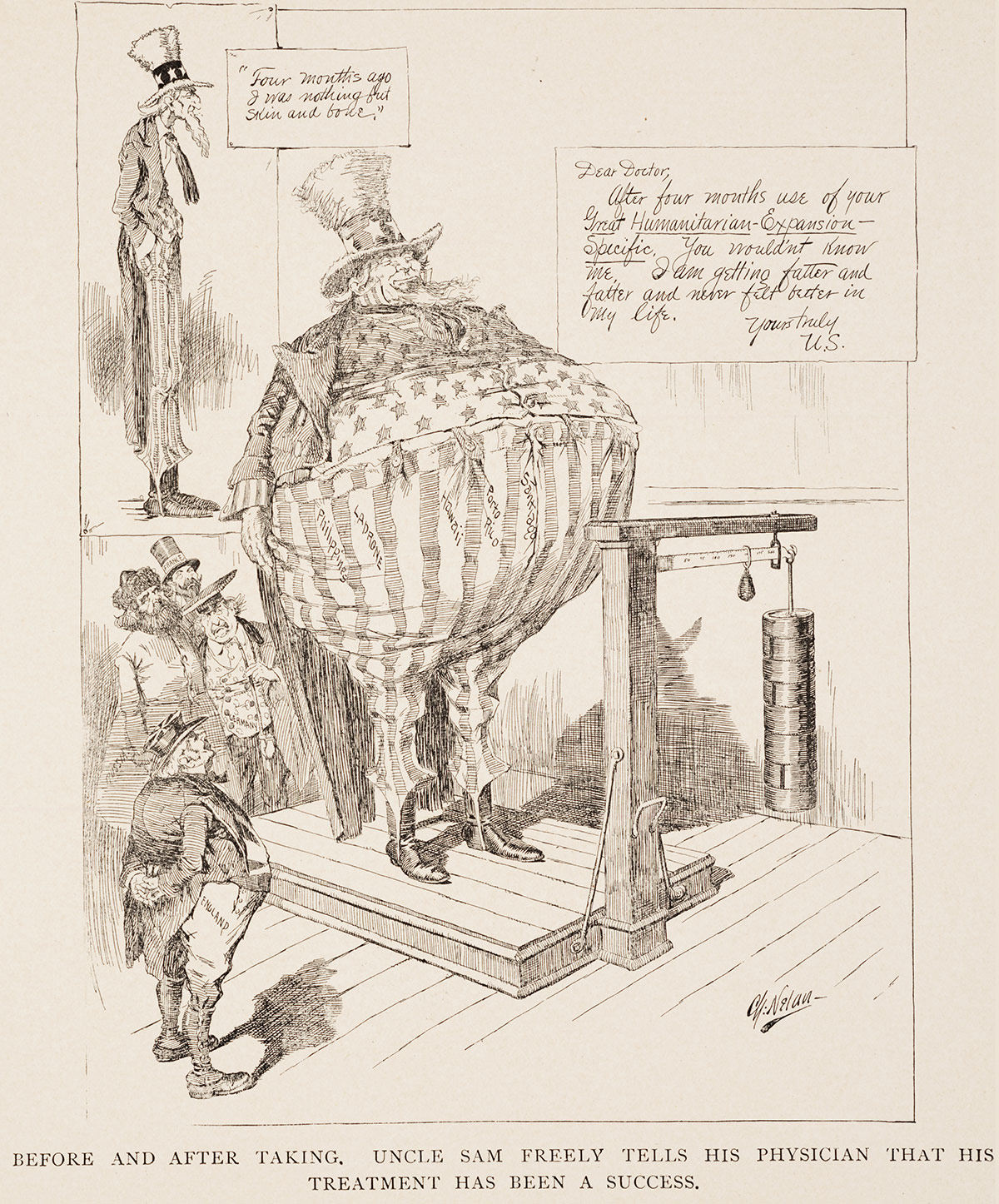
Uncle Sam: No stranger to imperialism (from the Spanish-American War of 1898)

W.J. Astore

Why do empires fall?  Sometimes, it’s easy to identify a cause.  Whether led by the Kaiser or by Hitler, Germany’s Second and Third Empires were destroyed by world wars.  Germany’s ambition was simply too great, its militarism too dominant, its policies too harsh to win long-term converts, its leaders too blinded by the pursuit of power, its enemies too many to conquer or otherwise neutralize.

Other imperial falls are more complex.  What caused Rome’s fall?  (Leaving aside the eastern part of the empire, which persisted far longer as the Byzantine Empire.)  Barbarians and their invasions, say some.  The enervating message and spirit of Christianity, said the historian Edward Gibbon.  Rome’s own corruption and tyranny, say others.  Even lead in Roman water pipes has been suggested as a contributing cause to Rome’s decline and fall.  Taking a longer view, some point to the rise of Islam in the 7th century and its rapid expansion into previously Roman territories as the event that administered the final coup de grâce to a dying empire.

America’s empire, it is clear, is now in decline, and a key reason is imperial overstretch as manifested by endless wars and overspending on the military (with literally trillions of dollars being thrown away on fruitless wars).  An especially fine summary is Alfred McCoy’s article this week at TomDispatch.com.  As McCoy notes:

In effect, the president and his team, distracted by visions of shimmering ships and shiny planes (with their predictable staggering future cost overruns), are ready to ditch the basics of global dominion: the relentless scientific research that has long been the cutting edge of U.S. military supremacy.  And by expanding the Pentagon while slashing the State Department, Trump is also destabilizing that delicate duality of U.S. power by skewing foreign policy ever more toward costly military solutions (that have proved anything but actual solutions) …

In just one extraordinary year, Trump has destabilized the delicate duality that has long been the foundation for U.S. foreign policy: favoring war over diplomacy, the Pentagon over the State Department, and narrow national interest over international leadership. But in a globalizing world interconnected by trade, the Internet, and the rapid proliferation of nuclear-armed missiles, walls won’t work. There can be no Fortress America.

In this passage, McCoy stresses the damage being done by the Trump administration.  But Trump is just the culmination of certain trends, e.g. favoring the Pentagon over the State Department is nothing new, as I wrote about here in 2010.  And America has been in love with shimmering ships and shiny planes for generations, with several administrations supporting the F-35 jet fighter, a program that may end up costing as much as $1.4 trillion.  Plenty of money for weapons that kill; not so much for medicines that cure: that’s imperial America in a nutshell.

I would stress that America’s strength overseas was (and is) always based on its strength at home in areas such as science, education, infrastructure, medicine, manufacturing, and exports.  But what we’ve witnessed over the last 40 years is an immense and wasteful “investment” in wars and weapons even as our country itself has hollowed out. Science is now marked by the denial of facts (such as global warming). Education is all about students as consumers, with an overall decline in standards and performance. Infrastructure is crumbling. Medicine is too expensive and America’s overall health and life expectancy are both in decline. Manufacturing and exports have withered (except for the production and export of weapons, naturally).

As a result of all this, America is running a national debt of roughly 20 trillion dollars.  The future is being sacrificed for the present, a tragic reality reflected in the latest Republican tax cut, which benefits the richest Americans the most, along with big corporations, and which will likely add another trillion to the national debt.

In short, America’s foreign decline is mirrored (and driven) by its domestic decline as reflected by its choices.  Looking at the USA today, you get the sense it’s the best of times for the richest few, and the worst of times for so many Americans struggling with health care debt, student loan debt, and the uncertainty of low-wage jobs that could be outsourced at any moment.  At the same time, the American political scene is driven by fear: of immigrants, of a nuclear war with North Korea, of Russian meddling (real or imagined), of growing Chinese power, and of the perpetually-hyped threat of terrorist attacks on “the Homeland.”

Empires can fall very quickly, as the “thousand-year” Third Reich did, or they can fall ever so slowly, as the Roman Empire did.  But fall they do.  What is in the cards for the United States?  Readers, fire away in the comments section.

Update (1/20/18):  Secretary of Defense James Mattis now claims that China and Russia represent bigger threats than terrorism, along with Congress itself since it can’t pass an extended budget for the Pentagon.  He also claimed the U.S. military’s “competitive edge” is eroding in “every domain of warfare,” despite a defense budget of $700 billion.

None of this is a surprise.  Indeed, this is exactly what happens when you put a retired general and known war hawk in charge of the defense department.  Generals will always want more: more troops, more money, more resources, more authority.  And to support their demands, they will always find more enemies as well.