America the Sick and Anxious

And so too are our kids

BILL ASTORE

NOV 25, 2025

“America’s children are unwell.” From the New York Times this morning:

Nearly one in four 17-year-old boys in the United States has attention deficit hyperactivity disorder. In the early 1980s, a diagnosis of autism was delivered to one child in 2,500. That figure is now one in 31. Almost 32 percent of adolescents have at some point been given a diagnosis of anxiety. More than one in 10 have experienced a major depressive disorder, my colleague Jia Lynn Yang reports.

And the number of mental health conditions is expanding. A child might be tagged with oppositional defiance disorder or pathological avoidance disorder. “The track has become narrower and narrower, so a greater range of people don’t fit that track anymore,” an academic who studies children and education told Jia Lynn. “And the result is, we want to call it a disorder.”

Why did this happen? A lot of reasons. Kids spend hours on screens, cutting into their sleep, exercise and socializing — activities that can ward off anxiety and depression. Mental health screenings have improved.

And then there’s school itself: a cause of stress for many children and the very place that sends them toward a diagnosis.

I can’t read the main article since it’s behind a paywall. The gist of the article is that American schooling is hyper competitive, constricting, perhaps too demanding, and therefore a big part of the problem.

Maybe. Schools are also chronically underfunded. Teaching remains an underpaid profession. Classrooms can be overcrowded. Standards vary widely. And parents are stressed as they try to get their kids into the “right” schools. It’s not hard to see how that educational ecosystem might amplify distress.

But the explosion in ADHD diagnoses, autism, and anxiety is surely also driven by Big Pharma.* “We’ve got a drug for that” should be the motto of these companies. Americans are bombarded every day with drug ads promising to change our lives. I’m not a parent myself, but if my kid had trouble focusing or otherwise had behavioral issues, I’d explore medication as an option. I’m guessing it’s easier to get a prescription for Adderall or Ritalin than for kids to get wise treatment and sustained counseling from a psychiatrist or other mental health specialist.

Not just “mother’s little helper”

Some parents may even feel that particular diagnoses confer a kind of status— confirmation that their child is not merely struggling but exceptional in some “high-functioning” or creatively gifted way. That, too, reflects broader cultural forces.(“Annie is autistic and really too intelligent/creative/artistic/sensitive for this world.”)

But beyond parental dysfunction, omnipresent screens, school pressures, and pharmaceutical marketing, there’s a deeper question: Are our kids simply mirroring the broader dysfunction of American society? We live in a culture marked by relentless competition, materialism, polarization, and chronic stress. There’s little about our adult world that could be described as calm or balanced. If our society itself is unwell, why would we expect our kids to feel—or behave—otherwise?

I know it’s not easy, but surely kids need to unplug more (especially from social media, with all its pressures). They need to get outside more. They need to play more—they need more unstructured time. They probably need less stimulation—and arguably more time to be, in a word, bored. To find their own way to play, their own hobbies and interests to pursue, their own path in life.

A dysfunctional society produces dysfunctional kids. If that’s true, how do we make a society that better serves everyone? If American society and culture is uniquely disorienting and destabilizing, can’t we change that? Can’t we make a better saner world for our kids?

Grim factoid: In 2008, Americans consumed 80% of the world’s opioid supply. Though that percentage has dropped to roughly 40% today, what is it about American life that is so painful? Why are we so addicted to (legal and illegal) drugs? And now our kids too?

Readers, what do you make of all this?

*By no means am I dismissing mental illness; my brother Stevie had his first schizophrenic episode when he was sixteen in 1973 and never fully recovered from it. I have friends with a daughter with severe Asperger’s syndrome. My concern here is the vast increase in ADHD, autism, and similar diagnoses and the potential reasons for this.

Mobsters of the Mind

W.J. Astore

Of “Legal” Drug Ads and Anti-Russia Messaging

Mobsters are known for breaking kneecaps to bend people to their will. Marketers break into heads with repetitive and manipulative advertising, images, and narratives. Mobsters of the mind, they are.

I thought of this after watching all those repetitive (and largely interchangeable) ads for “legal” prescription drugs. Rarely do they show the often serious conditions they allegedly treat. Instead it’s image after image of people enjoying life, whether at amusement parks, the beach, dancing, or what-have-you. It’s as if drug companies are selling happiness pills whose only side effect is experiencing the best day of your life. Meanwhile, as images spill into your head of eternal bliss, a narrator quietly intones about potential serious side effects, even possible death in the case of one drug I’ve seen advertised.

Excuse me while I pop a few pills and denounce Russia—or China

Drug ads are the worst. People wonder why Americans take so many illegal drugs and why we have so many drug addictions — well, just look at all the ads for legal drugs, and how they’re advertised as making people incandescently happy. It’s all about the messaging: the repetition of powerful feel-good imagery, with drugs as panaceas.

Speaking of repetition, something similar is true of political manipulation. To cite one example: Russia. Has there ever been a worse “drug” with more serious side effects than Russia? Russia keeps hacking our elections! Russia is led by war criminals! Russia is raping Ukraine! Over and over again, the mainstream media encourages us to hate Russia and Vladimir Putin. Is this truly all we need to know about Russia? As Sting sang, don’t the Russians love their children too? (Back in the 1980s, the media didn’t go easy on Sting for his alleged naïveté and pro-Russian sentiments.)

Whether it’s drug advertisers, the mainstream media, or the U.S. government for that matter, America is infested with various “ministries of truth” that are driven by a mobster-like mentality. They may not break your kneecaps, but they nevertheless find ways to break into your mind.

Now you’ll excuse me while I pop a few pills while denouncing Russia. And China too, perhaps?

Guns and Grievances

The Matrix _DivX_ 311_0003
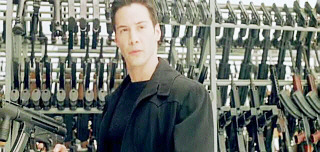
Guns look way too cool in our movies

W.J. Astore

The news out of Orlando is shocking.  Another mass shooting in America.  Another 50+ people dead with an additional 50+ wounded.  And then I saw this headline:

“America has 4.4% of the world’s population, but almost 50% of the civilian-owned guns around the world”

The ready availability of guns in America, to include military-style assault weapons with 30-round clips, makes it far easier for shooters bent on murder to kill large numbers of people.  It doesn’t matter what you call these shooters, whether you label them terrorists or lone wolves or crazed lunatics or whatever.  Apparently the latest shooter bought his guns legally, had a grievance against gay people, expressed some last-minute allegiance to ISIS, and then started blasting away at innocent people in a club that was friendly to gays.

Sure, guns alone are not to blame.  The primary person to blame is the shooter/murderer himself.  But (to repeat myself) the guns sure make it a lot easier to kill, and in large numbers.

We live in a sick society, often a very violent one, certainly a disturbed one, one that places enormous stress on people.  Another exceptional headline that I first heard on Bill Maher is that America, again with 4.4% of the world’s population, takes 75% of the world’s prescription drugs.

Guns and drugs – the two don’t mix, even when they’re legal.   Americans are over-armed and over-medicated.  Add to that mix the fact that Americans are under-educated, at least compared to our peers in the developed world, and you truly have a toxic brew.

Over-armed, over-medicated, and under-educated: surely this is not what our leaders have in mind when they call us the exceptional nation, the indispensable one, the greatest on earth.  Is it?


What’s the U.S. Strategy in Afghanistan?

poppy
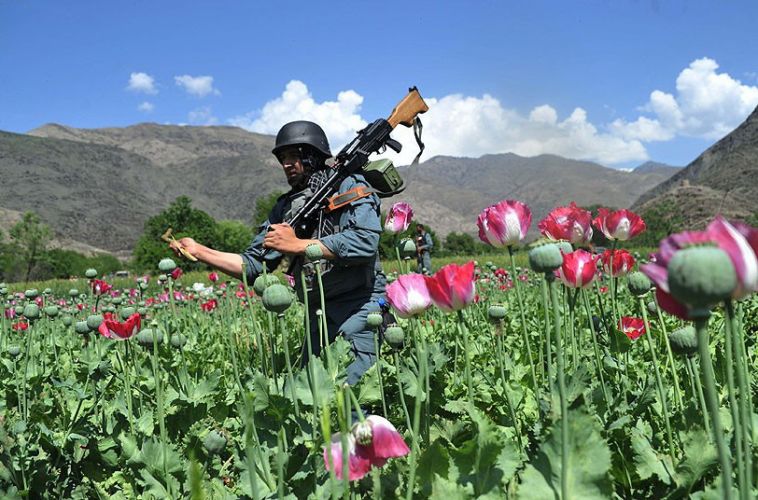
A poppy field in Afghanistan

W.J. Astore

Six years ago, I wrote an article about Afghanistan that opened like so:

In the U.S. debate on Afghanistan, virtually all experts agree that it’s not within the power of the American military alone to win the war. For that, Afghanistan needs its own military and police force, one that is truly representative of the people, and one that is not hopelessly corrupted by drug money and the selfish concerns of the Karzai government in Kabul.

What has changed since 2009?  Karzai is gone, but corruption remains endemic.  The U.S. military is still there, at least until 2017 and likely for far longer.  And drug money!  In a searching summary of the opium trade in recent Afghan history, Alfred McCoy at TomDispatch.com shows convincingly that the drug trade has flourished despite, or rather because of, American efforts to block it or control it.  In his words:

In the almost 15 years of continuous combat since the U.S. invasion of 2001, pacification efforts have failed to curtail the Taliban insurgency largely because the U.S. could not control the swelling surplus from the county’s heroin trade. As opium production surged from a minimal 180 tons to a monumental 8,200 in the first five years of U.S. occupation, Afghanistan’s soil seemed to have been sown with the dragon’s teeth of ancient Greek myth. Every poppy harvest yielded a new crop of teenaged fighters for the Taliban’s growing guerrilla army.

At each stage in Afghanistan’s tragic, tumultuous history over the past 40 years — the covert war of the 1980s, the civil war of the 1990s, and the U.S. occupation since 2001 — opium played a surprisingly significant role in shaping the country’s destiny. In one of history’s bitter twists of fate, the way Afghanistan’s unique ecology converged with American military technology transformed this remote, landlocked nation into the world’s first true narco-state — a country where illicit drugs dominate the economy, define political choices, and determine the fate of foreign interventions.

McCoy’s article, which you should read here in its entirety, raises many questions, but for me the obvious one is this: What is the U.S. military doing in Afghanistan?  What is its strategy?

If it’s trying to win Afghan hearts and minds, you can’t do that by destroying the main cash crop of so many people.  If it’s trying to create a measure of stability, you can’t do that by mounting destructive military operations that spread chaos.  If it’s trying to interdict the drug trade, you can’t do that successfully while maintaining the support of powerful interests in Afghanistan that profit so heavily from that trade.

After nearly 15 years, a sensible person would conclude that American interference in Afghanistan is only making matters worse.  Afghan drug wars are a no-win scenario for U.S. troops.  Lacking a coherent and sensible strategy that is attractive to Afghan power brokers, American forces should smarten up, load up, and pull out.

A sensible strategy in three words: Yankee come home.