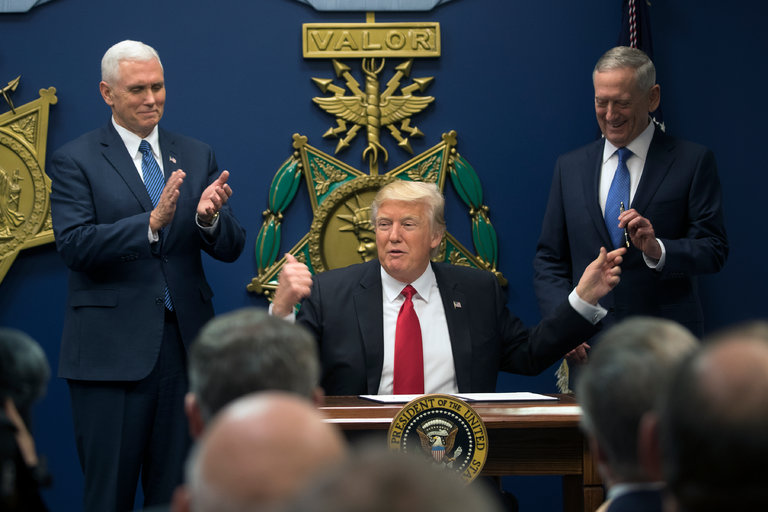
Trump has done it again. At the Pentagon, before a backdrop that honors America’s highest award for valor, the Medal of Honor, Trump signed an Executive Order on immigration. The backdrop seemed to suggest that Trump was doing something honorable and brave himself in signing yet another Executive Order. This EO, as the New York Timesreported, “suspended entry of all refugees to the United States for 120 days, barred Syrian refugees indefinitely and blocked entry for 90 days for citizens of seven predominantly Muslim countries. It also allows Christians to be granted priority over Muslims.”
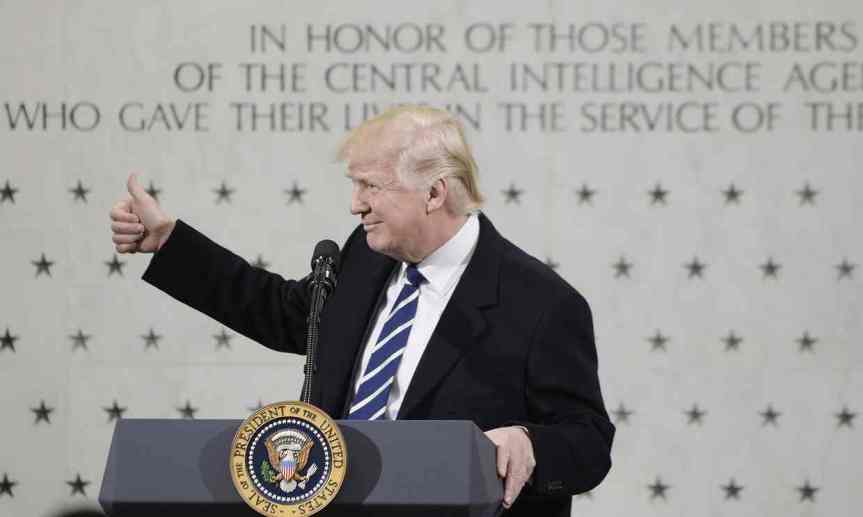
Last week, Trump appeared at the CIA, before its wall of heroes, blustering again about grabbing Iraq’s oil and boasting of the number of times he’d appeared on Time magazine (more than Patriots quarterback Tom Brady, which seemed to please him to no end).
Perhaps Trump will next appear before Christ on the cross to complain about how he (Trump) is being crucified in the press.
You’ve got to hand it to Trump: the man simply has no shame. And no taste either.
Trump’s pomposity was captured perfectly yesterday in a quip at my local bank. I was asking the teller about dollar coins (yes, we still have those), and she showed me a couple. They looked too much like quarters so I passed on getting any. The gent behind me quipped: “Just wait until Trump puts himself on the coin.” As I laughed and said words to the effect of, I can see it happening, the gent then quipped, “Trump will be on both sides!”
That about sums it up. Trump would indeed put his own mug on both sides of the coin. It would be a clear case of “heads he wins, tails we lose.”
Yesterday, I caught President Trump’s speech before the CIA. As he stood before the wall of honor, surrounded by the stars on that wall that represent those who gave their lives for their country, Trump deviated from his prepared comments to boast about how many times he’d appeared on the cover of Time magazine.
Here’s what he said: I HAVE BEEN ON THEIR COVER ABOUT 14 OR 15 TIMES. I THINK WE HAVE THE ALL-TIME RECORD IN THE HISTORY OF TIME MAGAZINE — IF TOM BRADY IS ON THE COVER, IT’S ONE TIME. I’VE BEEN ON 15 TIMES. I THINK THAT’S A RECORD THAT COULD NEVER BE BROKEN.
Really, President Trump? You’re giving a speech before members of the CIA, and what comes to mind is the number of times your own mug has appeared on a magazine cover? And you’re doing this in front of the CIA’s wall of honor, which, according to your own words, is “very special”?
Whatever one thinks of the CIA and its history, one thing is certain from this speech: America has elected an appallingly tone-deaf and callous narcissist as its 45th president.
Will Donald Trump keep his campaign promise to end America’s wasteful wars overseas? Since he’s stated he knows more than America’s generals, will he rein them in? Will he bring major reforms to the military-industrial complex, or will he be nothing but talk and tweets?
At Trump’s first news conference today as president-elect, he had little to say about the military, except once again to complain about the high cost of the F-35 jet fighter program. The questions asked of him dealt mainly with Russia, hacking, potential conflicts of interest, and Obamacare. These are important issues, but how Trump will handle the Pentagon and his responsibilities as commander-in-chief are arguably of even greater import.
Ironically, the last president who had some measure of control over the military-industrial complex was the retired general who coined the term: Dwight D. Eisenhower. Another president – Jimmy Carter – attempted to exercise some control, e.g. he cancelled the B-1 bomber, a pet project of the U.S. Air Force, only to see it revived under Ronald Reagan.
Excepting Carter, U.S. presidents since Ike have issued blank checks to the military, the Pentagon, and its bewildering array of contractors. Whether Democrats (JFK, LBJ, Clinton, Obama) or Republicans (Nixon, Ford, Reagan, the Bushes), rubber-stamping Pentagon priorities has been a common course of presidential action, aided by a willing Congress that supports military spending to “prime the economic pump” and create jobs.
Ike, of course, was hardly perfect, but he had the cred to command the military, to rein it in, perhaps as much as any one man could in the climate of fear generated by McCarthyism and the Cold War hysteria of the 1950s. Hardly a pacifist, Ike nevertheless came to hate war. Can we imagine any president nowadays writing these words?
Every gun that is made, every warship launched, every rocket fired signifies, in the final sense, a theft from those who hunger and are not fed, those who are cold and are not clothed. This world in arms is not spending money alone. It is spending the sweat of its laborers, the genius of its scientists, the hopes of its children… This is not a way of life at all, in any true sense. Under the cloud of threatening war, it is humanity hanging from a cross of iron.
Ike’s wisdom stemmed from his experience with the bloody awfulness of war. Recent presidents, by comparison, have been unstinting in their praise of the U.S. military. Ronald Reagan, who had a cozy job in Hollywood during World War II, was a snappy saluter who oversaw a major military expansion. More recently, Barack Obama, with no military experience, went out of his way to praise the U.S. military in hyperbolic terms as the “greatest” in human history.
Recent presidents have idolized the military, perhaps because they either never served in it or never really experienced its foibles and faults, its flaws and failings. Perhaps as well they’ve celebrated the military because they saw it as a popular and easy form of patriotism. But the Pentagon needs a commander-in-chief, not a cheerleader-in-chief. It needs to be challenged, it needs a boot up its collective ass, if it’s ever going to reform its prodigal ways.
Trump has been critical of the military, an encouraging sign. But his appointment of retired generals to key positions of power suggests conformity and business as usual. Trump himself is a military poseur, a man impatient with facts, a man who didn’t know what the nuclear triad was even as he talked of (false) nuclear gaps vis-à-vis Russia.
Even as he talked of wasteful wars and clueless generals, Trump promised to use the U.S. military as a battering ram to smash America’s enemies. He promised as well to rebuild the military, increasing the Pentagon budget while taking the fight to ISIS, words that suggest President Trump won’t often say “no” to the national security state. Ike, however, could and did say “no.” He had the toughness to weather the predictable Pentagon, Congressional, and military/corporate storms. Will Trump?
Again, the last president to lead a novel initiative in national security was Jimmy Carter, with his focus on human rights. Dismissed as naïve and pusillanimous, he became a one-term president. Trump has promised to end wasteful wars, to re-prioritize federal spending to focus on internal “security” measures such as national infrastructure, and to make NATO and other U.S. allies pay their fair share of defense costs.
If he carries through on these promises, he’ll be the first president since Ike to make a measurable and significant course correction to America’s warship of state. But first he needs to be held to account, most certainly at press conferences but elsewhere as well. Endless war is a threat to democracy; so too are politicians who posture but do nothing to rein in militarism, imperialism, and authoritarianism.
If Trump combines the two, if he doubles down on incessant war and a cult of authority, American democracy may suffer a mortal blow.
But America has been edging toward post-truth for a long time — even at its founding, skeptics might say. The “City on a Hill,” forged on an image of Christian rectitude, witnessed the genocide of Native Americans (“savages”) and the embrace of slavery based on specious theories of racial inferiority, even as the Bible taught the love of neighbor and the equality of all before God.
More recently, America has witnessed the triumph of post-truth in the aftermath of 9/11. Recall how the attacks on 9/11 were falsely connected to Iraq, which was then connected to false claims of Iraq having active programs of WMD development, including “yellowcake” uranium as well as chemical and biological agents spread by aerial drones. All proven false, but all used to justify the invasion of Iraq in 2003.
Indeed, many Americans continue to believe that Saddam Hussein planned the 9/11 attacks (in league with Osama Bin Laden). Recall here the rare honesty of Britain’s Downing Street Memo of 2002, which asserted that the “facts” being offered by the Bush/Cheney administration were being manufactured (“fixed”) around a pre-determined policy of invasion. The result? Iraq was yet another un-democratic war, based in part on lies. Indeed, it’s no accident that Congress hasn’t issued a formal declaration of war since 1941. (Another war based on lies: the Vietnam War, e.g. recall the false reports of attacks at Tonkin Gulf.)
Another example of post-truth was the Surge of 2007, advertised as a “win” for America even as General David Petraeus warned that progress in Iraq was both “fragile” and “reversible.” So it has proved, for here we are, a decade later, trying to recapture territory (such as Mosul) that had allegedly been pacified under Petraeus.
America’s post-truth crew has now been captured by a shameless con man, the Tweeter-in-chief, Donald Trump. Recall a saying often attributed to P.T. Barnum that “a sucker is born every minute.” Trump knows this — and will exploit it to the hilt, if the American people let him.
As January 20th approaches, Americans need to prepare themselves for a post-truth presidency. As my dad used to say to me: “Don’t believe anything that you read and only half of what you see.” Wise words for the days and years to come, but they come with a major problem. Some sense of truth, of consensus based on acknowledged facts and a rigorous and fair-minded process of reasoning, is needed for a democracy to function.
Without integrity, which is based on facts and honesty and a willingness to reason together in good will and with honorable intentions, democracy simply cannot function. Put simply, a post-truth America is an anti-democratic America. For without truth, without some consensus based on facts, all you have is lies, misinformation, and spin: a foundation of sand upon which nothing of worth can be built.
In a longer article for TomDispatch.com, I recently wrote about Donald Trump’s team of generals for national defense and homeland security. Trump wants four senior retired generals, two from the Army and two from the Marine Corps, to serve as his senior civilian advisers in matters of defense and security.
Here’s the point: You simply can’t have civilian control of the military when you appoint senior generals to these positions.
I’m astonished more Americans aren’t outraged at this. It’s a sign of how much militarism has gripped our nation and government, as well as the sweep and scope of the national security state.
I was reading Samuel Hynes’ excellent book, The Soldiers’ Tale: Bearing Witness to Modern War, and came across two passages that resonated with me. In talking about war as a culture, Hynes notes that “Military traditions, values, and patterns of behavior penetrate every aspect of army [and Marine Corps] life and make the most ordinary acts and feelings different.”
The generals Trump is hiring are all military careerists, men whose “traditions, values, and patterns of behavior” are steeped in the ways of the Army and Marine Corps, affecting even “the most ordinary acts and feelings.” Their behavior, their commitments, their loyalties, their world views, are the antithesis to civilian culture and to the ethos of democracy. (For example, General James Mattis, Trump’s selection as Secretary of Defense, is most often described as a “warrior-monk,” a man with a Spartan-like dedication to war. But would Athens have anointed a Spartan, even as its minister of war?)
Again, the point is not to attack the military. It’s that the U.S. government already has plenty of generals in charge, wielding enormous authority. Trump’s decision to add yet another layer of military authority to his government makes it less of a democracy and more of a junta.
A second point from Hynes. He notes how most citizen-soldiers in America’s military past were not war-lovers, but that a few were, notably General George S. Patton. In the same breath, Hynes notes that dictators like Hitler and Mussolini “loved war.”
Which American general does Trump profess to admire the most? George S. Patton. And who among his generals most resembles Patton as a “real” warrior? According to Trump, it’s General Mattis.
Again, the point is not to attack the military, but rather to note the U.S. national security state already has plenty of warriors and warfighters in charge. Putting an alleged Patton-clone in charge of the Pentagon represents an abrogation of two centuries of American tradition that insisted on civilian supremacy over the military.
Given his inflammatory tweets about nuclear arms races with their “bring it on” mentality, Trump has all the makings of tinpot provocateur, an unstable military poseur who likes to speak loudly while swinging a nuclear-tipped stick. Will Trump’s generals, his Pattons and MacArthurs, serve as a check to his provocations and his posturings? It doesn’t seem likely.
Congress should reject Trump’s choices for Secretary of Defense (Mattis) and Homeland Security (Kelly). Not because these retired generals are bad men, but because they are the wrong kind of people. If you want civilian control of the military (and don’t we still want that?), you need to hire true civilians. Men and women whose identities haven’t been forged in armories. Independent thinkers and patriots with some history of dissent.
How about someone like Daniel Ellsberg for Secretary of Defense? And, since global warming is a huge threat to the U.S., how about Bill McKibben for Homeland Security?
After all, whether they’re in or out of uniform, the U.S. government already has plenty of generals.
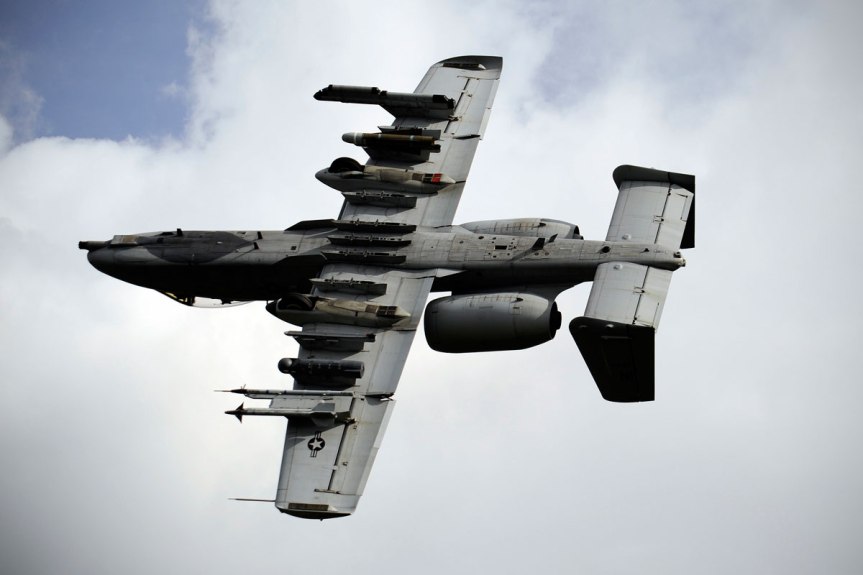
You can hang a lot more weaponry from an A-10 Warthog (vintage 1970s) than you can from a modern F-35
W.J. Astore
Is Donald Trump putting coal in Lockheed Martin’s Christmas stocking?
Trump has sent another tweet about the F-35 jet fighter (Lockheed Martin is the primary contractor), this time asking Boeing to price out a comparable F-18 Super Hornet as a possible replacement for that jet. Trump’s tweet caused Lockheed Martin shares to dive even as Boeing shares climbed.
Trump is right to pressure Lockheed Martin on the F-35, though I’m not sure tweets are the best way to do this. I remember planning for the F-35 twenty years ago when I was on active duty in the Air Force. The F-35 Joint Strike Fighter was supposed to be a relatively low cost fighter/attack aircraft that would meet Air Force, Navy, and Marine needs. Back then, the flyaway cost was estimated at $40 million per plane, more expensive than the F-16 but roughly equivalent to the F-15E “Strike Eagle.” The current flyaway cost is roughly $200 million per plane,* and even higher for the Marine Corps version with its vertical landing/short takeoff capacity.
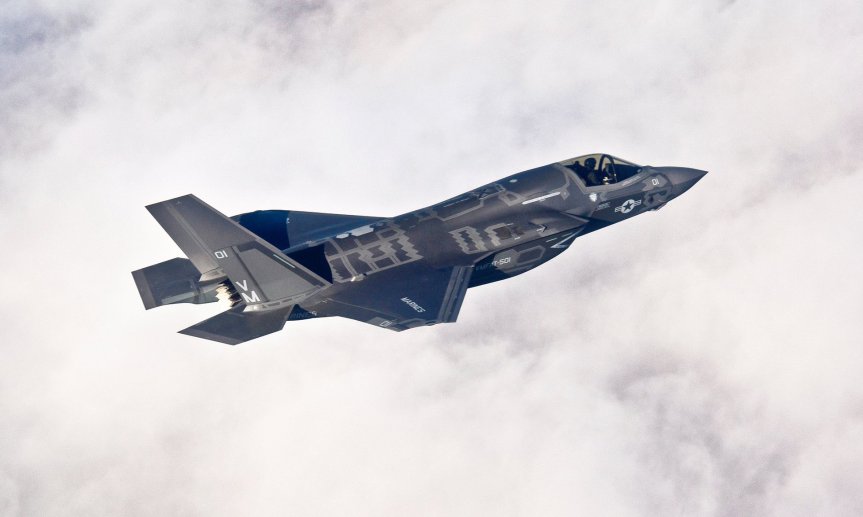
The F-35: Stealthy but expensive, with a long history of cost overruns
What happened? Everything went wrong as each service piled requirements onto the F-35 and all kinds of exotic features were added to it. Stealth capability. Loads of special software featuring millions of lines of code. Unique (and expensive) helmets for its pilots. Vertical landing/short takeoff capacity for the Marines, which drove an airframe configuration that made it less maneuverable for the Air Force. In short, the F-35 became like a Swiss army knife, featuring lots of tools and moving parts. Sure, in a pinch a Swiss army knife can be used as a screwdriver or what have you, but most of the time what you really need is the best screwdriver for the job.
The F-35 is reminiscent of another ill-fated effort to build a jet acceptable to all the services: the F-111 “swing-wing” program of the 1960s.
Big and ungainly, the F-111 was mainly used as a bomber and electronics warfare plane
The Navy never deployed it, and the Air Force was never that happy with it, converting it to a fighter/bomber and an electronics warfare plane. The Navy went on to build its own fighter jet, the F-14, even as the Air Force built its fighter jet, the F-15. Then the Air Force and Navy got two decent fighter/attack jets, the F-16 and F-18, out of the lightweight fighter competition.**
Here’s the thing: Although jets like the F-15 and F-18 are not stealthy, they are very effective, especially when updated with the latest weaponry and avionics and flown by skilled pilots. Meanwhile, highly effective UAVs (drones) have emerged, e.g. Predators and Reapers, with long loiter times and no risk of U.S. casualties. To put it bluntly, does the U.S. really need the F-35, especially given its high cost and underwhelming performance?
Back to Donald Trump. Is he bluffing when he threatens to buy Boeing-made F-18s instead of the F-35? Is he posturing to get Lockheed Martin to cut the price of the F-35 (which, at this late stage of its development, may not even be possible)? One thing is certain: A lot of good American jobs are riding on Trump’s tweets. Expect Lockheed Martin to rally its Congressional allies to defend the program. The plane’s multitude of contracts were deliberately spread throughout the 50 states to gain as much Congressional support as possible.
For a little fun, go to the Lockheed Martin website at the following link:
Let’s put in Pennsylvania. Here’s what you get: 41 supplier locations, 2100 jobs, $172.5M in economic impact. How about New York? 77 suppliers, 8160 jobs, $695.2M in economic impact. How about Bernie Sanders’s state of Vermont? 3 suppliers, 1410 jobs, $124.5 million in economic impact. Small wonder that even Bernie Sanders during the campaign was an F-35 supporter.
One thing is certain: the stealthy F-35 has not evaded Trump’s radar. Whether Trump will shoot it down or simply watch it as it soars on by while burning through piles of money remains to be seen.
Note: For a more detailed report on the F-35’s performance issues, see “The F-35 Stealth Fighter May Never Be Ready for Combat: Testing report contradicts the U.S. Air Force’s rosy pronouncements,” by DAN GRAZIER & MANDY SMITHBERGER, available at this link. In short, the plane’s “requirement” to be stealthy is driving higher costs and lower performance. The plane gobbles gas so it has limited combat endurance. It’s a step backwards in effectiveness, at a much higher cost to the American taxpayer than previous planes such as the F-15, F-16, and A-10. Meanwhile, many of its missions are now filled by drones.
For a counterpoint in favor of the F-35, see this link. The F-35 has unique capabilities; it should, given its price tag. Leaving aside high cost and questionable performance, it’s vital to remember the mission. Are there really missions that only the F-35 can do, or that no plane can do as effectively? But the real case for the F-35 seems to come down to the fact that the program is simply too big to fail; the “sunk costs” are too high; its rivals are too old; and too many American jobs are dependent on it. In short, the U.S. military is stuck with the plane — and the American taxpayer is stuck with the bill.
*Estimates vary about the final flyaway cost since it’s ultimately dependent on how many F-35s are produced. Current estimates for the entire U.S. purchase are $400 billion, with another trillion dollars for maintenance and spares and related costs over the program’s lifetime.
**The most rugged and effective attack jet in the Air Force’s inventory, the A-10, was never much liked by the Air Force; generals have fought to eliminate it in favor of the much less effective F-35, but Congress has actually fought back to keep the A-10, affectionately known as the Warthog, a name and image contrary to the AF fighter pilot mystique of “eagles” and “fighting falcons.”
Donald Trump’s cabinet choices form an anti-government of sorts. A climate change skeptic as head of the EPA who’s involved in suing the EPA. A head of the Energy department who previously said he wanted to eliminate that department. A head of Education who’s a fervid proponent of charter schools and further privatization. A head of housing and urban development with no background in government and no apparent sympathy for the poor. A head of Labor who’s a fast-food mogul, an opponent of a higher minimum wage, and a proponent of robots replacing humans because the former don’t get sick or need health care or strike for higher pay. And, let’s not forget, a gaggle of retired generals in civilian security positions at the Pentagon and within the White House.
You have to hand it to Trump and the Republicans: when they select cabinet members, they’re not trying to triangulate; they’re not trying to reach out to the Democrats or rule in a bipartisan fashion. Their attitude is “We won — and we’re taking no prisoners.”
Remember how newly elected President Obama triangulated in 2008? He kept on Republican Bob Gates as Secretary of Defense. He selected retired Marine Corps General James Jones to be his National Security Adviser, which drew high praise from John McCain. He appointed Tim Geithner at Treasury, a former member of the Kissinger Associates and advocate of the TARP (the Wall Street bailout). He tried to appoint other Republicans to his cabinet, such as Judd Gregg at Commerce. Despite Obama’s huge mandate and his message of “change,” most of his cabinet appointees were conventional Washington insiders, more than acceptable to Republicans.
Of course, this is just further proof (if more is needed) that Democrats like Obama and the Clintons are just another business party, a Republican-lite party. I’d say establishment Democrats don’t have the courage of their convictions, except I’m not sure they have convictions.
Well, Trump has convictions. And he’s unafraid to act on them with his cabinet choices. You think the Democrats might learn something from this?
At Informed Comment, Juan Cole has an excellent column on this whole issue, “Why do GOP Presidents get to go Hard Right, and Dems are just GOP Lite?” Here’s how Cole begins his column:
After it was confirmed that Donald J. Trump will appoint former Exxon Mobil CEO Rex Tillerson Secretary of State, the shape of the Trump cabinet and team has become clear. Neofascist Steve Bannon is White House Strategist. Openly racist Jeff Sessions is Attorney General (guess how many civil rights actions he is going to initiate). General James “Mad Dog” Mattis is Secretary of War (call it what it is). Notorious Islamophobe and conspiracy theorist, who denies that Islam is a religion, Lt. Gen. Michael Flynn is National Security adviser.
But Bill Clinton and Barack Obama, when they came to power (and both were very popular and had real mandates) did not go left in the way that George W. Bush and now Trump have gone right.
In fact, the anecdote is told that in 1993 Clinton and his cabinet looked around the room at each other and observed, “Here we are, Eisenhower Republicans.” Why?
Why, indeed? Just imagine if a true liberal Democrat won the White House. And let’s imagine he or she is casting about for a suitable Secretary of Defense, someone who thinks outside of the pentagonal box. How about Ralph Nader or Noam Chomsky? (Cole mentions Frida Berrigan, another provocative choice.)
Call it spine, call it stones, call it sand, call it whatever you want, but Trump’s Republicans have it and the spineless Democrats don’t. Just wait until January, when we start to hear about a few Democrats crossing the aisle to work with Trump in the spirit of “bipartisanship” and “putting government back to work.” It makes me think of another saying of my parents: Trump and his cabinet of billionaires and millionaires “will be laughing all the way to the bank.” The rest of us? We may be laughing, but only to hide the tears.
Note: Revised on 12/19 to add retired Marine Corps General Jones as another example of Obama’s ill-fated effort to “move to the center” and to appease Republicans.
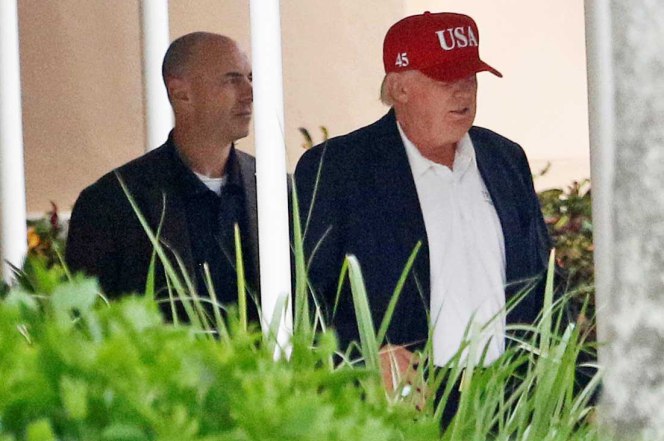
Trump’s latest “con man” hat puts USA front and center, with 45 on the side (Trump, sadly, will be America’s 45th president, unless widespread sanity breaks out)
W.J. Astore
Back in 2010, I wrote an article for TomDispatch.com in which I compared the U.S. government and its corporate handlers to a kleptocracy. Here’s what I wrote:
What drives America today is, in fact, business — just as was true in the days of Calvin Coolidge. But it’s not the fair-minded “free enterprise” system touted in those freshly revised Texas guidelines for American history textbooks; rather, it’s a rigged system of crony capitalism that increasingly ends in what, if we were looking at some other country, we would recognize as an unabashed kleptocracy.
That’s what we’re witnessing right now with Trump and his family: crony capitalism. Unabashed kleptocracy. It’s nothing new, except now it’s being done openly and unapologetically by the president-elect, who claims the law of the land says he can’t have conflicts of interest, because as president he’s exempted from those laws.
Recall the saying that history repeats itself, first as tragedy and then as farce. Trump is both tragedy and farce, but more than anything, he’s a tragedy for our democracy.
Here’s more of what I wrote back in 2010. It’s prescient, I think, and I’m not proud to say that:
An old Roman maxim enjoins us to “let justice be done, though the heavens fall.” Within our kleptocracy, the prevailing attitude is an insouciant “We’ll get ours, though the heavens fall.” This mindset marks the decline of our polity. A spirit of shared sacrifice, dismissed as hopelessly naïve, has been replaced by a form of tribalized privatization in which insiders find ways to profit no matter what.
Tom Engelhardt documents Trump’s opportunistic greed in his latest introduction to Nick Turse’s humorously painful article on the farce that is Trump. Here’s what Engelhardt has to say about Trump’s emerging kleptocracy:
Trump is a family man in every sense of the word. His business is a family business. No matter what anyone tells you, there’s no more way to separate him from his brand, with his kids running it, than there is to separate a shark from the ocean or Ivanka from her line of jewelry. There’s no way this administration can be anything but a walking, talking conflict of interest of a kind never before seen or even imagined in this country. It’s easy, in fact, to guarantee one thing: that foreign business and political interests will have a field day when it comes to applying pressure to the new American president.
Truer words were never written. Imagine placing Gordon “Greed is Good” Gekko (he of cinematic “Wall Street” infamy) in charge of America, and that’s Trump, except Trump seems to have even fewer scruples.
Anyway, the intrepid Nick Turse journeyed to Trump Tower in Manhattan to survey the farce that is the Trump transition team. I urge you to read his article in full, but here’s his conclusion:
Descending the switchback escalators [in the Trump Tower], I found myself gazing at the lobby where a scrum of reporters stood waiting for golden elevator doors to open, potentially disgorging a Trump family member or some other person hoping to serve at the pleasure of the next president. Behind me water cascaded several stories down a pink marble wall, an overblown monument to a bygone age of excess. Ahead of me, glass cases filled with Trump/Pence 2016 T-shirts, colognes with the monikers “Empire” and “Success,” the iconic red “Make America Great Again” one-size-fits-all baseball cap, stuffed animals, and other tchotchkes stood next to an overflowing gilded garbage can. Heading for the door, I thought about all of this and Joe [a secret service agent] and his commando-chic colleague and Trump’s deserted private-public park, and the army of cops, the metal barricades, and the circus that awaited me on the street. I felt I’d truly been given some hint of the future, a whisper of what awaits. I also felt certain I’d be returning to Trump Tower — and soon.
Circus, indeed. Trump has mastered that, but will he provide the bread as well to complete the bread and circuses pairing? And will the people be satisfied with empty spectacle and a few crumbs of bread as Trump takes America for a kleptocratic ride?
It was said about the Emperor Nero that he fiddled while Rome burned. Instead of fiddling, Trump, one assumes, will make deals and sell trinkets, all for his personal profit, even as American democracy burns.
Welcome to kleptocracy in the open, America. As the inferno rages, remember this happy fact: For only $10,000 you too can wear Ivanka’s bracelet!
One bracelet to bring them all and in the darkness bind them.
With Trump’s election, it’s a bull market at the Pentagon
W.J. Astore
In two recent speeches, President Obama has repeated the conceit that the United States is “the indispensable nation.” Apparently, that means the U.S. must lead “the free world,” with a none-too-subtle corollary that other “free” nations must follow. Yet the conceit of indispensability gets the U.S. into serious trouble. It facilitates interventionism and meddling, and when the U.S. intervenes and meddles, it’s almost always in military ways, often disastrously (Afghanistan, Iraq, Libya are just three recent examples).
This is hardly surprising. The U.S. military has roughly 800 bases worldwide. Its aircraft carriers are essentially mobile American bases, bristling with weapons and munitions. The U.S. spends roughly $600 billion a year maintaining this military and empire, even as it continues to dominate the world’s arms trade. This heavy investment in weaponry and war-making, abetted by a mentality that celebrates “global reach, global power,” is a strange way to define your nation as being “indispensable.”
How did America come to invest so much of itself in military weaponry and incessant wars? One reason is the quest for total safety. As one of my friends put it:
It [the notion of total safety] must be a post-1941 thing [after the shocking sneak attack on Pearl Harbor]. I think in both cases (1917 [U.S. entry into World War I] and 1941 and maybe 2001) the question Americans have asked is how to keep an evil “over there” somehow from affecting us. In all three cases, I think the answer was neutrality until neutrality no longer seemed to offer safety. My guess is that the idea that total safety required global involvement comes from c.1948, fears of the USSR’s globalism, atomic paranoia, and the desire to protect and preserve the new American affluence. Thus NSC-68 gets passed with nary a whisper of opposition.
What is NSC-68? We must turn the clock back to 1950, the Cold War, and the Truman Administration, as detailed here by The History Channel:
According to the [National Security Council’s] report, the United States should vigorously pursue a policy of “containing” Soviet expansion. NSC-68 recommended that the United States embark on rapid military expansion of conventional forces and the nuclear arsenal, including the development of the new hydrogen bomb. In addition, massive increases in military aid to U.S. allies were necessary as well as more effective use of “covert” means to achieve U.S. goals. The price of these measures was estimated to be about $50 billion; at the time the report was issued, America was spending just $13 billion on defense.
Under President Trump, we’re likely to see a new version of NSC-68, another expansion of the U.S. military (and U.S. militarism), along with covert action by a newly empowered CIA, this time in the name of containing and defeating radical Islam rather than godless communism.
Defense company stocks are already soaring at the prospect of much higher military spending under Trump, notes William Hartung today at TomDispatch.com. Trump is difficult to predict, so Hartung takes him at his word in this passage:
A window into Trump’s thinking [on defense] can be found in a speech he gave in Philadelphia in early September. Drawing heavily on a military spending blueprint created by Washington’s right-wing Heritage Foundation, Trump called for tens of thousands of additional troops, a Navy of 350 ships (the current goal is 308), a significantly larger Air Force, an anti-missile, space-based Star Wars-style program of Reaganesque proportions, and an acceleration of the Pentagon’s $1 trillion “modernization” program for the nuclear arsenal (now considered a three-decade-long project).
Todd Harrison of the Center for Strategic and International Studies estimates that, if Trump faithfully follows the Heritage Foundation’s proposal, he could add more than $900 billion to the Pentagon’s budget over the next decade.
In other words, Obama’s America, the “indispensable nation,” is likely under Trump to channel enormous resources into more weapons even as Trump’s military advisers, men like retired general Mike Flynn, posture for a no-holds-barred crusade against “the cancer” of radical Islam around the globe.
Here’s a harsh truth: America has allowed its arsenal of democracy of World War II fame to become simply an arsenal. A nation that fought in the name of democracy in two world wars has become one that wages endless wars driven by a crusader’s righteousness.
What will freedom mean in a Trump administration? During his campaign, why did Trump harp on the Second Amendment but none of the others? How did our country come to define freedom as buying lots of guns and ammo without restrictions, or flying objectionable symbols such as Confederate battle flags? What kind of “freedom” is the freedom to spend lots of money on guns? What kind of “speech” is flying a symbol that is highly offensive and hateful to many Americans?
The “freedom” to fly a flag associated with slavery, rebellion, oppression, and racism doesn’t seem to me to be much of a “freedom.” The same is true of the “freedom” to spend lots of money on guns and ammo. What is so “free” about that?
The “freedom” of the average Joe has come to be defined as the right to carry guns or the right to fly racist flags. But what about the right to a living wage, the right to privacy, the right to good health care, the right to a decent education, the right to clean water and fresh air, the right to have a real say in the political process? These rights are being increasingly abridged, yet so many Americans see no infringement to their “freedom” here.
Surely one of the great triumphs of the power elite has been the redefinition of “freedom” such that the freedoms that are allowed, like buying lots of guns, make no impact on the elite’s ability to rule and to exploit.
A couple of sobering facts. During his campaign, Trump railed against the press, suggesting that he’d work to change libel laws so that he could sue and punish the press for writing critical stories about him. Also, Trump has suggested some kind of national registry for Muslims, and members of his staff have suggested internment camps for unreliable elements, citing the internment of Japanese-Americans during World War II as a laudable precedent.
What the hell?
As the Trump administration takes shape, apparently with men like Jeff Sessions as Attorney General and retired General Michael Flynn as National Security Advisor, Americans would do well to read and re-read the Bill of Rights, all of them, not just rights like the Second Amendment. For what good is it to be able to buy lots of guns if you need to worry about your religion, your right to privacy, your ability to organize and protest, and your right to a press that is untrammeled by the government?
Alarmist? Consider the following facts about retired General Flynn, according to FP: Foreign Policy:
Earlier this year, Flynn Tweeted that “fear of Muslims is RATIONAL,” and just last month offered his support for a prominent Alt-Right writer and activist. In his book Field of Fight released earlier this year, Flynn wrote, “I’m totally convinced that, without a proper sense of urgency, we will be eventually defeated, dominated, and very likely destroyed” by Islamic militants, FP’s Paul McLeary and Dan De Lucenoted in a story about the book.
Sitting in your walled bunker, surrounded by guns as well as the stars and bars and “Don’t Tread on Me” flags, is not much of a “freedom” if the government is illegally watching you, or getting ready to intern you in a camp because you worship God in the name of Allah instead of Yahweh or Jehovah, or getting ready to deport you because not all of your papers are perfectly in order.
First they came for undocumented immigrants, and I did not speak out, for I was not undocumented. Then they came for the Muslims, and I did not speak out, for I was not Muslim. Then they came for the protesters, and I did not speak out, for I was not a protester. Then they came for me–and there was no one left to speak for me.






 Bracing Views