The Russia-Ukraine War Continues

The Endgame Remains Unpredictable–Dangerously So 

BILL ASTORE

OCT 08, 2025

Since the last time (July 19th) I wrote about the Russia-Ukraine War, perhaps the biggest change has been to President Trump’s rhetoric. After being frustrated in his efforts to end the war (and perhaps win a Nobel Peace Prize to boot), Trump effectively washed his hands of the conflict. A Truth Social post was especially surprising, as the BBC reported on 9/24:

US President Donald Trump has said Kyiv can “win all of Ukraine back in its original form”, marking a major shift in his position on the war with Russia. 

In a post on his Truth Social platform, he said Ukraine could get back “the original borders from where this war started” with the support of Europe and Nato, due to pressures on Russia’s economy …

Trump has repeatedly expressed his desire to end the war, but has previously warned that process would likely involve Ukraine giving up some territory, an outcome Zelensky has consistently rejected.

In his post, Trump added Ukraine could “maybe even go further than that”, but did not specify what he was referring to.

Exactly how Ukraine is going to win back all the land captured by Russia is unclear. Also less than clear is the role of the EU and NATO in this. Trump appears to have said it’s up to the EU and NATO to support Ukraine (as if NATO is not commanded and controlled by America), with the U.S. more than willing to sell weapons to EU and NATO countries to support Ukraine’s efforts.

Trump’s gambit is this: If Ukraine wins, he takes credit for continuing to supply weaponry and for his new vote of confidence. If Ukraine loses, Trump shifts the blame to the EU and possibly to Ukraine and Zelensky too.

It’s a cynical policy—but these are cynical times.

An undeniable truth is that the war grinds on with no end in sight. U.S. aid to Ukraine will soon reach $200 billion. Meanwhile, front lines have stagnated, counteroffensives have stalled, and Ukrainians themselves have grown increasingly weary of war.

Observers in the West point to a weakening Russian economy and high battlefield losses as signs Russia itself may be nearing a tipping point that could lead to collapse and defeat. Both a heavily damaged Ukraine and a destabilized Russia might be the fruits of “victory,” leading to chaos and possible nuclear escalation.
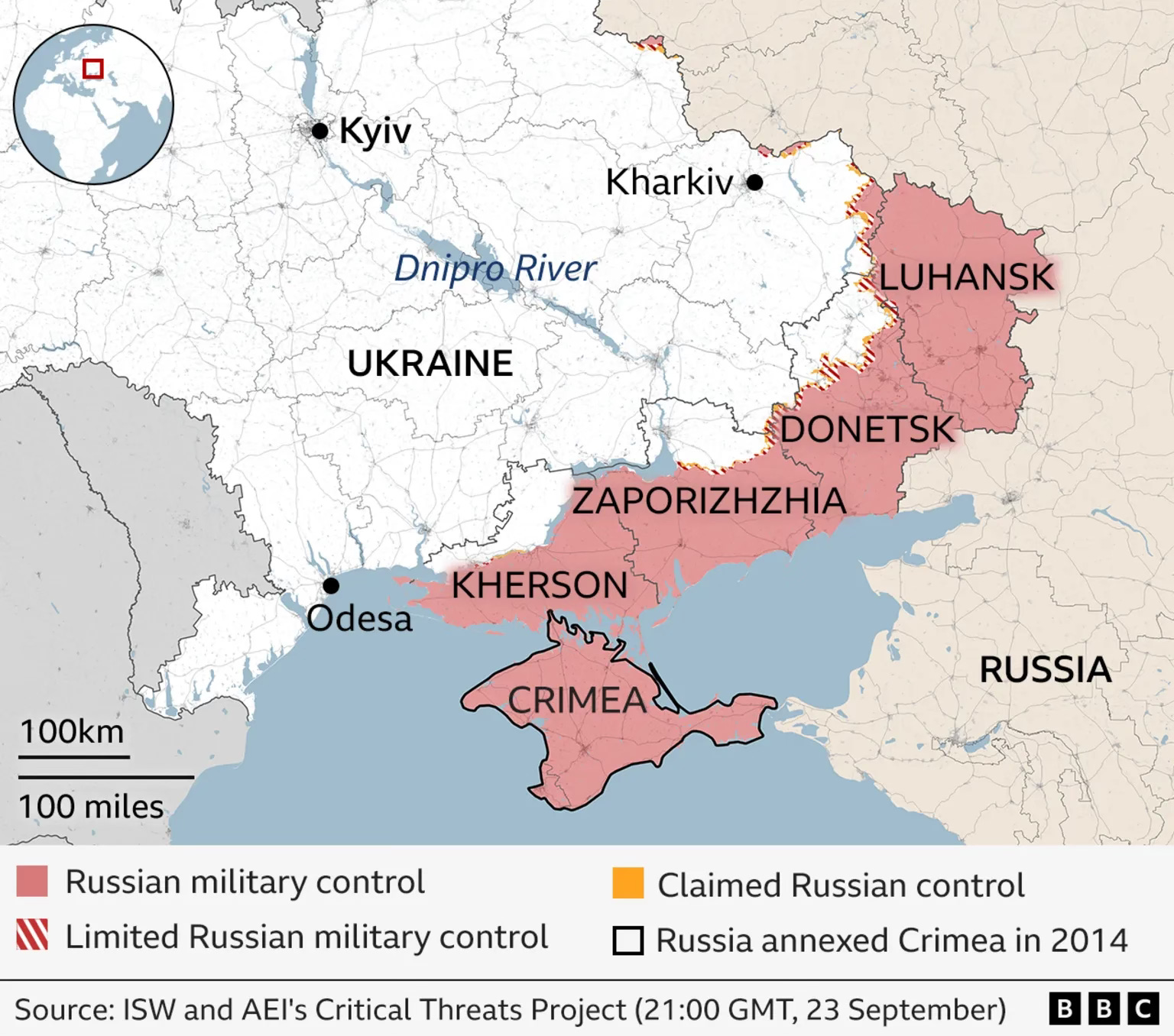
Again, no matter what Trump says, a total victory for Ukraine looks remote. Russia controls about 20 percent of Ukrainian territory, including the industrial Donbas and much of the south. Ukraine’s economy is weakened (as is Russia’s), its army is depleted, and its demographics are unfavorable to success (millions of Ukrainians have sought sanctuary abroad).

The Media’s Role in Perpetuating Illusion

The mainstream media in the U.S. has been partisan since day one. The MSM framed the conflict as a morality play: a heroic democracy versus an evil autocrat.

Meanwhile, the MSM overhyped U.S. weapons as “decisive” and Ukrainian counteroffensives in 2023 as “war-winning.” Media hype distorted expectations and contributed to public fatigue.

Most strikingly, the press has consistently downplayed the risks of escalation with a nuclear power. Ukraine’s use of long-range Western missiles to strike inside Russia carries serious dangers. That Putin will tolerate further provocations without escalating himself is a dangerous bet.

The Case for Diplomacy

Ukraine, no matter Trump’s new faith, cannot win this war in the maximalist sense of regaining all occupied territories and forcing Russia’s surrender. The longer the war continues, the more Ukraine will suffer—physically, economically, and politically.

Wars feed autocracy. Already, Ukraine has postponed elections, banned several opposition parties, and restricted media outlets. These measures may be understandable in wartime, but they belie the notion that Ukraine is a flourishing democracy.

A negotiated settlement is not capitulation. It is recognition of limits. The alternative is indefinite conflict—one that may bleed Ukraine dry even as it edges the world closer to catastrophe.

Dangerous Assumptions

Some policymakers argue a prolonged war will weaken Russia to the point of collapse. But a weakened Russia is not necessarily a safer one. If the Russian state disintegrates, who controls its nuclear arsenal? What if chaos in Moscow produces a more radical, vengeful leader? What if a desperate Kremlin lashes out, or if fighting spills into a NATO country like Poland?

Conversely, what if Ukraine, drained by endless war and reliant on foreign arms, slides toward authoritarianism? Wars have a way of transforming republics into garrison states. The longer the conflict lasts, the greater the risk that Ukraine’s democracy will become a casualty of its own “great patriotic war.”

The Limits of Analogy

Too often, the war is discussed through lazy historical analogies. Putin is Hitler; Zelensky is Churchill; negotiations are “another Munich.” Such framing flatters Western moral vanity but obscures strategic reality. This is not 1938. Putin is not on the verge of conquering Europe, and diplomats are not appeasing him by seeking peace.

Putin may be ruthless, but he is not suicidal. He knows that attacking a NATO member would invite his own destruction. Nuclear deterrence remains real. To suggest otherwise is to indulge in a fever-dream of perpetual conflict, one that justifies limitless military spending and forecloses diplomacy.

The American Connection

For most Americans, the Russia–Ukraine War remains distant and impersonal. We are not threatened by Russian artillery; the war is thousands of miles away. Yet we are paying for it—literally. Every artillery shell, every tank, every missile financed through our taxes contributes to death and destruction abroad. Some justify this as moral duty: helping Ukraine defend freedom. But morality also demands an accounting of consequences.

How many Americans know that 69 percent of Ukrainians report being weary of the war, or that their own government has suspended elections? How many realize that each dollar spent on war is a dollar not spent on schools, infrastructure, or healthcare at home?

We are told the U.S. can afford virtually limitless weapons for Ukraine, but when it comes to social programs, we always hear the same question: How are you going to pay for that? Apparently, there’s always money for war, never for peaceful pursuits.

A Broader Reckoning

The Russia–Ukraine War has become a mirror reflecting America’s own pathologies: our addiction to militarism, our aversion to diplomacy, our willingness to spend without scrutiny when the cause is war, and our moral complacency about the human cost of conflict.

We have turned foreign policy into a morality play, where compromise is dismissed as cowardice and negotiation is treated as akin to sin. Yet history teaches the opposite: the greatest statesmen are not those who glorify war but those who end it.

The Russia–Ukraine War continues, and so does the silence around the most basic of questions: What is America’s endgame? If the answer is “as long as it takes,” we should ask: takes for what? For Ukraine’s victory—or for its ruin? For democracy’s defense—or for another endless war?

It is time to demand accountability, restraint, and above all, diplomacy. Supporting Ukraine should not mean subsidizing endless cycles of death and destruction. How many more must die before this war is finally ended?

For Putin, It’s Business–For Trump, It’s Fame

Reflections on the Trump-Putin Meeting in Alaska

BILL ASTORE

AUG 16, 2025

I’m glad President Donald Trump met with his Russian counterpart, Vladimir Putin, in Alaska. No country possesses more nuclear warheads than Russia, so dialogue is essential. As Churchill once allegedly observed, “jaw-jaw” is better than “war-war,” especially when nuclear weapons and humanity’s fate are at stake.

Unsurprisingly, the two leaders announced no breakthrough on ending the Russia-Ukraine War. Still, the fact they were talking matters. They even floated the idea of a second meeting in Moscow. Putin quipped about it; Trump replied that he might “take some heat” for visiting the Kremlin. Innocuous banter, yes—but I’ll take that over nuclear threats any day.

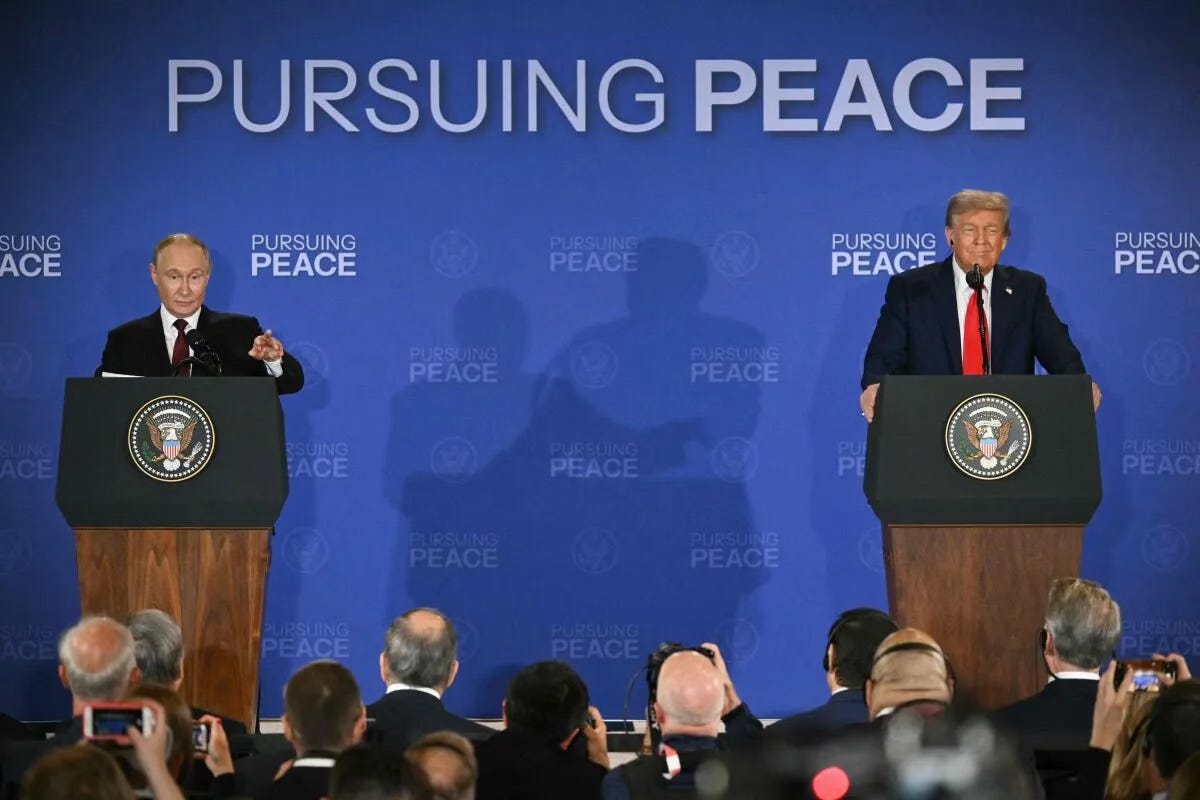
Pursuing peace—but not yet finding it.

The transcript of their closing remarks made for revealing reading. Putin spoke first, striking an amicable and measured tone. He invoked the U.S.-Soviet alliance of World War II, when both nations fought a common enemy. His words were thoughtful, cautious, above all diplomatic. He repeatedly emphasized the “businesslike” nature of the meeting, framing his approach as pragmatic and respectful—an approach likely to resonate with Trump, the self-proclaimed master of “the art of the deal.” Putin’s message, in essence, was: I’m someone you can do business with.

Trump’s remarks, by contrast, were more improvisational, filled with his trademark superlatives. Putin’s words, he said, were “very profound,” the meeting itself “very productive,” and the progress “great.” He even declared his relationship with Putin “fantastic.” That may be fantasy, but better that than animosity and hostility.

One passage from Trump’s comments stood out as both peculiar and revealing:

I would like to thank President Putin and his entire team—faces I know in many cases, faces I see all the time in the newspapers. You’re almost as famous as the boss—especially this one right over here. But we have had good, productive meetings over the years, and I hope to have more in the future.

That offhand line about Putin’s advisers being “almost as famous as the boss,” and about seeing their faces “all the time in the newspapers,” points to Trump’s obsession with fame. For Trump, people seem to matter only if they are celebrities. Recall his boasts about his own face appearing on the cover of Time magazine. His ego and craving for recognition make him vulnerable to manipulation. Unless you’re “famous”—someone whose picture appears regularly in the media—you scarcely exist in his world.

Trump’s deep need to be respected by other famous figures serves as a way to affirm his own worth. The danger, of course, is where that need might lead him—and the country.

Is China Really America’s Enemy?

W.J. Astore

Diplomacy is better than a land war in Asia

A friend of mine sent along a typical militarized think-tank article and asked for my comments. Here’s the title, with a link: 

Moneyball Military: An Affordable, Achievable, and Capable Alternative to Deter China

It was published by the Hoover Institution out of “liberal” Stanford University. 

“Moneyball” is a baseball term, the idea being that smaller market (and budget) teams can compete with larger teams (like the LA Dodgers or NY Yankees) by being smarter, by using metrics and stats to identify “cheap” but good players as well as more effective tactics to win ballgames. Check out the movie with the same title starring Brad Pitt.

Brad Pitt in “Moneyball.” But war, especially a land war in Asia, isn’t a game.

The “Moneyball Military” article basically argues the U.S. military must become more innovative, more responsive, more nimble, more flexible, etc., to meet the challenge of China. What articles like this one never suggest is diplomacy and the pursuit of PEACE. They never suggest that major cuts can be made to the Pentagon budget because the U.S. is fundamentally safe from invasion. They usually argue instead for more Pentagon spending, only “smarter.”

Why does the U.S. “need” 800 military bases around the globe? Why does it “need” to dominate the global trade in arms? Why has the U.S. wasted $10 trillion on unwinnable wars and conflicts (Iraq, Afghanistan, the GWOT, et al.) since 9/11? Why is China, a major U.S. trading partner and holder of U.S. debt, seen as an “enemy”?

These are questions that aren’t raised in think-tank articles like this one.

If you believe the polls, the U.S. is allegedly a Christian nation. Is there a worse sin than killing other humans in massive numbers? How do we stop doing this? Didn’t Christ say “Blessed are the peacemakers”? Why is the U.S. ennobling and saluting the warmakers instead? Why are we always envisioning wars with other peoples?

Again, is China really America’s enemy? Is China really planning to invade Taiwan? If so, wouldn’t diplomacy be a far smarter way of addressing this rather than a land war in Asia?

When one encounters think-tank articles like this one, one would be wise to remember Ray McGovern’s acronym, MICIMATT, which rightly includes these think tanks among the powerful entities that form America’s military-industrial-congressional complex.

When it comes to a land war in Asia, there is no smart way to “moneyball” it. The smart thing to do is to not play “ball” at all.

War, after all, is not a game.

The Russia-Ukraine War and the Management of Expectations

W.J. Astore

The U.S. Mainstream Media Finally Admits to a Costly Stalemate

It can’t be coincidence. In the past few days, I’ve seen articles at mainstream media outlets like the New York Times and Wall Street Journal that the much-hyped and much-delayed Ukrainian “spring” counteroffensive has stalled, and at high cost to Ukrainian troops. Here’s a quick online headline from the NYT on Monday:

The war is approaching a violent stalemate. Ukraine has made only marginal progress lately and is deploying less experienced soldiers after heavy casualties.

And here’s what the WSJ had to say (intro here from an article by Caitlin Johnstone):

In a new article titled “Ukraine’s Lack of Weaponry and Training Risks Stalemate in Fight With Russia,” the Wall Street Journal’s Daniel Michaels reports that western officials knew Ukrainian forces didn’t have the weapons and training necessary to succeed in their highly touted counteroffensive which was launched last month.

Michaels writes:

“When Ukraine launched its big counteroffensive this spring, Western military officials knew Kyiv didn’t have all the training or weapons — from shells to warplanes — that it needed to dislodge Russian forces. But they hoped Ukrainian courage and resourcefulness would carry the day.

“They haven’t. Deep and deadly minefields, extensive fortifications and Russian air power have combined to largely block significant advances by Ukrainian troops. Instead, the campaign risks descending into a stalemate with the potential to burn through lives and equipment without a major shift in momentum.”

So: We have both the NYT and WSJ admitting the war is likely to be stuck in a destructive stasis for the foreseeable future.  This isn’t that surprising.  Russia is deploying “defense in depth” tactics with minefields and other traps.  Ukrainian forces try bravely to advance, they get stuck, and Russia replies with withering artillery fire.

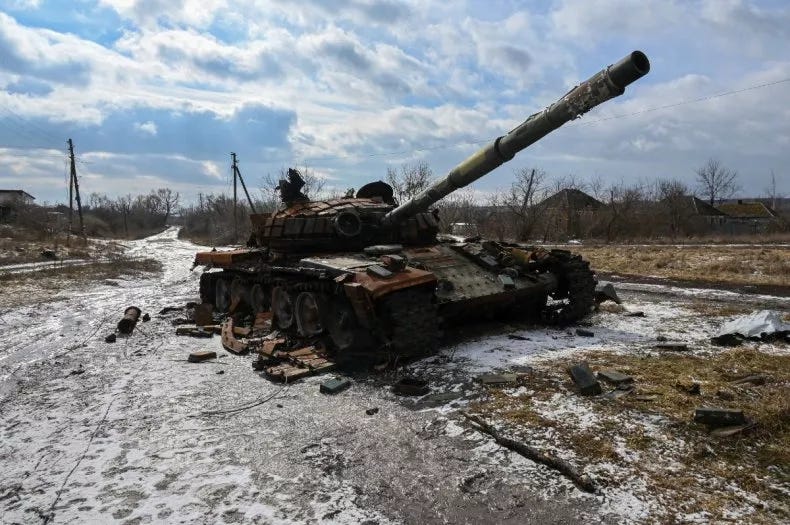
A destroyed Russian tank from March 2023, part of the poisonous detritus of war

There’s much of World War I here.  WWI only ended when Germany collapsed from exhaustion after four terribly long and incredibly costly years of war.

I don’t know if Russia or Ukraine will collapse first.  Certainly, Ukraine would collapse quickly without massive infusions of U.S./NATO aid.

What’s striking to me is how the MSM hyped the “decisive” spring counteroffensive, and how that narrative is now largely forgotten as a new narrative is rolled out, one where the course must be stayed until all those new U.S. weapons turn the tide, like M-1 tanks and F-16 jets.

Only time — and lots more dead — will tell. Supporters of Ukraine allege that progress is being made, that Russia is suffering more dearly, and that U.S./NATO aid must continue at the highest possible level to ensure that the forces of democracy will prevail against those of authoritarianism. These same supporters reject calls for diplomacy as misguided at best and at worst treasonous to Ukraine and appeasement to Putin. As long as Ukraine is apparently willing to fight to the last Ukrainian, the U.S./NATO should help them to do so.

I confess I don’t support this idea, which I hope doesn’t imply I’m a Putin puppet. Sorry, I don’t want to see Ukraine destroyed in a lengthy, murderous, and destructive war fought on their turf. Assuming this war is truly stalemated or otherwise bogged down, what better time for both sides to come together for a truce and some wheeling and dealing? The worst that could happen if talks bore no fruit, i.e. more killing, more war, is already happening and will continue to do so.

And indeed there are much worse things than a costly stalemate here: an expanded war that goes nuclear.

Interestingly, so far the mainstream sources I’ve read may be admitting to a stalemate but they’re not suggesting diplomacy in earnest. When they start doing that, I suppose that’ll mean things have truly gone bad for the embattled people of Ukraine.

Turmoil in Russia!

W.J. Astore

Is Putin’s Grip Weakening?

News of the rebellion of the Wagner mercenary group in Russia and the exile of its leader have led to confident announcements of Vladimir Putin’s weakening grip on power. Secretary of State Antony Blinken said the rebellion was “the latest failure” in Putin’s war against Ukraine, and NBC News declared “Putin’s rule is now more uncertain than ever.”

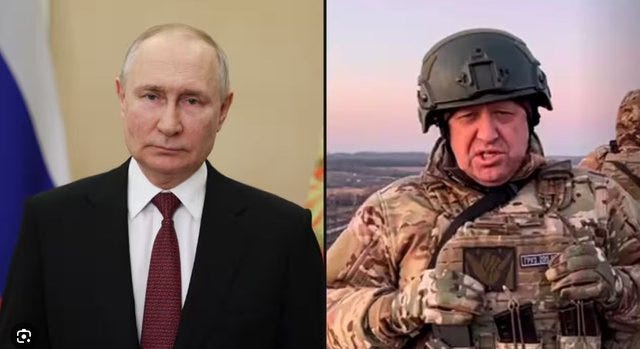
Vladimir Putin and the leader of the Wagner group, Yevgeny Prigozhin

Perhaps so. Wars often act as an accelerant to change, generating political chaos in their wake. The results of chaos, obviously, don’t lend themselves to predictability. Who knew in 1914, when the guns of August sounded, that four years later four empires would have collapsed under the strain of war (the Russian Empire, the Austro-Hungarian Empire, the Ottoman Empire, and the German Second Reich).

President Joe Biden was unusually frank in March of 2022 when he declared that Putin “cannot remain in power” due to his decision to invade Ukraine. Be careful what you wish for, Mr. President. Is overthrowing Putin truly a wise goal for global stability?

I honestly don’t know. A weaker, possibly fragmented Russia could increase the chances of nuclear war. A struggle for power within Russia could lead to the emergence of hardline leader who might make the West nostalgic for the relative predictability of Putin.

Most of us have heard the saying: better the devil you know than the one you don’t know. (This isn’t to suggest Putin is diabolical, of course.) In World War I, many of the allies professed to hate the Kaiser; his eventual successor as leader of the German people was Adolf Hitler. Again, wars may unleash elemental and fundamental changes, and change isn’t always for the better.

So, my position on the Russia-Ukraine War remains unchanged. Negotiate a truce. Use diplomacy to put a permanent end to this war. If Putin is truly weakened, this might be the best of times to seek a diplomatic settlement. After all, if Putin is truly worried about his grip on power within Russia, he might be open to ending the war largely on Ukraine’s terms so he can redirect his attention to consolidating his power base.

War has been given plenty of chances. Why not give peace a chance?

Hype and Hope in Ukraine’s Counteroffensive

W.J. Astore

“Certain Gains” in an Uncertain War

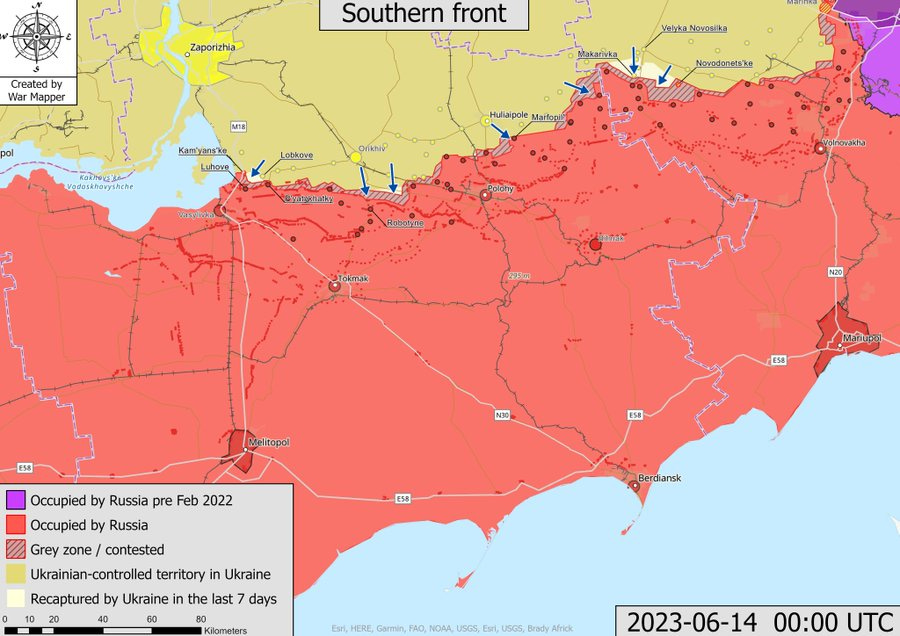
Ukraine’s counteroffensive is in motion; results so far appear to be mixed.  Today’s CNN summary had this to say: Ukrainian forces are claiming some success in their offensives in the south and east. Kyiv’s top general said this week that his troops have seen “certain gains.”

“Certain gains.”  Not only is the U.S. government sending Ukraine weapons and aid; it also is providing lessons in rhetorical BS.  How long before Ukraine speaks of “corners turned” and “the light at the end of the tunnel” in this dreadful war?

“Certain gains”: One thing that is certain is that maps like this are a sterile depiction of the dreadful and ghastly costs of war (Source: War Mapper)

Five days ago, the New York Times provided this short summary of Ukraine’s counteroffensive: As Ukraine Launches Counteroffensive, Definitions of ‘Success’ Vary. Privately, U.S. and European officials concede that pushing all of Russia’s forces out of occupied Ukrainian land is highly unlikely.

What is the definition of “success”? It sounds like a metaphysical puzzle.

Back on May 31st, I spoke with defense journalist Brad Dress at The Hill.  This is what I had to say then: “Sometimes, war is sold like a consumer product, where there’s a lot of hype and a lot of hope. That is contrary to the reality we often see.”

In our conversation, I reminded Dress of counteroffensives from military history that went dreadfully wrong.  Think of the first day of the Somme in July 1916 during World War I, when the British Army lost 20,000 dead and another 40,000 wounded.  Think of the Battle of the Bulge in December 1944 in World War II, when the German Army threw away its strategic reserve in a last gasp counteroffensive that ultimately made it easier for the Allies to defeat them in 1945.  History is replete with examples of failed counteroffensives, especially when the opponent is prepared and entrenched.

War is inherently unpredictable (as well as being hellish and horrific), but it does appear that Ukraine’s counteroffensive won’t be decisive.  It’s not going to defeat Russia in one fell swoop.  Battle lines may move a bit, but the war will continue.  And so will the killing—and the profiteering. Is that “success”?

Mostly unseen and unwritten about are all the dead soldiers on both sides, all the environmental destruction.  Which likely will produce cries for yet more violence in the cause of vengeance. “Success”?

So far, the Biden administration has used all its influence, indeed all means at its disposal, to continue the war.  The only way out, apparently, is over the bodies of dead Ukrainians and Russians.  Not surprisingly, then, the U.S. is providing even more deadly weaponry to Ukraine, including depleted uranium ammunition and (eventually) M-1 Abrams tanks and F-16 fighter jets.  Escalation, in sum, is America’s sole solution to ending the war.

I implore the U.S. government to pursue diplomacy as a means to ending this awful war.  No one is talking about surrendering to Putin.  No one wants to abandon Ukraine.  Indeed, I’m at a loss when people accuse me of not caring for the people of Ukraine when my goal is to end the killing on both sides.

All wars end.  Ukraine and Russia aren’t going anywhere.  They share a long border, a longer history, and now a lengthening war.  Shouldn’t we be doing everything we can to shorten it?

Let the Weapons Flow and the Body Count Grow

W.J. Astore

Say “no” to killing, “no” to war

Two articles I read yesterday are typical of polarized, indeed antithetical, views on the Russia-Ukraine War.

At the British Guardian, Simon Tisdall says this is Europe’s moment to step up and support Ukraine in a righteous war against Putin. He concludes, with passion:

Zelenskiy is right. Risk-averse Nato has been too slow and too cautious from the start. To outpace tyranny, Europe must fight – and fight to win. Our common future depends on it.

Putin, the tyrant, must be stopped in Ukraine, or Poland and Germany could be next. Fighting to win means that Ukraine must be given not only hundreds of Leopard 2 tanks but also combat jets. The combination of tanks, jets, and related ancillary equipment will enable Ukraine to drive Russian forces out of the country in a quasi-Blitzkrieg operation. Victory to the West!

Why not talks instead of tanks?

At Antiwar.com, Edward Curtin predicts Russia will win this war even as he suggests it’s mainly the West’s fault for inciting it via NATO expansion and U.S. involvement in the 2014 coup in Ukraine:

we are being subjected to a vast tapestry of lies told by the corporate media for their bosses, as the US continues its doomed efforts to control the world. It is not Russia that is desperate now, but propagandists such as the writers of this strident and stupid editorial [by the New York Times]. It is not the Russian people who need to wake up, as they claim, but the American people and those who still cling to the myth that The New York Times Corporation is an organ of truth. It is the Ministry of Truth with its newspeak, doublespeak, and its efforts to change the past.

Which is it? Is this a war that the U.S. and NATO must win, along with Ukraine, to stop an evil and expansionist dictator, or is this a war that the U.S. and NATO provoked, and surely will lose, given Russia’s military superiority empowered in part by the justice of its cause?

To me, the disturbing part of such polarized, us versus them, views is that they really guarantee only one thing: more fighting and more death. Let the weapons flow and the body count grow: that is the result of these debates.

War, as almost any military historian will tell you, is inherently unpredictable. I have no idea who’s going to “win” this war. I do know the Ukrainians are losing. I say this only because the war is being fought on their soil, and the longer it lasts, the more Ukraine will suffer.

That doesn’t mean I want Ukraine to surrender, nor do I want it to lose. But I don’t think it will win with more Western tanks and planes. Just about any escalation by the West can be matched by Russia. I see further stalemate, not Blitzkrieg-like victories, and stalemate means more and more suffering.

It’s said the pen can prove mightier than the sword. Why not try talking in place of tanks? Put those mighty pens to work by signing an armistice or even an enduring peace treaty. Ukraine and Russia are neighbors; unless they want perpetual war, they must find a way to live together.

More weaponry to Ukraine is unlikely to produce decisive victory, but it is likely to produce far more death and destruction in that country. It’s high time both sides said “no” to killing, “no” to yet more war.

Warfare Is Welfare for the Merchants of Death

W.J. Astore

Whatever else it is, the Russia-Ukraine War is a major money-making opportunity

Warfare is welfare for the merchants of death. Consider the Russia-Ukraine War. In the name of Ukrainian liberation, the U.S. Congress is preparing to approve another $37.7 billion in mostly military aid, bringing the total to nearly $100 billion in less than a year. This remarkable sum represents roughly 5% of federal discretionary spending, nearly the same as what the federal government spent on education in America this year. So far, all Democrats in Congress have supported aid to Ukraine, with only a minority of Republicans objecting.

Why is this? America is fertile ground for anti-Russian sentiment, but that’s not the main reason. It’s all about the Benjamins, as war is always immensely profitable for some sectors of society. Recall that President Dwight D. Eisenhower warned us of the disastrous rise of misplaced power represented by the military-industrial-congressional complex (MICC). Congress is heavily influenced by weapons contractors, not only through campaign contributions but by the jobs in their districts tied to the production of weapons of all sorts.

In a refreshing burst of honesty from the 1930s, the U.S. Senate referred to weapons contractors as “merchants of death,” and so they are. Weapons, from mundane bullets and artillery shells to “sexy” stealth fighters like the wildly expensive F-35, are designed to kill our fellow human beings. That’s why Eisenhower famously said in 1953 that humans essentially crucify themselves on a cross of iron when they prioritize weapons building over hospitals, schools, and other necessities of a civilized life.

More and more money to the merchants of death ensures three things: more power to weapons contractors, higher profits for them, and in this particular case a lot more dead Russians and Ukrainians. Some Americans seem to think it’s all worth it, though I’m skeptical about Ukrainian liberation being an important goal to officials in Washington.

Ike exhibited basic common sense when he noted the MICC is fundamentally anti-democratic. That it threatened our liberties and democratic processes. He told us to take nothing for granted, and challenged us to remain alert and knowledgeable. For when you empower the MICC, you weaken democracy. You also choose death over life.

Whether it’s the Russia-Ukraine War or previous ones like Vietnam, Iraq, and Afghanistan, the MICC has been and is making a killing in America and indeed across the globe— and in more ways than one. And as Ike said, that’s no way of life at all.

What is to be done? We need to start by recognizing that the MICC is fundamentally anti-democratic, often wasteful, driven by greed, and consistent with imperialism of the worst sort. Again, I’m not really saying anything new here; Ike, a five-star general and two-term president, said the same almost 70 years ago. His sentiments were echoed by James Madison when Madison wrote in 1795 that a large standing military and incessant warfare were deadly to democracy and liberty.1 Yet wars continue to find a way, and the MICC continues to thrive and expand its reach and power.

To resort to Scripture, not only is the flesh weak in America when it comes to reining in war and weapons: so too is the spirit. The spirit is unwilling because we are saturated in war and violence. An imperial vision like “full-spectrum dominance” has come to dominate American culture and society. Too many people believe that freedom is best projected and protected through the barrel of a gun.

The words of Ike come to me again when he said that only Americans could truly hurt America. The primary dangers are within not without. In that spirit, Ike warned us about a danger within, the MICC. We would do well to heed his warning if we wish to preserve and strengthen the tree of liberty.

How best to heed his warning? With respect to the Russia-Ukraine War, stop sending weapons that drive more killing. Put more effort on diplomacy. With respect to America itself, abandon the concept of a “new cold war” with Russia and China. Recognize America’s strength instead of focusing incessantly on hypothetical weaknesses. Stop listening to the screech of war hawks. Invest in life instead of death. Start from a place of life-affirming confidence rather than of fear and doubt.

There’s a powerful scene in “Enemy at the Gates” about the Battle of Stalingrad where Soviet political officers are debating how to inspire the troops to fight to the last. The Soviets had been relying on fear, and indeed at Stalingrad Soviet units killed thousands of their own troops for “cowardice” in the face of the Nazi enemy. One commissar is brave enough to offer something other than fear and death. “Give them hope!” he cries. Hope that they can and would prevail against a ruthless enemy.

That’s what we need in America today, a lot less fear and a lot more hope.

1

Madison wrote that: “Of all the enemies of true liberty, war is, perhaps, the most to be dreaded, because it comprises and develops the germ of every other.  War is the parent of armies; from these proceed debt and taxes; and armies, and debts, and taxes are the known instruments for bringing the many under the domination of the few.  In war, too, the discretionary power of the Executive is extended; its influence in dealing out offices, honors and emoluments is multiplied; and all the means of seducing the minds, are added to those of subduing the force, of the people.  The same malignant aspect in republicanism may be traced in the inequality of fortunes, and the opportunities of fraud, growing out of a state of war, and in the degeneracy of manner and of morals, engendered in both.  No nation can preserve its freedom in the midst of continual warfare.”

Peace Is Pro-Life and Pro-Choice

W.J. Astore

On learning the value of negotiation from the Outlaw Josey Wales

We’re in a strange moment when advocating for negotiations toward peace in Ukraine is dismissed as not only wrongheaded but morally wrong.  We’re told that only Ukraine can determine its future, and that one must not appease a dictator (Putin), but in the same breath we’re told that peace will only come when Russia is totally defeated by force of arms, with the main arms supplier being the United States.  Methinks various actors in the U.S. are evincing a conflict of interest here.  When war is profitable and you keep arguing for it, it doesn’t take a detective to see motives that are suspect.

Even when it’s necessary, war is bloody awful and murderously atrocious.  Not surprisingly, Jesus Christ preferred to bless the peacemakers instead of the warmongers.  Yet peacemakers today in the U.S. are rare indeed in the government and in mainstream media.  In God we (don’t) trust.

Being anti-war strikes me as a sane position for any human being.  War, in rare cases, may be unavoidable and even necessary (I’d point to World War II as a necessary war to defeat Nazi Germany and Imperial Japan), but being anti-war should be reflexive.  As I once read on a bumper sticker: “I’m already against the next war.”  I laughed at that one.  Peace is joyful.

I’d go further and argue that peace is pro-life and pro-choice.  Everyone should be for it, unless, that is, you make your fortune from war.  It’s hard to be pro-life, after all, when you’re shouting “kill” at some enemy.  And you really have no choices when you’re dead.  If you want more choices in life, turn away from war.  There’s nothing like war to deny you choices — and perhaps life as well.

The Russia-Ukraine War may soon enter its second year.  No one in their right mind should be cheering for this.  I don’t want to see more dead Russians and Ukrainians.  I don’t want escalating tensions between the U.S. and Russia, the world’s most powerful nuclear-armed nations.  Only a fool or a war profiteer should want another cold war, considering that the previous one wasted trillions of dollars, cost millions their lives, and almost ended in nuclear Armageddon sixty years ago off the coast of Cuba.

For some reason an old Clint Eastwood film comes to mind: “The Outlaw Josey Wales.”  As Josey Wales says to Ten Bears, a Native American chief, in a grim life-or-death faceoff, “Men can live together without butchering one another.”  Wales, unafraid to be seen as “weak” by negotiating with a Comanche chief, brought his word of death even as he sought an understanding that would preserve life.  And life it was.

Negotiation is not weakness.  Peace and life, as Josey Wales knew, is far preferable to war and death.  If the will exists, even bitter opponents can find common ground and a path forward away from death.  Words of peace have iron of their own, as Ten Bears says.  They ring true when they resonate from people of honor.

Josey Wales, a man who’d lost his family to war and its butchery, a man who’d had to kill to survive, wanted nothing more than peace and a chance for a better life.  So should we all.

(If you’d like to comment, please go to Bracing Views on Substack. Thanks.)

War Profits Soar as Diplomacy Sinks

W.J. Astore

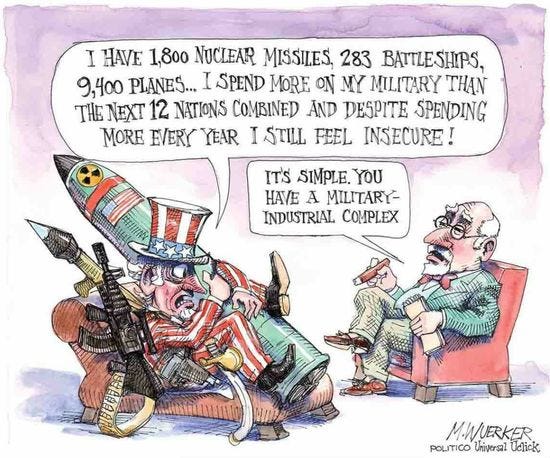
I came across a remarkable stat while reading William Hartung’s latest article, “The Profits of War,” at TomDispatch.com. The giant military contractor, Lockheed Martin, received $77 billion in federal funds in FY2020 (Lockheed Martin builds the F-35 fighter jet), almost double the entire budget for the U.S. State Department (roughly $44 billion). So as President Biden gives speeches about favoring diplomacy over military action, he might want to consider how the Pentagon’s budget (and related spending on weaponry, including new nuclear weapons) is roughly 20 times that of the State Department. Biden once said, show me your budget and I’ll tell you what you value. Looks like weaponry and war remains number one and job one. USA! USA!

I had to laugh when I saw this headline from the New York Times in my email this morning: “At U.N., Biden calls for diplomacy, not conflict, but some are skeptical.” Readers, I can’t fathom any skepticism about U.S. intentions, can you? We are a peace-loving nation. We just choose to show it by constantly building new weapons in a febrile quest for “full-spectrum dominance” as we showcase our global reach and global power with assassin drones and endless wars. Does any other country in the world have 750 overseas military bases in 80 countries? Does any other country in the world slice and dice the map into regional commands (Africa Command, Central Command, and so on) led by four-star generals and admirals? Proving the world is not enough, America now seeks to dominate space with our “Space Force” and virtual worlds like cyberspace.

Time to practice some “diplomacy” in space.

Remember how Teddy Roosevelt said to speak softly but also to carry a big stick? That needs to be amended. The U.S. policy for decades has been: Shout loudly and swing a big stick. And that “big stick” is the U.S. military, which routinely gobbles up more than half of the federal discretionary budget.

Let me know when the State Department’s budget soars to $750 billion and the Pentagon’s budget plunges to $44 billion and maybe I’ll believe Joe Biden’s words about the new importance of diplomacy in America.