Much is being made of Hillary Clinton’s private email server, which she used when she was Secretary of State. To me, the real issue is not that Hillary endangered national security by sending classified information in the clear. No — the real issue is that the Clintons act as if they are above the rules and laws that apply to “the little people.” They are superior and smug, totally devoted to themselves and their pursuit of power and the privileges that come with it. It’s a matter of character, in other words. Hillary’s evasiveness, her lack of transparency, her self-righteousness, her strong sense of her own rectitude, make her a dangerous candidate for the presidency.
My second point is this: The issue of classification should be turned on its head. The real issue is not that Hillary potentially revealed secrets. No — the real issue is that our government keeps far too much from us. Our government uses security classification not so much to keep us safe, but to keep the national security state safe — safe from the eyes of the American people.
“A committee established by Congress, the Public Interest Declassification Board, warned in December that rampant over-classification is ‘imped[ing] informed government decisions and an informed public’ and, worse, ‘enabl[ing] corruption and malfeasance’. In one instance it documented, a government agency was found to be classifying one petabyte of new data every 18 months, the equivalent of 20m filing cabinets filled with text.”
Nowadays, seemingly everything is classified. And if it’s classified, if it’s secret, we can’t know about it. Because we can’t be trusted with it. That’s a fine idea for an autocracy or dictatorship, but not so fine for a democracy.
Government of the people, by the people, for the people? Impossible when nearly everything of any importance is classified.
Too bad Hillary didn’t send everything in the clear — what a service she would have done for the American people and for democracy!
The American people are being kept divided, distracted, and downtrodden. Divisions are usually based on race and class. Racial tensions and discrimination exist, of course, but they are also exploited to divide people. Just look at the current debate on the Confederate flag flying in Charleston, South Carolina, with Republican presidential candidates refusing to take a stand against it as a way of appeasing their (White) radical activist base. Class divisions are constantly exploited to turn the middle class, or those who fancy themselves to be in the middle class, against the working poor. The intent is to blame the “greedy” poor (especially those on welfare or food stamps), rather than the greedy rich, for America’s problems. That American CEOs of top companies earn 300 times more than ordinary workers scarcely draws comment, since the rich supposedly “deserve” their money. Indeed, in the prosperity Gospel favored by some Christians, lots of money is seen as a sign of God’s favor.
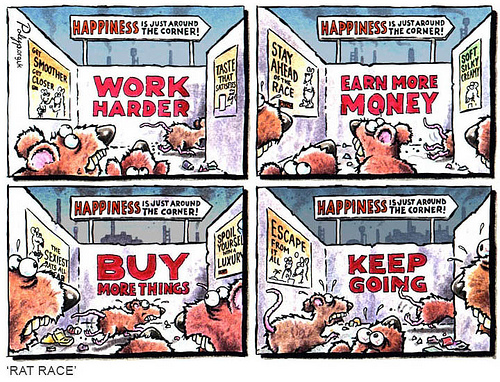
As people are kept divided by race, class, and other “hot button” issues (abortion and guns, for example), they are kept distracted by insatiable consumerism and incessant entertainment. People are told they can have it all, that they “deserve it” (a new car, a bigger home, and so on), that they should indulge their wants. On HGTV and similar channels, people go shopping for new homes, carrying a long list of “must haves” with them. I “must have” a three-car garage, a pool, a media room, surround sound, and so on. Just tell me what mortgage I can afford, even if it puts me deeply in debt. As consumerism runs rampant, people are kept further distracted by a mainstream media that provides info-tainment rather than news. Ultimately, the media exists to sell product; indeed, it is product itself. No news is aired that will disturb the financial bottom line, that will threaten the corporations that run the media networks, that will undermine the privileged and the powerful.
The people, kept divided and distracted, are further rendered powerless by being kept downtrodden. Education is often of poor quality and focused on reciting rote answers to standardized tests. Various forms of debt (student loan debt, credit card debt, debt from health care and prescription drugs costs, and so on) work to keep the people downtrodden. Even workers with good jobs and decent benefits are worried. Worried that if they lose their jobs, they lose their health care. So much of personal status and identity, as well as your ability to navigate American society, is based on your position. For many it’s lose your job, lose your life, as you’re consumed by debt you can’t repay.
Divided, distracted, and downtrodden: It’s a recipe for the end of democracy in America. But it also serves as a roadmap to recovery. To reinvigorate our democracy, we must fight against divisiveness, we must put distractions behind us, and we must organize to fight for the rights of the people, rights like a better education for all, less debt (a college education that’s largely free, better health care for everyone, and far less emphasis on consumerism as a sign of personal and societal health and wealth), and improved benefits for the workers of America, who form the backbone of our nation.
We can’t wait for the politicians. Most of them are already co-opted by the moneyed interests. Meaningful change will have to come from us. That is, after all, the way democracy is supposed to work.
Dissent is fundamental to democracy. Or so we claim. Until such dissent makes us angry or uncomfortable. Then we yell at the dissenter to shut up; better yet, we denounce him or her as a traitor to … well, whatever fits.
But responsible criticism of the actions of one’s government is not disloyalty; rather, it’s often a form of higher loyalty, a loyalty to the ideal of freedom of speech as well as the ideal of organized political action. The alternative is “My government, right or wrong.” And who wants that, except for government leaders and their lackeys?
The USA and Israel claim to be democracies. Yet in difficult times, dissent is often suppressed, and dissenters painted as disloyal. Recall the aftermath of 9/11 in the USA, when those who questioned the rush to war against Iraq were painted as naive peaceniks (at best) or as dupes of Saddam Hussein or even (at worst) as supporters of Al Qaeda. That was the mentality of Bush and Company, a Manichean “you’re either for us or against us.” And look where that got us.
Sorry, I’m not “for” a government and its leaders. I’m “for” the US Constitution and our essential rights and liberties, including the right to dissent from my government when I believe it is wrong.
Today, the debate on Israel and Gaza is similarly heated. Those who risk expressing sympathy for the Palestinians often get painted as supporters of Hamas and terrorism. Jon Stewart showcased this mentality on The Daily Showhere. Similarly, David Harris-Gershon wrote a telling article with the meaningful title, “Empathizing with Gaza does NOT make me anti-Semitic, nor pro-Hamas or anti-Israel. It makes me human.”
It almost goes without saying that Stewart and Harris-Gershon are Jewish. Indeed, Harris-Gershon’s wife was seriously injured by a terrorist bomb in Israel, an ordeal he wrote about in his book, “What Do You Buy the Children of the Terrorist Who Tried to Kill Your Wife? A Memoir of Jerusalem.” That they have to fight against the charge of being “self-hating Jews” or enemy sympathizers says much about the suppression of dissent by authoritarian elements in Israel as well as the USA.
Look: The situation in Gaza is highly inflammatory. As an organization, Hamas is quite obviously dedicated to launching rockets against innocents and building tunnels to launch terrorist attacks. Few people can blame Israel for wanting to stop the rocket attacks and destroy the tunnels. But honest people in good faith can definitely disagree with how the Israeli government is going about it.
Let me close with a comment from a Jewish friend. He wrote to me with grave concern about Israel’s actions in Gaza. What he said resonated with me. He said that the Israeli government’s actions in Gaza were betraying a fundamental core value of Jewish identity.
That value? Compassion.
You may agree or disagree with him. But is it too much to ask that we take his concern seriously, without denouncing him as naive or misguided or calling him a self-hating Jew or even a traitor?
Update (8/4/14): Call it “dissent” or call it “gumption” (the word Andrew Bacevich uses below): We need it when the experts are marching in lockstep in the pursuit of bad policies, as they did with the Tonkin Gulf Resolution in August 1964 that enabled the disastrous escalation of the Vietnam War. But let Bacevich tell it:
“It takes gumption to question truths that everyone “knows” to be true. In the summer of 1964, gumption was in short supply. As a direct consequence, 58,000 Americans died, along with a vastly larger number of Vietnamese, Cambodians, and Laotians.
“After 9/11, similar mistakes — deference to the official line and to the conventional wisdom (“terrorism” standing in for communism) — recurred, this time with even less justification. The misbegotten Iraq war was one result. Yet even today, events in Syria, Ukraine, and elsewhere elicit an urge to ‘do something,’ accompanied by the conviction that unless troops are moving or bombs dropping the United States is somehow evading its assigned responsibilities. The question must be asked: Are Americans incapable of learning?”
We’re especially incapable of learning when those few who dare to question the wrongheaded policies of our government are painted as malcontents or traitors.
A recent article by John Pilger in the British Guardian speaks of a silent military coup that has effectively gained control of American policymaking. It features the following alarmist passage:
In 2008, while his liberal devotees dried their eyes, Obama accepted the entire Pentagon of his predecessor, George Bush: its wars and war crimes. As the constitution is replaced by an emerging police state, those who destroyed Iraq with shock and awe, piled up the rubble in Afghanistan and reduced Libya to a Hobbesian nightmare, are ascendant across the US administration … The historian Norman Pollack calls this “liberal fascism”: “For goose-steppers substitute the seemingly more innocuous militarisation of the total culture. And for the bombastic leader, we have the reformer manqué, blithely at work, planning and executing assassination, smiling all the while.” Every Tuesday the “humanitarian” Obama personally oversees a worldwide terror network of drones that “bugsplat” people, their rescuers and mourners. In the west’s comfort zones, the first black leader of the land of slavery still feels good, as if his very existence represents a social advance, regardless of his trail of blood. This obeisance to a symbol has all but destroyed the US anti-war movement — Obama’s singular achievement.
Strong words. Is America the land of “liberal fascism”?
Certainly, since the attacks of 9/11 the U.S. has become more authoritarian, more militarized, and less free (witness the Patriot Act, NSA spying, and the assassination of American citizens overseas by drones). The U.S. Supreme Court has empowered corporations and the government at the expense of individual citizens. Powerful banks and corporations reap the benefits of American productivity and of special tax breaks and incentives available only to them, even as average American citizens struggle desperately to keep their heads above water.
But to describe this as “fascism” is misleading. It’s also debilitating and demoralizing.
It’s misleading because fascism has a specific historical meaning. The best definition I’ve seen is from the historian Robert Paxton’s The Anatomy of Fascism
For Paxton, fascism is:
A form of political behavior marked by obsessive preoccupation with community decline, humiliation or victimhood and by compensatory cults of unity, energy and purity, in which a mass-based party of committed nationalist militants, working in uneasy but effective collaboration with traditional elites, abandons democratic liberties and pursues with redemptive violence and without ethical or legal restraints goals of internal cleansing and external expansion.
In formulating this definition, Paxton had Hitler’s Germany and Mussolini’s Italy in mind, but his definition is an excellent starting point in thinking about fascism.
What about it? Is the U.S. fascistic? Plainly, no. We don’t have a messiah-like dictator. Our justice system still works, however imperfectly. Our votes still count, even if our political speech often gets drowned out by moneyed interests.
It’s true that, in the name of “support our troops,” we grant the Pentagon brass and defense contractors too much leeway, and allow our Department of Defense to seek “global power” without reflecting that such ambitions are the stuff of totalitarian states. But let’s also recall that our troops (as well as our representatives) still swear an oath to the Constitution, not to a dictator or party.
It’s also true that, as a society, we are too violent, too attracted to violence (think of our TV/Cable shows, our video games, and our sports), and too willing to relinquish individual liberties in the name of protecting us from that violence and the fear generated by it. Yet Americans are also increasingly weary and skeptical of the use of military force, as recent events involving Syria have shown.
The point is not to despair, not to surrender to the demoralizing idea that American politics is an exercise in liberal fascism. No — the point is to exercise our rights, because that is the best way to retain them.
Authority always wants more authority. But as political actors, we deny by our actions the very idea of fascism. For in fascist societies, people are merely subjects, merely tools, in the service of the state.
Don’t be a tool. Be an actor. Speak up. Get involved. Work to make your imperfect republic a little more representative of the better angels of our nature. Because it’ll be your deeds that keep our country from falling prey to fear and violence and the authoritarian mindset they breed.
A good friend of mine wrote to me the other day about an increasingly rare privilege he enjoyed, courtesy of a visitor from Europe. In my friend’s words,
Yesterday we had a friend visit from Europe. We sat from about 7 PM to midnight just talking about anything from personal or work problems to politics and the time just flew by… The contrast with the limited ability of the well-educated Americans we have met here to really discourse was astounding. Free discourse and examination of competing ideas is fundamental to democracy yet most Americans today consider it either “impolite” or “bad manners” to reveal themselves in even random conversations. Most Americans have decided to live in a black or white world, not the grey that is the reality.
Imagine that! My friend’s European guest demonstrated both the ability to reason, distinguishing facts from theories and conjecture, as well as tolerance, the ability to entertain other points of view, even when they disagree with your own.
Remember when Americans enjoyed the cut and fray of conversation, the pleasure of minds working hard to shed light on difficult matters? Just as our bodies prosper from demanding physical chores, so too do our minds.
Sadly, discourse in the USA today, such as it is, is mostly polarized. It’s I’m right and you’re wrong, and the way I prove it is to outshout you. This is one reason why otherwise thoughtful people tend to avoid protracted or revealing conversations. What’s the point, when all the other person wants to do is to cow you, condemn you, or convert you?
That said, Americans are slowly losing the ability to converse, for lots of different reasons. Young people are educated indoctrinated to get a job, with “success” measured by their pay and benefits. They place little value on becoming educated, informed, critical thinkers. They’re constantly distracted by various electronic devices and video games, and constantly bombarded with trivial information masquerading as meaningful news.
Immersion in the trivial stifles creative discourse and is an ever-present threat, as Alexandr Solzhenitsyn warned us 35 years ago:
People also have the right not to know, and it is a much more valuable one. The right not to have their divine souls stuffed with gossip, nonsense, vain talk. A person who works and leads a meaningful life does not need this excessive burdening flow of information.
Solzhenitsyn
A large part of leading a meaningful life is healthy communal discourse. But our society no longer sees discourse — the true exchange of ideas — as valuable. You can’t put a dollar figure on it, you can’t sell advertising for it, you can’t assign a metric to it, so just abandon it.
Writing skills are also degenerating. My students have difficulty sustaining an argument in print. They have difficulty in conversing intelligently on a range of subjects. They can’t distinguish facts from propaganda, or they prefer to deny facts that disagree with their received opinions. And they are tainted by me-first American exceptionalism.
And it’s only gotten worse since 9/11. As my friend noted, “On top of the social attitudes of feeling that conversation on serious topics is outré, the post 9/11 suppression of free speech has had a devastating effect on private discussion of national politics.”
In these times of conformity and confusion and complicity with power, we need thoughtful and contrarian discourse more than ever.
Come, let us reason together. And let’s not be afraid of heated discussion. A controlled burn can stop the most raging wildfire in the mind. We all need to burn more brightly to shed the light that is the essence of an active mind and a thriving democracy.





 Bracing Views