Strong, Smart, and Resolute Leaders: What America Needs Now

covid-19-featured-image
COVID-19: Not impressed by weak, dumb, and irresolute leaders 

W.J. Astore

If nothing else is true, COVID-19 is a wake-up call to all of us about the need for strong, smart, and resolute leadership.

Donald Trump is not that kind of leader.  He ducks all responsibility for mistakes, provides false information, and blames the crisis on others (Europeans, a “foreign” virus, the Obama administration, and so on).  His VP, Mike Pence, has been a non-entity for years and has done nothing to allay the concerns of Americans.

Meanwhile, the Democratic front runner, Joe Biden, has given short remarks read off a teleprompter.  I see headlines like “Can Biden handle a two-hour debate?” and I wince.  If serious people think Biden may not have the physical and mental endurance to perform well in a staged political conversation, how can we possibly believe he is fit enough to be president for four years?  Biden will be 78 in November, and none of us is getting younger.  If there are serious concerns about his mental and physical stamina now, when he’s not being pushed, how can there not be profound concerns about his ability to handle the burden of presidential leadership?  Severe stress ages everyone, and we shouldn’t close our eyes to this reality.

Roughly the same age, Bernie Sanders appears mentally and physically robust, and his speeches on the pandemic have been sensible, detailed, and smart.  But even Bernie isn’t getting any younger.

In Biden’s case, people may argue that Joe can always fall back on his VP if he fails in office.  But we don’t elect a president with the idea that he’s infirm and may soon need to pass his duties to a younger man or woman.

There is one presidential candidate still in the running for the Democrats who is strong, smart, and resolute and who is young to boot: Tulsi Gabbard.  She is 39 and has dramatic ideas to help ordinary Americans during this crisis.  Yet she’s been excluded from the Democratic debate by the DNC that can’t forgive her for supporting Bernie Sanders in 2016 while criticizing corruption within the party.

As Americans, we need to get serious about our leaders.  Trump has shown he has no answers.  Biden’s debate performances (among other public appearances) raise serious questions about his mental and physical capacity for office.

Yet as of this moment these two men appear to be our likely choices come November.  At a time of severe crisis, that’s no choice at all.

Pandemics and Partisan Politics

download
From the Oval Office: Beware of foreign viruses

W.J. Astore

If ever there was a time to put aside partisan politics, you’d think it would be now, as the United States faces the COVID-19 virus.  (When the American Mecca, Disney World, closes, you know times are tough.)  Instead, partisan politics are raging, especially in the White House, as President Trump implausibly blames his predecessor, Barack Obama, for the chaotic response by the Trump administration.  (Will “Crooked Hillary” be blamed next?)

Americans need to come together, and I think we are; Bernie Sanders gave a fine speech emphasizing science and teamwork as well as compassion and aid for those who lose their jobs and so on.  We need a much better testing regimen and we need to give doctors and health care personnel the resources they need to do their jobs.

But as I read David Lauter (LA Times Essential Politics), I despaired at the games being played as America faces a serious health crisis.  Here’s what Lauter had to say:

The Democrats have made clear what their line of attack will be: As Biden showed, they’re poised to say that while Trump didn’t cause the coronavirus outbreak, he made it worse by cutting government agencies designed to deal with epidemics and by refusing to take the advice of health officials and act aggressively to counter the illness when he could.

What Biden offers voters, Doyle McManus wrote, is a return to normalcy.

Trump has also tipped his hand on his likely response: Portray the disease as a foreign threat.

In his address to the nation Wednesday night, Trump repeatedly used rhetoric of a foreign invasion to describe the virus, as Noah Bierman wrote. His main policy response was to ban Europeans from traveling to the U.S., blaming them for having “seeded” many of the disease outbreaks in this country.

The speech did nothing to calm markets — indeed it roiled them further, as Bierman and Eli Stokols wrote. But it did provide a preview of Trump’s likely path.

Since the first moments of his astonishing political rise, with his opening blast against Mexican rapists, Trump has campaigned against immigrants and foreigners. And, despite much talk about blue-collar workers voting for him because of economic distress, the overwhelming weight of evidence is that opposition to immigration, concern about the changing demographics of the country and a belief that white Americans face discrimination form the biggest factors in predicting a person’s support for Trump.

In 2018, faced with the prospect that Republicans would lose control of the House, Trump tried to turn the election into a referendum on the supposed threat of immigrant caravans moving north through Mexico — a specter that largely evaporated soon after the election.

In 2020, deprived of the chance to campaign on economic prosperity and a rising stock market, it’s near certain that he will return to the theme that has powered his rise.

That approach might not work. His effort failed spectacularly in 2018 as suburban voters turned against Trump in droves. But Democrats would be wise to avoid overconfidence: The history of epidemics is also a history of xenophobia.

It would be a disaster if COVID-19 led to yet more fears of “foreigners,” however defined.

If anything, a threat like COVID-19 should remind us of our common humanity.  We are all vulnerable, and the smart way to meet this threat is to remain calm, to work together, and to listen to the experts.

Sure, the people who’ve botched America’s response so far should be held accountable.  But let’s first and foremost get a grip on the virus itself and stop its spread.  Because one thing is certain: partisan politics won’t stop a pandemic.  It’ll just make a bad situation worse.

A Few Words on the COVID-19 Pandemic

W.J. Astore

COVID-19 is now a pandemic, and each day brings news of cancellations and changes in an attempt to curb its spread, or to slow the rate at which it spreads.

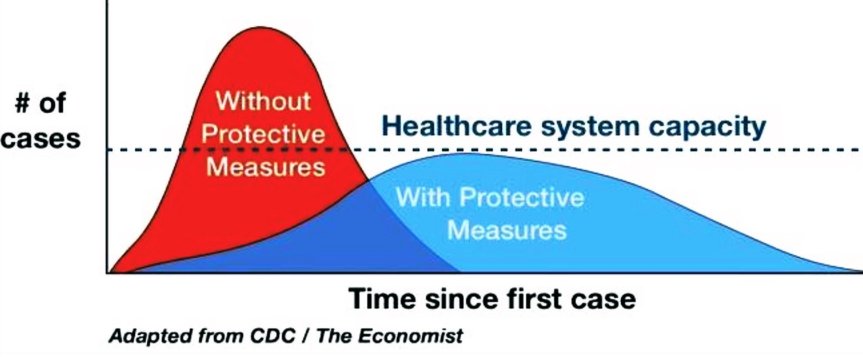
First off, I’m not a medical doctor, but I think I understand the gist of the approach, as represented by this graphic:

ESas8tHVAAAhr_I

If everyone gets sick at once, our healthcare system will be overwhelmed.  But if we take protective measures and slow the rate of transmission, our healthcare system should be able to cope.

What are some of these protective measures?

  1. “Social distancing”: Avoiding crowds and the like.  We see this as schools close and put classes online, the NBA suspends its season, etc.
  2. Quarantine for those who test positive for COVID-19.
  3. Helping to prevent transmission by washing hands vigorously with soap and hot water for 20 seconds and avoiding touching one’s face and eyes.
  4. Cover coughs and sneezes.
  5. Clean and disinfect surfaces.
  6. Wearing a face mask if you believe you are sick.

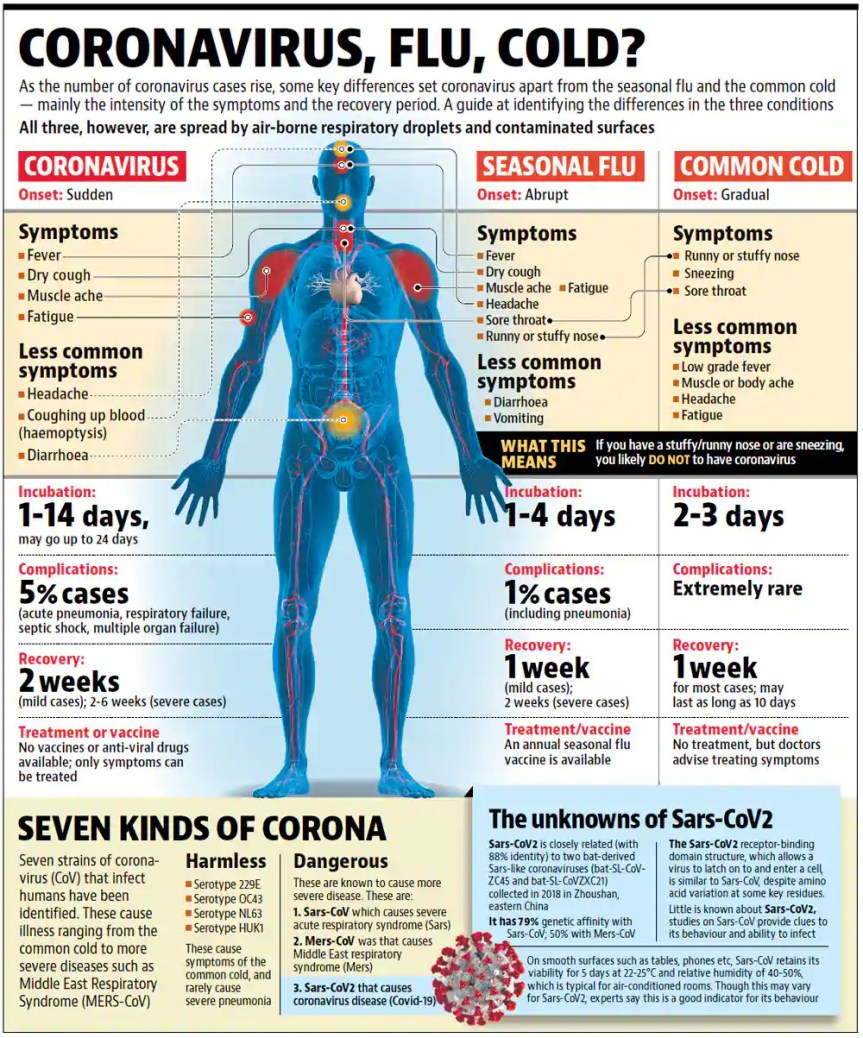
The chart below may be useful in recognizing the symptoms and knowing the difference between COVID-19 versus regular flu and the common cold.  But always defer to your doctor/health care practitioner:

corona

The best site for news on the virus is the CDC, the Centers for Disease Control and Prevention, at cdc.gov.  For example, go to https://www.cdc.gov/coronavirus/2019-ncov/about/prevention.html for tips on how to prevent the transmission of the virus.

The CDC site has many useful tips, including what to do if you are sick:

https://www.cdc.gov/coronavirus/2019-ncov/about/steps-when-sick.html

It’s important to stay informed and to follow the advice of health experts.