I’ve written several articles about the United States and creeping militarism (see here and here, for example). This should be obvious, but I’ll say it again: Calling attention to the militarization of American society is pro-democracy, not anti-military. Indeed, back in the citizen-soldier era of my father, being “gung ho” for the military wasn’t even applauded within the military!
As one veteran wrote to me:
When I was in the military, being “gung ho” was not considered a compliment by most of my friends… Of course we were not professional military types, just taking our turns to do our duty. We remembered the American soldier epitomized by Bill Mauldin as “Willie” and “Joe” who fought successfully against the German Army and the Japanese fanatics…The popular war movies of WWII after the war usually pitted the austere, indoctrinated Nazis fighting to demonstrate the Nazi superiority against the average American citizen soldier. Remember the movie “Battleground”? Today the images of our Army uncomfortably remind me of the way the German superman was portrayed that we overcame.
As America today celebrates its “superman” warriors (one soldier recently called this “the age of the commando”), our country neglects these same men and women when they leave the military, often with crippling physical and psychological wounds.
As another veteran wrote to me:
[There is a] disjunction between the cult of military hero-worship in American society and American ignorance of veterans’ problems. I am continually disgusted with those who are pimping off the mystique [surrounding our troops] who don’t deserve any special regard for their military service. And a final but important point: many combat vets, knowing full well the realities of combat and its effects on combatants, do not want to be thanked at all [by the public].
America’s militarism both feeds and draws support from our endless wars. The war on terror has been ongoing since 2001. So too the war in Afghanistan. Iraq keeps getting more chaotic. Miscalculation in Syria could lead to World War III.
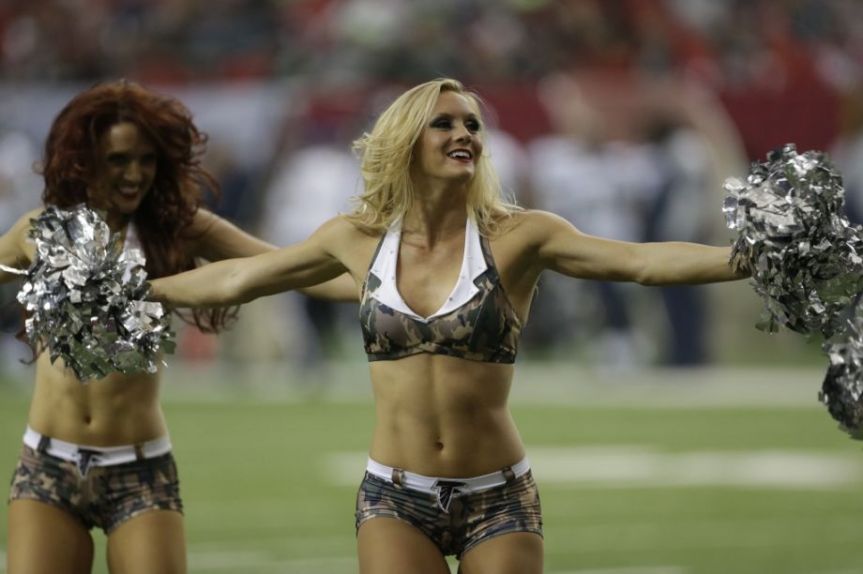
Speaking of future wars, just look at the rhetoric of our more popular political candidates for president, to include Donald “bomb those suckers” Trump and Ted “carpet bomb” Cruz. Chickenhawk politicians are nothing but opportunists. They may be leading the war charge, but they know they’re backed by a society in thrall to military spectacle (as represented, for example, by pom-pom shaking cheerleaders in skimpy camouflage outfits).
Unstinting praise of America’s “warriors” and “heroes” is reinforced by feel-good corporate/military advertising. Recall Budweiser’s “welcome home” party for an Army lieutenant that aired during the Super Bowl a couple of years back. Or red-white-and-blue Budweiser cans to “honor” the troops on July 4th. “Saluting” the troops with colorful beer cans – really?
Signs of militarism USA are everywhere. Police forces with MRAPs and similar tank-like vehicles. Colleges and universities jostling for “defense” funding (even bucolic campuses want those war bucks). Popular games that glorify military mayhem, such as the “Call of Duty” video games. Even mundane items like camouflage headsets for NFL coaches.
It’s time to end the madness. Paraphrasing Dwight Eisenhower, only Americans can defeat America. Constant celebration of all things military is not a recipe for victory. But it is a surefire recipe for the end of democracy.
The passionate discussion generated by our last article, America’s Military Academies Are Seriously Flawed, was heartening. Our military academies will not be improved if we merely accept the status quo, with allowance for minor, mainly cosmetic, reforms. But truly radical reforms are difficult to achieve since the academies are so deeply rooted in tradition. A reluctance to change can be a good thing, especially when an institution is performing well. Yet since the Korean Conflict, and certainly since the Vietnam War, America’s military performance has been mediocre. Placing blame here is obviously contentious, with military professionals tending to point to poor decisions by civilian leaders, among other causes.
Rather than placing blame, let’s entertain some probing questions about the future structure and mission of military academies, with the intent of making them better schools for developing military leaders, as well as better institutions for defending America and advancing its values.
Here in no particular order are a few questions and proposals:
1. Is America best served by military academies that emulate undergraduate colleges in providing a course of study lasting four years? Or should the academies recruit from students who have already finished most (or all) of an undergraduate degree? The academies could then develop a concentrated course of study, specifically tailored to military studies, lasting roughly two years. In effect, the academies would become graduate schools, with all cadets graduating with master’s degrees in military studies with varying concentrations (engineering, science, English, history, and so on). Such a change would also eliminate the need to kowtow to undergraduate accreditation boards such as ABET.
2. West Point and the AF Academy rely primarily on serving military officers as instructors, whereas Annapolis relies primarily on civilian instructors. Is this a distinction without difference? Would West Point and the AF Academy profit from more civilian instructors, and Annapolis from more military ones? Should all the service academies work harder to bring in top instructors from the Ivy League and similar universities as full-time visiting professors?
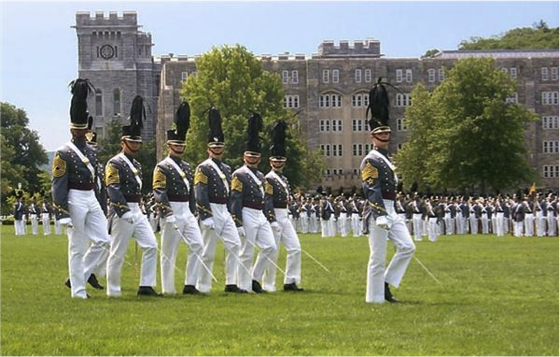
3. How much of today’s experience at military academies is busy work? Or work driven mainly by tradition, i.e. “We do this because we’ve always done this.” Do we still need lots of inspections, marching, parades, and the like? Do freshman (call them plebes, doolies, smacks, what have you) truly profit from being sleep-deprived and harassed and otherwise forced into compliance as a rite of passage in their first year? Does this truly develop character? Or are cadet schedules so jam-packed that they have little time to think?
4. Why do cadets continue to have limited exposure to the enlisted ranks? NCOs are the backbone of a professional military, a fact that is not stressed enough in officer training. How do we increase opportunities for cadets to work with NCOs in the field?
5. A strong emphasis on physical fitness and sports is smart. But is it necessary to place so much emphasis on big-time sports such as Division I-A football? What is gained by focusing academy recruiting on acquiring athletes that will help to win football games? What is gained by offering such athletes preferential treatment within the corps of cadets? (Some will claim that athletes receive no preferential treatment; if you believe this, I suggest you listen very carefully to cadets who are outside of the charmed circle of celebrated athletes.)
6. When I was a serving officer at the AF Academy, cadets used to ask me whether I believed they were “the best and the brightest.” Certain senior leaders had told them that, by virtue of being selected to attend a military academy, they were better than their civilian peers at universities such as Harvard or MIT. Is it wise to sell cadets on the idea that they are America’s best and brightest?
How I answered the question: I told my cadets that comparing military academies to universities such as Harvard or MIT was an apples/oranges situation. First and foremost, military academies were and are about developing military leaders of strong character. If you compared cadets to their peers at Harvard or MIT, of course you’d find smarter students at these and similar top-flight universities. But that wasn’t the point. Military academies had a different intent, a different purpose, a different mission. This answer seemed to satisfy my cadets; what I sensed was that they were tired of being told they were America’s best, when they could see for themselves that this often wasn’t true.
We do our cadets no service when we applaud them merely for showing up and working hard, just as our civilian leaders do the military no service when they applaud us as the best-led, best-equipped, best-trained, and so on, military force in all of human history. Any student of military history should laugh at such hyperbolic praise.
7. And now for a big question: Are the academies contributing to America’s current state of perpetual war? Have we abandoned Washington’s ideal of Cincinnatus, the citizen-soldier, the soldier who fights reluctantly and who seeks not military honors but only a return to normalcy and an end to war?
Some will argue that the world today demands perpetual vigilance and a willingness to use overwhelming “shock and awe” force to intimidate and defeat America’s enemies. And that only a professional corps of devoted regulars can lead such a force. Perhaps so.
But is it time to consider new paradigms?
What are the most serious threats that America faces today? For example, American infrastructure is crumbling even as we spend hundreds of billions in Iraq and Afghanistan with indifferent results. Should West Point return to its roots, unleashing its officer-engineers to lead a new Civilian Conservation Corps to rebuild America? (Recall that George C. Marshall ran the CCC.) Should America’s military be refocused not on winning the “global war on terror” (unwinnable by definition, for terror will always be with us), but on preserving the global environment?
As humans wage war against our planet and biosphere, should not a force dedicated to the defense of America focus on preserving our livelihood as represented by our planet’s resources? With its global presence, the American military is uniquely situated to take the lead here. Indeed, the U.S. Navy already advertises itself as “A global force for good.” Can we make that a reality?
Too pie in the sky? The U.S. military has enormous resources and a global role in leadership. What would it mean to America if our military took the lead in preserving the earth while rebuilding the core strength of America? Aren’t these “wars” (against global environmental degradation; for America’s internal infrastructure) worth fighting? Are they not more winnable than a perpetual war on terror?
There you have it. Let’s hear your ideas in the comments. And thanks.
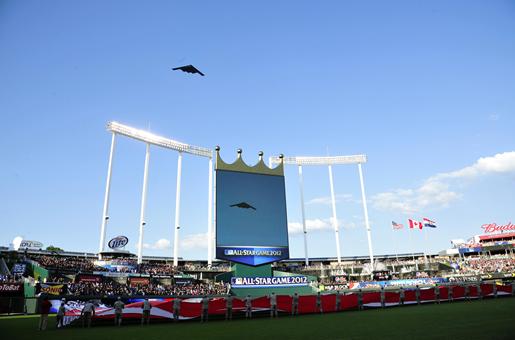
A nuclear-capable B-2 Stealth Bomber flies over a gigantic flag at the 2012 Baseball All-Star Game
W.J. Astore
As Veterans Day approaches, I thought I’d revive a column I wrote for TomDispatch.com back in 2009. I continue to marvel at the militarism of the USA, and the way in which the troops are defined as “warriors” and “warfighters” who increasingly see themselves as being divorced from, and superior to, “civilians” in the USA. Of course, there was a time in America when our troops were proud to define themselves as citizen-soldiers, with the emphasis on citizen. Not anymore. The ethos has changed, pushed toward a “professional” military that sees itself as a breed apart. And that’s not good for democracy.
I still recall the example set by Major Dick Winters, memorialized in the “Band of Brothers” series on HBO. Dick Winters swore that when the war was over against Nazi Germany and Imperial Japan, he’d return to his farm in Pennsylvania and leave soldiering and war behind. And that’s exactly what he did. No “warrior” nonsense for him.
Anyway, here’s the article I wrote five years ago. Sadly, its theme is more relevant today than it was in 2009.
What Ever Happened to Gary Cooper? A Seven-Step Program to Return America to a Quieter, Less Muscular, Patriotism By William Astore
I have a few confessions to make: After almost eight years of off-and-on war in Afghanistan and after more than six years of mayhem and death since “Mission Accomplished” was declared in Operation Iraqi Freedom, I’m tired of seeing simpleminded magnetic ribbons on vehicles telling me, a 20-year military veteran, to support or pray for our troops. As a Christian, I find it presumptuous to see ribbons shaped like fish, with an American flag as a tail, informing me that God blesses our troops. I’m underwhelmed by gigantic American flags — up to 100 feet by 300 feet — repeatedly being unfurled in our sports arenas, as if our love of country is greater when our flags are bigger. I’m disturbed by nuclear-strike bombers soaring over stadiums filled with children, as one did in July just as the National Anthem ended during this year’s Major League Baseball All Star game. Instead of oohing and aahing at our destructive might, I was quietly horrified at its looming presence during a family event.
We’ve recently come through the steroid era in baseball with all those muscled up players and jacked up stats. Now that players are tested randomly, home runs are down and muscles don’t stretch uniforms quite as tightly. Yet while ending the steroid era in baseball proved reasonably straightforward once the will to act was present, we as a country have yet to face, no less curtail, our ongoing steroidal celebrations of pumped-up patriotism.
It’s high time we ended the post-Vietnam obsession with Rambo’s rippling pecs as well as the jaw-dropping technological firepower of the recent cinematic version of G.I. Joe and return to the resolute, undemonstrative strength that Gary Cooper showed in movies like High Noon.
In the HBO series The Sopranos, Tony (played by James Gandolfini) struggles with his own vulnerability — panic attacks caused by stress that his Mafia rivals would interpret as fatal signs of weakness. Lamenting his emotional frailty, Tony asks, “What ever happened to Gary Cooper?” What ever happened, in other words, to quiet, unemotive Americans who went about their business without fanfare, without swagger, but with firmness and no lack of controlled anger at the right time?
Tony’s question is a good one, but I’d like to spin it differently: Why did we allow lanky American citizen-soldiers and true heroes like World War I Sergeant Alvin York (played, at York’s insistence, by Gary Cooper) and World War II Sergeant (later, first lieutenant) Audie Murphy (played in the film To Hell and Back, famously, by himself) to be replaced by all those post-Vietnam pumped up Hollywood “warriors,” with Sylvester Stallone and Arnold Schwarzenegger-style abs and egos to match?
And far more important than how we got here, how can we end our enduring fascination with a puffed up, comic-book-style militarism that seems to have stepped directly out of screen fantasy and into our all-too-real lives?
A Seven-Step Recovery Program
As a society, we’ve become so addicted to militarism that we don’t even notice the way it surrounds us or the spasms of societal ‘roid rage that go with it. The fact is, we need a detox program. At the risk of incurring some of that ‘roid rage myself, let me suggest a seven-step program that could help return us to the saner days of Gary Cooper:
1. Baseball players on steroids swing for the fences. So does a steroidal country. When you have an immense military establishment, your answer to trouble is likely to be overwhelming force, including sending troops into harm’s way. To rein in our steroidal version of militarism, we should stop bulking up our military ranks, as is now happening, and shrink them instead. Our military needs not more muscle supplements (or the budgetary version of the same), but far fewer.
2. It’s time to stop deferring to our generals, and even to their commander-in-chief. They’re ours, after all; we’re not theirs. When President Obama says Afghanistan is not a war of choice but of necessity, we shouldn’t hesitate to point out that the emperor has no clothes. Yet when it comes to tough questioning of the president’s generals, Congress now seems eternally supine. Senators and representatives are invariably too busy falling all over themselves praising our troops and their commanders, too worried that “tough” questioning will appear unpatriotic to the folks back home, or too connected to military contractors in their districts, or some combination of the three.
Here’s something we should all keep in mind: generals have no monopoly on military insight. What they have a monopoly on is a no-lose situation. If things go well, they get credit; if they go badly, we do. Retired five-star general Omar Bradley was typical when he visited Vietnam in 1967 and declared: “I am convinced that this is a war at the right place, at the right time and with the right enemy — the Communists.” North Vietnam’s only hope for victory, he insisted, was “to hang on in the expectation that the American public, inadequately informed about the true situation and sickened by the loss in lives and money, will force the United States to give up and pull out.”
There we have it: A classic statement of the belief that when our military loses a war, it’s always the fault of “we the people.” Paradoxically, such insidious myths gain credibility not because we the people are too forceful in our criticism of the military, but because we are too deferential.
3. It’s time to redefine what “support our troops” really means. We console ourselves with the belief that all our troops are volunteers, who freely signed on for repeated tours of duty in forever wars. But are our troops truly volunteers? Didn’t we recruit them using multi-million dollar ad campaigns and lures of every sort? Are we not, in effect, running a poverty and recession draft? Isolated in middle- or upper-class comfort, detached from our wars and their burdens, have we not, in a sense, recruited a “foreign legion” to do our bidding?
If you’re looking for a clear sign of a militarized society — which few Americans are — a good place to start is with troop veneration. The cult of the soldier often covers up a variety of sins. It helps, among other things, hide the true costs of, and often the futility of, the wars being fought. At an extreme, as the war began to turn dramatically against Nazi Germany in 1943, Germans who attempted to protest Hitler’s failed strategy and the catastrophic costs of his war were accused of (and usually executed for) betraying the troops at the front.
The United States is not a totalitarian state, so surely we can hazard criticisms of our wars and even occasionally of the behavior of some of our troops, without facing charges of stabbing our troops in the back and aiding the enemy. Or can we?
4. Let’s see the military for what it is: a blunt instrument of force. It’s neither surgical nor precise nor predictable. What Shakespeare wrote 400 years ago remains true: when wars start, havoc is unleashed, and the dogs of war run wild — in our case, not just the professional but the “mercenary” dogs of war, those private contractors to the Pentagon that thrive on the rich spoils of modern warfare in distant lands. It’s time to recognize that we rely ever more massively to prosecute our wars on companies that profit ever more handsomely the longer they last.
5. Let’s not blindly venerate the serving soldier, while forgetting our veterans when they doff their spiffy uniforms for the last time. It’s easy to celebrate our clean-cut men and women in uniform when they’re thousands of miles from home, far tougher to lend a hand to scruffier, embittered veterans suffering from the physical and emotional trauma of the battle zones to which they were consigned, usually for multiple tours of duty.
6. I like air shows, but how about — as a first tiny step toward demilitarizing civilian life — banning all flyovers of sporting events by modern combat aircraft? War is not a sport, and it shouldn’t be a thrill.
7. I love our flag. I keep my father’s casket flag in a special display case next to the very desk on which I’m writing this piece. It reminds me of his decades of service as a soldier and firefighter. But I don’t need humongous stadium flags or, for that matter, tiny flag lapel pins to prove my patriotism — and neither should you. In fact, doesn’t the endless post-9/11 public proliferation of flags in every size imaginable suggest a certain fanaticism bordering on desperation? If we saw such displays in other countries, our descriptions wouldn’t be kindly.
Of course, none of this is likely to be easy as long as this country garrisons the planet and fights open-ended wars on its global frontiers. The largest step, the eighth one, would be to begin seriously downsizing that mission. In the meantime, we shouldn’t need reminding that this country was originally founded as a civilian society, not a militarized one. Indeed, the revolt of the 13 colonies against the King of England was sparked, in part, by the perceived tyranny of forced quartering of British troops in colonial homes, the heavy hand of an “occupation” army, and taxation that we were told went for our own defense, whether we wanted to be defended or not.
If Americans are going to continue to hold so-called tea parties, shouldn’t some of them be directed against the militarization of our country and an enormous tax burden fed in part by our wasteful, trillion-dollar wars?
Modest as it may seem, my seven-step recovery program won’t be easy for many of us to follow. After all, let’s face it, we’ve come to enjoy our peculiar brand of muscular patriotism and the macho militarism that goes with it. In fact, we revel in it. Outwardly, the result is quite an impressive show. We look confident and ripped and strong. But it’s increasingly clear that our outward swagger conceals an inner desperation. If we’re so strong, one might ask, why do we need so much steroidal piety, so many in-your-face patriotic props, and so much parade-ground conformity?
Forget Rambo and action-picture G.I. Joes: Give me the steady hand, the undemonstrative strength, and the quiet humility of Alvin York, Audie Murphy — and Gary Cooper.
A visitor to my home today saw my retirement plaque, which marks my twenty years of service in the US Air Force. He immediately thanked me for my service to my country.
I appreciated his thanks because I took (and take) some pride in having served honorably in the military. But people who thank me make me uncomfortable. Why, you ask?
Because I believe it was an honor to serve my country. It was an honor to be entrusted by the people of our great land with their trust.
So when people thank me, I always feel like thanking them back for allowing me to serve; for giving me this honor, this privilege.
Now, I write articles that are often critical of today’s military. And there’s lots of things to criticize. But I don’t believe in criticizing the military’s ethic of service, an ethic that should be based on humility and tinged with pride. Because our nation’s ideal is a citizen-soldier military. Note how the word “citizen” comes first. We are not supposed to want a military composed of mercenaries or warriors. Such a military is inconsistent with our democratic ideals.
Also inconsistent with our democratic ideals is our national tendency to idolize officers of high military rank. You know, the generals and admirals, men like Tommy Franks or David Petraeus. Why? Because any citizen-civilian outranks any citizen-soldier in the military, generals included.
We must always remember that military members serve us: we the people. We don’t serve them. And we must remember as well that our president, a civilian commander-in-chief, is first and foremost exactly that: a civilian. And that he’s not the commander-in-chief of all Americans; merely of those Americans who choose to don a uniform and take the oath of office (to include active duty, reserves, and National Guard members).
These are fundamental points (or they should be). They are derived from our Constitution. Our founders saw (reluctantly) the need for a military, and perhaps our greatest founder, George Washington, was also arguably our greatest military leader. Not because he was a Napoleon, but precisely because he wasn’t. He was our Cincinnatus, a citizen-soldier, with the emphasis firmly placed on citizen. A man who placed his duty to the Constitution, and to the people, before himself and military vainglory.
If you wish to thank a service member for his or her service, by all means do so. Just don’t be completely surprised when they deflect your thanks, or even thank you back for the honor and privilege of being able to serve in the name of the people to protect our highest ideals as enshrined in our Constitution.



 Bracing Views