When you have an unrepresentative government, or, put differently, a government that represents oligarchic interests and corporations, as well as being heavily influenced by lobbyists, domestic and foreign (AIPAC), you get Trump and Congress conspiring to decrease Medicaid, to cut food support for the poor, while funneling more money upward to the very richest Americans.
American workers essentially have no agency, no ability to act in meaningful ways in the political realm. Along with no agency, Americans also have fewer liberties, especially if you should choose to criticize U.S./Israeli policies and otherwise challenge the imperatives of the powerful.
Be careful shouting “Give me liberty or give me death!” in these times. Death may be far easier to achieve.
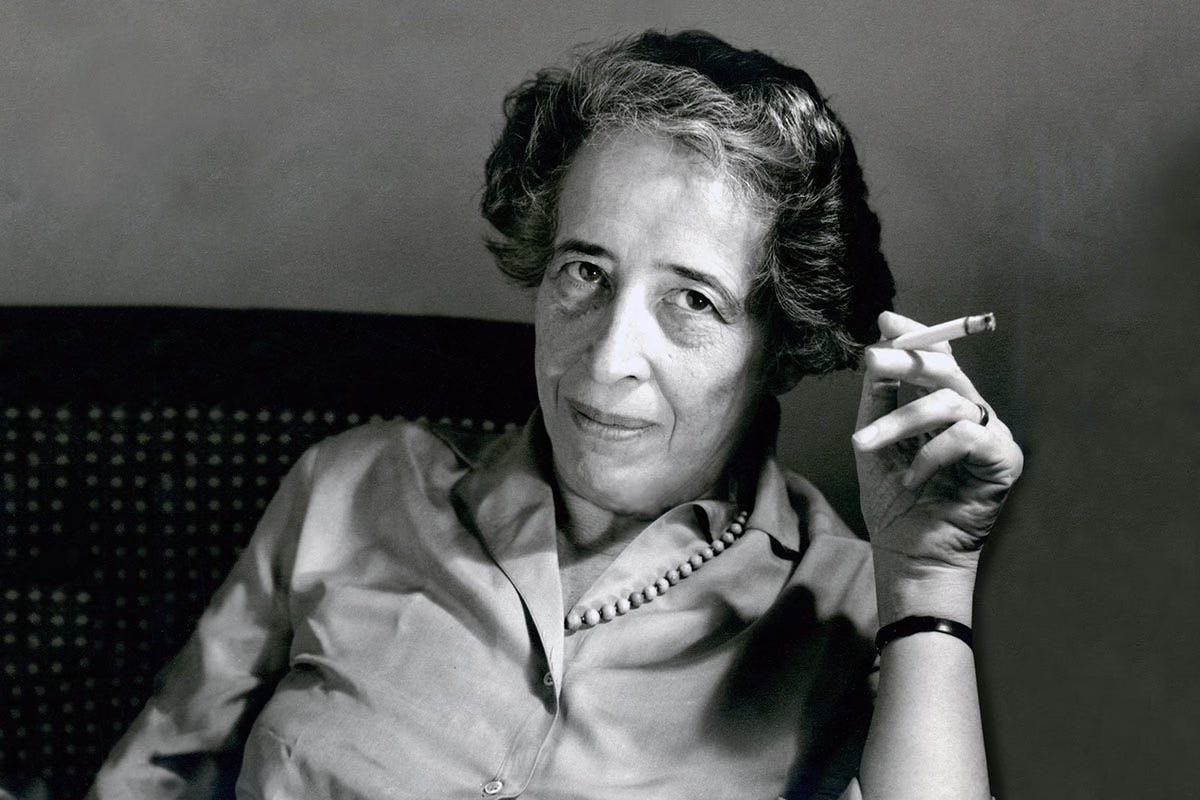
Hannah Arendt
What is the answer to regaining our agency? In “Between Past and Future,” the political philosopher Hannah Arendt wrote how French resisters to the Nazis during World War II discovered themselves—their true nature—in and through action. In resisting the Nazis, they seized control over their own agency by exercising it in the face of danger. They chose risk, they fought to effect change, they took stands that often meant life or death.
Through action, these resisters lifted themselves out of “normal” time, Arendt argued, entering instead a realm between past and future, a realm of true existence, a present of dynamism, of possibilities, of clarity of commitment.
Political agency is not going to be given back to the people. If we regain it, it will only be by seizing it ourselves, through action, through commitment, through risk-taking, and perhaps most of all through large-scale organized resistance.
Hopefully, that resistance can remain non-violent. I prefer reformation or restoration to revolution, recalling the words of Aleksandr Solzhenitsyn that revolutions unleash the most elemental barbarism.
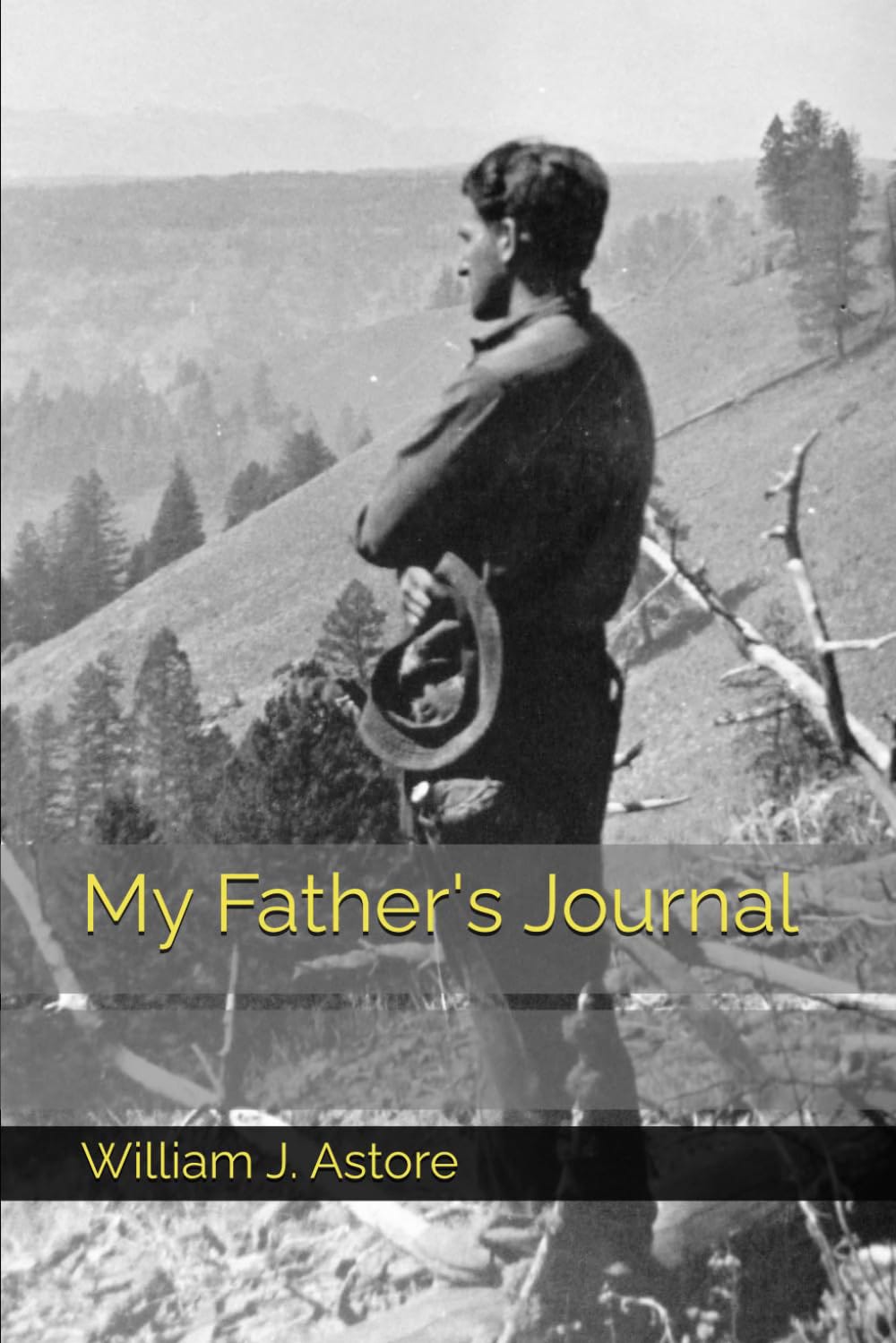
It seems like forever and a day, but I finally published my dad’s journal with my notes and photos at Amazon. Here’s the link.
It’s available for $10 in paperback, $5 on Kindle, or free if you have Kindle unlimited.
Here’s my description of the book:
Before he died, my father wrote a journal about his life. Born in 1917, he lived through the Great Depression, served in the Civilian Conservation Corps (mainly in Oregon) in the 1930s, survived working in factories and in the U.S. Army during World War II, and eventually became a firefighter for the City of Brockton (MA), serving for over 30 years.
Though he never finished high school, he read philosophy, loved classical music, and was an avid opera fan. The son of Italian immigrants, his story is the story of America, the story of a young man who worked hard and who in the process acquired a lot of wisdom from life’s setbacks.
This journal recounts many episodes in his life and the lessons he learned from them. It is one remarkable note in a fanfare for the common man.
*****
I started transcribing my dad’s journal soon after he died in 2003, but it took me two decades to put it all together in book form. If you find time to read it and you like it, perhaps you can bop on over to Amazon and write a review of it.
Thanks so much to all my readers. I hope you enjoy my book about my dad.
You won’t have to burn them if they’re never published
W.J. Astore
There are many forms of lying. One that we don’t always think about is lying by omission. A partial truth can be a more insidious lie than an outright falsehood. I might argue, for example, that the Vietnam War was awful for America, dividing the country and costing more than 58,000 U.S. troops their lives, along with innumerable other mental and physical casualties. But if I leave out or downplay the far more horrifying costs to Southeast Asia, the literally millions of Vietnamese, Laotians, and Cambodians killed in that war, the poisoning of their land by highly toxic chemicals like Agent Orange along with millions of unexploded mines and munitions, which still kill to this day, I have most definitely lied by omission. Perhaps the Vietnam War was a “tragedy” for the U.S., but it was far, far worse for those on the receiving end of American firepower.
It’s not easy to get books published that tell tough truths we’d prefer not to hear. For example, Nick Turse’s book about “the real American war in Vietnam,” entitled “Kill Anything that Moves,” was published by Metropolitan Books, which is now being shuttered and shut down, notes Tom Engelhardt in his latest article at TomDispatch.com. Engelhardt has seen this before, with Pantheon Books, another publisher known for publishing books that told uncomfortable truths about America. It too was a victim of consolidation in publishing, of being shut down, mainly because the consolidators simply didn’t like the books being published. And perhaps too because these same books sometimes didn’t make enough money (though some proved to be bestsellers, which, from the owners’ ideological perspective, may have been worse).
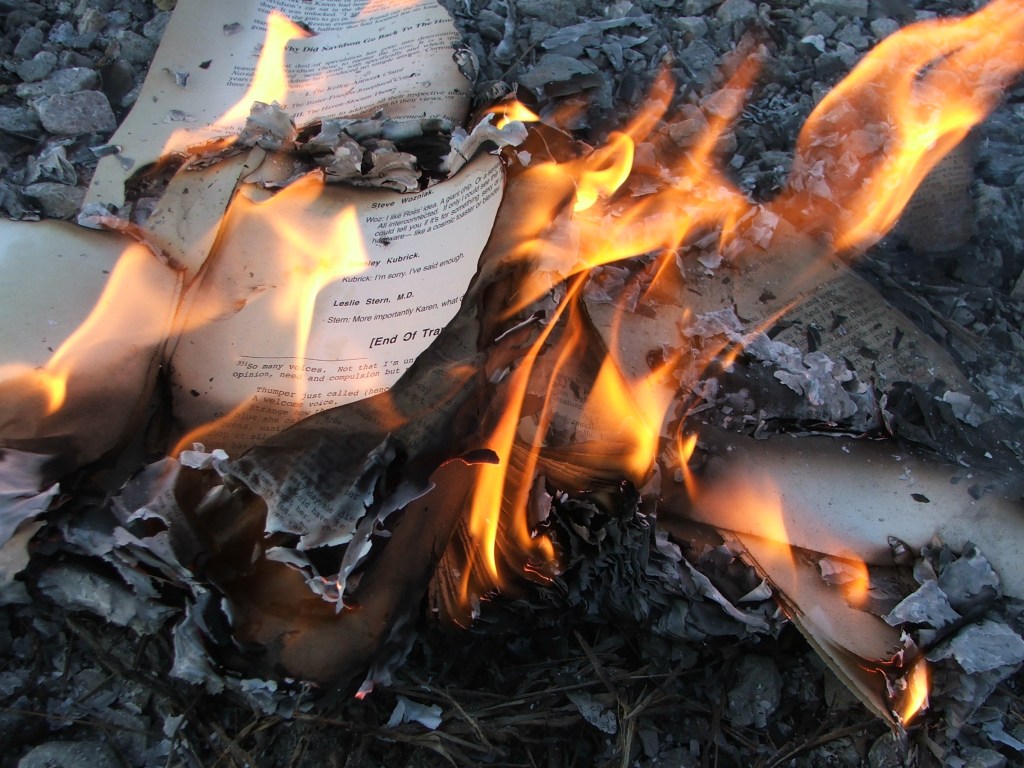
Engelhardt’s heartfelt article made me think. Imagine that. It made me think that the best way to “burn” books is to make sure they’re never published. Same with banning books. You don’t have to ban them when they can’t find their way into print.
Also, it’s far easier to manufacture consent — to control the national discourse — when only certain books are being published and hyped — the ones reflecting and reinforcing mainstream thought.
Whether it’s shutting down Pantheon or Metropolitan or similar publishing houses, it’s about blocking alternative views that challenge capitalism, neoliberalism,, neoconservatism, and similar mainstream ideologies. You can always claim that the house you’re shuttering just wasn’t making enough money, wasn’t moving enough product, never mind the quality of that “product” and the invaluable service it was providing to democracy and the free exchange of ideas.
Readers here know that I started writing for TomDispatch in 2007. My first article was critical of the Petraeus Surge in the Iraq War, but my goal back then was “to save the U.S. military from itself,” from its misleading and often mendacious metrics to its inflated sense of itself, shown most clearly with its obsession with medals and decorations even as the war was going very poorly indeed. I tried several mainstream publishers including the New York Times and Washington Post without success. A friend mentioned TomDispatch to me, I wrote to Tom, and he found something in my writing worthy of being published at his site. My next “Tomgram” will be the 95th I’ve written for the site.
If TomDispatch didn’t exist, my criticisms and critiques would probably have never been published. Tom’s example inspired me to write further, to become a regular at Huff Post and Antiwar.com and to start my own blogs. Bracing Views exists because of the example provided by TomDispatch.
Good books beget other good books. Critical books beget other critical books. Scholarship builds on itself. When you block or severely limit opportunities for good, daring, and critical books from being published, you strike a blow against scholarship, against the free exchange of ideas, against the very idea of an enlightened America made more powerful and righteous by its informed citizens.
Sure, it’s just another publisher being put out of business. Nothing to see here, move along. Except it’s much more than that. It’s a form of book burning before the book ever existed, a silencing of synapses in our minds, an insidious form of mind control in the sense of curtailing certain thoughts and ideas from ever taking form.
A concern I have about the new borderless digital world is its ephemeral nature. Even though I keep a blog and write a lot online, I still prefer books and hardcopy. I clip newspaper articles. I file them away and then occasionally resuscitate them and use them in class when I teach.
Hardcopy has a sense of permanence to it. A certain heft. Whereas our new digital world, as powerful as it is for instant access and personal customization, seems much more ephemeral to me.
I know similar complaints have been made throughout history. The proliferation of books was deplored as leading to the decline of visual memory skills. Television was equated with the end of civilization, with the medium becoming the message.
Perhaps what I’m truly lamenting is the slow decline of context, together with the erosion of deep memory. The digital world we increasingly inhabit seems to encourage an ephemeral outlook in which history just becomes one damn thing after another.
To switch metaphorical images, the dynamism and flash of the digital world is much like a landscape with lots of beautiful shiny leaves and glistening flowers to attract our attention.
Yet, at least in our minds, the landscape is rootless. Our gaze is enraptured, our minds are intrigued, but the moment is fleeting, and we fail to act. We fail to act because we are entertained without being nurtured.
Let’s take smartphones, for example. With their instant access to data, they seem to make us very smart indeed. But access to knowledge (data recall) isn’t intelligence. There’s simply no substitute for deep-seated intellectual curiosity and the desire to learn.
Smart phones are useful tools — a gateway to a dynamic digital world. But they’re not making us any smarter. Perhaps they’re helping us to connect certain dots a little faster. But are we connecting them in the right way? And are they the right dots to connect?
Those are questions that smartphones can’t answer. Those are questions that require deep, contextual, thinking. And group discussion. Think Socrates and his followers, debating and discoursing. And acting.
Sometimes it’s best to disconnect from the matrix, find a quiet place for reflection, sink down some roots, and hit the books. Then find other informed people and bounce your ideas off them. Collisions of minds in informed discourse. Competing ideas feed the completing of actions for the common good.
As the Moody Blues might say, it’s a question of balance. The astral planes of the digital world can open new vistas, but let’s not forget the need to return to earth and get things done.



 Bracing Views