Monday Musings About America

warrior
It’s an odd thing to see a pagan warrior of ancient Greece used as a symbol of Christianity, but what matters here is the idea Christianity is synonymous with warrior violence

W.J. Astore

It’s amazing how often America’s politicians dismiss proposals that would benefit workers as “too expensive” (such as a higher minimum wage, or more affordable college education, or single-payer health care) versus how much they’re willing to approve for new weapons and wars.  With little debate, this year’s “defense” budget will be roughly $750 billion, although the real number exceeds a trillion dollars, as Bill Hartung notes here for TomDispatch.  Meanwhile, spending on education, infrastructure improvements, and so on withers.

It’s almost as if the impoverishment of America’s workers is deliberate (some would say it is).  Four decades ago, I remember reading Crane Brinton’s “The Anatomy of Revolution” in AP Modern European History.  Brinton noted how rising expectations among the lower orders can lead to revolutionary fervor.  But if you keep people down, keep them busy working two or three jobs, keep them distracted with “circuses” like unending sports coverage and Trump’s every twitch and tweet, you can control them.

Thus the establishment sees a true populist politician like Bernie Sanders as the real enemy.  Bernie raises hopes; he wants to help workers; but that’s not the point of the American system.  So, Bernie must be dismissed as “crazy,” or marginalized as a dangerous socialist, even though he’s just an old-fashioned New Dealer who wants government to work for the people.

Related to keeping people under control (by keeping them divided, distracted, and downtrodden) is to keep them fearful.  A foreign bogeyman is always helpful here, hence the demonization of Vladimir Putin.  An old friend of mine sent me an article this past weekend about Putin’s strategy in reviving Russia.  I confess I don’t follow Russia and Putin that closely.  But it strikes me that Putin has played a weak hand well, whereas U.S. leaders have played a strong hand poorly.

In the article I noted the following quote by Putin:

[we] need to build our home and make it strong and well protected … The wolf knows how to eat … and is not about to listen to anyone … How quickly all the pathos of the need to fight for human rights and democracy is laid aside the moment the need to realize one’s own interests come to the fore.

Putin’s words are from a decade ago, when the U.S. still talked about fighting for “human rights and democracy.”  Under Trump, “one’s own interests” are naked again in U.S. foreign policy under men like John Bolton and Mike Pompeo.  Is this progress?

Overall, Russia has learned (or been forced) to limit its foreign burdens, whereas the U.S. is continuing to expand its “global reach.”  Russia learned from the Cold War and is spending far less on its military, whereas the U.S. continues to spend more and more.  It’s ironic indeed if Russia is the country cashing in on its peace dividend, even as the U.S. still seems to believe that peace is impossible and that war pays.

I wonder if Russia (joined by China) spends just enough on its military to present a threat to the U.S. for those who are so eager to see and exaggerate it.  For example, China builds an aircraft carrier, or Russia builds a nuclear cruise missile, not because they’re planning unprovoked attacks against the U.S., but as a stimulus to America’s military-industrial complex.  Because America’s reaction is always eminently predictable.  The national security state seizes on any move by China or Russia as dangerous, destabilizing, and as justification for yet more military spending.  The result is a hollowing out of the U.S. (poorer education, fewer factories, weaker economy, collapsing infrastructure), even as China and Russia grow comparatively stronger by spending more money in non-military sectors.

There are complicated forces at work here.  Of course, Ike’s military-industrial-Congressional complex is always involved.  But there’s also a weird addiction to militarism and violence in the USA.  War, gun violence, and other forms of killing have become the background noise to our lives, so much so that we barely perceive the latest mass killing, or the latest overseas bombing gone wrong.  (I’d also add here the violence we’re doing to our environment, our earth, our true “homeland.”)

I mentioned violence to my old friend, and he sent me this note:

On violence and American cultural DNA one place to start is Richard Slotkin’s trilogy, Regeneration Through Violence, The Fatal Environment, and Gunfighter Nation… The gist of what I have gotten about Slotkin’s thesis is that America’s frontier past trained settlers to think of violence (against natives and against each other) as forms of rebirth both for the individual and for the community.

My friend’s comment about violence and rebirth made me think of the film “Birth of a Nation” (1915) and the infamous scene of the KKK riding to the rescue.  We in America have this notion that, in one form or another, a heavily armed cavalry will ride to the rescue and save us (from savage Indians, violent immigrants, etc.).  In a strange way, Trump’s campaign tapped this notion of rebirth through violence.  Think of his threats against immigrants – and his promises to build a wall to keep them out – and his threats to torture terrorists and even to kill their families.

Trump tapped a rich seam of redemption through violence in the USA, this yearning for some sort of violent apocalypse followed by a “second coming,” notably in conservative evangelical circles.  For when you look at “end times” scenarios in evangelical settings, peaceful bliss is not the focus.  Suffering of the unredeemed is what it’s all about.  Christ is not bringing peace but a sword to smite all the evildoers.

For people who suffer toil and trouble daily, such apocalyptic visions are a powerful distraction and may serve as a potent reactionary tonic.  Why fight for Bernie’s political revolution when Christ’s return is imminent?

That’s enough musing for one Monday morning.  Readers, what say you?
Trump’s Priorities For Action

ardern
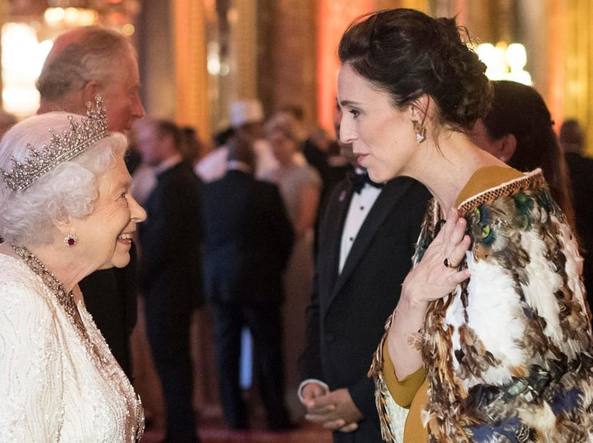
Jacinda Ardern with the queen

W.J. Astore

A good friend of mine, a Kiwi, sent me an update on Jacinda Ardern’s priorities for action in New Zealand.  It’s known there as a “Wellbeing Budget.”

* Creating opportunities for productive businesses, regions, iwi and others to transition to a sustainable and low-emissions economy.

* Supporting a thriving nation in the digital age through innovation, social and economic opportunities.

* Reducing child poverty and improving child wellbeing, including addressing family violence.

* Supporting mental wellbeing for all New Zealanders, with a special focus on under 24-year-olds.

* Lifting Māori and Pacific incomes, skills and opportunities.

I know: New Zealand is a small country on the other side of the world; a superpower like the United States has nothing to learn from Kiwis, right?

What struck me about these priorities is, well, that New Zealand has some.  That they’re clear and concise and focused on well-being for children and teenagers and families.  That they address poverty.  And that climate change isn’t forgotten (“sustainable” and “low-emissions” economy).

What about America’s great leader, Donald Trump?  What are his priorities for national well-being?  Near as I can tell, these are Trump’s priorities:

1. Enriching himself and his family.

2. Avoiding impeachment, or exploiting it if he is impeached.

3. Getting reelected.

4. More golf.

5. Screwing anyone who resists him.

What about issues like “build the wall”?  I don’t think Trump cares whether the wall is built; it’s merely a convenient issue to exploit as he rallies his base.  What about ending access to abortion?  Again, I don’t think Trump cares about this issue, except as it energizes a key component of his base.  What about appointing lots of conservative justices and judges?  Again, Trump cares only in the sense that such judges and justices will rule in a way that upholds his privileges.

My Kiwi friend’s list got me to reflect on the lack of consensus for action in the USA today among our “leaders”/politicians.  (Well, there is bipartisan support for enormous military budgets, but that’s about it.)  Put differently, most Americans express support for single-payer health care, a higher minimum wage, higher taxes on the richest Americans, climate-friendly policies, and so on, but our bought-and-paid-for politicians act against the people’s wishes.

Various power brokers may laugh at Trump’s vanities and object to his vulgarity and his selfishness and greed, but they also abet him because he serves to divide people while protecting elite privileges against reformers like Bernie Sanders.

I know one thing: the answer isn’t Joe Biden or any other DNC-approved candidate.  The answer is a movement that unites behind a candidate that actually cares for people like us, someone like Bernie Sanders.  Short of that, well-being will be in very short supply in America’s future.

America’s Peculiar Military Dictatorship

51G5eOhy2mL
A satirical cover for the ages

W.J. Astore

President Dwight D. Eisenhower famously warned Americans about the military-industrial complex in his farewell speech in 1961.  He had wanted to add Congress as a key player in and contributor to the Complex, but why alienate Congress, he decided, when he was already taking on the military, industry, and universities/research labs.  Ike did his best to rein in the Complex while he was president, but since then it has galloped freely under the not-so-steady hands of subsequent presidents.

Recently, I re-read a diatribe about the Complex that appeared a decade after Ike’s farewell speech.  “Playing Soldier” is its title, written by Frank Getlein, a journalist for the Washington Star (1961-76).  His critique, sadly, is even more relevant today than it was in 1971.

Here are six insights from Getlein:

  1. Military veterans, Getlein suggests, are not “pushovers for the panic approach from the Pentagon” because “They have seen it all from the inside. They know that the military machine is a fraud, that the military mind is deliberately deluded most of the time, that the military capacity for incompetence is infinite. They know all these things and they have suffered because of them.”
  2. Getlein says America’s wars are “Like the amoeba, they go on forever because they have no form.” To illustrate this argument, he tackles the war of his day, Vietnam:

“Like soap opera, the Vietnam war is endless and hard to follow … Characters come and go, like joint chiefs moving in from the field and out to retirement, or like commanders in chief, for that matter, explaining that their only desire is to get our boys back but we have to keep our boys over there in order to protect our boys who are over there.  It’s the same language, the same incredibly circular reasoning that follows doomed heroines every day from career triumphs to mysterious ailments to adulterous temptations.  There is no more reason to imagine the war in Indochina will end than ‘Edge of Night’ or ‘The Secret Storm’ will end.  All three have within them the seeds of immortality.”

Of course, the Vietnam war finally did come crashing down in Saigon in 1975, but one can’t but admire the Pentagon’s persistence despite declining ratings and disastrous results.

  1. Noting America’s linguistic turn to deny wars, referring to them instead as “police actions” (Korea), “advisory services” (Vietnam), and “incursions” (Cambodia), Getlein notes “We have thus eliminated wars completely except for the people who have to fight them and the people who have to suffer them being fought across their fields, through their villages, and over their dead bodies.”
  2. Getlein notes the emergence of a national security state as a fourth branch of government, one characterized by a hidebound bureaucracy that wages war ineffectively due to its inherent inflexibility, but one that is also deeply socialistic. Indeed, he cites “the biggest triumph of Creeping Socialism yet [is] its all but complete takeover of military procurement.” The national security state represents a “vast” system of “socialist disbursement of federal funds,” all in the nebulous cause of “defense” rather than for the older, more focused, cause of war.  From this rigged socialistic process, predictable results ensue, including “shoddy” quality of materiel and “amazing escalation” in costs.
  3. Worst of all, according to Getlein, is that “The purposes of the state have been subsumed in the purposes of the military establishment.” While the military is supposed to exist to defend the state, defending the military and its power and prerogatives has become the new priority, synonymous with the health of the state in a process that is antithetical to democracy.

In an amusing passage, Getlein suggests America has “become a military state out of the sheer [selective] incompetence of the military”:

“They [the generals] come before us … and confess, more or less annually, that the problems they are paid to handle are beyond their handling and therefore they need more of everything: more men, more rank, more science, more research, more think tankers, more paper condottiere, and, always and everywhere, more money.  Like some hopeless, drunken uncle, they seduce us by their inability to make anything work and come around every year to pick up the handout and blackmail us into raising the ante.  The American soul has always been a soft touch for a hard luck story, but surely this is the first time … when the panhandler, down on his luck, was invited in to run the show.”

  1. “War may be hell, but peace is no bargain either, from the point of view of a military man,” Getlein wittily notes. The solution is “Permawar,” or permanent war, of which Vietnam was an early example. Whereas many Americans saw Vietnam as an “utter failure,” it was a telling success for the military-industrial complex, Getlein argues, given its vast expenditures and long duration for what was advertised initially as a “brush-fire war.”  “Future possibilities of Permawar exist,” Getlein notes, “in the Middle East, in Africa, and, most of all at the moment, in Latin America.”  (He mentions Chile; today we’d say Venezuela.  And who can ignore the Trump administration’s saber-rattling with Iran and across the Middle East today?)

Even without actual shooting wars, however, Getlein notes how Permawar will continue “without respite or truce in the think tanks, the executive offices and the congressional hearing rooms.  The real Permawar is the one of ever-new, more elaborate, more lethal, more expensive, more absolutely essential, weapons systems.”

The result of militarized socialism, socialized militarism, and Permawar?  “Our country has become a military dictatorship in its own peculiar American way.”  Frank Getlein wrote that sentence toward the end of the Vietnam war.  What he said back then is even more accurate today.

********

Addendum 1: From the Kirkus Review of Getlein’s “Playing Soldier” in 1971:

An entertaining blitzkrieg on creeping or galloping militarism in America. According to journalist-commentator Getlein it began after World War II when the “cheery and modest, honest and limited” War Department was rebaptized the Defense Department thereby acquiring “a permanent all-season hunting license with no place out of bounds.” The inventive Americans outdid themselves acquiring a “nonprofit empire” just as the colony biz was becoming obsolete. Learn how Vietnam is a spectacular success as a “permawar” designed not to work. Meet the paper condottieri, the “contemplative military” (Kahn and Kissinger) who subsist on hypotheses. (“What if the Russians or the Chinese . . . come up with the incredible new weapon of knocking off edges of the moon and so timing the knockoffs that the eastern half of the United States can be thickly covered with moondust?”) Getlein is here to show you how the Pentagon has ‘gone Red’ via non-competitive, no-bidding contract letting under the insufficiently vigilant nose of Reverend Carl MacIntyre, yet. But don’t be fooled by the author’s avowal that Vietnam is “not moral tragedy but slapstick farce.” His true mentors are C. Wright Mills and George Orwell and the caricature, through a glass darkly, of a hardening “crypto-military dictatorship,” is razor-edged.

Addendum 2: A Recent Description of the Pentagon and the Complex (MIC)

The Pentagon Syndrome,” Harper’s, May 15, 2019 (“The Military-Industrial Virus:
How bloated defense budgets gut our armed forces,” by Andrew Cockburn)

“This entire process, whereby spending growth slows and is then seemingly automatically regenerated, raises an intriguing possibility: that our military-industrial complex has become, in [Chuck] Spinney’s words, a “living organic system” with a built-in self-defense reflex that reacts forcefully whenever a threat to its food supply—our money—­hits a particular trigger point. The implications are profound, suggesting that the MIC is embedded in our society to such a degree that it cannot be dislodged, and also that it could be said to be concerned, exclusively, with self-preservation and expansion, like a giant, malignant virus.”

Addendum 3: Every Democratic Senator Supported Trump’s Vast Military Budget in 2018

Senators voted 93-7 for the Pentagon’s $674 billion spending bill in 2018.  The seven Senators who voted against: six Republicans and Bernie Sanders (Independent).  Military dictatorship is bipartisan in America.


The Dream Democratic Ticket for 2020

Slate
Clockwise from left: Pete Buttigieg, Bernie Sanders, Joe Biden, Beto O’Rourke, Kamala Harris, and Elizabeth Warren.  Photo illustration by Slate. Photos by Sergio Flores/Getty Images, Mandel Ngan/AFP/Getty Images, Drew Angerer/Getty Images, and Kamil Krzaczynski/AFP/Getty Images.

W.J. Astore

Now that Joe Biden is officially in the race, the dream Democratic ticket has emerged: Biden and Kamala Harris.

By “dream,” I don’t mean the Progressive dream.  I don’t mean the dream of working-class voters who are hurting.  I don’t mean the dream of Americans who are tired of never-ending wars that enfeeble our economy (and kill lots of people, mainly foreigners).  Those “dream” candidates are true Progressives like Bernie Sanders and Tulsi Gabbard.  A Sanders/Gabbard ticket would truly shake things up, which is why it’s not going to happen, as much as I’d like to see it.

No — the corporate-loving DNC wants to preserve the status quo, wants to feed the military-industrial complex, wants big funding from Wall Street, and therefore favors status quo candidates like Joe Biden and Kamala Harris.

A likely scenario in 2020: Bernie Sanders wins the most votes and delegates, but Joe Biden emerges as a close second.  With all the other candidates (roughly 20 now) splitting the vote, no candidate has enough delegates to win in the first round at the national convention.  So the super-delegates (remember them?), the corporate tools, spring into action in the second and subsequent rounds of voting and throw their support to the “sensible, electable” candidate, in this case Biden.  But of course they can’t let an old white guy represent the “new” Democratic Party, and that’s where Kamala Harris comes in.  She’s black!  And a woman!  And makes noises that sound slightly progressive.  The perfect balanced ticket!  Shut up and color, liberals and Progressives.

Of course, if gaffe-prone Biden implodes, a distinct possibility, there are other safe white guys waiting in the wings to headline the ticket.  Mayor Pete?  Beto O’Rourke?

It’s all so sadly predictable.  And so too is Biden’s loss to Trump in 2020.

P.S.  To state the obvious, I hope I’m wrong about this.

What Do Leading Democrats Believe In?

pelosi
Would you buy a used car from them?

W.J. Astore

Give me five minutes, and I can tell you exactly what Bernie Sanders believes in.  Single-payer health care for all.  A $15 minimum wage.  Higher taxes on the richest Americans.  College education that doesn’t bankrupt families and leave students with crushing debt.  Criminal justice reform.  Investment in infrastructure and renewable energy.  He gives specifics, and he’s walked a principled walk for decades.

But what does the Democratic Partly leadership believe in?  As this article at Truthdig put it, “Nancy Pelosi Believes In Nothing.”  Of course, she does believe in something: her own power and privilege, which she seeks to maintain and expand.  But principles like those held by Bernie Sanders?  Forget about it.

I’ve been reading Matt Taibbi’s “The Great Derangement,” a terrific book that came out in 2008, and Taibbi nails it in this passage (pages 243-4):

The Democrats’ error was in believing that people wouldn’t notice this basic truth [that the party’s ideology is driven by power and nothing more] about their priorities. They were wrong on that score. In fact, a Quinnipiac poll taken around that time [2007] found the approval rating of Congress had fallen to 23 percent. Other polls saw the number plummet to the teens. The rating of the Democratic Congress was even lower than [George W.] Bush’s, and it was not hard to see why. Bush was wrong and insane, but he stood for something. It was a fucked-up something, but it was something. The Democrats stood for nothing; they viewed their own constituents as problems to be handled, and even casual voters were beginning to see this.

If you substitute Trump’s name for Bush’s in the above quotation, it makes even more sense.  “[Trump] was wrong and insane, but he stood for something. It was a fucked-up something, but it was something.”

This is the biggest issue for corporate Democrats: What do you stand for?  For so many in the establishment, what they stand for is themselves.  The perpetuation of their own power and privilege.  This is the biggest reason why Hillary Clinton lost in 2016.  It was always all about her.

Another quotation from Matt Taibbi made me laugh out loud even as I winced at the harsh truth of it (page 190):

You don’t elect politicians to commit crimes; you elect politicians to make your crimes legal. That is the whole purpose of the racket of government.

In this case, the “you” in question are all the banks, corporations, and other vested interests that essentially buy our politicians.  Until we get big money out of politics, this corruption will persist.

Bernie Sanders doesn’t take corporate money.  Neither does Tulsi Gabbard.  But most of the current batch of Democratic candidates for president in 2020 do take money from big corporate and financial donors.  And that should tell you what they believe in: their own power and privilege, and little else.

Speaking of Bernie Sanders, I recently read a depressing article in the Nation by Eric Alterman who argued Bernie can’t win in 2020.  Why?  Supposedly because Americans won’t elect a socialist, and also because Trump and the Republican attack machine will convince Americans he’s simply too radical.

WTF?  Americans are desperate for leaders who believe in something rather than nothing.  That’s why Trump won in 2016.  Again, in the spirit of Taibbi, Trump may be batshit crazy, but he does take a stand, e.g. “Build the wall.”  The best way to defeat Trump in 2020 is to go bold: to nominate a candidate with strong core beliefs.  A candidate who connects with young and old and who inspires enthusiastic participation.  That’s Bernie.

But perhaps Jimmy Dore, the comedian/political commentator, is right: establishment Democrats like Pelosi would rather defeat Progressives like Bernie Sanders than win the presidential election against Trump in 2020.  Because if Trump wins, they can continue to serve (and profit from) corporate interests while posing as being anti-Trump, i.e. they can continue life as they know it, with all the power and privilege that comes with it.

As my wife quipped today, “They don’t let their beliefs get in their way, do they?”  Which is another way of saying they really have no beliefs at all.

Dreaming Big About the U.S. Military

Ford
Let’s build two new faulty aircraft carriers at the same time.  Even before the bugs with the first one are worked out.  You may say I’m a dreamer, but I’m not the only one.

W.J. Astore

As the U.S. military enjoys enormous budgets ($718 billion this year, rising possibly to $750 billion for 2020), Americans are told not to dream big.  There might just be a connection here.

Due to budget deficits (aggravated by the Trump tax cut for the rich), Americans are warned against big projects.  Single-payer health care?  Forget about it!  (Even though it would lead to lower health care costs in the future.)  More government support for higher education?  Too expensive!  Infrastructure improvements?  Ditto.  Any ambitious government project to help improve the plight of working Americans is quickly dismissed as profligate and wasteful, unless, of course, you’re talking about national security.  Then no price is too high to pay.

In short, you can only dream big in America when you focus on the military, weaponry, and war.  For a democracy, however, is that not the very definition of insanity?

Consider the words of Dorothy Day, founder of the Catholic worker movement.  She wrote in the early 1950s about poverty as a form of grace, that she was “convinced” America needed such grace, especially at a time “when expenditures reach into the billions to defend ‘our American way of life.’  Maybe this defense will bring down upon us the poverty we are afraid to pray for,” she concluded.

Speaking of “defense,” the title of a recent article at The Guardian put it well: Trump wants to give 62 cents of every dollar to the military. That’s immoral.  As Joe Biden once said, show me your budget and I’ll tell you what you value.  The U.S. government has made that plain: more weaponry and more wars.  By wildly overspending on the military and driving up deficits, we just may find the grace of poverty that Dorothy Day spoke of.  It will indeed come at a very high price, one that will be paid mainly by the already poor and vulnerable.

How to cut the colossal Pentagon budget?  It’s not hard.  The Air Force doesn’t need new bombers and fighters.  The Navy doesn’t need two new aircraft carriers.  The Army doesn’t need new tanks and similar “heavy” conventional weaponry.  Get rid of the “Space” force.  No service needs new “modernized” nuclear weapons.  America should have a much smaller military “footprint” overseas.  And, to state what should be obvious, America needs to withdraw military forces from Afghanistan, Iraq, Syria, and elsewhere while ending the bombing currently in progress in seven countries.

A sane national defense is probably achievable at roughly half of current spending levels.  Just think what the U.S. could do with an extra $350 billion or so each year.  A single-payer health care system that covers everyone.  Better education.  Improved infrastructure.  A transition to greener fuels.  Safe water and a cleaner environment.

But today, the only people lustily singing “Imagine” have changed the lyrics: they’re not dreaming of peace but of more nukes, more weapons, and more wars.  And they’re winning.

Democratic Candidates for President in 2020

ticket
Tulsi Gabbard and Bernie Sanders: Change We Can Believe In

W.J. Astore

Yes, it’s much too early, but I count at least fourteen Democratic candidates for president in the 2020 election.  Here are a few impressionistic words on each of the candidates.

The True Progressives

1.  Bernie Sanders: Bernie is principled, sincere, honest, and dedicated to helping working people.  Yes, he’s a “Democratic socialist,” which is scary to the mainstream media.  The establishment of the Democratic Party is against him.  Advantage, Bernie.

2.  Elizabeth Warren: She identifies as a “capitalist,” but she’s proven she’s willing to take on Wall Street, the big banks, and other special interests.  She’s intelligent, sharp, and committed.  Her weakness: a lack of charisma and the whole “Pocahontas” angle, i.e. her identifying as Native American on past occasions.

3.  Tulsi Gabbard: A military veteran who’s strongly against regime-change wars, a vocal critic of the military-industrial complex, Tulsi has demonstrated poise, thoughtfulness, and coolness under pressure.  The DNC and media are against her because she’s independent-minded and refuses to bow down before special interests.  A dark horse candidate who may catch fire.  (I’m so excited I’m mixing metaphors.)

The Usual Suspects (Milquetoast Centrists)

1. Cory Booker: A water-bearer for Big Pharma, Booker has a pleasant demeanor but takes few chances.

2.  Kamala Harris: A former prosecutor, Harris seems to love prisons more than schools.

3.  Kirsten Gillibrand: Rumor has it she asked her friends on Wall Street whether it was OK for her to run.  They apparently said “yes,” so she announced her formal candidacy today.

4.  Amy Klobuchar: Already with a sad reputation for abusing her staff and making ill-judged jokes about it, Klobuchar is an uninspiring centrist.

5.  Beto O’Rourke: A millionaire who married a woman who will apparently inherit billions, Beto showed up in Iowa speaking in platitudes about the wonders of democracy in the USA.  His only firm principle is that he believes he deserves to be in the race, perhaps because he looks a little like a Kennedy if you squint really hard.

The Governors

1.  John Hickenlooper: A governor from Colorado, Hickenlooper made his money by opening a micro-brewery.  At a campaign appearance in Iowa, somebody broke a glass, and he helped to clean it up.  Though he was afraid to say he was a “capitalist” on TV, Hickenlooper may have some potential.

2.  Jay Inslee: Governor of Washington State, he’s made fighting climate change the central issue of his campaign.  He’s got one of the big issues right, so advantage to Inslee.

Wild Cards and Also-Rans

1.  Andrew Yang: A former venture capitalist and unconventional thinker, Yang has caught people’s attention by talking about a guaranteed income for all.  A possible anti-Trump in the sense he’s a successful financier with brains and heart.

2.  Pete Buttigieg: A gay mayor who’s also a veteran, Buttigieg got some air time recently by referring to Trump as a “porn president.”  Comes across like a young Mr. Rogers.

3.  Julian Castro: Formerly Secretary of Housing and Urban Development under Obama.  And that’s all I know.

4.  John Delaney: I just saw his name today.  The end.

The Ultimate Centrist and Establishment Man

1. Joe Biden: Hasn’t yet announced, but it looks like he will.  The presumed front-runner based on name recognition and his loyal service as Obama’s VP for eight years.  Will have the full support of the mainstream media, the DNC, and the Washington establishment.  A decent-enough man, Biden is effectively a moderate Republican.

Bracing Views, in all its power, fully supports Bernie Sanders and Tulsi Gabbard, real progressives who want to effect real change.

Which candidates do you like, readers?  And which ones don’t you like?  Look forward to your comments!

Update (3/19/19): Apparently two more candidates are waiting in the wings: Stacey Abrams and Andrew Gillum.  Both are candidates of color who recently ran close but unsuccessful races in Georgia and Florida.  Perhaps not presidential material (due to lack of experience on the national stage), they may emerge as strong candidates for a VP slot.

abramsgillum

An Anti-War Democrat Can Win the Presidency in 2020

peace-symbol-usa-flag
Isn’t it time to get behind the peace flag?

W.J. Astore

How can Democrats win the presidency in 2020?  The answer is simple: field a candidate who’s genuinely anti-war.  A candidate focused on America and the domestic health of our country rather than on global empire.  A candidate like Tulsi Gabbard, for example, who’s both a military veteran and who’s anti-war.  (Gabbard does say, however, that she’s a hawk against terrorism.)  Another possibility is Bernie Sanders, who’s beginning to hone his anti-war bona fides, and who’s always been focused on domestic issues that help ordinary Americans, e.g. a higher minimum wage, single-payer health care for all, and free college education at public institutions.

Many Democrats still don’t recognize that Hillary Clinton lost in 2016 in part because she was more hawkish than Trump on foreign policy and wars.  (As an aside, the burdens of war are most likely to fall on those people Hillary dismissed as “deplorables.”)  Most Americans are tired of endless wars in faraway places like Afghanistan and Syria as well as endless global commitments that drive a “defense” budget that stands at $716 billion this year, increasing to $750 billion next year.  Throwing more money at the Pentagon, to put it mildly, isn’t the wisest approach if your goal is to end wasteful wars and restore greatness here at home.

Many of Trump’s supporters get this.  I was reading Ben Bradlee Jr.’s book, The Forgotten, which examines the roots of Trump’s victory by focusing on Pennsylvania.  Bradlee interviews a Vietnam veteran, Ed Harry, who had this to say about war and supporting Trump:

“We’re tired.  Since I’ve been born, we’ve been in a state of war almost all the time.  When does it stop?  We’re pissing away all our money building bombs that kill people, and we don’t take care of veterans at home that need the help.”

Harry says he voted for Trump “because he was a nonpolitician” rather than a liberal or conservative.  Trump, the “nonpolitician,” dared to talk about America’s wasteful wars and the need to end them, whereas Hillary Clinton made the usual vague yet tough-sounding noises about staying the course and supporting the military.

Again, Democrats need to listen to and embrace veterans like Ed Harry when he says: “All the money pissed away on wars could be used here to take care of the needs of the people.”

I’d like to cite one more Vietnam veteran, Richard Brummett, who was interviewed in 2018 by Nick Turse at The Nation.  Brummett, I think, would identify more as a liberal and Harry more as a conservative, but these labels really mean little because these veterans arrive at the same place: arguing against America’s endless wars.

Here’s what Brummett had to say about these wars: “I feel intense sadness that we’ve gotten the country into this.  All these naive 20-year-olds, 18-year-olds, are getting chewed up by these wars–and then there’s what we’re doing to the people of all these countries.  The list gets longer all the time: Afghanistan, Iraq, Yemen, Libya, Syria.  Who is benefiting from all this agony?  I had the naive hope, in the years after Vietnam, that when I died–as a really old guy–the obituary would read: ‘America’s last combat veteran of any war died today.'”

If Democrats want to lose again, they’ll run a “centrist” (i.e. a pseudo-Republican) like Joe Biden or Kamala Harris who’ll make the usual noises about having a strong military and keeping the world safe by bombing everywhere.  But if they want to win, they’ll run a candidate who’s willing to tell the truth about endless wars and their incredibly high and debilitating costs.  This candidate will promise an end to the madness, and as a result he or she will ignite a fire under a large and diverse group of voters, because there are a lot of people out there like Harry and Brummett who are fed up with forever war.

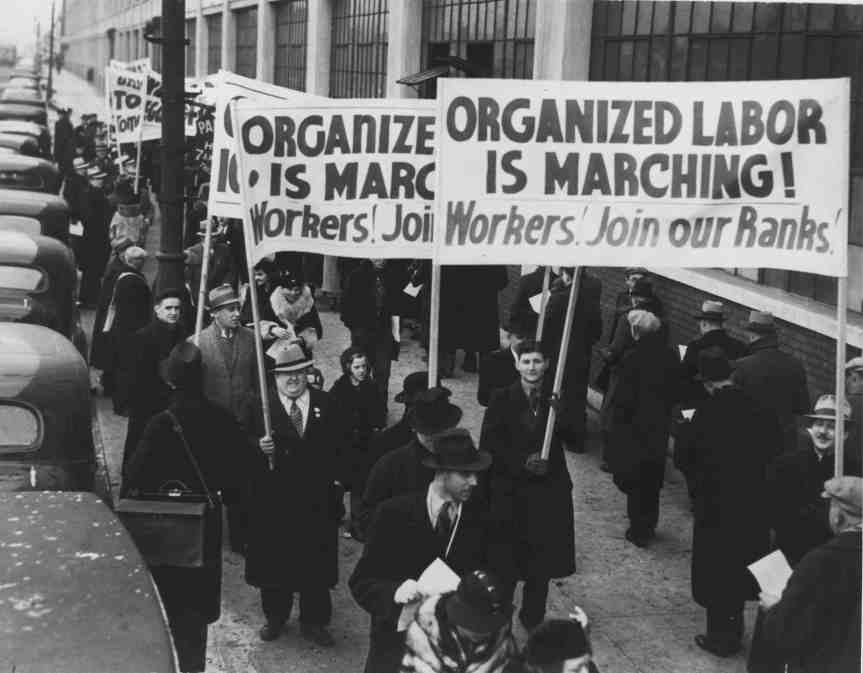
Putting Labor back in Labor Day Weekend

WPR: Marches & Pickets

W.J. Astore

Labor Day weekend is a reminder there’s no labor party in U.S. politics.  Instead, we have two pro-business parties: the Republicans and the Republicans-lite, otherwise known as the Democrats.  Both are coerced if not controlled by corporations through campaign finance “contributions” (bribes) and lobbyists (plus the promise of high-paying jobs should your local member of Congress lose an election or wish to transition to a much higher paying job as a lobbyist/influence peddler).  With money now defined as speech, thanks to the Supreme Court, there’s a lot of “speech” happening in Congress that has nothing to do with the concerns of workers.

Nevertheless, a myth exists within the mainstream media that “socialist” progressive politicians are coming this fall to take your money and to give it to the undeserving poor (and especially to “illegal” immigrants, who aren’t even citizens!).  First of all, the so-called Democratic Socialists are not advocating nationalization of industry; they’re basically New Deal Democrats in the tradition of FDR.  Just like Republicans, they believe in capitalism and the “free” market; they just want to sand down some of the rougher edges of exploitation.  Consider, for example, Bernie Sanders’s efforts to get a living wage for Disney employees.  Disney has finally promised to pay workers $15.00 an hour (phased in over the next few years), even as the corporation makes record profits and the CEO stands to earn hundreds of millions.  Second, you’ll notice the bulk of the Trumpian tax breaks aren’t going to the workers and middle class: it’s the richest Americans (and corporations) that benefit the most from these cuts.  Some of that money is supposed to “trickle down” to workers, but most of it doesn’t.  (Funding stock buy-backs, not pay raises, is especially popular among corporations.)

My father knew the score.  As a factory worker, he lived the reality of labor exploitation, and fought his own humble battle for decent wages.  I’ve shared this lesson before, but it bears repeating, especially since it’s Labor Day weekend.

My Dad’s Story

(My dad was attempting to get a dime pay raise at the local factory.  This was about the year 1950.)

It seems that Mike Calabrese on his own asked Harry Callahan [one of the owners] for a pay raise and he was refused. Mike decided to organize the men members and go down in a group. In our group he got ten men to approach Harry C. for a raise. But when it was time to “bell the cat” only three fellows went to see Harry. Well Mike said he couldn’t join the group because he had already tried to get a raise. I knew I was being used but I was entitled to a raise. Well Harry said to me, “What can I do for you men?” So I said to Harry: 1) Living costs were going up; 2) We deserved a raise. So Harry said, “How much?” and I said ten cents an hour would be a fair raise. So he said I’ll give you a nickel an hour raise and later you’ll get the other nickel. We agreed. So, I asked Harry will everyone get a raise and he replied, “Only the ones that I think deserve it.”

Well a month later I was drinking water at the bubbler and Harry saw me and said what a hard job they had to get the money to pay our raises. Well, Willie, Harry Callahan and his brother Sam and their two other Italian brother partners all died millionaires. No other truer saying than, “That the rich have no sympathy or use for the poor.”

My dad was no political radical.  He later became a firefighter and served for more than 30 years before retiring.  It’s precisely because my dad wasn’t a political firebrand that his words resonate so powerfully: “That the rich have no sympathy or use for the poor.”

It’s a good lesson to keep in mind.  Isn’t it high time we put Labor back in Labor Day weekend?

A trillion here, a trillion there, and pretty soon you’re talking real money

Imacon Color Scanner
Painting of Everett Dirksen, a thrifty Republican.  Remember those?

W.J. Astore

Though it’s unconfirmed that Congressman Everett M. Dirksen ever uttered perhaps the most famous words attributed to him: “A billion here, a billion there, and pretty soon you’re talking real money,” the sentiment surely needs to be updated for America’s profligate military moment.  Replace “billion” with “trillion” and you have the perfect catchphrase for today’s Pentagon.

Consider the following facts:

  1. The F-35 jet fighter is projected to cost $1.45 trillion over the life of the program.
  2. Modernization of the U.S. nuclear arsenal is projected to cost $1.2 trillion, though some estimates suggest $1.7 trillion as the more likely sum.
  3. America’s Afghan War has already cost $1 trillion.  Add to that another $45+ billion to support war ops for this year, and perhaps the same amount of spending each year for the next decade.
  4. A low-ball estimate for America’s Iraq War is $1 trillion, but when one adds in veterans health care and similar long-term issues, the cost rises into the $2-3 trillion range.
  5.  Each year, spending on the Pentagon, Homeland Security, wars, nuclear weapons, the VA, and interest on the national debt associated with previous military spending approaches $1 trillion.

We’re talking about real money, right?

Yet all this spending is scarcely debated within Congress.  Together with the Trump administration, Congress is a rubber stamp for the Pentagon.  Meanwhile, Congress will fight tooth and nail over a few million dollars to support the arts, humanities, and similar “wasteful” programs.  Planned Parenthood is always under attack, despite the paltry sum they receive (roughly half a billion) to provide vital functions for women’s health.  Even the $200 billion promised by Trump to support infrastructure improvements is a trickle of money compared to the gusher of funds dedicated to the Pentagon and all of its exotic WMD.

People laughed at Bernie Sanders when he proposed health care for all and free education in state colleges.  That socialist fool!  America can’t afford that!  Indeed, much better for people to go into debt as they struggle to pay for health care or college.  That’s private enterprise and “freedom” for you.  Own the debt and you can own the world.

No — Bernie Sanders wasn’t crazy.  America could easily afford universal health care and virtually free education at state colleges and universities.  Our elites simply choose not to consider these proposals, let alone fund them.  But more nukes?  More wars?  More jets and subs and tanks?  Right this way, my boy!

All these trillions for weapons and wars — one thing is certain: “freedom,” as they say, sure isn’t free.

Update (2/27/18): At TomDispatch.com, Bill Hartung goes into greater detail on the Pentagon’s massive budget for 2018 and 2019.  As he notes: “The figures contained in the recent budget deal that kept Congress open, as well as in President Trump’s budget proposal for 2019, are a case in point: $700 billion for the Pentagon and related programs in 2018 and $716 billion the following year. Remarkably, such numbers far exceeded even the Pentagon’s own expansive expectations. According to Donald Trump, admittedly not the most reliable source in all cases, Secretary of Defense Jim Mattis reportedly said, ‘Wow, I can’t believe we got everything we wanted’ — a rare admission from the head of an organization whose only response to virtually any budget proposal is to ask for more.”

The title of Hartung’s article sums it up: The Pentagon Budget as Corporate Welfare for Weapons Makers.

Put succinctly, it’s warfare as welfare — and wealth-care — for the military-industrial complex.