
America’s Mutant Military

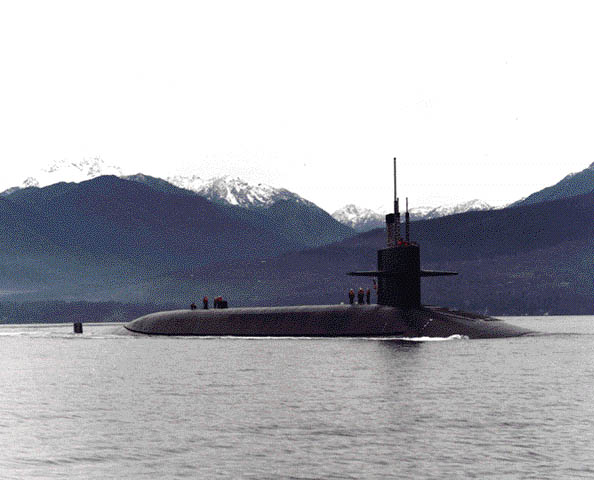
An Ohio-Class Submarine, armed with Trident nuclear missiles

W.J. Astore

I’ve been writing for TomDispatch.com and the amazing Tom Engelhardt since 2007.  When I wrote my first article, “Saving the Military from Itself: Why Medals and Metrics Mislead,” I never imagined I would come to write 37 more for Tom and his site over the next eight years.  TomDispatch has given me an opportunity to write about topics like the elimination of nuclear weapons, the rise of American militarism, the perils of calling all troops in the military “heroes,” the over-hyping of American military prowess by our leaders, and many others.  In all my articles, I hope I’ve offered a contrary perspective on the U.S. military as well as American culture, among other subjects.

My latest article, America’s mutant military, is a personal odyssey of sorts.  I reflect on how the military has changed since I entered it in 1985.  Today’s post-Cold War U.S. military is, to put it bluntly, not as I envisioned it would be as the Berlin Wall was falling and the Soviet Union was collapsing.  Today’s military still has its Cold War weaponry and mindset largely intact, even as a new “mutant” military has emerged, based on special ops and connected to corporations and intelligence agencies, a military hybrid that is often shrouded in secrecy even as it’s celebrated openly in Hollywood action films.

My essay runs 2300 words, so I encourage you to read all of it at TomDispatch.  What follows are a few excerpts from it:

It’s 1990. I’m a young captain in the U.S. Air Force.  I’ve just witnessed the fall of the Berlin Wall, something I never thought I’d see, short of a third world war.  Right now I’m witnessing the slow death of the Soviet Union, without the accompanying nuclear Armageddon so many feared.  Still, I’m slightly nervous as my military gears up for an unexpected new campaign, Operation Desert Shield/Storm, to expel Iraqi autocrat Saddam Hussein’s military from Kuwait.  It’s a confusing moment.  After all, the Soviet Union was forever (until it wasn’t) and Saddam had been a stalwart U.S. friend, his country a bulwark against the Iran of the Ayatollahs.  (For anyone who doubts that history, just check out the now-infamous 1983 photo of Donald Rumsfeld, then special envoy for President Reagan, all smiles and shaking hands with Saddam in Baghdad.)  Still, whatever my anxieties, the Soviet Union collapsed without a whimper and the campaign against Saddam’s battle-tested forces proved to be a “cakewalk,” with ground combat over in a mere 100 hours.

Think of it as the trifecta moment: Vietnam syndrome vanquished forever, Saddam’s army destroyed, and the U.S. left standing as the planet’s “sole superpower.”

Post-Desert Storm, the military of which I was a part stood triumphant on a planet that was visibly ours and ours alone.  Washington had won the Cold War.  It had won everything, in fact.  End of story.  Saddam admittedly was still in power in Baghdad, but he had been soundly spanked.  Not a single peer enemy loomed on the horizon.  It seemed as if, in the words of former U.N. ambassador and uber-conservative Jeane Kirkpatrick, the U.S. could return to being a normal country in normal times.

[But it didn’t happen.  With the Soviets gone, the U.S. military itself was now uncontained, and many hankered to use its power to achieve America’s goal of global power.]

Yet even as civilian leaders hankered to flex America’s military muscle in unpromising places like Bosnia and Somalia in the 1990s, and Afghanistan, Iraq, Libya, Pakistan, and Yemen in this century, the military itself has remained remarkably mired in Cold War thinking.  If I could transport the 1990 version of me to 2015, here’s one thing that would stun him a quarter-century after the collapse of the Soviet Union: the force structure of the U.S. military has changed remarkably little.  Its nuclear triad of land-based ICBMs, submarine-launched SLBMs, and nuclear-capable bombers remains thoroughly intact.  Indeed, it’s being updated and enhanced at mind-boggling expense (perhaps as high as a trillion dollars over the next three decades).  The U.S. Navy?  Still built around large, super-expensive, and vulnerableaircraft carrier task forces.  The U.S. Air Force?  Still pursuing new, ultra-high-tech strategic bombers and new, wildly expensive fighters and attack aircraft — first the F-22, now the F-35, both supremely disappointing.  The U.S. Army?  Still configured to fight large-scale, conventional battles, a surplus of M-1 Abrams tanks sitting in mothballs just in case they’re needed to plug the Fulda Gap in Germany against a raging Red Army.  Except it’s 2015, not 1990, and no mass of Soviet T-72 tanks remains poised to surge through that gap.

[Along with the persistence of America’s “Cold War” military, a new military emerged, especially in the aftermath of 9-11.]

In 2015, so many of America’s “trigger-pullers” overseas are no longer, strictly speaking, professional military.  They’re mercenaries, guns for hire, or CIA drone pilots (some on loan from the Air Force), or warrior corporations and intelligence contractors looking to get in on a piece of the action in a war on terror where progress is defined — official denials to the contrary — by body count, by the number of “enemy combatants” killed in drone or other strikes.

Indeed, the very persistence of traditional Cold War structures and postures within the “big” military has helped hide the full-scale emergence of a new and dangerous mutant version of our armed forces.  A bewildering mish-mash of special ops, civilian contractors (both armed and unarmed), and CIA and other intelligence operatives, all plunged into a penumbra of secrecy, all largely hidden from view (even as they’re openly celebrated in various Hollywood action movies), this mutant military is forever clamoring for a greater piece of the action.

While the old-fashioned, uniformed military guards its Cold War turf, preserved like some set of monstrous museum exhibits, the mutant military strives with great success to expand its power across the globe.  Since 9/11, it’s the mutant military that has gotten the lion’s share of the action and much of the adulation — here’s looking at you, SEAL Team 6 — along with its ultimate enabler, the civilian commander-in-chief, now acting in essence as America’s assassin-in-chief.

Think of it this way: a quarter-century after the end of the Cold War, the U.S. military is completely uncontained.

[And an uncontained military, in a country that celebrates its troops as heroes, that boasts of itself as having the best military in all of recorded history, does not bode well for America’s democratic future.]

Go to TomDispatch.com to read the entire article.  Thank you!

The United States: Empire or Umpire?

Is this really the role of the United States in the world?

Daniel N. White.  Introduction by W.J. Astore.

Is the United States an empire or umpire?  This is the intriguing question raised and interrogated in the latest probing article by Dan White.  Since I’m a baseball fan as well as a student of the U.S. military, let me take a swing at an answer.  An umpire is supposed to be a neutral observer and arbiter.  He is disinterested and dispassionate.  By definition, an umpire can’t be a player, and certainly not a main player, a “star.”  Umpires are supposed to fade into the background, plying a demanding profession without pursuing private agendas or personal glory.

Does that sound anything like the role the United States plays in the world?  But I’ll let Dan White take it from here.  W.J. Astore

Yes, We’re An Empire: Just Look At How We Treat the Natives

Daniel N. White

Recently I attended a guest lecture/seminar at the University of Texas at Austin, hosted by Jeremi Suri, a rising star of UT’s History department.  The topic was “The US—Empire or Umpire?”  Suri, a personable sort, brought in another mainstream historian, Elizabeth Cobbs Hoffman, to promote her latest tome which argues that the US is not in fact an empire but instead acts abroad as an umpire.

There are some lawyerly arguments that suggest that because the US does not enslave the rest of the world for its own financial benefit—this is fundamentally the argument made by Suri and Hoffman—the US isn’t an empire.  Cobbs Hoffman was proud that in her recent US history classes a majority of the students came in thinking that the US was an empire but left, after a semester of her ministrations, thinking otherwise.

How swell.  Lawyerly arguments are for lawyers in courtrooms attempting to convince other lawyers who all think along the same narrow lines.  Most lawyerly arguments aren’t but petty quibbles about word definitions.  For the rest of us, we are wise to heed instead the evidence of our senses and the stirrings of our hearts.

The most fundamental evidence of America as an empire is the wars we wage abroad.  Countries that have done us no injury have the “privilege” of the US waging a war in their land with their inhabitants having no say in the matter.  The most telling giveaway to the question of empire is our regard for the inhabitants in those countries who fight on our behalf.  Fundamentally, we have none.  They are our tools, nothing more.

During the Vietnam War, the weekly casualty lists routinely had South Vietnamese military (ARVN) killed and wounded exceeding ours.  Only two weeks in the entire war did American casualties exceed ARVN’s—the two weeks following the Tet Offensive.  South Vietnam, whose population may have been 14 million during the war, paid a terrible butcher’s bill for its leaders assenting to and participating in an American war in their country.

Yet how much reportage was there ever in the US press about the South Vietnamese army and its casualties?  ARVN troops were in it for the duration, unlike US troops, and they and their sacrifices were ignored almost entirely by the US press, people, and government.  Once a week, Walter Cronkite would recite ARVN casualty figures, when the US Military Assistance Command in Vietnam (MACV) released that week’s figures.  But that was all the attention the US press ever gave them.

That same neglect of the natives the US claims to be “liberating” has been repeated in our recent wars in the Middle East and Central Asia.  Where are the articles about the Afghan Army and its casualties in the US media?  The Iraqi Army and its casualties?  We corral the inhabitants in those countries into our schemes for our uses and have paid them—their lives, their hurts, their deaths—no attention, just as we paid ARVN no attention during the Vietnam War.

If we’re not an empire to behave like this, then we are surely the cruelest and most heartless race of people wandering the globe.

What follows is an illustration of the gruesome results of our imperial wars—the kind of illustration that never made our news reports.  Richard Critchfield was a war reporter in Vietnam, after which he wrote several superlative books about rural life, both in the US and in the Third World.  In 1965 Critchfield encountered a young Vietnamese draftee at Cong Hoa, ARVN’s largest military hospital.  The wounded draftee had just arrived after a 50-mile ambulance ride:

From Villages, by Richard Critchfield, pp 62-3:

After he (the ARVN doctor, a civilian drafted into ARVN six years earlier) read the student’s chart, the doctor’s manner softened.  He patted the boy gently on the shoulder and lifted up the cotton sheet from the foot of the stretcher.

‘Foot blown off with a mine,’ he told me in English.  He spoke to the boy again in their own language, then turned back.  ‘After treatment here, the boy will go back to his unit in My Tho to wait for the local military council to meet.  The council will decide whether he can go home or not, of whether he must stay in the army to do some light job.  He wants to go home.  He should go home.  When the wound has healed, we will send him to the rehabilitation department for an artificial limb.  He says his wife came south with him.  She rents a house outside the camp.  They have a two-month old son.  It must be a very small house.’  He said that as a private with one son, the boy got the equivalent of eighteen dollars a month; totally disabled, he would get thirty-five dollars a year.  The doctor thought there were at least fifty thousand partially disabled veterans in the country already; perhaps it was a blessing he did not know the war would last another ten years.

The doctor spoke to the boy again.  ‘He says he is an infantry rifleman and that he has never killed anybody.’  A wounded sergeant in a nearby stretcher muttered, ‘Who knows where the bullets go?’  The doctor lifted up the bandages from the boy’s forehead; the right eye was shut and swollen.  Unclipping an X-ray from the foot of the stretcher and holding it up to the light the doctor motioned me over.  The black film showed the boy’s skull; in the black socket of his right eye was a jagged rectangular shape a quarter inch long.  ‘Steel fragment.  That eye will have to come out.’  An orderly called the doctor and he went away.

I saw that the boy was moving; painfully, and with great effort, he reached down, groped for the X-ray on his legs where the doctor had left it, clutched it and held it up to the light.  We didn’t dare stop him.  There was no outcry, just thought—the deep private thought of someone faced with the final, tragic collapse of so much of his life.  After a moment he lowered the X-ray carefully back to where it had been, put his head down, and stared upward.

I told my interpreter to ask if there was anything we could do.  At first the boy did not seem to hear.  We waited.  Then he spoke and said, yes, he wanted to send telegrams to his wife and his mother, who did not know what had happened to him nor where he was.  The words started pouring out then; my interpreter could only catch part of it.  ‘The war must end….so there is no more killing…so I can go home…I want to go home…I want…my brothers*…’  He was crying hard now and the tears streamed down from his good eye.  In shame he tried to dab at them with his pajama sleeve.  I thrust some piaster notes into my interpreter’s hand to give to the boy and went outside to stare hard at the hedges shaped like rabbits and elephants.

Critchfield elsewhere tells another revealing story of Americans abroad at war, again from his Vietnam War days.  From p. 183 of Villages:

“Tran Van Huong, when prime minister of Vietnam in the 1960s, once told me no American had ever asked him, ‘What do you need and how can we help you?’”

In all my years of reading about the Vietnam War, I can’t recall any other American reporter ever asking any Vietnamese that same question of Critchfield’s.   I rather doubt that any American military officer, USAID worker, or diplomat ever asked that question at any time during the war.  Maybe some NCOs in the Army did.  Maybe.

And I can’t recall any US reporter with snap and wit enough to ever ask any Afghan or Iraqi official that same question: What do you need and how can we help you?   If they had they most certainly would have received the same answer as PM Huong gave Critchfield in 1965.

Once again, Americans ignore that our butcher’s bill in both these wars is a fraction of our much less populous allies’.  Except that this time there is never any word of Afghan or Iraqi military casualties in US war reports in our media.  Our total lack of interest in “the natives” is worse now in our globalized today than it was in our provincial yesterday.

Fifty years after Vietnam the US is still treating our “allies” as third-world primitives.  US reporters, politicians, academics, and moral leaders are just as blind to it this time around as they were then.  They are content with childish slogans and arguments about our inherent goodness.  Nguyen Cao Ky was right when he said that Americans are like big children.  We have a child’s self-centered view of ourselves, a child’s disregard for actions and their consequences to others, and we embrace childish rationalizations and arguments.

Our wars abroad are all about us and our plans and wishes.  They aren’t at all for the benefit of the host country and its peoples.  That makes us either an empire or a bunch of criminal lunatics.

What it most certainly doesn’t make us is an umpire.

*The young ARVN trooper had been a student from a coastal village, youngest of three brothers.   Both of his brothers had already been drafted into the ARVN and killed before he was drafted.  Unlike the US draft, there were no sole surviving son deferrals for the ARVN draft.

Daniel N. White has lived in Austin, Texas, for a lot longer than he originally planned to.  He reads a lot more than we are supposed to, particularly about topics that we really aren’t supposed to worry about.  He works blue-collar for a living–you can be honest doing that–but is somewhat fed up with it right now.  He will gladly respond to all comments that aren’t too insulting or dumb.  He can be reached at Louis_14_le_roi_soleil@hotmail.com.

The U.S. Military’s Limited Critique of Itself Ensures Future Disasters

War is political, human, and chaotic.  Who knew?
War is political, human, and chaotic. Who knew?

W.J. Astore

In the New York Times on July 20, Major General H.R. McMaster penned a revealing essay on “The Pipe Dream of Easy War.”  McMaster made three points about America’s recent wars and military interventions:

1.  In stressing new technology as being transformative, the American military neglected the political side of war.  They forgot their Clausewitz in a celebration of their own prowess, only to be brought back to earth by messy political dynamics in Afghanistan, Iraq, and elsewhere.

2.  Related to (1), the U.S. military neglected human/cultural aspects of war and therefore misunderstood Iraqi and Afghan culture.  Cultural misunderstandings transformed initial battlefield victories into costly political stalemates.

3.  Related to (1) and (2), war is uncertain and unpredictable.  Enemies can and will adapt.

There’s nothing inherently wrong with these points, or in the general’s broad lesson that “American forces must cope with the political and human dynamics of war in complex, uncertain environments. Wars like those in Afghanistan and Iraq cannot be waged remotely.”

The last sentence is a dig at the Air Force and an argument for the continuing relevance of ground forces, which is unsurprising coming from an Army general who commands Fort Benning in Georgia.

But the sum total of McMaster’s argument is remarkably banal.  Yes, war is political, human, and chaotic.  Did our military professionals and civilian experts really forget this before making their flawed decisions to go to war after 9/11?

McMaster ends his critique with a few words of praise for the U.S. military’s adaptability.  The usual refrain: We messed up, but we learned from our mistakes, and are ready to take on new challenges, as long as the department of defense remains fully funded, and as long as America puts its faith in men like McMaster and not in machines/technology.

If those are the primary lessons our country should have learned since 9/11, we’re in big, big trouble.

So, here are three of my own “lessons” in response to McMaster’s.  They may not be popular, but that’s because they’re a little more critical of our military – and a lot more critical of America.

1.  Big mistakes by our military are inevitable because the American empire is simply too big, and American forces are simply too spread out globally, often in countries where the “ordinary” people don’t want us.  To decrease our mistakes, we must radically downsize our empire.

2.  The constant use of deadly force to police and control our empire is already sowing the deadly seeds of blowback.  Collateral damage and death of innocents via drones and other “kinetic” attacks is making America less safe rather than more.

Like the Romans before us, as Tacitus said, we create a desert with our firepower and call it “peace.”  But it’s not peace to those on the receiving end of American firepower.  Their vows of vengeance perpetuate the cycle of violence.  Add to this our special forces raids, our drone strikes, and other meddling and what you get is a perpetual war machine that only we can stop.  But we can’t stop it because like McMaster we keep repeating, “This next war, we’ll get it right.”

3.  We can’t defeat the enemy when it is us.  Put differently, what’s the sense in defeating the enemies of freedom overseas at the same time as our militarized government is waging a domestic crackdown on dissent (otherwise known as freedom of speech) in the “homeland”?

Articles like McMaster’s suggest that our military can always win future wars, mainly by fighting more intelligently.  These articles never question the wisdom of American militarization, nor do they draw any attention to the overweening size and ambition of the department of defense and its domination of American foreign policy.

Indeed, articles like McMaster’s, in reassuring us that the military will do better in the next round of fighting, ensure that we will fight again – probably achieving nothing better than stalemate while wasting plenty of young American (and foreign) lives.

Is it possible that the best way to win future wars is to avoid them altogether?  As simple as that question is, you will rarely hear it asked in the halls of power in Washington.

Our Disneyland Approach to Empire

Iraqi theme park?Remember in 2011 after SEAL Team 6 killed Osama bin Laden and Disney wanted to trademark the unit’s name for a collection of toys and games and miscellanea?

It’s one of those blips on our collective cultural radar that seems insignificant, yet it points to our tendency to see war and empire as a game, as a form of entertainment, as a product.

This attitude is not confined to corporations like Disney.  Consider this telling passage from Kim Barker’s “The Taliban Shuffle,” which discusses the potential attractions to service in places like Afghanistan:

“It was a place to escape, to run away from marriages and mistakes, a place to forget your age, your responsibilities, your past, a country in which to reinvent yourself.  Not that there was anything wrong with that, but the motives of most people were not likely to help a fragile and corrupt country stuck somewhere between the seventh century and Vegas.”

Our tendency to view foreign lands and peoples as an opportunity for adventure and escape is hardly new, of course.  But it certainly says something about our failure to understand and confront the severity of the challenges once we intervened in Iraq and Afghanistan.  Recall President George W. Bush’s weirdly wistful comment in 2008 about Afghanistan being a sort of Wild West, a romantic adventure, a place of excitement and danger.  Bush said he envied our troops and their opportunity for Afghan romance.

I wonder why as a young buck he didn’t go to Vietnam in the 1960s for romance and danger.  And I gather he’d never heard of Rudyard Kipling’s take on the pleasures awaiting the young British soldier on the Afghan plains:

When you’re wounded and left on Afghanistan’s plains,
And the women come out to cut up what remains,
Jest roll to your rifle and blow out your brains
An’ go to your Gawd like a soldier.
Go, go, go like a soldier,
So-oldier of the Queen! 

It was said about the British that they acquired an empire in a fit of absentmindedness.  Did we acquire our empire in a fit of pure escapism?

Wanton and wasteful imperial entanglements are only accelerating our national decline.  Yet we continue to treat foreign lands as a sort of Disney theme park.   Troops smile and pose under Saddam Hussein’s crossed swords (at least they used to) or in front of Predator drones and other exotic weaponry.  Everything overseas is a photo op and an opportunity to win a trophy (or a medal).

But even as we seek “romance” and “danger” in foreign lands, a place “to reinvent ourselves,” we paradoxically bring with us all the trappings of consumerist America, hence our steroidal bases with all the conveniences of home (well, in Muslim lands, maybe not liquor, at least openly).

And when we get fed up with the natives and roughing it, we know we can just leave.

But if Iraq and Afghanistan have taught us anything, it’s that the price of admission is far too high.  We should keep our theme parks and our fantasies where they belong: right here in America.

W.J. Astore