The three Afghan officers who went missing (Cape Cod Times)
W.J. Astore
Two Afghan stories this week suggest much about U.S. progress in winning hearts and minds there. The first involves Hamid Karzai. Afghanistan’s departing president, the “Mayor of Kabul,” Karzai asserted that “America did not want peace for Afghanistan, because it had its own agendas and goals here.” It’s easy to paint Karzai as a dissembling ingrate, which is exactly what the American ambassador to Afghanistan did in response. But it truly says something that Karzai, the recipient of more than $100 billion in developmental aid from the U.S. for Afghanistan (not including military aid!), portrays the U.S. as working against the interests of the Afghan people. There’s one heart and mind the U.S. plainly didn’t win.
The second story involves three Afghan officers, one major and two captains, on a training mission at Camp Edwards in Massachusetts. The three officers, carefully vetted by U.S. Central Command, decided they had had enough of working with America. They drove to New York and attempted to enter Canada at Niagara Falls, seeking asylum, or so it seems. There are three more hearts and minds the U.S. plainly didn’t win.
The details of this particular story are farcical. The night before their unauthorized trip to the Canadian border, they enjoyed the pleasures of a genuine American strip club, where they were reportedly “well behaved” according to the club owner. The next day, they were brought to an American shopping mall as part of their introduction to “the cultural aspects of American life.” At the mall, they gave their escort the slip and headed to Canada, where they were eventually intercepted at the border crossing at Niagara Falls. According to The Cape Cod Times, when the three Afghan officers went missing, among the first places the U.S. military looked for them was at the strip club.
Talk about an introduction to American culture! First a strip club on Friday night, then a shopping mall on the weekend, then an unscheduled road trip to a major tourist attraction. These Afghan officers may have absorbed too much of the American way.
In all seriousness, what does it say about the success of American efforts vis-a-vis Afghanistan when its former president denounces the U.S. and visiting Afghan officers, after sampling American fleshpots and temples to consumerism, attempt to flee to Canada?
There’s a lesson here about folly, if only we would care to draw it.
In April 2009, I wrote an article for TomDispatch.com recounting Mary McCarthy’s critique of the American experience in Vietnam, and how her lessons applied to President Obama’s “surge” in Afghanistan. A central lesson cited by McCarthy was the American desire never to be labeled a loser. That desire explains, at least in part, the persistence of folly within the Obama Administration today, as Peter Van Buren explains in his latest article for TomDispatch, “Apocalypse Now, Iraq Edition: Fighting in Iraq Until Hell Freezes Over.”
Here’s what McCarthy had to say in 1968 about the American moment and the Vietnam War:
The American so-called free-enterprise system, highly competitive, investment-conscious, expansionist, repels a loser policy by instinctive defense movements centering in the ganglia of the presidency. No matter what direction the incumbent, as candidate, was pointing in, he slowly pivots once he assumes office.
Obama campaigned in 2008 as a “hope” and “change” candidate who as president would end the war in Iraq (so he could prosecute the “better” war in Afghanistan). Yet the U.S. finds itself yet again bombing widely in Iraq (and now Syria) while deploying thousands of military “advisers” (combat troops in plain speak). And after six weeks of airstrikes in Iraq against ISIS, with indecisive results, how long before those U.S. “advisers” start taking the fight directly to the enemy on the ground?
The questions I posed for President Obama back in 2009 were these:
Have you, like Vietnam-era presidents, pivoted toward yet another surge simply to avoid the label of “loser” in Afghanistan? And if the cost of victory (however defined) is hundreds, or even thousands, more American military casualties, hundreds of billions of additional dollars spent, and extensive collateral damage and blowback, will this “victory” not be a pyrrhic one, achieved at a price so dear as to be indistinguishable from defeat?
Similar questions apply to our latest military operations in Iraq and Syria. Is the U.S. surging militarily just to avoid the label of “loser”? And even if the U.S. “wins” this latest round (whatever “win” means), won’t the price paid be indistinguishable from defeat?
In his article, Van Buren offers an excellent summary of the U.S. experience in Iraq since the overthrow of Saddam in 2003. In his words:
The staggering costs of all this — $25 billion to train the Iraqi Army, $60 billion for the reconstruction-that-wasn’t, $2 trillion for the overall war, almost 4,500 Americans dead and more than 32,000 wounded, and an Iraqi death toll of more than190,000 (though some estimates go as high as a million) — can now be measured against the results. The nine-year attempt to create an American client state in Iraq failed, tragically and completely. The proof of that is on today’s front pages.
According to the crudest possible calculation, we spent blood and got no oil. Instead, America’s war of terror resulted in the dissolution of a Middle Eastern post-Cold War stasis that, curiously enough, had been held together by Iraq’s previous autocratic ruler Saddam Hussein. We released a hornet’s nest of Islamic fervor, sectarianism, fundamentalism, and pan-nationalism. Islamic terror groups grew stronger and more diffuse by the year. That horrible lightning over the Middle East that’s left American foreign policy in such an ugly glare will last into our grandchildren’s days. There should have been so many futures. Now, there will be so few as the dead accumulate in the ruins of our hubris. That is all that we won.
Under a new president, elected in 2008 in part on his promise to end American military involvement in Iraq, Washington’s strategy morphed into the more media-palatable mantra of “no boots on the ground.” Instead, backed by aggressive intel and the “surgical” application of drone strikes and other kinds of air power, U.S. covert ops were to link up with the “moderate” elements in Islamic governments or among the rebels opposing them — depending on whether Washington was opting to support a thug government or thug fighters.
The results? Chaos in Libya, highlighted by the flow of advanced weaponry from the arsenals of the dead autocrat Muammar Gaddafi across the Middle East and significant parts of Africa, chaos in Yemen, chaos in Syria, chaos in Somalia, chaos in Kenya, chaos in South Sudan, and, of course, chaos in Iraq.
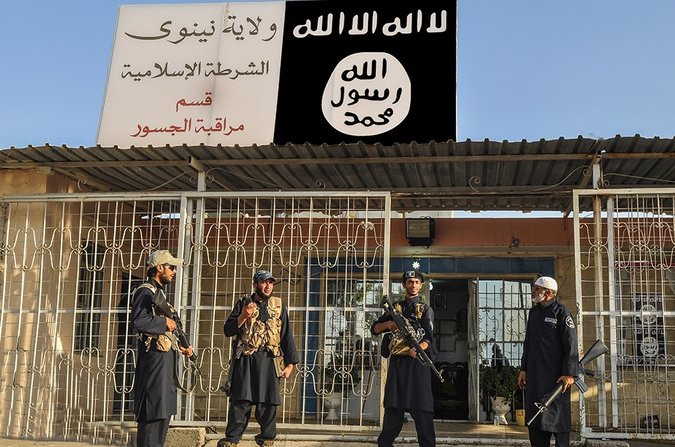
And then came the Islamic State (IS) and the new “caliphate,” the child born of a neglectful occupation and an autocratic Shia government out to put the Sunnis in their place once and for all. And suddenly we were heading back into Iraq. What, in August 2014, was initially promoted as a limited humanitarian effort to save the Yazidis, a small religious sect that no one in Washington or anywhere else in this country had previously heard of, quickly morphed into those 1,600 American troops back on the ground in Iraq and American planes in the skies from Kurdistan in the north to south of Baghdad. The Yazidis were either abandoned, or saved, or just not needed anymore. Who knows and who, by then, cared? They had, after all, served their purpose handsomely as the casus belli of this war. Their agony at least had a horrific reality, unlike the supposed attack in the Gulf of Tonkin that propelled a widening war in Vietnam in 1964 or the nonexistent Iraqi WMDs that were the excuse for the invasion of 2003.
And this is how Van Buren concludes his article:
We’ve been here before, as the failures of American policy and strategy in Vietnam metastasized into war in Cambodia and Laos to deny sanctuary to North Vietnamese forces. As with ISIS, we were told that they were barbarians who sought to impose an evil philosophy across an entire region. They, too, famously needed to be fought “over there” to prevent them from attacking us here. We didn’t say “the Homeland” back then, but you get the picture.
As the similarities with Vietnam are telling, so is the difference. When the reality of America’s failure in Vietnam finally became so clear that there was no one left to lie to, America’s war there ended and the troops came home. They never went back. America is now fighting the Iraq War for the third time, somehow madly expecting different results, while guaranteeing only failure. To paraphrase a young John Kerry, himself back from Vietnam, who’ll be the last to die for that endless mistake? It seems as if it will be many years before we know.
That is indeed the question. As Mary McCarthy noted about the Vietnam War, “The more troops and matériel committed to Vietnam, the more retreat appears to be cut off — not by an enemy, but by our own numbers. To call for withdrawal in the face of that commitment… is to seem to argue not against a policy, but against facts, which by their very nature are unanswerable.”
Back to 2014 and the present moment: The more troops committed against ISIS, the more bombing raids made, the more money spent, the more prestige put on the line, the fewer the options the United States has in the Middle East. Indeed, the only option that remains is “to win,” since losing is unacceptable for the reason Mary McCarthy indicated.
But as Michael Murry, a Vietnam Veteran and regular contributor to this site, noted about Vietnam (citing Bernard Fall’s classic book, Street Without Joy), “You can’t do a wrong thing the right way,” and “We lose the day we start (these stupid imperial wars) and we win the day we stop.” Put differently, just as with Vietnam, the Middle East is not an incredibly complex puzzle for us to solve; it’s simply an impossible situation. Impossible for us. Until we admit this, the U.S. can never “win”; it can only lose.
The U.S. finally “won” in Vietnam when we admitted defeat and left. How long before we come to this realization in the Middle East? Tragically, the persistence of American hubris, amplified by resistance to the very idea of being labeled a “loser,” suggests yet another long, bloody, learning curve.
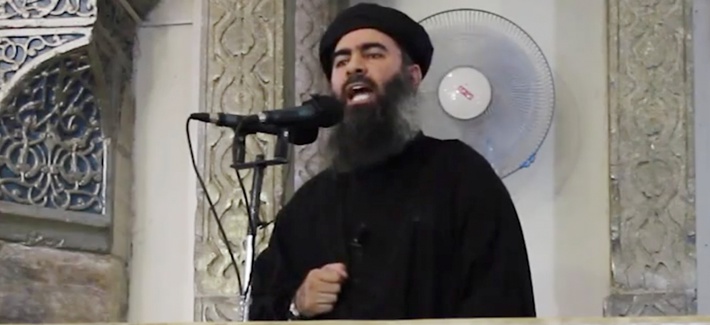
Is this the leader of a “scourge” and an “abomination” and a “witch’s brew”?
W.J. Astore
General John Allen wants to “destroy the Islamic State now.” So he says in an article for Defense One. Allen, a retired Marine Corps general who led troops in Iraq and Afghanistan, is currently a distinguished fellow at the Brookings Institution. But what is distinguishing him in this article is his crusader-speak, a remarkable blend of religious extremism and chauvinistic parochialism.
Let’s tackle the latter first. For Allen, the good people of Iraq are “poor” and “benighted.” But some of them can serve as our “boots on the ground” in the region, i.e. they can serve as bullet magnets while the U.S. provides air support with impunity. It’s up to the U.S. to “orchestrate” their attacks against the Islamic State. As long as they follow our conductor’s baton, all will end well, perhaps with a crescendo of U.S. bombs. (As an aside, he describes the Taliban in Afghanistan as “cavemen” when compared to the new enemy in Iraq. Some of those “cavemen” did fairly well against the former Soviet Union, did they not?)
My charge that the general’s language is that of “religious extremism” may itself appear extreme, but take a close look at his article. The general refers to the Islamic State as a “scourge” and an “abomination.” (I’ve read my Bible and recognize the religious resonances here.) They are “beyond the pale of humanity” and must be “eradicated” because they are engaged in “total war” aided by a “witch’s brew” of foreign recruits.
In sum, General Allen has demonized the enemy while at the same time diminishing potential allies (those “poor benighted” people in need of an American conductor). The answer is eradication, i.e. extermination of that enemy. Now!
Remind me again: Which side is engaged in religious war here?
As Richard Nixon used to say, let me make one thing perfectly clear: I’m not in any way defending the murderous extremism of the Islamic State. What I’m saying is that the best solution is not to return the favor (unless you’re truly seeking a crusade). I’m also suggesting that the general’s article is (unintentionally) indicative of a mindset that explains much about why American efforts in Iraq and Afghanistan have failed.
In April of 2009, I wrote the following article for TomDispatch.com on the situation in Afghanistan. During his 2008 campaign for President, Obama had claimed that Afghanistan was the right war to be fighting, and that Bush and Company had taken their eye off the Afghan ball when they chose to invade Iraq in 2003.
Here we are in August 2014 and the news from Afghanistan is about as grim as one could expect. This week has witnessed costly “insider” attacks that killed an American major general as well as eleven Afghan police officers. Progress toward democratic reforms and political stability remains elusive. U.S. efforts to reshape and rebuild Afghanistan have cost more than $100 billion, exceeding the Marshall Plan that rebuilt Europe after World War II, but without corresponding results.
Obama appears to be channeling Richard Nixon. Publicly, he’s seeking “peace with honor” in Afghanistan. Privately, he’s seeking a “decent interval” between when the U.S. exits Afghanistan for good and when Afghanistan returns to Taliban and tribal control, i.e. chaos, or at least that’s my guess. The “fall” of Afghanistan will then become a political football, with Republicans attempting to paint Democrats as being spineless in leaving Afghanistan, whereas the Democrats will likely paint Afghan leaders as corrupt and incompetent and ungrateful. Perhaps a Democratic candidate will emerge in 2020 to explain to Americans that our failed efforts in Afghanistan were nevertheless part of a “noble cause” in the global war on terror.
What follows is my article from April of 2009. I think lesson (2) below will be especially telling in the weeks and months ahead.
Mary McCarthy in Vietnam, Barack Obama in Afghanistan
Seven Lessons and Many Questions for the President
By William Astore
In 1967, outraged by the course of the Vietnam War, as well as her country’s role in prolonging and worsening it, Mary McCarthy, novelist, memoirist, and author of the bestseller The Group, went to Saigon, then the capital of South Vietnam, to judge the situation for herself. The next year, she went to the North Vietnamese capital, Hanoi. She wrote accounts of both journeys, published originally in pamphlet format as Vietnam (1967) and Hanoi (1968), and later gathered with her other writings on Vietnam as a book, The Seventeenth Degree (1974). As pamphlets, McCarthy’s accounts sold poorly and passed into obscurity; deservedly so, some would say.
Those who’d say this, however, would be wrong. McCarthy brought a novelist’s keen eye to America’s activities and its rhetoric in Vietnam. By no means a military expert, not even an expert on Vietnam — she only made a conscious decision to study the war in Vietnam after she returned from her trip to Saigon — her impressionistic writings were nevertheless insightful precisely because she had long been a critical thinker beholden to no authority.
Her insights into our approach to war-fighting and to foreign cultures are as telling today as they were 40 years ago, so much so that President Obama and his advisors might do well to add her unconventional lessons to their all-too-conventional thinking on our spreading war in Afghanistan and Pakistan.
What were those lessons? Here are seven of them, each followed by questions that, four decades later, someone at President Obama’s next press conference should consider asking him:
1. McCarthy’s most fundamental objection was to the way, in Vietnam, the U.S. government decided to apply “technology and a superior power to a political situation that will not yield to this.” At the very least, the United States was guilty of folly, but McCarthy went further. She condemned our technocentric and hegemonic form of warfare as “wicked” because of its “absolute indifference to the cost in human lives” to the Vietnamese people.
Even in 1967, the widespread, at times indiscriminate, nature of American killing was well known. For example, U.S. planes dropped roughly 7 million tons of bombs on Vietnam and parts of Laos and Cambodia during the war, nearly five times the tonnage used against Germany during World War II. The U.S. even waged war on the Vietnamese jungle and forest, which so effectively hid Vietnamese guerrilla forces, spraying roughly 20 million gallons of toxic herbicides (including the dioxin-contaminated Agent Orange) on it.
In her outrage, McCarthy dared to compare the seeming indifference of many of her fellow citizens toward the blunt-edged sword of technological destruction we had loosed on Vietnam to the moral obtuseness of ordinary Germans under Adolf Hitler.
Questions for President Obama: Aren’t we once again relying on the destructive power of technology to “solve” complex political and religious struggles? Aren’t we yet again showing indifference to the human costs of war, especially when borne by non-Americans? Even though we’re using far fewer bombs in the Af-Pak highlands than we did in Vietnam, aren’t we still morally culpable when these “precision-guided munitions” miss their targets and instead claim innocents, or hit suspected “terrorists” who suddenly morph into wedding parties? In those cases, do we not seek false comfort in the phrase, C’est la guerre, or at least that modern equivalent: unavoidable collateral damage?
2. As Richard Nixon campaigned for the presidency in 1968 by calling for “peace with honor” in Vietnam, McCarthy offered her own warning about the dangers that arose when the office of the presidency collided with an American desire never to be labeled a loser: “The American so-called free-enterprise system, highly competitive, investment-conscious, expansionist, repels a loser policy by instinctive defense movements centering in the ganglia of the presidency. No matter what direction the incumbent, as candidate, was pointing in, he slowly pivots once he assumes office.”
Questions for President Obama: Have you, like Vietnam-era presidents, pivoted toward yet another surge simply to avoid the label of “loser” in Afghanistan? And if the cost of victory (however defined) is hundreds, or even thousands, more American military casualties, hundreds of billions of additional dollars spent, and extensive collateral damage and blowback, will this “victory” not be a pyrrhic one, achieved at a price so dear as to be indistinguishable from defeat?
3. Though critical of the U.S. military in Vietnam, McCarthy was even more critical of American civilian officials there. “On the whole,” she wrote, they “behaved like a team of promoters with a dubious ‘growth’ stock they were brokering.” At least military men were often more forthright than the civilians, if not necessarily more self-aware, McCarthy noted, because they were part of the war — the product, so to speak — not its salesmen.
Questions for President Obama: In promising to send a new “surge” of State Department personnel and other civilians into Afghanistan, are you prepared as well to parse their words? Are you braced in case they sell you a false bill of goods, even if the sellers themselves, in their eagerness to speak fairy tales to power, continually ignore the Fantasyland nature of their tale?
4.Well before Bush administration officials boasted about creating their own reality and new “facts on the ground” in Iraq, Mary McCarthy recognized the danger of another type of “fact”: “The more troops and matériel committed to Vietnam, the more retreat appears to be cut off — not by an enemy, but by our own numbers. To call for withdrawal in the face of that commitment… is to seem to argue not against a policy, but against facts, which by their very nature are unanswerable.”
Questions for President Obama: If your surge in Afghanistan fails, will you be able to de-escalate as quickly as you escalated? Or will the fact that you’ve put more troops in harm’s way (with all their equipment and all the money that will go into new base and airfield and road construction), and committed more of your prestige to prevailing, make it even harder to consider leaving?
5.A cursory reading of The Pentagon Papers, the famously secret government documents on Vietnam leaked to the New York Times by Daniel Ellsberg, reveals how skeptical America’s top officials were, early on, in pursuing a military solution to the situation in South Vietnam. Nevertheless, knowing better, the “best and brightest,” as journalist David Halberstam termed them in his famous, ironic book title, still talked themselves into it; and they did so, as McCarthy noted, because they set seemingly meaningful goals (“metrics” or “benchmarks,” we’d say today), which they then convinced themselves they were actually achieving. When you trick yourself into believing that you’re meeting your goals, as Halberstam noted, there’s no reason to reexamine your course of action.
Questions for President Obama: Much has been written about an internal struggle within your administration over the wisdom of surging in Afghanistan. Now, you, too, have called for the setting of “benchmarks” for your new strategy’s success. Are you wise enough to set them to capture the complexities of political realities on the ground rather than playing to American strengths? Are you capable of re-examining them, even when your advisors assure you that they are being achieved?
6.In her day, Mary McCarthy recognized the inequities of burden-sharing at home when it came to the war in Vietnam: “Casualty figures, still low [in 1967], seldom strike home outside rural and low-income groups — the silent part of society. The absence of sacrifices [among the privileged classes] has had its effect on the opposition [to the war], which feels no need, on the whole, to turn away from its habitual standards and practices — what for? We have not withdrawn our sympathy from American power and from the way of life that is tied to it — a connection that is more evident to a low-grade G.I. in Vietnam than to most American intellectuals.”
Questions for President Obama: Are you willing to listen to the common G.I. as well as to the generals who have your ear? Are you willing to insist on greater equity in burden-sharing, since once again most of the burden of Iraq and Afghanistan has fallen on “the silent part of society”? Are you able to recognize that the “best and brightest” in the corridors of power may not be the wisest exactly because they have so little to lose (and perhaps much to gain) from our “overseas contingency operations”?
7.McCarthy was remarkably perceptive when it came to the seductiveness of American technological prowess. Our technological superiority, she wrote, was a large part of “our willingness to get into Vietnam and stay there… The technological gap between us and the North Vietnamese constituted, we thought, an advantage which obliged us not to quit.”
Questions for President Obama: Rather than providing us with a war-winning edge, might our robot drones, satellite imagery, and all our other gadgetry of war seduce us into believing that we can “prevail” at a reasonable and sustainable cost? Indeed, do we think we should prevail precisely because our high-tech military brags of “full spectrum dominance”?
One bonus lesson from Mary McCarthy before we take our leave of her: Even now, we speak too often of “Bush’s war” or, more recently, “Obama’s war.” Before we start chattering mindlessly about Iraq and Afghanistan as American tragedies, we would do well to recall what McCarthy had to say about the war in Vietnam: “There is something distasteful,” she wrote, “in the very notion of approaching [Vietnam] as an American tragedy, whose protagonist is a great suffering Texan [President Lyndon Baines Johnson].”
Yes, there is something distasteful about a media that blithely refers to Bush’s or Obama’s war as hundreds of thousands of Iraqis and Afghans suffer. For American troops, after all, are not the only ones paying the ultimate price when the U.S. fights foreign wars for ill-considered reasons and misguided goals.
A few years ago I was talking to an experienced U.S. Army lieutenant colonel, a battalion commander in Iraq. He compared the Iraqi situation to a Rubik’s Cube – a puzzling array of shifting loyalties, interconnected tribes, and religious sects. At the time, I thought it was a telling metaphor.
But the metaphor was misleading. A Rubik’s Cube can be solved. Iraq couldn’t. Not by the U.S. Why? Because Iraq was and is an Iraqi problem, not an American puzzle. The more we twisted and turned the Iraqi cube, the more we avoided the reality that the heavily militarized U.S. presence in Iraq was a large part of the problem.
Similarly, Afghanistan is an Afghan problem. Our long-term, heavily militarized, presence there is ultimately not in the best interests of the vast majority of Afghan people. Nor for that matter is it ultimately in the best interests of America.
This conclusion may seem deceptively simple, even simple-minded. But it isn’t. It requires us to be humble. It requires us to recognize that other countries and people are not problems for us to solve. And American officials are loath to do that. They are loath to admit any limits either to their power or insight.
This ham-fisted puzzle-solving mentality was endemic to the American presence in Vietnam. In a probing book review of Carl Oglesby’s Ravens in the Storm, Dan White cites Oglesby’s experiences talking with the Vietnamese journalist Cao Giao. One passage in particular caught my attention:
“You Americans [Cao Giao said] like to say the Vietnam problem is complex. But this is only an excuse to not face the truth. The truth is that the Vietnam problem is not complex at all. It is only impossible. Do you see? If it was complex, you could try to solve it. But it is simple because it is impossible. Because it is simple it cannot be solved.”
Iraq and Afghanistan (or Yemen or Somalia or Syria) are not complex puzzles. They’re not Rubik’s Cubes to be flipped and turned and massaged until we get all the colors to line up for us. They’re impossible. They’re impossible for us, that is. We can’t “solve” them, no matter how many billions of dollars we spend, no matter how many troop brigades we send, no matter how many weapons we sell to them.
The simple truth (that U.S. officialdom seeks to deny) is that we consume our own myths of global reach, global power, and global goodness. In the process we reduce other peoples and nations to puzzles. We play with them until we “solve” them to our satisfaction. Or we grow bored and tired and throw them away like yesterday’s toys.
Other nations and peoples are not toys. Nor are they complex puzzles. Nor should it be puzzling when the peoples we’ve flipped and spun like so many Rubik’s Cubes seek redress – and revenge.
Don’t worry, it’s just a game, and we have the best toys
When U.S. military theorists talk about asymmetrical warfare, they nearly always mean that the enemy has a diabolical advantage against us (They use human shields! They have no qualms about endangering women and children!). Rarely do these theorists recognize our own asymmetries, the enormous advantages they convey, and the seemingly irresistible temptation to use those advantages to smite our enemies, real or imagined.
Our enormous military capability and virtual invulnerability to direct attack combine to actuate “proactive” and “kinetic” aggressiveness whose means are entirely out of proportion to the ends. We “shock and awe” because we can, and because the targets on the receiving end of American firepower have little recourse and no ability to reply in kind.
How likely would it be that we’d meddle in Afghanistan or Iraq or Libya or Syria if these countries could strike with equal fury against the U.S.?
As the U.S. military responds with “urgent fury” in the name of “enduring freedom,” ordinary Americans are reduced to spectators at a bloodless video game, watching on American TV stock footage of missiles being launched, jet aircraft taking off, etc. We’re supposed to gaze, with pride, at our arsenal in action, and applaud when U.S. missiles, at a cost of $50 million plus, slam into their targets. It’s all bloodless (to us), just explosions from a distance blossoming on our TV screens in our living rooms.
So, when we talk of asymmetrical war, let’s remember our own asymmetries: the asymmetry of enormous American firepower, and the asymmetry of seeing war as a bloodless video game even as various enemies (or innocents) get vaporized by remotely-launched American missiles.
Our government has worked tirelessly to insulate the American people from the true costs of making war, which makes it far more likely that our war on terror, in one form or another, will continue indefinitely.
Let us recall, once again, the words of James Madison: No nation can preserve its freedom in the midst of continual warfare.
Confederate dead at Antietam, 1862, photo by Alexander Gardner (National Park Service)
In our media and our culture today, there’s an unfortunate tendency to see military service as uniquely efficacious and ennobling, and to see war as necessary and even to view it as antiseptic (notably our so-called “surgical” drone strikes).
But real war is dirty. It’s as likely to infect us, to spread sepsis through our bodies and souls, as it is to ennoble us by calling forth sacrifice.
This dark reality is captured in this quotation by the cultural critic Louis Menand:
War is specially terrible not because it destroys human beings, who can be destroyed in plenty of other ways, but because it turns human beings into destroyers.
Think here of Staff Sergeant Robert Bales in Afghanistan, who plead guilty to the premeditated murder of sixteen Afghan civilians. Think here of the atrocities committed by American troops in Vietnam, harrowingly documented in Nick Turse’s recent book, Kill Anything that Moves: The Real American War in Vietnam (2013).
The point is not to condemn American troops, who generally serve honorably under challenging, even horrendous, conditions. The point is to condemn war.
War warps. War corrupts. War murders. It warps men’s souls, corrupts their morals, murders their innocence.
Remember in 2011 after SEAL Team 6 killed Osama bin Laden and Disney wanted to trademark the unit’s name for a collection of toys and games and miscellanea?
It’s one of those blips on our collective cultural radar that seems insignificant, yet it points to our tendency to see war and empire as a game, as a form of entertainment, as a product.
This attitude is not confined to corporations like Disney. Consider this telling passage from Kim Barker’s “The Taliban Shuffle,” which discusses the potential attractions to service in places like Afghanistan:
“It was a place to escape, to run away from marriages and mistakes, a place to forget your age, your responsibilities, your past, a country in which to reinvent yourself. Not that there was anything wrong with that, but the motives of most people were not likely to help a fragile and corrupt country stuck somewhere between the seventh century and Vegas.”
Our tendency to view foreign lands and peoples as an opportunity for adventure and escape is hardly new, of course. But it certainly says something about our failure to understand and confront the severity of the challenges once we intervened in Iraq and Afghanistan. Recall President George W. Bush’s weirdly wistful comment in 2008 about Afghanistan being a sort of Wild West, a romantic adventure, a place of excitement and danger. Bush said he envied our troops and their opportunity for Afghan romance.
I wonder why as a young buck he didn’t go to Vietnam in the 1960s for romance and danger. And I gather he’d never heard of Rudyard Kipling’s take on the pleasures awaiting the young British soldier on the Afghan plains:
When you’re wounded and left on Afghanistan’s plains,
And the women come out to cut up what remains,
Jest roll to your rifle and blow out your brains
An’ go to your Gawd like a soldier.
Go, go, go like a soldier,
Go, go, go like a soldier,
Go, go, go like a soldier,
So-oldier of the Queen!
It was said about the British that they acquired an empire in a fit of absentmindedness. Did we acquire our empire in a fit of pure escapism?
Wanton and wasteful imperial entanglements are only accelerating our national decline. Yet we continue to treat foreign lands as a sort of Disney theme park. Troops smile and pose under Saddam Hussein’s crossed swords (at least they used to) or in front of Predator drones and other exotic weaponry. Everything overseas is a photo op and an opportunity to win a trophy (or a medal).
But even as we seek “romance” and “danger” in foreign lands, a place “to reinvent ourselves,” we paradoxically bring with us all the trappings of consumerist America, hence our steroidal bases with all the conveniences of home (well, in Muslim lands, maybe not liquor, at least openly).
And when we get fed up with the natives and roughing it, we know we can just leave.
But if Iraq and Afghanistan have taught us anything, it’s that the price of admission is far too high. We should keep our theme parks and our fantasies where they belong: right here in America.







 Bracing Views
