Let’s (Not) Go To War!

W.J. Astore

Remember the days when America had to be attacked before it went to war? And when it did, it made formal Congressional declarations of the same?

In December 1941, the Japanese attacked the U.S. Pacific Fleet at Pearl Harbor as well as elsewhere in the Pacific. In response to those attacks, President Franklin Roosevelt asked Congress for a formal declaration of war. Nazi Germany then declared war on the U.S., after which the U.S. responded in kind. Compared to the future wars of U.S. empire, Americans were generally united and had some understanding of what the war (World War II, of course) was about.

We haven’t had that kind of unity and clarity since 1945, which is certainly the biggest reason America has suffered so many setbacks and defeats in unpromising places like Vietnam, Iraq, and Afghanistan. In all three of those places, there really wasn’t a clear and compelling cause for war, hence there was no Congressional declaration of the same. Hmm … maybe that should have told us something?

In Vietnam, the Gulf of Tonkin Resolution by Congress followed on the heels of an “attack” that had never happened. In Iraq, the “evil dictator” didn’t have the weapons of mass destruction we accused him of having, nor had he played any role in the 9/11 attacks. In Afghanistan, the Taliban had played a secondary role in providing a safe haven to Osama bin Laden prior to 9/11, but it was Al Qaeda, not the Taliban, that was behind the 9/11 attacks.

Indeed, since 15 of the 19 Al Qaeda terrorists were Saudi, as well as their leader, Osama bin Laden, it would have made much more sense to have declared war on Saudi Arabia and invade that country than to have invaded Afghanistan. Of course, it made no sense at all to have declared a general “war on terror,” and rather unsurprisingly, that 20-year-war has only succeeded in spreading terror further.

Now we turn to today’s situation between Russia and Ukraine. Frankly, I don’t see a border dispute between these two countries as constituting a major threat to U.S. national security. It’s certainly no reason for America to go to war. Yet the Biden Administration is taking a hard line with its economic sanctions, its weapons shipments, and its troop deployments to the region.

Somehow, America’s leaders seem to think that such actions will deter, or at least punish, Russia and its leader. But there’s another possibility, one equally as likely, that sanctions and weapons and troops will lead to escalation and a wider war, and for what reason? A Russian-Ukrainian border dispute? This dispute might resolve itself if the U.S. and NATO just had the sense and patience to mind its own business.

A rush to war made sense in 1941, when the U.S. faced powerful and implacable enemies that were focused on its destruction. It hasn’t made sense since then, nor does it make sense today.

In short, let’s not go to war.
The U.S. Mainstream Media and War

W.J. Astore

When it comes to war, mainstream media voices in the U.S. are almost always for it, even when it could conceivably escalate to a nuclear exchange.

That’s a disturbing lesson reinforced by recent U.S. media coverage of the Russia-Ukraine crisis. The basic narrative is that Putin’s Russia is the aggressor, the U.S. is the defender of democracy, and that U.S. actions are high-minded even when they involve weapons sales, troop deployments, and draconian economic sanctions.

You don’t get more mainstream than David Brooks and Jonathan Capehart on PBS, so I tuned in to watch their “debate” (2/18) on the issue. Both men expressed their approval of Democrats and Republicans coming together to support the Biden administration’s hardline against Russia. Bipartisan unity is to be celebrated when it comes to warmongering, I suppose. Especially revealing was David Brooks’s quick dismissal of left/right critics of the administration’s policies:

There will be some people who worry on the left that this is part of American imperialism to get involved in Europe. There are some people on the right who like Vladimir Putin. They see him as a manly, socially conservative, authoritarian kind of guy who they kind of like. So, I’m sure, on either end, there will be some [critics]. But, among the mainstream of both parties, I think, right now, there’s strong unity. The Biden administration has done an excellent job of rallying the Western alliance. It’s been a demonstration of why the world needs America to be a leader of the free world.

So, leftist critics are knee-jerk anti-imperialists; rightists critics are authoritarian Putin-lovers. But real Americans in the mainstream support Joe Biden and America as the “leader of the free world.”

What’s amazing about the “mainstream” in America is how narrow that stream is allowed to be. Of course, as Noam Chomsky famously wrote, it’s all about manufacturing consent. But imagine if true diversity of opinion was allowed on PBS. Imagine if someone like Jonathan Capehart said the following:

“The U.S. betrayed its promise not to expand NATO to the borders of Russia. Even worse, the U.S. meddled in Ukrainian politics in 2014, driving a coup and empowering neo-Nazi forces there. Sending weapons to Ukraine is making a bad situation worse, and constant threats are ratcheting up tensions that could lead to war. In war, mistakes are always possible, even common, which could lead to a wider and disastrous war between the world’s two leading nuclear powers. Measured diplomacy is what we need, even as the U.S. should take a step back in a region of the world that is not directly related to our national defense.”

Imagine that statement as a counter-narrative to the idea the U.S. is always in the right (as well as blameless), that more troops and weapons are always the answer, and that Russia has no national defense issues of its own, because NATO obviously poses no military threat to anyone. (Imagine, for one second, seeing the expansion of NATO and U.S. meddling in Ukraine from a Russian perspective, which we should be willing to do because you should always plumb the mindset of your rival or enemy.)

Truly, the lack of diversity of opinion on foreign relations and war is startling in U.S. media. It’s almost as if we have an official state media, isn’t it, comrade? I still remember Tass and Pravda from the days of the Soviet Union; who knew that today the U.S. would have its very own versions of them, while still applauding itself as the unbesmirched leader of the “free” world?

America’s Twin Pandemics of Covid and Agency Panic

M. Davout

Agency and autonomy are fundamental to democracy. Panic is fundamental to fear and chaos.  Preserving personal agency while avoiding panicked reactions is one of the great challenges ahead of us. While the Covid pandemic will burn itself out, America’s pandemic of panic–manifested in the rise of wild and often evidence-free conspiracies–continues to accelerate. How much misinformation and mistrust can America tolerate before democracy itself crashes around us? Our very own M. Davout, who teaches political science, introduces the concept of “agency panic” and challenges us to take the red pill of uncomfortable truths.  W.J. Astore

America’s Twin Pandemics of Covid and Agency Panic

M. Davout

America is awash in conspiracy thinking and it is doing terrible damage to the country. However, the solution is not to dismiss conspiracy thinking altogether but to distinguish fake conspiracies from real ones.

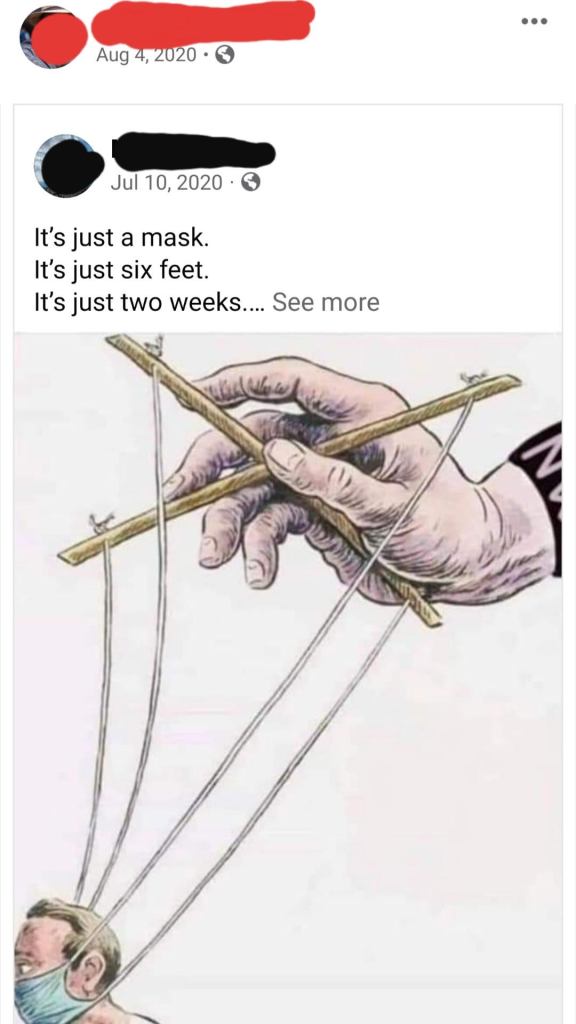
Consider the many theories afloat about Covid-19.  Scrolling through the Facebook posts of anti-maskers and anti-vaxxers curated on the Herman Cain Award subreddit, one is struck by the sheer quantity of conspiratorial memes circulating among networks of likeminded Facebook friends. The Covid pandemic is variously presented as the product of a nefarious plot enacted by the Chinese government or by the US government or by the Centers for Disease Control or…the list goes on. Public health measures that have been recommended or mandated at the federal, state or local levels such as quarantining, masking, and vaccinating are similarly condemned as elements of the conspiratorial machinations of Anthony Fauci or Bill Gates (or both of them working in cahoots), of profiteering Big Pharma, of collectivizing communists, of Medicare-For-All socialists, and so on.

As Richard Hofstadter demonstrated in his famous essay, “The Paranoid Style in American Politics,” the United States has from very early in its history provided fertile ground for the organized circulation of political rhetoric warning in shrill tones about the impending takeover of the political system. Alleged nefarious groups named in these conspiracy theories included the Illuminati, the Freemasons, papists, Jesuits, anarchists, Jews, international financiers, and communists. 

While the anti-mask and anti-vax conspiracies circulating on Facebook today manifest the characteristics of “heated exaggeration, suspiciousness, and conspiratorial fantasy” which Hofstadter identified as typical of the paranoid style, the sense of what is at stake has changed. It is no longer just constitutional government that seems to be at risk. When you read the conspiratorial warnings available across the ideological spectrum—from QAnon enthusiasts or Trumpist dead-enders or health purists or anti-corporate populists, among others—you get the sense that people feel their very identities to be under threat. Has a threshold been passed that separates the conspiracy-mongers of today from their anti-papist, anti-Masonic forebearers?   

In his book, Empire of Conspiracy: The Culture of Paranoia in Postwar America (2000), Timothy Melley argued that conspiracy thinking fundamentally changed after World War II with the rise of the “information age.” Consumers of electronic mass media became susceptible to what he characterized as a state of “agency panic,” an “intense anxiety about an apparent loss of autonomy or self-control” in the face of pernicious systems of social control acting with a singular will. Notions of secret plots hatched by bands of conspirators aiming at the conquest of political power were increasingly replaced by visions of “whole populations being openly manipulated without their knowledge” through the effects of advertising, schooling, fluoridation, and so on. The USA was ground zero for this new form of conspiratorial thinking because the American embrace of the idea of rugged individualism was so at odds with the reality of an increasingly interdependent society in which self-sufficient farmers were a dying breed.

Empire of Conspiracy was published at the dawn of the surveillance economy ushered in by Google and Facebook. This economy has at the same time systematically perfected the relentless tracking of individual activities and facilitated the exchange of conspiratorial memes and messages lamenting the threats to individual integrity and freedom. Paranoid messages that are likely to attract eyes are moved algorithmically to the top of search results or share lists. The Covid pandemic has only supercharged these developments by boosting mass dependence on the internet and amplifying mass grievance against infringements on individual freedoms. 

The easy response to this internet-fueled conspiratorial dynamic would be to dismiss conspiracy thinking as the paranoid raving of the uneducated and ignorant if it weren’t for the fact that real conspiracies are continually afoot in our political system. One has only to take note of the ever-accelerating revolving door between public officialdom and the lobbying-industrial complex or to monitor the ever-greater lobbying and campaign expenditures of major industries such as Big Pharma or Big Coal or Big Tech to know that well-paid influencers are working diligently with corrupted politicians to poach the common good.

Yet the rising tide of agency panic-driven conspiratorial thinking continually diverts Americans from the true causes of their collective misery into attacks on those few public measures that are in our collective interest. 

It truly is a choice between taking the red pill or the blue pill, as The Matrix meme circulated by so many of the Covid conspiracy Facebook posters suggests. But, against their expectation, taking the red pill would lead to a clear-eyed understanding of how corporate influence peddling diminishes our lives rather than to a revelation that supposed college roommates Bill Gates and Anthony Fauci hatched a conspiracy against our freedoms fifty years ago.

M. Davout, an occasional contributor to Bracing Views, teaches political science at the collegiate level.

America’s Disastrous 60-Year War

W.J. Astore

In my latest for TomDispatch.com, I tackle America’s disastrous 60-year war (1961-2021), which began with Ike’s warning of the pernicious threat to democracy of the military-industrial complex and ended with last year’s humiliating retreat from Afghanistan. Has America learned anything? Based on recent events with Russia and Ukraine, together with bellicose acts toward China, it doesn’t seem so.

Here’s an excerpt from my article; you can read it in its entirety at TomDispatch.com.

Three Generations of Conspicuous Destruction by the Military-Industrial Complex

BY WILLIAM ASTORE

In my lifetime of nearly 60 years, America has waged five major wars, winning one decisively, then throwing that victory away, while losing the other four disastrously. Vietnam, Afghanistan, and Iraq, as well as the Global War on Terror, were the losses, of course; the Cold War being the solitary win that must now be counted as a loss because its promise was so quickly discarded.

America’s war in Vietnam was waged during the Cold War in the context of what was then known as the domino theory and the idea of “containing” communism. Iraq and Afghanistan were part of the Global War on Terror, a post-Cold War event in which “radical Islamic terrorism” became the substitute for communism. Even so, those wars should be treated as a single strand of history, a 60-year war, if you will, for one reason alone: the explanatory power of such a concept.

For me, because of President Dwight D. Eisenhower’s farewell address to the nation in January 1961, that year is the obvious starting point for what retired Army colonel and historian Andrew Bacevich recently termed America’s Very Long War (VLW). In that televised speech, Ike warned of the emergence of a military-industrial complex of immense strength that could someday threaten American democracy itself. I’ve chosen 2021 as the VLW’s terminus point because of the disastrous end of this country’s Afghan War, which even in its last years cost $45 billion annually to prosecute, and because of one curious reality that goes with it. In the wake of the crashing and burning of that 20-year war effort, the Pentagon budget leaped even higher with the support of almost every congressional representative of both parties as Washington’s armed attention turned to China and Russia.

At the end of two decades of globally disastrous war-making, that funding increase should tell us just how right Eisenhower was about the perils of the military-industrial complex. By failing to heed him all these years, democracy may indeed be in the process of meeting its demise.

The Prosperity of Losing Wars

Several things define America’s disastrous 60-year war. These would include profligacy and ferocity in the use of weaponry against peoples who could not respond in kind; enormous profiteering by the military-industrial complex; incessant lying by the U.S. government (the evidence in the Pentagon Papers for Vietnam, the missing WMDfor the invasion of Iraq, and the recent Afghan War papers); accountability-free defeats, with prominent government or military officials essentially never held responsible; and the consistent practice of a militarized Keynesianism that provided jobs and wealth to a relative few at the expense of a great many. In sum, America’s 60-year war has featured conspicuous destruction globally, even as wartime production in the U.S. failed to better the lives of the working and middle classes as a whole.

Let’s take a closer look. Militarily speaking, throwing almost everything the U.S. military had (nuclear arms excepted) at opponents who had next to nothing should be considered the defining feature of the VLW. During those six decades of war-making, the U.S. military raged with white hot anger against enemies who refused to submit to its ever more powerful, technologically advanced, and destructive toys.

Please read the rest of my article here.

Many Decades of the Condor

W.J. Astore

I recently rewatched “Three Days of the Condor” (1975) featuring Robert Redford and Faye Dunaway. It’s a smart and understated spy thriller that takes on the Central Intelligence Agency (CIA) and the deadly games the agency plays in its pursuit of global dominance. In the aftermath of the Vietnam War and the backlash from Richard Nixon and Watergate, not to mention America’s role in overthrowing the Allende government in Chile in 1973, it became acceptable in Hollywood to make films that portrayed the U.S. government as sometimes less than noble in all its pursuits. Condor, the codename for Redford’s character, stumbles across a plot within the CIA to overthrow governments in the Middle East so that U.S. corporations could dominate the oil market, and for that he and his colleagues in the special branch where he works must die. The movie follows his efforts to stay alive among people who will execute their own for the greater good of The Company (the CIA).

At the end (spoiler alert), Redford goes to the New York Times as a whistleblower in an effort both to stay alive and to reveal the nefarious machinations of the CIA. A CIA senior official, played by Cliff Robertson, confronts Redford and asks him a question that is deadly in its implications: Will they print it? Redford is confident the newspaper will, but Robertson, in asking Redford how he can be sure that they will, reminds us that there’s no certainty the “liberal” New York Times will go against the wishes of the CIA.

Robert Redford and Cliff Robertson in “Three Days of the Condor”

This was on my mind today as news broke once again that the CIA is collecting “bulk data” on Americans without Congressional authorization and outside of normal oversight. Well, as some of my students used to say, if you’ve done nothing wrong, you have nothing to fear from the diligent and honest agents of the CIA, right?

There’s a little scene in the movie where Condor laughs at the conceit of the CIA in referring to themselves as the intelligence “community.” A community of powerful and ultra-secretive intelligence agencies — I’m sure we have nothing to fear from such an Orwellian concoction.

Anyway, if you haven’t seen “Three Days of the Condor,” I recommend it. As a bonus, it has one of the most powerful yet understated romantic relationships caught on film, with Redford and Dunaway both superb in portraying two people on the edge who are desperately looking for connection.

A Few Thoughts About NATO and Russia

W.J. Astore

NATO, the North Atlantic Treaty Organization, dates from 1949. From its very name, the alliance focused on North Atlantic countries and Western Europe, and stated its intent was to deter the Soviet Union from attacking European countries like Germany, France, and Italy.

Interestingly, Dwight D. Eisenhower was NATO’s first SACEUR, or Supreme Allied Commander in Europe, and he favored the complete withdrawal of U.S. troops when Europeans were back on their feet from World War II and capable of defending themselves. Since U.S. troops are still stationed in Europe nearly 75 years after the founding of NATO, one must assume Europe is still not ready.

All kidding aside, getting the U.S. to commit troops to NATO was in part a European ploy against a repeat of American isolationism, which had manifested itself in the aftermath of World War I. There was indeed a time when Americans wanted nothing to do with European intrigue and folly, and in the 1930s the U.S. Senate even attacked European arms manufacturers as warmongering “merchants of death.” Imagine that!

Nowadays, of course, it’s the USA that dominates the world’s arms market, and our merchants of death truly dominate the world. Our weapons merchants now deliver weapons to places like Ukraine in the name of “freedom” and “protecting democracy,” though I have yet to see a freedom or democracy bomb. (Interestingly, the names we choose for weapons systems are far more honest, like Hellfire missiles and Predator and Reaper drones. Talk about peddling death!)

When the Soviet Union collapsed in 1991, NATO’s reason for being collapsed along with it, but reason not the need, as King Lear said. NATO was not about to disband itself; lucrative and powerful bureaucracies rarely do. So NATO’s mission began to change to “out of area” operations, working in concert with the UN in places like Bosnia and Kosovo. Speaking of “out of area,” NATO countries also got involved in the War on Terror, including U.S. folly in Afghanistan, which provided political cover for the U.S. in the sense that American officials could claim to be working as part of a coalition to help the Afghan people.

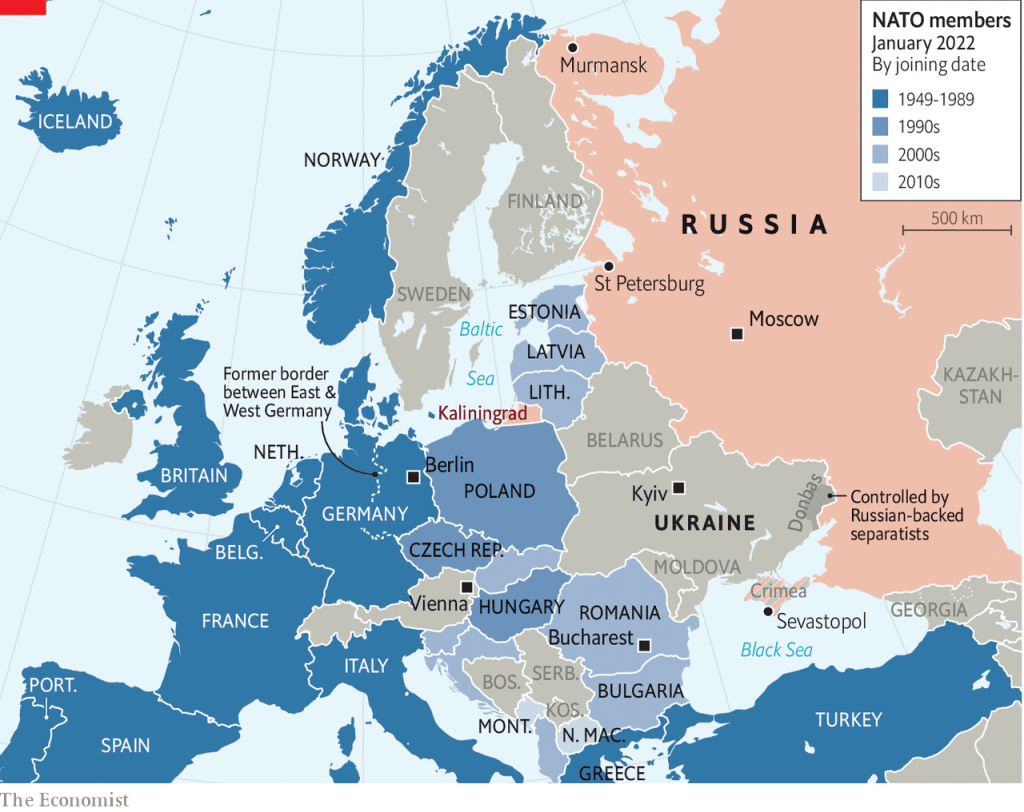
But the biggest money maker of all for NATO and for today’s merchants of death has been expansion. Recall that the Soviet Union collapsed in 1991. Recall that NATO was created to deter a Soviet attack on Western Europe. If NATO was going to continue to exist, it needed to morph into something else, but most of all it needed to grow. And so it did.

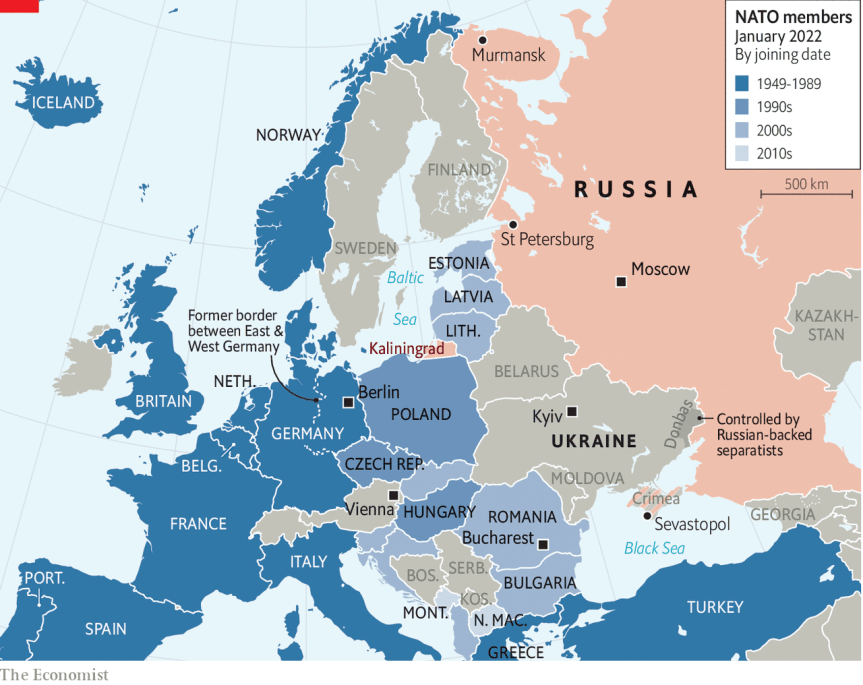
In 1999, former Warsaw Pact countries like Poland, Hungary, and the Czech Republic joined. Five years later, Bulgaria, Romania, Slovakia, Slovenia, and the three Baltic States (Latvia, Lithuania, and Estonia) joined as well. In short, what began as a defensive alliance focused on Western Europe has grown into an alliance that includes just about all of Eastern Europe. And the new NATO members have been eager customers for NATO-compatible weaponry, much of it made in the USA.

The caption from the Economist suggested this map showed how Russia was menacing Ukraine! And that NATO was unlikely to retreat

If I were Russian, I think I’d look at the dramatic eastern expansion of NATO as worrisome. If not aggressive, it is most certainly constrictive. And with former Soviet republics like Georgia and Ukraine mentioned as future NATO members, this constriction would seem more like strangulation if I occupied the Kremlin. And I’m not an ex-KGB agent like Vladimir Putin.

I remember a military history symposium in 1998 I attended in which the future of NATO was bandied about. Russian concerns about NATO expansion were discussed by four senior generals. One of them, General Sir Anthony Farrar-Hockley, basically argued that NATO should tell the Russians to go pound sand. In the notes I took from the discussion, Farrar-Hockley said that to forego NATO expansion because of Russian concerns would be to grant Russia a continuing fiefdom in Eastern Europe. Besides, Russia had nothing to fear from an expanded NATO, he added. The three other generals expressed some concern that Russia could see expansion as encirclement, and given Russia’s history of being invaded and devastated by countries to its west, any expansion would have to be done carefully, with plenty of dialogue.

We’re not witnessing much dialogue, are we? Instead, NATO expansion is seen by the U.S. as uncontroversial, and indeed as desirable, and certainly as non-threatening. Surely the Russians have nothing to fear from such a vast alliance creeping up to its very door step! It’s not like Russia wasn’t devastated by Napoleon in 1812, or by Germany and its various allies in World Wars I and II. I’m sure that will never happen again. Right, comrade?

Here’s an idea. Perhaps NATO expansion would be less problematic for the Russians if the U.S. withdrew all its troops from Europe, harkening back to Eisenhower’s initial vision. Shouldn’t European countries be able to defend themselves after almost 75 years of U.S. aid? Maybe Donald Trump wasn’t so crazy after all in asking whether NATO was really worth the candle.

When In Doubt, Send Troops

W.J. Astore

On that proverbial table in Washington D.C. where all options are allegedly kept, the one option that’s always used is military escalation. First, the U.S. sent more weaponry to Ukraine. Now, America’s commander-in-chief is sending more troops, according to this news update today from the Boston Globe:

President Biden is sending about 2,000 troops from Fort Bragg, North Carolina, to Poland and Germany this week and sending part of an infantry Stryker squadron of roughly 1,000 troops based in Germany to Romania, a senior administration official said Wednesday.

The military moves come amid stalled talks with Russia over its military buildup at Ukraine’s borders. And they underscore growing fears across Europe that Russian President Vladimir Putin is poised to invade Ukraine — and smaller NATO countries on the eastern flank worry they could be next.

Has Russia given any sign of invading “smaller NATO countries on the eastern flank”? No matter. The solution is obviously to send small contingents of U.S. troops as a sign of resolve. A couple thousand troops split between Poland and Romania will show Vladimir Putin that America means business. (War business, that is.)

Such small troop contingents have negligible military value, so their real significance is in domestic politics. Biden, a typical Democratic president, is forever on guard against accusations of “weakness” vis-a-vis Russia or China or Iran or you-name-it. To minimize such accusations, while keeping the military-industrial complex happy, the go-to option on the table is to send in the weapons and the troops. Who cares about the risk of military escalation and a wider war between major nuclear powers?

One could imagine a different president, a savvier one, winning major international points by offering to defuse tensions between Ukraine and Russia through negotiation. But that option, farfetched as it would be, is never on that table of options kept in Washington. And why Russia would trust the U.S. is beyond me.

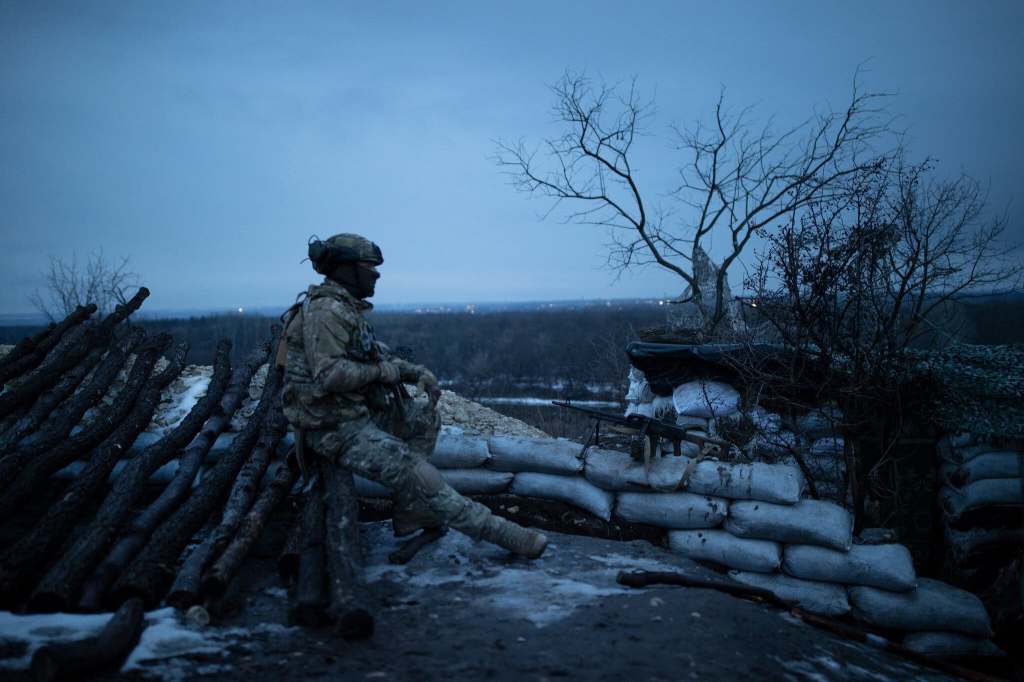
Kyiv (Kiev) in Ukraine is roughly 5500 miles from me by airplane. That’s a very long way indeed from what I consider to be my “eastern flank.” Maybe America should practice a new foreign policy in which we learn to mind our own business, or, if you prefer, stay in our own backyard?

A Ukrainian soldier. One imagines he’s hoping for a peaceful solution. But this is not what I think of as America’s (or NATO’s) eastern flank

Fixing NFL Overtime

W.J. Astore

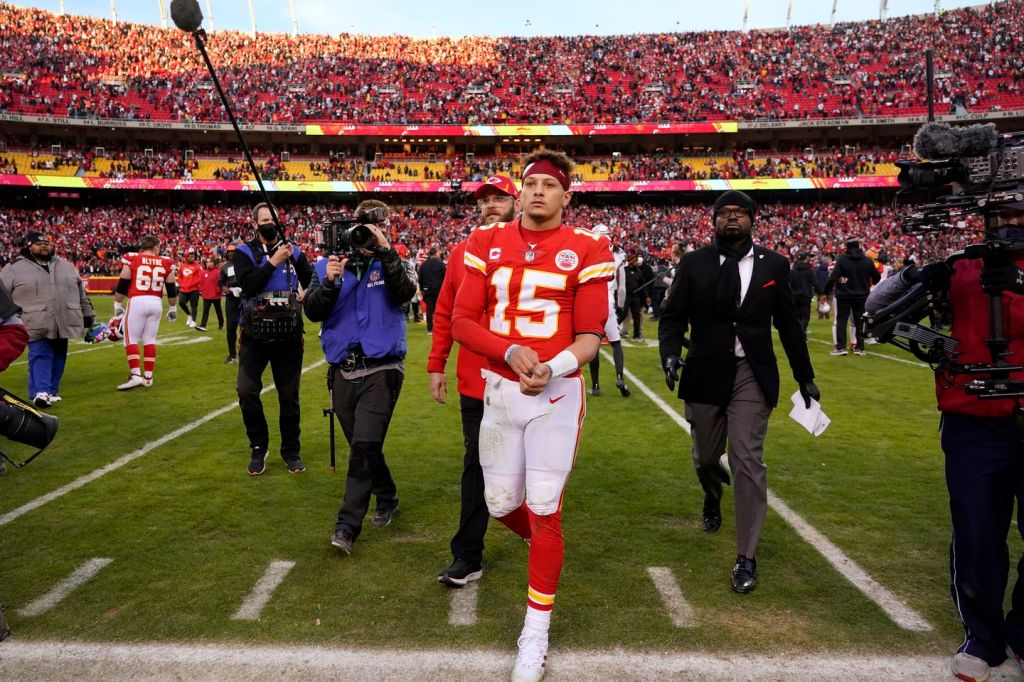
We tackle heavy subjects here at Bracing Views: war, militarism, politics, religion. But surely the heaviest of all is the clear inequity and unnecessary complexity of the National Football League’s overtime rules. Especially in the playoffs, the team that wins the coin flip before OT usually wins the game, though not always, as the Kansas City Chiefs proved this past weekend, as they won the coin toss but lost the game. Also, NFL OT rules for playoff games are different than the OT rules for the regular season (the latter games can end in a tie).

Why not one set of rules for OT for both the regular season and the playoffs? A set of rules that is simple and consistent, producing a victor fairly quickly but without changing the game?

Here’s my idea, which is a variation of the rules for OT that currently exist:

  1. OT shall consist of a single ten-minute period. The team with the highest score at the end of this period wins the game.
  2. If the teams are still tied at the end of this OT period, the winner will be determined by two-point conversions (as teams have the option of trying after touchdowns).
  3. If Team A scores on its 2-point conversion, Team B will then get its try. If Team B succeeds, Team A tries again. If Team B fails, Team A wins. (If Team A had failed and then Team B had succeeded, Team B wins.) Tries will continue until one team succeeds and the other fails, thus the winning team will win by 2-points.

Other details can be worked out, such as the number of timeouts each team gets. I’d suggest two. Also, if one team ties the game at the end of regulation, that team would then kickoff at the start of OT. Otherwise the kickoff is determined by a coin flip.

I like this idea because each team should get plenty of time to have the ball in OT and attempt to score — or even to mount a comeback. And if OT ends in a tie, the 2-point conversion tiebreaker contest will be immensely exciting for the fans since it will involve the offenses and defenses — and the best players and plays — of both teams.

Assuming you watch football, readers, what do you think?

Once Kansas City lost possession of the ball in OT, the Bengals marched quickly down the field and kicked a field goal to win. If OT had been a 10-minute period, however, the Bengals would have tried to score a TD, and KC would have had a chance to answer. If KC had scored a TD on its first possession, the Bengals would have lost without ever getting a chance on offense.

HERE ARE THE OFFICIAL RULES AS THEY EXIST TODAY

OVERTIME RULES FOR NFL REGULAR SEASON

  • At the end of regulation, the referee will toss a coin to determine which team will possess the ball first in overtime. The visiting team captain will call the toss.
  • No more than one 10-minute period will follow a three-minute intermission. Each team must possess, or have the opportunity to possess, the ball. The exception: if the team that gets the ball first scores a touchdown on the opening possession.
  • Sudden death play — where the game ends on any score (safety, field goal or touchdown) — continues until a winner is determined.
  • Each team gets two timeouts.
  • The point after try is not attempted if the game ends on a touchdown.
  • If the score is still tied at the end of the overtime period, the result of the game will be recorded as a tie.
  • There are no instant replay coach’s challenges; all reviews will be initiated by the replay official.

OVERTIME RULES FOR NFL POSTSEASON GAMES

Unlike regular season games, postseason games cannot end in a tie, so the overtime rules change slightly for the playoffs.

  • If the score is still tied at the end of an overtime period — or if the second team’s initial possession has not ended — the teams will play another overtime period. Play will continue regardless of how many overtime periods are needed for a winner to be determined.
  • There will be a two-minute intermission between each overtime period. There will not be a halftime intermission after the second period.
  • The captain who lost the first overtime coin toss will either choose to possess the ball or select which goal his team will defend, unless the team that won the coin toss deferred that choice.
  • Each team gets three timeouts during a half.
  • The same timing rules that apply at the end of the second and fourth regulation periods also apply at the end of a second or fourth overtime period.
  • If there is still no winner at the end of a fourth overtime period, there will be another coin toss, and play will continue until a winner is declared.

Why It’s So Hard to Give Peace A Chance in America

W.J. Astore

It sure is hard to give peace a chance in America, as recent events with Russia and Ukraine show. The Washington consensus is all about weapons and more weapons, of economic sanctions, i.e. economic warfare, of not being seen as a pitiful helpless giant, as Richard Nixon once said during the Vietnam War. America can never stand on the sidelines, even when its national security interests aren’t even threatened. Something must be done, something forceful, something involving troops and weapons and ultimatums that could very well escalate into disaster.

Revealingly, Washington insiders always talk of “all options” being on a metaphorical table, meaning the most violent ones, including war, for the president to choose from. They lie. Because the one option that’s never on that imaginary table is peace.

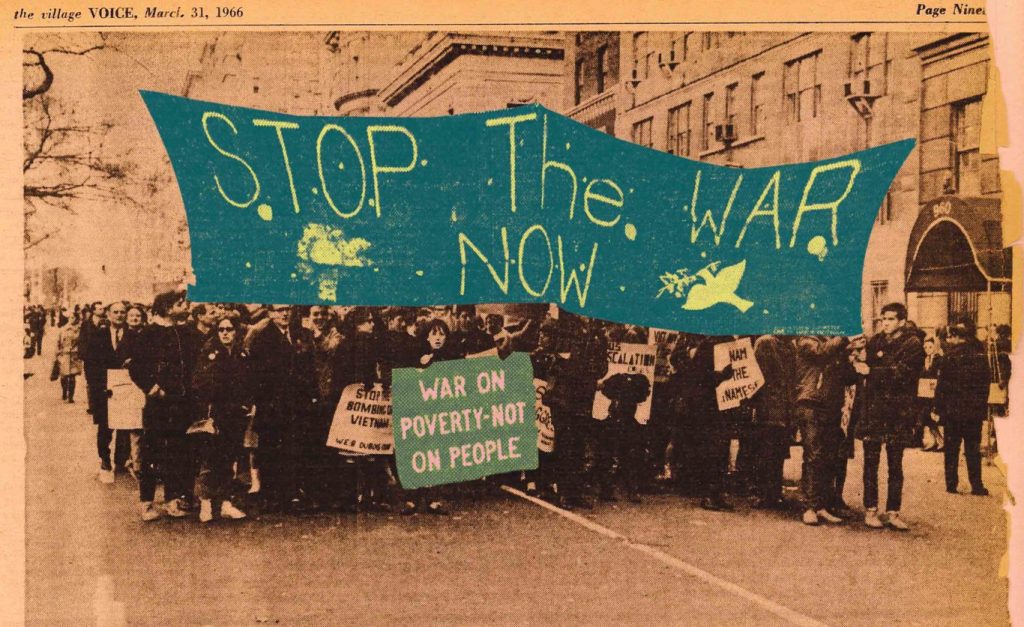
Peacemakers might be the children of God, but perhaps America is more godless than it knows. Or maybe it just worships the god of war, a Pentagod. It’s discouraging to face the obstacles to peace in America, because these obstacles are not going to be removed just by singing songs and writing articles or even by protesting. What is truly needed is a mass movement against war, as we saw during the Vietnam War years, but even that mass movement took years to have an impact. And it was motivated as well by resistance to the draft, which no longer exists.

A short list of the obstacles to peace is sobering indeed:

  • The power of the military-industrial-congressional complex. It doesn’t want to get smaller or less powerful. It thrives off weaponry and wars. It has no interest in peace.
  • The mainstream media. It’s owned by major corporations and advances corporate agendas. It smears antiwar voices as naive (at best) and often as traitorous and/or weak. Antiwar voices simply aren’t heard on the MSM. Instead, retired colonels and generals, as well as senior ex-CIA officials, are put forward as unbiased voices of reason as they promote the most hawkish lines.
  • The absence of a draft. Let’s face it: the youth of America are much more likely to resist war if they have to risk their lives. But America has an “all volunteer force,” and if these volunteers are sent off to war, that’s what they signed up for. Right?
  • American culture in general is suffused with violence and misinformed about the world, especially America’s imperial role in it. Myths about American exceptionalism and beliefs about the troops as freedom-fighters serve to inhibit antiwar criticism and protests.
  • The difficulty of launching any kind of sustained protest nowadays. Ready to gather in the streets to march against war? Sorry, do you have a permit? Covid restrictions may prevent you from gathering. And maybe we’ll move you to a special “free speech” zone, which I assure you will be far away from media cameras. What good is protesting if you gain no traction because few people see you and the media ignores you?

Don’t get me wrong. I’m not saying it’s impossible to give peace a chance. Just that it’s very difficult, given the power structures of our society and our collective national ethos. It’s mind-boggling that America has so many agencies for “defense” and “intelligence.” We have the Pentagon, the Department of Homeland Security (a domestic mini-Pentagon), something like 17 intelligence agencies like the CIA and NSA, the list goes on. State and local police forces are now heavily militarized and generally unsympathetic to your right to assemble and to protest vigorously. Get a job, commie peacenik!

Meanwhile, society’s heroes are U.S. military troops, or the “thin blue line” of police that “protect and serve.” Those who are committed to peace are generally not viewed as heroes, at least not by society at large. Again, Christ may have seen peacemakers as God’s children, but in the U.S. there’s a preference (judging by gun sales) for Colt Peacemakers.

How to overcome these obstacles to truly give peace a chance is perhaps the most pressing issue of our age, given the risk of war going nuclear and ending most life on our planet. Readers, I don’t have easy answers, but I’d begin with Ike’s warning about the military-industrial complex in 1961, JFK’s peace speech in 1963, MLK’s speech against the Vietnam War on April 4th, 1967, perhaps even John Lennon’s song “Imagine.”

How do we imagine — and then create — a new reality that favors peace instead of war? How do we pursue a just and lasting peace with ourselves and with all nations that Abraham Lincoln spoke of near the end of the U.S. Civil War?

The words are there. The vision is there. Tapping the nobility of Lincoln, Ike, JFK, and MLK and their antiwar messages is possible. Isn’t it?

As JFK said in his “peace speech,” to believe that war is inevitable is a “dangerous defeatist belief.” I’m with JFK.

The antiwar movement helped to stop the disastrous Vietnam War, but it sure wasn’t easy

Russia, Ukraine, and the USA

W.J. Astore

The situation along the border of Russia and Ukraine is volatile. War is possible. Given this volatility and the possibility of war, does it make any sense to send more weaponry to Ukraine?

From this CNN report, that is exactly what the USA is doing: sending more arms and ammunition to Ukraine:

“The second bird in Kyiv! More than 80 tons of weapons to strengthen Ukraine’s defense capabilities from our friends in the USA! And this is not the end,” Ukrainian Defense Minister Oleksii Reznikov said in a tweet Sunday. The first shipment of security assistance from the US had arrived in Ukraine on Friday. That shipment included “close to 200,000 pounds of lethal aid, including ammunition for the front line defenders of Ukraine,” the US Embassy in Kyiv tweeted Friday night. The shipments come as the US has sought to convince Moscow to de-escalate the situation at the Ukrainian border, where Russia has amassed more than 100,000 troops. Earlier Sunday, Secretary of State Antony Blinken amplified his warning against a Russian invasion of Ukraine, saying “a single additional Russian force” entering Ukraine “in an aggressive way” would result in a severe response by the US and its allies. “If a single additional Russian force goes into Ukraine in an aggressive way, as I said, that would trigger a swift, a severe and a united response from us and from Europe,” Blinken told CNN’s Dana Bash on “State of the Union.”

Let me get this straight: weapons and ammo are “security assistance,” or “lethal aid,” a construction that should win a prize for best oxymoron of the year. Hi! I’m here to help you. How about some “lethal” aid? Meanwhile, even as the US escalates the situation with “lethal aid” and threats, the US State Department insists it’s the Russians who need to “de-escalate the situation.” No contradiction here, right?

Consider here the words of Antony Blinken, he of the “swift” and “severe” and “united” response if only a “single” Russian force should enter Ukraine “in an aggressive way.” This naked bombast directly contradicts President Joe Biden’s words at last week’s press conference. Biden, who occasionally has “senior moments” of inadvertent truth, explained that NATO wasn’t united and that a minor incursion by Russian forces probably wouldn’t trigger a swift and severe response. It’s reassuring to know we have such skilled and consistent leaders as Biden and Blinken in charge here.

US meddling in Ukraine is complex, but let’s just say America’s leaders are part of the problem, not the solution. As usual, the US response to almost any situation is to send troops and weapons while telling the other side to “de-escalate.”

Worst of all, though, from an American perspective, is the lack of skilled and smart leadership in the White House. Biden appears confused and his vice president is hapless. Blinken is a neo-con tool who won’t be confused with Bismarck, let alone Henry Kissinger. He thinks American diplomacy is most effective when it’s backed by brazen military threats. No speaking softly with a big stick held prudently in reserve; Blinken prefers to shout loudly while openly brandishing the big stick of the US military.

It doesn’t bode well, does it?

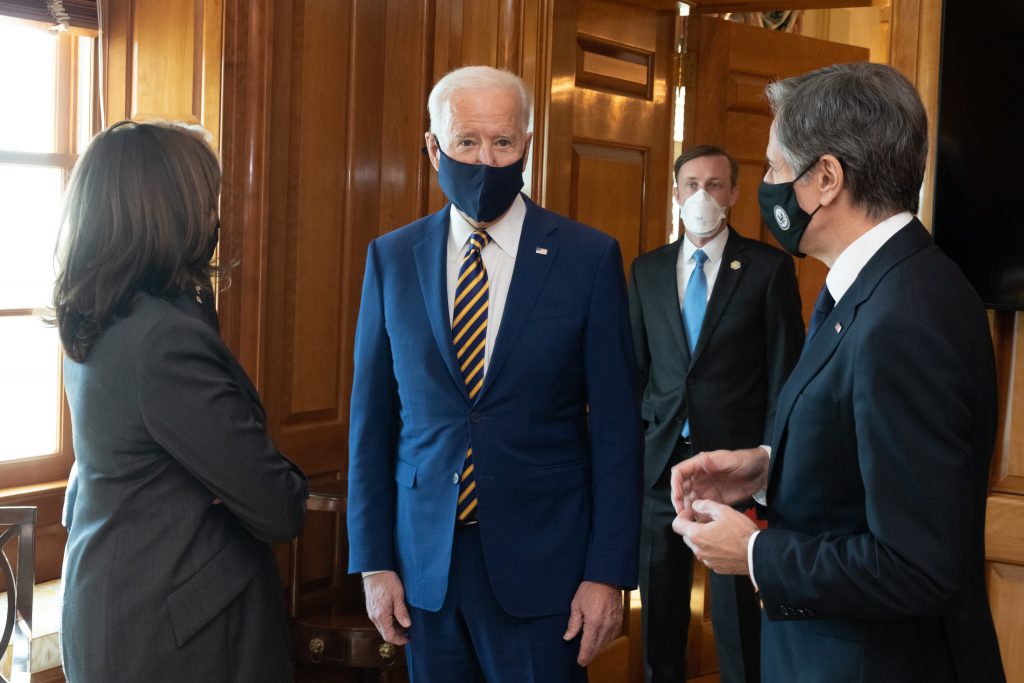
Kamala Harris and Joe Biden with Antony Blinken on the far right. Not exactly the A-Team.