Testimony before the International Court of Justice
Israeli military action is killing roughly 50 mothers a day in Gaza; 120 children a day; one journalist a day. Gaza is at the brink of mass famine. The Israeli strategy is clear: render Gaza uninhabitable. Force the Palestinians to flee. Create a desert and call it “peace.”
The following testimony before the International Court of Justice makes it abundantly clear that Israel is engaged in a campaign of incremental genocide, a genocide in slow motion, supported without equivocation by the United States. More than supported: U.S. weaponry facilitates the destruction of Gaza.
The destruction of Gaza, the mass murder of Palestinians, makes a mockery of the so-called rules-based order that the Biden administration allegedly upholds.
Yemen, Israel, Ukraine, and the U.S. Embrace of War Everywhere
Last night, the U.S. bombed another country, Yemen, in the name of the “rules-based order.” Yemen has been striking shipping as a form of protest against the ongoing Israeli genocide-in-slow-motion in Gaza. It always looks good when the U.S. uses its military to enable mass murder elsewhere. I’m sure the “peace bombs” we dropped will bring stability to the region.
The U.S. military bombs and launches Tomahawk missiles as its answer to everything. Meanwhile, our dynamic commander in chief, Joe Biden, launched a new front in this war of terror without Congressional authorization, an impeachable offense. But of course most in Congress will salute him for taking “decisive” action by bombing yet another poor country with brown-skinned Muslim people living in it. Perhaps Biden is counting on being a “wartime president” as a way to eke out a narrow victory in November.
In Gaza, incremental genocide continues with at least 23,000 Palestinians dead and another 60,000 wounded, the majority being women and children. The Israeli government is poisoning the land and water of Gaza, blasting buildings into rubble, and starving the Palestinians while still claiming to be the victims of the war. Antony Blinken, America’s diplomat-in-chief, says the war will end when Hamas offers its unconditional surrender. After which, what, exactly? Israel will rebuild Gaza and embrace Palestinians as brothers and sisters?
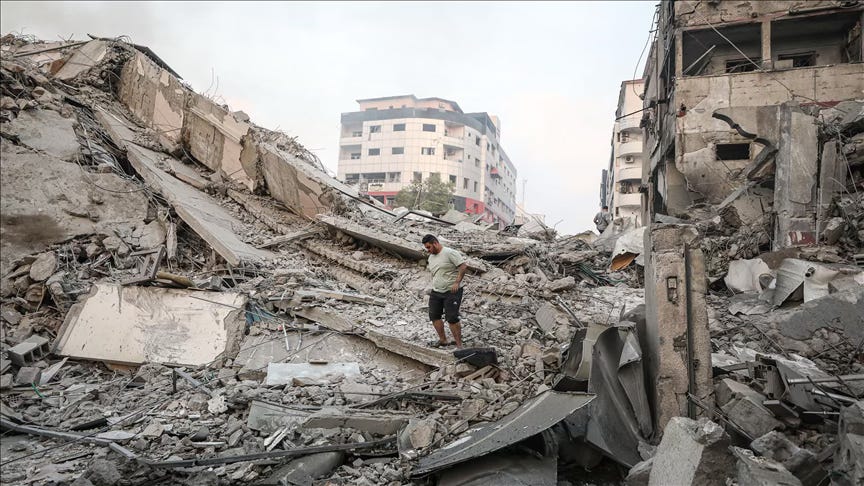
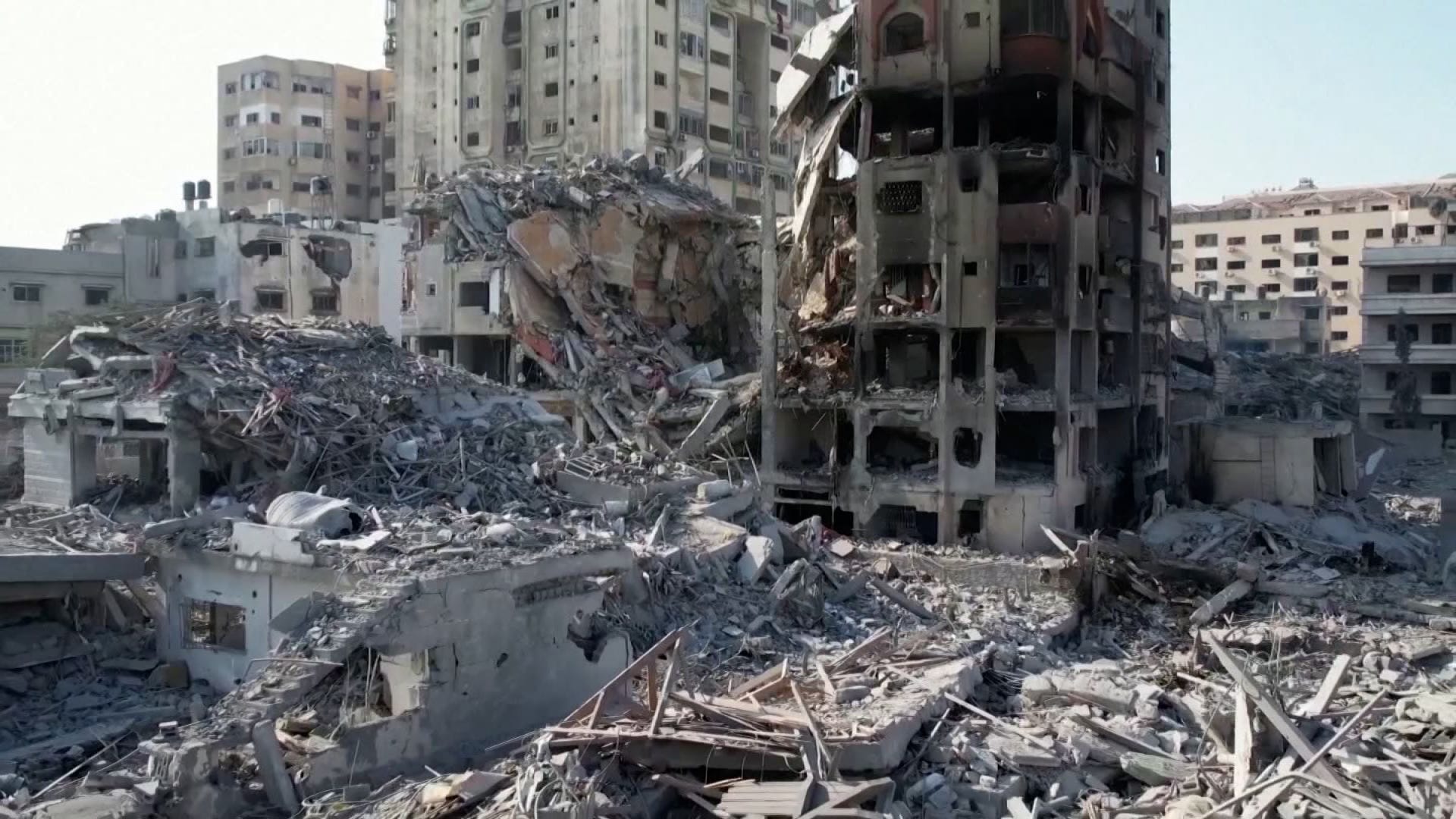
Israel is going to rebuild all this for the Palestinians in Gaza?
In Ukraine, the war continues to be stalemated as Ukraine waits for another $65 billion or so in aid from the Biden administration. Which brings me to this story from The Boston Globe this morning:
More than $1 billion worth of shoulder-fired missiles, drones, and night-vision goggles that the United States has sent to Ukraine have not been properly tracked by US officials, a new Pentagon report concluded, raising concerns they could be stolen or smuggled at a time when Congress is debating whether to send more military aid to Ukraine.
Over the last two years, the U.S. has flooded Ukraine with weaponry, producing a stalemated war and a healthy black market in stolen arms. The next step should be obvious: persist in the same folly by sending Ukraine even more weapons. Again, the argument is made that it’s all Russia’s fault and that, if Putin wants the war to end, he should basically surrender by withdrawing all Russian troops from the territory he has seized.
There you have it. The annihilation of Gaza will stop when Hamas totally surrenders and the war in Ukraine will stop when Russia totally surrenders, otherwise the U.S. must keep sending more than $100 billion in weaponry and aid to the “democracies” of Israel and Ukraine in their righteous battles against evil. Yes, that really is the position of Biden and Blinken.
Finally, a reader sent along this important article on how the U.S. is funding these wars and in fact the entire war on terror: by deficit spending. Call it “the ghost budget.” America’s national debt has ballooned to $34 trillion mainly due to the disastrous war on terror (roughly $8 trillion), colossal Pentagon budgets, and gargantuan bailouts of banks and corporations due to financial and Covid crises, real or constructed. Vast wealth continues to flow upwards in America as Biden’s “everyday people” struggle. Whether for Biden or Trump, the answer to the debt is always more tax breaks for the rich in the name of “stimulating” growth. Those tax breaks, of course, only drive the national debt up further, but never mind that.
What’s coming is a concerted attack on social security and Medicare/Medicaid in the name of fiscal responsibility. As the comedian George Carlin predicted: They’re coming for your social security. And they’ll get it, he added. Which is consistent with what Joe Biden has said in the past about the need to cut social security as well as health and veterans’ benefits.
What will historians say decades or centuries from now when the U.S. empire collapses into ruin? How will they explain it?
Consider the United States in the big picture. I see a country with unique strengths. Two wide oceans protecting us. A long secure border with Canada. A securable border with Mexico, the current immigrant “crisis” be damned. Canada and Mexico aren’t our enemies. No invasion is coming from them. As a country, the USA occupies a geographical/global position that is uniquely safe and advantageous.
Why are we so fearful? Why do we spend a trillion dollars (or more) each year on national “defense”?
How incredibly lucky we are! (Credit: Tom Van Sant/Geosphere Project, Santa Monica/Science Photo Library)
Of course, I put “defense” in quotes because the USA is an empire with a military configured for offense. Global reach, global power, was the motto of my service, the U.S. Air Force. The U.S. military strives for full-spectrum dominance, meaning total control of the land, sea, air, space, and cyberspace, justified in the false name of “defense.” The cost of this febrile quest for dominance is, I believe, ultimately unbearable. Why do we persist in such folly?
What country would dare to attack the USA? Other than small terrorist networks like Al Qaeda, no country, no people, no leaders in their right mind would dare attack us, let alone invade us. They know they’d likely be obliterated if they did. Does anyone truly fear an attack on the USA from China? Russia? Iran? North Korea? Given America’s belligerence, evidence of our unbridled vengeance after Pearl Harbor and 9/11, and our vast arsenal of highly destructive weaponry, including thousands of nuclear warheads, anyone attacking the U.S. would be pursuing a death wish.
I am not afraid of Russia, a regional power that is stuck in a quagmire war against Ukraine. I am not afraid of China, a regional military power and economic superpower that is tied to us in global trade and has no intent, near as I can tell, to attack my country. I am not afraid of Iran, or North Korea, or similar “threats” of the moment. So why is my government constantly exaggerating these threats and telling me to be afraid?
Of course, I know all about Ike’s military-industrial-congressional complex. I write against it all the time. It’s not just the MICC and its pursuit of profits and power, however. It’s the corporate interests that say Taiwan must be “protected” for its microchips, the Middle East must be “protected” because of its oil, that Ukraine must be “protected” for its rich agricultural wealth (even as Russia’s gas pipelines to Germany are destroyed) and the riches to be had once the war is over and Ukraine is rebuilt. I know there’s nothing new about this; I’ve read my Smedley Butler.
When I first signed up for the U.S. military in 1981, and then went on active duty in 1985, I thought the U.S. did face a possible existential threat: the Soviet Union, the Warsaw Pact, and Communism. By 1991, that threat was largely gone. Even Cold War hawks like Jeanne Kirkpatrick wrote enthusiastically of the U.S. becoming a normal country in normal times. WTF happened? Why didn’t we?
Here we are, more than 30 years after the collapse of the Soviet Union, and the U.S. government is selling Putin’s Russia as a serious threat again. When we see clear evidence that Putin has more than enough to handle with Ukraine, we’re told to look toward China as the Next Big Threat. Meanwhile, irrational, indefensible, blank checks of support given to Israel in its murderous campaign of ethnic cleansing in Gaza threaten a wider war in the Middle East, a war some in our government seem to be spoiling to fight, knowing of course that they and theirs won’t be fighting it.
We Americans need to get a collective grip on ourselves and our own government. Stop feeding the Pentagon brass with money: it only encourages the bastards. Stop listening to the fear mongers. Turn off the mainstream media and ignore all the threat inflation. Look within yourself and control the fear and divisiveness they try to instill in you.
As Senator George McGovern, a war hero, said in 1972 when he won the Democratic nomination for the presidency: Come home, America. Close most of the military bases that America has overseas. Make deep cuts to the Pentagon war budget. Let other peoples settle their differences without our meddling, without our depleted uranium shells, without our cluster munitions, without our Hellfire missiles, without our mendacious rhetoric about a “rules-based order.”
Come home, America. We have a vast country with vast potential—and serious problems. Time to tackle them instead of seeking to dominate the world.
Or, as the Good Book says, “Why do you look at the speck of sawdust in your brother’s eye and pay no attention to the plank in your own eye?” (Matthew 7:3 NIV) Yes, indeed. Let’s remove the planks from our own eyes, which should keep us very busy for decades, rather than globetrotting to remove the sawdust from the eyes of other peoples who’d prefer us to stay home and leave them alone.
Another “emergency” shipment of arms to Israel: What a way to end the year! First, the Biden administration sent $106 million in tank shells to Israel without Congressional approval. Now, the government is sending $147.5 million in fuses, charges, etc. to Israel for 155mm artillery shells, also without Congressional approval. Mind you, Hamas doesn’t have tanks or heavy artillery, so these shipments aren’t for “defense.” Tank and artillery shells are really for one thing: urban destruction. Artillery is the very definition of an area weapon, i.e. imprecise. Yet, even as the Biden administration sends this weaponry to Israel, which will enable more killing on a mass scale, it expresses concern that Israel is ethnically cleansing too fast, killing too many innocent civilians too quickly.
Along with bombs, this is what tanks and artillery shells are good for
You can’t have it both ways, obviously. You can’t send heavy calibre weaponry to Israel and then complain when they use it. And to justify this aid as an “emergency” for America’s national defense interests! If democratic processes can be bypassed simply by declaring an emergency that clearly doesn’t exist, there is no democracy. Thanks for making that obvious, Joe Biden.
Meanwhile, Gaza continues to be pounded into rubble. Casualties there will soon exceed 100,000 as nearly half a million Palestinians begin to starve. The Israeli/US end game is clear: render Gaza uninhabitable, forcing the Palestinians to make a choice: leave or die.
The two self-declared democracies of Israel and the USA are combining to ethnically cleanse Gaza of Palestinians with the goal of incorporating its territory into Israel. Now I know why the world hates us: for our freedoms, right?
How can Israel commit such a crime? I suggest you watch the interview below with Gideon Levy, who explains it plainly and succinctly. As he notes:
Israeli Jews generally believe they are God’s Chosen People.
Israeli Jews generally believe they are the real victims here (the Holocaust; Hamas attacks).
Palestinians have been dehumanized as barbarians, as worse than animals.
The Chosen People, the eternal victims, are tired of the beasts in Gaza and are getting rid of them, one way or another.
“We [Israelis] live in denial,” Levy says. Ignorance is combined with nationalism. Most Israelis simply don’t want to know what their government is doing in their name. To that end, media coverage in Israel is entirely one sided; the suffering of Palestinians in Gaza is almost never shown. The only people who suffer are Jews.
To Israelis, life is precious and dear; but Israel acts to show Palestinians their lives are cheap. Gaza, Levy says, was a “cage” for the Palestinians living there; Israel has now decided to empty that cage.
Levy has no illusions about the nature of the Israeli government under Bibi Netanyahu, which he calls a brutal dictatorship. And, if we accept him at his word, for he is an Israeli Jew who knows his country, America is aiding a brutal dictatorship in its goal of clearing the Gaza ghetto irrespective of the cost in lives of innocents.
What does that make the Biden administration? What does that make us?
Note: the video link below contains a warning about graphic material. It’s apparently designed to discourage viewing. There is nothing “graphic” about this video except the truths that Levy speaks.
America as the Essential Nation for Trigger Treats
Some thoughts — more or less connected — on war in Gaza and Ukraine:
Israel is engaged in a “traditional” war of conquest. Like the Romans destroyed Carthage, Israel is essentially destroying Gaza using American-provided weaponry, together with hoary approaches like famine and disease.
What surprises so many is that ruthless wars of conquest aren’t supposed to happen. It’s 2023! We’re civilized people! Only dictators like Putin are ruthless! But, as many people have noted, Israel has already killed more children in two months than Russia has killed in nearly two years of war in Ukraine.
No — Israel and the USA are not civilized. The so-called rules-based order is might makes right. Thucydides defined Israel/USA policy 2400 years ago: The strong do what they will; the weak suffer what they must.
The Palestinians are being killed, starved, and shoved off their land because Israel wants it. The Hamas attacks provided the excuse for the final solution to the Gaza question.
But let’s be clear here: Wars of conquest are a feature of humanity throughout history. Look at the history of the United States and its conquest of Native Americans or its war of “manifest destiny” against Mexico. It’s a land grab.
Gaza isn’t primarily a religious war of Jews versus Muslims. There may be some Jews who believe it’s “their” land because the Torah says so, but many other Jews are against this brazen war of conquest. Religion isn’t the main cause here. The causes are greed and power, land lust and the pursuit of black gold (fossil fuels off Gaza). And vengeance.
The Biden administration refuses to place any conditions on massive weapons shipments to Israel. So much for “leverage.”
*****
Judging by the U.S. federal budget, America’s leaders are most addicted to violence and war, whether manifested against our fellow humans or against nature and the planet. Dangerously, in violence people often find a sense of purpose and belonging as well as scapegoats even as they embrace and empower leaders who promise them blood-soaked redemption.
It’s quite possible the historical Jesus was betrayed and killed because he rejected redemptive violence. Jesus seems to have taught redemptive peace, and that was an unpopular message among Jewish people 2000 years ago, who apparently were looking for liberation through military victory over the Romans, not salvation through the grace offered them by a peace-preaching prophet and rabbi who took the side of the marginalized and oppressed.
*****
The average age of Ukrainian troops is now 43. Young women are being actively recruited into the ranks. Men as old as 60 are being pressed into service. “Body snatchers” are illegally grabbing men off the streets and forcing them to the front. Does this sound like a winnable war for the “imperfect democracy” of Ukraine?
I continue to see a stalemated situation with little chance of a decisive military victory for Ukraine. Assuming the war continues, Ukraine will continue to be hollowed out.
Meanwhile, Russia has most certainly been weakened militarily by this war, and perhaps economically as well with the destruction of the Nordstream pipelines. Russia is less of a threat to NATO than it was two years ago, meaning that NATO has even less to fear from an alleged expansionist Putin. Given the quagmire faced by Russia in Ukraine, I doubt very much that Putin is contemplating an invasion of any NATO country.
Suffice to say I am against another $62+ billion for Ukraine and I am for diplomatic efforts to foster a ceasefire and settlement. Indeed, I think that if the U.S. stops military aid to Ukraine, Zelensky and Putin would likely find a way to end this war and all its killing and destruction.
Yet, the Biden administration is persisting in its plans to send scores of billions in more weaponry to Ukraine, with Senator Lindsey Graham still boasting Ukraine will fight and die to the last man (and woman?). If Biden’s war package is approved, U.S. aid (mainly military) to Ukraine will approach $200 billion in two years. That’s roughly $8 billion a month, double the monthly cost of the Afghan War. Yet Americans are told this is the price of freedom: massive shipments of weapons and other forms of aid so that Ukraine can kill Russians.
The Biden administration has embraced war in Ukraine as well as war in Gaza, essentially placing no conditions on massive shipments of U.S. weaponry to fuel these conflicts. Someone please tell me what is “progressive” and humane about Joe Biden’s policies.
I know freedom isn’t free; I had no idea freedom came at so high a cost in deadly military weaponry and dead bodies. I guess it’s true, then: America is the freest country in the world because we dominate the world’s trade in life-takers and widow-makers. Exceptional we are in our belief in war and weapons; essential we are to any country looking to add “trigger treats” to their arsenals of democracy.
Hellfire Missiles and Cluster Munitions under the White House Christmas Tree
As Christmas approaches, it doesn’t seem to be the season to be jolly, unless you’re a U.S. weapons manufacturer. It seems instead yet another season for war, as the president and Congress fight over how much deadly weaponry to send to Ukraine and Israel (and to Taiwan as well). Look under the White House Christmas tree and you’ll find Hellfire missiles for Israel, cluster munitions for Ukraine, and similar gifts offering joy to the world.
Last week, Ukraine’s president paid a visit to Washington where he posed with his most fervent supporters and gift-givers: U.S. arms manufacturers. Talk about a photo op!
Zelensky meets with high-ranking executives of the “merchants of death,” or Santa’s DC Beltway elves
Zelensky is no dummy. He knows that Congress and the President ultimately answer to the military-industrial complex. Look for a compromise bill in January that gives Ukraine most of the weapons that it’s requesting.
Meanwhile, the U.S. continues to send Israel the bombs, missiles, and shells it’s using to level Gaza. Last night, I was reading a book and came across this quote about war. Can you guess the person speaking?
“The victor will not be asked afterwards whether he told the truth or not [about the war]. When starting and waging a war it is not right that matters, but victory. Close your hearts to pity. Act brutally. [The] people must obtain what is their right. Their existence must be made secure. The stronger man is right. The greatest harshness.”
“The greatest harshness” might give the game away. It’s Adolf Hitler before the Nazi invasion of Poland in 1939. It’s from Ian Kershaw’s definitive two-volume biography of Hitler, v.2, p. 209.
A brutal, pitiless, war of the greatest harshness: that description doesn’t seem alien to our world today.
Two nights ago, I watched the classic film version of H.G. Wells’s “The War of the Worlds.” Made in 1953, the film depicts a Martian invasion of the Earth, with humans being massacred in droves due to the superior technology of the Martian fighting machines. As the narrator intoned, channeling the book by Wells, it was the “massacre of humanity.” Spoiler alert: humanity is saved by viruses and bacteria that infect and kill the Martians.
As I watched the Martian fighting ships with their heat rays obliterate human cities, turning them into so much rubble, I was reminded of the scenes of destruction I’ve seen from Gaza. Essentially, the Israeli military, with its superior technology, most of it provided by the United States, are those Martians. The Palestinian people in Gaza are the outgunned humans facing annihilation.
There is a “War of the Worlds” in Gaza, and the Martians are winning. Whether diseases spread by the elimination of hospitals in Gaza by Israel, the cutting off of safe drinking water, the destruction of sewerage systems, and just general destruction of infrastructure will ultimately doom the Israeli war of conquest is unlikely. This time, the Martians just might win, at least in the short term.
Here in the USA, I continue to read articles that suggest Israel is justified in its massacres, though increasingly you see some hedging that perhaps the massive killing and bombing is a bit too indiscriminate. Good luck telling the Martians that.
The Martians in their war on Earth were quite plain about what they were about: the conquest of Earth and the elimination or subjugation of humanity. The Israeli government has been quite plain about what this war is about for them: the conquest of Gaza and the elimination or subjugation of the Palestinians there. It’s an old-fashioned war of conquest that is readily recognizable. One “world” has decided that another “world” must cease to exist.
In 1973, I followed the Yom Kippur War as a ten-year-old. I kept a scrapbook of articles on the war and cheered for Israel to win. Back then, I thought of Israel as a beleaguered U.S. ally, fighting for its survival against superior numbers of hostiles armed and supported by America’s #1 enemy, the Soviet Union.
Things didn’t go well for Israel in the opening days of that war. Soviet-supplied SAMs shot down or damaged Israeli planes; Soviet-supplied anti-tank missiles inflicted a heavy toll on Israeli tanks that were rushed into battle without supporting infantry. Things looked bleak for the IDF. But a rush of U.S. replacement equipment to Israel helped to turn the tide as Israel’s enemies turned overly cautious, consolidating their gains rather than exploiting their initiative. The IDF was able to stabilize the fronts then counterattack, seizing territory until both superpowers intervened to broker a truce.
Fifty years later, Israel’s strategic situation is far different. In 2023 Israel is a regional superpower, no longer threatened by the militaries of countries like Egypt, Syria, and Jordan. Forces like Hamas and Hezbollah have the capability to launch terrorist attacks, as Hamas did on October 7th, yet these attacks, gruesome as they often are, don’t pose a threat to Israel’s very existence.
Which is why the response by both Israel’s government and the Biden administration to October 7th is so over-the-top and indefensible. The reduction of Hamas does not require the reduction of Gaza to rubble. Conquest of land won’t conquer atrocity-driven hatreds. Anti-semitism won’t be alleviated by thousands of bombs and missiles, tens of thousands of innocent Palestinians killed and wounded, and the displacement of well over one million Palestinians from their homes.
Looks like conquest to me
Israel’s war against Gaza today isn’t being driven by concerns of national defense. It’s being driven by a desire for conquest. Israel is no longer a plucky underdog, if it ever was. Israel is now a death-dealing overlord exacting a Biblical level of destruction and revenge against a hated people, as Bibi Netanyahu himself admitted, and proudly so.
Shocking to me has been the total compliance, and I mean total, of the Biden administration. Whatever Israel wants, it gets: missiles, artillery and tank shells, bullets, drones, even a couple of aircraft carrier battle groups to deter other countries in the region from striking Israel in solidarity with the Palestinian people in Gaza. Biden and Blinken go to Israel only to embrace Bibi, flying political top cover for him as he launches all his kill missions.
True, we do hear from Biden and Blinken some concern that Israel may be ethnically cleansing too fast, too ruthlessly. Slow down a bit, Bibi. Don’t make it too obvious that you’re conquering Gaza while driving its people into the desert—or into their graves.
Fifty years ago, I rooted for Israel in what I perceived as its war of survival. Today, I refuse to accept the notion Israel is engaged in a righteous struggle against evil Hamas, which is how the war is being sold here in the USA. Israel, with its powerful military, supplied bounteously by the USA, is engaged in a war of conquest, a retrograde struggle where ethnic cleansing is clearly the goal. Never mind, we are told, all the innocent children who have already died and will continue to die as Israeli warplanes drop more bombs and fire more missiles as the tanks continue to roll firing all those tens of thousands of shells shipped from the USA so that the IDF can bounce the rubble in Gaza.
Israel may be mighty in war, but wars not make one great. In reducing Gaza to rubble, Israel has reduced itself to an imperious and immoral conquering force. In enabling that force, in feeding it the most deadly weaponry and supporting it unequivocally, the Biden administration has shown it can out-Kissinger Kissinger in the practice of amoral realpolitik while obsequiously licking the blood off Bibi’s boots.
If I still had my 1973 scrapbook today, I’d have to burn it.
I’m a member of the Eisenhower Media Network, or EMN. We’re a small network of retired military types and former U.S. government officials who are openly critical of the military-industrial-congressional complex, America’s open-ended forever wars (the global war on terror; the cold war against Russia and China), and rising militarism within and across our society.
Recently, EMN issued a new letter in opposition to the Washington bipartisan consensus for war and more war. I’m proud to say I had a hand in writing it, as did Matthew Hoh and other members of EMN. Here’s what we had to say:
Military and Foreign Policy Experts Open Letter on U.S. Diplomatic Malpractice
Does America inspire the world by the power of its example or the example of its power? Far too often, and despite President Joe Biden’s words during his inaugural address, America’s overmilitarized power and diplomatic malpractice are its examples to the world.
We must change that. To make America truly essential and indispensable, we must not remain the world’s leading arms maker and weapons exporter. We must instead become the world’s greatest and most committed peacemaker and diplomat.
The problem is that America continues to make war, continues being “essential” only as the world’s leading merchant of death, and continues seeking dominance through military supremacy that ends, in places like Afghanistan, Iraq, and earlier in Vietnam, in mass death and colossal folly.
In our first open letter last spring in The New York Times, we, the undersigned, argued that a thoroughly militarized U.S. foreign policy would generate ruinous and worsening consequences and increasingly limited options for the U.S. and the world. Recent events bear this out.
The results of U.S. diplomatic malpractice are cruelly displayed in Eastern Europe, the Middle East and the Indo-Pacific. Risks of further escalation and a world war are rising. Predictably, a militarized foreign policy characterized by rejecting or ignoring international laws and treaties and by disingenuous negotiations and talks has offered no solutions to volatile wars in Eastern Europe and the Middle East while making war more likely in the Indo-Pacific.
Militarized solutions breed and feed more war. Earnest and deliberate diplomacy is the best hope to bring peace, stability and reconciliation to the world.
We chose Ike as our inspiration because he warned Americans of the dangers of the military-industrial complex and because he rejected a world dedicated to manufacturing weapons to commit mass murder.
War in Ukraine
The failure to pursue diplomacy in Eastern Europe, both before and after Russia’s invasion of Ukraine, has resulted in a costly and destructive stalemate for which there are two likely futures:
The collapse of the Ukrainian state due to a deteriorating economic and military situation hastened by corruption.Here, Ukraine’s fragility resembles that of previous houses of cards built by the U.S. in Afghanistan, Iraq, and Vietnam.
A harrowing and bloody stalemate in Ukraine where firepower, made more lethal by technological advances, rules a battlefield where neither side can achieve decisive tactical or operational gains. The pursuit of ways out of this stalemate likely entails horizontal and vertical escalation, neither of which offers solace to those seeking an end to death and destruction in Ukraine and the establishment of peace and stability.
Horizontal escalation sees the war extending further to civilian population centers and infrastructure and includes the possibility of other nations joining the conflict. Vertical escalation sees the expansion of arsenals to weapons of greater range, lethality, and consequence, including nuclear weapons. These two forms of escalation may be intertwined and reinforcing. So, as the war may expand horizontally to resemble The War of Cities between Iran and Iraq in the 1980s, it may expand vertically as well with more powerful weapons being introduced by both sides. The use of nuclear weapons is increasingly conceivable under these conditions.
These two likely futures may intersect. For example, a Ukrainian collapse could see NATO forces, likely Polish and Romanian, marching into western and central Ukraine to counter a Russian push to fill a collapsing Ukrainian state. Such an event could lead to a war between NATO and Russia, a war that conceivably could go nuclear.
Hamas, Israel and the Middle East
The Russia-Ukraine War now rages concurrently with the war between Hamas and Israel. This war, too, is born of a U.S. refusal to foster diplomacy. Unlike the conventional war between Russia and Ukraine, we are witnessing an asymmetrical conflict more akin to the wars of insurgency many of us experienced in Vietnam, Afghanistan, and Iraq.
Worse, the Hamas/Israel bloodletting in Gaza is characterized by an ethnic cleansing campaign that would be impossible without U.S. diplomatic, economic, media, military and political support. We are disgusted by and find repugnant the brazen and bipartisan support by the U.S. government for rampant violations of international law by Israel. Ethnic cleansing in Gaza, long planned by senior members of the Israeli government and powerful elements of Israel’s reactionary right wing, follows in the ghastly wake of Hamas atrocities against civilians on October 7.
Here, the U.S. government isn’t just passively witnessing war crimes; it is enabling them. With the frightening possibility of escalation to a regional or even a world war, the violence in Gaza has fed and feasted upon decades of deliberate diplomatic malpractice in America. Decades of putting Israel first, second, and last while ignoring the plight and pleas of Palestinians have made political settlements to the blockade of Gaza and the occupation of East Jerusalem and the West Bank nearly impossible.
Whereas a month ago, we lived with the risk of nuclear war as an outcome of escalating conflict in Ukraine, we now face the elevated risk of a rightfully feared world war as a consequence of entangling alliances between nuclear-armed Moscow and Washington in the Middle East.
China and the Path Ahead
To this, we must add the dangers of war with China, something hyped by leading U.S. politicians; the still unpaid costs of the $8 trillion wars in Afghanistan and Iraq; a militarized federal budget for which 60% of discretionary spending goes to war and all its wounds; and a hollowed American economy.
Decades of reckless U.S. war-making, both direct and via proxies, while coddling corrupt, ruthless, and unjust foreign governments has, not surprisingly, made the world more dangerous and less stable. Failure to invest in and maintain our country has weakened and corroded America’s infrastructure, institutions, and industries. A hypocritical flaunting of international law and an espousal of an ethereal rules-based order, coupled with an arrogant disregard for past U.S. crimes and blunders, have caused dozens of nations to flock to competitors – a movement away from America that will undoubtedly accelerate if we remain on our current militaristic path.
Moreover, decades of colossal military spending have witnessed few strategic gains for the U.S. Our military, often saluted as the world’s greatest by politicians, hasn’t won a major war since World War II. That same military annually faces significant recruiting shortfalls that cast considerable doubt on the integrity and staying power of the All-Volunteer Force. America’s legacy of failed wars is not redeemed by ongoing displays of vacuous military boosterism. Feel-good patriotism can’t suppress the bitterness many of us military veterans feel toward the past, nor does it calm the worries we have about our nation’s future.
Pope Francis has spoken of a “famine of peace” that exists in the world today. In this spirit, we call for immediate ceasefires, without conditions, in Gaza and Ukraine.
The surest way to prevent wars from exploding into uncontainable wildfires is to starve them of fuel. To think or speak that these conflagrations can be managed, adjusted as if by damper or thermostat, is a fool’s conceit or a liar’s word. We have been burned too many times in our professional lives to believe hot wars can be “won” by throwing more gasoline on them, whether rhetorically or in the form of cluster munitions, depleted uranium shells, and similar forms of “aid.”
A better path ahead is clear. Peace, not war, must be fostered. In embracing peace through diplomacy conducted in good faith, America would indeed exhibit the power of its example, becoming essential to a world that cries out for liberty and justice for all.
We are witnessing the obliteration of Gaza. The death toll has already surpassed 16,000 as Israel continues to pummel targets with American-made bombs and missiles. Even CNN is worried (from my email update this AM):
Top UN officials are warning of an “apocalyptic” situation in Gaza with “no place safe to go” for civilians as the deepening humanitarian crisis sparks international concern. Israel is expanding ground operations to the entire territory to “eliminate” Hamas and has told Palestinians to flee large swaths of southern Gaza, where many had previously sought refuge. But the war-torn region is in the midst of a near-total internet blackout as the last major telecommunications operator said services are completely cut off. This means many Palestinians are unable to communicate with one another or call for help while evacuating, and emergency workers can’t coordinate their responses.
Caitlin Johnstone has a telling article in which she states an important truth: Israel couldn’t be doing this without generous U.S. support. Israel is dropping the bombs, firing the missiles, and shooting the artillery rounds and bullets, but the U.S. is largely serving as the merchant of death for all this, though “merchant” is the wrong word. The U.S. is giving all this deadly weaponry to Israel as “aid,” even as there’s much rhetorical gnashing of teeth in Washington about Israel’s “indiscriminate” bombing and wanton killing of Palestinian innocents, including thousands of children. I say “rhetorical” because as Johnstone notes, the U.S. government could curtail Israeli military action by turning off the spigot of arms flowing from U.S. arsenals and warehouses to Israel.
But that’s not going to happen. AIPAC has a hammerlock on Congress; those few members of Congress who’ve called for a ceasefire in Gaza are already being targeted by the powerful pro-Israel lobby, with AIPAC promising to spend upwards of $100 million to unseat those politicians who aren’t consumed by bloodlust against Gaza. The power of AIPAC is reinforced here by the MICC, the military-industrial-congressional complex that Ike warned us about in 1961, which stands to profit immensely from more war in the Middle East as well as Ukraine. The combination of AIPAC with the MICC is akin to Mechagodzilla, an almost unstoppable monster of immense power.
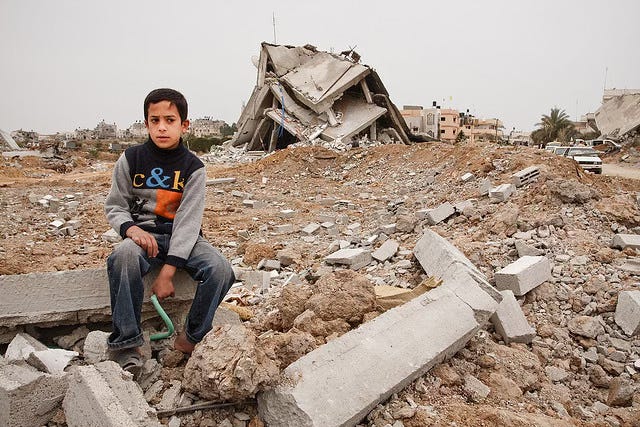
They create a desert and call it “peace”: Gaza turned to rubble
Godzilla in its various incarnations would be hard-pressed to duplicate the scenes of devastation we’re seeing in Gaza. Israel is practicing its own version of the infamous statement from America’s war against Vietnam: “It became necessary to destroy the town to save it.”
The Israeli version: We had to destroy Gaza to save it from Hamas.
It made no sense in Vietnam, and it makes no sense today in Gaza. But this is not about making sense: it’s about power and vengeance and profit.








 Bracing Views