Why the Pentagon Gets So Much Money So Easily

pent
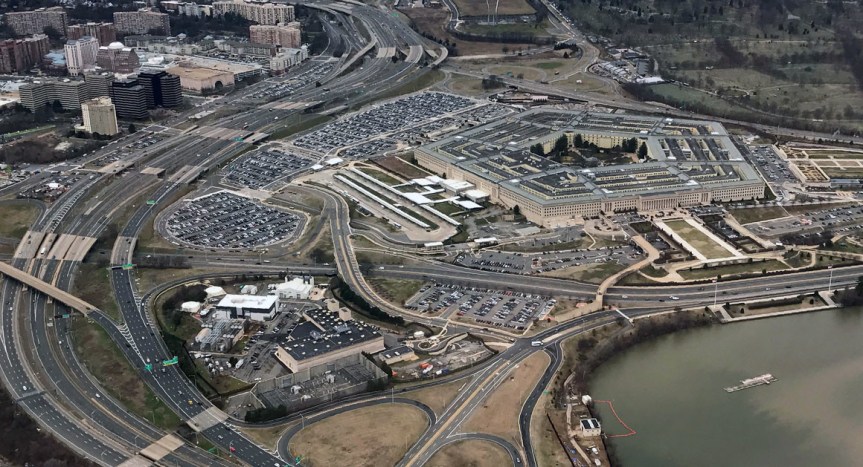
The five-sided puzzle palace on the Potomac is about to be flooded with new money

W.J. Astore

Over at Foreign Policy, there’s a good article on how the Pentagon gets so much money so easily.  Basically, the Pentagon complains about lack of “readiness” for war, and Congress caves.  But as the article’s author, Gordon Adams, notes, most of the boost in spending goes not to training and maintenance and other readiness issues but to expensive new weaponry:

But the big bucks, according to the Pentagon’s own briefing, will go into conventional military equipment. That means more F-35s and F-18s than planned, a new presidential helicopter, Navy surveillance planes and destroyers, Marine helicopters, space launch rockets, tank modifications, another Army multipurpose vehicle, and a joint tactical vehicle the Army, Marines, and Air Force can all use. Basically, the services will soon have shiny new hardware.

With its $160+ billion budgetary boost over the next two years, the U.S. military will soon have many more shiny toys, which pleases Congress (jobs) and of course the military-industrial complex (higher and higher profits).

All of this is par for the Pentagon course, yet there are other, cultural and societal, reasons why the Pentagon is winning all the budgetary battles at home.  Here are seven key reasons:

  1. The heroes narrative. Collectively and individually, U.S. troops have been branded as heroes. And who is churlish and ungenerous enough to underfund America’s heroes?
  2. Military weaponry has been rebranded as being all about our “safety” and “security.” With spillover into the Homeland, and even America’s classrooms (think about how guns for teachers are now being equated with safety for America’s children).
  3. Defense contractors increasingly influence (and even own) the media, ensuring “journalists” like Brian Williams will wax poetically about the inspiring beauty of weapons. Rarely do you hear sustained criticism from the mainstream media about wasteful spending at the Pentagon.
  4. At the same time, the mainstream media relies on “retired” senior military officers for analysis and commentary. Some of these men have links to defense contractors, and all of them are loath to criticize the military.  They are, in a word, conflicted.
  5. Throughout U.S. popular culture, military hardware is portrayed as desirable and “cool.” Think of all the superhero movies featuring jet fighters and other military hardware, or all the jets and helicopters flying over sports stadiums across the USA.  For that matter, think of all the video games that focus on war and weaponry.
  6. Related to (5) is a collective fantasy of power based on violence in war. Most Americans are powerless when it comes to politics and decision-making.  Here is where our “beautiful” weapons can serve as potent symbols for a largely impotent people.
  7. Finally, the ever-present climate of fear: fear of terrorists, immigrants, missiles from North Korea, Russian nukes, and so forth, even as the real killers in the USA (opioid abuse, vehicle accidents, shootings, bad or no healthcare, poor diets, climate-change-driven catastrophes, and of course diseases, some of which are preventable) are downplayed.

Defense spending used to be examined closely, with many programs exposed as wasteful.  This was common in the aftermath of the Vietnam War in the 1970s and early 1980s – remember Senator William Proxmire and his Golden Fleece awards?  Now, it seems there’s no such thing as wasteful spending.  It’s a remarkable change of narrative representing an amazing success story for the military-industrial complex.

It will take more than cutting the Pentagon’s budget to effect change.  America needs to change its mindset, an ethos in which weapons, even wars, are equated with safety and security and potency, and even occasionally with entertainment and fun.

In sum, the Pentagon is doing what it’s always done: issuing demands for more and more money.  It’s up to us (and Congress) to say “no.”

A trillion here, a trillion there, and pretty soon you’re talking real money

Imacon Color Scanner
Painting of Everett Dirksen, a thrifty Republican.  Remember those?

W.J. Astore

Though it’s unconfirmed that Congressman Everett M. Dirksen ever uttered perhaps the most famous words attributed to him: “A billion here, a billion there, and pretty soon you’re talking real money,” the sentiment surely needs to be updated for America’s profligate military moment.  Replace “billion” with “trillion” and you have the perfect catchphrase for today’s Pentagon.

Consider the following facts:

  1. The F-35 jet fighter is projected to cost $1.45 trillion over the life of the program.
  2. Modernization of the U.S. nuclear arsenal is projected to cost $1.2 trillion, though some estimates suggest $1.7 trillion as the more likely sum.
  3. America’s Afghan War has already cost $1 trillion.  Add to that another $45+ billion to support war ops for this year, and perhaps the same amount of spending each year for the next decade.
  4. A low-ball estimate for America’s Iraq War is $1 trillion, but when one adds in veterans health care and similar long-term issues, the cost rises into the $2-3 trillion range.
  5.  Each year, spending on the Pentagon, Homeland Security, wars, nuclear weapons, the VA, and interest on the national debt associated with previous military spending approaches $1 trillion.

We’re talking about real money, right?

Yet all this spending is scarcely debated within Congress.  Together with the Trump administration, Congress is a rubber stamp for the Pentagon.  Meanwhile, Congress will fight tooth and nail over a few million dollars to support the arts, humanities, and similar “wasteful” programs.  Planned Parenthood is always under attack, despite the paltry sum they receive (roughly half a billion) to provide vital functions for women’s health.  Even the $200 billion promised by Trump to support infrastructure improvements is a trickle of money compared to the gusher of funds dedicated to the Pentagon and all of its exotic WMD.

People laughed at Bernie Sanders when he proposed health care for all and free education in state colleges.  That socialist fool!  America can’t afford that!  Indeed, much better for people to go into debt as they struggle to pay for health care or college.  That’s private enterprise and “freedom” for you.  Own the debt and you can own the world.

No — Bernie Sanders wasn’t crazy.  America could easily afford universal health care and virtually free education at state colleges and universities.  Our elites simply choose not to consider these proposals, let alone fund them.  But more nukes?  More wars?  More jets and subs and tanks?  Right this way, my boy!

All these trillions for weapons and wars — one thing is certain: “freedom,” as they say, sure isn’t free.

Update (2/27/18): At TomDispatch.com, Bill Hartung goes into greater detail on the Pentagon’s massive budget for 2018 and 2019.  As he notes: “The figures contained in the recent budget deal that kept Congress open, as well as in President Trump’s budget proposal for 2019, are a case in point: $700 billion for the Pentagon and related programs in 2018 and $716 billion the following year. Remarkably, such numbers far exceeded even the Pentagon’s own expansive expectations. According to Donald Trump, admittedly not the most reliable source in all cases, Secretary of Defense Jim Mattis reportedly said, ‘Wow, I can’t believe we got everything we wanted’ — a rare admission from the head of an organization whose only response to virtually any budget proposal is to ask for more.”

The title of Hartung’s article sums it up: The Pentagon Budget as Corporate Welfare for Weapons Makers.

Put succinctly, it’s warfare as welfare — and wealth-care — for the military-industrial complex.

Frederick Douglass on Patriotism and Taking A Knee

taking a knee
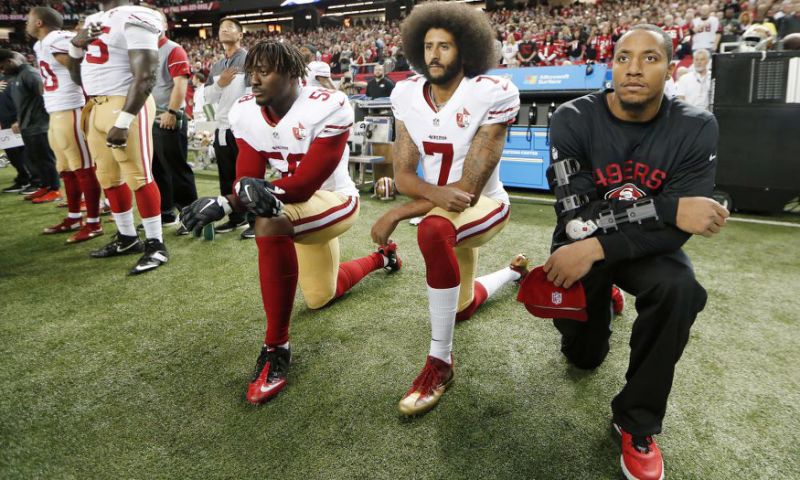
Colin Kaepernick (#7) takes a knee

M. Davout

A week after Super Bowl Sunday, I was reading Frederick Douglass’s “Fourth of July Address,” given by the intrepid abolitionist and eminent public intellectual on July 5, 1852 to several hundred spectators in Rochester, New York. It struck me then how contemporary Douglass’s antebellum insights into the nature of patriotism in America seemed, especially in the wake of an NFL season steeped in controversy over football players (mostly African-American) taking a knee during the national anthem.  Their symbolic protest, dismissed by some, notably including a tweeting president, as unpatriotic, was intended to highlight how police encounters with people of color in this country all too often and disproportionately end in unjustified uses of deadly force.

800px-Frederick_Douglass_by_Samuel_J_Miller,_1847-52
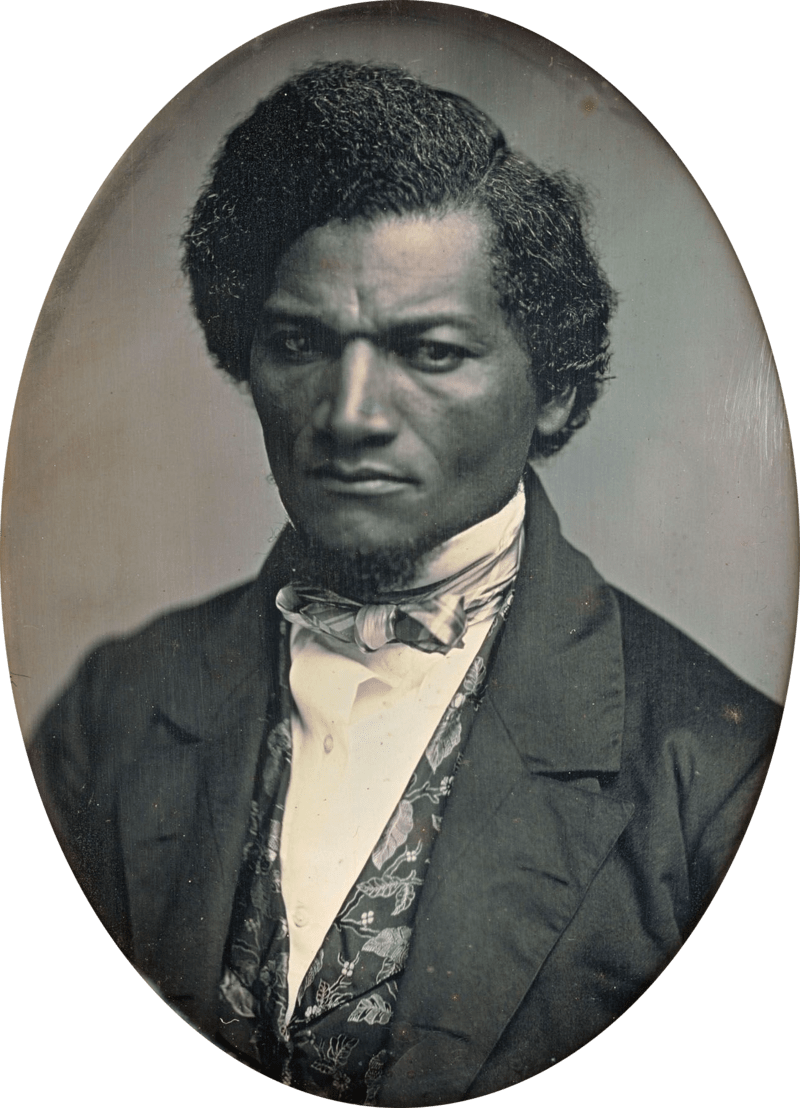
Frederick Douglass near the time of the Rochester Speech, given on the 5th of July 1852

At the time of his Fourth of July Address, Douglass was about fifteen years removed from a state of enslavement he managed, against steep odds, to escape and had become an orator of note in abolitionist circles. Attesting to a sense of trepidation in accepting an invitation to speak before such a large audience on their august day of national celebration, Douglass praised the generation of 1776 (“your fathers,” he calls them) for “lov[ing] their country better than their own private interests” and for their “solid manhood” in “preferr[ing] revolution to peaceful submission to bondage.”

Douglass then reminded his audience that, while it is easy in present times to celebrate the founders for resisting British oppression, “to pronounce against England, and in favor of the cause of the colonies” in the 1770s meant being pilloried and browbeaten as “plotters of mischief, agitators and rebels, dangerous men.”  Moving beyond this critique of the easy and self-congratulatory patriotism of his contemporaries, Douglass raised the prospect that the founders’ great deeds might even be evoked by men of tyrannical intent: “The cause of liberty may be stabbed by the men who glory in the deeds of your fathers.”

Douglass went on to warn his listeners, and free citizens of the American republic generally, against shirking their own responsibility for carrying on the emancipatory tradition celebrated each Fourth of July–“You have no right to wear out and waste the hard-earned fame of your fathers to cover your indolence.”

While there is much more to Douglass’s powerful address, his opening discourse on the patriotic meaning of the Fourth of July provides a way of dousing the “fire and fury” that has been generated by the right-wing media around the symbolic protest started by Colin Kaepernick in 2016 and seeing the significance of that protest with a quiet clarity.

Douglass’s Fourth of July Address warns against the self-serving belief that routinized, programmed patriotic gesture is equivalent to a true love of liberty.  He daringly calls out those who would abuse patriotic gesture in order to control others. His words remind us that the struggle for freedom is always a work in progress and that it is too easy to celebrate its provisional achievement after the hard and risk-laden work is done by others.

Douglass’s speech is part of a tradition of exposing empty patriotic gesture and challenging citizens to live up to the emancipatory demands of true patriotism, a tradition which Colin Kaepernick and his emulators can be seen as stalwartly embracing.  His speech serves as a powerful rejoinder to those who would, like Donald J. Trump, attempt to shame NFL player-protesters into anthem-standing conformity with transparently cynical references to the sacrifices of US veterans and members of the armed forces.

M. Davout (pseudonym) is a professor of political science who teaches in the Deep South.

David Petraeus: A Gold Medal Winner in Spin

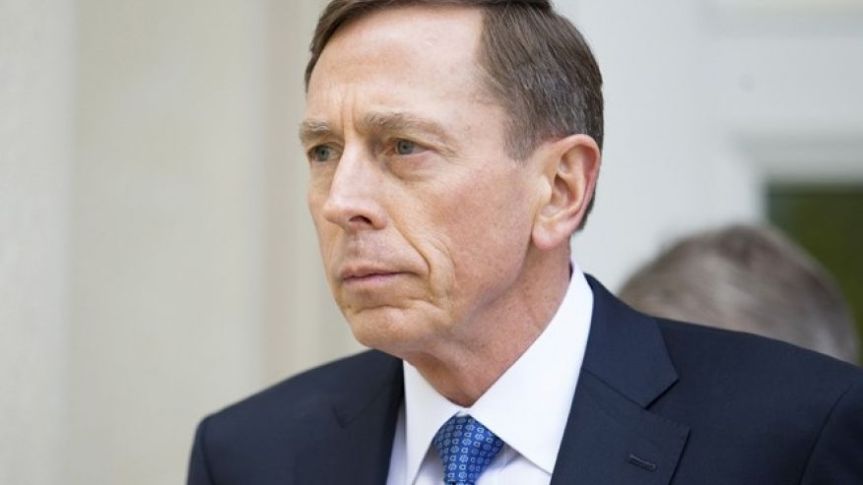
Petraeus mufti

W.J. Astore

I’ve been watching the Winter Olympics on TV, and the color commentators for NBC are typically athletes who’ve earned gold medals in the past, like Tara Lipinski in figure skating or Bode Miller in skiing.  Why is it, then, when NBC and other networks seek expert “color” commentary on America’s wars, they turn to retired generals like David Petraeus, who’ve won nothing?

I’m not dissing Petraeus here.  He himself admitted his “gains” in Iraq as well as Afghanistan were both “fragile and reversible.”  And so they proved.  The U.S. fought in Iraq and Afghanistan and lost thousands of troops and trillions of dollars for gains that truly were ephemeral.  Despite this disastrous and tragic reality, Petraeus remains the sage on the stage, the go-to guy for analysis of our never-ending wars on PBS, Fox News, and elsewhere.

But then I got to thinking.  Sure, Petraeus hasn’t won any wars.  But he’s earned a gold medal in public relations.  In spin.  In 2007 he spun the Surge as a major U.S. victory in Iraq.  (Temporary stability, bought at such a high price, did indeed prove fragile and reversible.)  A later surge in Afghanistan didn’t prove as spinnable, but in a strange way his adulterous affair, a personal failure, came to obscure his military one.  Now he regularly appears as a pundit, the voice of reason and experience, spinning the Afghan war, for example, as winnable as long as Americans continue to give the Pentagon a blank check to wage generational war.

In facilitating the growth of the national security state and ensuring it never takes the blame for its military defeats, Petraeus has indeed excelled in the eyes of those who matter in Washington.  He’s no Tara Lipinski on ice or Bode Miller on snow, but when it comes to spinning wars and gliding over the facts, he takes the gold.

Ike’s Military-Industrial-Congressional Complex Is Alive and Very Well

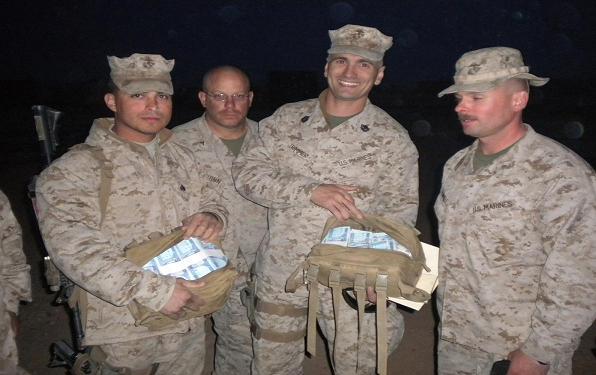
250 000 dollar - 50
Look, Ma: More Money!  Don’t Worry: We’ll Spend It Wisely

W.J. Astore

The new Congressional budget boosts military spending in a big way.  Last night’s PBS News report documented how military spending is projected to increase by $160 billion over two years, but that doesn’t include “overseas contingency funding” for wars, which is another $160 billion over two years.  Meanwhile, spending for the opioid crisis, which is killing roughly 60,000 Americans a year (more Americans than were killed in the Vietnam War), is set at a paltry $6 billion ($25 billion was requested).

One thing is certain: Ike was right about the undue influence of the military-industrial-Congressional complex.

The military talks about needing all these scores of billions to “rebuild.”  And, sure, there are ships that need to be refitted, planes in need of repairs, equipment that needs to be restocked, and veterans who need to be cared for.  But a massive increase in military and war spending, perhaps as high as $320 billion over two years, is a recipe for excessive waste and even more disastrous military adventurism.

Even if you’re a supporter of big military budgets, this massive boost in military spending is bad news.  Why?  It doesn’t force the military to think.  To set priorities.  To define limits.  To be creative.

Perhaps you’ve heard of the expression, “Spending money like drunken sailors on shore leave.”  Our military has been drunk with money since 9/11.  Is it really wise to give those “sailors” an enormous boost in the loose change they’re carrying, trusting them to spend it wisely?

Of Military Parades and Super Bowls

2015-07-14T115355Z_01_SAA67_RTRIDSP_3_FRANCE-BASTILLEDAY
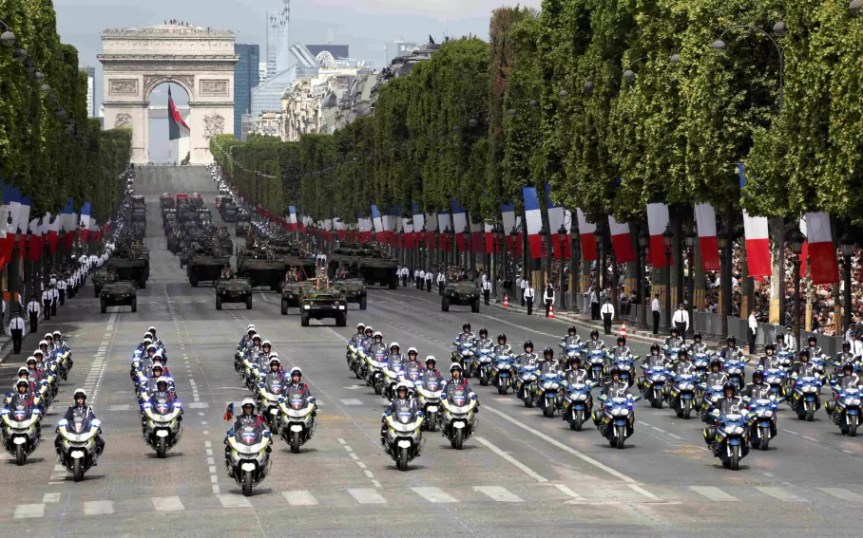
Trump, inspired by the French, wants his own military parade

W.J. Astore

News that President Trump favors a military parade in Washington D.C., perhaps to coincide with Veterans Day in November, has drawn criticism, and rightly so.  The president has a juvenile fascination with parades and other forms of pomp and circumstance, but more than anything I’m guessing he relishes the thought of posing as “The Leader,” reviewing and saluting “his” troops and generals as they pass in review.  If only “Cadet Bone Spurs,” the telling nickname that Tammy Duckworth has pegged him with, could don a military uniform for the occasion — his fantasy would be complete.

The idea of a military parade down Pennsylvania Avenue, complete with tanks and jets (and maybe some big missiles and bombs too?), sounds radical.  But is it really that different from other militarized celebrations that America has been witnessing and applauding since 9/11?

Consider this year’s Super Bowl.  It was played in a domed stadium, yet there was the obligatory military flyover (featuring A-10 attack planes, which the Air Force ironically wants to get rid of).  Fifteen Medal of Honor recipients were celebrated on the field, with one (a Marine) performing the coin toss for the game.  A video link showed U.S. troops watching from overseas.  In past years, troops featured were usually in combat zones like Iraq and Afghanistan.  This year the troops were in South Korea, perhaps because NBC wanted a link to the forthcoming Olympic games, hopefully not because the Trump administration is foreshadowing a “bloody nose” strike against North Korea that would turn that region into a combat zone.

Such patriotic (read: militarized) hoopla has become standard, not just at the Super Bowl and other NFL events, but at many other sporting events.  At last year’s U.S. Open tennis tournament in New York, prior to the men’s final played on 9/10, there was a ceremony to mark the 9/11 attacks, complete with the usual jumbo-sized U.S. flag, with uniformed troops joined by officer cadets from West Point, climaxed by a military flyover.  The ceremony was timed for maximum TV exposure.

As a retired military officer, I can’t tell you how many times I’ve saluted the colors and sung the National Anthem.  I have no objection to military color guards and proud renditions of our anthem.  It’s all the other hoopla — the flyovers, the video links, the gigantic flags, the increasing size of military contingents on playing fields and tennis courts and elsewhere — that I find so exaggerated.  It’s as if I sat down to watch a football game or a tennis match and a military parade broke out instead.

Give President Trump his due: he knows his audience.  His supporters will revel in a military parade in Washington.  So too will Trump.  The rest of us?  Why should we complain: we’ve been watching over-the-top military celebrations for nearly two decades.  A big parade down Pennsylvania Avenue is the logical culmination of all this, especially with Trump in charge.

Like many other aspects of American culture, Trump is just bringing our love of the military into higher relief.  Don’t blame him (or only him) if you don’t like what you see.

Our Enemy, Ourselves

W.J. Astore

In my latest article for TomDispatch.com, I suggest how America can pursue a wiser, more peaceful, course.  This is exactly what our leaders are not doing (and haven’t been doing for decades), as I document in the first half of my article, which I’m sharing here.  Bottom line: perpetual war doesn’t produce perpetual peace.  Nor does it make us safer.

Whether the rationale is the need to wage a war on terror involving 76 countries or renewed preparations for a struggle against peer competitors Russia and China (as Defense Secretary James Mattis suggested recently while introducing America’s new National Defense Strategy), the U.S. military is engaged globally.  A network of 800 military bases spread across 172 countries helps enable its wars and interventions.  By the count of the Pentagon, at the end of the last fiscal year about 291,000 personnel (including reserves and Department of Defense civilians) were deployed in 183 countries worldwide, which is the functional definition of a military uncontained.  Lady Liberty may temporarily close when the U.S. government grinds to a halt, but the country’s foreign military commitments, especially its wars, just keep humming along.

As a student of history, I was warned to avoid the notion of inevitability.  Still, given such data points and others like them, is there anything more predictable in this country’s future than incessant warfare without a true victory in sight?  Indeed, the last clear-cut American victory, the last true “mission accomplished” moment in a war of any significance, came in 1945 with the end of World War II.

Yet the lack of clear victories since then seems to faze no one in Washington.  In this century, presidents have regularly boasted that the U.S. military is the finest fighting force in human history, while no less regularly demanding that the most powerful military in today’s world be “rebuilt” and funded at ever more staggering levels.  Indeed, while on the campaign trail, Donald Trump promised he’d invest so much in the military that it would become “so big and so strong and so great, and it will be so powerful that I don’t think we’re ever going to have to use it.”

As soon as he took office, however, he promptly appointed a set of generals to key positions in his government, stored the mothballs, and went back to war.  Here, then, is a brief rundown of the first year of his presidency in war terms.

In 2017, Afghanistan saw a mini-surge of roughly 4,000 additional U.S. troops (with more to come), a major spike in air strikes, and an onslaught of munitions of all sorts, including MOAB (the mother of all bombs), the never-before-used largest non-nuclear bomb in the U.S. arsenal, as well as precision weapons fired by B-52s against suspected Taliban drug laboratories.  By the Air Force’s own count, 4,361 weapons were “released” in Afghanistan in 2017 compared to 1,337 in 2016.  Despite this commitment of warriors and weapons, the Afghan war remains — according to American commanders putting the best possible light on the situation — “stalemated,” with that country’s capital Kabul currently under siege.

How about Operation Inherent Resolve against the Islamic State?  U.S.-led coalition forces have launched more than 10,000 airstrikes in Iraq and Syria since Donald Trump became president, unleashing 39,577 weapons in 2017. (The figure for 2016 was 30,743.)  The “caliphate” is now gone and ISIS deflated but not defeated, since you can’t extinguish an ideology solely with bombs.  Meanwhile, along the Syrian-Turkish border a new conflict seems to be heating up between American-backed Kurdish forces and NATO ally Turkey.

Yet another strife-riven country, Yemen, witnessed a sixfold increase in U.S. airstrikes against al-Qaeda on the Arabian Peninsula (from 21 in 2016 to more than 131 in 2017).  In Somalia, which has also seen a rise in such strikes against al-Shabaab militants, U.S. forces on the ground have reached numbers not seen since the Black Hawk Down incident of 1993.  In each of these countries, there are yet more ruins, yet more civilian casualties, and yet more displaced people.

Finally, we come to North Korea.  Though no real shots have yet been fired, rhetorical shots by two less-than-stable leaders, “Little Rocket Man” Kim Jong-un and “dotard” Donald Trump, raise the possibility of a regional bloodbath.  Trump, seemingly favoring military solutions to North Korea’s nuclear program even as his administration touts a new generation of more usable nuclear warheads, has been remarkably successful in moving the world’s doomsday clock ever closer to midnight.

Clearly, his “great” and “powerful” military has hardly been standing idly on the sidelines looking “big” and “strong.”  More than ever, in fact, it seems to be lashing out across the Greater Middle East and Africa.  Seventeen years after the 9/11 attacks began the Global War on Terror, all of this represents an eerily familiar attempt by the U.S. military to kill its way to victory, whether against the Taliban, ISIS, or other terrorist organizations.

This kinetic reality should surprise no one.  Once you invest so much in your military — not just financially but also culturally (by continually celebrating it in a fashion which has come to seem like a quasi-faith) — it’s natural to want to put it to use.  This has been true of all recent administrations, Democratic and Republican alike, as reflected in the infamous question Madeleine Albright posed to Chairman of the Joint Chiefs Colin Powell in 1992: “What’s the point of having this superb military you’re always talking about if we can’t use it?”

With the very word “peace” rarely in Washington’s political vocabulary, America’s never-ending version of war seems as inevitable as anything is likely to be in history.  Significant contingents of U.S. troops and contractors remain an enduring presence in Iraq and there are now 2,000 U.S. Special Operations forces and other personnel in Syria for the long haul.  They are ostensibly engaged in training and stability operations.  In Washington, however, the urge for regime change in both Syria and Iran remains strong — in the case of Iran implacably so.  If past is prologue, then considering previous regime-change operations in Afghanistan, Iraq, and Libya, the future looks grim indeed.

Despite the dismal record of the last decade and a half, our civilian leaders continue to insist that this country must have a military not only second to none but globally dominant.  And few here wonder what such a quest for total dominance, the desire for absolute power, could do to this country.  Two centuries ago, however, writing to Thomas Jefferson, John Adams couldn’t have been clearer on the subject.  Power, he said, “must never be trusted without a check.”

The question today for the American people: How is the dominant military power of which U.S. leaders so casually boast to be checked? How is the country’s almost total reliance on the military in foreign affairs to be reined in? How can the plans of the profiteers and arms makers to keep the good times rolling be brought under control?

As a start, consider one of Donald Trump’s favorite generals, Douglas MacArthur, speaking to the Sperry Rand Corporation in 1957:

“Our swollen budgets constantly have been misrepresented to the public. Our government has kept us in a perpetual state of fear — kept us in a continuous stampede of patriotic fervor — with the cry of grave national emergency. Always there has been some terrible evil at home or some monstrous foreign power that was going to gobble us up if we did not blindly rally behind it by furnishing the exorbitant funds demanded. Yet, in retrospect, these disasters seem never to have happened, seem never to have been quite real.”

No peacenik MacArthur.  Other famed generals like Smedley Butler and Dwight D. Eisenhower spoke out with far more vigor against the corruptions of war and the perils to a democracy of an ever more powerful military, though such sentiments are seldom heard in this country today.  Instead, America’s leaders insist that other people judge us by our words, our stated good intentions, not our murderous deeds and their results.

For ten suggestions (plus a bonus) on how the U.S. can pursue a wiser, and far less bellicose, course, please read the rest of my article here at TomDispatch.com. 

Get the Widow on the Set: Trump’s State of the Union Address

180130-sotu-dem-women-reaction-njs-1004p_719e1eb8c128b0e7b47baa9a0d2b28ca.nbcnews-ux-2880-1000
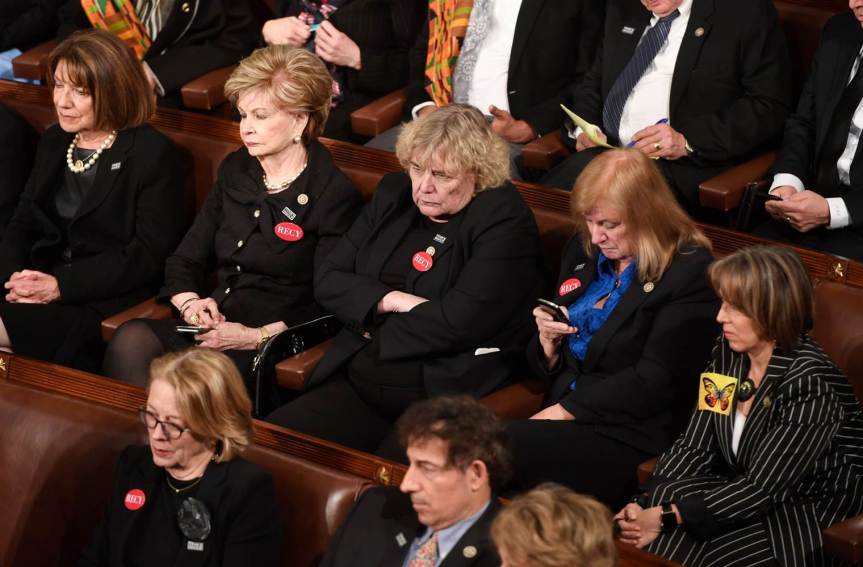
I felt like this, only worse

W.J. Astore

Last night’s State of the Union address was disturbing on many levels.  Republicans applauded when President Trump touted the elimination of the individual mandate for purchasing health care insurance — so it’s a good thing people have no health insurance?  Wait until they go to the emergency room for an appendectomy and leave with a bill for $20,000.  Republicans applauded as well when Trump touted the American prison at Guantanamo Bay in Cuba.  So it’s a good thing our President is vowing to send more “terrorists” to an offshore U.S. military prison?

I could go on and on, but what was most disturbing to me was the use of people in the audience as props for Trump’s positions.  A brave soldier who won the Bronze Star for valor was celebrated to support America’s wars overseas.  Parents whose daughters were killed by illegal immigrants were used to support Trump’s policies on immigration.  A family whose son suffered grievous, ultimately deadly, wounds in North Korea was used to support Trump’s bellicose policies toward Kim Jong-un and his regime, as was a courageous North Korean defector.

It reminded me of the Don Henley song, “Dirty Laundry” and its lines: Can we film the operation?/Is the head dead yet?/You know the boys in the newsroom got a running bet/get the widow on the set/we need dirty laundry. 

The shameless exploitation of other people’s grief is something I can’t stand.  It’s sordid and cynical and dirty.  There are many other things I could say about Trump’s State of the Union address, but my overall feeling was one of exploitation.  After his speech, I felt dirty.

The Kennedy Administration: Camelot or Incompetence?

jackie-and-john-jackie-kennedy-3856502-816-800
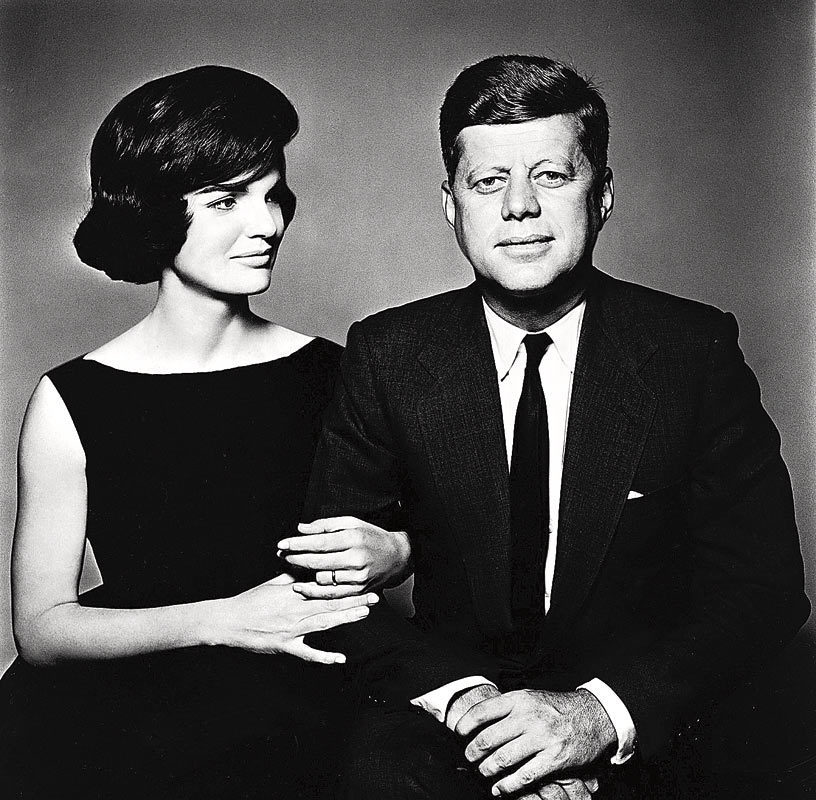
They seemed perfect …

The Kennedy Administration: Camelot or Incompetence?

W.J. Astore

President John F. Kennedy is surrounded by myths, the most famous of which is Camelot. The Kennedys brought youth and glamour to the White House, a reprieve from the perceived stodginess of Ike and Mamie Eisenhower (as well as the “square” and indeed criminal Nixon White House to come).  They seemed the perfect couple, John and Jackie, and it seems churlish and graceless to note how much of this was image.  Kennedy was a notorious womanizer, a fact both known and suppressed by a fawning Washington Press Corps.  Jackie came across as a traditional wife: loyal, unobjectionable, limited by her times but also steely in her grace and fortitude after her husband was assassinated in Dallas in November 1963 (the latest movie that captures this awful event is Jackie, starring Natalie Portman).

Kennedy’s father, Joe Sr., taught his sons a sense of winning at all costs. A sense of recklessness. Kennedy’s older brother, Joe Jr. died leading a risky bombing mission in World War II, and John F. Kennedy nearly died when he lost his PT boat in action in the Pacific.  The loss of PT-109 was depicted as a heroic act, as the young JFK helped to save some of his crew, but one may question how he came to lose his boat in the first place. JFK’s perfect marriage, as already mentioned, was a sham, and despite his relative youth, he was not in the best of health, plagued by a bad back, Addison’s disease, and other health issues. His Pulitzer-prize winning book, “Profiles in Courage,” was largely ghost written.  JFK’s life was often more a triumph of image than a profile in courage.

As President, Kennedy made many unwise decisions.  He escalated American involvement in Laos and Vietnam, setting the stage for a major commitment of U.S. ground troops by President Lyndon Johnson early in 1965.  He oversaw the disastrous Bay of Pigs invasion of Cuba, which backfired badly on the inexperienced U.S. commander-in-chief.  As Lawrence Freedman put it in his book, Kennedy’s Wars (2000), “This was exactly the sort of move—gambling on the basis of insufficient strength and then abandoning the operation before it was complete—that made [Dean] Acheson despair.”  Freedman further cites Acheson as saying European leaders compared JFK’s bungling to “a gifted amateur practicing with a boomerang and suddenly knocking himself cold.  They were amazed that so inexperienced a person should play with so lethal a weapon.”

Greater lethality was to come the next year with the Cuban Missile Crisis.  This is often sold as JFK’s moment of steely toughness, when he made the Soviets blink and back down, but as a recent book by Daniel Ellsberg reveals, that crisis nearly resulted in nuclear war between the U.S. and the Soviet Union.  It was yet another instance of JFK’s tendency toward taking big risks as a way of proving himself.  Almost precipitating nuclear Armageddon, however, is terrifying way to prove one’s fitness for office.

Even before JFK became president, he fabricated what today might be called “alternative facts.”  He invented a missile gap vis-à-vis the Soviet Union that didn’t exist.  In fact, the true missile gap was the opposite of what JFK claimed, in that the U.S. had many more nuclear ICBMs than the Soviets did.  When he became president, JFK embarked on a strategic policy of “Flexible Response” (suggested by General Maxwell Taylor) that activated and empowered more conventional operations by the U.S. military.  In practice what this meant was that the U.S. became embroiled in conflicts that were secondary to national interests; worst of all, of course, was a major land war in Vietnam that was essentially a lost cause even before Kennedy chose to escalate it with more advisers and materiel aid.

Defenders of JFK suggest he grew in office and would have seen the folly of continuing in Vietnam, but there’s little evidence to support this narrative.  The recent Ken Burns series on the Vietnam War cites Kennedy as saying the U.S. couldn’t win in Vietnam, but that he couldn’t order a withdrawal because to do so would cost him his reelection in 1964.  JFK, moreover, fancied the notion of Flexible Response, his New Look military and its emphasis on special ops forces such as the Green Berets, and he saw Vietnam as a test bed for a “counterinsurgency” approach to defeating communism. What LBJ did in 1965 in escalating that conflict by committing U.S. ground troops is probably what JFK would have done if he had lived.  (In his book, Choosing War: The Lost Chance for Peace and the Escalation of War in Vietnam, Fredrik Logevall suggests JFK may have had the political will to resist escalation in 1965, effectively allowing South Vietnam to fall to communism, an intriguing if unprovable scenario.)

In sum, JFK set the stage for America’s disastrous war in Southeast Asia while provoking the Soviet Union into an escalatory nuclear arms race that threatened the world with extinction.  Profiles in courage these are not.

It’s worth briefly comparing JFK’s record to that of Richard Nixon, who has no Camelot myths attached to him.  Nixon, of course, was and is vilified as “Tricky Dick” and dismissed as one of America’s worst presidents.  He deserves opprobrium for his mendacious, meretricious, and murderous policies vis-à-vis Southeast Asia, especially his well-nigh treasonous meddling in peace negotiations in 1968, before he was elected president.  Nixon and Henry Kissinger saw themselves as the world’s powerbrokers, working to overthrow governments they disliked, as in Chile with the coup against Allende.  But Nixon and Kissinger deserve a measure of credit for opening negotiations with communist China as well as starting a process of détente with the Soviet Union.  Nixon showed a capacity for growth in office even as he permitted his own ego and paranoia to undermine his administration’s accomplishments in foreign policy.

The point here is not to praise Nixon, a man of considerable gifts but also of crippling flaws.  Rather, the point is to highlight an overly fawning approach to the presidency of John F. Kennedy.  His administration, rather than serving as a shining moment, a Camelot, ultimately was an exercise in imagery and incompetence.

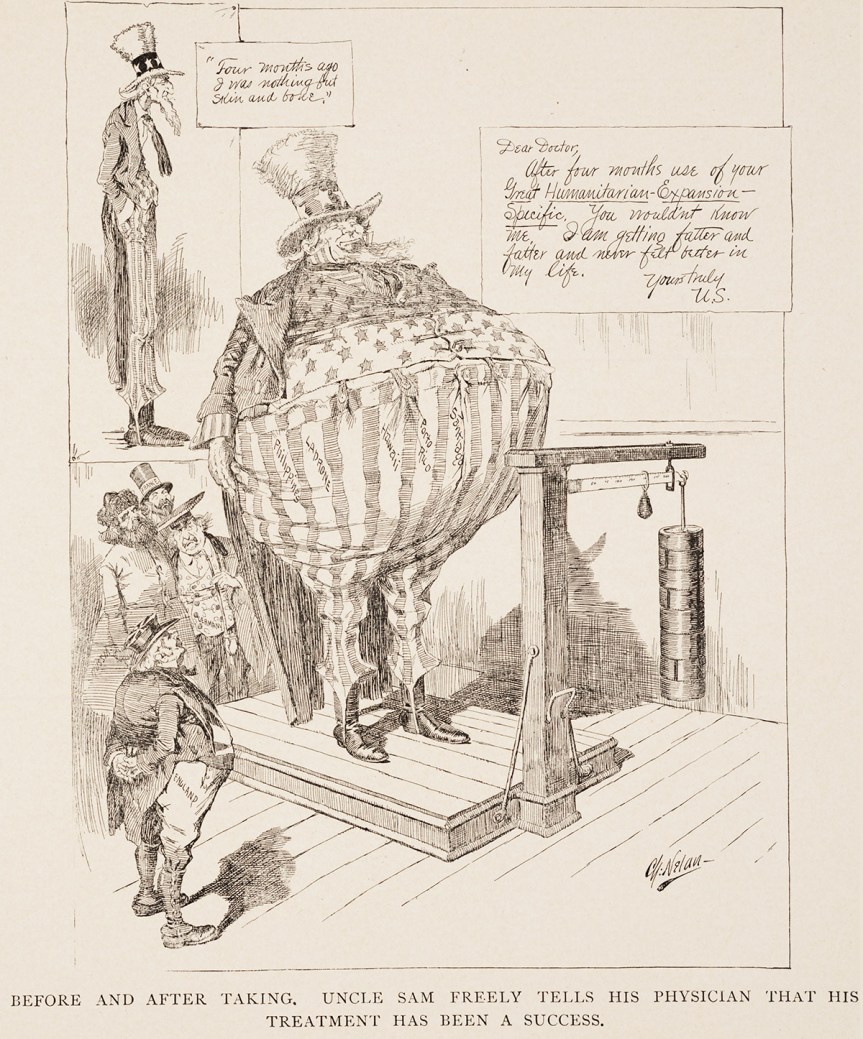
The Fall of the American Empire

sawtreatment
Uncle Sam: No stranger to imperialism (from the Spanish-American War of 1898)

W.J. Astore

Why do empires fall?  Sometimes, it’s easy to identify a cause.  Whether led by the Kaiser or by Hitler, Germany’s Second and Third Empires were destroyed by world wars.  Germany’s ambition was simply too great, its militarism too dominant, its policies too harsh to win long-term converts, its leaders too blinded by the pursuit of power, its enemies too many to conquer or otherwise neutralize.

Other imperial falls are more complex.  What caused Rome’s fall?  (Leaving aside the eastern part of the empire, which persisted far longer as the Byzantine Empire.)  Barbarians and their invasions, say some.  The enervating message and spirit of Christianity, said the historian Edward Gibbon.  Rome’s own corruption and tyranny, say others.  Even lead in Roman water pipes has been suggested as a contributing cause to Rome’s decline and fall.  Taking a longer view, some point to the rise of Islam in the 7th century and its rapid expansion into previously Roman territories as the event that administered the final coup de grâce to a dying empire.

America’s empire, it is clear, is now in decline, and a key reason is imperial overstretch as manifested by endless wars and overspending on the military (with literally trillions of dollars being thrown away on fruitless wars).  An especially fine summary is Alfred McCoy’s article this week at TomDispatch.com.  As McCoy notes:

In effect, the president and his team, distracted by visions of shimmering ships and shiny planes (with their predictable staggering future cost overruns), are ready to ditch the basics of global dominion: the relentless scientific research that has long been the cutting edge of U.S. military supremacy.  And by expanding the Pentagon while slashing the State Department, Trump is also destabilizing that delicate duality of U.S. power by skewing foreign policy ever more toward costly military solutions (that have proved anything but actual solutions) …

In just one extraordinary year, Trump has destabilized the delicate duality that has long been the foundation for U.S. foreign policy: favoring war over diplomacy, the Pentagon over the State Department, and narrow national interest over international leadership. But in a globalizing world interconnected by trade, the Internet, and the rapid proliferation of nuclear-armed missiles, walls won’t work. There can be no Fortress America.

In this passage, McCoy stresses the damage being done by the Trump administration.  But Trump is just the culmination of certain trends, e.g. favoring the Pentagon over the State Department is nothing new, as I wrote about here in 2010.  And America has been in love with shimmering ships and shiny planes for generations, with several administrations supporting the F-35 jet fighter, a program that may end up costing as much as $1.4 trillion.  Plenty of money for weapons that kill; not so much for medicines that cure: that’s imperial America in a nutshell.

I would stress that America’s strength overseas was (and is) always based on its strength at home in areas such as science, education, infrastructure, medicine, manufacturing, and exports.  But what we’ve witnessed over the last 40 years is an immense and wasteful “investment” in wars and weapons even as our country itself has hollowed out. Science is now marked by the denial of facts (such as global warming). Education is all about students as consumers, with an overall decline in standards and performance. Infrastructure is crumbling. Medicine is too expensive and America’s overall health and life expectancy are both in decline. Manufacturing and exports have withered (except for the production and export of weapons, naturally).

As a result of all this, America is running a national debt of roughly 20 trillion dollars.  The future is being sacrificed for the present, a tragic reality reflected in the latest Republican tax cut, which benefits the richest Americans the most, along with big corporations, and which will likely add another trillion to the national debt.

In short, America’s foreign decline is mirrored (and driven) by its domestic decline as reflected by its choices.  Looking at the USA today, you get the sense it’s the best of times for the richest few, and the worst of times for so many Americans struggling with health care debt, student loan debt, and the uncertainty of low-wage jobs that could be outsourced at any moment.  At the same time, the American political scene is driven by fear: of immigrants, of a nuclear war with North Korea, of Russian meddling (real or imagined), of growing Chinese power, and of the perpetually-hyped threat of terrorist attacks on “the Homeland.”

Empires can fall very quickly, as the “thousand-year” Third Reich did, or they can fall ever so slowly, as the Roman Empire did.  But fall they do.  What is in the cards for the United States?  Readers, fire away in the comments section.

Update (1/20/18):  Secretary of Defense James Mattis now claims that China and Russia represent bigger threats than terrorism, along with Congress itself since it can’t pass an extended budget for the Pentagon.  He also claimed the U.S. military’s “competitive edge” is eroding in “every domain of warfare,” despite a defense budget of $700 billion.

None of this is a surprise.  Indeed, this is exactly what happens when you put a retired general and known war hawk in charge of the defense department.  Generals will always want more: more troops, more money, more resources, more authority.  And to support their demands, they will always find more enemies as well.