At the Guardian today, I saw the following headline: US Navy: for first time in history four women of color command war ships; Kimberly Jones, LaDonna Simpson, Kristel O’Cañas and Kathryn Wijnaldum break new ground in white and male-dominated field.
Are we supposed to love the military because more women of color are reaching positions of command?
Don’t get me wrong: this is a good thing. My boss at my last job in the Air Force was a Black female colonel. Serving in the U.S. military, I saw and befriended plenty of “diverse” people during my career. (In today’s military-media context, I guess “diverse” means anything but your standard white male.) Few people seemed to care about gender, race, sex, color, ethnicity, and so on as long as the person was competent. Good bosses come in all shapes, shades, and sizes — and so do bad ones.
So, I don’t want to join Tucker Carlson in a misinformed and ridiculous rant against an alleged feminization of the U.S. military. For a military and a country that is supposedly too feminine or too soft or whatever, we still spend more on war than the next ten countries combined (and most of those countries are America’s allies); we continue to have a global network of 800 or so military bases; we still dominate the world’s trade in deadly weaponry; we still throw our weight around like bullies and fancy ourselves the world’s lone superpower. Are any of these facts changed or softened because more women or more people of color are reaching high rank within that military?
That the Secretary of Defense is a Black male doesn’t seem to have affected policy decisions in any meaningful way. Why should it, when he spent his life in the U.S. military and then joined Raytheon and profited greatly after retiring?
Again, it’s a good thing that people of color aren’t as hamstrung as they used to be in reaching positions of command in the U.S. military. But does it change anything if the Hellfire missiles that kill civilians in Afghanistan are launched from a Reaper drone by a Black female pilot rather than a white guy?
I remember during this year’s Super Bowl festivities that the lead B-2 bomber pilot was a woman. Good for her! But if she pilots a B-2 into a nuclear war, will anyone be pleased that a city gets nuked by a woman rather than a man?
The only “diversity” the Pentagon seemingly rejects is anyone who wants to pursue a new, more peaceful, course, in which the military is not the primary tool of U.S. foreign policy. How about some “diverse” people who will put an end to the war in Afghanistan? Who will argue for less spending on wars and weapons?
Women can be warriors too. We get it. The Greeks had Athena. The Romans had Bellona. This is not new. As others have said, it’s not enough to put Black faces in high places. Or for women to shatter glass ceilings. Not if the policies and power arrangements stay the same.
At his first presidential press conference yesterday, Joe Biden had this to say on China: “They have an overall goal to become the leading country in the world, the wealthiest country in the world and the most powerful country in the world. That’s not going to happen on my watch.”
Sorry, Joe, it’s happening and it’s partly your fault.
Here’s a symbol for you. I have an American flag t-shirt. It’s made by a company called “True Grit” (John Wayne!) and the label says “Authentic California.” But was the shirt made in California? Ha ha! It was “Made in China.”
My t-shirt label says it all
Why is China ascending while the USA descends? Here are five reasons:
America’s wasteful war on terror has cost somewhere in the neighborhood of $6 trillion with nothing to show for it.
Politicians like Obama/Biden prefer to bailout Wall Street and the banks rather than ordinary Americans. For example, the bailout of Wall Street in 2008 was a trillion-dollar mess, Matt Taibbi notes.
The Covid Bailout passed by the Trump administration in 2020 (the CARES Act) funneled $2.3 trillion mainly to the banks and corporate America, with a surge option of $4 trillion for big business, notes Matt Taibbi.
Bad trade deals like NAFTA, advanced by Democrats like Bill Clinton and Joe Biden, ensured that American jobs would go overseas to countries like China having much lower labor costs.
Tax cuts for the richest Americans under the Trump administration starve the government of funds, ensuring little investment in the homeland even as the rich get richer.
Now, imagine if this money had been invested in America. We’re talking $10-12 trillion for infrastructure, essentials like roads, bridges, dams, high-speed rail, renewable energy, better schools, and so on. Imagine how much more advanced and healthy America could be if our priorities changed.
Our government has been captured by the special interests, specifically corporations, banks, and the military-industrial complex. It’s socialism for the rich and dog-eat-dog capitalism for the poor. The plutocrats, kleptocrats, and militarists are cashing in even as America hollows out.
What we need is a true Marshall Plan — for America. A reinvestment in ourselves. What this means is an end to forever wars, major cuts in military spending, higher taxes on the plutocrats and corporations, and a focus on putting Americans back to work and with a living wage. A green new deal could and should be one aspect of this.
We need to show some “true grit” again, America; not grit that’s “Made in China.”
What is your best guess at when the following passage was written?
Under a leadership of charlatans and bullies this great Republic clumped about among the nations like a lout, feared by most, respected by none. Nor were things much better at home where a thinly disguised racism was in the saddle, the people’s worst instincts were appealed to, and the noble sentiments of patriotism were reduced to the cliche of the bigot’s bumper sticker.
A sensible guess would be roughly 2018, focusing on the Trump administration. But it was published in 1973 by Richard Dougherty in “Goodbye, Mr. Christian: A Personal Account of McGovern’s Rise and Fall.” Dougherty, of course, was writing about the Nixon administration and its infamous Southern strategy.
Well, as my wife immediately noticed, things are worse today, since many Republicans have abandoned any pretense to thin disguises when it comes to racism. Two stories caught my eye this weekend. The first was Stacey Abrams’ angry and accurate denunciation of Republican voter suppression efforts as “Jim Crow in a suit.” As a friend put it, “the vote suppressors in Georgia are at work even now trying to block their [Black churches] ‘souls to the polls’ tradition.” The second was Wisconsin Senator Ron Johnson’s statement that he wasn’t afraid of largely white pro-Trump rioters in the U.S. Capitol in January since they “love this country,” but he would, he confessed, had feared them if they had been BLM (Black Lives Matter) protesters. Johnson bizarrely added that the pro-Trump protesters “truly respect law enforcement” and “would never do anything to break a law.” Assuming Johnson isn’t completely mad, he’s obviously pandering to the Trumpian base as he’s up for reelection in 2022. Or perhaps he’s a mad panderer.
Senator Ron Johnson (NBC News)
Again, America is allegedly a democracy. We should be doing everything we can to increase the number of people who vote. We shouldn’t be passing laws to make it more difficult for people to vote, specifically minority voters. Such laws are not only sordid and cowardly, they’re un-American.
About Senator Johnson: Strangely, I find his brazen bigotry to be useful. Useful in reminding us that America has far to go before we put racism behind us. Politicians used to use dog whistles, so to speak, to make racist appeals to like-minded haters. Now they simply say the quiet part out loud, not caring who hears it, because they figure they can get away with it. They think it’s a winning tactic. We have to prove them wrong. Racism, whether blatantly obvious or thinly disguised, must be rejected by all Americans.
To return to the quotation from Dougherty: How many nations around the world respect America for its ideals and actions, and how many pretend to respect us because they fear our bullying and loutish actions? Honest answers to this question should disturb us. Division at home and fear abroad is a recipe for neither domestic tranquility nor international comity.
We often hear the USA is the richest, most powerful, most advanced, nation in the world. We also hear much talk about freedom and democracy in America, and how exceptional our country is. Given all these riches, all this power, and all this freedom, shouldn’t we have high expectations about what our government is able to accomplish for us?
Yet I’ve run across the opposite of this. I’ve come to think of it as the tyranny of low expectations. I see it most often when I criticize Joe Biden and the Democrats. I’m told that I expect too much, that Joe is doing his best but that his power is limited as president, and that I should wait patiently for party insiders to move the Biden administration ever so slightly toward the left. And if I keep criticizing Joe and Company, I’m dismissed as an unreasonable leftist who’s helping Trump and his followers, so the effect of my criticism is bizarrely equated to far-right Trumpism.
Here are a few items that I believe the richest, most powerful, most advanced nation in the world should do for its citizens in the cause of greater freedom and democracy:
A living wage of at least $15 an hour for workers.
Affordable single-payer health care for all.
A firm commitment to ending child poverty.
A firm commitment to affordable housing for all.
A firm commitment to affordable education and major reductions in student debt.
A Covid aid package dedicated to helping workers and small businesses.
A government that is transparent to the people and accountable to them rather than one cloaked in secrecy and open for business only to the rich.
These items seem reasonable to me. They don’t seem “left” or “right.” They’re not too much to expect from the richest, most powerful, nation, the one that boasts of its exceptional freedom and its strong commitment to democracy.
The money is there. A trillion dollars a year is spent in the name of national defense. Trillions have been spent to bailout Wall Street and to wage wasteful wars overseas. Why is the money always there for Wall Street and wars and weapons but it’s rarely if ever there for workers and students and children?
Why do we persist in setting our expectations so low for “our” government, whether the POTUS of the moment is Trump or Biden or someone allegedly more competent and focused on “ordinary folk,” like Obama?
Warning to ideological warriors: This is not about Trump, or Biden, or your particular party allegiance. This is about creating a government that actually listens and responds to the needs of everyone, but especially to the weakest among us, those needing the most help in their pursuit of happiness.
Too simplistic? Too idealistic? I don’t think so. Not once we overthrow the tyranny of low expectations.
Somewhere I’ve read about a government of the people, by the people, for the people. We had better find it or reinvigorate it before it perishes from the earth.
There’s a bill before the Rhode Island State Legislature (House Bill 6026) that aims to divest state pension funds from military contractors. I wrote a short letter in favor of this bill and submitted it, as follows:
I served in the U.S. Air Force for 20 years, retiring as a lieutenant colonel in 2005. There are many of us within the military who recognize the wisdom of General Smedley Butler, twice awarded the Medal of Honor. Butler wrote that the best way to end war is to take the profit out of it. Butler wrote in the 1930s, when our country believed that weapons makers were “merchants of death.” They were called that because of the vast killing fields of World War I, a war that killed more than 100,000 Americans, together with millions of other troops from Britain, France, Germany, and elsewhere.
Joining Smedley Butler was another great American, General (later President) Dwight D. Eisenhower. In his famous “Cross of Iron” speech in 1953, Ike wrote that unnecessary spending on weaponry would lead to humanity being crucified on a cross of iron. Here are his words:
Every gun that is made, every warship launched, every rocket fired signifies, in the final sense, a theft from those who hunger and are not fed, those who are cold and are not clothed. This world in arms is not spending money alone. It is spending the sweat of its laborers, the genius of its scientists, the hopes of its children… This is not a way of life at all, in any true sense. Under the cloud of threatening war, it is humanity hanging from a cross of iron.
In 1961, President Eisenhower warned all Americans against the dangers of the military-industrial complex. Sixty years later, in 2021, America dominates the world in selling weapons across the globe. We have become the “merchants of death” that Generals Butler and Eisenhower warned us about.
Weapons kill. Weapons make wars more likely. And as Eisenhower said in 1946, “I hate war as only a soldier who has lived it can, only as one who has seen its brutality, its futility, its stupidity.”
It’s time for us to hate war again. It’s time for us to beat our swords into ploughshares, as the Bible tells us. It’s time for us to pursue more peaceful activities.
Rhode Island can set a strong example – a shining example – in the pursuit of peace and sanity. I urge you to vote “for” House Bill 6026.
Let us beat our swords into ploughshares …
*****
The “Divestment Fact Sheet” for the bill explains its purpose, as follows:
Allows us to redirect our investment dollars toward socially productive corporations addressing important social assets like climate resilience, health, and education, which aid economic growth;
Seeks to move money away from corporations whose output foments violence, death, destruction, and social chaos.
Educates the general public about the role of weapons manufacturers in the cycle of tax breaks, lobbying largesse, increasing military budgets and weapon sales.
Reduces the flow of scarce economic resources to military weapons manufacturers by reducing public investment;
Sends a message to the US Congress that we need to sharply reduce investment in military weapons where the costs are increasingly public (ever increasing health bills for traumatized and injured vets of the endless wars, reconstruction bills in foreign lands, ever increasing maintenance bills and graft on weapons systems) and the benefits are private (lobbying firm profits, huge weapons manufacturer bonuses and excessive CEO pay packages).
In America, money talks. As Smedley Butler said, ending the madness of war will most likely come when we can take the profit out of it. Here’s hoping Rhode Island’s effort succeeds — and sets an example for others across our nation.
“Nothing would fundamentally change” when he’s elected. Promise kept.
Joe Biden is keeping one campaign promise: that nothing would fundamentally change in his administration. So, for example, Americans are not getting single-payer (and much more affordable) health care for all. (Biden, one must admit, promised nothing more than Obamacare with perhaps more funding for those struggling to afford it.) American workers are not getting a $15 minimum wage, despite Biden’s (broken) promise of supporting the same. And Biden is not cutting defense spending — at all. Instead, the Pentagon budget is to be “flatlined” at the near-record high levels reached under the Trump administration. So much for forcing the military to cut wonky wasteful weapons. It’s business as usual at the Pentagon, with an emphasis on business and profit at the expense of the American taxpayer.
What is to be done? Many Democrats argue that Joe Biden has to be the sensible centrist, constrained as he allegedly is by conservative Democrats like Joe Manchin. But of course Joe Biden himself is a conservative pro-business president who sees Manchin as a sympathetic senator and supporter. Meanwhile, Republicans, still in thrall to Trump, refuse to play along with bipartisan malarkey, except when it comes to maintaining massive military budgets. Again, under these conditions, nothing will fundamentally change.
The American people want affordable health care and support a single-payer system run by the federal government. They also support a $15 minimum wage for full-time workers. They’re getting neither. And this is by design. Not to rehash the 2020 Democratic primaries, but Joe Biden didn’t win by appealing to voters; he won because party heavyweights like Obama threw their support to him. Biden didn’t win the nomination; it was handed to him. Because the owners and donors know Joe, and they know Joe hasn’t a liberal bone in his body, let alone a progressive one. The same is true of Kamala Harris, his vice president, a thoroughly conventional and predictable conservative.
As my Uncle Gino would have said, Biden and Harris are spineless jellyfish. (No offense to jellyfish.) They float around in the swamp of DC assuming any shape and form they need to take to conform to the pressures and interests around them. And their lack of spine leaves open the possibility of Trump or some other wannabe demagogue emerging in 2024. Because more than a few people prefer an incompetent ass like Trump to insincere hacks like Biden and Harris, if only because Trump shows some spine, even if his policies are often even worse for America than those of the spineless Democrats.
Democracy, real democracy, isn’t about a “choice” between two parties, each of which refuses to listen to workers or to serve the interests of sanity and peace. Americans need real choice, including a party that would truly fight for health care for all, truly fight for a $15 minimum wage, and truly fight for peace and against colossal military spending. Only then will America have a semblance of real democracy. Right now, we have a sham democracy, a sham that is well on its way to leaving most of America in shambles.
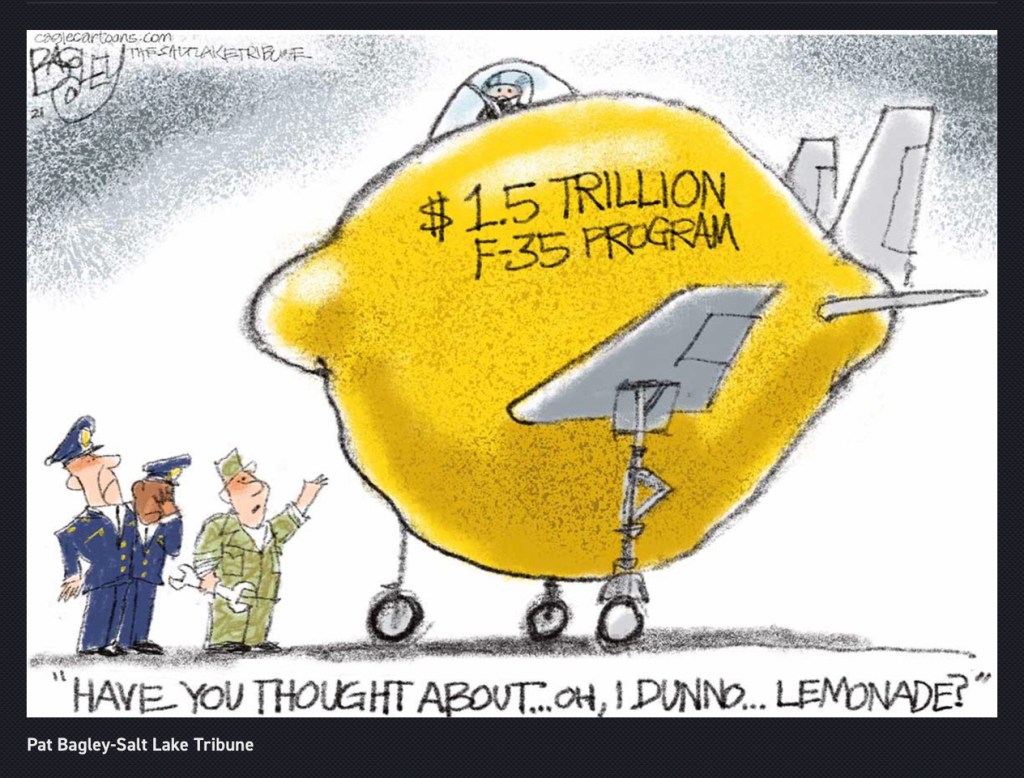
Now the “lemon” is up to $1.7 trillion. Even more lemonade?
W.J. Astore
Imagine you’re a soldier in combat. What’s the most important feature of any weapon system? That it works. That it’s reliable. Nobody wants a weapon that jams in a firefight. Reliability, simplicity, ruggedness are key features of weaponry. Yet the Pentagon and the military-industrial complex seem to specialize in unreliable, complex, fragile ones. Ones that don’t work, or that don’t work very well, and at inflated prices as well. This is the subject of my latest article at TomDispatch, and here’s an excerpt from it:
Cancel culture is a common, almost viral, term in political and social discourse these days. Basically, somebody expresses views considered to be outrageous or vile or racist or otherwise insensitive and inappropriate. In response, that person is “canceled,” perhaps losing a job or otherwise sidelined and silenced. In being deplatformed by Twitter, Facebook, and other social media sites, for instance, this country’s previous president has, it could be argued, been canceled — at least by polite society. More than a few might add, good riddance.
Cancel culture is all around us, with a single glaring exception: the U.S. military. No matter how poorly a major weapons system performs, no matter how much it goes over budget, no matter how long it takes to field, it almost never gets canceled. As a corollary to this, no matter how poorly a general performs in one of our twenty-first-century wars, no matter his lack of victories or failure to achieve mission objectives, he almost never gets cashiered, demoted, or even criticized. A similar thing could be said of America’s twenty-first-century wars themselves. They are disasters that simply never get canceled. They just go on and on and on.
Is it any surprise, then, that a system which seems to eternally reward failure consistently produces it as well? After all, if cancel culture should apply anywhere, it would be to faulty multibillion-dollar weapons systems and more than a few generals, who instead either get booted upstairs to staff positions or retire comfortably onto the boards of directors of major weapons companies.
Let’s take a closer look at several major weapons systems that are begging to be canceled — and a rare case of one that finally was.
* The F-35 stealth fighter: I’ve writtenextensively on the F-35 over the years. Produced by Lockheed Martin, the plane was at one point seven years behind schedule and $163 billion over budget. Nonetheless, the U.S. military persisted and it is now nearing full production at a projected total cost of $1.7 trillion by the year 2070. Even so, nagging problems persist, including engine difficulties and serious maintenance deficiencies. Even more troubling: the plane often can’t be cleared for flying if lightning is anywhere in the area, which is deeply ironic, given that it’s called the Lightning II. Let’s hope that there are no thunderstorms in the next war.
* The Boeing KC-46 tanker: A tanker is basically a flying gas station, air-to-air refueling being something the Air Force mastered half a century ago. Never underestimate the military’s ability to produce new problems while pursuing more advanced technology, however. Doing away with old-fashioned windows and an actual airman as a “boom operator” in the refueling loop (as in a legacy tanker like the KC-135), the KC-46 uses a largely automated refueling system via video. Attractive in theory, that system has yet to work reliably in practice. (Maybe, it will, however, by the year 2024, the Air Force now says.) And what good is a tanker that isn’t assured of actually transferring fuel in mid-air and turns out to be compromised as well by its own fuel leaks? The Air Force is now speaking of “repurposing” its new generation of tankers for missions other than refueling. That’s like me saying that I’m repurposing my boat as an anchor since it happened to spring a leak and sink to the bottom of the lake.
* And speaking of boats, perhaps you won’t be surprised to learn that the Navy has had serious problems of its own with its most recent Gerald R.Ford-class aircraft carriers. That service started building carriers in the 1920s, so one might imagine that, by now, the brass had gained some mastery of the process of updating them and building new ones. But never underestimate the allure of cramming unproven and expensive technologies for “next generation” success on board such vessels. Include among them, when it comes to the Ford-class carriers, elevators for raising munitions that notoriously don’t operate well and a catapult system for launching planes from the deck (known as the Electromagnetic Aircraft Launch System or EMALS) that’s constantly breaking down. As you might imagine, not much can happen on an aircraft carrier when you can’t load munitions or launch planes effectively. Each new Ford-class carrier costs in the neighborhood of $14 billion, yet despite all that money, it simply “isn’t very good at actually being a carrier,” as an article in Popular Mechanics magazine bluntly put it recently. Think of it as the KC-46 of the seas.
* And speaking of failing ships, let’s not forget the Navy’s Littoral Combat Ships (LCS), which have earned the nickname “little crappy ships.” A serious propulsion design flaw may end up turning them into “floating garbage piles,” defense journalist Jared Keller recently concluded. The Navy bought 10 of them for roughly half a billion dollars each, with future orders currently on hold. Lockheed Martin is the lead contractor, the same one responsible for the wildly profligate (and profitable) F-35.
* Grimly for the Navy, problems were so severe with its Zumwalt-class of stealth destroyers that the program was actually canceled after only three ships had been built. (The Navy initially planned to build 32 of them.) Critiqued as a vessel in search of a mission, the Zumwalt-class was also bedeviled by problems with its radar and main armament. In total, the Navy spent $22 billion on a failed “next generation” concept whose cancelation offers us that utter rarity of our moment: a weapon so visibly terrible that even the military-industrial complex couldn’t continue to justify it.
Chief of Naval Operations Admiral Michael Gilday has gone on record as rejecting the idea of integrating exotic, largely untried and untested technologies into new ship designs (known in the biz as “concurrent development”). Godspeed, admiral!
Much like the troubled F-35 and the Littoral Combat Ship, the Zumwalt’s spiraling costs were due in part to the Pentagon’s fixation on integrating just such “leading-edge” technologies into designs that themselves were in flux. (Not for nothing do military wags refer to them as bleeding edge technologies.) Such wildly ambitious concurrent development, rather than saving time and money, tends to waste plenty of both, leading to ultra-expensive less-than-fully effective weapons like the Zumwalt, the original version of which had a particularly inglorious breakdown while passing through (or rather not passing through) the Panama Canal in November 2016.
Given such expensive failures, you might be forgiven for wondering whether, in the twenty-first century, while fighting never-ending disastrous wars across significant parts of the planet, America’s military isn’t also actively working to disarm itself. Seriously, if we’re truly talking about weapons that are vital to national defense, failure shouldn’t be an option, but far too often it is.
With this dubious record, one might imagine the next class of Navy vessel could very well be named for Philip Francis Queeg, the disturbed and incompetent ship captain of novelist Herman Wouk’s The Caine Mutiny. It’s also quite possible that the Pentagon’s next advanced fighter jet will fulfill former Martin Marietta CEO Norman Augustine’s estimate from the 1980s that, by the year 2054, the entire Pentagon budget would be needed to buy one — and only one – combat aircraft. Perhaps a Death Star for America’s new Space Force?
Be sure to read the rest of the article here at TomDispatch.com.
We lose a lot of imagination as we become adults. We become limited. I remember playing make-believe as a kid, when the only limits were those of my imagination. As adults, we’re supposed to be hardheaded and realistic, perhaps even cold-hearted. The world’s tough; don’t be a dreamy fool. But what if we used a bit more imagination in America? What if we returned to the days of make-believe?
Here’s a few aspects of my make-believe America:
* All workers make a living wage with raises pegged to the rate of inflation and cost of living.
* Everyone has “free” health care as a human right.
* Everyone has a home of some sort, i.e. there are no homeless or “unhoused” people living in the streets.
* Prison populations are small, with only the most violent offenders locked away for long terms.
* Climate change, recognized as a problem in the 1980s, is being controlled with massive investments in renewable energy sources.
* Nuclear disarmament, begun with the collapse of the Soviet Union in 1991, will be complete in 2021 after thirty years of dedicated effort.
* No one leaves school with massive amounts of student debt.
* Corporations are not citizens, money is not speech, and all political campaigns are publicly funded.
* Wars are universally reviled and are only fought for defensive purposes via a Congressional declaration. Thus America hasn’t fought a shooting war since 1945.
* The U.S. political scene has a range of “major” parties and a wealth of choices, including a socialist or people’s party and a Green party, along with Libertarians and Populists and Progressives.
* The top priority for most Americans is sustainability and the environment: preserving the planet for future generations.
* There is no such thing as a billionaire, since a progressive tax code ensures an equitable distribution of resources.
* People are respected for who they are and what they do, meaning that racism, sexism, ageism, and other forms of discrimination are largely unknown.
* “Hero” is a term used to describe peacemakers and helpers, the most compassionate and giving among us, the ones fighting hardest for equal rights, fairness, and justice.
* Government is completely transparent to the people. Meanwhile, people have privacy and autonomy.
* Most drugs are legal, and essential medicines like insulin are affordable for all.
Well, I did say this was the land of make-believe. What do you say, readers? What’s in your land of make-believe?
Remarkably, the federal minimum wage still sits at $7.25 an hour and hasn’t been raised since 2009. As a reminder, Barack Obama and Joe Biden were riding high from 2009 to 2016 and they never saw fit to fight hard enough to raise that paltry sum. That’s why Bernie Sanders was so appealing in 2015 when he challenged Hillary Clinton and advocated for a $15.00 minimum wage. People may forget that Hillary initially equivocated, proposing only a $12.00 minimum wage. Ah, the generosity and compassion of Hillary. No boundaries except for $12.00 an hour.
Allegedly, Joe Biden and Nancy Pelosi are now for the $15.00 sum, but of course it would be phased in over several years since the peasants must be reminded of their place. It’s possible that the Covid relief plan currently in the works will finally set the country on a firm if slow path to $15.00. Even so, consider a full-time employee working 40 hours a week for 50 weeks a year. If she makes $15.00 an hour, her pay before taxes would max out at $30,000.00 a year, hardly a munificent sum. Consider that she’d have to work full-time for 22 years to make as much money as Hillary Clinton made in three short speeches to the financial and banking sectors. I’m with her (for the money)!
My father knew the score. As a factory worker, he had to fight for a dime pay raise, a story he recounted in his journal. Here’s an excerpt:
It seems that Mike Calabrese on his own asked Harry Gilson for a pay raise [at the factory] and he was refused. Mike decided to organize the men members and go down in a group. In our group he got ten men to approach Harry G. for a raise. But when it was time to “bell the cat” only three fellows went to see Harry. Well Mike said he couldn’t join the group because he had already tried to get a raise. I knew I was being used but I was entitled to a raise. Well Harry said to me, “What can I do for you men?” So I said to Harry: 1) Living costs were going up; 2) We deserved a raise. So Harry said, “How much?” and I said ten cents an hour would be a fair raise. So he said I’ll give you a nickel an hour raise and later you’ll get the other nickel. We agreed. So, I asked Harry will everyone get a raise and he replied, “Only the ones that I think deserve it.”
Well a month later I was drinking water at the bubbler [water fountain] and Harry saw me and said what a hard job they had to get the money to pay our raises. Well, Willie, Harry Gilson and his brother Sam and their two other Italian brother partners all died millionaires. No other truer saying than, “That the rich have no sympathy or use for the poor.”
And then my father added this pearl of wisdom: From my life’s experience I’ve found that the harder I worked physically the less money I made.
Lee Camp knows the score as well as he calls for real redistribution of wealth in this humorous article. My dad would like this guy.
I know, we can’t say “class warfare” in America, comrade. But maybe that’s because, as the billionaire Warren Buffett put it, the richest among us are so clearly winning.
A friend sent along a story from The Intercept about a spoiled corporate Democrat running for the Senate in Wisconsin. The article’s title reads like satire but it’s all-too-telling of our American moment: Son of Wall Street Mogul Running for Wisconsin Senate Seat Was Pleasantly Surprised Milwaukee Is a Normal City: “What most surprised me,” said Alex Lasry, “is the fact that Milwaukee has all the same things as any city,” citing bars, restaurants, and an art scene.
Who knew Milwaukee was so sophisticated. Even an “art scene”! Alex Lasry sure has his finger on the pulse of the people. We need more Senators like him, moneyed and smug and elitist — and ignorant too. He’s perfect.
Some more details about the career arc of Alex Lasry, which is short and not bending toward justice:
Though he doesn’t note it in his bio, Lasry began as an intern at Goldman Sachs during college, while Lasry’s father was a major Goldman Sachs client. Marc Lasry was a bundler for Barack Obama’s 2012 presidential campaign, gathering $500,000 for his reelection, and he led a Wall Street effort to restore relations with the White House after the president mildly criticized the financial sector. His son then scored an internship in the White House in the Office of Public Engagement, run by senior adviser Valerie Jarrett, who was one of the White House’s key links to the CEO class. The White House gig was his first job out of college, and he rose through the ranks of the office. From there, he returned to Goldman Sachs as an analyst in their government affairs department.
More recently, Alex Lasry helped lead the effort to bring the Democratic National Convention to Milwaukee in 2020 as finance chair of the city’s host committee. Lasry was also in the news this month for getting his Covid-19 vaccine, though the state’s 69-year-old governor had yet to get his.
Vitally important people like Lasry, who’s 33 years old, obviously need the Covid vaccine and pronto. I’m 57 and my wife and I joke that our scheduled date for the Covid vaccine is the 12th of never. But, heck, who are we?
It’s sure nice to see the Democratic Party so focused on “everyday” people, as Hillary Clinton called them. There are few people more down to earth, more relatable, than Goldman Sachs royalty or those like Hillary who take their money.
And the Democrats wonder why so many Americans saw and continue to see a clown like Trump as a viable alternative. One thing you can say for Trump: as much as he lies, there is an honesty to him. He’s a rich blowhard who’s out for himself and he doesn’t care who knows it. Limousine liberals are more circumspect, or more hypocritical if we’re being blunt, which makes Trump’s naked greed seem strangely refreshing.
Finally, maybe America should be more honest with itself and just elect Senator Goldman Sachs, Senator Raytheon, Senator Walmart, Senator Lockheed Martin, Senator Monsanto, and so on. Then again, why should the puppeteers come out from behind the curtain when the senatorial puppets they control are dancing so prettily and obediently?
Addendum: Of course, examples of GOP senatorial hypocrisy are legion; consider this article by David Sirota. Ready for a third party, anyone?











 Bracing Views