Abortion in America

W.J. Astore

I truly believe that if men got pregnant, abortion would be free, legal, and readily available across the United States.

But men don’t get pregnant, so the idea of carrying an unwanted baby to term is mainly theoretical for them. How easy it is, then, to outlaw abortion while claiming to be pro-life.

Having been raised Catholic, I was taught abortion is murder. It’s that blunt. As the Church was teaching me that, it was allowing predatory priests to molest children. There was even a predatory priest assigned to my parish when I was young. So I’m not too keen on the moral authority and teachings of the Church here. Again, if priests got pregnant, I truly believe abortion would be accepted within the Church. Perhaps it would be justified by arguing that priests, first and foremost, have to serve God and the Church and therefore shouldn’t be encumbered by children.

The U.S. Supreme Court seems ready to overturn Roe v Wade by next summer, which is not surprising. So much for respecting judicial precedent. Even as it does so, we’ll hear arguments about how the Court isn’t partisan or political or influenced by religious beliefs, which is absurd. So-called pro-life Republicans have won the battle of placing partisan justices on the Court, and soon they’ll reap their reward.

Establishment Democrats are not as unhappy as you might think. I’ve already received urgent requests to donate money in the cause of abortion rights. Abortion is a “hot-button” issue and a real money-maker for partisans on both sides. Sorry, Democrats, this is your mess too, and you won’t see a penny from me.

Why do I claim Democrats are responsible too? President Obama could have appointed a justice to the Supreme Court when Mitch McConnell refused to do his job. It may have touched off a Constitutional crisis, but it was a fight worth having. But Obama figured Hillary Clinton couldn’t lose to Trump, so he did nothing. Meanwhile, Hillary ran a horrible campaign and lost to a failed casino owner and C-list celebrity apprentice. Because of that, we got three new justices who were all picked in large part because of their opposition to Roe v Wade. (That, and the fact they’re all pro-business.)

We will soon take a giant step backwards in America. Roughly half of American states will outlaw abortion; the other half will likely allow it under various conditions. Of course, as Ruth Bader Ginsburg noted, rich women, no matter where they live, will be able to get abortions. Women of lesser means will struggle and suffer. The pro-life movement will applaud that there are fewer abortions even as they cut benefits to the mothers who are forced to have these babies. They will do this with no pangs of conscience and in the name of loving the unborn — until they’re born to the “wrong” kind of mother.

And so it goes in America.

Being “pro-life” shouldn’t end when the baby is born. Jesus helped the poor, the lame, and the sick. He didn’t tell them to get a job while cutting their benefits. Image from a prayer card sent to me by my local bishop.

A Coda (12/5/21)

I welcome all comments on this difficult issue.

Instead of Cui bono, or who benefits, I think of who suffers if Roe v Wade is overturned. Not men. Not women of means, who will find a way to secure a safe abortion irrespective of the law in their particular state. It will be poor and desperate women who suffer, especially those who’ve been raped or who’ve been the victims of incest. Imagine being raped and then being forced to carry the fetus to term — it’s unimaginable to me.

I should note as well the burden placed on women — always women. What about the man who got her pregnant? Why may a woman be forced to give birth to an unwanted child while the father walks away freely in virtually all cases? People often discuss abortion as if women got pregnant by immaculate conception. As if men hold no responsibility whatsoever. Believe me, if men got pregnant too, abortion would be freely available.

So it’s likely that next summer, five men and one very conservative woman aligned with a fringe group in the Catholic Church will rule to compromise the bodily autonomy of women across the country; they’ll be opposed by two women and one man who seek to uphold a less-than-perfect precedent but one that has served to reduce state and patriarchal domination in the US of A for half a century.

Meanwhile, the Supreme Court will obviously be revealed for what it is: a partisan hack shop in which the law is for sale or otherwise open to manipulation by the well-connected for unsavory purposes.

Tell me how this is a good thing.

Coda 2 (12/6/21)

As a (lapsed) Catholic, I realize people have religious reasons why they oppose abortion.

To these people I say: If you’re opposed to abortion, don’t have one. But don’t seek to impose your religious beliefs on everyone else.

A decision on abortion should be between a woman and her doctor. It’s a private decision. You have no say. Your religious beliefs don’t matter.

Against abortion? Don’t have one — simple as that. And MYOB.

Disagreeing Without Being Disagreeable: The Kyle Rittenhouse Verdict

W.J. Astore

Disagreements are part of life. And indeed my friends, and readers of this blog, have been known to disagree with me. And thank goodness for that! Who’d want obsequious toadies for friends? And, if I’m writing articles that are truly “bracing,” obviously I should expect disagreements. And I do, which is one of the best aspects of this site. We learn from people who disagree with us, that is, when they have reasons well supported by facts, or wisdom learned from their own life experiences, and so on.

America is highly polarized today, and it seems as if people can no longer disagree without being disagreeable. Discussions quickly become arguments, which turn into shouting matches, with lots of name-calling and attacks on people and their alleged motives and leanings.

There’s nothing wrong with impassioned disagreement. But too many people start from there and quickly descend to being disagreeable, even violently so. The end result is that no common ground is discovered, nothing is learned, and any kind of concerted action to effect meaningful change is sabotaged.

Take the case of Kyle Rittenhouse. He was recently acquitted of murder after shooting three people during a Black Lives Matter protest in Kenosha, Wisconsin, that turned violent. The jury found that there wasn’t enough evidence to convict him beyond a reasonable doubt. I’ve watched video from the protests, and it appears to me that Rittenhouse acted in self-defense. Other people may watch this video evidence and watch the trial and reach a different conclusion, and that’s OK. We should be able to discuss this reasonably and rationally, while putting some faith in the verdict reached by the jury.

Kyle Rittenhouse (SEAN KRAJACIC/PHOTOGRAPHER: SEAN KRAJACIC /GET)

Scanning my Facebook feed, however, I see polarization and vituperation about the verdict. It seems like if you agree with the verdict of “not guilty,” you’re obviously a white supremacist, a gun enthusiast, and a Trump supporter. On the other hand, if you disagree with the verdict, you’re obviously a libtard who hates guns and wants to defund the police. It’s a disagreeable mess with no common ground except mutual suspicion, even hate.

Even as I wrote those words, I got an email with an article on the verdict:

Kyle Rittenhouse, white supremacy, and the privilege of self-defense

Rittenhouse has the benefit of boyhood — white boyhood

By Jeneé Osterheldt

In this article, Osterheldt writes that the three white victims of Rittenhouse were “perceived to be fighting for Black lives to matter,” so their lives were “also up for grabs.” But Rittenhouse, also white, was supported by the system because he “believ[ed] in the authority of whiteness.” His life was apparently never “up for grabs.”

This author then authoritatively declares that: “Had he [Rittenhouse] been white and protecting Black lives in Kenosha instead of purportedly protecting cars, he’d be in prison. Or maybe cops would have pepper-sprayed him instead of giving him gratitude and water. Rittenhouse has the privilege of white power.”

Again, based on the video evidence and the trial, I don’t see this verdict as being driven by “white power” and privilege. Rittenhouse’s first victim was a man who chased him, threatened him, and tried to take his gun from him. The second victim was beating Rittenhouse with a skateboard. The third victim (wounded in the arm) was pointing a gun at Rittenhouse, as he himself admitted during the trial. The jury watched the videos, heard the testimony, and decided Rittenhouse’s actions did not constitute murder or attempted murder. From what I’ve seen and heard, I agree with the jury.

Now, it shouldn’t matter, but all three of Rittenhouse’s victims were white. Two of the three were attacking him before they were shot (the two he killed), and the other pointed a handgun at him (the one he wounded). The first man he shot was mentally unbalanced; video at the scene shows him shouting racial obscenities, including the N-word, at Blacks, daring them to shoot him.

So, I disagree that Rittenhouse’s acquittal is an example of white privilege and power. I shouldn’t have to say this, but I’ll add that I support the Black Lives Matter movement, that I’m not a “gun enthusiast,” and that I’ve never voted for Trump and never will. (I’m not a fan of Biden either.)

We can disagree based on evidence, reason, facts. We can disagree without being disagreeable. Can’t we?

The Pentagon as Pentagod

W.J. Astore

The other day, retired General Michael Flynn called for “one religion under God” in the United States.

Ah, General Flynn, we already have one religion of militant nationalism and imperialism, and we already have one god, the Pentagod, which is the subject of my latest article for TomDispatch.com.

First, one religion. This weekend I watched the New England Patriots play the Cleveland Brown during which a Pentagon recruiting commercial broke out. The coaches wore camouflage jackets and caps, the game started with military flyovers of combat jets, and there even was a mass military swearing-in ceremony hosted by a four-star general and admiral. That same general claimed during an on-field interview during the game that the military is what keeps America free, which might just be the best definition of militarism that I’ve heard.

(Aside: In a true democracy, the military is seen as a necessary evil, because all militaries are essentially undemocratic. The goal of a true democracy is to spend as little as possible on the military while still providing for a robust defense.)

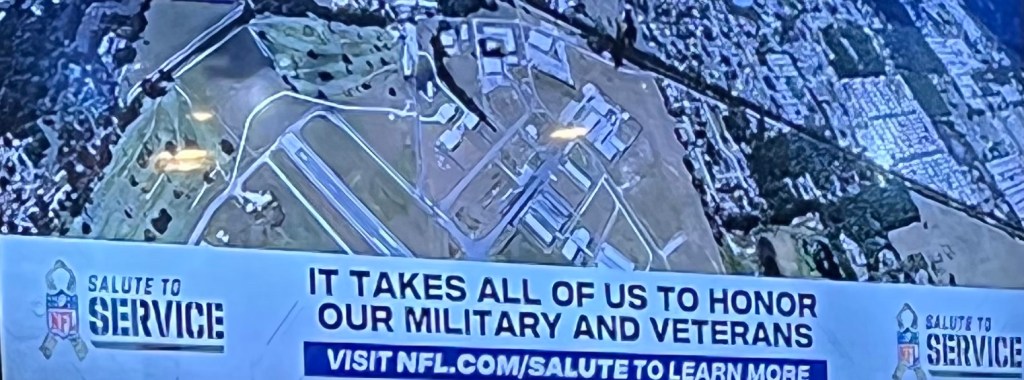
Here’s an illustration, sent by a friend, of America’s one religion:

So, according to the NFL and the mainstream media, “all of us” need to honor “our” military and indeed anyone who’s ever worn a uniform, no questions asked, apparently. I wore a military uniform for 24 years: four years as a cadet, twenty as a military officer, and I’m telling you this is nonsense — dangerous nonsense. Don’t “salute” authority. Question it. Challenge it. Hold it accountable and responsible. At the very least, be informed about it. And don’t mix sports, which is both business and entertainment, with military service and the machinery of war.

OK, so now let’s talk about America’s god. As I argue below, it certainly isn’t the Jesus Christ I learned about by reading the New Testament and studying the Gospels in CCD. America has never worshipped that god. Clearly the god we worship — at least as measured by money and societal influence — is the Pentagod, which leads me to my latest article at TomDispatch. Enjoy!

The Pentagon As Pentagod

Who is America’s god? The Christian god of the beatitudes, the one who healed the sick, helped the poor, and preached love of neighbor? Not in these (dis)United States. In the Pledge of Allegiance, we speak proudly of One Nation under God, but in the aggregate, this country doesn’t serve or worship Jesus Christ, or Allah, or any other god of justice and mercy. In truth, the deity America believes in is the five-sided one headquartered in Arlington, Virginia.

In God We Trust is on all our coins. But, again, which god? The one of “turn the other cheek”? The one who found his disciples among society’s outcasts? The one who wanted nothing to do with moneychangers or swords? As Joe Biden might say, give me a break.

America’s true god is a deity of wrath, whose keenest followers profit mightily from war and see such gains as virtuous, while its most militant disciples, a crew of losing generals and failed Washington officials, routinely employ murderous violence across the globe. It contains multitudes, its name is legion, but if this deity must have one name, citing a need for some restraint, let it be known as the Pentagod.

Yes, the Pentagon is America’s true god. Consider that the Biden administration requested a whopping $753 billion for military spending in fiscal year 2022 even as the Afghan War was cratering. Consider that the House Armed Services Committee then boosted that blockbuster budget to $778 billion in September. Twenty-five billion dollars extra for “defense,” hardly debated, easily passed, with strong bipartisan support in Congress. How else, if not religious belief, to explain this, despite the Pentagod’s prodigal $8 trillion wars over the last two decades that ended so disastrously? How else to account for future budget projections showing that all-American deity getting another $8 trillion or so over the next decade, even as the political parties fight like rabid dogs over roughly 15% of that figure for much-needed domestic improvements?

Paraphrasing Joe Biden, show me your budget and I’ll tell you what you worship. In that context, there can’t be the slightest doubt: America worships its Pentagod and the weapons and wars that feed it.

Prefabricated War, Made in the U.S.A.

I confess that I’m floored by this simple fact: for two decades in which “forever war” has served as an apt descriptor of America’s true state of the union, the Pentagod has failed to deliver on any of its promises. Iraq and Afghanistan? Just the most obvious of a series of war-on-terror quagmires and failures galore.

That ultimate deity can’t even pass a simple financial audit to account for what it does with those endless funds shoved its way, yet our representatives in Washington keep doing so by the trillions. Spectacular failure after spectacular failure and yet that all-American god just rolls on, seemingly unstoppable, unquenchable, rarely questioned, never penalized, always on top.

Talk about blind faith!

To read the rest of my article, please go to TomDispatch here. Here’s my conclusion:

Yet, before I bled Air Force blue, before I was stationed in a cathedral of military power under who knows how many tons of solid granite, I was raised a Roman Catholic. Recently, I caught the words of Pope Francis, God’s representative on earth for Catholic believers. Among other entreaties, he asked “in the name of God” for “arms manufacturers and dealers to completely stop their activity, because it foments violence and war, it contributes to those awful geopolitical games which cost millions of lives displaced and millions dead.”

Which country has the most arms manufacturers? Which routinely and proudly leads the world in weapons exports? And which spends more on wars and weaponry than any other, with hardly a challenge from Congress or a demurral from the mainstream media?

And as I stared into the abyss created by those questions, who stared back at me but, of course, the Pentagod.

Are You Ready for Four More Years of Trump?

W.J. Astore

I had no idea America elected Joe Manchin and the Senate Parliamentarian as the two most powerful people in our country. Senator Manchin has been the convenient obstacle and scapegoat for the corporate Democrats. He’s allegedly blocked tougher action on climate change. He’s helped to defund efforts to make community college free, to extend Medicare, to lower prescription drug prices, and so on. The Senate Parliamentarian, meanwhile, who is in fact unelected and has no real power, ruled that hiking the minimum wage is something that simply can’t be countenanced under budgetary reconciliation rules. I think I got that right, not that it matters. It’s all a smokescreen, it’s all BS. The Democratic Party, like the Republican, answers to the owners and donors. It is doing exactly what it’s been told to do, abandoning all its progressive promises (it never had any principles) in the false name of compromise and bipartisanship.

And this is exactly why Donald Trump will be reelected in 2024.

Not that the corporate-owned Democrats care, mind you. Things are actually easier for them with Trump in office. They can raise more money off their fake “resistance” to Trump, and they can wash their hands of tax cuts for the rich and more and more corporate-friendly deals, blaming them on Trump when of course the Democrats too support all these things. For that matter, so too does the Supreme Court. Justices like Brett Kavanaugh, Neil Gorsuch, and Amy Coney Barrett weren’t just picked because they lean against abortion: they were picked because of their pro-business sympathies. Joined by Justices Roberts and Thomas and Alito, corporations can count on winning cases in their favor by at least a 6-3 margin. Corporations are people, my friends, and they rule us through the political parties they own and the court they have packed.

If many Americans don’t know this, they certainly sense it. They know politicians like Biden and Harris are phonies. They are so phony that people actually prefer a twice-divorced wife-cheater, con man, and reality TV host like Trump for his authenticity. At least Trump speaks their language and apes their grievances.

Former President Obama, meanwhile, gives speeches blaming the voters for not voting. He says with a straight face that we can’t always get what we want, but that if you don’t despair and keep voting blue no matter who, you may yet get a few crumbs after 2024. Who believes this anymore?

Hillary Clinton and the DNC were so bad in 2016 that America elected a failed casino owner with a fake university named after him. Biden/Harris and the DNC are so bad now that in 2024 America will elect a bloviating dictator wannabe and coup-plotter who threw his own VP under the bus as president. Yup, the same guy again. Maybe this time Ivanka will run the World Bank or possibly the State Department (can she be worse than Mike Pompeo?).

That blurry man is returning — and so too is his daughter. Not so sure about the guy on the right

America has become a very bad joke — worst of all, the joke’s on us.

Are All Wars Local?

Carl von Clausewitz. Postage stamp issued in 1981, 150 years after his death.

W.J. Astore

Tip O’Neill, Speaker of the House when Ronald Reagan was president in the 1980s, liked the saying, “All politics is local.”

Carl von Clausewitz, the famous Prussian theorist of war in the time of Napoleon, taught that war is the continuation of politics by other (violent) means.

Does it follow from this that all wars are, in a sense, local?

It doesn’t seem so at first glance. Americans tend to see wars like Iraq and Afghanistan as distant events that are disconnected from our daily lives. (Obviously, if a loved one is in the military and deployed overseas, concern and connection are greatly heightened.)

But when we begin to see the local costs of war, fully to see them, the way they poison lives, infect and erode democracy, and compromise the very climate we live in, we may finally act to put a stop to war.

No matter how distant and obscure America’s wars may be (and who among us really knows what’s happening this minute in Somalia, to cite one example), there are effects that are local.  And until we calculate those costs, and confront the waste and inhumanity of them, we simply won’t work synergistically to end them.

What are some of these local costs? As President Eisenhower said in his famous “cross of iron” speech, every warship we build, every rocket we fire, every warplane we launch, represents a theft from those who hunger, a theft from projects such as building schools or repairing roads and bridges. Every dollar we spend on war is a dollar we don’t spend here in America on our own sustenance, our own health as a civil society. Meanwhile, the dreadful costs incurred by wasteful wars, which will eventually exceed $8 trillion for the Iraq and Afghan wars, drives up our national debt, which is then cited, rightly or wrongly, as a reason to curb domestic spending. Profligacy for war, austerity for ordinary Americans, seems to be the new American way. And it’s impoverishing our democracy and our civic culture.

Other effects of war would include the costs of aiding veterans who are wounded, whether in body or mind or both, in our local communities. It would include the militarization of local police forces with surplus military weaponry that is then used to suppress legitimate dissent. And, if you’ve lived on or near a military base, you’ve likely experienced noise pollution to go with environmental pollution and degradation, much of it kept classified or otherwise hidden from view.

America’s wars, in short, are never truly distant and disconnected from our lives. They are instead connected to us, shaping our vision of what’s possible and impossible, what’s inevitable and what’s preventable, what’s normal and what’s abnormal.

A state of permanent war is not normal, America. Its effects are all around us and they are not good. But the good news is that, just as the effects of war are local, so too can the fight against war be local. Raise your voice and take a stand against war. If all politics is local, the political fight against war can and should be local too.

The Biggest Threat to America

W..J. Astore

Aside from climate change (Armageddon in slow motion) and nuclear war (Armageddon in the blink of an eye), the biggest threat to America is perpetual war and preparations for war driven by threat inflation. We’re witnessing it now, before our very eyes, with America’s increasingly polarized relations with China, notes David Vine in his latest effort for TomDispatch.com. Both parties, Republican and Democratic, accuse the other of being “soft” on China, even as the U.S. “defense” budget (meaning the war and weapons budget) soars with bipartisan support in Congress.

It’s folly, of course, and dangerous folly at that. China has roughly four times as many people as the U.S. and a vibrant economy; China is also a leading trading partner and owner of American debt. China, in short, should be a friend, or friendly rival, or a competitor worthy of respect. What China shouldn’t be in American eyes is a manifestation of a new “Yellow Peril,” an inscrutable foe, a soon-to-be enemy. Anything that tips us in that direction is truly folly, since any war with China could end in nuclear catastrophe. And even if such a catastrophe is avoided, war, even a “cold” one, will destroy any chance for concerted action against climate change, imperiling the very planet we live on.

If we want to avoid Armageddon, whether the one in slow motion or the one in the blink of an eye, the USA needs good relations with China, based again on mutual respect and a cooperative spirit. What should unite us (working to mitigate climate change and reduce the threat of nuclear war) is far more important than what is allegedly dividing us.

But threat inflation works, especially for the military-industrial-congressional complex, to justify colossal war budgets to the American people. Here’s the problem, though: When you inflate the threat, in some way you also create it. You instantiate it, at least in your own mind. You give it more and more substance.  And the more weapons you build to meet the threat you created, the more likely it becomes that you’ll choose to use those weapons when push comes to shove — and Americans sure do a lot of shoving in the world.

I just hope the Chinese are wise enough to see that America’s national security state is indeed a big threat — to America.  So they’d be wisest to stand back and let America defeat itself with debilitating wars and profligate spending on costly weaponry.  Meanwhile, they can use their strong economy to dominate trade.  While we build weapons and fight wars, China will defeat us — at capitalism!  Ah, the irony, comrade.

Yet even as China wins the new cold war, the planet itself will lose. Anything that distracts humanity from facing climate change together is folly. It may not seem so at this moment, but check back with the planet in 2031. Another decade lost to military folly is another nail in the coffin to efforts at preserving and restoring life on our planet.

So, as David Vine asks in his article, Do you want a new cold war? Anyone with any sense knows that “No!” is the only possible answer.

The Military and Conformity — and Democracy

Officers’ Wives’ Club in 1967. In the mid-1980s, I belonged to a bowling league with my military unit in Colorado. Good times.

W.J. Astore

Few people will be surprised to learn that the U.S. military is about conformity. Uniformity. Heck, it’s one reason why we wear uniforms to begin with. To a certain extent, individuality is tolerated but only if it’s harmless and doesn’t interfere with unit cohesion or performance — and, not just performance but image.

I can’t count the number of times I heard about my Air Force “family” when I wore the uniform, with the message I had to go along to get along; we’re all family, so stop grumbling and enjoy your “family” time.

A heavy stress on conformity can be a particular burden to civilian spouses, however, who didn’t necessarily think they were enlisting when their partner signed up and donned a uniform. In the bad old days, wives of officers were especially burdened with expectations. If they didn’t join officers’ wives’ clubs and otherwise “support” their husbands, they might find themselves ostracized from the “family.” Their husbands might see their careers suffer as well, not exactly a dynamic that promotes family values and amity at home.

Those bad old days are not entirely over, notes Andrea Mazzarino at TomDispatch.com, and being the wife of a U.S. Naval officer, she should know. I urge you to read her article here at TomDispatch. Nowadays, pressure takes new forms, notably on social media, that crazy 24/7/365 world, with email, Instagram, and Facebook posts (among other social sites) being scrutinized incessantly for right-thinking and right behavior, as judged by the self-anointed keepers of conformity and uniformity.

Militaries, again you won’t be surprised to learn, are not known to embrace criticism and non-conformity, which is why they should be kept as small as possible within a democracy that is supposed to celebrate or at least tolerate critiques and eccentrics. But here’s the rub: The more America celebrates its military and feeds it with money. the more it reinforces anti-democratic forces and tendencies within our larger society. And that’s not a good thing in a country where money is speech, i.e. where the richest already rule. (Which is no surprise to military members, as we all know the Golden Rule: He who has the gold makes the rules.)

Here’s an excerpt from Mazzarino’s article. Believe me, she knows of what she speaks.

Eyes Are Always On You

Andrea Mazzarino

I know what it means to be watched all too carefully, a phenomenon that’s only grown worse in the war-on-terror years. I’m a strange combination, I suspect, being both a military spouse and an anti-war-on-terror activist. As I’ve discovered, the two sit uncomfortably in what still passes for one life. In this country in these years, having eyes on you has, sadly enough, become a common and widespread phenomenon. When it’s the government doing it, it’s called “surveillance.” When it’s your peers or those above you in the world of the military spouse, there’s no word for it at all.

Now, be patient with me while I start my little exploration of such an American state at the most personal level before moving on to the way in which we now live in ever more of a — yes — surveillance state.

A Navy Wife’s Perspective on Military Life, Post-9/11

“The military sounds like the mafia. Your husband’s rank determines how powerful you are.” That was a good friend’s response, a decade or so ago, when a more experienced Navy wife shamed me for revealing via text message that my husband’s nuclear submarine would soon return to port. Her spouse had been assigned to the same boat for a year longer than mine and she headed up the associated Family Readiness Group, or FRG.

Such FRGs, led by officers’ wives, are all-volunteer outfits that are supposed to support the families of the troops assigned to any boat. In a moment of thoughtless excitement, I had indeed texted another spouse, offering a hand in celebrating our husbands’ imminent return, the sort of party that, as the same woman had told me, “All wives help with to thank our guys for what they do for us. It’s key to command morale.”

She had described the signs other wives had been making under the direction of both the captain’s wife’s and hers, as well as the phone chain they had set up to let us know the moment the boat would arrive so that we could rush to the base to greet it. In response to my message, she’d replied in visibly angry form (that is, in all capital letters), “NEVER, EVER INDICATE IN ANY WAY OVER TEXT THAT THE BOAT WILL BE RETURNING SOON. YOU ARE ENDANGERING THEIR LIVES.” She added that I would be excluded from all boat activities if I ever again so much as hinted that such a return was imminent.

Alone in my apartment in a sparsely populated town near the local military base, my heart raced with the threat of further isolation. What would happen because of what I’d done?

And yes, I’d blundered, but not, as became apparent to me, in any way that truly mattered or actually endangered anything or anyone at all — nothing, in other words, that couldn’t have been dealt with in a kinder, less Orwellian fashion, given that this was a supposedly volunteer group.

It was my first little introduction to being watched and the pressure that goes with such surveillance in the world of the military spouse. Years later, when my husband was assigned to another submarine, an officer’s wife at the same naval base had burst into tears telling me about the surprise visit she’d just been paid by three women married to officers of higher rank on other boats stationed at that base.

Sitting across from her in their designer dresses, they insisted she wasn’t doing enough to raise raffle money to pay for a military child’s future education. Am I really responsible for sending another kid to college? That was her desperate question to me. Unable to keep a job, given her husband’s multiple reassignments, she had struggled simply to save enough for the education of her own children. And mind you, she was already providing weekly free childcare to fellow spouses unable to locate affordable services in that town, while counseling some wives who had become suicidal during their husbands’ long deployments.

I could, of course, multiply such examples, but you get the idea. In the war-on-terror-era military, eyes are always on you.

Married to the Military (or the Terror Within)

On paper, the American military strives to “recognize the support and sacrifice” of the 2.6 million spouses and children of active-duty troops. And there are indeed gestures in the right direction — from partnerships with employers who have committed to hiring military spouses to short-term-crisis mental-health support.

READ THE REST OF THE ARTICLE HERE.

Support Our Troops — But How?

A1C Courtney Wagner, getting the job done as the 774th Expeditionary Airlift Squadron loadmaster in 2017. When America thinks of “our” troops, someone like A1C Wagner may come to mind (U.S. Air Force photo/Staff Sgt. Divine Cox)

W.J. Astore

Today I saw a “support our troops” magnetic ribbon on a pickup truck.  I used to see more of them, especially in the Bush/Cheney years of the Afghan and Iraq Wars.  I don’t oppose the sentiment, though the “support” it encourages is undefined.  I’ve always thought the best way to “support” our troops is to keep them out of unnecessary and disastrous wars.  Even to bring them home, not only from these wars but from imperial outposts around the globe.  But, again, “support” on these ribbons is unspecified, though the Pentagon seems to equate it with huge budgets that approach a trillion dollars every year.

Americans continue to profess confidence in “their” military, with 69% of us saying so in July 2021, whereas only 12% of us have much confidence in Congress.  Can it be said we hold Congress in contempt?  Americans know, I think, that Congress is bought and paid for, that it answers to the rich and the strong while dismissing the poor and the weak.  If you’re looking for affordable health care, for higher pay, for fair treatment, best not look to Congress.

Indeed, if you want a $15 minimum wage, free government health care, and a government-funded college education, your only option is to enlist in the U.S. military.  These “socialist” programs are a big part of the military, including government-provided housing as well.  Yet we don’t think of them as socialistic when the person getting these benefits is wearing a military uniform.

It’s truly remarkable that despite disastrous wars in Afghanistan, Iraq, Libya, and elsewhere, Americans continue to “support” and have great confidence in “our troops.”  There are many reasons for this.  I think most Americans recognize now that the wars our troops are sent to are losing concerns from the get-go.  You really can’t blame the troops for failing to win unwinnable wars.  You can, and should, blame the leaders for lying us into these wars and then lying again and again about (false) progress in Iraq, Afghanistan, and elsewhere.  But the troops who bleed on the frontlines?  No – we sense it’s not their fault.

I think many Americans also support our troops out of guilt and ignorance.  Most Americans are isolated from the military and therefore have little understanding of its ways and even less understanding of its wars.  Less than 1% of Americans currently serve in the military, plus there’s no draft, so young Americans can safely ignore, so they think, the discomforts and potential perils of a few years spent within the ranks.  After a flurry of attention paid to a humiliating withdrawal from Afghanistan, the mainstream media is back to saluting the troops while warning of potential conflicts elsewhere, perhaps with China over Taiwan.

The disasters of Afghanistan and Iraq, among others, are already being sent down the Memory Hole to oblivion.  After all, there’s always another war looming, so we’re told, which serves to convince most Americans that a strong “defense” is needed.  So why not support our troops.  We’re going to need them to fight the next war, right?

This is precisely how we fail to support our troops.  We don’t ask enough tough questions – and we don’t demand enough honest answers – about why the next war is necessary.  How it serves national defense and the ideals of the U.S. Constitution.  We are always pressured to salute smartly, even if we’ve never served in the military.  And that way lies militaristic madness.

So, if I had to define how best to support our troops, I’d answer with another bumper sticker motto: Question Authority.  Especially when it’s wrapped in the flag and camouflaged by a military uniform.

It’s folly in the extreme that Americans routinely acquiesce to Pentagon “defense” budgets – let’s face it, these are war budgets — that consume more than half of federal discretionary spending each year, even as the Pentagon loses wars and fails audits. Nevertheless, our very unpopular Congress continues to throw money at the generals and admirals and war contractors, and indeed these groups are often interchangeable, as many senior officers join corporate “defense” boards after retiring from the military.

It’s not Private Jones (or A1C Wagner, pictured above) who’s cashing in here.  It’s America’s military-industrial-congressional complex, which is guided and motivated by one word: more. More money, more power, and, often enough, more wars.

If we keep “supporting” our troops while funneling vast and unaccountable funds to the Pentagon and the weapons makers, America will get more weapons and more wars.  It’s that simple.  And more weapons and more wars will combine to destroy what little is left of our democracy, no matter how many “support our troops” ribbons we stick to our pickup trucks.

Do you really want to support our troops?  Besides questioning authority, one might best begin by reducing their numbers.  America’s military should be no larger than what it needs to be to provide for a robust national defense.  Then we need to remember that a state of permanent war represents a death blow to democracy, no matter how much we profess confidence in our troops.  Since Congress is already deeply unpopular, it should have the guts to cut and limit military and war spending to no more than 25% of federal discretionary spending.

Cutting funds to the military-industrial complex will help bring it to heel – and force more than few spoiled and hidebound generals and admirals to bring our troops home rather than wasting them in faraway countries fighting unwinnable conflicts.

What say you, America?  Ready to support our troops?

We’re Mad As Hell — And Fighting Each Other

Peter Finch in “Network”

W.J. Astore

In the movie “Network” from 1976, a TV news anchor played by Peter Finch builds a mass following by promising to kill himself on the air while declaring that “I’m as mad as hell and I’m not gonna take this anymore!”  The network execs are all too happy to encourage him – as long as his outrage is good for ratings and doesn’t threaten the system.  But when Finch starts to step on corporate agendas, he has the riot act read to him by Ned Beatty, who explains “There is no America.  There is no democracy” and that “The world is a college of corporations.”  A visibly shaken Finch realizes he’s in over his head.

I’ve always liked that catchphrase from the movie, for we the people should be as mad as hell, and we should refuse to take it.  We should act.  But what’s interesting is how our anger is redirected before we can act.    

We’re not supposed to be mad at the oligarchs – that “college of corporations” – who own it all and who push all the buttons. No — our anger is supposed to be tribal. We’re supposed to hate Republicans, or Democrats, or anti-vaxxers, or Trump supporters, or someone — someone ultimately like us, without much power. The anger is ginned up to encourage us to punch down while keeping us disunited.

Being mad can be good if the anger is channeled against the exploiters; it’s not good when it’s exploited by the powerful to keep us divided and weak.

America’s two-party system is designed to deflect anger away from the moneyed interests and toward each other.  What we need is a new political party that truly represents the people rather than the oligarchs.  Neither major party, Republican or Democrat, seems reformable.  Both are captured by moneyed interests.  After all, if money is speech, who can yell louder: you and me, or Lockheed Martin and Amazon? Even the “anti-establishment” voices in either major party have largely been neutralized. Or they get sicced on the enemy of the day, whether it’s evil woke Democrats or evil unwoke Trumpers.

Hence nothing really changes … and that’s the point.

America needs an anti-imperial party, a “Come home, America” party, a party that puts domestic needs first as it works to downsize the military and dismantle the empire.  Yet, in the spirit of Orwell’s 1984 and the Two Minutes’ Hate, Americans are always kept hating some putative enemy.  Russia!  Radical Islamic Terror!  China!  Immigrants at the gate!  Maybe even an enemy within.  We’re kept divided, distracted — and downtrodden

If we continue to be at war with each other while punching down, we’ll never turn righteous anger against the right people.  We’ll never effect meaningful change.

It’s said that power never concedes anything without a demand.  Why do we demand so much from the powerless and so little from the powerful?  Isn’t it high time we reversed that?

Fear Is the Mind-Killer

W. J. Astore

As a new movie version of Dune is released, it’s a good time to be reminded of Frank Herbert’s wise saying that fear is the mind-killer.

Americans are kept constantly in a state of fear, or at least of high anxiety (a Mel Brooks movie, if memory serves), and that fear or anxiety makes us open and responsive to claims the Pentagon must have more weapons, more authority, and always more money, justified in the name of keeping us safe, whether from “terror” or from China (echoes of the old “Yellow Peril”) or from some other threat just beyond the horizon.

How is it that the world’s most militarily powerful empire is always so fearful? And always needs more weaponry for “security”? Perhaps it’s precisely because fear helps to stifle critical thinking? And because we think of weaponry as job-creators instead of life-takers?

I talk about this and other subjects with Burt Cohen on his podcast, “Keeping Democracy Alive.” Even Yoda makes an early appearance! To listen, please click on the link below.

https://bit.ly/3ijbePc

Wars not make one great