I’ve been noticing a new word of the moment: “guardrails.” President Trump is smashing the guardrails of democracy. At the same time, new guardrails are the answer to ICE murders in Minneapolis, at least according to Chuck Schumer and Hakeem Jeffries.
New guardrails will stop ICE!
If guardrails are so easy for Trump to smash, how are new ones going to restrain the power of ICE and prevent abuses?
Remember when we used to talk about laws? That you had to obey the law of the land else be prosecuted for violating it? We need clear and enforceable laws and a system that upholds them, not more “guardrails.”
I suppose “guardrail” is a metaphor that’s easily understood—they help keep us on the road, right? Yet cars and trucks do smash through them, so are they really the answer to restraining Trump and ICE?
As Stephen Semler notes here, Schumer and Jeffries promote “guardrails” for ICE even as they propose to fully fund the agency, making it easy for ICE to say, sure, we’ll respect your guardrails even as they drive their SUVs and surplus military equipment through them.
America is supposed to be a nation of laws, not guardrails. If ICE and Trump are like out-of-control trucks, no metaphorical guardrail is going to restrain them. A strong Constitutional system upheld and enforced by officials of integrity and courage, however, could and should.
I was reading an article by James Baldwin today from July 11, 1966 about the “Harlem Six” and his thoughts on policing. His words resonated as I thought of recent events in Minneapolis and the deaths of Renee Good and Alex Pretti.
James Baldwin
Here’s what Baldwin had to say in 1966:
This is why those pious calls to “respect the law,” always to be heard from prominent citizens each time the ghetto explodes, are so obscene. The law is meant to be my servant and not my master, still less my torturer and my murderer. To respect the law, in the context in which the American Negro finds himself, is simply to surrender his self-respect. [Emphasis added.]
Yes, Renee Good, Alex Pretti, indeed all Americans expect the law to be our servant. We don’t expect the law to be our murderer.
President Trump is now saying Good and Pretti’s deaths shouldn’t have happened even as he’s also said they were no angels (hinting that maybe their murders were justified, or that they somehow were responsible for their own executions).
Of course, Trump and members of his administration have said far worse, reflexively denouncing Good and Pretti as “domestic terrorists” while suggesting the people who’ve suffered the most have been the ICE agents who shot and killed them!
Claims such as these are an insidious form of authoritarian madness.
ICE agents, like all elements of law enforcement, are supposed to be public servants, upholders of the law, not a law unto themselves. When the law becomes a torturer and a murderer, it becomes a moral obscenity, as Baldwin noted.
If we are to make any progress in America, we need equal justice for all; we need to stop blaming the victims; and we must stop kowtowing to murderous authority.
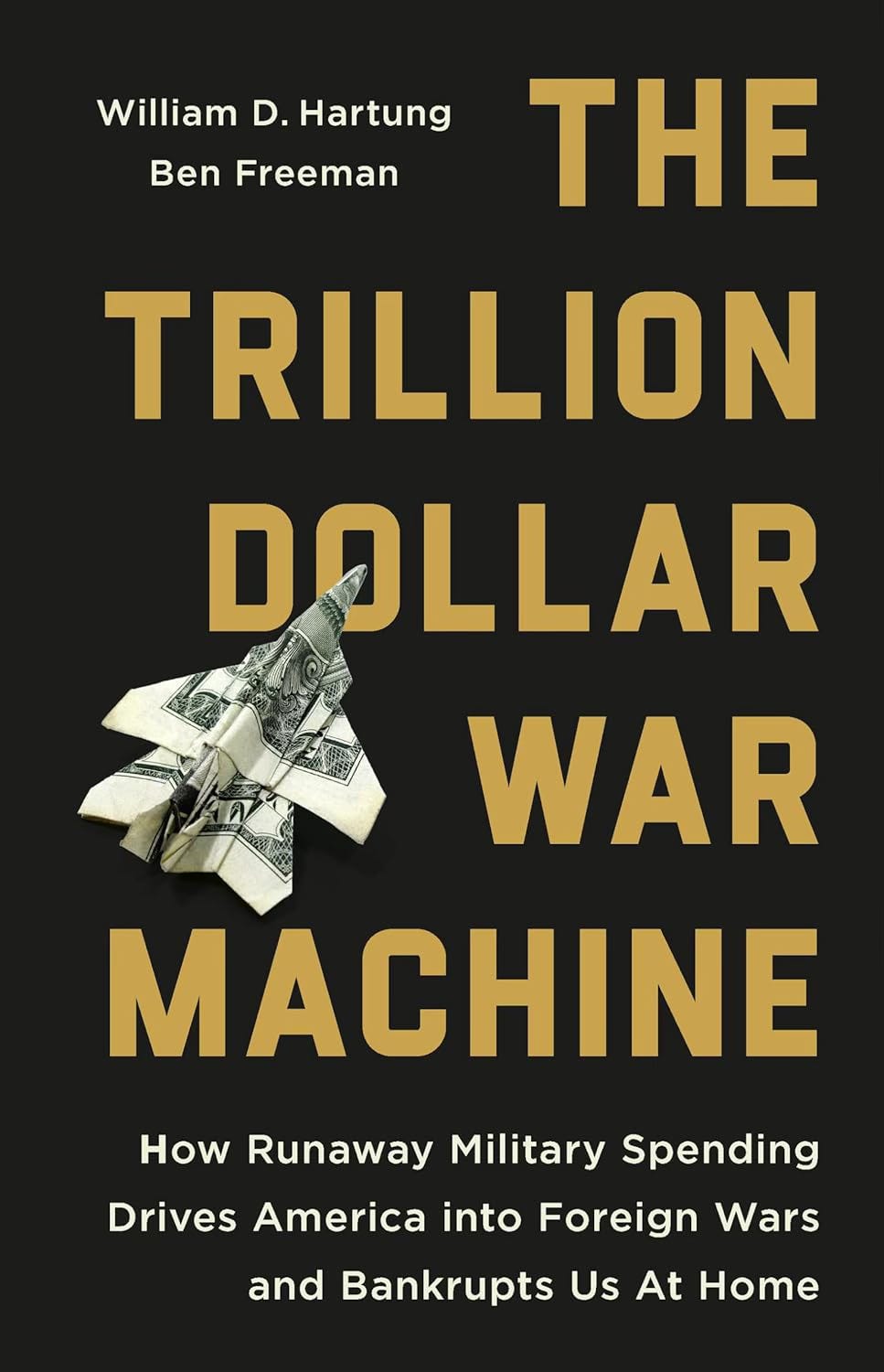
Wow. Just wow. That was my response after reading “The Trillion Dollar War Machine” by Bill Hartung and Ben Freeman. The book’s subtitle captures the “wow” part succinctly: “How runaway military spending drives America into foreign wars and bankrupts us at home.” And now, naturally, President Trump wants even more money for that runaway war machine: an almost unimaginable $500 billion more for FY2027. Egads! How did America’s so-called elites come to embrace war and weapons so wholeheartedly, so lustily, so greedily?
Many of the answers to that question are provided by Hartung and Freeman. They cite and explore President Dwight D. Eisenhower’s famous warning from 1961 about an emerging military-industrial complex. They explain how Congress is complicit in the growing power (and dangers) of the MIC, funding incessant warfare overseas and explosive spending on (often overpriced and largely ineffective) weaponry like the F-35 fighter and the Littoral Combat Ship (known colloquially as “little crappy ships”). Corruption, they show, is baked into the system: the corruption of the revolving door that spins so easily between the military, think tanks, the government, and weapons makers like Boeing and Lockheed Martin. It’s all thoroughly shocking as well as depressing.
Hartung and Freeman, both experienced researchers, know the MIC well. They also know it’s more than the MIC: it’s more like the MICIMATTSHG, or the military-industrial-congressional-intelligence-media-academe-think-tank-sports-Hollywood-gaming complex, so thoroughly has profiteering through militarism and war permeated American culture and society. Military and weapons funding is so colossal it’s seemingly everywhere even as it adds inexorably to the U.S. debt while contributing to military adventurism that further deepens that same debt. Small wonder that our national debt clock is fast approaching $39 trillion. It’s a golden dome of debt!
Reading this book made me think back to another classic account of the MIC and its many follies: James Fallows’s “National Defense.” That book came out in 1981, just as the “defense” buildup under President Ronald Reagan began. Timely as that book was, the Pentagon and its many camp followers were and are rarely forced to retreat when confronted by sensible and logical analysts. I fear this latest effort by Hartung and Freeman, much needed as it is, will similarly be ignored by a purblind Pentagon always in pursuit of power irrespective of the cost.
That would truly be a shame, not only for Americans in general but for the Pentagon as well. Hartung and Freeman aren’t anti-military: they’re pro-defense when defense is smart, effective, thrifty, and focused on upholding the U.S. Constitution. Everyone in uniform, indeed everyone without a uniform, should read this book. You really should know where so much of your taxpayer dollars go—and how much of that money is being wasted by a system that is not only burning your money but weakening America as a democracy. (Indeed, when it comes to money, the Pentagon may be the ultimate burn pit.)
Buy it, study it, absorb it. As Sun Tzu said, it’s smart to know your opponent. Far too often, the military-industrial complex is exactly that.
Two headlines caught my eye this AM in my email media stream.
From the New York Times: “How the Trump Administration Rushed to Judgment in Minneapolis Shooting”
There was no “judgment” displayed in the execution of Alex Pretti. The Trump administration blatantly, maliciously, and viciously lied about what happened. Video evidence incontrovertibly shows that the Trump administration lied. Period.
Trump officials simply didn’t and don’t care about the truth. About justice. About the life of a U.S. citizen. They only care about their own petty lives and violent narratives. Anyone who gets in their way is a potential “domestic terrorist.” They’re sending a loud message clearly: resist us and you’ll end up bloodied in the streets—and maybe dead.
All governments lie, as I.F. Stone famously reminded us. But rarely can I remember lies of such obvious viciousness about regular people whose only real crime is exercising their right to dissent in democracy.
The other headline was this one from the Boston Globe: “Maine and Minnesota: A tricky tale of ICE surges in two states.”
What had been a careful, rhetorical balancing act has begun turning to increasing anger after the shooting of Alex Pretti, a 37-year-old Veterans Affairs nurse, in Minneapolis
*****
There’s that word again: Surge. Remember the U.S. military “surges” in Iraq and Afghanistan? Remember how those “surges” in troops and violence were supposed to win those wars for America? How did that work out for us?
We know how. Both surges failed, but they did succeed in producing a lot of dead Iraqis and Afghans (“foreign terrorists”) along with U.S. troops killed and wounded in action.
“Surges” are not how you win wars, whether overseas or here at home. In fact, surges in Iraq and Afghanistan were admissions of a sort that the wars were already lost; their main purpose was to show resolve and to provide political cover for dishonest leaders like George W. Bush, Dick Cheney, and Barack Obama.
But government officials have an amazing capacity not to learn. Their “solution” is always to show resolve through military and/or police action. Nothing is “won,” nothing is achieved, and the main product is more blood in the streets.
Isn’t it nice to know that your government reflexively views you as a “domestic terrorist” if you exercise your right to assemble and protest? Especially if you inconveniently get shot and killed by an ICE agent?
Last January, I published “My Father’s Journal,” which recounts my dad’s experience surviving the Great Depression, serving in the Civilian Conservation Corps in Oregon fighting forest fires, military service in the Army during World War II, and bringing up five children during the “Baby Boom” years of the 1950s and 1960s while serving as a city firefighter. If you’re interested, it’s available at Amazon for $10 for the paperback and $5 for the Kindle version. Follow this link, and thanks!
*****
I received two interesting queries this week, one on Blitzkrieg and the other on how much the U.S. spends on weapons and war. On the first subject, I was asked about the characteristics of Blitzkrieg, when the concept was developed and seen in battle, and for post-World War II examples. I was also asked about Russia-Ukraine and the recent U.S. attack on Venezuela. Here are my answers:
1. Speed, surprise, combined arms, and disruption are the main characteristics of Blitzkrieg. “Combined arms” refers to all combat arms working synergistically, i.e. infantry, armor, artillery, supported by air forces (nowadays, drones might be involved in large numbers). Special forces like airborne units may also be involved. Deception and misdirection are also aspects of Blitzkrieg. The fundamental idea is to move and maneuver so quickly that the enemy can’t keep pace–to disrupt the enemy’s cohesion. To place them in an untenable position where they have to withdraw or perhaps even surrender.
2. Blitzkrieg, though associated with Nazi Germany in World War II, is an old concept in warfare. Perhaps the best practitioners were the Mongols in the 13th century. The Western concept has its roots in World War I and the stalemate of trench warfare. Ideas associated with what became known as Blitzkrieg were tried on various World War I battlefields. The idea was to break the stalemate of fixed lines and fortifications without getting into costly battles of attrition. These ideas came to maturity in World War II.
3. Blitzkrieg, perhaps ironically, is sometimes attached to the Israeli Defense Forces, as in their attacks in 1967 in the Six Day War. You might say the USA used Blitzkrieg against Iraq in 1991. Russia’s initial attack on Ukraine in 2022 was not a Blitzkrieg–it was more of an uncoordinated show of force that backfired. The USA attack on Venezuela was a “snatch and grab” kidnapping, not a military campaign per se.
*****
The second query focused on how much the U.S. spends on weaponry and war and how we measure that as a percentage of the federal budget. Here’s my answer to that:
Yes, it’s a numbers game. If you include all federal spending (including non-discretionary spending like social security and Medicare/Medicaid), it’s a smaller percentage. Roughly 15% of the federal budget.
If you focus on discretionary spending, it’s more than 50%. It depends on how you count it. If you add Pentagon spending to Homeland Security, the VA, the DOE (nukes), and interest on the federal debt due to wars and military spending, the percentage is 60% or even higher.
When the warmongers really want to minimize war spending, they compare it to GDP.
*****
No matter how you measure it (or attempt to minimize it), a trillion dollars is a lot of money. Of course, the best way to think of “defense” spending is from President Dwight D. Eisenhower’s “Cross of Iron” speech in 1953:
Every gun that is made, every warship launched, every rocket fired signifies, in the final sense, a theft from those who hunger and are not fed, those who are cold and are not clothed. This world in arms is not spending money alone. It is spending the sweat of its laborers, the genius of its scientists, the hopes of its children… This is not a way of life at all, in any true sense. Under the cloud of threatening war, it is humanity hanging from a cross of iron.
That is the true cost of spending on weapons and war.
There are at least 30 trillion reasons why the Trump administration is waging war against Venezuela. Recall that Venezuela has proven oil reserves of 300 billion barrels. If those barrels average $100 over the decades of their extraction, that’s $30 trillion, an immense sum representing about 80% of America’s colossal national debt. Of course, most of those trillions will go to multinationals and billionaires, not to the American people—and certainly not to the Venezuelan people. But who said life is fair?
The so-called Donroe Doctrine of hemispheric dominance represents the return of unapologetic gangster capitalism. The basic policy of the Trump administration recalls Michael Corleone, the mafia don in “The Godfather” saga. When his consigliere Tom Hagen (played by Robert Duvall) asks Michael (played by Al Pacino) whether he has to wipe everyone out, Michael coldly replies “Just my enemies.” Anyone who defies the Corleone Family must be eliminated.
Maduro defied the Trump “family” so he had to be taken out. Cuba and Iran may be the next “enemies” to be “wiped out.”
As Trump once said in an interview, the U.S has plenty of killers. This is what the exercise of naked power looks like. Power without morality. Power without principles other than profit and the further consolidation of power.
U.S. democracy is a sham. We have shamocracy. Thugocracy. The strong do what they will; the weak suffer as they must. What matters is control, power, and profits.
Again, as Caitlin Johnstone noted, Trump has been transparent about his motives. Put bluntly, it’s the oil, stupid.
“We’re gonna take back the oil that frankly we should have taken back a long time ago,” Trump told the press following Maduro’s abduction, saying “We’re going to be taking out a tremendous amount of wealth out of the ground, and that wealth is going to the people of Venezuela, and people from outside of Venezuela that used to be in Venezuela, and it goes also to the United States of America in the form of reimbursement for the damages caused us by that country.”
“We’re going to have our very large United States oil companies, the biggest anywhere in the world, go in, spend billions of dollars, fix the badly broken infrastructure, the oil infrastructure, and start making money for the country, and we are ready to stage a second and much larger attack if we need to do so,” Trump said.
“We have tremendous energy in that country. It’s very important that we protect it. We need that for ourselves, we need that for the world,” the president added.
Trump is America’s most scrutable president. He doesn’t bother to hide his motives here. This is theft, impure and very simple. We have the power to take it and we will, full stop.
I’m a Mutt-American. I’m half Italian, 3/8th English, and 1/8th Swedish. But I’ve never thought of myself as other than 100% American.
Ancestors on my mother’s side go back to the 1630s when they came across the Atlantic to the Massachusetts Bay Colony. Surnames like Wilder, Bird, and Hayward. I’ve been able to trace them back to England and to specific regions, even to ship’s names that they took in emigrating to the New World. At least one of my mother’s ancestors fought in the American Revolutionary War. Take that, J.D. Vance.
Another ancestor on my mother’s side, surname of Johnson, came from Sweden in the 19th century. He was a janitor. Other ancestors were reverends, clockmakers, and tanners, among other occupations. Again, typically American.
On my father’s side, his parents came from Italy in 1902 and 1913, so in that sense my American pedigree is more recent. That said, my father and his two brothers all served in World War II, my dad staying stateside as his two brothers served overseas, one in Europe, the other in the Pacific.
I think my family background is about as typical, as unexceptional, about as “normal” as they come. Unless you are of Native American ancestry, your roots here in America are fairly shallow, relatively speaking. A few centuries at best—not much on the cosmic timescale.
I mention all this because of the Trump administration’s vilification of immigrants, notably so-called illegals. Yes, I think people should immigrate legally to this country, but I don’t think anyone should be demonized.
Ilhan Omar, American (official portrait, 2019)
Trump in particular likes to attack Congresswoman Ilhan Omar, who is a Somali-American. His harsh rhetoric against her is dangerously irresponsible as well as hateful. I see Omar as akin to my Italian grandmother, who proudly became a naturalized U.S. citizen in 1945.
Trump is a remarkably puny man—a man who thinks he can puff himself up by belittling others. It’s shameful behavior. He should be impeached by Congress and removed for his un-American attacks that endanger other lawmakers—that demean others, that sow discord.
So many immigrants came (and come) to this country seeking a better life, a fresh start, a land where you really could be judged by the content of your character. In its attacks on immigrants, the Trump administration has shown itself to be characterless and wanting of the true American spirit.
Unless you’re Cheyenne or Pawnee or Iroquois or some other kinship group drawn from indigenous peoples, you’re a recent American, and probably a Mutt-American like me. As Americans, we’re all in this together—all equal under the law, all striving to form a more perfect union.
Well, except for Trump and his tribe of dividers. It’s high time they left America. Perhaps Elon Musk has a few rockets ready to send them to the Moon and beyond.
It’s been a busy week of news. Here are four items that stood out.
A group of Democratic members of Congress released a short video addressed to the U.S. military, reminding service members that they may refuse unlawful orders. President Trump denounced the video as “seditious behavior” and said such behavior was “punishable by death,” even resharing posts calling for the lawmakers to be hanged. The Democratic message itself was partisan and thin on specifics, but Trump’s response was far more troubling. U.S. troops already know they can and should refuse unlawful orders—though determining what is lawful in practice is rarely simple. What struck me most was the timing: Democrats issued this warning to the troops in response to Trump, but I don’t recall a similar concern when President Biden continued military support to Israel amid mounting accusations from human-rights bodies of grave—indeed, genocidal—violations in Gaza.
In sum, Congress should confront questionable executive actions directly rather than shifting responsibility to Lieutenant Smith or Corporal Jones.
The Trump administration has floated a 28-point plan to end the Russia-Ukraine War. Reports indicate the plan involved Russian input but did not include Ukraine or key European partners. Unsurprisingly, many provisions cross Ukraine’s stated red lines. Diplomacy is still preferable to endless war—jaw-jaw over war-war is a sound motto—but it’s hard to see this plan gaining real traction, especially when it seems designed more to satisfy Washington and Moscow than Kyiv.
One thing is certain: Ukraine is learning that when you dance with elephants, you’re likely to get trampled.
Marjorie Taylor Greene has announced her resignation from Congress, effective January 5, 2026. This surprised me. I read her resignation letter and, despite disagreeing with much of her politics, I respected her consistent opposition to regime-change wars and her outspoken criticism of Israel’s genocidal effort in Gaza and of the undue influence of AIPAC and similar lobbies. She is also right to highlight how far our government has drifted from serving America’s working and middle classes.
MTG, as unlikely as it sounds, is a viable candidate for the Republican nomination for President in 2028, assuming Trump obeys the Constitution and steps aside.
The UN Security Council has approved a U.S.-sponsored Gaza resolution, with Russia and China abstaining. Their decision not to veto suggests a calculation: let Washington bear responsibility for the consequences of its own neocolonial proposal. The plan itself looks like a thinly veiled endorsement of a murderous status quo—one that provides political cover as Gaza remains strangled and devastated. If the United States is now the guarantor of this “peace,” then it also owns the moral and political fallout. If anything, this “peace” plan will only provide cover for Israel’s ongoing genocide in slow motion.
Which brings me back to unlawful orders. Any U.S. service member asked to support actions that clearly violate international law has a duty to refuse. Yet the Democrats who admonished troops about unlawful orders seemed focused only on hypothetical abuses under Trump, not on real-world concerns about U.S. support for Israel’s genocidal operations in Gaza. For too many in Washington, unwavering support for Israel overrides legal, moral, and humanitarian considerations.
Readers, what did you make of this week’s events? One thing seems certain: we continue to live in “interesting times.”
War and rumors of war dominate the headlines. Venezuela. Nigeria. Iran. Somalia. A “new Cold War” involving Russia and China. What are we to believe?
The events of the 62 years of my short life (Vietnam, Afghanistan, Iraq, Libya, peace dividends that never arrive, military budgets that keep soaring, U.S. domination of the world’s weapons trade, the National Security State as America’s fourth and arguably most powerful branch of government, and on and on) make me highly suspect of official narratives about any war, especially as those same Pentagon budgets soar and those same arms exports keep flooding the world in the (false) name of democracy.
Nevertheless, warmongers in our country continue to shout and bray for more war. Those who make the most noise are typically the furthest from the fighting. Typically, the closer you are to the fighting, the more you want it to stop. Especially if you’re doing the fighting. Consider Erich Maria Remarque’s “All Quiet on the Western Front.” When the main character, Paul, a frontline grunt, goes home on leave, he realizes the blood-thirstiness of the REMFs is far different from the war he’s seeing at the front. (REMF, rear-echelon mother-fucker, is a colorful and meaningful military acronym.)
Often those who talk about war use the most bloodless expressions. So, for example, I’ve read that Ukrainians must “prosecute their war of defense,” helped by generous supplies of American-made weaponry. When I think of war, I think of the concrete. Blasted bodies, a poisoned environment, disease, dead animals, PTSD and TBI, moral injury, atrocities and war crimes (because wars always produce atrocity), and so on. Phrases like “help Ukraine prosecute their war of defense” strike me as Orwellian in the sense of his classic essay on politics and the English language. It sounds good and noble, but how ready are those who support Ukraine to join the cause in the trenches?
An American president now speaks of “the enemy within” and city streets as a training ground for U.S. military action. When everything is war, nothing is safe as the worst crimes and atrocities become possible.
As a young man, Cheney had “other priorities” than serving in the U.S. military. Later, the further he was from battle, the more hawkish he became.
Postscript: As I was writing this, I learned that Dick Cheney has died at the age of 84. NBC News described him as the “Iraq war architect,” as if he was a highly skilled and creative builder instead of a war criminal. A reader sent along a BBC headline that suggests there was “faulty” intelligence leading up to the Iraq war in 2003, as if Cheney had no hand in manufacturing a malicious and mendacious narrative of weapons of mass destruction in Iraq.
Even warmongers like Cheney, proud of their mailed fists, get treated and fitted with kid gloves by a fawning media. Of course, Cheney, when he had an opportunity to serve in Vietnam, famously said he had other priorities.
Maybe the American people, collectively, need to say we have other priorities than waging war around the globe.
Remember when politicians had some notion of public service? That ideal now feels positively antediluvian.
What I’d really like to see is a genuine commitment to public service—especially from the most powerful figures in our government. That should begin with a reaffirmation of their oath to the U.S. Constitution as the supreme law of the land, and with a renewed dedication to transparency. Citizens have a right to privacy; the government, by contrast, should not. Yet today we have an unaccountable government that routinely hides behind “that’s classified” or the dark humor of “we could tell you, but then we’d have to shoot you.”
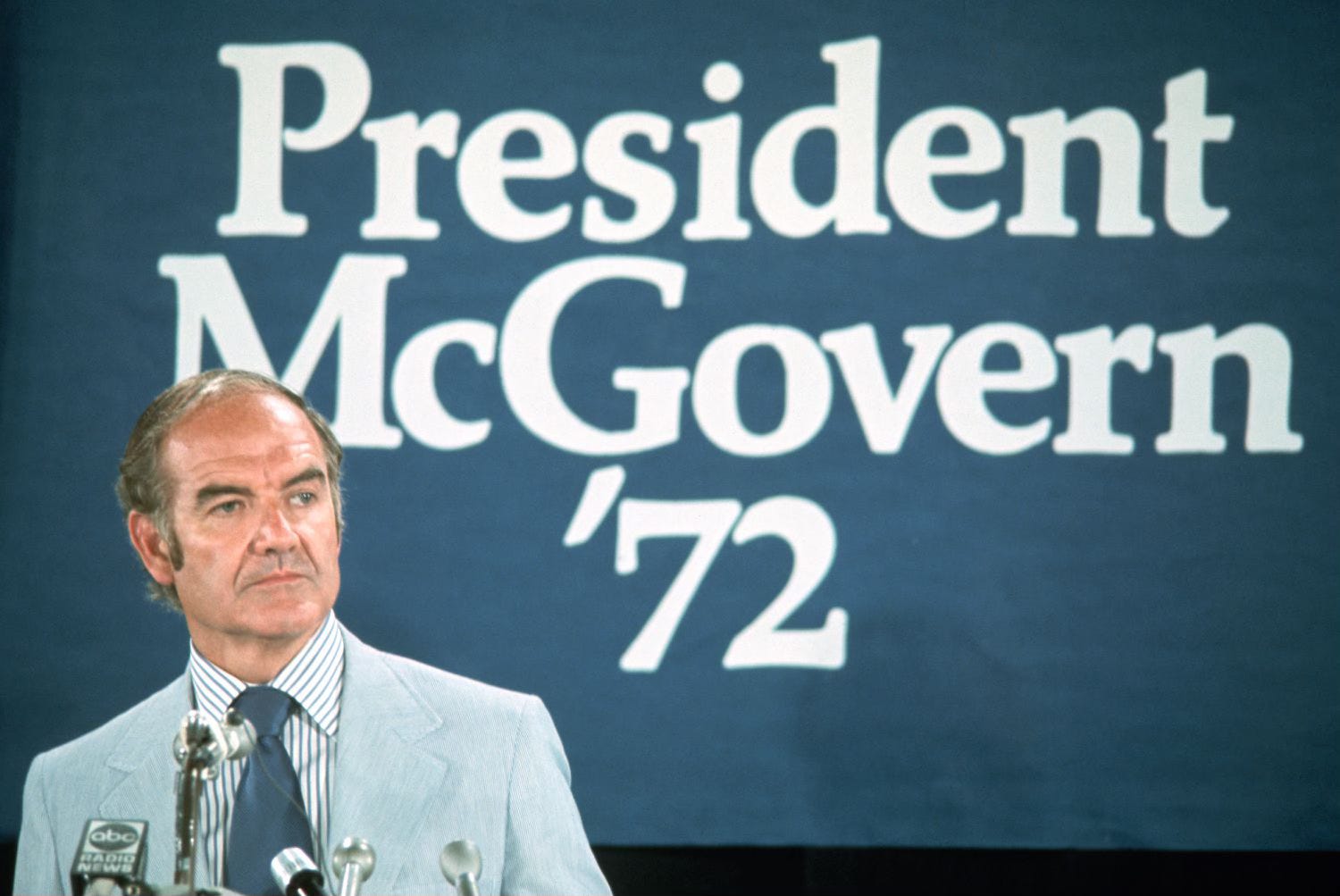
George McGovern, a true public servant
True public service also means not profiting from one’s position. I’d gladly support higher salaries for members of Congress if they swore off investing in sectors where they hold influence or privileged information. (Nancy Pelosi comes to mind, though she’s hardly alone in benefiting through dubious if technically “legal” means.) When, exactly, did public service turn into a “get rich quick” scheme?
It would also be refreshing if members of Congress, retired generals and admirals, and other officials were barred from becoming corporate lobbyists for at least ten years after leaving office. The revolving door between government, industry, and the military breeds conflicts of interest that corrode the public trust.
Once, public service was seen as sacrificial—and therefore honorable. Today, it’s often self-serving, self-enriching, and self-glorifying. Those in power increasingly see themselves as big fish—if not outright sharks—while the rest of us are left as so many minnows, or worse, chum.
It’s hard to imagine America becoming “great again” when the very notion of public service has come to be regarded as something only a sap would believe in.








 Bracing Views