In Iraq, Afghanistan, and elsewhere, the U.S. military is fairly good at projecting power. Indeed, the military prides itself on “global reach, global power,” achieved through a worldwide system of bases and funded by enormous amounts of “defense” spending. What the U.S. military is not so good at is understanding foreign cultures. Often, it seems the number one goal of military interventions is selling weapons to armies in the countries in which the U.S. military intervenes, so-called foreign military sales or FMS for short. This is true of Iraq, Afghanistan, and now many countries in Africa, as Nick Turse has shown in several groundbreaking articles at TomDispatch.com.
The U.S. military is “can-do” when it comes to projecting power, and “can-do” when it comes to building host nation armies (of course, the reliability of those armies, such as the Afghan National Army, is often highly suspect, even after a decade of training and billions of dollars in weapons and related equipment). But what the military always gives short-shrift to is cultural understanding. Cultural gaps are either ignored or dismissed as irrelevant (“Grab them by the balls and their hearts and minds will follow”) or bridged in ways that ultimately reveal how little we know about the foreign peoples on the receiving end of American largesse.
I learned this firsthand about ten years ago when I was at the Defense Language Institute (DLI) in Monterey, California. Of all things my lesson came as the result of a Peter, Paul, and Mary song. While I was the Associate Provost at DLI, the school received an urgent request from a U.S. official working with Iraqi schools. The official wanted help translating the song, “Don’t Laugh At Me,” from English to Arabic. The song, which appears on the Peter, Paul, and Mary CD Songs of Conscience & Concern, is used in U.S. elementary schools to promote tolerance. Its first lines are “I’m a little boy with glasses/The one they call a geek/A little girl who never smiles/’Cause I have braces on my teeth.” The refrain urges: “Don’t laugh at me/Don’t call me names/Don’t get your pleasure from my pain/In God’s eyes we’re all the same.” Rather safe and innocuous lyrics, one might think.
Yet, translating this feel-good song of tolerance into Arabic was neither safe nor easy. After gathering our best Arabic translators, we quickly learned that even the simplest lyrics posed problems of translation. What about that geeky American boy with glasses, the one being taunted for being bookish? Our translators, many of whom hailed from Middle Eastern countries, explained that in Iraq he would most likely be admired and praised for his smarts. How about that American girl with braces, so reluctant to smile? Well, most Iraqi kids would be fortunate indeed to have access to orthodontia. In an Iraqi cultural context, laughing at geeks with glasses or girls with braces just didn’t translate.
And if such seemingly simple lines as these were untranslatable due to the culture gap, what about lines like “I’m gay, I’m lesbian, I’m American Indian,” or even more treacherously, “A single teenage mother/Tryin’ to overcome my past”? Best not go there, we concluded.
I learned a lot from this experience. If we can’t translate seemingly harmless song lyrics to promote diversity and tolerance, how do we expect to “translate” democracy?
It seems the military’s answer to this is to focus on what needs no translation: violence. So the goal is to build host armies and police forces and to sell them weapons while building fortress-like American embassies (in Iraq and Afghanistan) or American bases (which are mini-fortresses) to watch over the benighted buggers of the world.
Some might say that warm guns serve as universal translators. But a harsher conclusion is this: That we are indeed translating our culture overseas: a culture built less on tolerance than it is on violence.
Eleven years after my freshman essay on the Vietnam War in 1982, I found myself at Oxford in a Strategic Studies Seminar. For that seminar, I wrote the following paper on People’s War and Vietnam. Based on deeper reading and more reflection than my freshman essay, I concluded that the Vietnam War had been unwinnable for the United States. Note that this paper was written soon after the apparently decisive victory of the U.S. military over Iraq in Desert Storm. This victory had supposedly cured the U.S. military of its Vietnam Syndrome, a claim which I doubted at that time. Again, I have decided not to edit what I wrote in early 1993 about Vietnam. This paper is what one young Air Force captain thought about the meaning and legacies of the Vietnam War in the early 1990s, with all the biases of a serving military officer intact.
Insurgencies and America’s Defeat in Vietnam (Written in January 1993)
A revolutionary war is a war within a state; the ultimate aim of the insurgents is political control of the state. Nowhere is Clausewitz’s dictum of war as a continuation of politics more true than in a revolutionary war. It typically takes the form of a protracted struggle, conducted patiently and inexorably, a variant of Chinese water torture. Educating or, more accurately, indoctrinating, the people – gaining their sympathy, cooperation, and assistance – is paramount. And all people have a role to play: men and women, young and old. After World War II, insurgencies have been guided by Mao Zedong’s concept of People’s War, and inspired by a complex combination of nationalism, anti-colonialism, and communism. They have bedeviled France, Great Britain, and the United States. This paper addresses the strategy of People’s War in terms of means, ends, and will, and details some of the reasons why the United States lost the Vietnam War.
The strategic end of People’s War is simple in its boldness: the overthrow of the existing government and its replacement with an insurgent-led government. The means are incredibly complex, encompassing social, economic, psychological, military, and political dimensions, but it must be remembered that all means are directed towards the political end. Strength of will usually favors the insurgents, partly because a major goal of People’s War is to mold the minds of its followers to convince them of the righteousness of their cause.
People’s War passes through three stages. At first the insurgents get to know the people as they spread propaganda and build a political infrastructure. Every insurgent is an ambassador for the cause. They create safe havens while intimidating opponents and neutrals, and they commit terrorist acts to undermine the legitimacy of the government. They build their safe havens on the periphery of the state, usually in rural or impoverished areas where they can feed on the misery of the people. The more difficult the terrain, the better, whether it be the mountains of Spain and Afghanistan or the jungles of Malaya and Vietnam. They extend their control over the countryside and into the urban areas during the second stage of People’s War. They use guerrilla tactics and terrorism to further undermine the political legitimacy of the government. The main target is not the government’s troops but the will of its leaders. As they extend their physical control over the countryside, they install their own political structure to control the people. With the government’s will fatally weakened, the insurgents move to the final stage: a conventional military offensive to overthrow the government.
The three stages are not rigidly sequential, however. For example, while conducting guerrilla operations against the government, the insurgents continue to build their infrastructure, conduct terrorist acts, and spread propaganda. Even during the last stage — the general offensive — the insurgents continue stages one and two. This aspect of People’s War was well expressed by John M. Gates in the Journal of Military History in July 1990:
American conventional war doctrine does not anticipate reliance upon population within the enemy’s territory for logistical and combat support. It does not rely upon guerrilla units to fix the enemy, establish clear lines of communication, and maintain security in the rear. And it certainly does not expect enemy morale to be undermined by political cadres within the very heart of the enemy’s territory, cadres who will assume positions of political power as the offensive progresses. Yet all of these things happened in South Vietnam in 1975….
Flexibility, judgement, and comprehensiveness of methods are the keys to success. If the insurgents overestimate the weakness of the government and lose large-scale battles, they slip back into the earlier two phases and continue to work towards weakening the government for the next general offensive.
It bears repeating the primary goal of insurgents is political control. Military actions are only one tool for obtaining this control. As Mao cautions, guerrilla operations are just “one aspect of the revolutionary struggle.” The insurgent appeals to the hearts and minds of the people. He is, after all, one of them. Too much can be made of Mao’s “fish and sea” analogy. The insurgent is not just a fish that swims in the sea of the people: his purpose is to convert the sea to his purpose. He employs any method to command the sea to his will. He would prefer ideological converts, true believers, but converts through terror are acceptable. Those who can’t be converted he ruthlessly kills. That his methods produce squeamishness among some in the West only accentuates their value to him.
As a strategy, People’s War is difficult but not impossible to counter. The United States defeated the Philippine insurrection in the first two decades of this century, and after World War II Great Britain put down a communist insurgency in Malaya. More famous, however, have been the stunning successes of People’s War: Mao’s victory over Japan and the Nationalists in the 1930s and ’40s, and Ho Chi Minh’s victories over France and the United States in the 1950s, ’60s, and ’70s. Perhaps most unsettling was America’s defeat in Vietnam. How could the world’s foremost superpower lose to, in the words of General Richard G. Stilwell in 1980, a “fourth-rate half-country?”
There are no simple answers to America’s defeat, although Hollywood tells us otherwise. A theory still believed by some in the US military is a variation of the German “stab-in-the-back” legend of the Great War. Our hands were tied by meddling civilians who didn’t let the military fight and win the war. One American soldier is the equal of hundreds of pajama-clad midgets, or so it appears in the Rambo flicks. A wretched, dishonorable government also abandoned our POWs to the godless communists, now rescued several times over by Stallone, Chuck Norris, and other martial arts experts. That such films make money is an affront to the genuine sacrifices of Americans represented so tragically by the Vietnam War memorial in Washington.
Perhaps such sentiments seem out of place in a paper devoted to a dispassionate strategic analysis of America’s role in Vietnam. Yet my feelings are perhaps typical of the emotionalism that still surrounds this topic among Americans. A dispassionate critique from an American, let alone an American service member, may still be impossible; nevertheless, I’ll give it a shot.
The United States lost the war for several related reasons. First, we fought the wrong kind of war. As the Navy and especially the Air Force built up their nuclear forces, the army chaffed against its “New Look” and diminished role in the 1950s. Under Kennedy and Johnson, the Army had a new doctrine – Flexible Response – and an opportunity – the Vietnam War – to prove its worth. Vietnam was to be the proving ground for a revitalized Army.
The opposite proved to be the case because the Army pursued the wrong strategy. From 1965-68, when we sent more than half a million troops to Vietnam, the US Army tried to fight a conventional war against the Viet Cong (VC) and North Vietnamese Army (NVA). As LTG Harry Kinnard, commander of the Army’s elite 1st Cavalry Division (Airmobile), put it, “I wanted to make them fight our kind of war. I wanted to turn it into a conventional war – boundaries – and here we go, and what are you going to do to stop us?” Obeying Mao’s teachings, the VC and NVA wisely avoided stand up fights. The Army responded with search-and-destroy operations to find, fix and kill the enemy. The goal was attrition through decisive battles, reflected by high body counts. Nothing illustrates the bankruptcy of American strategy better than the idea of body counts. In theory, a high body count means you’re killing the fish in the sea, without hurting the sea. In practice, a high body count is a measure of the success of the insurgents: they’re recruiting many fish to their cause. And in killing the fish, Americans poisoned the sea with defoliants, bomb craters, unexploded artillery shells, the list goes on. Americans were stuck in Catch-22 dilemmas: they had to destroy villages to save them, they had to destroy villagers’ crops while pursuing guerrilla bands. Such an approach flies in the face of Mao’s “Three Rules and Eight Remarks,” which exhibit a profound respect for the people and their property.
After killing, or perhaps more often not killing, the guerrillas, the Army left, and the guerrillas regained control of the area. This did not disturb LTG Stanley Larson, who observed that if guerrillas returned, “we’ll go back in and kill more of the sons of bitches.” But the VC and NVA retained the initiative, had plenty of manpower, and time was on their side.
Why did the Army pursue such a faulty strategy? In part due to the legacy of World War II, particularly American experience in the Pacific. In island-hopping to Japan, Americans gained faith in massive firepower and lost interest in controlling land. The islands were a means to an end, not the end itself, and success could be measured in some sense by the number of Japanese casualties. Such was not the case in Vietnam, where control of the land was essential to winning the support of the people. Part of the Army’s problem was its lack of experience in counterinsurgency (or COIN) operations. Ronald Spector reports that in the 1950s, COIN operations were limited to four hours in most infantry training courses. What little was taught focused on preventing a conventional enemy from holding raids or infiltrating rear areas. But in the end, the Army fought the war it was trained to fight: a conventional war of maneuver and massive firepower. This worked well in Desert Storm, but failed in Vietnam.
In contrast to the Army, the Marines were far more aware of the nature of the war they were fighting, reports Andrew Krepinevich. They combined 15 marines and 34 Popular Force territorial troops (who lived in and provided security for a village or hamlet) into combat action platoons (CAPs). These CAPs sought to destroy insurgent infrastructure, protect the people and the government infrastructure, organize local intelligence networks, and train local paramilitary troops. In other words, they adopted traditional COIN tactics. But the Army ran the show in Vietnam, and its leaders rejected the Marines’ approach.
The Marines were not alone in their appreciation of the multidimensional aspects of COIN. Robert Komer’s Phoenix program also targeted the Viet Cong infrastructure, but the efforts of the CIA were not well coordinated with those of the military or the State Department, let alone the South Vietnamese. In fact Westmoreland refused to create a combined command to coordinate American actions with those of the South Vietnamese. The latter were an especially neglected resource.
Admittedly, the Army of the Republic of Vietnam (ARVN) was corrupt and at times incompetent, but part of the problem was caused by American mistraining and the Army’s contempt. In the 1950s, American military advisors trained ARVN to repel a conventional invasion from the north, using North Korea as a model. From 1965-68, the US Army gave ARVN the static security mission, judged to be of low importance by the Army. US advisors assigned to help ARVN recognized their careers were endangered: they would advance far quicker if they had “true” combat assignments. After years of neglect, ARVN was built up with billions of US dollars during Nixon’s Vietnamization policy (and that’s exactly what it was – a policy, not a strategy), but by 1969 the rot had gone too far. ARVN lacked a unifying national spirit, VC agents had penetrated the ranks, and the officers were thoroughly politicized. Our ally always thought we’d be there if they ran into trouble, but they didn’t understand how American government worked. As Ambassador Bui Diem explained in 1990, “Our faith in America was total, and our ignorance was equally total.” South Vietnam paid the price in 1975.
Could the United States have won the Vietnam War if we had followed a proper strategy? This question may be unanswerable and ultimately moot, but it’s worth discussing. First, one must admit the war may not have been worth winning. Hannah Arendt has stated the Vietnam War was a case of excess means applied for minor aims in a region of marginal interest. In retrospect this seems irrefutable, but in the climate of the Cold War and Containment Vietnam seemed a critical theater in which communist aggression had to be stopped. Second, one must admit the United States was not protecting a viable government in South Vietnam: we were trying to create one. But we were creating one in our image. We ignored the Vietnamese culture and destroyed their economy with our hard currency. Rear area troops with money to spend spread prostitution and drugs in the streets of Saigon. In short, we alienated the people instead of winning them over to our cause. The few people we did win over were terrorized and often killed by the Viet Cong. Even following a proper COIN strategy, victory would have taken 5-10 more years at least. With weak support from the American people, (the “Silent Majority” was silent due to its ignorance and ambivalence), which waned dramatically after Tet, we never had a chance in Vietnam.
The one strategy that would have succeeded for the United States, I believe, is Mao’s People’s War. We must not deceive ourselves: if free elections had been held as promised in 1956, Ho Chi Minh would have won and unified the country. His was the legitimate government; we were trying to overthrow that government and replace it with almost any non-communist regime. In that effort, we should have formed an alliance of military, state department, intelligence, and academic resources to educate Americans in Vietnamese language and culture. These experts, with a suitable, politically-indoctrinated military force to protect them, would win the hearts of the people. Our main weapons would be our ideas and the ideological fervor of our troops, whether civilian or military. Diplomacy and military strikes would be used to cut-off the flow of arms to the VC and NVA from the Soviet Union. The political infrastructure of the enemy would be targeted, including Ho Chi Minh himself.
But this is ridiculous. Our very arrogance blinded us to the war’s complexities. We attacked the symptoms of the disease – the guerrillas and NVA -without examining what caused the disease in the body politic. Our can-do attitude was reinforced by our military traditions and our pride in our nation as being more moral than the rest of the world. We became our own worst enemy as we tried to manage the war. The commitment was there (at least among the soldiers), the energy was there, the money was there, the technology was there -the strategy, intelligence, and leadership wasn’t. People’s War proved superior to search-and-destroy, the VC and NVA intelligence proved superior to ARVN and ignorant Americans, the brilliant Giap out-thought the dedicated but shortsighted Westmoreland. The Vietnam War was ultimately unwinnable.
In the aftermath of the American-led victory over Iraq in Desert Storm, many Americans predicted the stigma of our defeat in Vietnam had finally been exorcised from our minds. Such was not the case, nor is such a result even desirable. The “dreaded V-word,” as the London Times recently described it, is being whispered again in the endless corridors of the Pentagon. If this breeds an aversion to the use of military force, harm may result; but if it leads to more thought and a more subtle study of the efficacy of military force as applied under different conditions, the dreaded V-word will have served a useful purpose, and those names engraved on the Wall in Washington will not have died in vain.
Much like my father, I can be a pack rat. Going through old files, I found a “blue book” exam that I took as a college freshman in 1982. The essay question I had to answer was whether the U.S. could have won the Vietnam War. Recall that in 1975, South Vietnam had fallen to the communist North Vietnamese invaders, with U.S. diplomats ignominiously escaping by helicopter from the roof of our embassy in Saigon. In the 1980 Presidential Election, Ronald Reagan defeated Jimmy Carter, with Reagan declaring that the unpopular Vietnam War had been “a noble cause.”
I have not edited my answer (except for a few additions, in brackets, for clarity), which follows below. This is what one U.S. college freshman thought about Vietnam and the U.S. involvement in that war seven years after the defeat in 1975. (You can’t even call it sophomoric, since I was only a freshman.) I think my answer reflects a certain naivete as well as can-do optimism: That we were fighting for the right reasons but in the wrong way, and if we had followed a better strategy, and bossed around the South Vietnamese more, we could have, in some sense, “won.”
Today, I don’t believe the Vietnam War was winnable, and I lament the enormous amount of destruction we visited on the Vietnamese and their country, which I’ve written about in other articles, here and here for example.
Update (8/27/2014): Having watched the recent HBO documentary Nixon by Nixon: In His Own Words, it’s now glaringly obvious that the Vietnam War was unwinnable. Indeed, that’s precisely what Nixon and Kissinger (secretly) concluded. As they talked publicly about “peace with honor,” Nixon and Kissinger were privately conceding that the war was lost. They were looking only to deflect blame from themselves, for “a decent interval” between when US troops withdrew and when South Vietnam collapsed, which is exactly what they got — roughly three years, by which time Nixon had resigned in disgrace due to Watergate. Nixon and Kissinger also cast about for scapegoats; at the time, they planned to blame the inevitable defeat on the corruption of South Vietnamese leaders.
Why did the U.S. lose in Vietnam? A big reason, I think, is the dishonesty of our own government in consistently misleading the American people about the war and the region as well. This dishonesty started just after World War II and extended to LBJ and Nixon as revealed in “The Pentagon Papers.” In other words, Nixon’s “silent majority” wasn’t silent because it supported his policies. It was silent because it had been lied to by Nixon and his predecessors. If the U.S. government had had the guts to level with the American people, the worst of the war may have been averted. Even Watergate would have been averted, since you can draw a clear line from Daniel Ellsberg and “The Pentagon Papers” to attempts to “get” Ellsberg to the “dirty tricks” of the Nixon Campaign in 1972 that ended in his resignation. Lies begat crimes that begat more lies that begat more crimes…
[Winning the Vietnam War, as written in March of 1982]
The Vietnam War was a costly struggle involving over 500,000 U.S. troops [at peak deployment strength] and billions of dollars of equipment. The war was attacked both at home and abroad, and when the U.S. finally did pullout in 1972, the South Vietnamese government and the ARVN [Army of the Republic of Vietnam] collapsed in three years. The Vietnam War was a failure of U.S. foreign policy making, but if other alternatives had been pursued, the results would have been much better for the United States.
The U.S. became involved in Vietnam to contain communism, to prevent the takeover of South Vietnam by North Vietnam, and to contain China. Unfortunately, the U.S. underestimated the strength of the North Vietnamese will, and turned a local civil war between two conflicting ideologies into a major conflict. The U.S. believed that South Vietnam was a vital area of American interest, but it really wasn’t.
The South Vietnamese government was politically inefficient and corrupt. Most of the natives did not support the government, which was why the Viet Cong were able to succeed the way they did. U.S. foreign policy concentrated on defeating the Viet Cong and the North Vietnamese Army, not realizing that the reform of the South Vietnamese government and the pacification of the local villagers were of more importance.
What could we have done, then, to “save” South Vietnam from North Vietnam? The answers are not concrete or exact. Most people believe that if the U.S. Army had had fewer restrictions and more men, North Vietnam would have lost. This pedestrian view is wrong for two basic reasons. One is that the U.S. Army fought the wrong type of war. Instead of conducting counterguerrilla activities, the U.S. Army adopted tactics intended for conventional warfare in Europe. The U.S. tried to defeat North Vietnam by sheer firepower, but superior numbers and materiel lose their advantage against a determined guerrilla enemy. Employing hit-and-run tactics, the Viet Cong fought only when they wanted to fight, and on ground of their choosing. Cincinnatus [Cecil B. Currey], in his book Self-Destruction:[The Disintegration and Decay of the United States Army during the Vietnam Era] stated that the U.S. Army could not have won the war because of the way they fought it.
The second reason is that each escalation of American troops in Vietnam could be easily matched by North Vietnam. Each year over 200,000 men [in North Vietnam] became eligible for the draft. When General Westmoreland asked for 200,000+ troops to launch a major counteroffensive after Tet [in early 1968], he was denied them on the grounds that more numbers would have had little or no effect in ending the war.
What can one conclude from this? A definite conclusion is that U.S. tactics were totally unsuited to the type of war fought in Vietnam. This suggests one change in our policy that would have improved the result. If we had pursued a policy of counterguerrilla warfare, and if we had protected the local villagers better, then we could have concentrated on the main problem—reforming the South Vietnamese government and creating an ARVN that didn’t lose every battle they fought.
The Vietnamization policy [under Nixon] was a step in the right direction, but it was implemented haphazardly and inefficiently. U.S. foreign policy should have recognized that the support of the government by the people was of paramount importance, but needed reforms [in South Vietnam] were not carried out and the people became disillusioned and bitter. If the government cannot protect us, the people thought, what good was it? The U.S. should have forced the various South Vietnamese governments to implement reforms, and it also should have pursued a more vigorous pacification program.
The handling of ARVN was also a mistake. ARVN came to rely upon the U.S. Army to great extent, and when the U.S. Army withdrew, the ARVN desertion rate reached an all-time high. The U.S. should have realized that giving the South Vietnamese billions of dollars in equipment and, among other things, the fourth largest air force in the world, was not enough. It did not cure the disease that afflicted ARVN, which was corruption and the lack of experienced officers.
What conclusions can be reached? U.S. foreign policy was definitely flawed, but we could have attained better results if other policies were implemented. A more effective pacification program, combined with counterguerrilla activities and increased defense of local villages, would have eroded the support of the Viet Cong, since a guerrilla war needs the support of the populace to succeed. The most basic flaw in U.S. policy, however, was ignoring the faults and corruption of the South Vietnamese government. Needed reforms of the overbearing totalitarian government would have gained the support of the South Vietnamese people, and this more than any other factor might have changed the results of 1975 and “won” the war for the United States.
What will West Point graduates do without wars in Iraq and Afghanistan? Don’t worry! There are a lot more threats listed on the classroom chalkboard.
The New York Times this morning has an interesting article on this year’s West Point graduates. With the end of the war in Iraq (at least for us) and the winding down of the Afghan conflict (again, at least for us), West Point graduates face the prospect of not being immediately deployed to a shooting war. The article paints this as grim times, at least for the graduates, many of whom are seeking opportunities in the Special Forces for a better chance at earning “coveted” combat badges and patches.
And this is precisely the problem with a professional military that is self-defined as “warriors.” Its members desire war: a chance, so they think, to test themselves in the crucible of combat. They want to be where the action is, even if that action is ill-advised or even illegal under international law.
Two centuries ago, the model for West Point was a citizen-soldier engineering school, a band of brothers who would help tame our continent more through engineering skill than fighting prowess. Our army, of course, has never been reluctant to fight when the cause was just (or when they were told by various leaders the cause was just), but the emphasis was on civilian needs first, notably the development of our nation’s infrastructure.
Contrast that with today. The article in the New York Times includes a photo of a chalkboard used in a West Point class to explain today’s security environment. The threats listed on the board include terrorism, cyber, Egypt, Syria, China, Iran, and North Korea (NK). The Army’s priorities appear to be defense of the homeland (the HL), something about preserving order, and something about promoting our economic interests and values overseas. Notably absent (as far as I can tell from the photo) was any explicit mention of the citizen-soldier ideal of supporting and defending our Constitution.
A slice of military education at West Point (Source: New York Times)
I wouldn’t want to make too much of a few words scribbled on a chalkboard. But it appears from that list of “threats” that our West Point graduates will have plenty of opportunities in their military careers to march to the sound of gunfire. And probably more than a few opportunities to add some “coveted” combat badges and patches to their uniforms.
They’ll be no lack, in short, of red badges of courage. More’s the pity for ourselves and for our nation.
Back in January, James Carroll had an op-ed in the Boston Globe that called for eliminating the Air Force as a separate service. He claimed that the Air Force’s strategic components (its nuclear ICBMs and manned bombers) were now largely irrelevant, that the Air Force’s tactical mission could be folded into the Army and Navy, and that unmanned aerial vehicles or drones would soon largely replace manned surveillance and attack planes.
By folding the Air Force into its two older rivals, the Army and Navy, Carroll suggested the Pentagon would be forced to economize, the magic coming from reorganization. I highly doubt that.
OK. I’m a retired Air Force officer, so I’m biased. But there are certain things the Air Force does, certain skills the Air Force has, that won’t be easily duplicated and probably will be lost in a bureaucratic war touched off by elimination and reorganization. Here’s a quick list:
1. The Air Force concentrates on air and space, just like the Army concentrates on land and the Navy on sea. These are unique elements, requiring unique services with specialized mindsets.
2. The Air Force is not just about fighter planes and nuclear missiles. Much of the Air Force’s mission is in the less glorious aspects of air and space control. Missions like cargo transport, tankers for aerial refueling, aerial and satellite reconnaissance, and the like. Do we really believe the Army and Navy will adequately focus on and fund these vital missions?
3. The U.S. Air Force was hardly the first independent air force in the world. Great Britain saw the need for an independent air force in 1918 when the Royal Air Force was created. (The USAF had to wait until 1947, i.e. after World War II.) An independent air force reflects the technological revolution inaugurated by the Wright Brothers in 1903 and the inherent reach and power of aerial vehicles. This is especially relevant to “island” nations such as Great Britain — and the United States.
4. Related to (2), the Air Force has a wide range of missions, to include aerial intelligence-gathering, AWACS (airborne warning and control) and vital national command planes such as Air Force One. Again, are these missions truly suited to the Army or Navy?
5. In the chaos that is war, there’s something to be said for military continuity and tradition and experience. Eliminating the Air Force and folding it into the Army and Navy will generate enormous internal friction within the Pentagon, possibly destabilizing a national defense system that is already less than optimal in its stability (as well as its wisdom).
The Air Force today certainly has its problems. It’s the most top heavy of the services, with far too many colonels and generals. It spends way too much on under-performing aircraft such as the F-35 Lightning II. It’s always shied away from adequately funding the close air support mission, which is why the Army pursues its own fleet of attack helicopters. Since its early days, it’s placed way too much faith in the efficacy of bombing, so much so that it’s generated its own Strangelovian caricatures, men like Curtis LeMay.
That said, the last thing we need is more internecine warfare in the Pentagon. Eliminating the Air Force is not a recipe for cost-savings. It’s a recipe for a bureaucratic bloodbath that will ultimately hurt rather than help America’s national defense.
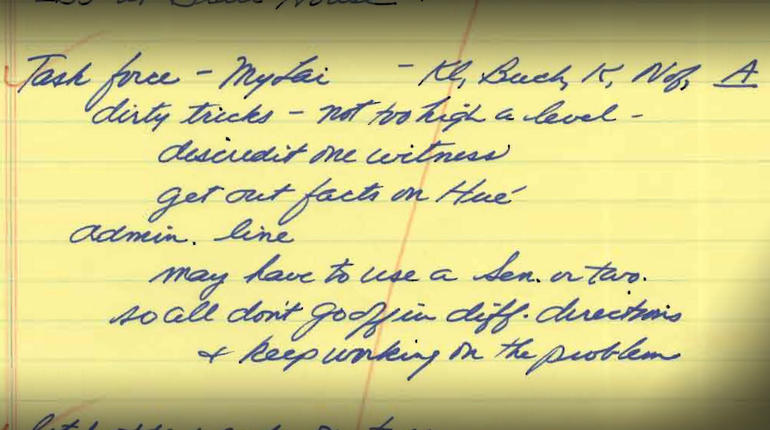
CBS News has an article that shows that President Richard Nixon sought to cover up the My Lai Massacre during the Vietnam War. The article draws from notes taken at the time by H.R. Haldeman, Nixon’s chief of staff and hatchet man. The notes suggest that Nixon ordered “dirty tricks” to discredit the testimony of the true Army heroes who intervened to stop the massacre. It further suggests neutralizing the gory details of My Lai by playing up atrocities committed by communist forces at Huế (“You think we’re bad in massacring innocents at My Lai? Well, the commies are a lot worse”).
Here are Haldeman’s notes from his meeting with Nixon:
Credit: Richard Nixon Presidential Library and Museum
Note that My Lai is treated as a problem in public relations, not as a war crime. It’s to be managed by dirty tricks and the exploitation of a senator or two. As long as we all stay on the same page and spout the same message (while suppressing the facts and intimidating and discrediting witnesses), My Lai and the 504 Vietnamese killed there in 1968 can just be made to disappear. That’s the gist of Haldeman’s notes.
Haldeman’s notes are further evidence of what The Contrary Perspectiveargued previously on the Vietnam War: We lost more than a war in Vietnam. We lost our humanity.
My Dad, Julius Anthony Astore, was a child of the Great Depression. Born in 1917, he had to quit high school in 1933 to help support his family. In 1935 he joined the Civilian Conservation Corps, or CCC, working in forestry and as a firefighter in Oregon until he left in 1937.
Finding a job after he left the CCC was tough, but eventually Dad got one working at F.B. Washburn’s Candy Company during the Christmas rush.
Here’s how Dad described his job:
I was hired for a five week job starting at 6:00PM and my night shift would be over 6:00AM the next morning. I would have Saturdays and Sundays off. My work hours would add up to sixty hours a week and I would get twenty cents an hour. Total twelve dollars a week. Those days there wasn’t any time-and-a-half after forty hours. It was quite a grind. I had to sugar hard candy that was shaped like a small peach stone. I won’t go into detail but it was a very tiring job.
From my life’s experience I’ve found that the harder I worked physically the less money I made.
Time goes by and I thought I was going to be laid off at the end of five weeks [but] I was put to work on the day shift permanently. That was in 1938, four years before I was drafted into the Army and introduced to World War II.
At Washburn’s candy factory, Dad operated a lollipop machine, candy cookers, and he mixed sugar. His starting salary was $9 a week (working forty-five hours). By 1942 he was making $17 a week. As with most factory jobs, the work was tedious, physically demanding, and unrewarding. Writing ruefully to his brother Gino in 1938, and comparing factory work to his time spent in the CCC, Dad wrote “The CCCs are a helluva lot better than that place [Washburn’s].”
When Dad was drafted into the Army in February 1942, he took a major cut in salary. From making roughly $70 a month at Washburn’s Candy Factory, his salary dropped to $21 a month as an Army private (which was still $9 less than what he had earned in the CCC in 1935!). When he was discharged from the Army in January 1946 as a corporal technician, he was finally making what he had earned at Washburn’s, about $69 a month.
Although it’s true that the American soldier was paid better than his British counterpart, it’s still shocking to hear that U.S. privates were fighting and dying in Europe and the Pacific for less than $30 a month basic pay.
The truth is simply this: Even the richest, most prosperous country in the world grossly underpaid its frontline troops. While contractors got rich on the homefront, never risking a hair on their precious necks, young Americans fought and died for peanuts.
Hasn’t it always been this way? Today, Americans are uncomfortable calling attention to pay discrepancies and exploitation because it smacks of Marxism and class warfare. Yes, some of the worst abuses of workers have been curbed since my Dad suffered through the Great Depression, but today’s workers are simply scared: scared that their jobs will be outsourced, scared that they’ll be “downsized” (i.e., fired); scared that they’ll be replaced by robots. Thus they put up and shut up.
For all the rhetoric about the dignity of work in the USA, Dad’s words still ring true: so-called unskilled labor, or demanding physical work, is still undervalued and disrespected in our country. And for all the talk of “supporting our troops,” those young men and women sent into harm’s way are still paid little when you consider they’re risking their necks.
Which makes me think of another one of my Dad’s sayings: “the more things change, the more they remain the same.” Especially if we don’t work to change them.
A visitor to my home today saw my retirement plaque, which marks my twenty years of service in the US Air Force. He immediately thanked me for my service to my country.
I appreciated his thanks because I took (and take) some pride in having served honorably in the military. But people who thank me make me uncomfortable. Why, you ask?
Because I believe it was an honor to serve my country. It was an honor to be entrusted by the people of our great land with their trust.
So when people thank me, I always feel like thanking them back for allowing me to serve; for giving me this honor, this privilege.
Now, I write articles that are often critical of today’s military. And there’s lots of things to criticize. But I don’t believe in criticizing the military’s ethic of service, an ethic that should be based on humility and tinged with pride. Because our nation’s ideal is a citizen-soldier military. Note how the word “citizen” comes first. We are not supposed to want a military composed of mercenaries or warriors. Such a military is inconsistent with our democratic ideals.
Also inconsistent with our democratic ideals is our national tendency to idolize officers of high military rank. You know, the generals and admirals, men like Tommy Franks or David Petraeus. Why? Because any citizen-civilian outranks any citizen-soldier in the military, generals included.
We must always remember that military members serve us: we the people. We don’t serve them. And we must remember as well that our president, a civilian commander-in-chief, is first and foremost exactly that: a civilian. And that he’s not the commander-in-chief of all Americans; merely of those Americans who choose to don a uniform and take the oath of office (to include active duty, reserves, and National Guard members).
These are fundamental points (or they should be). They are derived from our Constitution. Our founders saw (reluctantly) the need for a military, and perhaps our greatest founder, George Washington, was also arguably our greatest military leader. Not because he was a Napoleon, but precisely because he wasn’t. He was our Cincinnatus, a citizen-soldier, with the emphasis firmly placed on citizen. A man who placed his duty to the Constitution, and to the people, before himself and military vainglory.
If you wish to thank a service member for his or her service, by all means do so. Just don’t be completely surprised when they deflect your thanks, or even thank you back for the honor and privilege of being able to serve in the name of the people to protect our highest ideals as enshrined in our Constitution.
The Pentagon brass and bureaucrats can’t win foreign wars, but they sure as hell kick ass in domestic budgetary wars. That point is clear from Mattea Kramer’s new article at TomDispatch.com. Allowing the Pentagon a largely untouchable second budget to fund the ongoing military occupation of Afghanistan is an invitation both to prolong that war and for exercises in money-changing. Masters at budgetary sleight of hand, the military spins any reduction, no matter how small, in apocalyptic terms, as we saw with claims that cuts in the end strength of the US Army would reduce it to 1940 levels, i.e. the somnolent peacetime days just before Pearl Harbor.
Any cut to military spending is spun as “appeasement,” as recklessly endangering our security vis-a-vis the exaggerated threats of the day, usually China or Russia or both. Yet the true “threat” that the Pentagon sees is not so much China or Russia (they can be handled) but cuts to their privileges and power. The Pentagon still maintains an unimaginably top-heavy bureaucracy that continues to throw pallets of money into the afterburners of costly weapons programs like the F-35 jet fighter.
Here is Kramer’s full text, courtesy of TomDispatch. Isn’t it nice to know that in lean times the Pentagon continues to live off the fat of the land?
The Pentagon’s Phony Budget War: Or How the U.S. Military Avoided Budget Cuts, Lied About Doing So, Then Asked for Billions More
By Mattea Kramer
Washington is pushing the panic button, claiming austerity is hollowing out our armed forces and our national security is at risk. That was the message Secretary of Defense Chuck Hagel delivered last week when he announced that the Army would shrink to levels not seen since before World War II. Headlines about this crisis followed in papers like the New York Times and members of Congress issued statements swearing that they would never allow our security to be held hostage to the budget-cutting process.
Yet a careful look at budget figures for the U.S. military — a bureaucratic juggernaut accounting for 57% of the federal discretionary budget and nearly 40% of all military spending on this planet — shows that such claims have been largely fictional. Despite cries of doom since the across-the-board cuts known as sequestration surfaced in Washington in 2011, the Pentagon has seen few actual reductions, and there is no indication that will change any time soon.
This piece of potentially explosive news has, however, gone missing in action — and the “news” that replaced it could prove to be one of the great bait-and-switch stories of our time.
The Pentagon Cries Wolf, Round One
As sequestration first approached, the Pentagon issued deafening cries of despair. Looming cuts would “inflict lasting damage on our national defense and hurt the very men and women who protect this country,” said Secretary Hagel in December 2012.
Sequestration went into effect in March 2013 and was slated to slice $54.6 billion from the Pentagon’s $550 billion larger-than-the-economy-of-Sweden budget. But Congress didn’t have the stomach for it, so lawmakers knocked the cuts down to $37 billion. (Domestic programs like Head Start and cancer research received no such special dispensation.)
By law, the cuts were to be applied across the board. But that, too, didn’t go as planned. The Pentagon was able to do something hardly recognizable as a cut at all. Having the luxury of unspent funds from previous budgets — known obscurely as “prior year unobligated balances” — officials reallocated some of the cuts to those funds instead.
In the end, the Pentagon shaved about 5.7%, or $31 billion, from its 2013 budget. And just how painful did that turn out to be? Frank Kendall, who serves as the Undersecretary of Defense for Acquisition, Technology, and Logistics, has acknowledged that the Pentagon “cried wolf.” Those cuts caused no substantial damage, he admitted.
And that’s not where the story ends — it’s where it begins.
Sequestration, the Phony Budget War, Round Two
A $54.6 billion slice was supposed to come out of the Pentagon budget in 2014. If that had actually happened, it would have amounted to around 10% of its budget. But after the hubbub over the supposedly devastating cuts of 2013, lawmakers set about softening the blow.
And this time they did a much better job.
In December 2013, a budget deal was brokered by Republican Congressman Paul Ryan and Democratic Senator Patty Murray. In it they agreed to reduce sequestration. Cuts for the Pentagon soon shrank to $34 billion for 2014.
And that was just a start.
All the cuts discussed so far pertain to what’s called the Pentagon’s “base” budget — its regular peacetime budget. That, however, doesn’t represent all of its funding. It gets a whole different budget for making war, and for the 13th year, the U.S. is making war in Afghanistan. For that part of the budget, which falls into the Washington category of “Overseas Contingency Operations” (OCO), the Pentagon is getting an additional $85 billion in 2014.
And this is where something funny happens.
That war funding isn’t subject to caps or cuts or any restrictions at all. So imagine for a moment that you’re an official at the Pentagon — or the White House — and you’re committed to sparing the military from downsizing. Your budget has two parts: one that’s subject to caps and cuts, and one that isn’t. What do you do? When you hit a ceiling in the former, you stuff extra cash into the latter.
It takes a fine-toothed comb to discover how this is done. Todd Harrison, senior fellow for defense studies at the Center for Strategic and Budgetary Assessments, found that the Pentagon was stashing an estimated extra $20 billion worth of non-war funding in the “operation and maintenance” accounts of its proposed 2014 war budget. And since all federal agencies work in concert with the White House to craft their budget proposals, it’s safe to say that the Obama administration was in on the game.
Add the December budget deal to this $20 billion switcheroo and the sequester cuts for 2014 were now down to $14 billion, hardly a devastating sum given the roughly $550 billion in previously projected funding.
And the story’s still not over.
When it was time to write the Pentagon budget into law, appropriators in Congress wanted in on the fun. As Winslow Wheeler of the Project on Government Oversight discovered, lawmakers added a $10.8 billion slush fund to the war budget.
All told, that leaves $3.4 billion — a cut of less than 1% from Pentagon funding this year. It’s hard to imagine that anyone in the sprawling bureaucracy of the Defense Department will even notice. Nonetheless, last week Secretary Hagel insisted that “[s]equestration requires cuts so deep, so abrupt, so quickly that… the only way to implement [them] is to sharply reduce spending on our readiness and modernization, which would almost certainly result in a hollow force.”
Yet this less than 1% cut comes from a budget that, at last count, was the size of the next 10 largest military budgets on the planet combined. If you can find a threat to our national security in this story, your sleuthing powers are greater than mine. Meanwhile, in the non-military part of the budget, sequestration has brought cuts that actually matter to everything from public education to the justice system.
Cashing in on the “Cuts,” Round Three and Beyond
After two years of uproar over mostly phantom cuts, 2015 isn’t likely to bring austerity to the Pentagon either. Last December’s budget deal already reduced the cuts projected for 2015, and President Obama is now asking for something he’s calling the “Opportunity, Growth, and Security Initiative.” It would deliver an extra $26 billion to the Pentagon next year. And that still leaves the war budget for officials to use as a cash cow.
And the president is proposing significant growth in military spending further down the road. In his 2015 budget plan, he’s asking Congress to approve an additional $115 billion in extra Pentagon funds for the years 2016-2019.
My guess is he’ll claim that our national security requires it after the years of austerity.
Mattea Kramer is a TomDispatch regular and Research Director at National Priorities Project, which is a 2014 nominee for the Nobel Peace Prize. She is also the lead author of the book A People’s Guide to the Federal Budget.
You’ve probably seen the headline: Secretary of Defense Chuck Hagel is gutting the Army to numbers not seen since the sleepy days before Pearl Harbor! Senior Republicans like Lindsey Graham and John McCain have already declared that these cuts are DOA (dead on arrival) in the Senate. Why? Allegedly because they endanger our national defense. Naturally, such claims are often politically-motivated. Former Vice President Dick Cheney has already gone on record as claiming that President Obama prefers to fund food stamps and other social entitlement programs to funding the military at adequate levels.
Should we be worried? Conor Friedersdorf has an excellent article at The Atlantic to explain why Hagel’s proposed cuts to today’s Army should not be compared to the Army’s end strength in 1940. The U.S. military has obviously changed greatly since then. Today, the military relies much more on technology as “force multipliers.” There is simply no military on the planet as high-tech and capable of projecting power as the U.S. military. Moreover, because we’re not fighting simultaneous wars in Iraq and Afghanistan, we simply no longer need as many soldiers in the Army as we did during the Surge years.
Today’s military is far less concerned with end strength than it is with capabilities. I recall talking to an Army lieutenant colonel and experienced battalion commander in Iraq. He explained that one of his infantry companies (of approximately 100 men) could easily defeat an enemy battalion (of approximately 500 men). He wasn’t boasting; just stating facts. An American company, assuming it could tap its technology as well as all of its fire support units (artillery, helicopters, and close air support from the U.S. Air Force), would simply move faster and hit harder and more accurately than its enemy. Again, it’s not about numbers; it’s about capabilities.
The US military is enormously powerful. Its naval and air assets are second to none. So is its ability to hit hard at a distance. So is its equipment — its force multipliers — from divisional/brigade levels down to the platoon/squad level. Reversing the old Soviet dictum, in this case quality has a quantity all its own.
To suggest that Hagel’s proposed retrenchment in Army end strength would return us to 1940 is the ultimate in ignorance — or the ultimate in deliberate disinformation for political gain.
America’s weakness has nothing to do with its military. America’s weakness is the rampant dishonesty of its political discourse. Even adding a million soldiers to our Army’s rolls won’t fix that.






 Bracing Views