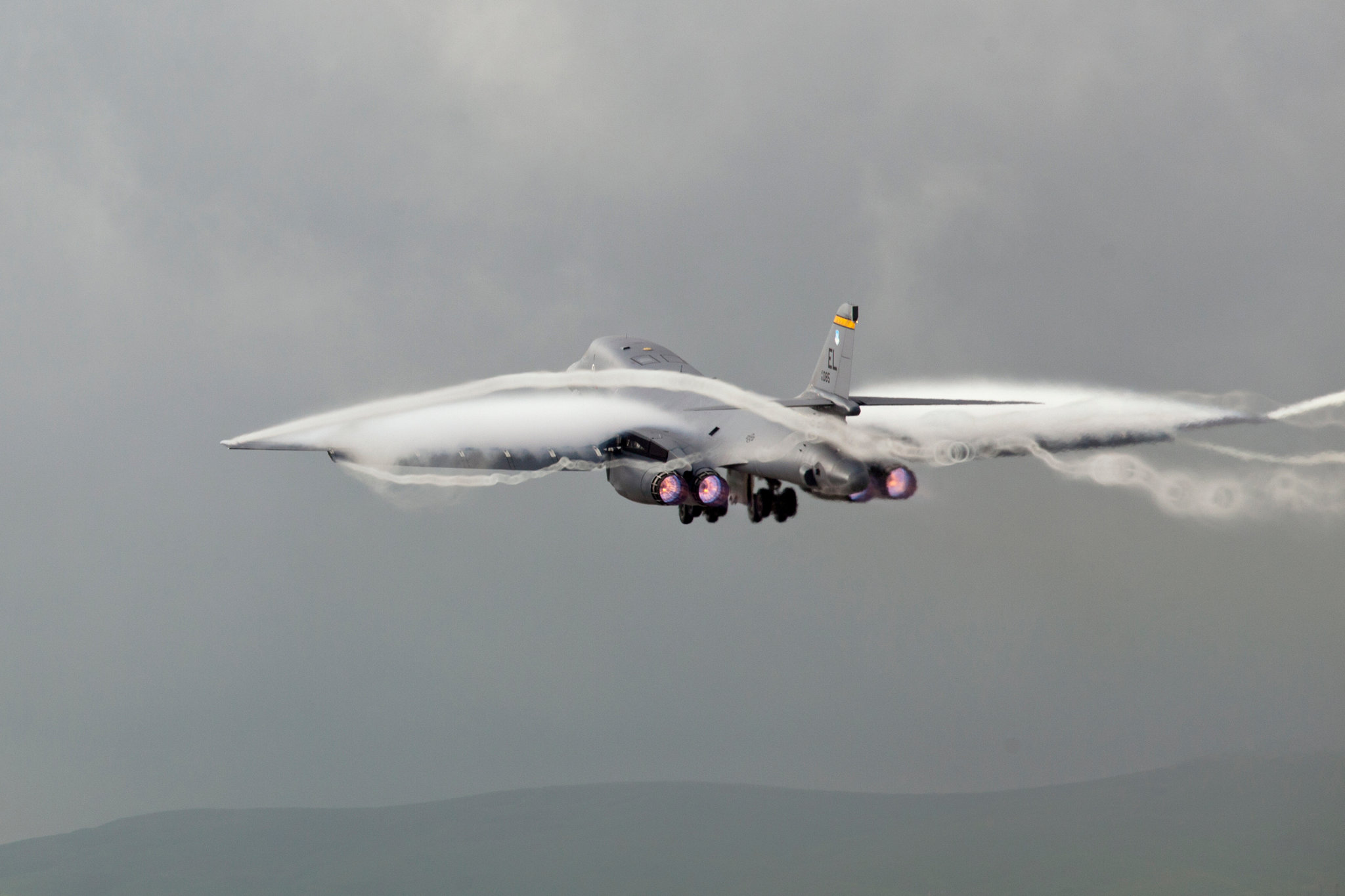
Back in January, James Carroll had an op-ed in the Boston Globe that called for eliminating the Air Force as a separate service. He claimed that the Air Force’s strategic components (its nuclear ICBMs and manned bombers) were now largely irrelevant, that the Air Force’s tactical mission could be folded into the Army and Navy, and that unmanned aerial vehicles or drones would soon largely replace manned surveillance and attack planes.
By folding the Air Force into its two older rivals, the Army and Navy, Carroll suggested the Pentagon would be forced to economize, the magic coming from reorganization. I highly doubt that.
OK. I’m a retired Air Force officer, so I’m biased. But there are certain things the Air Force does, certain skills the Air Force has, that won’t be easily duplicated and probably will be lost in a bureaucratic war touched off by elimination and reorganization. Here’s a quick list:
1. The Air Force concentrates on air and space, just like the Army concentrates on land and the Navy on sea. These are unique elements, requiring unique services with specialized mindsets.
2. The Air Force is not just about fighter planes and nuclear missiles. Much of the Air Force’s mission is in the less glorious aspects of air and space control. Missions like cargo transport, tankers for aerial refueling, aerial and satellite reconnaissance, and the like. Do we really believe the Army and Navy will adequately focus on and fund these vital missions?
3. The U.S. Air Force was hardly the first independent air force in the world. Great Britain saw the need for an independent air force in 1918 when the Royal Air Force was created. (The USAF had to wait until 1947, i.e. after World War II.) An independent air force reflects the technological revolution inaugurated by the Wright Brothers in 1903 and the inherent reach and power of aerial vehicles. This is especially relevant to “island” nations such as Great Britain — and the United States.
4. Related to (2), the Air Force has a wide range of missions, to include aerial intelligence-gathering, AWACS (airborne warning and control) and vital national command planes such as Air Force One. Again, are these missions truly suited to the Army or Navy?
5. In the chaos that is war, there’s something to be said for military continuity and tradition and experience. Eliminating the Air Force and folding it into the Army and Navy will generate enormous internal friction within the Pentagon, possibly destabilizing a national defense system that is already less than optimal in its stability (as well as its wisdom).
The Air Force today certainly has its problems. It’s the most top heavy of the services, with far too many colonels and generals. It spends way too much on under-performing aircraft such as the F-35 Lightning II. It’s always shied away from adequately funding the close air support mission, which is why the Army pursues its own fleet of attack helicopters. Since its early days, it’s placed way too much faith in the efficacy of bombing, so much so that it’s generated its own Strangelovian caricatures, men like Curtis LeMay.
That said, the last thing we need is more internecine warfare in the Pentagon. Eliminating the Air Force is not a recipe for cost-savings. It’s a recipe for a bureaucratic bloodbath that will ultimately hurt rather than help America’s national defense.
CBS News has an article that shows that President Richard Nixon sought to cover up the My Lai Massacre during the Vietnam War. The article draws from notes taken at the time by H.R. Haldeman, Nixon’s chief of staff and hatchet man. The notes suggest that Nixon ordered “dirty tricks” to discredit the testimony of the true Army heroes who intervened to stop the massacre. It further suggests neutralizing the gory details of My Lai by playing up atrocities committed by communist forces at Huế (“You think we’re bad in massacring innocents at My Lai? Well, the commies are a lot worse”).
Here are Haldeman’s notes from his meeting with Nixon:
Credit: Richard Nixon Presidential Library and Museum
Note that My Lai is treated as a problem in public relations, not as a war crime. It’s to be managed by dirty tricks and the exploitation of a senator or two. As long as we all stay on the same page and spout the same message (while suppressing the facts and intimidating and discrediting witnesses), My Lai and the 504 Vietnamese killed there in 1968 can just be made to disappear. That’s the gist of Haldeman’s notes.
Haldeman’s notes are further evidence of what The Contrary Perspectiveargued previously on the Vietnam War: We lost more than a war in Vietnam. We lost our humanity.
My Dad, Julius Anthony Astore, was a child of the Great Depression. Born in 1917, he had to quit high school in 1933 to help support his family. In 1935 he joined the Civilian Conservation Corps, or CCC, working in forestry and as a firefighter in Oregon until he left in 1937.
Finding a job after he left the CCC was tough, but eventually Dad got one working at F.B. Washburn’s Candy Company during the Christmas rush.
Here’s how Dad described his job:
I was hired for a five week job starting at 6:00PM and my night shift would be over 6:00AM the next morning. I would have Saturdays and Sundays off. My work hours would add up to sixty hours a week and I would get twenty cents an hour. Total twelve dollars a week. Those days there wasn’t any time-and-a-half after forty hours. It was quite a grind. I had to sugar hard candy that was shaped like a small peach stone. I won’t go into detail but it was a very tiring job.
From my life’s experience I’ve found that the harder I worked physically the less money I made.
Time goes by and I thought I was going to be laid off at the end of five weeks [but] I was put to work on the day shift permanently. That was in 1938, four years before I was drafted into the Army and introduced to World War II.
At Washburn’s candy factory, Dad operated a lollipop machine, candy cookers, and he mixed sugar. His starting salary was $9 a week (working forty-five hours). By 1942 he was making $17 a week. As with most factory jobs, the work was tedious, physically demanding, and unrewarding. Writing ruefully to his brother Gino in 1938, and comparing factory work to his time spent in the CCC, Dad wrote “The CCCs are a helluva lot better than that place [Washburn’s].”
When Dad was drafted into the Army in February 1942, he took a major cut in salary. From making roughly $70 a month at Washburn’s Candy Factory, his salary dropped to $21 a month as an Army private (which was still $9 less than what he had earned in the CCC in 1935!). When he was discharged from the Army in January 1946 as a corporal technician, he was finally making what he had earned at Washburn’s, about $69 a month.
Although it’s true that the American soldier was paid better than his British counterpart, it’s still shocking to hear that U.S. privates were fighting and dying in Europe and the Pacific for less than $30 a month basic pay.
The truth is simply this: Even the richest, most prosperous country in the world grossly underpaid its frontline troops. While contractors got rich on the homefront, never risking a hair on their precious necks, young Americans fought and died for peanuts.
Hasn’t it always been this way? Today, Americans are uncomfortable calling attention to pay discrepancies and exploitation because it smacks of Marxism and class warfare. Yes, some of the worst abuses of workers have been curbed since my Dad suffered through the Great Depression, but today’s workers are simply scared: scared that their jobs will be outsourced, scared that they’ll be “downsized” (i.e., fired); scared that they’ll be replaced by robots. Thus they put up and shut up.
For all the rhetoric about the dignity of work in the USA, Dad’s words still ring true: so-called unskilled labor, or demanding physical work, is still undervalued and disrespected in our country. And for all the talk of “supporting our troops,” those young men and women sent into harm’s way are still paid little when you consider they’re risking their necks.
Which makes me think of another one of my Dad’s sayings: “the more things change, the more they remain the same.” Especially if we don’t work to change them.
A visitor to my home today saw my retirement plaque, which marks my twenty years of service in the US Air Force. He immediately thanked me for my service to my country.
I appreciated his thanks because I took (and take) some pride in having served honorably in the military. But people who thank me make me uncomfortable. Why, you ask?
Because I believe it was an honor to serve my country. It was an honor to be entrusted by the people of our great land with their trust.
So when people thank me, I always feel like thanking them back for allowing me to serve; for giving me this honor, this privilege.
Now, I write articles that are often critical of today’s military. And there’s lots of things to criticize. But I don’t believe in criticizing the military’s ethic of service, an ethic that should be based on humility and tinged with pride. Because our nation’s ideal is a citizen-soldier military. Note how the word “citizen” comes first. We are not supposed to want a military composed of mercenaries or warriors. Such a military is inconsistent with our democratic ideals.
Also inconsistent with our democratic ideals is our national tendency to idolize officers of high military rank. You know, the generals and admirals, men like Tommy Franks or David Petraeus. Why? Because any citizen-civilian outranks any citizen-soldier in the military, generals included.
We must always remember that military members serve us: we the people. We don’t serve them. And we must remember as well that our president, a civilian commander-in-chief, is first and foremost exactly that: a civilian. And that he’s not the commander-in-chief of all Americans; merely of those Americans who choose to don a uniform and take the oath of office (to include active duty, reserves, and National Guard members).
These are fundamental points (or they should be). They are derived from our Constitution. Our founders saw (reluctantly) the need for a military, and perhaps our greatest founder, George Washington, was also arguably our greatest military leader. Not because he was a Napoleon, but precisely because he wasn’t. He was our Cincinnatus, a citizen-soldier, with the emphasis firmly placed on citizen. A man who placed his duty to the Constitution, and to the people, before himself and military vainglory.
If you wish to thank a service member for his or her service, by all means do so. Just don’t be completely surprised when they deflect your thanks, or even thank you back for the honor and privilege of being able to serve in the name of the people to protect our highest ideals as enshrined in our Constitution.
The Pentagon brass and bureaucrats can’t win foreign wars, but they sure as hell kick ass in domestic budgetary wars. That point is clear from Mattea Kramer’s new article at TomDispatch.com. Allowing the Pentagon a largely untouchable second budget to fund the ongoing military occupation of Afghanistan is an invitation both to prolong that war and for exercises in money-changing. Masters at budgetary sleight of hand, the military spins any reduction, no matter how small, in apocalyptic terms, as we saw with claims that cuts in the end strength of the US Army would reduce it to 1940 levels, i.e. the somnolent peacetime days just before Pearl Harbor.
Any cut to military spending is spun as “appeasement,” as recklessly endangering our security vis-a-vis the exaggerated threats of the day, usually China or Russia or both. Yet the true “threat” that the Pentagon sees is not so much China or Russia (they can be handled) but cuts to their privileges and power. The Pentagon still maintains an unimaginably top-heavy bureaucracy that continues to throw pallets of money into the afterburners of costly weapons programs like the F-35 jet fighter.
Here is Kramer’s full text, courtesy of TomDispatch. Isn’t it nice to know that in lean times the Pentagon continues to live off the fat of the land?
The Pentagon’s Phony Budget War: Or How the U.S. Military Avoided Budget Cuts, Lied About Doing So, Then Asked for Billions More
By Mattea Kramer
Washington is pushing the panic button, claiming austerity is hollowing out our armed forces and our national security is at risk. That was the message Secretary of Defense Chuck Hagel delivered last week when he announced that the Army would shrink to levels not seen since before World War II. Headlines about this crisis followed in papers like the New York Times and members of Congress issued statements swearing that they would never allow our security to be held hostage to the budget-cutting process.
Yet a careful look at budget figures for the U.S. military — a bureaucratic juggernaut accounting for 57% of the federal discretionary budget and nearly 40% of all military spending on this planet — shows that such claims have been largely fictional. Despite cries of doom since the across-the-board cuts known as sequestration surfaced in Washington in 2011, the Pentagon has seen few actual reductions, and there is no indication that will change any time soon.
This piece of potentially explosive news has, however, gone missing in action — and the “news” that replaced it could prove to be one of the great bait-and-switch stories of our time.
The Pentagon Cries Wolf, Round One
As sequestration first approached, the Pentagon issued deafening cries of despair. Looming cuts would “inflict lasting damage on our national defense and hurt the very men and women who protect this country,” said Secretary Hagel in December 2012.
Sequestration went into effect in March 2013 and was slated to slice $54.6 billion from the Pentagon’s $550 billion larger-than-the-economy-of-Sweden budget. But Congress didn’t have the stomach for it, so lawmakers knocked the cuts down to $37 billion. (Domestic programs like Head Start and cancer research received no such special dispensation.)
By law, the cuts were to be applied across the board. But that, too, didn’t go as planned. The Pentagon was able to do something hardly recognizable as a cut at all. Having the luxury of unspent funds from previous budgets — known obscurely as “prior year unobligated balances” — officials reallocated some of the cuts to those funds instead.
In the end, the Pentagon shaved about 5.7%, or $31 billion, from its 2013 budget. And just how painful did that turn out to be? Frank Kendall, who serves as the Undersecretary of Defense for Acquisition, Technology, and Logistics, has acknowledged that the Pentagon “cried wolf.” Those cuts caused no substantial damage, he admitted.
And that’s not where the story ends — it’s where it begins.
Sequestration, the Phony Budget War, Round Two
A $54.6 billion slice was supposed to come out of the Pentagon budget in 2014. If that had actually happened, it would have amounted to around 10% of its budget. But after the hubbub over the supposedly devastating cuts of 2013, lawmakers set about softening the blow.
And this time they did a much better job.
In December 2013, a budget deal was brokered by Republican Congressman Paul Ryan and Democratic Senator Patty Murray. In it they agreed to reduce sequestration. Cuts for the Pentagon soon shrank to $34 billion for 2014.
And that was just a start.
All the cuts discussed so far pertain to what’s called the Pentagon’s “base” budget — its regular peacetime budget. That, however, doesn’t represent all of its funding. It gets a whole different budget for making war, and for the 13th year, the U.S. is making war in Afghanistan. For that part of the budget, which falls into the Washington category of “Overseas Contingency Operations” (OCO), the Pentagon is getting an additional $85 billion in 2014.
And this is where something funny happens.
That war funding isn’t subject to caps or cuts or any restrictions at all. So imagine for a moment that you’re an official at the Pentagon — or the White House — and you’re committed to sparing the military from downsizing. Your budget has two parts: one that’s subject to caps and cuts, and one that isn’t. What do you do? When you hit a ceiling in the former, you stuff extra cash into the latter.
It takes a fine-toothed comb to discover how this is done. Todd Harrison, senior fellow for defense studies at the Center for Strategic and Budgetary Assessments, found that the Pentagon was stashing an estimated extra $20 billion worth of non-war funding in the “operation and maintenance” accounts of its proposed 2014 war budget. And since all federal agencies work in concert with the White House to craft their budget proposals, it’s safe to say that the Obama administration was in on the game.
Add the December budget deal to this $20 billion switcheroo and the sequester cuts for 2014 were now down to $14 billion, hardly a devastating sum given the roughly $550 billion in previously projected funding.
And the story’s still not over.
When it was time to write the Pentagon budget into law, appropriators in Congress wanted in on the fun. As Winslow Wheeler of the Project on Government Oversight discovered, lawmakers added a $10.8 billion slush fund to the war budget.
All told, that leaves $3.4 billion — a cut of less than 1% from Pentagon funding this year. It’s hard to imagine that anyone in the sprawling bureaucracy of the Defense Department will even notice. Nonetheless, last week Secretary Hagel insisted that “[s]equestration requires cuts so deep, so abrupt, so quickly that… the only way to implement [them] is to sharply reduce spending on our readiness and modernization, which would almost certainly result in a hollow force.”
Yet this less than 1% cut comes from a budget that, at last count, was the size of the next 10 largest military budgets on the planet combined. If you can find a threat to our national security in this story, your sleuthing powers are greater than mine. Meanwhile, in the non-military part of the budget, sequestration has brought cuts that actually matter to everything from public education to the justice system.
Cashing in on the “Cuts,” Round Three and Beyond
After two years of uproar over mostly phantom cuts, 2015 isn’t likely to bring austerity to the Pentagon either. Last December’s budget deal already reduced the cuts projected for 2015, and President Obama is now asking for something he’s calling the “Opportunity, Growth, and Security Initiative.” It would deliver an extra $26 billion to the Pentagon next year. And that still leaves the war budget for officials to use as a cash cow.
And the president is proposing significant growth in military spending further down the road. In his 2015 budget plan, he’s asking Congress to approve an additional $115 billion in extra Pentagon funds for the years 2016-2019.
My guess is he’ll claim that our national security requires it after the years of austerity.
Mattea Kramer is a TomDispatch regular and Research Director at National Priorities Project, which is a 2014 nominee for the Nobel Peace Prize. She is also the lead author of the book A People’s Guide to the Federal Budget.
You’ve probably seen the headline: Secretary of Defense Chuck Hagel is gutting the Army to numbers not seen since the sleepy days before Pearl Harbor! Senior Republicans like Lindsey Graham and John McCain have already declared that these cuts are DOA (dead on arrival) in the Senate. Why? Allegedly because they endanger our national defense. Naturally, such claims are often politically-motivated. Former Vice President Dick Cheney has already gone on record as claiming that President Obama prefers to fund food stamps and other social entitlement programs to funding the military at adequate levels.
Should we be worried? Conor Friedersdorf has an excellent article at The Atlantic to explain why Hagel’s proposed cuts to today’s Army should not be compared to the Army’s end strength in 1940. The U.S. military has obviously changed greatly since then. Today, the military relies much more on technology as “force multipliers.” There is simply no military on the planet as high-tech and capable of projecting power as the U.S. military. Moreover, because we’re not fighting simultaneous wars in Iraq and Afghanistan, we simply no longer need as many soldiers in the Army as we did during the Surge years.
Today’s military is far less concerned with end strength than it is with capabilities. I recall talking to an Army lieutenant colonel and experienced battalion commander in Iraq. He explained that one of his infantry companies (of approximately 100 men) could easily defeat an enemy battalion (of approximately 500 men). He wasn’t boasting; just stating facts. An American company, assuming it could tap its technology as well as all of its fire support units (artillery, helicopters, and close air support from the U.S. Air Force), would simply move faster and hit harder and more accurately than its enemy. Again, it’s not about numbers; it’s about capabilities.
The US military is enormously powerful. Its naval and air assets are second to none. So is its ability to hit hard at a distance. So is its equipment — its force multipliers — from divisional/brigade levels down to the platoon/squad level. Reversing the old Soviet dictum, in this case quality has a quantity all its own.
To suggest that Hagel’s proposed retrenchment in Army end strength would return us to 1940 is the ultimate in ignorance — or the ultimate in deliberate disinformation for political gain.
America’s weakness has nothing to do with its military. America’s weakness is the rampant dishonesty of its political discourse. Even adding a million soldiers to our Army’s rolls won’t fix that.
This past weekend [February 2014], CBS 60 Minutes did a segment on the F-35 fighter program. The basic facts are these: the program is seven years behind schedule and $163 billion over budget. Yes, you read that right: Not $163 million, but $163 billion. The lead contractor, Lockheed Martin, is essentially unapologetic about the delays and cost overruns. Why should they be? The general in charge of the F-35 acquisition program said we’re going to buy thousands of the plane over the next two decades. Talk about rewarding failure!
If we continue like drunken sailors to throw money at the F-35, it’ll be an effective fighter jet. But the biggest issue is that we don’t need it. Predator and Reaper drones are just the beginning of a new generation of pilotless aircraft that promise to be more effective. Why? Because we need not risk pilots getting shot down. Also, when you combine long loiter time over targets with super-sensitive sensors, drones reduce collateral damage while increasing the odds of “one shot, one kill.”
Proponents of the F-35 like to brag about its (costly) stealthy features, its (costly) cameras and sensors (especially the computer- and sensor-integrated helmet worn by each pilot, which creates a virtual reality and visual scape for that pilot), and its survivability vis-a-vis Russian and Chinese fighters (which are largely still on the drawing boards in those countries). But the truth is that an updated generation of F-15s, F-16s, F-18s, and F-22s are more than capable of defending America and projecting power. (The Vietnam War proved that, in aerial combat, pilot training and skill matter more than technology. That’s why the U.S. military established realistic training at “Top Gun” schools.)
The F-35, given the amount of money thrown at it, doubtless has some improvements over planes such as the F-15 and F-18. But at a price tag of at least $400 billion to purchase the F-35, and $1.45 trillion over the life of the program to operate and maintain them, it has simply become far too prohibitive for the United States to afford, especially in a climate of fiscal austerity.
Based on its track record, it’s probably safe to say that the F-35 will soon be a decade behind schedule and $200 billion over budget, even as it’s increasingly rendered irrelevant by improvements in drone technologies. So why are we buying it? Simply because the program is too big to fail. The Air Force, Navy, and Marines are all counting on it.
Meanwhile, Lockheed Martin has distributed its subcontractors across the USA, making it exceedingly difficult for Congress to cut the program without hurting jobs in virtually every Congressional district. Indeed, in an awesome display of chutzpah, you can go to the Lockheed Martin website to see how much your state is involved in building the F-35. Clicking on the “economic impact map,” I see that for the State of Pennsylvania, for example, the F-35 creates 759 jobs and an economic impact of nearly $51 million.
For the DoD, the F-35 may have ridden off the rails, but for Lockheed Martin the F-35 will continue to soar into the stratosphere as a major money-maker for decades to come. In the battle between DoD program managers and Lockheed Martin, the winner and “top gun” is as obvious as it is depressing. Score another victory for Lockheed Martin! But please avert your eyes as America itself goes down in flames.
Update 1: Another critical perspective from “War Is Boring” on the F-35 program that also takes “60 Minutes” to task for relying only on government sources for their (weak) critique. Here’s an excerpt:
“But where was the long list of design and quality-control issues with the aircraft, 12 years after development began? What about discussing the many alternatives to this under-performing machine, such as F-22s and drones plus rebuilt F-15s, F-16s and F/A-18s? Why not point out how many experts in the defense journalism and analysis worlds see the JSF program as detracting from America’s security rather than enhancing it?”
Those are very good questions.
Update 2: For military/contractor perspectives, check out this video, which includes testimony by test pilots that is generally favorable to the F-35 program (at least from a technical sense).
Update 3: Winslow Wheeler reveals the high cost and serious limitations of the F-35 here and here. Wheeler knows his stuff. He’s the Director of the Straus Military Reform Project of the Center for Defense Information, part of the Project on Government Oversight (POGO) in Washington, DC, and is the author of The Wastrels of Defense: How Congress Sabotages National Security (US Naval Institute Press) and Military Reform: An Uneven History and an Uncertain Future (Stanford University Press). Another critical article is by the legendary Chuck Spinney here with the telling title “F-35: Out of Altitude, Airspeed, and Ideas — But Never Money.”
Update 4: An excerpt from Franklin C. “Chuck” Spinney: “But the F-35 program is not at serious risk, despite all the hysterical hype in the trade press — not by a long shot. The F-35′s political safety net has been front-loaded and politically engineered (the general practices of the power games are explained here) with exquisite malice aforethought. Domestically, the F-35 employs 130,000 people and 1300 domestic suppliers in 47 states and Puerto Rico. The only states missing the gravy train are Hawaii, Wyoming, and North Dakota. Internationally, there are already cooperative development/production plans involving nine countries, and more are in the offing. Given the intensity of the geographic carpet-bombing of contracts around the globe, can there be any question why the Secretary of the Air Force said in September, ‘Simply put, there is no alternative to the F-35 program. It must succeed.’ If you think that is an accident, dear reader, I have a Brooklyn Bridge to sell you.”
Update 5: I’ve worked on two Air Force software programs. Both were overly complex and plagued with coding problems that drove up costs and extended schedules while degrading performance. The software on the F-35 is yet another example of this, as this report indicates. The F-35 continues to slip in schedule as costs rise due to software flaws, even as reports emerge that the software is vulnerable to hacking. In trying for leading edge abilities, the contractor has found the bleeding edge, as they say in the military, but what is being bled is the American taxpayer.
Update 6: More problems for the F-35, including oil leaks and one plane bursting into fire as it was taking off, are leading to more countries questioning their commitment to the plane. For a program so deep into testing and initial production, such problems are worrisome indeed.
Update 7: The latest from Winslow Wheeler on the F-35 (July 11, 2014); see his article A Big Week for the F-35? (pasted below):
“Even if the mainstream U.S. media has been late in coming to the story, the largest defense program in U.S. history is facing two critical events this coming week.
“As major British media has been reporting for some time, the F-35 Joint Strike Fighter may be facing a major international marketing embarrassment: It has failed to show up for two of three scheduled (and much ballyhooed) public demonstrations in the United Kingdom. Now, it may miss the main event, a flying demonstration before the world’s aviation community at the Farnborough International Airshow, starting Monday. You see, the F-35 is grounded-again. An engine blew up on take-off at Eglin Air Force Base on June 23 and reportedly burned up much of the plane’s flammable, plastic composite rear fuselage and tail. No F-35s are flying until inspectors know what the problem is and can say it’s safe to fly-at least in the very limited regimes the F-35 has been cleared for. Moreover, even if the F-35 is released to participate at Farnborough, there may be a new problem: weather predictions for next week in England are not good, and the F-35 has real issues flying near thunder- and rainstorms; it even has problems with wet runways.
“Stuck at home or coddled in UK hangars, the timing could not be worse for F-35 advocates. This Tuesday, the Defense Subcommittee of the Senate Appropriations Committee (SAC-D) will mark up its 2015 Defense Appropriations bill, and more than the usual routine approval of the Pentagon’s F-35 budget request is at stake. As pointed out in two timely commentaries (one by the Center for International Policy’s William Hartung and a second by Taxpayers for Common Sense’s Ryan Alexander), the House Appropriations Committee larded onto the already gigantic $8.3 billion request by adding four unrequested F-35s, costing an extra $479 million.
“The four added planes are clearly at risk given the F-35’s self-embarrassment at Eglin, surely inspiring the F-35 talking points Lockheed is planting on the Members of the SAC-D well beyond their usual spinmeister fantasies on cost and performance. Worse, there could-at least theoretically-arise a critic of the F-35 in the membership of the SAC-D who might try to take real action on the F-35, beyond the rhetorical hyperbole that critics like Senator John McCain (R-AZ) have been hurling at the F-35. Imagine the shock and awe if some Member were to offer a meaningful amendment requiring the F-35 to be tested-actually imposing “fly-before-buy”-before a few hundred more mistake-laden jets are produced.
“Not to worry: the F-35 defenders are rushing to the rescue. Beyond whatever election year financing promises major F-35 contractors Lockheed-Martin, Northrop-Grumman, and Pratt & Whitney may be distributing to keep the program on track, Secretary of Defense Chuck Hagel has just completed a baby-kissing exercise for the airplane. Travelling to Eglin Air Force Base where that F-35 destroyed itself, Hagel declared“This aircraft is the future of fighter aircraft for all our services,” thereby removing any notions that his junket might have some useful purpose other than showing fealty to the beleaguered F-35 program. Any expectation that he went to Eglin to exercise oversight of the F-35’s recurring embarrassments, as one might expect from a functioning Secretary of Defense, has been thoroughly excised. That leaves it up to the Defense Subcommittee of the Senate Appropriations Committee.
“The SAC-D has many important defense spending decisions to make. None will be a better test of whether the committee is willing to conform DOD program ambitions to Pentagon budget realities than this point in the endless F-35 drama. Of course, the easy road beckons; defense business-as-usual will be happy to shower the Members with handsome signs of approval, material and otherwise.
“Unfortunately, more of the same simply accelerates the decay of our defenses at ever-higher expense.
“All eyes are turning to the Senate Appropriations Committee’s Defense Subcommittee. Thus far, political support for the F-35 has rolled over every ground truth, but realities like multiple groundings occurring amidst a continuing torrent of technical failures and cost overruns have a relentlessness all their own. Perhaps the only real question is when, not if, the politicians in Congress and the Pentagon will succumb to the inevitable tide. If next week does not end up as a tipping point for the F-35, it will come. It will come. And, that will be long before we buy the 2,433 Lockheed and its other boosters dream of.” [End of Wheeler’s article.]
Coddled indeed!
Update 8 (9/8/2014): Professor Mark Clodfelter in Air & Space Power Journal notes that the U.S. Air Force today is “purchasing far more remotely piloted than manned aircraft,” making it “remote” that the service will buy 1,763 F-35s at “flyaway costs of roughly $185 million each.” Meanwhile, the Navy version of the F-35 now exceeds $200 million in “flyaway cost,” with the Marines’ short takeoff and vertical landing variant (the F-35B) approaching $300 million per plane. And these per-unit costs are only due to rise as various countries buy fewer planes than currently projected.
I can still recall being on active duty twenty years ago when the Joint Strike Fighter, progenitor to the F-35, was sold as a “low-cost” (at about $35-50 million per plane) multi-role combat jet in the tradition of the F-16. Since then, “low-cost” has become high-cost as the F-35 program spun wildly out of control.
Don’t take my word for it. Listen to Lt Gen Christopher Bogdan, USAF, the F-35 program’s chief. He admitted that “basically the (F-35) program ran itself off the rails.”
Yet despite the fact that the F-35 is the equivalent to a derailing and runaway train, the passengers on board remain captives to it, with some of them smiling all the while.
Update 9 (11/7/2014): The AF is now claiming that A-10s need to be eliminated to free up maintenance staff for the F-35. If the venerable A-10s are not mothballed, initial operational capability (IOC) for the F-35 will be delayed, according to Lt Gen Bogdan.
The AF has never liked the A-10, since it was designed to provide close air support for ground troops. As Winslow Wheeler notes, “The simple truth is that the Air Force does not think the close support mission for troops in combat is a prime responsibility. It never wanted to buy and operate the A-10 in the first place, and it protests that other — unsuitable—aircraft are good enough for the job.”
The AF also knows that Congress as well as soldiers love the A-10. Chances are that the A-10 will be preserved by Congress, which gives the AF the perfect excuse when IOC for the F-35 is delayed. See, the AF will say — We told you we needed those A-10 maintainers for the F-35. That’s the reason why the schedule has slipped yet again. It’s your fault, not ours.
Perhaps the AF believes this is a clever gambit, but what’s being sacrificed (along with credibility) is combat effectiveness. And that may prove a deadly price for our troops to pay.
Update 10 (3/17/2015): In this video, Pierre Sprey, the designer of the F-16 Fighting Falcon, explains why the F-35 is such a “Kluge,” an inherently terrible airplane, as he puts it, an overpriced and ineffective multi-role fighter/bomber that neither fights well nor bombs well.
Update 11 (3/18/2015): Is the F-35 FUBAR? According to this article by AJ Vicens at Mother Jones, it is. Here is the text:
Originally slated to cost $233 billion, the Pentagon’s F-35 Joint Strike Fighterprogram could end up being costing more than $1.5 trillion. Which might not be so bad if the super-sophisticated next-generation jet fighter lives up to its hype. Arecent report from the Defense Department’s Director of Operational Test and Evaluation paints a pretty damning picture of the plane’s already well documented problems. The report makes for some pretty dense reading, but the Project on Government Oversight, a watchdog group that’s long criticized the F-35 program, has boiled down the major issues.
Here are a few:
Teaching to the test: The blizzard of testing required on the plane’s equipment and parts isn’t exactly going well, so the program’s administrators are moving the goal posts. Test scores are improving because the stats are being “massaged” with tricks like not recounting repeated failures. Some required testing is being consolidated, eliminated, or postponed. “As a result,” POGO writes, “the squadron will be flying with an uncertified avionics system.”
Unsafe at any airspeed? The high-tech stuff that was supposed to make the F-35 among the most advanced war machines ever built pose serious safety risks. For example: The fuel tank system “is at significant risk of catastrophic fire and explosion in combat,” according to POGO. The plane isn’t adequately protected against lightning strikes (in the air or on the ground); it’s currently prohibited from flying within 25 miles of thunderstorms. That’s a major problem for a plane training program based in the Florida panhandle.
Flying blind: The F-35’s fancy helmet-mounted display system, which is supposed to show pilots an almost 360-degree view that includes panel controls and threat information, has “high false alarm rates and false target tracks.” Its unreliability, combined with the plane’s design, make it impossible for pilots to see anything behind or below the cockpit.
Wing drop: The DOD report points out an ongoing problem with “wing drop“: When maneuvering at high speeds, the F-35 may drop and roll to one side. This issue has been known to designers for years, and they’ve tried designing add-on parts to address the problem. The fixes, unfortunately, will “further decreas[e] maneuverability, acceleration, and range,” according to POGO.
Engine trouble: For years the F-35s engines have suffered design and performance problems, and these problems have never been fully solved. Last summer these problems resulted in one engine ripping itself apart and destroying one of the planes. At the time, officials said this was a one-time occurrence, but a permanent fix has yet to be determined and the plane may not be airworthy, according to Department of Defense regulations.
Software bugs: The plane’s software includes more than 30 million lines of code. Problems with the code are causing navigation system inaccuracies, false alarms from sensors, and false target tracks. The operating system is so cumbersome that it requires the “design and development of a whole new set of…computers.” The software glitches also affect the plane’s ability to “find targets, detect and survive enemy defenses, deliver weapons accurately, and avoid fratricide.”
More cost overruns: Due to all the testing delays, design problems, and maintenance issues, taxpayers could be on the hook for an additional $67 billion to deploy the F-35. That’s a lot of money. Even for the US military.”
Update 12 (4/28/15): More trouble for the F-35, this time involving its engines. According to Reuters, “The Pentagon’s internal watchdog on Monday said it found 61 violations of quality management rules and policies during an inspection of Pratt & Whitney’s work on the F-35 fighter jet engine and warned the problems could lead to further cost increases and schedule delays on the biggest U.S. arms program.” Further cost increases and schedule delays — where have we heard that before?
The report further added:
“Pratt and the Pentagon are still correcting a design problem with the high-performance F135 engine that grounded the F-35 fleet last year, but that was not due to manufacturing issues. However, quality issues have grounded the fleet in the past.
Earlier this month, the congressional Government Accountability Office also faulted the reliability of the F135 engine.”
Unreliable engines — nothing to worry about. Right?
Update 13 (7/29/15): Not surprisingly, given its design flaws, the F-35 is distinctly inferior to the F-15, F-16, and F-18 in dogfighting capability. Even worse, its cockpit design seriously restricts a pilot’s ability to “Check Six” (to look behind, often the most likely sector from which an enemy plane will attack). For more on this, check out this link: http://www.pogo.org/our-work/straus-military-reform-project/weapons/2015/leaked-f-35-report-confirms-deficiencies.html.
Given its design flaws, which stem from compromises made at the very beginning of the program, the F-35 is not a “next generation” fighter — it’s a lost generation, a step backwards, and a very expensive one at that.
Update 14 (9/25/15): Satire is often good at revealing uncomfortable truths. Here’s a golden example from Duffel Blog:
Pentagon Requests 500 Gold-Plated F-35s
The Pentagon released a report today requesting Congressional authorization for 500 gold-plated F-35 fighter planes.
The F-35 Lightning II is a fifth-generation multirole stealth fighter intended to replace numerous aging aircraft, including the A-10 Thunderbolt II and the F-16 Fighting Falcon. The F-35 program has been fraught with problems, including numerous delays, cost overruns, and failure to deliver on promised operational performance.
The new variant, dubbed the F-35G, is proposed as an upgrade over existing F-35 models. In addition to 24K gold plating encasing its exterior, its cockpit is trimmed with wood grain paneling harvested from the endangered African blackwood tree and leather upholstery from the hide of the northern white rhinoceros. Its GAU-12/A 25mm rotary cannon is able to fire solid platinum rounds at a rate of 3300 per minute. Each round is handcrafted by a Swiss jeweler.
“In an ever-evolving battlefield, it is imperative to have a military equipped with tactical vehicles that offer versatility, adaptability, and mother of pearl ice buckets to keep champagne bottles cold during missions,” reads the Pentagon report. “Our service men and women deserve to fly in only the finest combat aircraft.”
Each F-35G unit is projected to cost 8.2 billion dollars, approximately twice the average annual GDP of some of the countries it is expected to bomb. The total cost, including development, procurement, operation, and sustainment, will top $15 trillion over the life of the program.
While most on Capitol Hill are interested in fulfilling the Pentagon’s request, there is heated debate on how best to pay for it.
“This program can easily be funded by eliminating Medicare,” said Rep. Paul Ryan (R-WI), at a luncheon co-sponsored by Lockheed Martin and Newmont Mining Corp. “Eliminating Medicare will also have the second-order effect of slashing Social Security costs by culling the nation’s senior citizen population.”
The White House was quick to dismiss Ryan’s proposal.
“We’re not going to end anyone’s free lunch,” said White House Press Secretary Josh Earnest. “President Obama has instead proposed funding the program with a 5% tax hike on the wealthiest 1% of Americans.”
“Also, President Obama is not very good at math,” he added.
While most on Capitol Hill are supportive, some naysayers continue to offer criticism. Sen. John McCain (R-AZ) has remained vocal in his staunch opposition to the F-35 program.
“There is nothing a gold-plated F-35 can do in close air support that can’t be done better by a silver-plated A-10,” he opined.
It also remains to be seen if the F-35G’s combat performance will be able to deliver on the program’s promises. At present, the added weight from the gold plating has prevented the F-35G from achieving flight. Its first test was a disaster, as the prototype F-35G rolled straight through the end of the test runway and careened into oncoming traffic on a nearby highway, resulting in 12 fatalities.
“Slight tweaks to the design are still required, however it is clear that the F-35G is the future of United States combat aviation,” the report concluded.
Update 15 (1/27/18): The F-35 continues to suffer serious teething pains, notes this report at breakingdefense.com. From the article:
Here’s what the new DOTE, Robert Behler, says about the F-35 Joint Strike fighter in his office’s latest annual report:
The operational suitability of the F-35 fleet remains below requirements and is dependent on work-arounds that would not meet Service expectations in combat situations (emphasis added). Over the previous year, most suitability metrics have remained nearly the same, or have moved only within narrow bands which are insufficient to characterize a change in performance.
Overall fleet-wide monthly availability rates remain around 50 percent, a condition that has existed with no significant improvement since October 2014, despite the increasing number of new aircraft. One notable trend is an increase in the percentage of the fleet that cannot fly while awaiting replacement parts – indicated by the Not Mission Capable due to Supply rate.
Update 16 (8/17/19): More teething pains for the F-35. notes Dan Grazier at The American Conservative. Here’s the beginning of his report:
The fleet of F-35 Joint Strike Fighters flying in the critical operational testing phase is struggling to stay airborne, which could delay the troubled program’s great leap forward into mass production.
As I recently reported for the Project on Government Oversight (POGO), a document from the program’s test force shows that the fleet’s test aircraft, housed at California’s Edwards Air Force Base, have netted an average 11 percent “fully mission capable rate”—the key measure of how often an aircraft can perform all of its assigned missions—since the process began last December.
To put this into context, the Pentagon’s former operational testing director, Michael Gilmore, has said the fleet needs an 80 percent availability rate to successfully complete the combat-testing phase.
The F-35, by the way, is already the most expensive weapons system in history. As of March, its acquisition price tag was $400 billion. However, the cost of operating and maintaining the fleet over the next several decades stands at an estimated $1.45 trillion.
The 17-year-old program reached an important milestone when, after many delays, officials started the Initial Operational Test and Evaluation (IOT&E) process on December 5, 2018. This is the phase in which the completed product is put through its paces in realistic combat scenarios to determine whether it can fulfill its intended role and is suitable for pilots’ use.
This is supposed to take place after the former design phase. But because the F-35 program hasn’t actually finished the design process, the program effectively created extra obstacles to successful completion of this legally required testing phase. That the test fleet struggles even to get off the ground only compounds these challenges …
The United States spends nearly a trillion dollars a year on national defense, to include wars, homeland security, a bewildering array of intelligence agencies, and the maintenance of nuclear weapons. Are we buying greater security with all this money?
Consider the following fact. A private contractor hired to vet security clearances for US intelligence agencies has been accused of faulty and incomplete background checks in 665,000 cases. Yes, you read that right. More than half a million background checks for security clearances were not performed properly. Doesn’t that make you feel safer?
Meanwhile, our nuclear forces have been bedeviled by scandal and mismanagement. The latest is a cheating scandal involving 34 nuclear launch officers and the potential compromise of nuclear surety. Previous scandals include a vice admiral, the deputy commander of US nuclear forces, being relieved of command for using forged gambling chips in a casino. Far worse was the incident in 2007 when a B-52 flew across the US with six “live” nuclear missiles on board. (The missiles were not supposed to have nuclear warheads in them.)
Public servants, especially military officers who put “integrity first,” are expected to be good stewards of the trillions of dollars entrusted to them. What to make, then, of an alarming bribery scandal in the Pacific, involving a wealthy Malaysian contractor who allegedly used money, hookers, and gifts to bribe several high-ranking US naval officers into awarding him lucrative contracts? Something tells me this was not the pivot to the Pacific that the Obama Administration had in mind.
Such stories show how moth-eaten the shroud for our national security state really is. Small wonder that we’re told to avert our eyes (Hey! It’s classified!) rather than inspecting it closely.
What lessons are we to draw from such betrayals of public trust? One big one: Our “security” apparatus has grown so large and all-encompassing that it has become far more powerful than the threat it is supposed to check. Call it the enemy within, the inevitable corruption that accompanies unchecked power.
Any institution, no matter if it puts integrity first, will be compromised if it’s given too much power, especially when that institution veils itself in secrecy.
“With great power comes great responsibility,” as Peter Parker’s gentle Uncle Ben reminded him. It’s an aphorism from “Spiderman,” but it’s no less true for that. We’ve given great power to our national security apparatus, but that power is being exercised in ways that too often are irresponsible — and unaccountable.
And that doesn’t bode well for true security.
Update (1/28): Unfortunately, with great power often comes great irresponsibility, as this article on US military brass behaving badly indicates in today’s Washington Post. And let’s not forget the US general and master of nuclear missiles who got drunk in Moscow while bragging about keeping the world safe — at least he enjoyed the banquet featuring tortillas stuffed with caviar and dill.
Update (2/5): A new story reveals that Army recruiters as well as civilians cheated the American taxpayer out of $100 million in recruiting bonuses. The bonuses were aimed at boosting recruits during the difficult days of the Iraq War. Sadly, it also boosted fraud within the Army, as some recruiters lined their own pockets with bonuses obtained under fraudulent terms.
Yes, I know it’s a harsh claim that Members of Congress don’t care about sending your son or daughter off to war. Partly that’s because more than half of them are millionaires. And if they’re not millionaires now, they will be when they leave office and cash in as lobbyists and similar Beltway bandit jobs. After all, it’s hard to sympathize with working-class families with sons and daughters in the military when 1) You’re rich (or at least comfortably well-off); and 2) You have no sons or daughters in the military, and never will.
I wrote to one of my senators in PA, Bob Casey, about the need to end our wars in Afghanistan and elsewhere — about the need to bring our troops home rather than continuing to place them in harm’s way for no reason that’s in our national interest. When I wrote, I asked him if he would send any of his four daughters to Afghanistan, or even if he’d urge any of them to serve our country in any capacity in the military. I never heard back from him or his staff, not that I was surprised.
Senator Bob Casey is a Catholic who went to Holy Cross in Massachusetts in the early 1980s. I’m a Catholic who did my ROTC service at Holy Cross in the early 1980s. We may have even crossed paths on campus. But Bob Casey is from a well-connected political family. I’m the son of a firefighter and a homemaker who joined ROTC to help pay for college. Bob Casey and his daughters have never had to think about military service except in the most abstract terms. They might applaud it, but they won’t do it.
The same was true for Mitt Romney and his five sons. Eager to salute the military; not eager to join and serve. Fortunate sons (and daughters), all.
You could say the same for virtually all Members of Congress today. Almost no military service. Few sons or daughters in the military, and certainly none in the front lines in combat branches. Certainly, they’ll praise our troops. They’ll salute the flag with vigor. But what they won’t do is to send their loved ones into harm’s way.
Each and every time our Congress or our President sends troops into harm’s way, they should think whether they’d risk their own. For example, it’s conceivable that President Obama’s oldest daughter, Malia, could join the military in 2015 at the age of seventeen. (You can join the military at seventeen with parental permission.) After basic and advanced training, many American teenagers have been sent into combat only to die before they’re out of their teen years.
Can we imagine such a tragic fate befalling the son or daughter of any prominent politician in the United States? Of course not. The burden of military service has perhaps never been shared equally in our history, but its inequality has never been more slanted than it is now. The rich and privileged exempt their offspring from service (or at least from dangerous service), which only emboldens them when they cast their votes for more war. In doing so, they risk nothing near and dear to them. Heck, they may even pose as being “tough” and “uncompromising.”
Save me the flag lapel pins of our millionaire politicians and all their posing. Want to support our troops? If you’re young enough, quit Congress and enlist in the military. Or be sure to encourage your own sons and daughters to join and serve in harm’s way. At least then you can say you’ve made a sacrifice commensurate with those made by so many working-class families across the USA.
The World as Confessional, with the NSA as its Priests
W.J. Astore
At TomDispatch.com, Tom Engelhardt has an especially fine exposé of the National Security State as a religion with its own priesthood, holy books, dogma, and true believers/followers.
I recommend reading the entire article, but I do want to highlight some implications of his argument. Like the Catholic Church (and I’m Catholic), the National Security State is hierarchical, conservative, and often anti-democratic. We, the laity, have little if any say in how the system operates, even as we’re the ones who fill the coffers and collection plates. We are subject to a militarized (or militant) aristocracy that sees itself as uniquely privileged, the “best and the brightest,” working to keep us safe from the devil of the day. To question the system and privileges of the powerful is to risk being seen as an apostate.
But the Catholic Church is, at least in theory, dedicated to the cause of peace (though historically sometimes at the point of a sword). The U.S. National Security State, despite (or rather because of) the evangelicals or true-believers in its midst, is dominated by a church militant and a church triumphant. This is unsurprising. Powerful militaries seek military solutions. Defeats or stalemates like Iraq and Afghanistan are reinterpreted as triumphs (at least for the U.S. military). If they defy reinterpretation, defeats can always be attributed to Judas-like figures within the body of the American politic, like the anti-war hippies of the Vietnam era (even if the latter looked more like Jesus than Lucifer).
The biggest problem is how the dominance of the National Security State weakens our democratic structures, including our right to privacy. Consider the penetration and interception of all forms of electronic communication by the NSA and similar “intelligence” agencies. Like the Catholic Church with its rite of confession, the NSA listens to our “sins” in the name of safeguarding us from harm. In the bad old days, the Church used its rite of confession to gain access to the secrets of the powerful. Leave it to the NSA to trump the Church by turning the whole world into a confessional booth.
Such a subversion of privacy doesn’t preserve democracy – it destroys it. Like the Catholic Church of the late 15th and early 16th centuries, the National Security State is choking on its own power and privileges, losing its sense of mission as it wallows in money and sanctimony.
Where is Martin Luther when you need him? For like the Catholic Church in the 16th century, the U.S. National Security State needs a serious reformation.
Update (1/7): At TomDispatch.com, Nick Turse has a great article today on the growing reach and power of Special Operations Command (SOCOM) within the U.S. military. It’s a powerful coda to Engelhardt’s article. Extending the Catholic Church analogy, SOCOM in the U.S. military today is much like the Jesuit Order of the Catholic Church — missionaries of the American military across the world. And like the Jesuits they see themselves as an elite, as true believers, as holy warriors deserving of secrecy and privilege and power.
As such, they believe they should not be accountable to the laity — meaning us. Neither do they believe they are accountable to our legal representatives in Congress. They answer to their Loyola (Admiral McRaven) and ultimately to the Pope (whoever the commander in chief happens to be, as long as he supports them).
The National Security State has truly become the new national religion of America. We worship at its Pentagon of Power, its huge NSA facilities. They are America’s true national cathedrals.