Last Night, Donald Trump Disqualified Himself

Donald Trump
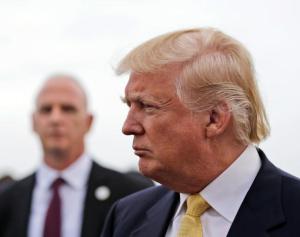
Hail the Leader (Trump at FreedomFest, July 11, 2015 (AP Photo/John Locher)

W.J. Astore

As a retired military officer, I watched last night’s Republican debate from Detroit (transcript here) with a special focus on which candidate is qualified to lead the military as commander-in-chief.  I knew, of course, that Donald Trump had promised in the past to use torture against America’s enemies (last night, he called them “animals”), that he would pursue and kill not only terrorists but their families (apparently because the families always know, according to Trump, what their father/brother/sister is up to, as if there are no secrets in families).  Trump, in short, is an Old Testament “eye for an eye” man: if they behead us, we’ll torture and kill them, end of story.

But Trump was put on the spot when he was asked what he would do if the U.S. military failed to carry out his unlawful orders.  Instead of saying he wouldn’t issue unlawful orders, that he would support and defend the U.S. Constitution, which as president would be his sworn duty to uphold, Trump boasted that the military would follow his orders no matter what.

America: those are the words of a dictator.

Here’s what was said:

BAIER: Mr. Trump, just yesterday, almost 100 foreign policy experts signed on to an open letter refusing to support you, saying your embracing expansive use of torture is inexcusable. General Michael Hayden, former CIA director, NSA director, and other experts have said that when you asked the U.S. military to carry out some of your campaign promises, specifically targeting terrorists’ families, and also the use of interrogation methods more extreme than waterboarding, the military will refuse because they’ve been trained to turn down and refuse illegal orders.

So what would you do, as commander-in-chief, if the U.S. military refused to carry out those orders?

TRUMP: They won’t refuse. They’re not going to refuse me. Believe me.

BAIER: But they’re illegal.

TRUMP: Let me just tell you, you look at the Middle East. They’re chopping off heads. They’re chopping off the heads of Christians and anybody else that happens to be in the way. They’re drowning people in steel cages. And he — now we’re talking about waterboarding.

This really started with Ted, a question was asked of Ted last — two debates ago about waterboarding. And Ted was, you know, having a hard time with that question, to be totally honest with you. They then came to me, what do you think of waterboarding? I said it’s fine. And if we want to go stronger, I’d go stronger, too, because, frankly…

(APPLAUSE)

… that’s the way I feel. Can you imagine — can you imagine these people, these animals over in the Middle East, that chop off heads, sitting around talking and seeing that we’re having a hard problem with waterboarding? We should go for waterboarding and we should go tougher than waterboarding. That’s my opinion.

BAIER: But targeting terrorists’ families?

(APPLAUSE)

TRUMP: And — and — and — I’m a leader. I’m a leader. I’ve always been a leader. I’ve never had any problem leading people. If I say do it, they’re going to do it. That’s what leadership is all about.

Our military does not follow blindly orders issued by “The Leader.” Our military swears an oath to the Constitution.  We swear to uphold the law of the land.  We don’t swear allegiance to a single man (or woman) as president.

Trump’s performance last night reminded me of Richard Nixon’s infamous answer to David Frost about Watergate: “When the president does it, that means it’s not illegal.” No, no, a thousand times no.  The president has to obey the law of the land, just as everyone else has to.  No person is above the law, an American ideal that Trump seems neither to understand nor to embrace.

And that disqualifies him to be president and commander-in-chief.

Might Makes Right: An American Tradition

162111-akmdv

W.J. Astore (also posted at History News Network)

To hear Republican candidates like Donald Trump and Ted Cruz talk, almost any act of violence is justifiable to defeat the enemy. Trump talks of torture, far worse than waterboarding, and total destruction. Cruz ups the ante, speaking of carpet bombing and making the sand glow, apparently via nuclear weapons. Both appear to treat the enemy as inhuman.

Sadly, for America this is nothing new. Just read Bernard Fall on America’s war against Vietnam. In an article for Ramparts (“This Isn’t Munich, It’s Spain”), Fall wrote late in 1965 that the American military strategy in Vietnam was based on massive killing through overwhelming firepower:

The new mix of air war and of land and seaborne firepower in Vietnam is one of technological counter-insurgency — if you keep up the kill rate you will eventually run out of enemies. Or at least armed enemies. Of course, the whole country will hate you, but at least they won’t resist you. What you will get is simply a cessation of resistance — an acquiescence in one’s fate rather than a belief that your side and your ideas have really prevailed.

In other words, America sought to bludgeon the Vietnamese into compliance, rather than winning their hearts and minds through ideas or ideals.

“But what I really fear most,” Fall continued, “is the creation of new ethics to match new warfare. Indications are that a new ethic is already being created, and such influential men as former Secretary of State Dean Acheson have begun to provide its intellectual underpinning.”

Fall cited a speech at Amherst College in 1965 in which Acheson declared:

The end sought by our foreign policy . . . is, as I have said, to preserve and foster an environment in which free societies may exist and flourish. Our policies and actions must be decided by whether they contribute to or detract from achievement of this end. They need no other justification or moral or ethical embellishment. . .

To keep the free world free, America was justified to do anything it desired, irrespective of ethics and morality. Acheson’s words in 1965 have become the essence of U.S. foreign policy today as advanced by men like Trump and Cruz. In short, the end (a “free” society) justifies any means (torture, carpet bombing, perhaps even nuclear weapons) to preserve it.

Fall went on to cite a Pastoral Letter from French Cardinal Feltin in 1960 during France’s war with Algeria. In that letter to French military chaplains, Cardinal Feltin noted:

There cannot be a morality which justifies efficacy by all means, if those means are in formal contradiction with Natural Law and Divine Law. Efficacy, in that case, goes against the very aim it seeks to achieve. There can be exceptional laws for exceptional situations. . . there cannot exist an exceptional morality which somehow takes leave of Natural Law and Divine Law.

Too often in the past as well as today, U.S. foreign policy has taken leave of natural and divine law. The ends do not and should not justify the means, especially when the means (torture, carpet bombing, and the like) contravene the end (a “free” society based on ethical and moral principles).

Rather than posing as protectors of the free world, people like Trump and Cruz should admit their own amorality. They should admit they see the world as a brutal place, occupied by brutes, and that only by slaying those brutes in a brutish way can America preserve its dominant position as chief brute.

Doubtless many of their followers would still salute them for this view. But more reflective souls would see the honesty of Pogo’s famous insight that “We have met the enemy and he is us.”


Today’s Pentagon as an Ant Farm

ant-farm

W.J. Astore

I was on active duty in the military for twenty years.  My experience: It’s very difficult to see the big picture in the military.  The everyday pressures of the mission keep you focused on the short term.  I recall writing many WARs (weekly activity reports) and being focused on the immediate.  Even the yearly budgetary process tends to keep you focused on the short term.  Assignments for officers and enlisted rarely last longer than three years, with combat tours typically much shorter.  Personnel are constantly changing: for one acquisition project I worked on, four program managers (colonels) rotated in and out in three years.

Along with being focused on the immediate, you are actively discouraged from criticizing the system in any fundamental way.  Of course, you’re not supposed to criticize the commander-in-chief, you’re not supposed to be insubordinate to your chain of command, you’re not supposed to undermine morale.  At the same time, one mistake can be deadly to a career.  People in the military therefore tend to play it safe.  Doubters tend to conform.  They shut their mouths.  Or they vote with their feet by leaving the military.

Critics with the best of intentions often get squashed.  Consider the Air Force pilot who found a problem with the F-22 Raptor’s cockpit oxygen supply system.  This was a top priority, safety of flight, issue, but the Air Force played down the problem so as to protect procurement for the Raptor.  The pilot eventually complained to CBS “60 Minutes” and saw his career stall as a result.  Or consider General Eric Shinseki, who as Army Chief of Staff had the temerity to disagree with the Bush Administration’s rosy talk of low troop requirements in the wake of the invasion of Iraq in 2003.  Shinseki was shunted aside by a system that had no room for well-informed dissent.

Pressures to conform and short-term planning and personnel cycles combine to produce mediocrity and to reproduce the past.  John Paul Vann, an expert on the Vietnam War who died in that war, noted the U.S. military didn’t have 12 years’ experience in Vietnam: it had one years’ experience repeated 12 times over.  Something similar is true in Afghanistan today: the U.S. doesn’t have 14 years’ experience fighting the Taliban and building Afghan security forces, but rather one years’ experience repeated 14 times.

U.S. military actions are sequential rather than synergistic.  It’s just one damn thing after another.  The reality of this is often seen more clearly by people who are outside of the military.  Outsiders aren’t caught up in everyday pressures or limited by conformism.  They’re not caught in a Pentagonal box in which misguided tactics and mistaken goals are accepted by insiders as SOP – standard operating procedure.

But perhaps “box” is the wrong image for the Pentagon and its unreflective busyness; ant farm might be better.  If you’re of a certain age, you may remember those old ant farms advertised in the back pages of comic books.  You could send away for a see-through container with sand and ants that allowed you to watch as your crew of ants busily worked away in your “farm.”

Today’s Pentagon reminds me of those old ant farms.  The ants work busily within it.  Anyone watching wouldn’t question their dedication.  Yet as you’re standing outside the farm, watching them, you can see how tightly their world is delimited and circumscribed.  What is obvious to you is simply beyond them.  The ants keep digging in and rolling along.

It’s well worth asking why the U.S. military puts so much pride on working to the point of exhaustion.  A friend of mine worked at the Pentagon.  He worked hard during his normal shift – but he left on-time to go home.  His co-workers, noses to the grindstone, would hassle him about leaving “early.”  He’d reply: I can leave on-time because I didn’t spend hours rotating between the coffee maker and the gym.

A mindless emphasis on over-caffeinated work and fitness, as another friend suggested, may be a post-Vietnam War reaction to the McNamara “managerial” culture of the 1960s.  As he put it, “One easy way of showing one has the right stuff is to be an exercise nut, and the penumbras of that mind-set have really distorted the allocation of effort in our military.”  Recall that General David Petraeus made a moral fetish out of personal fitness and how that indirectly cost him his career (he made his initial connection to his mistress/biographer while running together).  Recall that General Stanley McChrystal was celebrated for his fitness regimen, which didn’t convey the smarts to rein in the insubordinate behavior of his men.

One more anecdote about incessant “army ant” work.  A Vietnam veteran told me this story about mindless work for the sake of show:

“One feature of my first Vietnam unit epitomized all this to me: the trucks in our motor pool were perfectly lined up. I don’t know how they did it. Must have had squads of soldiers pushing them to just the right spot then stuck chocks under the wheels to keep them there. The 4-star-corps commander used to drive by our motor pool frequently to go to USARV HQ. He never stopped to see if the trucks were drivable. They were not. Almost all deadlined.”

Lots of busy-work down on the ant farm may look good from a distance, but it does not produce victory.

Today’s U.S. military has its enemies outgunned.  There’s little wrong with its work ethic.  What the U.S. military hasn’t done is to outthink its enemies.  Indeed, the military’s actions often conspire to create new ones.  To admit this is not to place the blame entirely on the military.  Its civilian leaders have to shoulder blame as well.  But ultimately it’s the military that advises the president and Congress, and I haven’t witnessed senior military officers resigning because their advice hasn’t been followed.

If the U.S. military is to be reformed, you can’t look to the ants to do it.  They’re too busy keeping the system running.  We must look beyond the farm, to outsiders who are able and willing to think freely.  Yet the military too needs to act, if for no other reason than to end a miserable run of defeats (or pyrrhic victories, if that sounds less harsh).  Rather than simply promoting loyal and hardworking ants, it needs to foster seers and thinkers – people willing to buck the system.

It won’t be easy – but it’s sure better than losing.

The Pentagon as Business and Church

Ike
Ike had it right

W.J. Astore

Military spending is supposed to be about keeping America safe.  It’s supposed to be tied to vital national interests.  And at roughly $750 billion a year (for defense, homeland security, wars overseas, the VA, and nuclear weapons), it’s a colossal chunk of money, representing nearly two-thirds of federal discretionary spending.

There’s also a colossal amount of waste in defense spending, and nearly all of the major candidates currently running for commander-in-chief want more.  Only Bernie Sanders has suggested, tepidly, that defense spending might be cut.

Why is this?  It’s because much of Pentagon spending is not about “keeping us safe.” Listen to the social critic and essayist Lewis Lapham.  For him, the U.S. military establishment is both “successful business enterprise and reformed church.”  In his words, “How well or how poorly the combined services perform their combat missions matters less than their capacity to generate cash and to sustain the images of omnipotence.  Wars, whether won or lost, and the rumors of war, whether true or false, increase the [defense] budget allocations, stimulate the economy, and add to the stockpile of fear that guarantees a steady demand for security and promotes a decent respect for authority.”

Is Lapham too cynical?

It’s true that the more ISIS or China or Russia are hyped as threats, the more money and authority the Pentagon gains.  Not much incentive – if any – exists within the Pentagon to play down the threats it perceives itself as facing.  Minimizing danger is not what the military is about.  Nor does it seek to minimize its funding or its authoritative position within the government or across American society.  Like a business, the Pentagon wants to enlarge its market share and power.  Like a church, it’s jealous of its authority and stocked with true believers.

There was a time when Americans, as well as their commander-in-chief, recognized the onerous burden of defense spending as a regressive tax on society and humanity.  That time was 1953, and that commander was Dwight D. Eisenhower, the former five-star general who’d led the D-Day invasion on June 6, 1944.

This is what Ike had to say about “defense” spending:

Every gun that is made, every warship launched, every rocket fired signifies, in the final sense, a theft from those who hunger and are not fed, those who are cold and not clothed. This world in arms is not spending money alone. It is spending the sweat of its laborers, the genius of its scientists, the hopes of its children. This is not a way of life at all in any true sense. Under the cloud of threatening war, it is humanity hanging from a cross of iron.

Economists use the term “opportunity cost,” and certainly massive spending on weapons and warfare is an opportunity lost for greater spending in needed areas such as education, infrastructure, environmental preservation, and alternative energies.

Keeping Ike’s words in mind, Americans may yet come to recognize that major cuts in the Pentagon “tax” are in the best interests of all.  Even, I daresay, the Pentagon.


What’s the U.S. Strategy in Afghanistan?

poppy
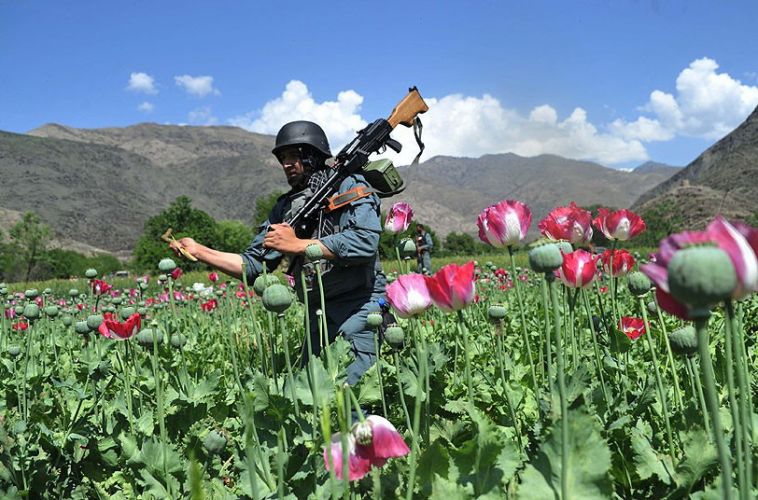
A poppy field in Afghanistan

W.J. Astore

Six years ago, I wrote an article about Afghanistan that opened like so:

In the U.S. debate on Afghanistan, virtually all experts agree that it’s not within the power of the American military alone to win the war. For that, Afghanistan needs its own military and police force, one that is truly representative of the people, and one that is not hopelessly corrupted by drug money and the selfish concerns of the Karzai government in Kabul.

What has changed since 2009?  Karzai is gone, but corruption remains endemic.  The U.S. military is still there, at least until 2017 and likely for far longer.  And drug money!  In a searching summary of the opium trade in recent Afghan history, Alfred McCoy at TomDispatch.com shows convincingly that the drug trade has flourished despite, or rather because of, American efforts to block it or control it.  In his words:

In the almost 15 years of continuous combat since the U.S. invasion of 2001, pacification efforts have failed to curtail the Taliban insurgency largely because the U.S. could not control the swelling surplus from the county’s heroin trade. As opium production surged from a minimal 180 tons to a monumental 8,200 in the first five years of U.S. occupation, Afghanistan’s soil seemed to have been sown with the dragon’s teeth of ancient Greek myth. Every poppy harvest yielded a new crop of teenaged fighters for the Taliban’s growing guerrilla army.

At each stage in Afghanistan’s tragic, tumultuous history over the past 40 years — the covert war of the 1980s, the civil war of the 1990s, and the U.S. occupation since 2001 — opium played a surprisingly significant role in shaping the country’s destiny. In one of history’s bitter twists of fate, the way Afghanistan’s unique ecology converged with American military technology transformed this remote, landlocked nation into the world’s first true narco-state — a country where illicit drugs dominate the economy, define political choices, and determine the fate of foreign interventions.

McCoy’s article, which you should read here in its entirety, raises many questions, but for me the obvious one is this: What is the U.S. military doing in Afghanistan?  What is its strategy?

If it’s trying to win Afghan hearts and minds, you can’t do that by destroying the main cash crop of so many people.  If it’s trying to create a measure of stability, you can’t do that by mounting destructive military operations that spread chaos.  If it’s trying to interdict the drug trade, you can’t do that successfully while maintaining the support of powerful interests in Afghanistan that profit so heavily from that trade.

After nearly 15 years, a sensible person would conclude that American interference in Afghanistan is only making matters worse.  Afghan drug wars are a no-win scenario for U.S. troops.  Lacking a coherent and sensible strategy that is attractive to Afghan power brokers, American forces should smarten up, load up, and pull out.

A sensible strategy in three words: Yankee come home.

Donald Trump and American Fascism?

The Donald has done it again, winning decisively in South Carolina. Back in July, I wrote this article on Trump and how he was tapping a “fascist spring” in American politics. Since then, he’s vilified Muslims as well as Mexicans, called for torture, made fun of women, mocked a reporter with a physical disability, and on and on. At the same time, he keeps promising to make America big and bad again — a promise he doubtless intends to keep.

I’ve heard people say that Trump will change if he becomes president. Even Trump claims he’d be a different man in the Oval Office. Don’t believe it. Trump is what he is: a demagogue and a chauvinist who enjoys scapegoating the vulnerable. Presidential he is not; dangerous he is.

wjastore's avatarBracing Views

The Donald: Easy to make fun of ... too easy The Donald: Easy to make fun of … too easy (AP/Seth Wenig)

W.J. Astore

A reader wrote to me this morning about Donald Trump and American fascism.  Is Trump, with his anti-immigrant posturing and his generally bombastic demeanor, tapping into a “fascist spring” in America?

The question seems unduly alarming as well as absurd.  But let’s pause for a moment.  I recently saw on TV the results of a poll in which Americans were asked, “Which presidential candidate would best revive the American economy?”  The clear winner: Donald Trump. Yes, maybe it’s just name recognition or an association of Trump’s name with money-making, but the result was nevertheless disturbing.

Here’s the thing: It’s easy to view Trump as a joke.  His bad hair.  His vulgar manner.  His obvious bombast.

But guess who else was dismissed as a joke?  Adolf Hitler.

Before he got his grip on power, many in…

View original post 350 more words

The U.S. Military and Religion

image
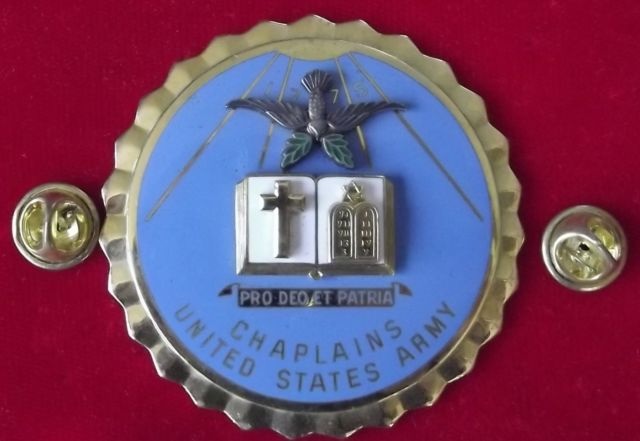
An older symbol of the Chaplain Corps that includes Christian and Jewish symbols. There are now Buddhist, Hindu, and Muslim symbols as well

W.J. Astore

Disturbing, upsetting, baffling: these words often apply when young troops face religious pressure or discrimination for the first time.

And it disturbs, upsets, and baffles me that a nation founded on religious freedom produces people that want to abridge or eliminate that freedom in the (false) name of following Christ.

It also disturbs, upsets, and baffles me that a military that is supposed to defend our Constitutional freedoms, to include freedom of religion, occasionally works in ways that undermine that very freedom.

I was born and raised within the Catholic church, but I would never push my religious beliefs on someone else.  Certainly not in a military context, in which supervisory authority is nearly absolute.

I believe there is a place for God (or gods, or no god) in the military, and a place for chaplains.  Troops should be able to worship freely in the military, as is their right as American citizens.  But there’s no place for proselytizing, pressure, “mandatory” Bible studies, and all the rest of that.

I remember how much Colorado Springs and the Air Force Academy changed between my first tour there (1990-92) and my second (1998-2002).  Lots of evangelical organizations (like Focus on the Family) built headquarters just to the east of the AF Academy.  I started to see that evangelical influence permeate the Academy.  I suppose I was lucky I left in 2002, just before the scandals involving religious discrimination broke.

The military attracts many young people looking for certitude as well as a mission, a calling.  Some of these young people come to espouse a narrow form of “Christianity,” one that sees itself as uniquely American and uniquely suited to a military context.

Yet how can troops take an oath to support and defend the Constitution, which enshrines freedom of religion, and then work to curtail or offend the religious freedoms of others?

Here’s what people need to remember about military settings: the authority of your direct supervisor is nearly absolute.  If your drill sergeant, your platoon commander, your company commander, makes it obvious that he or she favors Christianity, it puts enormous pressure on subordinates to conform, or at least to fake it.

If your boss in a civilian setting is an assertive Christian evangelist, at least you have the option of quitting (however painful that might prove).  There is no option in the military of “quitting” your platoon, your company, your unit.  Furthermore, in a war zone, refusing to conform to an evangelical zealot as a leader could literally become a matter of life and death.  Hey, Private Jones, you’re an atheist: go ahead and walk point again, i.e. take the lead as the unit walks through dangerous enemy territory infested with IEDs and snipers.  Maybe that’ll give you some faith in God.  Ha ha.

Again, the U.S. military must remember its purpose: to support and defend the Constitution.  In fulfilling that purpose, there is simply no place for evangelism of any religion, Christian or otherwise.

Note: Since 2005, the Military Religious Freedom Foundation (MRFF) has fought to ensure religious freedom within military settings.  The foundation represents nearly 45,000 service members, 96% of whom identify as Christian.  Find out more about the MRFF at http://www.militaryreligiousfreedom.org.

The Military Officer’s Oath

450x360_q95

W.J. Astore

The U.S. military exists to win America’s wars.  But even more fundamentally, the military exists to support and defend the U.S. Constitution, i.e. America’s laws.  America is supposed to be a nation of laws.  The military, as a defender of the Constitution, must uphold those laws to the best of its ability.

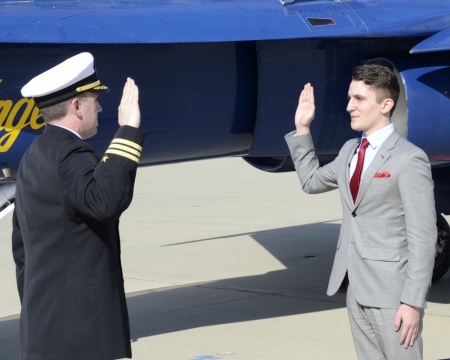
Here is the key sentence I recited as a regular officer in the U.S. military: “I do solemnly swear to support and defend the Constitution of the United States against all enemies, foreign and domestic.”

The oath says nothing directly about obeying the president as commander-in-chief.  It says nothing directly about the need to “win” wars.  Its primary meaning is clear.  Uphold the Constitution.  Defend it.

Indeed, it would be better to lose a war than to subvert the Constitution.  Wars come and go, but the Constitution and our laws must be permanent.  They are the nation’s bedrock.

As Thomas Paine wrote in Common Sense in 1776, in a newly forged America, the law was to be made “king” — the law was to be our monarch and our guiding light.

It all sounds idealistic, but that’s where the rubber meets the road, and too many of our most senior officers don’t recognize this.  They are far more concerned with enlarging the Navy, or the Army, or the Marines, or the Air Force, as well as protecting their service’s (and the military’s) reputation.  Hence the misleading “progress” reports in Iraq and elsewhere.  Better to lie (or to be economical with the truth), they think, than to be honest and to “hurt” the services.

So, in lying to protect their service branch, they harm the Constitution — indeed, push the lie far enough and you end up betraying the Constitution you’ve sworn to uphold.

It takes men and women of courage and integrity to speak the truth when those truths are uncomfortable.  We don’t have enough of such officers today.  As a first step in reinvigorating our republic, officers need to look to the oath and meet its demands on their integrity and their courage – most notably their moral courage.

Lactation Station Nation

readyandresilient_header5
Where do lactating troops fit in this picture?

Walter Stewart (Guest Post)

Sleep tight tonight, America.  At least some of the roughly one million soldiers of your Modern Volunteer Army (MOVAR, a dated acronym), part of the “finest fighting force in the history of the world,” remain awake.

A relative few are awake because they are in harm’s way.  Sleep in “Indian Country,” as my gun platoon warriors called the Mekong Delta badlands in Vietnam, is difficult.  More of our MOVAR troops are awake because of the harm their countrymen did to their bodies and minds by launching them on one of this nation’s many undeclared and therefore unwinnable wars – their restlessness will last a lifetime.

And then there are those awake breastfeeding infants or “expressing milk,” whatever that means.

It’s hard for this old soldier to get his mind around the concept of lactating troops and the realities of dealing with new Department of the Army guidance, such as “Non-restroom lactation areas must include a flat space where the soldier can rest her breast pump.”  It’s even harder to fathom how lactating “Ranger Janes” can be anything but a drag on the common defense.

Regarding the common defense, I observe that in my pre-MOVAR days there were more than enough America males to fill the ranks of a far larger army – and from a national population roughly half what it is now.  Countrymen, what happened to turn so many of us boys to beating the war drums while hiding behind skirts?  To borrow a term from Arnold Schwarzenegger, it’s as if “girly-men” have taken over to do nothing more than cheer the troops into battle while chugging one cup of “finest-military-ever” Kool-Aid after another.  Too many of us, gentlemen, are pantywaists.

It wasn’t supposed to be this way.  Throw enough money at the MOVAR, promised big government facilitator Alan Greenspan, and more than enough quality males would enlist as servicemen.  Regrettably, this bit of Greenspan happy talk wasn’t any better than his pre-meltdown assurance of bank health, so now, with the ordered opening of all service positions to females, we launch on a quest to flesh out service ranks with quality women, some nursing, some expressing.

Having led troops in war and peace, I’m trying to figure out how I would accomplish giving female soldiers time to express milk “with the intent to maintain physiological capability for lactation.”  I’m not sure what that means, but if we’re at war can the noise of a lactation pump reveal friendly positions to the enemy?  These questions, and more, need to be asked and answered.  However, and with certainty, service seniors will just go along to get along.

That’s what I would do – go into survival mode.  Take the pay, perks, pensions, and “thank you for your service” platitudes, while remembering Rudyard Kipling’s admonition to keep your head while all those about you are losing theirs.

Lactation station nation, that’s us, pumping pap to those so delusional as to believe that in the world of warriors, males and females are universally interchangeable.

Walter Stewart rose from a private in the army of regulars, reservists, and draftees raised to fight in Vietnam, to a major general serving with the thousands of citizen-soldiers of the 28th Infantry Division, Pennsylvania Army National Guard. Now retired, Stewart is a strong advocate for a citizen-military and a saner world.

Spoiling the Pentagon

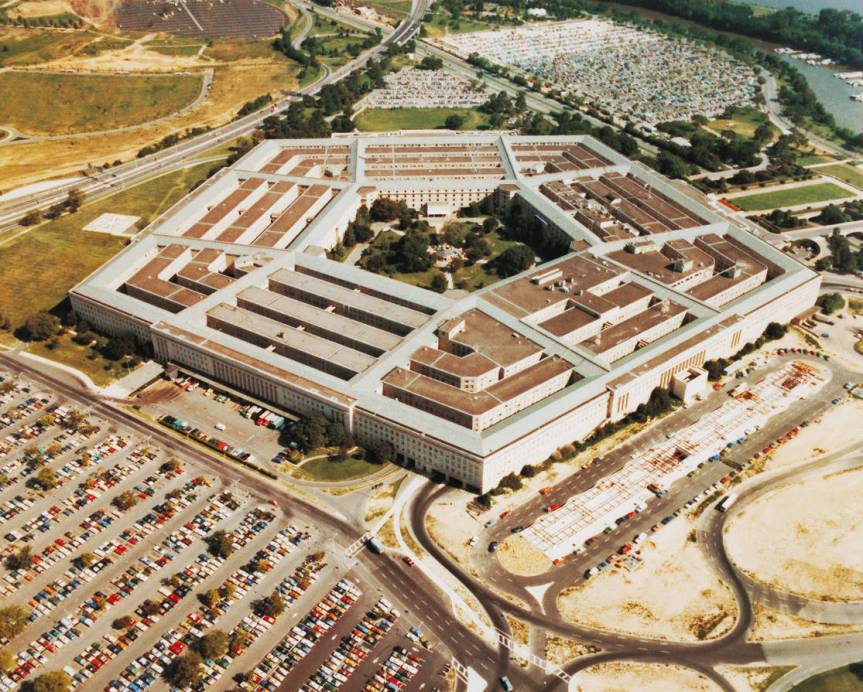
Pentagon
Spoiled?

W.J. Astore

In my latest article for TomDispatch.com, I compare the Pentagon and the Department of Defense to Ethan Couch, the Texas teenager said to be suffering from “affluenza.”  Like Couch, the Pentagon has been showered with money and praise, yet despite all the preferential treatment, the Pentagon is never called to account for its mistakes and its crimes.  You can read the entire article here; what follows is an excerpt.

A Spoiled Pentagon Means Never Having to Say You’re Sorry

To complete our affluenza diagnosis, let’s add one more factor to boundless praise and a bountiful allowance: a total inability to take responsibility for one’s actions. This is, of course, the most repellent part of the Ethan Couch affluenza defense: the idea that he shouldn’t be held responsible precisely because he was so favored.

Think, then, of the Pentagon and the military as Couch writ large. No matter their mistakes, profligate expenditures, even crimes, neither institution is held accountable for anything.

Consider these facts: Iraq, Afghanistan, and Libya are quagmires. The Islamic State is spreading. Foreign armies, trained and equipped at enormous expense by the U.S. military, continue to evaporate. A hospital, clearly identifiable as such, is destroyed “by accident.” Wedding parties are wiped out “by mistake.” Torture (a war crime) is committed in the field. Detainees are abused. And which senior leaders have been held accountable for any of this in any way? With the notable exception of Brigadier General Janis Karpinskiof Abu Ghraib infamy, not a one.

After lengthy investigations, the Pentagon will occasionally hold accountable a few individuals who pulled the triggers or dropped the bombs or abused the prisoners. Meanwhile, the generals and the top civilians in the Pentagon who made it all possible are immunized from either responsibility or penalty of any sort. This is precisely why Lieutenant Colonel Paul Yingling memorably wrote in 2007 that, in the U.S. military, “a private who loses a rifle suffers far greater consequences than a general who loses a war.” In fact, no matter what that military doesn’t accomplish, no matter how lacking its ultimate performance in the field, it keeps getting more money, resources, praise.

When it comes to such subjects, consider the Republican presidential debate in Iowa on January 28th. Jeb Bush led the rhetorical charge by claiming that President Obama was “gutting” the military. Ted Cruz and Marco Rubio eagerly agreed, insisting that a “dramatically degraded” military had to be rebuilt. All the Republican candidates (Rand Paul excepted) piled on, calling for major increases in defense spending as well as looser “rules of engagement” in the field to empower local commanders to take the fight to the enemy. America’s “warfighters,” more than one candidate claimed, are fighting with one arm tied behind their backs, thanks to knots tightened by government lawyers. The final twist that supposedly tied the military up in a giant knot was, so they claim, applied by that lawyer-in-chief, Barack Obama himself.

Interestingly, there has been no talk of our burgeoning national debt, which former chairman of the Joint Chiefs of Staff Admiral Mike Mullen once identified as the biggest threat facing America. When asked during the debate which specific federal programs he would cut to reduce the deficit, Chris Christie came up with only one, Planned Parenthood, which at $500 million a year is the equivalent of two F-35 jet fighters. (The military wants to buy more than 2,000 of them.)

Throwing yet more money at a spoiled military is precisely the worst thing we as “parents” can do. In this, we should resort to the fiscal wisdom of Army Major General Gerald Sajer, the son of a Pennsylvania coal miner killed in the mines, a Korean War veteran and former Adjutant General of Pennsylvania. When his senior commanders pleaded for more money (during the leaner budget years before 9/11) to accomplish the tasks he had assigned them, General Sajer’s retort was simple: “We’re out of money; now we have to think.”

Accountability Is Everything

It’s high time to force the Pentagon to think. Yet when it comes to our relationship with the military, too many of us have acted like Ethan Couch’s mother. Out of a twisted sense of love or loyalty, she sought to shelter her son from his day of reckoning. But we know better. We know her son has to face the music.

Something similar is true of our relationship to the U.S. military. An institutional report card with so many deficits and failures, a record of deportment that has led to death and mayhem, should not be ignored. The military must be called to account.

How? By cutting its allowance. (That should make the brass sit up and take notice, perhaps even think.) By holding senior leaders accountable for mistakes. And by cutting the easy praise. Our military commanders know that they are not leading the finest fighting force since the dawn of history and it’s time our political leaders and the rest of us acknowledged that as well.