More on Trump’s Generals

trump

W.J. Astore

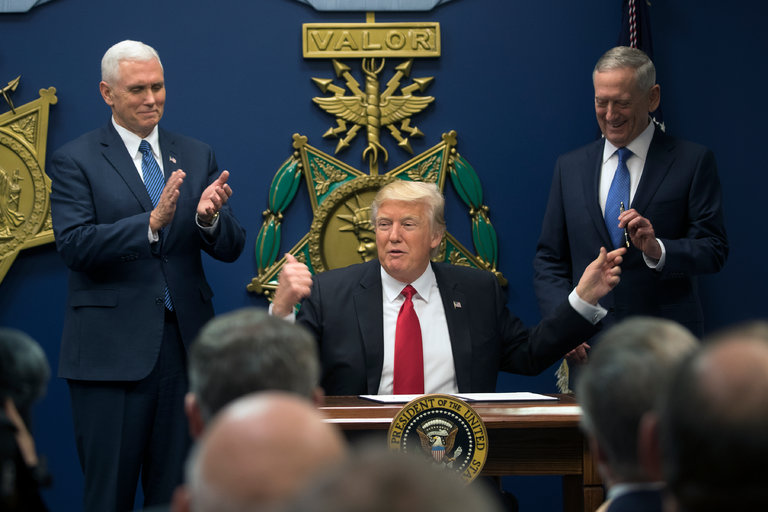
In a longer article for TomDispatch.com, I recently wrote about Donald Trump’s team of generals for national defense and homeland security. Trump wants four senior retired generals, two from the Army and two from the Marine Corps, to serve as his senior civilian advisers in matters of defense and security.

Here’s the point: You simply can’t have civilian control of the military when you appoint senior generals to these positions.

I’m astonished more Americans aren’t outraged at this. It’s a sign of how much militarism has gripped our nation and government, as well as the sweep and scope of the national security state.

I was reading Samuel Hynes’ excellent book, The Soldiers’ Tale: Bearing Witness to Modern War, and came across two passages that resonated with me. In talking about war as a culture, Hynes notes that “Military traditions, values, and patterns of behavior penetrate every aspect of army [and Marine Corps] life and make the most ordinary acts and feelings different.”

The generals Trump is hiring are all military careerists, men whose “traditions, values, and patterns of behavior” are steeped in the ways of the Army and Marine Corps, affecting even “the most ordinary acts and feelings.” Their behavior, their commitments, their loyalties, their world views, are the antithesis to civilian culture and to the ethos of democracy. (For example, General James Mattis, Trump’s selection as Secretary of Defense, is most often described as a “warrior-monk,” a man with a Spartan-like dedication to war.  But would Athens have anointed a Spartan, even as its minister of war?)

Again, the point is not to attack the military. It’s that the U.S. government already has plenty of generals in charge, wielding enormous authority. Trump’s decision to add yet another layer of military authority to his government makes it less of a democracy and more of a junta.

A second point from Hynes. He notes how most citizen-soldiers in America’s military past were not war-lovers, but that a few were, notably General George S. Patton. In the same breath, Hynes notes that dictators like Hitler and Mussolini “loved war.”

Which American general does Trump profess to admire the most? George S. Patton. And who among his generals most resembles Patton as a “real” warrior? According to Trump, it’s General Mattis.

Again, the point is not to attack the military, but rather to note the U.S. national security state already has plenty of warriors and warfighters in charge. Putting an alleged Patton-clone in charge of the Pentagon represents an abrogation of two centuries of American tradition that insisted on civilian supremacy over the military.

Given his inflammatory tweets about nuclear arms races with their “bring it on” mentality, Trump has all the makings of tinpot provocateur, an unstable military poseur who likes to speak loudly while swinging a nuclear-tipped stick. Will Trump’s generals, his Pattons and MacArthurs, serve as a check to his provocations and his posturings? It doesn’t seem likely.

Congress should reject Trump’s choices for Secretary of Defense (Mattis) and Homeland Security (Kelly). Not because these retired generals are bad men, but because they are the wrong kind of people. If you want civilian control of the military (and don’t we still want that?), you need to hire true civilians. Men and women whose identities haven’t been forged in armories. Independent thinkers and patriots with some history of dissent.

How about someone like Daniel Ellsberg for Secretary of Defense? And, since global warming is a huge threat to the U.S., how about Bill McKibben for Homeland Security?

After all, whether they’re in or out of uniform, the U.S. government already has plenty of generals.

The F-35 Fighter: Not Invisible to Trump’s Radar

a-10-thunderbolt-ii_001
You can hang a lot more weaponry from an A-10 Warthog (vintage 1970s) than you can from a modern F-35

W.J. Astore

Is Donald Trump putting coal in Lockheed Martin’s Christmas stocking?

Trump has sent another tweet about the F-35 jet fighter (Lockheed Martin is the primary contractor), this time asking Boeing to price out a comparable F-18 Super Hornet as a possible replacement for that jet.  Trump’s tweet caused Lockheed Martin shares to dive even as Boeing shares climbed.

Trump is right to pressure Lockheed Martin on the F-35, though I’m not sure tweets are the best way to do this.  I remember planning for the F-35 twenty years ago when I was on active duty in the Air Force.  The F-35 Joint Strike Fighter was supposed to be a relatively low cost fighter/attack aircraft that would meet Air Force, Navy, and Marine needs.  Back then, the flyaway cost was estimated at $40 million per plane, more expensive than the F-16 but roughly equivalent to the F-15E “Strike Eagle.”  The current flyaway cost is roughly $200 million per plane,* and even higher for the Marine Corps version with its vertical landing/short takeoff capacity.

f-35
The F-35: Stealthy but expensive, with a long history of cost overruns

What happened?  Everything went wrong as each service piled requirements onto the F-35 and all kinds of exotic features were added to it.  Stealth capability.  Loads of special software featuring millions of lines of code.  Unique (and expensive) helmets for its pilots. Vertical landing/short takeoff capacity for the Marines, which drove an airframe configuration that made it less maneuverable for the Air Force.  In short, the F-35 became like a Swiss army knife, featuring lots of tools and moving parts.  Sure, in a pinch a Swiss army knife can be used as a screwdriver or what have you, but most of the time what you really need is the best screwdriver for the job.

The F-35 is reminiscent of another ill-fated effort to build a jet acceptable to all the services: the F-111 “swing-wing” program of the 1960s.

f111
Big and ungainly, the F-111 was mainly used as a bomber and electronics warfare plane

The Navy never deployed it, and the Air Force was never that happy with it, converting it to a fighter/bomber and an electronics warfare plane.  The Navy went on to build its own fighter jet, the F-14, even as the Air Force built its fighter jet, the F-15.  Then the Air Force and Navy got two decent fighter/attack jets, the F-16 and F-18, out of the lightweight fighter competition.**

Here’s the thing: Although jets like the F-15 and F-18 are not stealthy, they are very effective, especially when updated with the latest weaponry and avionics and flown by skilled pilots.  Meanwhile, highly effective UAVs (drones) have emerged, e.g. Predators and Reapers, with long loiter times and no risk of U.S. casualties.  To put it bluntly, does the U.S. really need the F-35, especially given its high cost and underwhelming performance?

Back to Donald Trump.  Is he bluffing when he threatens to buy Boeing-made F-18s instead of the F-35?  Is he posturing to get Lockheed Martin to cut the price of the F-35 (which, at this late stage of its development, may not even be possible)?  One thing is certain: A lot of good American jobs are riding on Trump’s tweets.  Expect Lockheed Martin to rally its Congressional allies to defend the program.  The plane’s multitude of contracts were deliberately spread throughout the 50 states to gain as much Congressional support as possible.

For a little fun, go to the Lockheed Martin website at the following link:

https://www.f35.com/about/economic-impact-map

Let’s put in Pennsylvania.  Here’s what you get: 41 supplier locations, 2100 jobs, $172.5M in economic impact.  How about New York?  77 suppliers, 8160 jobs, $695.2M in economic impact.  How about Bernie Sanders’s state of Vermont?  3 suppliers, 1410 jobs, $124.5 million in economic impact.  Small wonder that even Bernie Sanders during the campaign was an F-35 supporter.

One thing is certain: the stealthy F-35 has not evaded Trump’s radar.  Whether Trump will shoot it down or simply watch it as it soars on by while burning through piles of money remains to be seen.

Note: For a more detailed report on the F-35’s performance issues, see “The F-35 Stealth Fighter May Never Be Ready for Combat: Testing report contradicts the U.S. Air Force’s rosy pronouncements,” by DAN GRAZIER & MANDY SMITHBERGER, available at this link. In short, the plane’s “requirement” to be stealthy is driving higher costs and lower performance. The plane gobbles gas so it has limited combat endurance. It’s a step backwards in effectiveness, at a much higher cost to the American taxpayer than previous planes such as the F-15, F-16, and A-10.  Meanwhile, many of its missions are now filled by drones.

For a counterpoint in favor of the F-35, see this link.  The F-35 has unique capabilities; it should, given its price tag.  Leaving aside high cost and questionable performance, it’s vital to remember the mission.  Are there really missions that only the F-35 can do, or that no plane can do as effectively?  But the real case for the F-35 seems to come down to the fact that the program is simply too big to fail; the “sunk costs” are too high; its rivals are too old; and too many American jobs are dependent on it.  In short, the U.S. military is stuck with the plane — and the American taxpayer is stuck with the bill.

*Estimates vary about the final flyaway cost since it’s ultimately dependent on how many F-35s are produced.  Current estimates for the entire U.S. purchase are $400 billion, with another trillion dollars for maintenance and spares and related costs over the program’s lifetime.

**The most rugged and effective attack jet in the Air Force’s inventory, the A-10, was never much liked by the Air Force; generals have fought to eliminate it in favor of the much less effective F-35, but Congress has actually fought back to keep the A-10, affectionately known as the Warthog, a name and image contrary to the AF fighter pilot mystique of “eagles” and “fighting falcons.”

Is the Idea of a Military Coup Hysterical?

cincinnatus_cincinnatorum
Unlike George Washington or Cincinnatus, today’s warrior-generals don’t return to the plough.  They cash-in at the trough of the military-industrial complex

W.J. Astore

The National Review labels the idea of a military coup in Trump’s America “hysterical.” Here’s David French criticizing my recent article at TomDispatch.com:

Here we go again — another article talking about how the retired generals in Trump’s cabinet, civilians who are nominated by a civilian and confirmed by a civilian senate, represent the erosion of the principle of civilian control over the military. But this time, there’s a hysterical twist. The nomination of James Mattis for secretary of defense and John Kelly for secretary of homeland security and the selection of Michael Flynn for national security adviser is worse than a real-life coup. No, really.

French goes on to say the following:

Lots of people read this nonsense. Lots of people believe this nonsense. I’ve been arguing for some time that the prime threat to our national unity isn’t action but reaction. Activists and pundits take normal politics (retired generals have a long history of serving this nation in civilian offices, beginning with George Washington) and respond with an overreaction that pushes their fellow citizens into believing that the sky is falling.

In my article for TomDispatch.com, I made the same point that retired generals have a long history of serving this nation, beginning with Washington.  But Washington was a special case, an American Cincinnatus, a citizen first, a soldier second.  As I mentioned in my article, today’s generals are cut from a different cloth.  They self-identify as warriors first and foremost.  Even when they retire, they usually go to work immediately for the military-industrial complex, making millions in the process.

French seems to think that if a civilian like Donald Trump nominates four recently retired warrior/generals, and if a civilian Congress approves them, this in no way constitutes a coup.  And, strictly speaking, that’s true.

Yet consider this.  These four warrior/generals will direct the Department of Defense, Homeland Security, and the National Security Council.  Professional warriors are filling the highest leadership positions in a superpower military complex that is supposed to be overseen by civilians.  They will command budgetary authority approaching a trillion dollars annually. If this isn’t a de facto military coup, what is?

Consider as well that their boss, Donald Trump, professes to admire two American generals: George S. Patton and Douglas MacArthur.  In choosing Patton and MacArthur, Trump has all the signs of an immature military hero-lover. Mature historians recognize that generals like George C. Marshall, Dwight Eisenhower, and Omar Bradley were far more distinguished (and far more in keeping with the American citizen-soldier ideal) than Patton and MacArthur. Indeed, both Patton and MacArthur were over-hyped, deliberately so, for propaganda purposes during Word War II. MacArthur was a disaster in the Philippines, and Patton wasn’t even needed during D-Day. Both fancied themselves to be warriors; both were vainglorious showboats, stuck on themselves and their alleged military brilliance.

“Retired” warriors are simply not the right men in a democracy to ride herd on the military. Warrior/generals like Mattis, Flynn, and Kelly — men defined by the military and loyal to it for their entire lives — are not going to become free-thinkers and tough-minded critics in a matter of months, especially when they’ve already cashed in after retirement by joining corporate boards affiliated with the military-industrial complex.

Look, I realize some Americans see nothing wrong with generals taking charge of America. As one disgruntled reader wrote me, “I value the experience of generals who led Soldiers and Marines in combat on the ground.”

Well, I value that too.  So does our country, which is why the Joint Chiefs of Staff (JCS) advise our president.  But what Trump has done is to surround himself with a rival JCS, his own band of warriors, generals that he sees as the equivalent to Patton and MacArthur. He’s created a dynamic in which the only advice he’ll get on national security is from military minds.  And if you’re looking to Congress as a check on military rule, consider that the last time Congress formally exercised its authority to declare war was December 1941.  Yes, 75 years ago this month.

Hey, nothing to worry about here.  Don’t get hysterical.  Let the “civilian” generals rule! After all, what could possibly go wrong?

Further Thoughts: I think many in America equate militarism to fascism; they think that, so long as jackbooted troops aren’t marching loudly down American streets and breaking down doors, militarism doesn’t exist here.

But militarism, as a descriptive term, also involves the permeation of military attitudes and values throughout civil society and political culture in America.  Since 9/11, if not before, Americans have been actively encouraged to “support our troops” as a patriotic duty.  Those troops have been lauded as “warriors,” “war-fighters,” and “heroes,” even as the U.S. military has become both thoroughly professionalized and increasingly isolated from civil society.  This isolation, however, does not extend to public celebrations of the military, most visibly at major sporting events (e.g. NFL football games).  (A small sign of this is major league baseball players wearing camouflaged uniforms to “honor” the troops.)

Trump’s decision — to put four senior “retired” generals in charge of America’s military and national security — acts as an accelerant to the permeation of military attitudes and values throughout America’s civil society and political culture.  Again, the USA, one must recall, was founded on civilian control of the military as well as the ideal of the citizen-soldier.  The latter ideal is dead, replaced as it has been by a new ideal, that of the warrior.

And civilian control?  With four generals in command, enabled by an inexperienced civilian commander-in-chief whose ideal general is defined by Patton and MacArthur, you have in essence a repudiation of civilian control.


Prussia Without the Victories: Kaiser Trump’s Cabinet of Generals

Trump holds a rally with supporters at the Suburban Collection Showplace in Novi, Michigan, U.S.
Kaiser Trump is surrounding himself with generals

W.J. Astore

In my latest article at TomDispatch.com, “All the President’s Generals,” I examine Trump’s affection for retired military generals to fill America’s most senior civilian positions related to national defense.  I urge you to read the entire article at TomDispatch.com; here I wish to focus on the quartet of generals/warriors Trump is empowering as part of his drive to “win” again.  Trump seems most pleased that “his” generals are allegedly cut from the same cloth as George S. Patton and Douglas MacArthur, two of America’s most anti-democratic generals.

Perhaps this shouldn’t surprise us.  Like Prussia in the age of Frederick the Great, America is increasingly becoming a colossal military establishment with a state attached to it. Unlike Prussia, our colossus is not producing any meaningful victories.  And no one, I think, would confuse the educated and enlightened Frederick with America’s angry and undisciplined Tweeter-in-chief.

Too Many Generals Spoil the Democracy (from TomDispatch.com)

General officers, by the way, have come to resemble a self-replicating organism.  The grooming process, favoring homogeneity as it does, is partly to blame. Disruptive creativity and a reputation for outspokenness can mark one as not being a “team player.”  Political skills and conformity are valued more highly.  It’s a mistake, then, to assume that America’s generals are the best and the brightest. “The curated and the calculating” is perhaps a more accurate description.

With that in mind, let’s take a closer look at Trump’s chosen threesome, starting with General Mattis.  He has his virtues: a distinguished career in the Marine Corps, a sensible stance against torture, a dedication to all ranks within the military.  Yet like so many high-ranking military retirees — take General Mark Welsh of the Air Force, for example — Mattis quickly cashed in on his career, reputation, and continuing influence via the military-industrial complex.  Despite a six-figure pension, he joined corporate boards, notably that of military-industrial powerhouse General Dynamics where he quickly earned or acquired nearly $1.5 million in salary and stock options.  Mattis is also on the board at Theranos, a deeply troubled company that failed to deliver on promises to develop effective blood-testing technologies for the military.

And then, of course, there was his long military career, itself a distinctly mixed bag.  As head of U.S. Central Command under President Obama, for instance, his hawkish stance toward Iran led to his removal and forced retirement in 2013.  Almost a decade earlier in 2004, the aggressive tactics he oversaw in Iraq as commanding general of the 1st Marine Division during the Battle of Fallujah have been characterized by some as war crimes.  For Trump, however, none of this matters.  Mattis, much like General Patton (in the president-elect’s view), is a man who “plays no games.”

And Mattis seems like the voice of reason and moderation compared to Flynn, whose hatred of Islam is as virulent as it is transparent.  Like Trump, Flynn is a fan of tweeting, perhaps his most infamous being “Fear of Muslims is RATIONAL.”  A brusque man convinced of his own rectitude, who has a reputation for not playing well with others, Flynn was forced from his position as director of the Defense Intelligence Agency in 2014, after which he became a harsh critic of the Obama administration.

In his brief retirement, Flynn served as a paid lobbyist to a Turkish businessman with close ties to President Recep Tayyip Erdogan of Turkey, while running a business consultancy that is due to profit by providing surveillance drones to patrol the U.S.-Mexican border.  Rising to prominence during the Trump campaign, he led the chant against Hillary Clinton (“Lock her up!”) at the Republican National Convention in July.  (His son recently helped spread the false rumor that Clinton was involved in a child sex trafficking ring involving a Washington, D.C., pizzeria.)  Flynn, who sees Islam as a political conspiracy rather than a legitimate religion, is an angry warrior, a dyed-in-the-wool crusader.  That Trump sees such a figure as qualified to serve as the nation’s senior civilian security adviser speaks volumes about the president-elect and the crusading militarism that is likely to be forthcoming from his administration.

Serving in a supporting capacity to Flynn as chief of staff of the National Security Council (NSC) is yet another high-ranking military man (and early supporter of Trump’s presidential run), Army retired Lieutenant General Keith Kellogg.  Almost a generation older than Flynn, Kellogg served as chief operations officer for the ill-fated Coalition Provisional Authority in Iraq, which badly mismanaged the U.S. military’s occupation of the country after the fall of Baghdad in 2003.  Like most retired generals, Kellogg has profited from close links to defense-related industries, including CACI International, Oracle Corporation (Homeland Security Division), and Cubic, where he was senior vice president for ground combat programs.  It’s hard to see fresh ideas coming from the NSC with long-serving military diehards like Flynn and Kellogg ruling the roost.

General John Kelly, the last of the quartet and soon to be head of the Department of Homeland Security, is yet another long-serving Marine with a reputation for bluntness.  He opposed efforts by the Obama administration to close the prison at Guantanamo Bay in Cuba, claiming that the remaining detainees were “all bad boys,” both guilty and dangerous.  He also ran afoul of the administration by criticizing efforts to open combat positions to qualified servicewomen, claiming such efforts were “agenda-driven” and would lead to lower standards and decreased military combat effectiveness.  Despite these views, or perhaps because of them, Kelly, who served as senior military assistant to Defense Secretary Leon Panetta and has been well vetted by the system, is likely to be confirmed with little real debate.

Of Coups and Crusades

Collectively, the team of Mattis, Flynn, and Kelly could not be more symbolic of the ongoing process of subversion of civilian control of the military.  With Trump holding their reins, these self-styled warriors will soon take charge of the highest civilian positions overseeing the military of the world’s sole superpower.  Don’t think of this, however, as a “Seven Days in May” scenario in which a hard-headed general mounts a coup against an allegedly soft-hearted president.  It’s far worse.  Who needs a coup when generals are essentially to be given free rein by a president-elect who fancies himself a military expert because, as a teenager, he spent a few years at a military-themed boarding school?

In all of this, Trump represents just the next (giant) step in an ongoing process.  His warrior-steeds, his “dream team” of generals, highlight America’s striking twenty-first-century embrace of militarism.

Read the entire article at TomDispatch.com.  Many thanks.

The Cost of Empire

cincinnatus_cincinnatorum
Cincinnatus at his plow in Ohio.

W.J. Astore

With all these generals being called out of retirement to serve as Donald Trump’s “civilian” advisers, whether it’s General James “Mad Dog” Mattis as Secretary of Defense or General Mike Flynn (the real mad dog) as National Security Adviser, it’s difficult to envision the American empire being shrunk anytime soon.  The U.S. military is overcommitted around the world, attenuating its strength even as the American taxpayer foots the bill to the tune of over $600 billion a year, not including nuclear weapons, veterans affairs, interest on the national debt related to war and defense spending, and so on.

With its endless wars and global adventurism, the U.S. is slowly bankrupting itself even as President-elect Trump promises higher military spending and more toughness abroad.  Imperial over-commitment, for the historically-minded, recalls the fate of the Roman empire.  Many moons ago, the classicist Steven Willett wrote the following words to me, words that America’s militarists and imperialists would be wise to read – and heed:

My personal concern is the misallocation of our resources in futile wars and global military hegemony.  We are acting under the false belief that the military can and should be used as a foreign policy tool.  The end of US militarism is bankruptcy.  I agree with [Andrew] Bacevich’s recommendation that the US cut military spending 6% a year for 10 years.  The result would be a robust defensive military with more freed-up resources for infrastructure, education, research and alternative energy.  Our so-called defense budget is a massive example of what economists call an opportunity cost.

The US is now about where Rome was in the third to fourth centuries.  In his magisterial study “The Later Roman Empire, 284-602: A Social, Economic, and Administrative Survey,” A. H. M. Jones shows what a drain the army was on the [economy of Rome].  By the third to fifth centuries, the army numbered about 650,000 scattered along the limes and stationed at central strategic locations.  It took most of the state’s revenues, which had long been declining as the economy in the west declined.  And even that 650,000 was far too small for adequate defense of the [Roman] empire.

General Mattis, described as a “warrior-monk” with a reputation for a close study of military history, perhaps understands some of this.  But can he rein in the American empire and decrease U.S. military spending?  The prospects seem grim.

Trying to be strong everywhere is a recipe for being weak when and where it counts.  Under the five good emperors, Rome was able to balance imperial ambition with domestic vitality.  Any chance Donald Trump is going to be a “good” emperor, a Marcus Aurelius, a man of wisdom?  Early signs are unpromising, to say the least.

Of course, America is supposed to be a democracy.  We’re supposed to look back to the Roman Republic, not its empire.  We’re supposed to be committed to a limited military of citizen-soldiers who are eager to shed their armor and weapons and return to the plow, like Cincinnatus — or George Washington.  We’re not supposed to worship warriors and violence.

Imperial decline and cultural decadence march together in step. Under Trump, it appears they’ll soon be marching in lockstep at double-time.  Grim times, indeed.


The Poison of War

george
President Bush just before he gave his “mission accomplished” speech in May 2003

Chris Hedges

In May 2003, Chris Hedges gave a controversial commencement speech at Rockford College (Rockford University since 2013) in Illinois.  Back then, Hedges was an award-winning reporter for the New York Times who had recently completed a book, War Is A Force that Gives Us Meaning (2002), which I highly recommend.  Earlier that month, President George W. Bush had given his “Mission Accomplished” speech about the Iraq war, and patriotic pride was riding high.  Hedges had the foresight to recognize the mission had not been accomplished, and that the cost of war (all wars) would be high to the United States as well as to the countries purportedly liberated.

Booed and interrupted on several occasions during his speech, Hedges persevered.  His words from 2003 are well worth reading again, especially as President-elect Trump assembles a team of former generals and hardline rightists with the promise of obliterating ISIS and of “winning” conflicts around the world.

Here is his speech, in its entirety.  I have bolded one passage on Athens and the poison of war that is particularly telling for the current American moment.  W.J. Astore

Chris Hedges at Rockford College, Commencement Address, May 2003

I want to speak to you today about war and empire.

Killing, or at least the worst of it, is over in Iraq. Although blood will continue to spill — theirs and ours — be prepared for this. For we are embarking on an occupation that, if history is any guide, will be as damaging to our souls as it will be to our prestige, power, and security. But this will come later as our empire expands and in all this we become pariahs, tyrants to others weaker than ourselves. Isolation always impairs judgment and we are very isolated now.

We have forfeited the good will, the empathy the world felt for us after 9-11. We have folded in on ourselves, we have severely weakened the delicate international coalitions and alliances that are vital in maintaining and promoting peace and we are part now of a dubious troika in the war against terror with Vladimir Putin and Ariel Sharon, two leaders who do not shrink in Palestine or Chechnya from carrying out acts of gratuitous and senseless acts of violence. We have become the company we keep.

The censure and perhaps the rage of much of the world, certainly one-fifth of the world’s population which is Muslim, most of whom I’ll remind you are not Arab, is upon us. Look today at the 14 people killed last night in several explosions in Casablanca. And this rage in a world where almost 50 percent of the planet struggles on less than two dollars a day will see us targeted. Terrorism will become a way of life, and when we are attacked we will, like our allies Putin and Sharon, lash out with greater fury. The circle of violence is a death spiral; no one escapes. We are spinning at a speed that we may not be able to hold. As we revel in our military prowess — the sophistication of our military hardware and technology, for this is what most of the press coverage consisted of in Iraq — we lose sight of the fact that just because we have the capacity to wage war it does not give us the right to wage war. This capacity has doomed empires in the past.

“Modern western civilization may perish,” the theologian Reinhold Niebuhr warned, “because it falsely worshiped technology as a final good.”

The real injustices, the Israeli occupation of Palestinian land, the brutal and corrupt dictatorships we fund in the Middle East, will mean that we will not rid the extremists who hate us with bombs. Indeed we will swell their ranks. Once you master people by force you depend on force for control. In your isolation you begin to make mistakes.

Fear engenders cruelty; cruelty, fear, insanity, and then paralysis. In the center of Dante’s circle the damned remained motionless. We have blundered into a nation we know little about and are caught between bitter rivalries and competing ethnic groups and leaders we do not understand. We are trying to transplant a modern system of politics invented in Europe characterized, among other things, by the division of earth into independent secular states based on national citizenship in a land where the belief in a secular civil government is an alien creed. Iraq was a cesspool for the British when they occupied it in 1917; it will be a cesspool for us as well. The curfews, the armed clashes with angry crowds that leave scores of Iraqi dead, the military governor, the Christian Evangelical groups who are being allowed to follow on the heels of our occupying troops to try and teach Muslims about Jesus.

The occupation of the oil fields, the notion of the Kurds and the Shiites will listen to the demands of a centralized government in Baghdad, the same Kurds and Shiites who died by the tens of thousands in defiance of Saddam Hussein, a man who happily butchered all of those who challenged him, and this ethnic rivalry has not gone away. The looting of Baghdad, or let me say the looting of Baghdad with the exception of the oil ministry and the interior ministry — the only two ministries we bothered protecting — is self immolation.

As someone who knows Iraq, speaks Arabic, and spent seven years in the Middle East, if the Iraqis believe rightly or wrongly that we come only for oil and occupation, that will begin a long bloody war of attrition; it is how they drove the British out and remember that, when the Israelis invaded southern Lebanon in 1982, they were greeted by the dispossessed Shiites as liberators. But within a few months, when the Shiites saw that the Israelis had come not as liberators but occupiers, they began to kill them. It was Israel who created Hezbollah and was Hezbollah that pushed Israel out of Southern Lebanon.

As William Butler Yeats wrote in “Meditations in Times of Civil War,” “We had fed the heart on fantasies / the hearts grown brutal from the fair.”

This is a war of liberation in Iraq, but it is a war now of liberation by Iraqis from American occupation. And if you watch closely what is happening in Iraq, if you can see it through the abysmal coverage, you can see it in the lashing out of the terrorist death squads, the murder of Shiite leaders in mosques, and the assassination of our young soldiers in the streets. It is one that will soon be joined by Islamic radicals and we are far less secure today than we were before we bumbled into Iraq.

We will pay for this, but what saddens me most is that those who will by and large pay the highest price are poor kids from Mississippi or Alabama or Texas who could not get a decent job or health insurance and joined the army because it was all we offered them. For war in the end is always about betrayal, betrayal of the young by the old, of soldiers by politicians, and of idealists by cynics. Read Antigone, when the king imposes his will without listening to those he rules or Thucydides’ history. Read how Athens’ expanding empire saw it become a tyrant abroad and then a tyrant at home. How the tyranny the Athenian leadership imposed on others it finally imposed on itself.

This, Thucydides wrote, is what doomed Athenian democracy; Athens destroyed itself. For the instrument of empire is war and war is a poison, a poison which at times we must ingest just as a cancer patient must ingest a poison to survive. But if we do not understand the poison of war — if we do not understand how deadly that poison is — it can kill us just as surely as the disease.

We have lost touch with the essence of war. Following our defeat in Vietnam we became a better nation. We were humbled, even humiliated. We asked questions about ourselves we had not asked before.

We were forced to see ourselves as others saw us and the sight was not always a pretty one. We were forced to confront our own capacity for atrocity — for evil — and in this we understood not only war but more about ourselves. But that humility is gone.

War, we have come to believe, is a spectator sport. The military and the press — remember in wartime the press is always part of the problem — have turned war into a vast video arcade came. Its very essence — death — is hidden from public view.

There was no more candor in the Persian Gulf War or the War in Afghanistan or the War in Iraq than there was in Vietnam. But in the age of live feeds and satellite television, the state and the military have perfected the appearance of candor.

Because we no longer understand war, we no longer understand that it can all go horribly wrong. We no longer understand that war begins by calling for the annihilation of others but ends if we do not know when to make or maintain peace with self-annihilation. We flirt, given the potency of modern weapons, with our own destruction.

The seduction of war is insidious because so much of what we are told about it is true — it does create a feeling of comradeship which obliterates our alienation and makes us, for perhaps the only time of our life, feel we belong.

War allows us to rise above our small stations in life; we find nobility in a cause and feelings of selflessness and even bliss. And at a time of soaring deficits and financial scandals and the very deterioration of our domestic fabric, war is a fine diversion. War for those who enter into combat has a dark beauty, filled with the monstrous and the grotesque. The Bible calls it the lust of the eye and warns believers against it. War gives us a distorted sense of self; it gives us meaning.

Once in war, the conflict obliterates the past and the future all is one heady intoxicating present. You feel every heartbeat in war, colors are brighter, your mind races ahead of itself.  We feel in wartime comradeship.  We confuse this with friendship, with love. There are those who will insist that the comradeship of war is love — the exotic glow that makes us in war feel as one people, one entity, is real, but this is part of war’s intoxication.

Think back on the days after the attacks on 9-11. Suddenly we no longer felt alone; we connected with strangers, even with people we did not like. We felt we belonged, that we were somehow wrapped in the embrace of the nation, the community; in short, we no longer felt alienated.

As this feeling dissipated in the weeks after the attack, there was a kind of nostalgia for its warm glow and wartime always brings with it this comradeship, which is the opposite of friendship. Friends are predetermined; friendship takes place between men and women who possess an intellectual and emotional affinity for each other. But comradeship — that ecstatic bliss that comes with belonging to the crowd in wartime — is within our reach. We can all have comrades.

The danger of the external threat that comes when we have an enemy does not create friendship; it creates comradeship. And those in wartime are deceived about what they are undergoing. And this is why once the threat is over, once war ends, comrades again become strangers to us. This is why after war we fall into despair.

In friendship there is a deepening of our sense of self. We become, through the friend, more aware of who we are and what we are about; we find ourselves in the eyes of the friend. Friends probe and question and challenge each other to make each of us more complete; with comradeship, the kind that comes to us in patriotic fervor, there is a suppression of self-awareness, self-knowledge, and self-possession. Comrades lose their identities in wartime for the collective rush of a common cause — a common purpose. In comradeship there are no demands on the self. This is part of its appeal and one of the reasons we miss it and seek to recreate it. Comradeship allows us to escape the demands on the self that is part of friendship.

In wartime when we feel threatened, we no longer face death alone but as a group, and this makes death easier to bear. We ennoble self-sacrifice for the other, for the comrade; in short we begin to worship death. And this is what the god of war demands of us.

Think finally of what it means to die for a friend. It is deliberate and painful; there is no ecstasy. For friends, dying is hard and bitter. The dialogue they have and cherish will perhaps never be recreated. Friends do not, the way comrades do, love death and sacrifice. To friends, the prospect of death is frightening. And this is why friendship or, let me say love, is the most potent enemy of war. Thank you.

The Indispensable Nation?

101222_pentagon_605_reuters
With Trump’s election, it’s a bull market at the Pentagon

W.J. Astore

In two recent speeches, President Obama has repeated the conceit that the United States is “the indispensable nation.”  Apparently, that means the U.S. must lead “the free world,” with a none-too-subtle corollary that other “free” nations must follow.  Yet the conceit of indispensability gets the U.S. into serious trouble.  It facilitates interventionism and meddling, and when the U.S. intervenes and meddles, it’s almost always in military ways, often disastrously (Afghanistan, Iraq, Libya are just three recent examples).

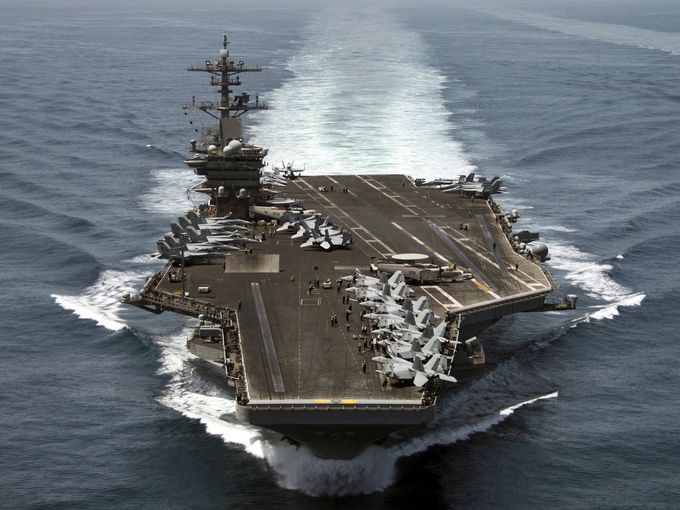
This is hardly surprising.  The U.S. military has roughly 800 bases worldwide.  Its aircraft carriers are essentially mobile American bases, bristling with weapons and munitions.  The U.S. spends roughly $600 billion a year maintaining this military and empire, even as it continues to dominate the world’s arms trade.  This heavy investment in weaponry and war-making, abetted by a mentality that celebrates “global reach, global power,” is a strange way to define your nation as being “indispensable.”

How did America come to invest so much of itself in military weaponry and incessant wars?  One reason is the quest for total safety.  As one of my friends put it:

It [the notion of total safety] must be a post-1941 thing [after the shocking sneak attack on Pearl Harbor]. I think in both cases (1917 [U.S. entry into World War I] and 1941 and maybe 2001) the question Americans have asked is how to keep an evil “over there” somehow from affecting us. In all three cases, I think the answer was neutrality until neutrality no longer seemed to offer safety. My guess is that the idea that total safety required global involvement comes from c.1948, fears of the USSR’s globalism, atomic paranoia, and the desire to protect and preserve the new American affluence. Thus NSC-68 gets passed with nary a whisper of opposition.

What is NSC-68?  We must turn the clock back to 1950, the Cold War, and the Truman Administration, as detailed here by The History Channel:

According to the [National Security Council’s] report, the United States should vigorously pursue a policy of “containing” Soviet expansion. NSC-68 recommended that the United States embark on rapid military expansion of conventional forces and the nuclear arsenal, including the development of the new hydrogen bomb. In addition, massive increases in military aid to U.S. allies were necessary as well as more effective use of “covert” means to achieve U.S. goals. The price of these measures was estimated to be about $50 billion; at the time the report was issued, America was spending just $13 billion on defense.

Under President Trump, we’re likely to see a new version of NSC-68, another expansion of the U.S. military (and U.S. militarism), along with covert action by a newly empowered CIA, this time in the name of containing and defeating radical Islam rather than godless communism.

Defense company stocks are already soaring at the prospect of much higher military spending under Trump, notes William Hartung today at TomDispatch.com.  Trump is difficult to predict, so Hartung takes him at his word in this passage:

A window into Trump’s thinking [on defense] can be found in a speech he gave in Philadelphia in early September. Drawing heavily on a military spending blueprint created by Washington’s right-wing Heritage Foundation, Trump called for tens of thousands of additional troops, a Navy of 350 ships (the current goal is 308), a significantly larger Air Force, an anti-missile, space-based Star Wars-style program of Reaganesque proportions, and an acceleration of the Pentagon’s $1 trillion “modernization” program for the nuclear arsenal (now considered a three-decade-long project).

Todd Harrison of the Center for Strategic and International Studies estimates that, if Trump faithfully follows the Heritage Foundation’s proposal, he could add more than $900 billion to the Pentagon’s budget over the next decade. 

In other words, Obama’s America, the “indispensable nation,” is likely under Trump to channel enormous resources into more weapons even as Trump’s military advisers, men like retired general Mike Flynn, posture for a no-holds-barred crusade against “the cancer” of radical Islam around the globe.

Here’s a harsh truth: America has allowed its arsenal of democracy of World War II fame to become simply an arsenal.  A nation that fought in the name of democracy in two world wars has become one that wages endless wars driven by a crusader’s righteousness.

Remind me: What is so “indispensable” about that?

The Conservative Critique of Higher Education Misses the Mark

George Will has an article here https://www.washingtonpost.com/opinions/higher-education-is-awash-with-hysteria-that-might-have-helped-elect-trump/2016/11/18/a589b14e-ace6-11e6-977a-1030f822fc35_story.html in which he caricatures higher education as coddling students, as sheltering them in “safe spaces” from “micro-aggressions” while providing “trigger warnings” of ideas and events that might upset them. In short, it’s hysterical liberals who are responsible for electing Trump, according to Will. This is pure nonsense. Higher education is not too liberal: it’s too beholden to corporate and financial interests and the military-industrial complex, as I explained in this article. Nowadays, higher ed is just another business, with students treated as customers and faculty as providers. And if we’re going to run higher ed as a business, why not the country? If college presidents are hired because they are great at fund raising and have close ties to high finance and big government, why not elect a president whose main claim to fame is making (and losing) money?

George Will gets it exactly wrong: higher ed is not too liberal or too radical, it’s far too obedient and compromised.

wjastore's avatarBracing Views

Prius Politics -- Seen at a campus near you! Prius Politics — Seen at a campus near you!

W.J. Astore

I have conservative friends (Yes, I do!) who express disfavor with higher education.  They see higher ed as being in lockstep with liberal/leftist agendas.  Things like gay marriage, aggressive feminism, multiculturalism, and diversity that focuses not on wide-ranging political views but on the politics of gender and race.  They further see higher ed as being unfriendly to conservatives, hostile to organized religion (especially Christianity), and intolerant of alternative views that challenge leftist shibboleths.

There’s truth to this critique.  I’ve been around enough liberal faculty members to recognize a certain collectivism, often manifested by smug superiority, in their treatment of anyone who challenges their views.  So-called Birkenstock Bolsheviks are hardly immune to prejudice, including the refusal of job interviews or the denial of tenure to conservatives.  Such prejudice is especially galling among faculties that pride themselves on tolerance.

But while…

View original post 655 more words

Trump: A Worrisome Commander-in-Chief

Trump holds a rally with supporters at the Suburban Collection Showplace in Novi, Michigan, U.S.
He doesn’t speak softly, even as he now inherits a very big U.S. military stick. REUTERS/Jonathan Ernst

W.J. Astore

I’d never watched a U.S. presidential candidate who scared me – truly scared me – until the Republican debate on March 3, 2016.  This candidate literally gave me the creeps.  As a historian and as a retired U.S. military officer, his answer to a question on torture and the potential illegality of his orders if he became the military’s civilian commander-in-chief horrified me.  The next day, I wrote a short blog post in which I argued that this candidate had disqualified himself as a candidate for the presidency.  That candidate’s name was Donald Trump.

What did candidate Trump say that so horrified me?  He said this: They [U.S. military leaders] won’t refuse [my illegal orders]. They’re not going to refuse me. Believe me.  After again calling for waterboarding and more extreme forms of (illegal) torture, as well as not denying he’d target terrorists’ families in murderous reprisal raids, candidate Trump then said this: I’m a leader. I’m a leader. I’ve always been a leader. I’ve never had any problem leading people. If I say do it, they’re going to do it. That’s what leadership is all about.

As I wrote at the time, “Our military does not follow blindly orders issued by ‘The Leader.’ Our military swears an oath to the Constitution.  We swear to uphold the law of the land. We don’t swear allegiance to a single man (or woman) as president.”

“Trump’s performance … reminded me of Richard Nixon’s infamous answer to David Frost about Watergate: ‘When the president does it, that means it’s not illegal.’ No, no, a thousand times no.  The president has to obey the law of the land, just as everyone else has to.  No person is above the law, an American ideal that Trump seems neither to understand nor to embrace.”

“And that disqualifies him to be president and commander-in-chief.”

Yes, I wrote those words just before the Ides of March.  And yet here we are, with Trump as our president-elect and, come January 2017 the U.S. military’s next commander-in-chief.  What the hell?

Confronted with criticism of his remarks that the U.S. military would follow his orders irrespective of their legality, Donald Trump soon walked them back.  But for me his dictatorial instincts, his imperiousness, and, worst of all, his ignorance of or indifference to the U.S. Constitution, stood revealed in horrifyingly stark relief.  Little that Trump said or did after this major, to my mind disqualifying, gaffe convinced me that he was fit to serve as commander-in-chief.

Here’s what I wrote back in March about the prospect of Trump serving as commander-in-chief:

Donald Trump: Lacks an understanding of the U.S. Constitution and his role and responsibilities as commander-in-chief.  Though he has shown a willingness to depart from orthodoxies, e.g. by criticizing the Iraq War and the idea of nation-building, Trump’s temperament is highly suspect.  His bombast amplified by his ignorance could make for a deadly combination.  Hysterical calls for medieval-like torture practices are especially disturbing.

Another disturbing tack he took was to suggest that he’d clean house among the military’s senior ranks — apparently, America today doesn’t have enough men like George Patton and Douglas MacArthur, Trump’s all-time favorite generals.  Patton was a notorious hothead, and MacArthur was vainglorious, egotistical, and insubordinate.  Leaving that aside, Trump doesn’t seem to understand that the president is not a dictator who can purge the military officer corps. Officers are appointed by Congress, not by the president, and they serve at the will of the American people, not at the whim of the president.

Combine Trump’s ignorance of the U.S. Constitution with his cavalier attitude toward nuclear weapons and you truly have a combustible formula.  Clearly, Trump had no idea what America’s nuclear triad was during the Republican primary debates, but few people in the media seemed to care.  (Gary Johnson, meanwhile, was pilloried by the press for not knowing about Aleppo.)  Trump gave statements that seemed to favor nuclear proliferation, and seemed to suggest he saw nuclear weapons as little different from conventional ones.  He also repeated that hoary chestnut, vintage 1960, that some sort of “missile gap” existed between the U.S. and Russia: the lie that Russia was modernizing its nuclear forces and the USA was falling hopelessly behind.  Again, there was little push back from the press on Trump’s ignorance and lies: they were enjoying the spectacle and profits too much.

When it comes to nuclear war, ignorance and lies are not bliss.  Can Trump grow up?  Can he become an adequate commander-in-chief? America’s future, indeed the world’s, may hinge on this question.

Hillary Clinton’s Deplorables and Irredeemables

It’s repeat week at Bracing Views as I attempt to process the result of this election. A big reason Hillary lost the electoral vote, I think, is Clinton fatigue. Hillary and Bill again, for another four, possibly eight, years? Didn’t we already see that show in the 1990s? Like Jeb! Bush, Hillary was a stale candidate. More of the same. Clinton fatigue was compounded by a sense of arrogance, as shown in her “basket of deplorables” comment. Want to motivate people to show up at the polls and vote against you? Talk down to them, call them names, tell them they’re beyond hope, even beyond redemption. Contempt is a powerful force, not quickly forgotten by those on the receiving end of it. (I’ve read where contempt between partners is an almost certain of divorce or breakup.)

Combine Clinton fatigue with open contempt and you get two big reasons why Hillary faded down the stretch.

wjastore's avatarBracing Views

hillaryW.J. Astore

When Hillary Clinton called out half of Trump’s supporters as “deplorables,” to the point where some are “irredeemable,” I shook my head at her elitism even as I was surprised by her lack of political acumen.  Her comment lumping these “deplorables” into a “basket” came at a fundraiser on September 9th, even as her podium touted the message “stronger together.”  As I wrote in a Facebook post on September 10th, “Painting half your opponent’s supporters as [potentially] irredeemable is just bad strategy.”

But it’s worse than that.  First off, Hillary should have known better.  After all, she went aggressively after Barack Obama when in 2008 he made his comment about bitter rural folk clinging to guns and religion.  (And Obama’s comment is considerably milder than Hillary’s.) By calling out Obama for his comment, Hillary was able to win that year’s primary in Pennsylvania.  Second, for a seasoned pol…

View original post 434 more words