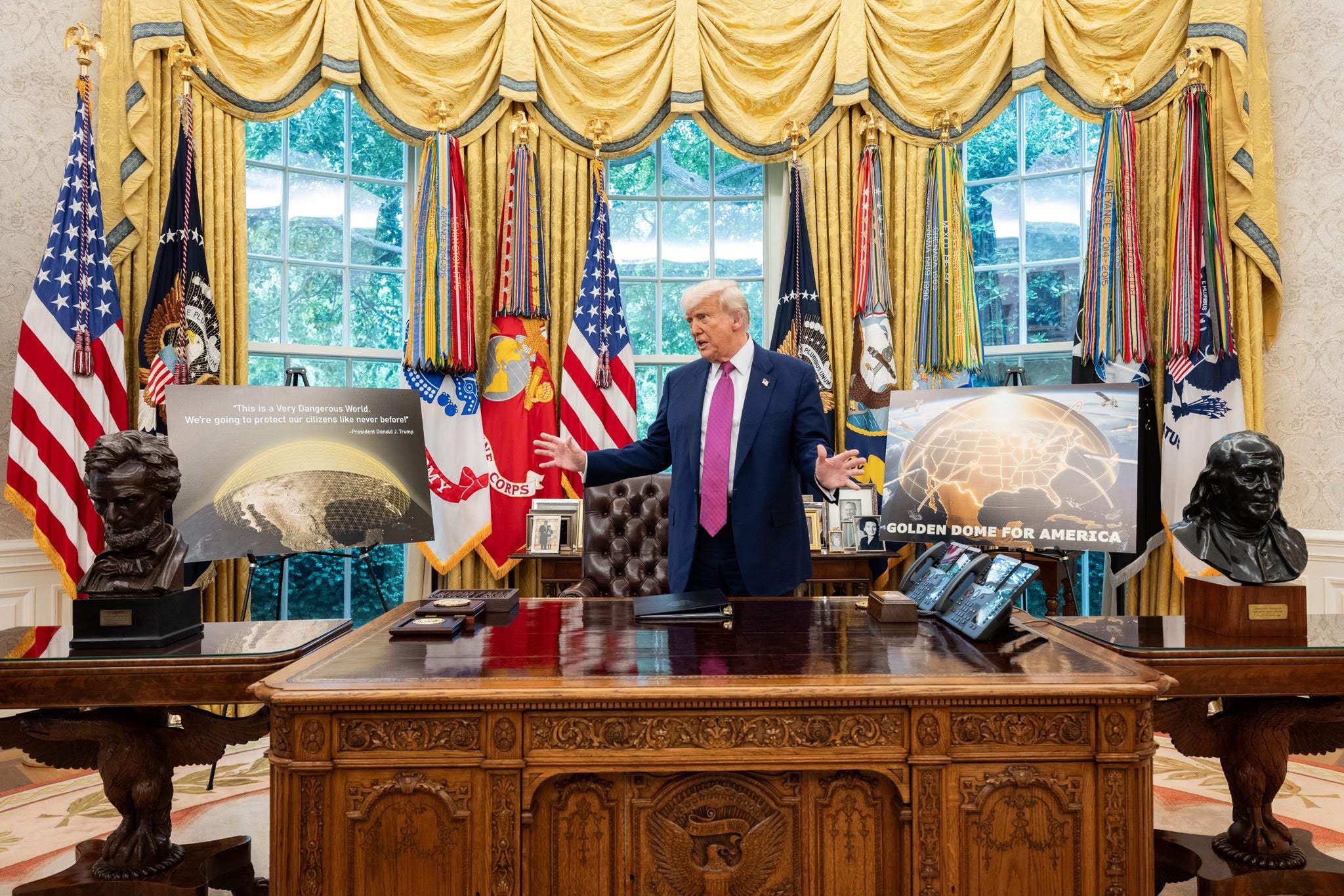
Donald Trump has a dream: a “golden dome” over America to defend the country against nuclear missiles. It’s a repeat of Ronald Reagan’s dream, the Strategic Defense Initiative, nicknamed “Star Wars” after the movie. The problem is that the dream represents a nightmare.
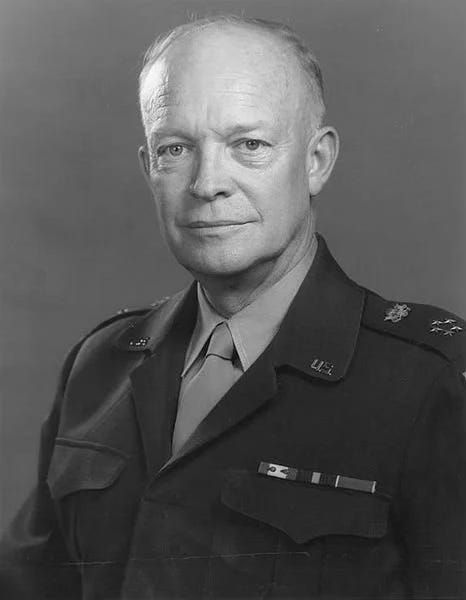
How so? Golden Dome would be dangerously escalatory, wildly expensive, and unlikely to work as a “shield” to America. It is worse than a mistake: it is a crime. It represents a massive theft from those who hunger and suffer in America. As Republican President Dwight D. Eisenhower said in 1953, wasting enormous resources on weapons systems is no way of life at all. It is humanity crucifying itself on a cross of iron. Crucifixion is not made more pleasant when the cross is golden.
A new golden idol occupies his mind
Put differently, the Golden Dome is a golden idol, a false god, one that by making a massive nuclear strike more likely endangers all of us and God’s creation.
Golden Dome is a grotesque example of makework militarism and warfare as welfare for weapons makers. Though it’s unlikely to work, if it did (partially) it would make a massive nuclear strike more likely, not less, endangering the world with the ecocidal terror of nuclear winter.
Golden Dome and the so-called investment in America’s nuclear triad are both examples of socio-technological madness–America’s leaders are like the mutants in “Beneath the Planet of the Apes,” worshipping the bombs that twisted them and which can only destroy what’s left of civilization.
Some Christians today await the apocalypse when Christ is supposed to return–but the most likely apocalypse features not the second coming of a God-man but a third world war featuring bomb-gods of thermonuclear destruction.
As Daniel Ellsberg once noted, U.S. nuclear attack plans in the early 1960s envisioned 600 million killed, or 100 Holocausts (before we knew such an attack would lead to nuclear winter). We’re lucky this insanity never came to pass. The only sane policy is to cancel Golden Dome and end “investment” in a new nuclear triad. Disarmament, not rearmament, is what’s needed.
*****
The Global Network Against Weapons & Nuclear Power in Space has released a statement against Golden Dome that you can read here. You can add your name to the statement, as I have. Here are some bullet points released along with the statement:
Golden Dome is financially reckless and unsustainable. Early cost estimates range from $550 billion to several trillion dollars over two decades. This dwarfs even the Pentagon’s annual budget and adds to the US’s $37 trillion national debt—a price tag that makes the project fiscally indefensible.
Experts overwhelmingly agree that 100% effective missile interception is a fantasy, especially against complex attacks involving decoys, hypersonic missiles, and maneuverable warheads. Even Israel’s Iron Dome has been bypassed by more rudimentary drone and missile attacks.
Golden Dome includes space-based interceptors—effectively weaponizing the Earth’s orbit and triggering an arms race. This violates the spirit of the Outer Space Treaty and pushes nations like China and Russia to accelerate space weapons development.
By giving the illusion of first-strike survivability, it runs counter to the Mutually Assured Destruction (MAD) doctrine that has prevented so far a nuclear holocaust and incentivizes other powers to retain or expand their nuclear arsenals, blocking disarmament efforts permanently.
Thousands of rocket launches for satellite interceptors would further damage the ozone layer, could generate dangerous orbital debris (Kessler Syndrome), and will harm our already fragile space environment.
The only guaranteed winners of Golden Dome are weapons giants like Lockheed Martin, Raytheon, and Palantir, which stand to profit enormously regardless of the system’s effectiveness or risks.
The trillions funneled into Golden Dome could be used for urgent domestic priorities—such as healthcare, infrastructure, climate action, and education, directly benefiting millions of Americans.
In short, Golden Dome is a massive, dangerous, and futile vanity project, cloaked in patriotism but driven by profit, politics, and illusion.
Over at Foreign Exchanges, there’s an informative article by Alex Thurston on the devaluation of foreign area expertise by the U.S. government.
I witnessed this myself after the 9/11 attacks in 2001. The Army has FAOs, or foreign area officers, who specialize in specific regions and countries, learning the language and culture while being stationed overseas in Spain, Germany, South Korea, or wherever. What I discovered in talking to FAOs, however, is that they weren’t on the fast-track to promotion in the Army. So-called Big Army didn’t look with favor on FAOs. You were more competitive for promotion if you served and specialized in a specific combat branch, like infantry or armor, and if you also had some special forces training (a Ranger Tab or the like).
Hooah!
After 9/11, the U.S. government in general, and the U.S. military specifically, lacked foreign area expertise with respect to the Middle East. FAOs who could speak Arabic and had some knowledge of Iraq, Iran, and so on were especially in short supply. Thus what the Army did was to deploy FAOs to the Middle East whose specialty was Latin America or Asia or whatever. Makes sense, right? Who cares if they spoke Spanish or Mandarin and knew nothing about Arab culture: they were FAOs, dammit! They could learn!
The U.S. military has occasionally pushed for its senior officers to become less parochial, perhaps by learning a foreign language, but to my knowledge proposals to that effect have never gained much traction. The U.S. military says it values education, but education often becomes a box-checking exercise. To be promoted to field grade (major or above; the Navy equivalent is lieutenant commander or above), you generally need a master’s degree in, well, something. Anything. In my day (roughly 25-30 years ago), many officers got an MBA or similar degree, often from an online university that catered to military and government personnel. (An MBA was desirable for future possibilities after one separated or retired from the military.)
Another box military officers had to check was PME, or professional military education. This could be done by correspondence (online), by seminar, or “in residence” at specific military schools. (For me as a major in the Air Force, this was ACSC, or Air Command and Staff College). Doing your PME “in residence” was seen as more desirable than doing it other ways, but ultimately what mattered was that you did it. It was a sign of your commitment—and your conformity. I did ACSC by correspondence, a necessary box to check on my way to being promoted to lieutenant colonel.
All this is to say that FAOs, who worked hard to develop specific expertise in areas of alleged vital interest to America, were in a way often punished by the system, or at the very least misused by it. I don’t know what it’s like in the U.S. military today, in 2025, but something tells me FAOs are still not valued for the knowledge they’ve gained. What matters is being a “warrior” and focusing on “kinetic action” and getting a CIB (combat infantryman badge). I assume officers on the career track are still getting master’s degrees in, well, something and also completing PME while learning very little. (PME tends to promote the party line. You won’t hear meaningful and sustained critiques of the military-industrial complex here: surprise!)
But perhaps it really doesn’t matter, as the article by Alex Thurston cited above suggests. America’s senior leaders seem most concerned about exercising power for power’s sake; the subtleties and nuances that FAOs and other foreign area experts bring to the table are typically ignored or disregarded. Who needs language skills and deep knowledge of local culture and customs when you can just shock and awe them? As President Trump recently said at West Point, America spreads democracy at the point of a gun. Again, who needs language skills or deep knowledge for that?
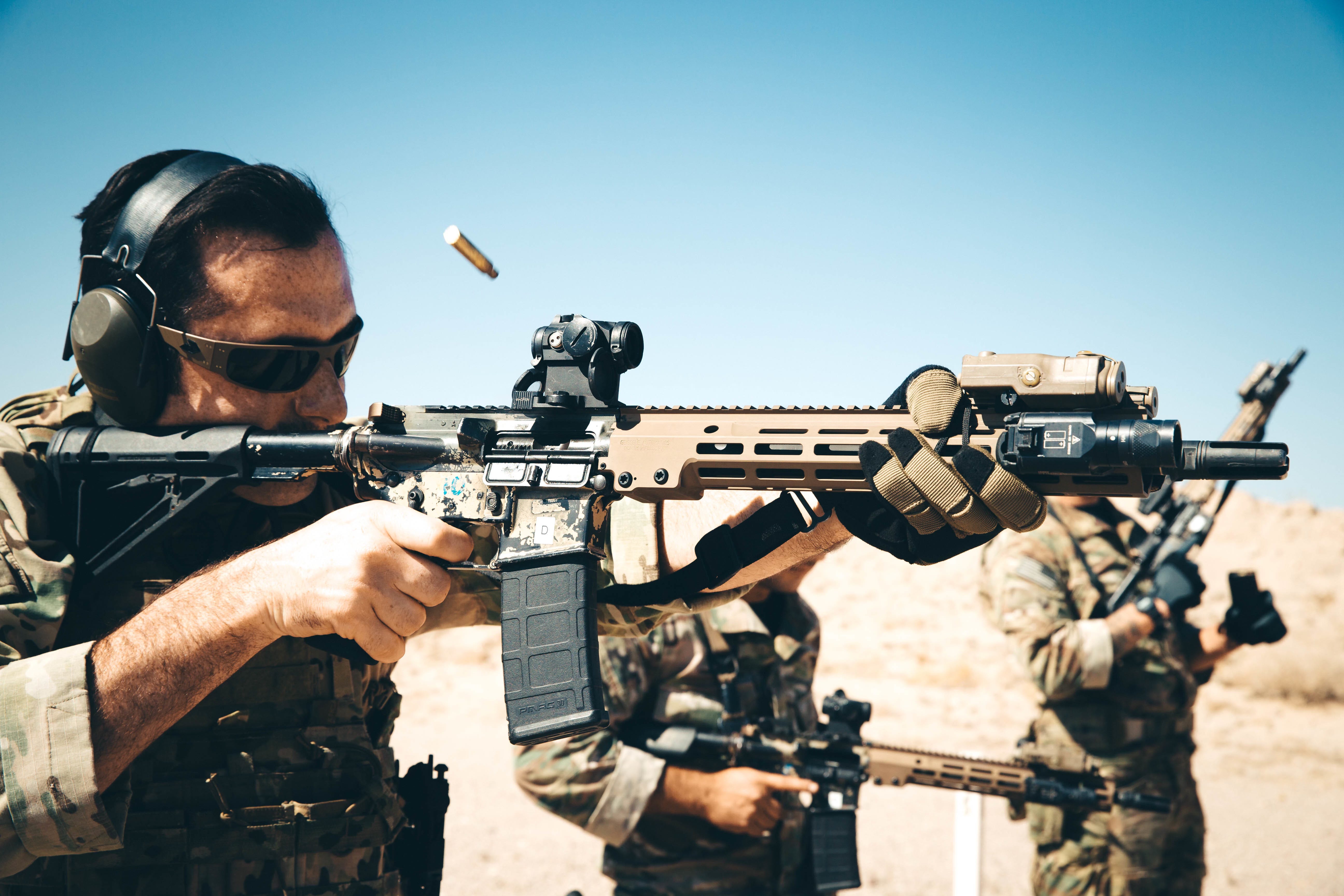
America, this is how you spread democracy! (USMC photo at Wikipedia)
When I think of celebratory military parades with lots of heavy weaponry and the like, images of Nazi Germany and the Soviet Union come to mind. Authoritarian regimes, strongly militaristic, led by dictators.
When I think of U.S. military parades, featuring large numbers of troops, I think of victory parades after World War II that celebrated the defeat of Nazi Germany. Back then, the idea was to celebrate the triumph of the free world over darkness, not the triumph of Trump’s will over wokeness.
The naked celebration of military strength in Trump’s proposed parade is yet another example of American militarism on steroids. It marks the further erosion of democracy in America and a coarsening of the human spirit in America.
Trump’s parade, scheduled to coincide with his birthday on June 14th (Flag Day as well), may cost as much as $100 million. But that price tag is minuscule compared to the damage it does to America’s image.
For Trump, openly embracing the idea (and ideal) of America as a dominant empire built around a trillion-dollar-a-year military just seems commonsensical. An acknowledgement of the obvious and the irreversible.
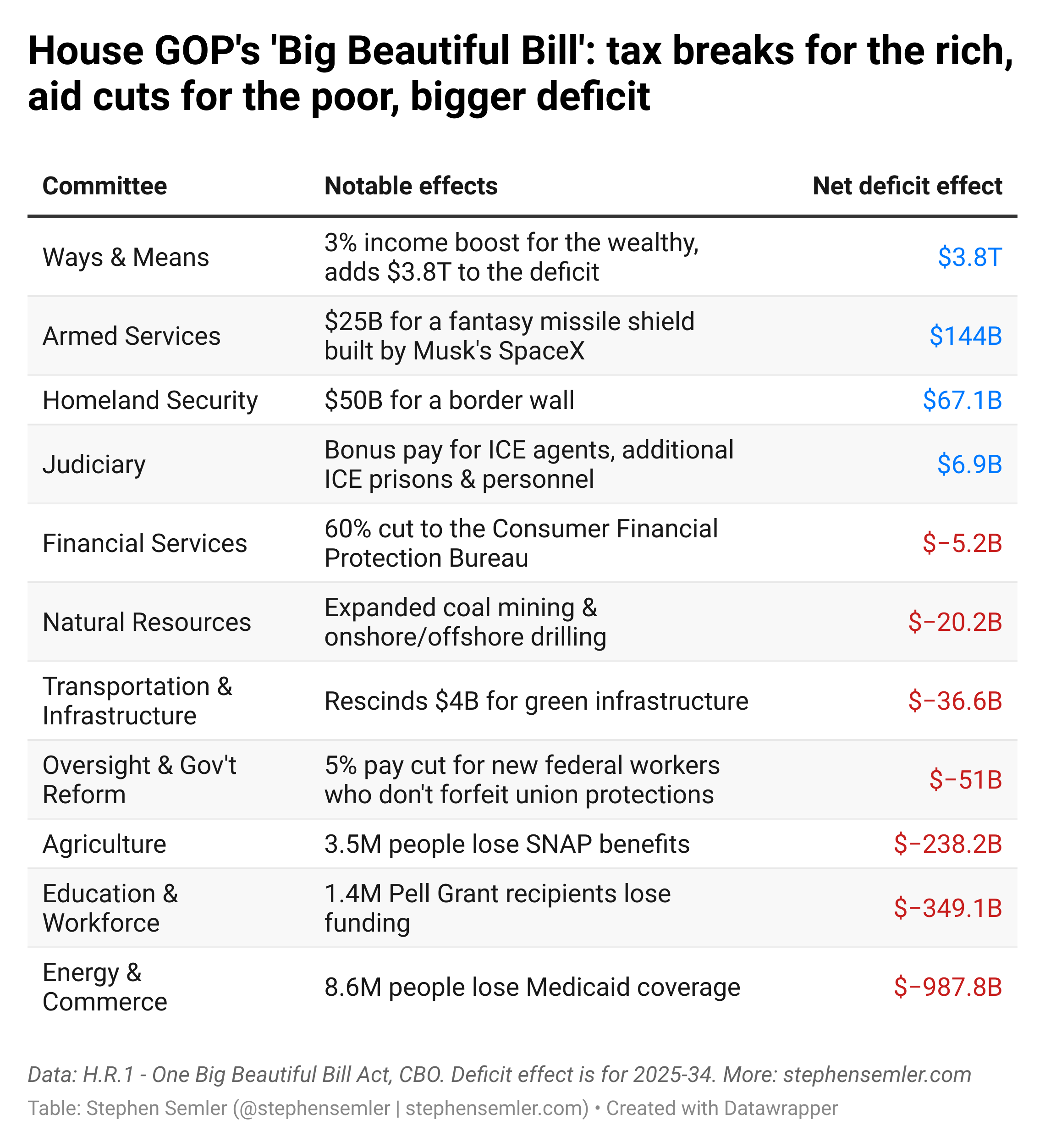
The “Big Beautiful Bill” passed recently by the House is petty and ugly. A sham. A reverse Robin Hood. It cuts SNAP benefits (food stamps) to the poor. It cuts Medicaid. Because who needs food and medical care, amirite? Meanwhile, it cuts taxes for the richest Americans and funds various weapons follies (a foolish and wasteful missile shield known as “Golden Dome,” more nuclear weapons, yet more billions for the wall on America’s border with Mexico). And it adds significantly to the national debt.
Remember when Republicans were once known as fiscal conservatives? Remember calls for a balanced budget? Those days are long gone. The “Big Beautiful Bill” is a fever dream, or a night terror if you prefer, of wanton and wasteful spending that rewards the already well-heeled and hurts the most vulnerable of Americans.
Trump, who is truly an expert at the craft of the con, concocts the most outrageous names to sell his BS. Thus a missile shield that may end up wasting $500 billion is a “golden dome.” Heck, the whole bill, which is contempuous toward the poor and punishing to workers organizing for higher wages, is sold as “big” and “beautiful.”
When Trump describes things as “golden” and “big” and “beautiful,” you should know to hold tightly to your wallets and purses, America, because you’re about to get scammed.
At his site, Stephen Semler has a superb chart that breaks down the petty ugly bill the House just passed. Here’s an excerpt. Read it and weep, America.
The bottom line: More money for the already affluent and for the Pentagon; less money and benefits for the poor. The rich get richer, the poor poorer, as America reinforces its turn to weapons, walls, police, domes, and warriors.
Yesterday, I talked to Dick Price, a Vietnam War veteran, at the LA Progressive about the U.S. military, the Vietnam War, the all-volunteer military, media coverage, and why America just can’t stop making war.
When no one is held accountable for failure, when lies are used as the basis for killing, when war produces colossal profits for a select few, when Congress refuses to take responsibility for oversight, when war budgets keep climbing to the trillion dollar mark, it isn’t all that surprising that wars prove essentially endless as democracy withers.
The new pope, Leo XIV, is off to an encouraging start as he calls for peace (from CNN):
Pontiff calls for ‘authentic, just and lasting peace’ Pope Leo XIV delivered his first Sunday blessing from the balcony of St. Peter’s Basilica on Sunday and used the address to pray for peace. “In today’s dramatic scenario of a third world war being fought piecemeal, as Pope Francis said, I too turn to the world’s leaders with an ever timely appeal: never again war!”
Pope Leo XIV at the central Loggia of St. Peter’s Basilica (Photo: Isabella Bonotto/Anadolu via Getty Images)
Sadly for the pope, U.S. leaders believe that peace is achieved through military strength and total dominance, unleashing “warriors” across the world. It doesn’t matter who the president is or which political party is putatively in charge. The Imperial State insists on colossal spending on wars and preparations for the same.
With respect to Gaza and the ongoing death and destruction there, Leo XIV had this to say:
“I am deeply pained by what is happening. Let the fighting cease immediately, let humanitarian aid be provided to the exhausted civilian population, and may all hostages be released.”
Sensible words. But it will take far more than words to stop Israel from its destruction of Gaza and its evisceration and evacuation of the Palestinians there.
Leo XIV also called for a just and lasting peace in Ukraine while highlighting the suffering of the Ukrainian people.
The word “peace” has almost disappeared from American discourse. Leo is helping to reinvigorate it. U.S. leaders are doing their best to sabotage it with war budgets that approach and exceed a trillion dollars yearly (this coming from a Christian nation, at least according to its leaders).
Leo is pointing the way. It’s time all those self-confessed Christians in America start following the Prince of Peace rather than the god of war.
As a teenager in the late 1970s, I read about Israel’s “Six-Day War” in 1967. The account I read was sympathetic toward Israel, respecting the audacity of its sneak attack on the Egyptian and Syrian air forces and its Blitzkrieg in the Sinai. But it also mentioned the Israeli attack on a U.S. Navy ship, the USS Liberty, a signals intelligence ship that was monitoring the war in international waters. The Israeli air and sea attack killed 34 crew members aboard the Liberty and wounded another 173. The ship, heavily damaged, never sailed again and was later sold as scrap.
The USS Liberty, post-attack
The Israeli government claimed the attack was unintentional and a mistake. There’s plenty of evidence to suggest the story is far more complicated. Yet I was thinking this morning about how the Trump administrations’s strenuous attempt to criminalize critical speech vis-à-vis Israel is yet another assault on liberty. Once again, the ship of liberty is endangered in the U.S., yet the U.S. government is content to look the other way, or even to collaborate with the attackers.
Let me be clear: Those Americans who criticize Israel for its actions in Gaza are exercising their liberty. We are free to speak, and indeed we should speak freely on crimes against humanity, for that is what ethnic cleansing in Gaza is: a crime against humanity.
Yet the U.S. government, which essentially agreed to look the other way in response to Israel’s attack on the USS Liberty in 1967, is now looking the other way as free speech in America is suppressed, or even twisting denunciations of Israel’s war crimes in Gaza as anti-Semitic hate speech.
Liberty is something precious, and we as Americans are supposed to admire and applaud Patrick Henry and his sentiment from 250 years ago: “Give me liberty or give me death!”
If we as Americans have the right to criticize our own government, which we do, we certainly have the right to criticize foreign governments, including, of course, Israel. Yet, judging by U.S. mainstream media coverage and the words of government spokespeople, American citizens actually have less scope to criticize Israel than any other country, including their own.
Liberty attacked and abridged is liberty denied. How long before liberty itself in America, rocketed and strafed and torpedoed, is decommissioned and sold for scrap, just as the USS Liberty was?
Addendum: There are many books and videos about Israel’s attack on the USS Libertyand what was *really* behind it. I’m not an expert on the subject, but the official story of a regrettable “mistake” is decidedly fishy. Wikipedia does a decent job of summarizing a complex subject. Here’s an excerpt to ponder:
Some intelligence and military officials dispute Israel’s explanation.[79]Dean Rusk, U.S. Secretary of State at the time of the incident, wrote:
I was never satisfied with the Israeli explanation. Their sustained attack to disable and sink Liberty precluded an assault by accident or some trigger-happy local commander. Through diplomatic channels we refused to accept their explanations. I didn’t believe them then, and I don’t believe them to this day. The attack was outrageous.[80]
Below is my latest article for TomDispatch.com. Why do I write these articles? I started in 2007, this is 2025, and after 112 articles, nearly all of them calling for America to walk a far less militaristic path, militarism and authoritarianism continue to sink their roots deeper into our culture. Talk about fighting a losing war!
I suppose I write them to preserve my sanity—they’re my effort to make sense of what’s happening around me. But I also write them in the hope that my words might matter, that they might, just might, make a small difference, shifting America away from incessant warfare and colossal military spending. I haven’t given up hope, even as military budgets soar to a trillion dollars and above.
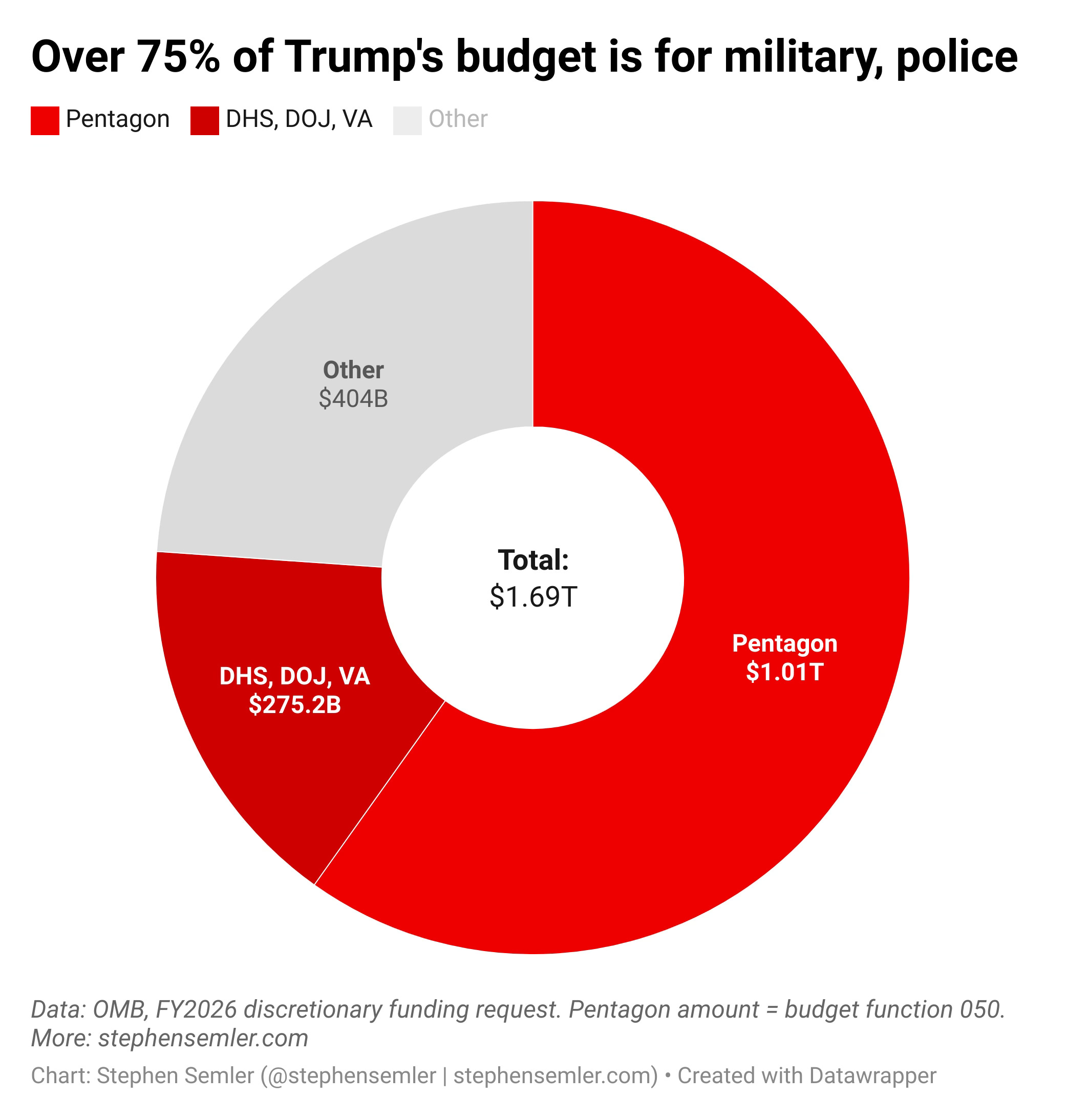
Speaking of which: Here’s an eye-opening chart from Stephen Semler on Trump’s FY2026 budget for America. Sure seems like we’re the Empire in “Star Wars,” doesn’t it?
Anyway, here’s my latest article for TomDispatch:
Forty years ago this month, I was commissioned a second lieutenant in the U.S. Air Force. I would be part of America’s all-volunteer force (AVF) for 20 years, hitting my marks and retiring as a lieutenant colonel in 2005. In my two decades of service, I met a lot of fine and dedicated officers, enlisted members, and civilians. I worked with the Army, Navy, and Marine Corps as well, and met officers and cadets from countries like Great Britain, Germany, Pakistan, Poland, and Saudi Arabia. I managed not to get shot at or kill anyone. Strangely enough, in other words, my military service was peaceful.
Don’t get me wrong: I was a card-carrying member of America’s military-industrial complex. I’m under no illusions about what a military exists for, nor should you be. As an historian, having read military history for 50 years of my life and having taught it as well at the Air Force Academy and the Naval Postgraduate School, I know something of what war is all about, even if I haven’t experienced the chaos, the mayhem, the violence, or the atrocity of war directly.
Military service is about being prepared to kill. I was neither a trigger-puller nor a bomb-dropper. Nonetheless, I was part of a service that paradoxically preaches peace through superior firepower. The U.S. military and, of course, our government leaders, have had a misplaced — indeed, irrational — faith in the power of bullets and bombs to solve or resolve the most intractable of problems. Vietnam is going communist in 1965? Bomb it to hell and back. Afghanistan supports terrorism in 2001? Bomb it wildly. Iraq has weapons of mass destruction in 2003? Bomb it, too (even though it had no WMD). The Houthis in Yemen have the temerity to protest and strike out in relation to Israel’s atrocities in Gaza in 2025? Bomb them to hell and back.
Sadly, “bomb it” is this country’s go-to option, the one that’s always on the table, the one our leaders often reach for first. America’s “best and brightest,” whether in the Vietnam era or now, have a powerful yen for destruction or, as the saying went in that long-gone era, “It became necessary to destroy the town to save it.” Judging them by their acts, our leaders indeed have long appeared to believe that all too many villages, towns, cities, and countries needed to be destroyed in order to save them.
My own Orwellian turn of phrase for such mania is: destruction is construction. In this country, an all-too-offensive military is sold as a defensive one, hence, of course, the rebranding of the Department of War as the Department of Defense. An imperial military is sold as so many freedom-fighters and -bringers. We have the mega-weapons and the urge to dominate of Darth Vader and yet, miraculously enough, we continue to believe that we’re Luke Skywalker.
This is just one of the many paradoxes and contradictions contained within the U.S. military and indeed my own life. Perhaps they’re worth teasing out and exploring, as I reminisce about being commissioned at the ripe old age of 22 in 1985 — a long time ago in a country far, far away.
The Evil Empire
When I went on active duty in 1985, the country that constituted the Evil Empire on this planet wasn’t in doubt. As President Ronald Reagan said then, it was the Soviet Union — authoritarian, militaristic, domineering, and decidedly untrustworthy. Forty years later, who, exactly, is the evil empire? Is it Vladimir Putin’s Russia with its invasion of Ukraine three years ago? The Biden administration surely thought so; the Trump administration isn’t so sure. Speaking of Trump (and how can I not?), isn’t it correct to say that the U.S. is increasingly authoritarian, domineering, militaristic, and decidedly untrustworthy? Which country has roughly 800 military bases globally? Which country’s leader openly boasts of trillion-dollar war budgets and dreams of the annexation of Canada and Greenland? It’s not Russia, of course, nor is it China.
Back when I first put on a uniform, there was thankfully no Department of Homeland Security, even as the Reagan administration began to trust (but verify!) the Soviets in negotiations to reduce our mutual nuclear stockpiles. Interestingly, 1985 witnessed an aging Republican president, Reagan, working with his Soviet peer, even as he dreamed of creating a “space shield” (SDI, the strategic defense initiative) to protect America from nuclear attack. In 2025, we have an aging Republican president, Donald Trump, negotiating with Putin even as he floats the idea of a “Golden Dome” to shield America from nukes. (Republicans in Congress already seek $27 billion for that “dome,” so that “golden” moniker is weirdly appropriate and, given the history of cost overruns on American weaponry, you know that would be just the starting point of its soaring projected cost.)
When the Soviet Union collapsed in 1991, fears of a third world war that would lead to a nuclear exchange (as caught in books of the time like Tom Clancy’s popular novel Red Storm Rising) abated. And for a brief shining moment, the U.S. military reigned supreme globally, pulverizing the junior varsity mirror image of the Soviet military in Iraq with Desert Storm in 1991. We had kicked the Vietnam Syndrome once and for all, President George H.W. Bush exulted. It was high time for some genuine peace dividends, or so it seemed.
The real problem was that that seemingly instantaneous success against Saddam Hussein’s much-overrated Iraqi military reignited the real Vietnam Syndrome, which was Washington’s overconfidence in military force as the way to secure dominance, while allegedly strengthening democracy not just here in America but globally. Hubris led to the expansion of NATO to Russia’s borders; hubris led to unipolar dreams of total dominance everywhere; hubris meant that America could somehow have the most moral as well as lethal military in the world; hubris meant that one need never concern oneself about potential blowback from allying with Osama bin Laden in Afghanistan or the risk of provoking Russian aggression as NATO floated Ukraine and Georgia as future members of an alliance designed to keep Russia down.
It was the end of history (so it was said) and American-style democracy had prevailed.
Even so, militarily, this country did anything but demobilize. Under President Bill Clinton in the 1990s, there was some budgetary trimming, but military Keynesianism remained a thing, as did the military-industrial-congressional complex. Clinton managed a rare balanced budget due to domestic spending cuts and welfare reform; his cuts to military spending, however, were modest indeed. Tragically, under him, America would not become “a normal country in normal times,” as former U.N. Ambassador Jeanne Kirkpatrick once dreamed. It would remain an empire — and an increasingly hungry one at that.
In that vein, senior civilians like Secretary of State Madeleine Albright began to wonder why this country had such a superb military if we weren’t prepared to use it to boss others around. Never mind concerns about the constitutionality of employing U.S. troops in conflicts without a congressional declaration of war. (How unnecessary! How old-fashioned!) It was time to unapologetically rule the world.
The calamitous events of 9/11 changed nothing except the impetus to punish those who’d challenged our illusions. Those same events also changed everything as America’s leaders decided it was then the moment to double down on empire, to become even more authoritarian (the Patriot Act, torture, and the like), to go openly to “the dark side,” to lash out in the only way they knew how — more bombing (Afghanistan, Iraq), followed by invasions and “surges” — then, wash, rinse, repeat.
So, had we really beaten the Vietnam Syndrome in the triumphant year of 1991? Of course not. A decade later, after 9/11, we met the enemy, and once again it was our unrepresentative government spoiling for war, no matter how ill-conceived and ill-advised — because war pays, because war is “presidential,” because America’s leaders believe that the true “power of its example” is example after example of its power, especially bombs bursting in air.
The “All-Volunteer” Force Isn’t What It Seems
Speaking as a veteran and a military historian, I believe America’s all-volunteer force has lost its way. Today’s military members — unlike those of the “greatest generation” of World War II fame — are no longer citizen-soldiers. Today’s “volunteers” have surrendered to the rhetoric of being “warriors” and “warfighters.” They take their identity from fighting wars or preparing for the same, putting aside their oath to support and defend the Constitution. They forget (or were never taught) that they must be citizens first, soldiers second. They have, in truth, come to embrace a warrior mystique that is far more consistent with authoritarian regimes. They’ve come to think of themselves — proudly so — as a breed apart.
Far too often in this America, an affinitive patriotism has been replaced by a rabid nationalism. Consider that Christocentric “America First” ideals are now openly promoted by the civilian commander-in-chief, no matter that they remain antithetical to the Constitution and corrosive to democracy. The new “affirmative action” openly affirms faith in Christ and trust in Trump (leavened with lots of bombs and missiles against nonbelievers).
Citizen-soldiers of my father’s generation, by way of contrast, thought for themselves. They chafed against military authority, confronting it when it seemed foolish, wasteful, or unlawful. They largely demobilized themselves in the aftermath of World War II. But warriors don’t think. They follow orders. They drop bombs on target. They make the war machine run on time.
Americans, when they’re not overwhelmed by their efforts to simply make ends meet, have largely washed their hands of whatever that warrior-military does in their name. They know little about wars fought supposedly to protect them and care even less. Why should they care? They’re not asked to weigh in. They’re not even asked to sacrifice (other than to pay taxes and keep their mouths shut).
Too many people in America, it seems to me, are now playing a perilous game of make-believe. We make-believe that America’s wars are authorized when they clearly are not. For example, who, other than Donald Trump (and Joe Biden before him), gave the U.S. military the right to bomb Yemen?
We make-believe all our troops are volunteers. We make-believe we care about those “volunteers.” Sometimes, some of us even make-believe we care about those wars being waged in places and countries most Americans would be hard-pressed to find on a map. How confident are you that all too many Americans could even point to the right hemisphere to find Syria or Yemen or past war zones like Vietnam, Afghanistan, and Iraq?
War isn’t even that good at teaching Americans geography anymore!
What Is To Be Done?
If you accept that there’s a kernel of truth to what I’ve written so far, and that there’s definitely something wrong that should be fixed, the question remains: What is to be done?
Some concrete actions immediately demand our attention.
*Any ongoing wars, including “overseas contingency operations” and the like, must be stopped immediately unless Congress formally issues a declaration of war as required by the Constitution. No more nonsense about MOOTW, or “military operations other than war.” There is war or there is peace. Period. Want to bomb Yemen? First, declare war on Yemen through Congress.
*Wars, assuming they are supported by Congressional declarations, must be paid for with taxes raised above all from those Americans who benefit most handsomely from fighting them. There shall be no deficit spending for war.
*Americans are used to “sin” taxes for purchases like tobacco and alcohol. So, isn’t it time for a new “sin” tax related to profiteering from war, especially by the corporations that make the distinctly overpriced weaponry without which such wars couldn’t be waged?
To end wars and weaken militarism in America, we must render it unprofitable. As long as powerful forces continue to profit so handsomely from going to war — even as “volunteer” troops are told to aspire to be “warriors,” born and trained to kill — this violent madness in America will persist, if not expand.
Look, the 22-year-old version of me thought he knew who the evil empire was. He thought he was one of the good guys. He thought his country and his military stood for something worthy, even for “greatness” of a sort. Sure, he was naïve. Perhaps he was just another wet-behind-the-ears factotum of empire. But he took his oath to the Constitution seriously and looked to a brighter day when that military would serve only as a deterrent in a world largely at peace.
The soon-to-be-62-year-old me is no longer so naïve and, these days, none too sure who’s evil and who isn’t. He knows his country is on the wrong path, that the bloody path of bullets and bombs (and profiting from the same) is always perilous for any freedom-loving people to travel on.
Somehow, America needs to be put back on the freedom trail that inspires and empowers citizens rather than wannabe warriors brandishing weapons galore. Somehow, we need to aspire again to be a nation of laws. (Can we agree that due process is better than no process?) Somehow, we need to dream of being a nation where right makes might, one that knows that destruction is not construction, one that exchanges bullets and bombs for ballots and beauty.
Language and repetition of the same is so important. We hear about the Department of Defense (DoD) and the Pentagon budget and we think little of it. The DoD, of course, used to be called the Department of War until 1947, a far more telling and accurate name, and there wasn’t a Pentagon until we built one during World War II. In the old days, the Army fought the Navy for which service would get more money in the War Budget, with the Navy usually winning as America sought to control the seas as a means of dominating trade and “intercourse” among nations.
Those were more honest times when retired generals like Smedley Butler wrote in the 1930s that he’d served as a “gangster” for capitalism. Butler was a Marine who was twice awarded the Medal of Honor, so it wasn’t easy for the imperialists to smear him, though they certainly tried (as they did to David M. Shoup, another Marine Corps general and Medal of Honor recipient who turned against the Vietnam War in the 1960s).
Anyhow, I just saw at Antiwar.com that President Trump is proposing a $1.01 trillion budget for the Pentagon for FY2026, a 13% increase in imperial spending. Trump, of course, is proud of reaching the Trillion Dollar threshold. Big numbers have always appealed to him.
It doesn’t seem to matter who is president, whether it’s Biden or Trump, Democrat or Republican, when it comes to the Department of Empire and its bloated imperial budget. For that is what it is, a budget that seeks to sustain and enlarge America’s imperial domain. If you add other costs related to imperial dominance, such as interest on the national debt due to war spending, VA costs, nuclear weapons, and the like, the true imperial budget soars toward $1.7 trillion yearly.
No matter. A trillion here, a trillion there, and pretty soon you’re talking real money.
The Pentagon tries to disguise the enormous waste of this imperial budget by speaking of it as an “investment,” but imagine an “investment” that you’re involved in which fails seven audits in a row. How likely would you be to see this as anything other than theft?
Dwight D. Eisenhower had it right in 1953 when he spoke of military spending as a theft from those who hunger. Ike’s words are almost never heard today inside the Washington Beltway. It’s worth reflecting upon them again as America’s leaders boast of trillion-dollar war budgets:
Every gun that is made, every warship launched, every rocket fired signifies, in the final sense, a theft from those who hunger and are not fed, those who are cold and are not clothed. This world in arms is not spending money alone. It is spending the sweat of its laborers, the genius of its scientists, the hopes of its children… This is not a way of life at all, in any true sense. Under the cloud of threatening war, it is humanity hanging from a cross of iron.
To them, the right lessons; to everyone else, the wrong ones
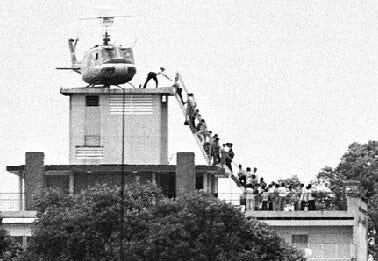
We just marked the 50th anniversary of the Fall of Saigon on April 30, 1975. Did American officials learn anything from the disastrous Vietnam War?
Saigon, April 1975
Of course they did. Just not the lessons you’d have wished they’d learned.
So, what did they learn?
They learned that wars can indeed last forever, but that Vietnam wasn’t the best “forever war” for the military-industrial complex because it became deeply unpopular and was disrupting cohesion within the military itself. The best forever wars are open-ended “wars” like the global war on terror. And perhaps a “new Cold War” with Russia and/or China. Wars that don’t involve the deployment of over half a million men (unless that “new” Cold War turns hot).
They learned to control the narrative. No more journalists traveling freely in war zones as in the 1960s in Vietnam. Journalists are now most often embedded in U.S. military units. Embedded reporters, dependent on the military for access and protection, know what they can and can’t say, even as they tend to sympathize with the troops they’re with.
They learned that forced conscription via a draft doesn’t work well for unpopular wars. So they transformed the military into an “all-volunteer” force. Draftees may well be resentful, rightly so, but volunteers? Too bad—they volunteered for this.
Along with “volunteers,” they learned to indoctrinate U.S. troops to be “warriors” and “warfighters” rather than citizen-soldiers. Warriors exist to fight wars, so shut up and blast away.
They learned to keep the American people isolated from war and its deadly effects. Recall that under Bush/Cheney, Americans weren’t even allowed to see flag-draped caskets. During Vietnam, war was in America’s living rooms during dinner, complete with body counts. Coverage of wars in Iraq, Afghanistan, and elsewhere was sanitized, almost bloodlessly so.
They learned never to talk of sacrifice (except by those volunteer warriors) by the American people. Taxes aren’t raised in the name of war. There are no war bond drives. America’s leaders tell the rest of us to enjoy life, to visit Disney and to go shopping, while “our” warriors fight overseas.
Together with those “lessons,” they continue to preach “peace through strength,” attacking those who truly seek peace as misguided (at best) and treasonous (at worst). As ever, they tend to attack those who’d dare criticize the U.S. military as ungrateful backstabbers. And of course they consistently obscure the truth of how poorly wars like Iraq and Afghanistan were going while holding no one in the upper echelons responsible and accountable for rampant corruption and disastrous endings.
All these “lessons” ensured that Vietnam wouldn’t be the last example of hubris, folly, and atrocity, and indeed it hasn’t been. Until the right lessons are learned, expect future repeats, tragic variations on a theme of Vietnam.





 Bracing Views