

About fifteen years ago, I wrote a short history of World War II for an encyclopedia on military history. I was supposed to be paid for it, but apparently the money ran out, though my article and the encyclopedia did appear in 2006. Having not been paid, I still own the rights to my article, so I’m posting it today, hoping it may serve as a brief introduction for a wider audience to a very complex subject. A short bibliography is included at the end.
Dr. William J. Astore
World War II (1939-1945): Calamitous global war that resulted in the death of sixty million people. The war’s onset and course cannot be understood without reference to World War I. While combat in the European theater of operations (ETO) lasted six years, in Asia and the Pacific combat lasted fourteen years, starting with the Japanese invasion of Manchuria in 1931. Unprecedented in scale, World War II witnessed deliberate and systematic killing of innocents. Especially horrific was Germany’s genocidal Endlösung (Final Solution), during which the Nazis attempted to murder all Jewish, Sinti, and Roma peoples, in what later became known as the Holocaust.
Rapid campaigns, such as Germany’s stunning seven-week Blitzkrieg (lightning war) against France, characterized the war’s early years. Ultimately, quick victories gave way to lengthy and punishing campaigns from mid-1942 to 1945. Early and rapid German and Japanese advances proved reversible, although at tremendous cost, as the Soviet Union and the United States geared their economies fully for war. The chief Axis powers (Germany, Japan, and Italy) were ultimately defeated as much by their own strategic blunders and poorly coordinated efforts as by the weight of men and matériel fielded by the “Big Three” Allies (Soviet Union, United States, and Great Britain).
Causes
Militant fascist regimes in Italy and Germany and an expansionist military regime in Japan exploited inherent flaws in the Versailles settlement, together with economic and social turmoil made worse by the Great Depression. In Germany, Adolf Hitler dedicated himself to reversing what he termed the Diktat of Versailles through rearmament, remilitarization of the Rhineland, and territorial expansion ostensibly justified by national representation.
Concealing his megalomaniac intent within a cloak of reasoned rhetoric, Hitler persuaded Britain’s Neville Chamberlain and France’s Édouard Daladier that his territorial demands could be appeased. But there was no appeasing Hitler, who sought to subjugate Europe from the Atlantic to the Urals, re-establish an African empire, and ultimately settle accounts with the United States. For Hitler, only a ruthless rooting out of a worldwide “Jewish-Bolshevik conspiracy” would gain the Lebensraum (living space) a supposedly superior Aryan race needed to survive and thrive.
Less ambitious, if equally vainglorious, was Italy’s Benito Mussolini. Italian limitations forced Il Duce to follow Germany. Disparities in timing made the “Pact of Steel,” forged by these countries in 1936, fundamentally flawed. The Wehrmacht marched to war in 1939, four years before the Italian military was ready (it was still recovering from fighting in Ethiopia and Spain). Yet Mussolini persevered with schemes to dominate the Mediterranean.
Japan considered its war plans to be defensive and preemptive, although in their scope they nearly equaled Hitler’s expansionist ambitions. The Japanese perceived the alignment of the ABCD powers (America, Britain, China, and Dutch East Indies) as targeted directly against them. The ABCD powers, in contrast, saw themselves as deterring an increasingly bellicose and aggressive Japan. As the ABCD powers tightened the economic noose to compel Japan to withdraw from China, Japan concluded it had one of two alternatives: humiliating capitulation or honorable war. Each side saw itself as resisting the unreasonable demands of the other; neither side proved willing to compromise.
Nevertheless, Japan looked for more than a restoration of the status quo. Cloaked in the rhetoric of liberating Asia from Western imperialism, Japanese plans envisioned a “Greater East Asian Co-Prosperity Sphere,” in which Japan would obtain autarky and Chinese, Koreans, and Filipinos would be colonial subjects of the Japanese master race. In their racial component and genocidal logic, made manifest in the Rape of Nanking (1937), Japanese war plans resembled their Nazi equivalents.
European Theater of Operations (ETO), 1939-1941
1939-1941 witnessed astonishing successes by the Wehrmacht. With its eastern border secured by the Molotov-Ribbentrop Non-Aggression Pact, Germany invaded Poland on 1 September 1939. Two days later, Britain and France declared war on Germany. As French forces demonstrated feebly along Germany’s western border, Panzer spearheads supported by Luftwaffe dive-bombers sliced through Poland. Attacked from the east by Soviet forces on 17 September, the Poles had no choice but to surrender.
Turning west, Hitler then attacked and subdued Denmark and Norway in April 1940. By gaining Norway, Germany safeguarded its supply of iron ore from neutral Sweden and acquired ports for the Kriegsmarine and bases for the Luftwaffe to interdict shipping in the North Sea, Arctic, and North Atlantic. Throughout this period, Germany and France engaged in Sitzkrieg or Phony War.
Phony War gave way on 10 May 1940 to a massive German invasion of the Low Countries and France. A feint on the extreme right by Germany’s Army Group B in Belgium drew French and British forces forward, while the main German thrust cut through the hilly and forested Ardennes region between Dinant and Sedan. The German plan worked to perfection since the French strategy was to engage German forces as far as possible from France’s border. The Wehrmacht’s crossing of the Meuse River outpaced France’s ability to react. Their best divisions outflanked, the Franco-British army retreated to Dunkirk, where the Allies evacuated 335,000 men in Operation Dynamo. The fall of Paris fatally sapped France’s will to resist. The eighty-four-year-old Marshal Philippe Pétain oversaw France’s ignominious surrender, although the French preserved nominal control over their colonies and the rump state of Vichy.
Surprise, a flexible command structure that encouraged boldness and initiative, high morale and strong ideological commitment based on a shared racial and national identity (Volksgemeinschaft), and speed were key ingredients to the Wehrmacht’s success. Intoxicated by victory, the Wehrmacht’s rank-and-file looked on the Führer as the reincarnation of Friedrich Barbarossa. Higher-ranking officers who disagreed were bribed or otherwise silenced.
Hitler next turned to Britain, which under Winston Churchill refused to surrender. During the Battle of Britain the Luftwaffe sought air superiority to facilitate a cross-channel invasion (Operation Sea Lion). This goal was beyond the Luftwaffe’s means, however, especially after Hitler redirected the bombing from airfields to London. By October the Luftwaffe had lost 1887 aircraft and 2662 pilots as opposed to RAF losses of 1023 aircraft and 537 pilots. Temporarily stymied, Hitler ordered plans drawn up for the invasion of the Soviet Union. Stalin’s defeat, Hitler hoped, would compel Churchill to sue for peace.
Hitler’s victories stimulated Japan to conclude, on 27 September 1940, the Tripartite Pact with Germany and Italy. Japan also expanded its war against China while looking avariciously towards U.S., British, Dutch, and French possessions in Southeast Asia and the Pacific. Meanwhile, Mussolini, envious of Hitler’s run of victories, invaded Greece in October. The resulting Italo-Greek conflict ran until April 1941 and exposed the Italian military’s lack of preparedness, unreliable equipment, and incompetent leadership. Italian blunders in North Africa also led in Libya to Britain’s first victory on land. The arrival of German reinforcements under General Erwin Rommel reversed the tide, however. Rommel’s Afrika Korps drove British and Dominion forces eastwards to Egypt even faster than the latter had driven Italian forces westwards. Yet Rommel lacked sufficient forces to press his advantage. Meanwhile, German paratroopers assaulted Crete in May 1941, incurring heavy losses before taking the island. Events in the Mediterranean and North Africa soon took a backseat to the titanic struggle brewing between Hitler and Stalin.
The Eastern Front, 1941
After rescuing the Italians in Greece and seizing the Balkans to secure his southern flank, Hitler turned to Operation Barbarossa and the invasion of the Soviet Union. Deluded by his previous victories and a racial ideology that viewed Slavs as Untermenschen (sub-humans), Hitler predicted a Soviet collapse within three months. Previous Soviet incompetence in the Russo-Finnish War (1939-40) seemed to support this prediction. The monumental struggle began when Germany and its allies, including Hungary, Slovakia, Rumania, Bulgaria, Italy, and Finland, together with volunteer units from all over Europe, invaded the USSR along a 1300-mile front on 22 June 1941. The resulting death struggle pit fascist and anti-Bolshevik Europe against Stalin’s Red Army. For Hitler the crusade against Bolshevism was a Vernichtungskrieg (war of annihilation). Under the notorious Commissar Order, the Wehrmacht shot Red Army commissars (political officers) outright. Mobile killing units (Einsatzgruppen) rampaged behind the lines, murdering Jews and other racial and ethnic undesirables.
The first weeks of combat brought elation for the Germans. Nearly 170 Soviet divisions ceased to exist as the Germans encircled vast Soviet armies. Leningrad was surrounded and endured a 900-day siege. But by diverting forces towards the vast breadbasket of the Ukraine and the heavy manufacturing and coal of the Donets Basin, Hitler delayed the march on Moscow for 78 days. By December, sub-zero temperatures, snow, and fresh Soviet divisions halted exhausted German soldiers on the outskirts of Moscow. A Soviet counteroffensive (Operation Typhoon) threw Hitler’s legions back 200 miles, leading him to relieve two field marshals and 35 corps and division commanders. Hitler also dismissed the commander-in-chief of the army, Walter von Brauchitsch, and assumed command himself. His subsequent “stand fast” order saved the Wehrmacht the fate of Napoleon’s army of 1812, but this temporary respite came at the price of half a million casualties from sickness and frostbite.
A crucial Soviet accomplishment was the wholesale evacuation of its military-industrial complex. By November the Soviets disassembled 1500 industrial plants and 1300 military enterprises and shipped them east, along with ten million workers, to prepared sites along the Volga, in the Urals, and in western Siberia. Out of the range of the Luftwaffe, Soviet factories churned out an arsenal of increasingly effective weapons, including 50,000 T-34s, arguably the best tank of the war. Hitler now faced a two-front war of exhaustion, the same strategic dilemma that in World War I had led to the Second Reich’s demise.
Hitler arguably lost the war in December 1941, especially after declaring war on the United States on 11 December, which soon became the “arsenal of democracy” whose Lend-Lease policy shored up a reeling Red Army. Operation Barbarossa, moreover, highlighted a failure of intelligence of colossal proportions as the Wehrmacht fatally underestimated the reserves Stalin could call on. As Franz Halder, chief of the army general staff noted in his diary, “We reckoned with 200 [Soviet] divisions, but now [in August 1941] we have already identified 360.” As German forces plunged deeper into Soviet territory, they had to defend a wider frontage. A front of 1300 miles nearly doubled to 2500 miles. The vastness, harshness, and primitiveness of Mother Russia attenuated the force of the Panzer spearheads, giving Soviet forces space and time to recover from the initial blows of the German juggernaut. When the Red Army refused to die, Germany was at a loss at what to do next. Well might the Wehrmacht have heeded the words of the famed military strategist, Antoine Jomini: “Russia is a country which it is easy to get into, but very difficult to get out of.”
The Eastern Front, 1942-1945
Soviet strategy was to draw Germany into vast, equipment-draining confrontations. Germany, meanwhile, launched another Blitzkrieg, hoping to precipitate a Soviet collapse. Due to the previous year’s losses, the Wehrmacht in 1942 could attack along only a portion of the front. Hitler chose the southern half, seeking to secure the Volga River and oil fields in the Caucasus. Initial success soon became calamity when Hitler diverted forces to take Stalingrad.
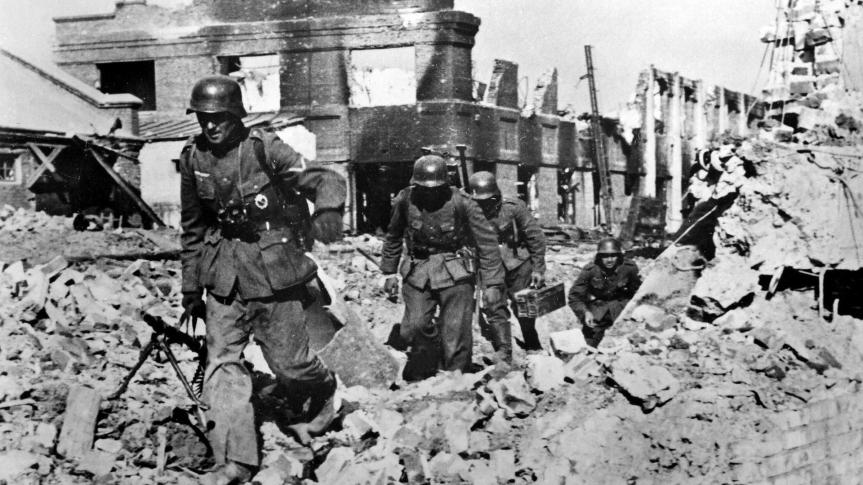
The battle of Stalingrad lasted from August 1942 to February 1943 as the city’s blasted terrain negated German advantages in speed and operational art. As more German units were fed into the grinding street fighting, the Soviets prepared a counteroffensive (Operation Uranus) that targeted the weaker Hungarian, Italian, and Rumanian armies guarding the German flanks. Launched on 19 November, Uranus took the Germans completely by surprise. Encircled by 60 Red Army divisions, the 20 divisions of Germany’s Sixth Army lacked adequate strength to break out. The failure of Erich von Manstein’s relief force to reach Sixth Army condemned it to death. Although Hitler forbade it, the remnants of Sixth Army capitulated on 2 February 1943.
Stalingrad was a monumental moral victory for the Soviets and the first major land defeat for the Wehrmacht. After losing the equivalent of six months’ production at Stalingrad, Hitler belatedly placed the German economy on a wartime footing, but by then it was too late to close an ever-widening production gap. The Wehrmacht bounced back at Kharkov in March 1943, but it was to be their last significant victory. In July Hitler launched Operation Citadel at Kursk, which resulted in a colossal battle involving 1.5 million soldiers and thousands of tanks. Remaining on the defensive, the Red Army allowed the Wehrmacht to expend its offensive power in costly attacks. After fighting the Wehrmacht to a standstill, the Red Army drove it back to the Dnieper.
The dénouement was devastating for Germany. Preceded by a skilful deception campaign, Operation Bagration in Byelorussia in June 1944 led to the collapse of Germany’s Army Group Center. When Hitler ordered German forces to stand fast, 28 German divisions ceased to exist. By 1945, the Wehrmacht could only sacrifice itself in futile attempts to slow the Soviet steamroller. Soviet second-line forces used terror, rape, and wanton pillaging and destruction to avenge Nazi atrocities. Soviet forces had prevailed in the “Great Patriotic War” but at the staggering price of ten million soldiers killed, another 18 million wounded. Soviet civilian deaths exceeded 17 million. The Germans and their allies lost six million killed and another six million wounded. Hitler’s overweening ambition and fatal underestimation of Soviet resources and will led directly to Germany’s destruction.
The Anglo-American Alliance and the ETO, 1942-1945
In 1942 two-thirds of Americans wanted to defeat Japan first, but Franklin Delano Roosevelt and Churchill agreed instead on a “Germany first” policy. Their decision reflected concerns that Germany might defeat the Soviet Union in 1942. That year U.S. Army Chief of Staff George C. Marshall argued for a cross-channel assault, but the British preferred to bomb Germany, invade North Africa, and advance through Italy and the Balkans. This indirect approach reflected British memories of the Western Front in World War I and a desire to secure lines of communication in the Mediterranean to the Suez Canal and ultimately to India. British ideas prevailed because of superior staff preparation and the reality that the Allies had to win the Battle of the Atlantic before assaulting Germany’s Atlantic Wall in France.
Operation Torch in November 1942 saw Anglo-American landings in North Africa, in part to assure Stalin that the United States and Britain remained committed to a second front. Superior numbers were telling as Allied forces drove their Axis counterparts towards Tunisia, although the U.S. setback at Kasserine Pass in February 1943 reflected the learning curve for mass citizen armies. Fortunately for the Allies, Hitler sent additional German units in a foolhardy attempt to hold the remaining territory. With the fall of Tunisia in May 1943 the Axis lost 250,000 troops.
The Allies next invaded Sicily in July but failed to prevent the Wehrmacht’s withdrawal across the Straits of Messina. Nevertheless, the Sicilian Campaign precipitated Mussolini’s fall from power and Italy’s unconditional surrender on 8 September. Forced to occupy Italy, Hitler also rushed 17 divisions to the Balkans and Greece to replace Italian occupation forces. Churchillian rhetoric of a “soft underbelly” in the Italian peninsula soon proved misleading. The Allied advance became a slogging match in terrain that favored German defenders. At Salerno in September, Allied amphibious landings were nearly thrown back into the sea. At Anzio in January 1944, an overly cautious advance forfeited surprise and allowed German forces time to recover. Allied forces finally entered Rome on 4 June 1944 but failed to reach the Po River valley in northern Italy until April 1945.
The Italian campaign became a sideshow as the Allies gathered forces for a concerted cross-channel thrust (Operation Overlord) in 1944. It came in a five-division assault on 6 June at Normandy. Despite heavy casualties at Omaha Beach, the Allies gained a strong foothold in France. Success was due to brilliant Allied deception (Operation Fortitude) in which the Allies convinced Hitler that the main attack was still to come at Pas de Calais and that they had 79 divisions in Britain (they had 52). Germany’s best chance was to drive the Allies into the sea on the first day, but Hitler refused to release reserves. Once ashore in force, and with artificial harbors (Mulberries), Allied numbers and air supremacy took hold. In 80 days the Allies moved two million men, half a million vehicles, and three million tons of equipment and supplies to France. Once the Allies broke out into open country, there was little to slow them except their own shortages of fuel and supplies. After destroying Germany’s Army Group B at Falaise, the Allies liberated Paris on 25 August. Field-Marshal Bernard Montgomery’s attempt in September at vertical envelopment (Operation Market Garden) failed miserably, however, as paratroopers dropped into the midst of Panzer divisions. High hopes that the war might be over in 1944 faded as German resistance stiffened and Allied momentum weakened.
Hitler chose December 1944 to commit his strategic reserve in a high-stakes offensive near the Ardennes. Known as the Battle of the Bulge, initial Allied disorder and panic gave way to determined defense at St. Vith and Bastogne. Once the weather cleared, Allied airpower and armor administered the coup de grâce. The following year the Allies pursued a broad front offensive against Germany proper, with George S. Patton’s Third Army crossing the Rhine River at Remagen in March. Anglo-American forces met the Red Army on the Elbe River in April, with Soviet forces being awarded the honor of taking Berlin.
The second front in France was vital to Germany’s defeat. Yet even after D-Day German forces fighting the Red Army exceeded those in France by 210 percent. Indeed, 88 percent of the Wehrmacht’s casualties in World War II came on the Eastern Front. That the U.S. Army got by with just 90 combat divisions was testimony to the fact that the bulk of German and Japanese land forces were tied down fighting Soviet and Chinese armies, respectively. Helping the Allies to husband resources in the ETO was a synergistic Anglo-American alliance, manifested by joint staffs, sharing of intelligence, and (mostly) common goals.
The Air War in Europe
The air forces of all the major combatants, the USAAF and RAF excepted, primarily supported ground operations. U.S. and British air power theory, however, called for concerted strategic bombing campaigns against enemy industry and will. Thus these countries orchestrated a combined bomber offensive (CBO) as a surrogate second front in the air. While the USAAF attempted precision bombing in daylight, RAF Bomber Command employed area bombing by night. The CBO devastated Cologne (1942), Hamburg (1943), and Dresden (1945), but Germany’s will remained unbroken. The CBO succeeded, however, in breaking the back of the Luftwaffe during “Big Week” (February 1944) in a deadly battle of attrition. Eighty-one thousand Allied airmen died in the ETO, with the death rate in RAF Bomber Command alone reaching a mind-numbing 47.5 percent. Hard fought and hard-won, air supremacy proved vital to the success of Allied armies on D-Day and after.
Battle of the Atlantic
Nothing worried Churchill more than the Kriegsmarine’s U-boats (submarines). Surface raiders like the Bismarck or Graf Spree posed a challenge the Royal Navy both understood and embraced with relish. Combating U-boats, however, presented severe difficulties, including weeks of tedious escort duty in horrendous weather. Despite Allied convoys and fast merchantmen, U-boats sank an average of 450,000 tons of shipping each month from March 1941 to December 1942. In March 1943 the Allies lost 627,000 tons, which exceeded the rate of replacement.
Yet only two months later, the tide turned against Germany. Allied successes in reading the Kriegsmarine’s Enigma codes proved vital both in steering convoys away from U-boat “wolf packs” and in directing naval and air units to attack them. Decimetric radar and high-frequency directional finding helped the Allies detect U-boats; B-24 Liberators armed with depth charges closed a dangerous gap in air coverage; and escort groups (including carriers) made it perilous for U-boats to attack, especially in daylight. These elements combined in May 1943 to account for the loss of 41 U-boats, 23 of which were destroyed by air action. Faced with devastating losses of experienced crews, Grand-Admiral Karl Dönitz withdrew his U-boats from the North Atlantic. They never regained the initiative. Germany ultimately lost 510 U-boats while sinking 94 Allied warships and 1900 merchant ships. Because the Kriegsmarine pursued lofty ambitions of building a blue-water navy, however, Germany never could produce enough U-boats to cut Britain’s economic lifeline. Poor resource allocation and strategic mirror imaging ultimately doomed the Kriegsmarine to defeat.
The Rising Sun Ascendant, 1937-1942
By 1938 the Imperial Japanese Army (IJA) had 700,000 soldiers in China. In 1939 the IJA attempted to punish the Soviets for supplying China only to be defeated at the battle of Khalkin Gol. After this defeat, and spurred on by the Imperial Japanese Navy (IJN), Japanese leaders increasingly looked southward, especially as British, Dutch, and French possessions became vulnerable when Germany ran rampant in the ETO. Bogged down in an expensive war with China, and facing economic blockade, Japan decided to seize outright the oil, rubber, tin, bauxite and extensive food resources of the Malay Peninsula, the Dutch East Indies, and Southeast Asia.
After concluding a non-aggression pact with Stalin in April 1941, Japan viewed Britain’s Royal Navy and the U.S. Pacific Fleet as its chief obstacles. To destroy the latter, Japan launched a surprise attack on Pearl Harbor on 7 December 1941, followed by attacks on British and Dutch naval units and invasions of Burma, Malaya, the Philippines, and other island groups using quick-moving, light infantry. Employing islands as unsinkable aircraft carriers, the Japanese hoped to establish a strong defensive perimeter as a shield, with the IJN acting as a mobile strike force or javelin. When the Allies confronted this “shield and javelin” strategy, Japan hoped their losses would prove prohibitive, thereby encouraging them to seek an accommodation that would preserve Japan’s acquisitions.
Japan’s key strategic blunder was that of underestimating the will of the United States, partly due to faulty intelligence that mistakenly stressed American isolationism. Pearl Harbor became for Americans a “date that shall live in infamy,” which permitted neither negotiation nor compromise. Japanese leaders knew they could not compete with U.S. industry (U.S. industrial capacity was nine times that of Japan’s), but they failed to develop feasible plans for ending the war quickly.
Nevertheless, until April 1942 the Japanese enjoyed a string of successes. Pearl Harbor was followed by attacks against the Philippines, where the United States lost half its aircraft on the ground. British attempts to reinforce Singapore led to the sinking of the battlecruiser Repulse and battleship Prince of Wales. At the Battle of Java Sea in February 1942 the IJN destroyed the Dutch navy. For the Allies, disaster followed disaster. At minimal cost, Japan seized Hong Kong, Malaya, most of Burma, and Singapore. Singapore’s surrender on 15 February was psychologically catastrophic to the British since they had failed at what they believed they did best: mounting a staunch defense. From this shattering blow the British Empire never fully recovered. By May 1942 remnants of the U.S. Army at Bataan and Corregidor surrendered, and the Japanese were in New Guinea. To this point not one of the IJN’s eleven battleships, ten carriers, or cruisers had been sunk or even badly damaged.
Eclipse of the Rising Sun, 1942-1945
The IJN suffered its first setback in May 1942 at the Battle of Coral Sea, where the USN stopped Japanese preparatory moves to invade Australia. The IJN next moved against Midway Island, hoping to draw out the U.S. Pacific Fleet and destroy it. The Japanese plan, however, was overcomplicated. It included coordination of eight separate forces and a diversionary assault on the Aleutians. Planned as a battleship fight by Admiral Isoroku Yamamato, the USN was forced instead to rely on carrier strike forces. Japanese indecision and American boldness, enhanced by effective code-breaking (known as MAGIC in the Pacific), led to the loss of four Japanese carriers. Midway was the major turning point in the Pacific theater. After this battle, the USN and IJN were equal in carrier strength, but the United States could build at a much faster rate. From 1942 to 1945 the USN launched 17 fleet carriers and 42 escort carriers, whereas the Japanese launched only four, two of which were sunk on their maiden voyage. Japan also lost its best admiral when U.S. code-breaking led, in April 1943, to the shooting down of Yamamoto’s plane.
The Japanese compounded defeat at Midway by failing to build an adequate merchant marine or to pursue anti-submarine warfare to defend what they had. Constituting less than two percent of USN manpower, American submariners accounted for 55 percent of Japanese losses at sea, virtually cutting off Japan’s supply of oil and reducing imports by 40 percent. By the end of 1944 U.S. submarines had sunk half of Japan’s merchant fleet and two-thirds of its tankers.
Much difficult fighting on land and sea remained. The United States adopted a Twin-Axis strategy designed to give the army and navy equal roles. While General Douglas MacArthur advanced through New Guinea in the southwest Pacific, neutralizing the major Japanese base at Rabaul to prepare for the invasion of the Philippines, Admiral Chester Nimitz island-hopped through the central Pacific. Guadalcanal (Operation Watchtower) in the Solomons turned into a bloody battle of attrition from August 1942 to February 1943 that ultimately favored U.S. forces. Tarawa in the Gilberts (Operation Galvanic) was the first test of the Fleet Marine Concept (FMC) that shortened the logistical tail of the U.S. Pacific Fleet. U.S. landings nearly proved disastrous, however, when Japanese defenders inflicted 42 percent casualties on the invading force. But the USN and Marines learned from their mistakes, and subsequent island operations had high yet sustainable casualty rates.
Battles such as Tarawa highlighted the astonishing viciousness and racism of both sides in the Pacific, with Americans depicting Japanese as “monkeys” or “rats” to be exterminated. Reinforcing the fight-to-the-death nature of warfare was the Japanese warrior code of Bushido that considered surrender as dishonorable. Jungle warfare on isolated islands left little room for maneuver or retreat and bred claustrophobia and desperate last stands. Ruthlessness extended to the U.S. air campaign against Japan that included the firebombing of major cities such as Tokyo, where firestorms killed at least 83,000 Japanese and consumed 270,000 dwellings.
The U.S. invasion of Saipan in June 1944 led to the “Great Marianas Turkey Shoot” in which U.S. pilots shot down 243 of 373 attacking Japanese aircraft while losing only 29 aircraft. Most devastating to Japan was the irreplaceable loss of experienced pilots. To pierce American defenses, Japan employed suicide pilots or Kamikazes at the Battle of Leyte Gulf in October and in subsequent battles. Leyte Gulf in the Philippines was a decisive if close-run victory for the USN, since the IJN missed a golden opportunity to crush Allied landing forces. Costly U.S. campaigns in 1945 led to the capture of Iwo Jima in March and Okinawa in June before the United States dropped atomic bombs on Hiroshima and Nagasaki in August. Together with Soviet entry into the war against Japan, these atomic attacks convinced the Japanese Emperor to surrender, with formal ceremonies being held on the USS Missouri on 2 September 1945.
Japan’s unconditional surrender highlighted what had been a fundamental, and ultimately fatal, schism between the IJA and IJN. Whereas the IJA had focused on the Asian continent to neutralize China and the Soviet Union, the IJN had identified the United States and Britain as its principal enemies. The IJA had been more influential in Japanese politics and dominated Imperial general headquarters. Interservice rivalry led to haphazard coordination and bureaucratic infighting that degraded the Japanese war effort. Like their nominal allies the Germans, Japan had essentially engaged in a two-front war of exhaustion against foes possessing superior resources. IJA gains in the China-Burma-India theater had not been sustainable, especially as British, Chinese, and Indian forces learned to counter Japanese infantry tactics under the determined tutelage of William Slim, Orde Wingate, and “Vinegar Joe” Stilwell.
Technology and Medicine
World War II is known as the “physicist’s war” due to the success of the U.S./British/Canadian Manhattan Project that developed atomic bombs, as well as the invention and use of radar. Germany was especially innovative, developing the V-1 cruise missile and V-2 ballistic missile as “vengeance” weapons. While a remarkable technical achievement, the V-2 was ultimately a waste of precious resources. Its circular error probable (CEP) of 20 kilometers and small one-ton warhead made it little more than a deadly nuisance. Germany also developed the Me-262, the world’s first operational jet fighter, but its late deployment in small numbers had little impact on the air war. Less spectacular, but more telling, was the Allied emphasis on fielding large numbers of proven weapons, such as Soviet T-34 and U.S. M-4 Sherman tanks; aircraft such as P-51 long-range escort fighters and Lancaster four-engine bombers; and Higgins boats for amphibious operations.
Penicillin and DDT, both developed by the Allies, were the leading medical developments. Penicillin saved the lives of untold tens of thousands of wounded Allied troops, and DDT vastly reduced casualties due to mosquito-borne diseases in the Pacific. The Germans developed nerve gas but decided against employing it, apparently because they (wrongly) believed the Allies also had it. Unlike the previous world war, chemical weapons were rarely used. Finally, Allied code-breaking efforts such as ULTRA saw the development of primitive computers.
Legacies of the War
World War II saw the emergence of the United States and Soviet Union as superpowers. The resulting Cold War between them created a bi-polar world until the Soviet Union’s collapse in the early 1990s. With the end of the myth of Western superiority came the decline of colonial empires and the independence of countries such as India (1947). The war also resulted in the division of Germany (reunited in 1989) and the occupation and democratization of Japan; the creation of the United Nations and the state of Israel; and the rise of leaders formed in the crucible of war, such as Dwight D. Eisenhower and Charles de Gaulle. A vastly destructive war with tragic consequences, World War II nevertheless saw the demise of Hitler’s Third Reich, a regime based on mass slavery of “inferiors” and the categorical extermination of “undesirables” (Jews, Gypsies, the handicapped and mentally ill, etc.), as well as the overthrow of a Japanese regime that glorified militarism and justified slavery and racial discrimination on a massive scale.
BIBLIOGRAPHY
Bartov, Omer. The Eastern Front, 1941-45: German Troops and the Barbarisation of Warfare, New York, 1986.
Churchill, Winston S. The Second World War, 6 vols, New York, 1948-53.
Costello, John. The Pacific War 1941-1945, New York, 1982.
Dear, I.C.B., ed. The Oxford Companion to World War II, New York, 1995.
Dower, John W. War Without Mercy: Race and Power in the Pacific War, New York, 1986.
Gilbert, Martin. The Second World War: A Complete History, New York, 1989.
Glantz, David M. and Jonathan M. House. When Titans Clashed: How the Red Army Stopped Hitler, Lawrence, KS, 1995.
Iriye, Akira. Power and Culture: The Japanese-American War, 1941-1945, Cambridge, MA, 1981.
Jones, R.V. The Wizard War: British Scientific Intelligence 1939-1945, New York, 1978.
Keegan, John. The Second World War, New York, 1990.
Lukacs, John. The Last European War, September 1939/December 1941, New Haven, CT, 1976, 2000.
Miller, Edward. War Plan Orange: The U.S. Strategy to Defeat Japan, 1897-1945, Annapolis, MD, 1991.
Murray, Williamson and Allan R. Millett. A War to be Won: Fighting the Second World War, Cambridge, MA, 2000.
Overy, Richard. Russia’s War: A History of the Soviet War Effort: 1941-1945, New York, 1997.
Overy, Richard. Why the Allies Won, New York, 1995.
Parker, R.A.C. Struggle for Survival: The History of the Second World War, New York, 1990.
Spector, Ronald H. Eagle Against the Sun: The American War with Japan, New York, 1985.
Stoler, Mark A. Allies and Adversaries: The Joint Chiefs of Staff, The Grand Alliance, and U.S. Strategy in World War II, Chapel Hill, NC, 2000.
Taylor, A.J.P. The Origins of the Second World War, New York, 1961.
Thorne, Christopher G. Allies of a Kind: The United States, Britain, and the War Against Japan, 1941-1945, New York, 1978.
Van der Vat, Dan. The Atlantic Campaign: World War II’s Great Struggle at Sea, New York, 1988.
Weinberg, Gerhard L. A World At Arms: A Global History of World War II, Cambridge, 1994.
Willmott, H.P. The Great Crusade: A New Complete History of the Second World War, New York, 1991.




 Bracing Views